Good profile on Leamington and its seasonal agricultural workers:
On Friday evening, in the heart of this farming city, the workers arrive by bicycle and private bus.
Hundreds of labourers crowd the sidewalks, restaurants and shops on this municipality 50 kilometres southeast of Windsor, famous for its greenhouses and tomatoes.
It’s payday and at almost every turn the old city core is alive with bodies and chatter.
But these farm labourers are speaking Spanish and Patois.
Like many of Ontario’s downtowns, Leamington’s has seen better days. But the thousands of low-wage temporary farm workers from Mexico and the Caribbean, the work they provide and the money they spend here — Mayor John Paterson figures $15 million a year — has transformed the local economy.
Where Theresa’s Fashion once was is now Chica Linda, catering to workers looking to buy clothes to send home to family. Across the road, Mr. 2 Pizzas is now Crazy Chicken, where the menu is available in Spanish and features a cartoon sombrero-wearing bird rocking maracas, its fridge stocked with bottles of Mexican Jarritos soft drinks. Gino’s Restaurant and Wine Bar next door is now La Hacienda, a Mexican restaurant. Clubs offer salsa music and buckets of Corona and Caribbean vibe.
For the unfamiliar, it is jaw-dropping to behold. Yet transformation, like any change, can be simultaneously embraced, tolerated and loathed.
While these migrant workers and their effects on the community are particularly obvious in Leamington, the racial tension between them and the locals is far from unique in a rural Canada increasingly reliant on the labour provided by the migrant worker program.
This is the story of one migrant worker town and how people are learning to get along. Mostly.
Dubbed the “Greenhouse Capital of North America,” Leamington is located on the 42nd parallel — the same latitude as northern California — and draws its agricultural strength from the amount of sunshine it gets and the fertile soil it’s blessed with.
Everyday, some 200 tractor-trailers leave this municipality to deliver fresh produce — from its famous tomatoes to peppers, cucumbers, mushrooms and flowers — to destinations around the world.
Initially called Gainesville, the community was built by immigrants: first, the Scottish, German and Dutch, followed in the postwar era by Italians, Portuguese and Lebanese.
A shortage of labour has always been an issue for Leamington, as far back as Paterson, 63, who was born and grew up here, can remember.
But what distinguishes the earlier waves of migrants from those coming now is that the former came as permanent residents, while the majority nowadays are guest workers — mostly lonely men separated from their families, with temporary status only.
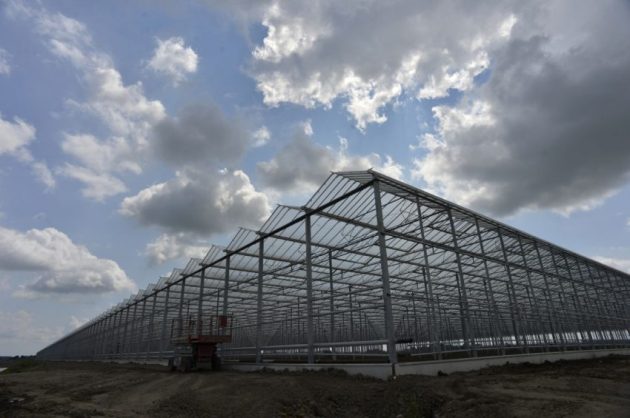
Leamington has more than 1,500 acres of greenhouses, with another 200 acres waiting for municipal approvals. (JIM RANKIN/TORONTO STAR)
More than 10 per cent of the 54,000 average migrant farm workers to Canada work in Leamington, accounting for one-sixth of the town’s population during the farming season.
The number of migrant farm workers in Leamington has surged in the last decade, mostly because of the exponential growth of the greenhouse operations here. Today, the town has more than 1,500 acres of greenhouses, with another 200 acres waiting for municipal approvals.
South of Hwy. 401, along Hwy. 77 are row after row of greenhouses, with new ones under construction. With a $60 million gas line completed earlier this year, the town hopes to finish its $80 million hydro line next June, along with a $7 million water system and a $40 million sewage system in order to meet the needs of more greenhouses in the next five years. Medical cannabis production companies are knocking on its doors.
Everywhere you go, you see hiring signs for general labour, pickers and packing staff at greenhouses. The jobs promise a minimum 48 hours of work a week.
“We don’t have enough people in Ontario that are willing to do that kind of labour or those kind of hours for that kind of pay,” said Paterson.
“I don’t think the greenhouse industry would exist if it wasn’t for the farm worker program. There just wouldn’t be the manpower to make it happen. The program is of ultimate importance.”
Questions for the mayor: just how much do we spend on multiculturalism? Just how much do we spend on the monarchy? And are the two incompatible? And what exactly does it mean to be Canadian? Only from Scotland or Great Britain?
As the royal tour makes its way through Canada, one southwest Ontario mayor is calling on Canada to scrap its current multicultural policies and focus on ties to the monarchy.
In a Facebook post Sunday, Leamington, Ont., Mayor John Paterson responded to a post criticizing the monarchy:
The original Facebook post appears to have been deleted by the poster Dharmesh Patel. But a viewer shared a screen capture with CBC News in Windsor.
When CBC reached Patel, he said he’s not personally offended by Paterson’s comments and the two remain friends. He said he believes the money spent on hosting Prince William and Kate could be better spent elsewhere.
Patel said his parents came to Canada in the 1970s and they are proud Canadians.
Paterson stood by his Facebook comments Monday, telling CBC he welcomes new Canadians from around the world. But he expects them to conform to Canadian culture.
“If you’re going to come to Canada and swear allegiance to Canada, which includes an allegiance to the monarchy, then be Canadian, that’s all I’m saying,” Paterson said. “Don’t force us to change our ways. Come to Canada and be Canadian.”


 Multicultural Meanderings