Certain blindness to have let this issue fester for so long:
Jeremy Corbyn has issued his strongest condemnation of antisemitism so far as he came under intense pressure from his own backbenchers and the wider Jewish community over his failure to tackle antisemitism in the Labour party.
He was forced to step up his response during the day after an extraordinary open letter was published on Sunday night by the Board of Deputies of British Jews and the Jewish Leadership Council (JLC), accusing him of “siding with antisemites” and calling for supporters to stage a show of solidarity outside parliament as the parliamentary Labour party held its weekly meeting on Monday evening.
At the PLP meeting, backbenchers denied there was any kind of coup attempt. Wes Streeting MP, often a critic of Corbyn’s, said: “No one’s calling for a leadership election. We just want leadership.”
The pressure from backbench MPs began building on Friday when Luciana Berger challenged Corbyn over supportive comments he posted to the artist behind an antisemitic mural. It came to a head on Monday morning when John Mann, chair of the all-party antisemitism group, tweeted that the Labour party “ceases to have a reason for existence if it cannot stand up against discrimination and racism”. He said the party was “rotten to the core”.
His criticism was backed by the veteran former minister Dame Margaret Hodge, who said Corbyn had allowed himself to become “the poster boy of antisemites everywhere”.
As hundreds gathered at Westminster, including dozens of Labour MPs and peers, and a small group of rival demonstrators from Jewish Votes for Labour, Corbyn issued a “sincere apology” that acknowledged that his previous responses had been inadequate.
“I recognise that antisemitism has surfaced within the Labour party, and has too often been dismissed as simply a matter of a few bad apples,” he said on Twitter.
“This has caused pain and hurt to Jewish members of our party and to the wider Jewish community in Britain. I am sincerely sorry for the pain which has been caused, and pledge to redouble my efforts to bring this anxiety to an end.”
Corbyn’s previous apology merely recognised that there were “pockets” of antisemitism in the party. That was rejected as inadequate by Jonathan Goldstein of the JLC, who said the Labour leader had become a figurehead for antisemitism.
Speaking at the solidarity protest outside parliament, the former Labour MP Gillian Merron, who is now chief executive of the Board of Deputies, said Corbyn had only made concessions because he had been forced into it by their actions.
“People here are angry and sad,” she said. “Nobody dreamt they would be in this position. The Jewish community has had enough and we are joined in that feeling by many many people inside and out of the Labour party.”
Later, Louise Ellman, who is a former chair of the Jewish Labour Movement, told BBC Newsnight it was “unprecedented” that the mainstream Jewish community had to take to the streets to protest at antisemitism in a mainstream political party.
In the second letter, Corbyn expressly apologised for failing to study the content of the antisemitic mural in the East End of London before posting supportive comments to its artist.
Jewish leaders claimed in their letter, released on Sunday night, that the controversy proved the Labour leader “cannot seriously contemplate antisemitism, because he is so ideologically fixed within a far-left worldview that is instinctively hostile to mainstream Jewish communities”.
Countering the charge, Corbyn says in his letter: “While the forms of antisemitism expressed on the far right of politics are easily detectable, such as Holocaust denial, there needs to be a deeper understanding of what constitutes antisemitism in the labour movement. Sometimes this evil takes familiar forms – the east London mural which has caused such understandable controversy is an example.
“The idea of Jewish bankers and capitalists exploiting the workers of the world is an old antisemitic conspiracy theory … I am sorry for not having studied the content of the mural more closely before wrongly questioning its removal in 2012.”
In a much more nuanced recognition of the forms that antisemitism can take, the letter also accepts that anti-Zionism and antisemitism have become conflated.
“Criticism of Israel, particularly in relation to the continuing dispossession of the Palestinian people, cannot be avoided. Nevertheless, comparing Israel or the actions of Israeli governments to the Nazis… and using abusive phraseology about supporters of Israel such as ‘Zio’ all constitute aspects of contemporary antisemitism.”
He also promises that the party will implement in full the “overdue” recommendations of the Chakrabarti report,which was published nearly two years ago.
Andy McDonald, the shadow transport minister, insisted that action would be taken. He pledged to speed up the “far too slow” complaints process. He was unable to say how many complaints had been successfully dealt with.
A related article on the extent of antisemitism in the UK (CST report):
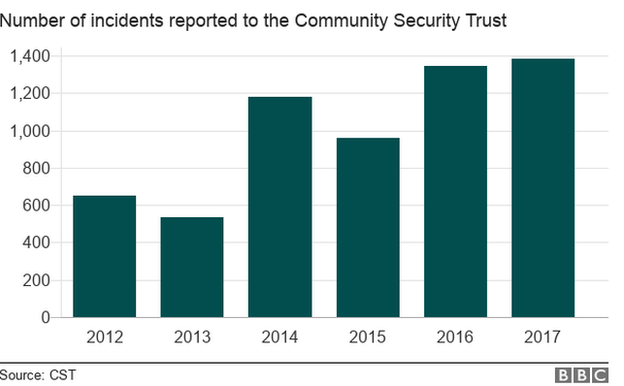
The Community Security Trust (CST), a charity that works with Jewish community organisations and police forces, recorded 1,382 anti-Semitic incidents in 2017 – the highest total ever.
Of these, 145 incidents were classed as “assaults” – up from 108 the year before. But the most common type of incident was “verbal abuse directed at random Jewish people in public” – being shouted at in the street.
Meanwhile, almost one in five incidents involved the use of social media.
One tweet sent to a Jewish charity appeared to show a rollercoaster above a concentration camp. Another social media user posted messages saying “Hitler was right”.
The CST said there had been three incidents involving damage to, or desecration of, a Jewish cemetery; eight involving stones or bricks being thrown; and eight involving eggs being thrown at property.
The charity also cited improvements in the reporting of anti-Semitic incidents – but said it believed there was still “significant under-reporting”.
Earlier this month, the former Chief Rabbi Lord Sacks told the Jewish News newspaper: “Any political party has to adopt a zero-tolerance to anti-Semitism. If they fail to do so, they are a danger not only to themselves but to the country and all inhabitants.”
Lord Sacks has previously said that anti-Semitism is an ancient hatred and a contemporary warning sign that community relations within a culture are endangered.
It is why the Jewish community is inviting members of other faiths, and of none, to join in the chorus: “Enough is Enough.”
Immigration excerpts (looking forward to exploring the various data tables):
Immigrants accounted for almost one-quarter of the labour force
From 2006 to 2016, about two-thirds of Canada’s population growth was the result of migratory increase (the difference between the number of immigrants and emigrants). Similarly, the labour force was growing in large part due to increased immigration, with immigrants accounting for 23.8% of the labour force in 2016, up from 21.2% in 2006.
In 2016, half of the workforce in the CMA of Toronto were immigrants. The CMA of Vancouver had the second-highest proportion of immigrants in its labour force at 43.2%, followed by the CMA of Calgary at 32.5%.
The contribution of immigrants to the Canadian labour market is an important component of strategies to offset the impact of population aging, which might otherwise lead to a shrinking pool of workers and labour shortages. Many immigrants are admitted into Canada based on their skills and education.
In May 2016, among recent immigrants aged 25 to 54, 68.5% were employed, compared with an employment rate of 79.5% for core-aged immigrants who landed more than five years before the census, and 82.0% for the Canadian-born population. Among recent immigrants in this age group, 79.6% of men were employed, compared with 58.6% of women.
Although the employment rate for core-aged recent immigrants was lower than that of other immigrants and the Canadian-born, it increased from 67.1% in 2006 to 68.5% in 2016. For core-aged recent immigrant women, the employment rate increased from 56.8% in 2006 to 58.6% in 2016, and for core-aged recent immigrant men, the rate increased from 78.7% to 79.6%. In contrast, employment rates for core-aged Canadian-born men, as well as for non-recent immigrant men and women, declined over this 10-year period.
Over half of recent immigrants have a bachelor’s degree or higher
Immigrants contribute to Canada’s economy by bringing their skills and high levels of educational attainment. Canada’s immigration system highly values education. In recent years, new programs have made it easier for international students who have completed their postsecondary education in Canada to immigrate into the country. As of the 2016 Census, 4 in 10 immigrants aged 25 to 64 had a bachelor’s degree or higher. In comparison, just under one-quarter of the Canadian-born population aged 25 to 64 had a bachelor’s degree or higher. Recent immigrants who landed in the five years prior to the 2016 Census were especially well-educated, with over half having a bachelor’s degree or higher. Recent immigrant women were more likely than recent immigrant men to have a bachelor’s degree or higher in 2016. The reverse was true in the 2006 Census.
The percentage of all immigrants with a master’s or doctorate degree is twice that of the Canadian-born population. Among immigrants aged 25 to 64, 11.3% had a master’s or doctorate degree compared with 5.0% among the Canadian-born population. Recent immigrants were even more likely to have a master’s or doctorate degree, with 16.7% of them holding these graduate degrees in 2016.
Chart 5
Percentage of the population aged 25 to 64 with selected degrees, by immigrant status and period of immigration, Canada, 2016
…Close to one-third of refugees have upgraded their educational credentials in Canada
For the first time, the census included information on the admission category under which immigrants to Canada have arrived. The Canadian immigration system has three broad goals: to attract educated and skilled immigrants, to reunify families, and to provide humanitarian and compassionate refuge. Immigrants admitted under the refugee category face particular challenges as they are not admitted based on education, language or other assets, and may not have all of the skills required to find employment in their new country.
Close to one-third of refugees (31.5%) who have received their permanent resident status, upgraded their educational credentials by completing their highest postsecondary qualification in Canada. When looking only at those who arrived as adults (aged 18 and older), about 22% upgraded their education with higher qualifications in Canada, slightly more than immigrants admitted under either the economic or family categories, both at about 20%. The majority (71.1%) of refugees who immigrated to Canada as adults and upgraded their educational qualifications in Canada completed a trades or college diploma. In comparison, among economic immigrants who upgraded their education in Canada, the majority (56.5%) completed a bachelor’s degree or higher.
One of the better commentaries that I have seen but welcome comments from those closer to UK politics:
In responding to this morning’s debate on party rule changes, Jim Kennedy, the Labour national executive committee (NEC) member who moved them, shook his head in wonder: “The rules used to be the most mundane part of the conference.” He was correct to reflect that the passionate attention paid to rule changes is a sign of the newly vibrant nature of the party’s internal democracy.
One of those rule changes looks like it should have been uncontroversial in a party where anti-racism is a central value:
“No member of the party shall engage in conduct which in the opinion of the NEC is prejudicial, or in any act which in the opinion of the NEC is grossly detrimental to the party. The NEC shall take account of any codes of conduct currently in force and shall regard any incident which in their view might reasonably be seen to demonstrate hostility or prejudice based on age; disability; gender reassignment or identity; marriage and civil partnership; pregnancy and maternity; race; religion or belief; sex; or sexual orientation as prejudicial to the party; these shall include but not be limited to incidents involving racism, antisemitism, Islamophobia or otherwise racist language, sentiments, stereotypes or actions, sexual harassment, bullying or any form of intimidation towards another person on the basis of a protected characteristic as determined by the NEC, wherever it occurs, as conduct prejudicial to the party.”
To the untrained eye, the manner in which the amendment was proposed looks like a welcome example of the party coming together after a fractious series of widely publicised controversies over antisemitism. It was proposed by the Jewish Labour Movement – which represents those Jews in the party who are Zionists – but it was also endorsed by Jeremy Corbyn himself, whose relationship with Zionism is sceptical to say the least, together with Momentum, some of whose activists have been accused in the past of antisemitism.
But such is the ability of antisemitism to spark conflict in the Labour party, that the amendment has not gone unchallenged, despite the apparent consensus. Labour Party Marxists already told its members: “This is supported by the Jewish Labour Movement, which already tells you that you should probably oppose without even having to read it.” There have been calls to expel the JLM for its support for Israel, including by delegate Sara Callaway during the debate.
Leah Levane, a Jewish delegate from Hastings and Rye, whose constituency had initially put forward a different wording, reluctantly withdrew her amendment in favour of the NEC one but not without a sharply worded declaration that the Jewish Labour Movement did not speak for her. Then, in the response to the debate, Naomi Wimborne-Idrissi castigated the JLM for “running to the Daily Mail and the Telegraph with stories” before objecting to the reference in Levane’s amendment to “holding” beliefs since: “That’s thought crime, comrades, and we can’t be having it.” Wimborne-Idrissi also lauded the launch the previous evening of Jewish Voice for Labour, a group that aims to push back at what it sees as attempts to “widen” the definition of antisemitism.
The controversy over antisemitism in Labour is therefore unlikely to go away any time soon. However much the party’s rules might condemn antisemitism and enable disciplinary action against those accused of it, there is no getting around the fact that there are competing definitions of what antisemitism consists of. That Jews themselves disagree only complicates matters further.
Nonetheless, the fact that the JLM, the NEC, Corbyn and Momentum were able to cooperate in this matter does suggest a desire to come together for the good of the party. Indeed, the JLM’s Twitter account proclaimed “help Jeremy Corbyn fight antisemitism”, a striking refutation of the accusation that the group is seeking to undermine his leadership. As Mike Katz from the JLM and Philip Cohen, a Jewish councillor from Finchley, both argued from the platform, the amendment might help to rally Jews back to Labour in some constituencies. The desire to achieve power can be a way of concentrating minds of Corbynites and Labour Zionists alike.
The amendment is another example of the tension between enabling free debate within Labour and ensuring it is a disciplined party that can win elections (the lack of Brexit debate is another). If Polly Toynbee is right and Corbyn has been transformed into a politically savvy pragmatist, then his backing of the amendment is a manifestation of this. What remains to be seen is whether those who spoke against the amendment will accept the inevitable restraint that this implies.
The shadow minister for citizenship, Tony Burke, has accused Peter Dutton of misleading journalists about having properly briefed Labor on the government’s proposed changes to citizenship laws.
Dutton, the immigration minister, announced on Sunday he would introduce legislation to parliament this week that made it harder to get Australian citizenship.
“It won’t pass through the Senate unless we can get Labor’s support, so that’s the key objective for this week, to speak with the Labor party,” he told Sky News.
“They’ve already had a briefing in relation to many of these matters and once they’ve seen the legislation this week they can ask questions.”
Labour response
But Burke said on Tuesday that Labor hadn’t been briefed on the policy details that appeared in media reports over the last couple of days.
He said the last briefing Labor received was before the 9 May budget, over a month ago.
“I was given a briefing on the 8th of May,” Burke said. “Was I briefed on the issues of the citizenship changes that were in the papers on the weekend? No, not at all. That’s all new. None of that existed as part of the proposal at the time of the briefing.
“[During that briefing], when I asked which parts of what I was being briefed on the government was committed to, the answer was none.
“When I asked, on the English-language test, how many people who currently apply for citizenship would pass the test, the government didn’t know.
“When I asked how many Australians would pass the test at a university level, the government didn’t know.
“Today I see in the papers, a claim that it is somehow linked to national security … once again, we’ve got changes here that have appeared in the paper that weren’t part of the briefing, that weren’t part of the government’s original proposal,” he said.


 Multicultural Meanderings