Cryderman: Liberals are late to housing, and time is running out

Arguably, already run out given time lags in increasing supply and likely reluctance by government to freeze or reduce levels of permanent and temporary residents:

Whether talking about shacks or sidesplits, Pierre Poilievre has owned the housing affordability file from the time he became Conservative leader one year ago. This is not because he has all the answers, or warms hearts with his words. It’s because he gives the issue the time and weight it deserves.

After a cabinet retreat in Prince Edward Island where housing was the key focus, it appears the Liberals are finally grasping the practical and political urgency of the situation, as Mr. Poilievre long has. They are listening to what people have been saying in the country’s largest cities for years – and is now being said from Charlottetown to Kingston to Kelowna: The cost and scarcity of housing in Canada is bonkers.

At least in words, there appears to be greater recognition of that from newly minted Housing Minister Sean Fraser. He has added shifts of tone on housing since the Liberal cabinet shuffle in July.

He’s saying reasonable things such as: Maybe the federal governmentshould be more thoughtful about its international student program that has seen “explosive growth” and driven up housing costs in postsecondary communities. And it should start to use the power of the $4-billion Housing Accelerator Fund, first promised by the Liberals two years ago, with some political gusto.

In an interview with The Globe, Mr. Fraser added something new to the list: that his government has put a new focus on housing affordability for the middle class.

“This is now not just a crisis for low-income families,” Mr. Fraser said.

“This is a crisis for seniors who are looking to retire under very different circumstances than existed even a few years ago. It is a crisis for students who cannot find a place they can afford to live within an hour commute of the campus. And it is a crisis for young people who are seeking to get into the market who often have two people working in the household, and still can’t afford a place to live.

“It’s not reasonable for us to maintain an exclusive focus, or even a primary focus, that only speaks to low-income social housing.”

This reflects the truth that rents are up across the country, as demand grows and higher interests weigh on pocketbooks. Where I sit in Calgary, relatively affordable by other big city standards, rents are up an average of 16 per cent, year-over-year. The typical price of a home in the country is more than $760,000. The Canadian public is not going to be particularly patient in waiting for the 5.3 million homes economists say the country needs to build by 2030 to solve the affordability crisis.

Mr. Fraser said Canada is looking at a total capital spend that could exceed a trillion dollars to hit that housing target – “not an amount of money that most people can conceive of.” This will have to come both from the private and public sectors.

But it’s needed, not only in the real world, but also in the political sphere. Young people, according to recent polls, are increasingly disenchanted with the governing party. Some believe the Liberals aren’t doing enough on climate change, a concern exacerbated by a summer of wildfires. But economic anxiety about out-of-control costs, especially on housing, is likely an even bigger reason.

Nik Nanos, chief data scientist and founder of Nanos Research, told CTV the Liberals’ popularity is down overall but plummeting among younger voters, the demographic that’s helped Prime Minister Justin Trudeau win past elections. The latest Nanos polling shows the Liberals in third place among Canadians aged 18 to 29 years old with 16 per cent support, compared with the Conservatives and the NDP with 39 per cent and 31 per cent respectively.

Polls are just a snapshot in time, but the trend isn’t good for the incumbents. Although the election is likely two years away, the problem requires complicated solutions and time is not on their side.

Mr. Fraser refutes Conservative claims that the Liberals weren’t paying attention or were negligent as the housing situation worsened. The last two years have been exceptional, he said. “What’s happened in the last couple of years in particular is there has been a shift in the housing continuum in terms of where the intense need is.”

As the former immigration minister, Mr. Fraser appears keenly aware his current and past portfolios have some overlap. He speaks of not decreasing immigration to address housing pressures, but becoming more thoughtful about it.

The country needs new people and workers, and has a moral imperative to welcome refugees. But the Liberals have boosted Canada’s immigration and non-permanent resident numbers to historic levels – and sometimes undercount those who are here. Canada’s ranks are growing quickly, and a BMO analysis earlier this year said that for every 1 per cent of population growth, housing prices typically increase by 3 per cent.

“The people we want to bring in want to stay for the rest of their lives. Let’s plan for it. And then let’s target the people who can improve the quality of life that not only their family gets to enjoy in Canada, but to improve the quality of life for Canadians who’ve lived here for generations, by addressing some of these social challenges – in particular around housing and health care.”

Even before Parliament resumes on Sept. 18, Mr. Fraser said he intends to act by “actually leveraging the federal spending power to incentivize change at municipal levels.” In short order, there will be an announcement on the municipalities that will receive help through the vaunted Housing Accelerator Fund.

BMO has also raised concerns about “an investor class” that’s increasingly dominating the real-estate market, as opposed to the people who actually live in the homes. Mr. Fraser said investors have a key role to play in creating housing units, but he is worried about homes being held by investors that remain vacant.

Ottawa will soon change the financial equation for home builders to get more units built, he added in the interview. Although the minister wouldn’t go into specifics, economists have said it’s time to waive or defer the sales tax developers incur for purpose-built rentals to incentivize new building.

All and all, Mr. Fraser said Canadians should expect to see aggressive action by the federal government to get more homes built, across the housing continuum. The question is not only whether this large task can be accomplished but also whether the Liberals, late to urgency on this issue, can catch up to the Conservatives on the political front.

Source: Liberals are late to housing, and time is running out
Alberta, and the rest of Canada, are woefully unprepared for the coming immigration boom 

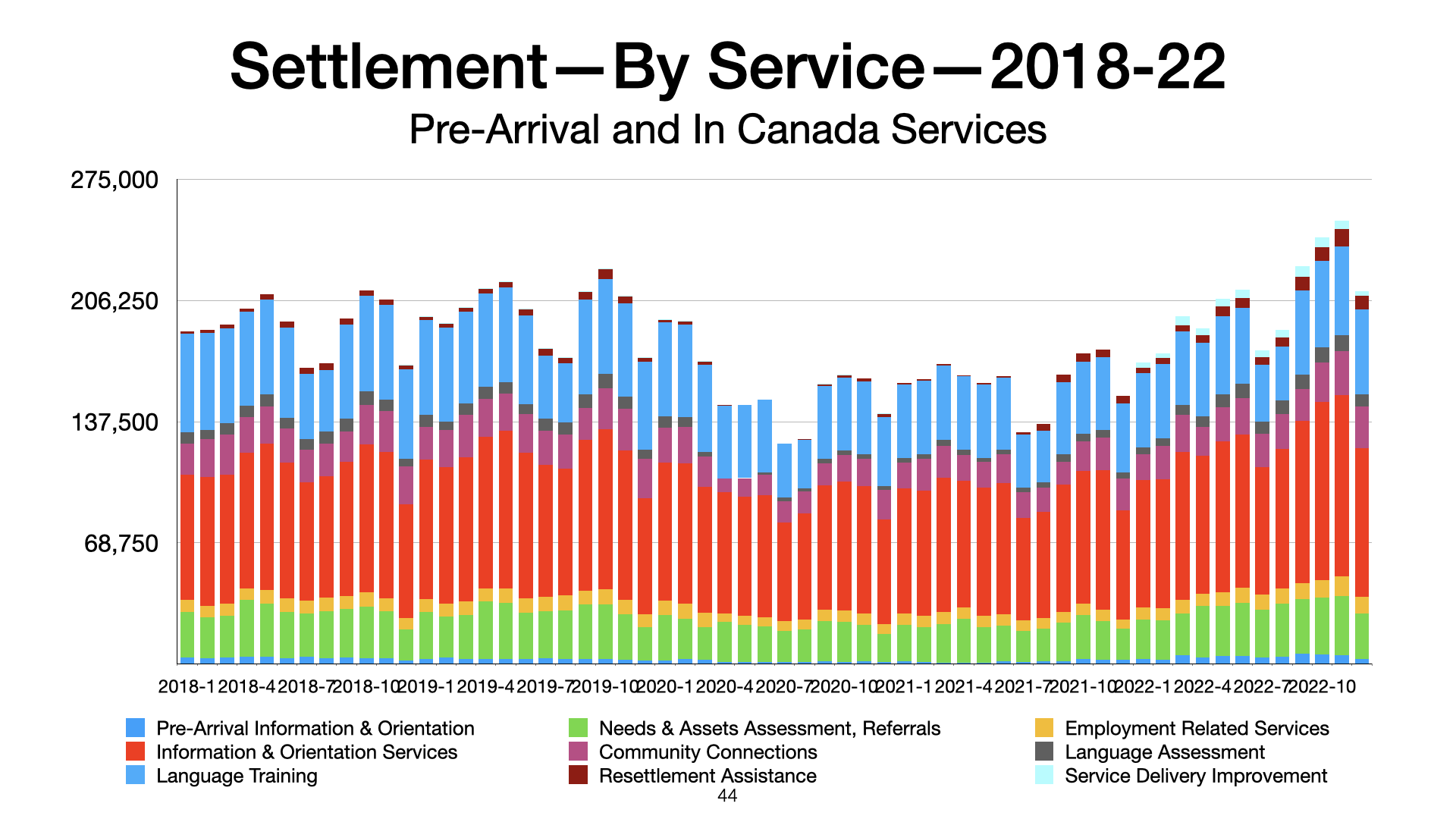
Over focus on the challenge to settlement agencies compared to the real physical and workforce challenges in housing, healthcare and infrastructure. Settlement service stats have been largely flat compared to the pre-pandemic period, suggesting less demand than stated:

There’s a long list of reasons for Canada to open its arms to newcomers from around the world – but when you invite half a million new people to the country every year, you better be prepared. And it’s looking more and more like we’re not.

It goes beyond the affordable-housing crunch and whether everyone will have access to primary health care. Now, some of the Calgary agencies that help people get settled in the country say uncertainty about funding from the federal government is leading to long waiting lists and layoffs.

“It’s always been a challenge, but I’ve never seen it like this. Never,” said Shirley Philips, interim chief executive at Immigrant Services Calgary, who has decades of experience in the sector.

ISC said they will receive less money from Ottawa – which makes up the majority of their funding – this fiscal year than last year. Contract updates from the federal government don’t reflect increased demand even as Alberta’s largest city grows by leaps and bounds, and so job vacancies won’t be filled.

Newcomers are already facing a 55-day wait to get a language proficiency assessment done, Ms. Philips said. And then four to six months to get into English classes after that. As demand continues to grow, she fears those wait times will stretch longer.

“You’ve got this talent pool that Canada says they want in their country, but we’re doing very little even at the basic level of language, employment services and housing.”

Another agency, the Centre for Newcomers, has laid off about 65 people – almost a quarter of its staff – in recent weeks. Chief program officer Kelly Ernst said the issue is a delay in contract updates with the federal government, which would provide a flow of money based on higher demand. He’s worried about some people falling through the cracks, as was the case for a newly arrived Ukrainian family he said his agency found living on the streets of Calgary last week.

“We served over 35,000 people last year, and if this continues, we’re going to break that record again this year,” Mr. Ernst said.

For its part, Immigration, Refugees and Citizenship Canada said planned investment for settlement services in Alberta is increasing by 6 per cent this year, to nearly $133-million.

“These investments align with Alberta’s proportion of all permanent resident landings,” the federal department said in a statement to The Globe and Mail.

IRCC did not comment on the situation for individual agencies, but added it has “in the past, adjusted investments over the course of the year to respond to pressures, such as an influx of newcomers, and when additional funding becomes available.”

Overall, the department’s budget is being reduced beginning this fiscal year. Temporary programs are being wound down, including the commitment to resettle at least 40,000 Afghans by the end of this year, and provisions for Ukrainians making their way to Canada.

The problem is, settlement agencies say, Afghans and Ukrainians are still coming and they still need help getting acclimatized in Canada – as do many more from all around the world.

The numbers are huge. The federal government is aiming to welcome between 410,000 and 505,000 new permanent residents this year, between 430,000 and 542,500 in 2024, and between 442,500 and 550,000 in 2025. Canada is well on its way to reaching – or exceeding – those ambitious goals, with Statistics Canada saying the country welcomed 145,417 immigrants in the first quarter of 2023, the highest number for any quarter on record. (There was also a net gain of 155,300 non-permanent residents in the first quarter.)

It’s unclear whether Calgary immigration agencies are alone in their struggle for federal funding. Edmonton MP and cabinet minister Randy Boissonnault said he’s not hearing the same concerns in Alberta’s capital.

On a percentage basis, the Alberta population is growing at a rate not seen for more than a century – back to a time when prairie sod houses were a perfectly acceptable form of housing. The provincial population has increased by 200,000 in the past 12 months, standing at more than 4.7 million. The numbers are surging in part because of interprovincial migration, but mostly as a result of new arrivals from outside of Canada.

Another factor that might not be fully quantified is that many immigrants land in Ontario or Quebec, and then make their way to Alberta – often Calgary – when they find out housing is less expensive and there’s plentiful work. This “secondary migration” might not be reflected in federal funding to settlement agencies, their leaders say.

Canada is built on immigration. There is a moral imperative for the country to help those whose lives have been torn apart by war or deeply regressive governments. Climate change is likely to force the movement of millions more.

There are also economic reasons to welcome immigrants. The country badly needs workers – everyone from medical professionals to home builders to child care providers. Canada also needs younger workers, as the country’s population grows greyer.

“We actually need a million people a year. But that would definitely crack the system,” Mr. Boissonnault said.

Calgary immigration agencies are looking to increase their budgets through private donations. And the Alberta government said in its budget that it would provide an extra $7-million over three years for settlement and language supports, on top of some regular funding. That money will start to flow by year’s end.

It all might not be fast enough. It’s already a struggle to provide affordable housing for everyone. The Bank of Canada acknowledged this as it hiked interest rates again this week, in part in another desperate attempt to dampen what appears insatiable demand for real estate in the country.

And beyond finding everyone a place to live, not having basic settlement services in place to help people as they arrive on this scale is indefensible. The soaring political messaging from Ottawa on immigration needs to come with solid support for the agencies doing the on-the-ground work.

Source: Alberta, and the rest of Canada, are woefully unprepared for the coming immigration boom

ICYMI: We should be paying attention to foreign interference in our provincial elections

Of note. Also at municipal levels:

Alberta’s vote this spring will mark the first major provincial election after a series of news reports on intelligence that Beijing meddled in the most recent federal election. But recommendations that the province’s independent chief electoral officer made last year to bolster Alberta’s legal guards against the rapidly evolving challenge of disinformation, including from foreign actors, won’t be implemented in time for voting day on May 29.

Foreign interference hasn’t been a major concern in the province’s electoral process in the past. Becca Polak, a spokeswoman for Danielle Smith, said no issues have been brought to the Premier’s attention. Political parties using social media to battle among themselves is – at this moment – still probably a graver concern. A Global Affairs Canada report examining foreign interference in Alberta’s 2019 provincial election found evidence of co-ordinated inauthentic behaviour from social media accounts, but determined the majority of these accounts were likely not foreign.

But we should be paying attention. A big portion of Canadian governance takes place in the provinces and territories. And the question of whether they are prepared for a new world of borderless cyberthreats and other sophisticated tools employed by foreign governments should be considered in British Columbia, Ontario, Alberta and other provinces alongside fears about interference in federal elections.

The reports on interference in federal elections from The Globe and Mail and Global News have already intruded into provincial spheres. On Friday, a member of Ontario’s legislature, Vincent Ke, left the Progressive Conservative caucus after allegations in a Global News story that he was part of a Beijing-led effort to interfere with the 2019 federal election. Mr. Ke denies the report and says he will work to clear his name.

Except for Prince Edward Island, Alberta’s will be the next big election in Canada. In his December annual report, Alberta’s chief electoral officer noted weak spots in the province’s electoral laws, singling out the lack of power the province has to tackle misinformation and disinformation in election campaigns. Glen Resler noted that while federal election legislation has provisions related to foreign interference to fraudulently affect the outcome of an election, Alberta doesn’t have the same safeguards.

The report made a few specific recommendations to beef up Alberta’s Election Act, including specifically prohibiting any person or entity, including foreign persons and entities, from knowingly making false statements about the voting process – including voting and counting procedures – to disrupt the conduct of the election, or to undermine the legitimacy of the election or its results.

The annual report also noted how the province’s laws need to reflect the digital age. The Alberta law has a provision that allows the office of the chief electoral officer to remove non-compliant advertisements, including a physical sign. But it can’t compel social media platforms to remove content in a timely fashion.

The Globe’s reporting in recent weeks has focused on secret and top-secret Canadian Security Intelligence Service documents outlining how Chinese diplomats and their proxies backed the re-election of Justin Trudeau’s Liberals – but only to another minority government – in 2021, and worked to defeat Conservative politicians considered to be unfriendly to Beijing.

The CSIS documents outline how China spread falsehoods on social media and provided undeclared cash donations in the 2021 election. The documents also outline how Beijing directed Chinese students studying in Canada to work as campaign volunteers, and illegally returned portions of donations so donors were not out of pocket after claiming a tax receipt.

In an e-mail this week, Elections Alberta spokesperson Cora-Lee Conway said any efforts that threaten to compromise the integrity of democratic processes are of great concern to Elections Alberta. She noted that the office is in regular contact with a local CSIS office and the Canadian Centre for Cyber Security, the lead agency on federal response to cybersecurity events.

Alberta’s Justice Ministry indicated there won’t be any changes to Alberta’s Election Act coming before May, noting the legislative agenda for the rest of the legislature’s sitting is already laid out. Spokesperson Ethan Lecavalier-Kidney said the government is in the process of reviewing the chief electoral officer’s recommendations from December.

British Columbia and Ontario are provinces likely far away from elections. But B.C. is in the process of amending its laws to address online political campaigns and election advertising to match with current technologies. Recent reports from Elections BC have raised broad concerns about foreign interference, but the provincial attorney-general’s office says Elections BC has advised it that foreign interference has not been an issue in B.C. provincial elections.

In past years, Ontario’s chief electoral officer, Greg Essensa, has said it will be looking for cases of foreign interference. This week, Elections Ontario said in an e-mail it takes the integrity, security and accuracy of elections very seriously and works with security partners to monitor and review internal processes. In a response to a question about Mr. Ke, the office said it doesn’t comment on whether it has received a complaint or is investigating any matter.

There will be politicians and critics, whenever the topic of foreign interference in Canadian elections is raised, who say the very act of focusing on the issue will create distrust in the political processes we rely on.

But there is hope – to paraphrase a famous bit of Fitzgerald wisdom – that voters are able to hold two opposing ideas in mind at the same time, and still hold onto a democracy’s ability to function. For instance, although there were efforts to meddle in the 2021 federal election, those efforts did not affect the outcome of the vote, says a report based on the work of a panel of senior public servants. And a new Leger poll released this week shows the majority of Canadians want Ottawa to call an independent inquiry into foreign interference in the past two federal elections, but still feel the country’s electoral system is safe.

Most voters still trust in our political processes. For that to continue, politicians and public institutions must also say that foreign interference is possible and real, and show they are intent on stopping it.

source: We should be paying attention to foreign interference in our provincial elections