Jonathan Kay: The one place in Canada where racism is still tolerated: native reserves

Jon Kay tackles the thorny integration vs accommodation issue with respect to First Nation reserves:

On the other hand, let’s give the Mohawk Council of Kahnawake their due, shall we? In the modern context, what is the point of the reserve system except to give natives a space that provides them with a measure of autonomy and cultural “authenticity”? Having embraced the notion that one’s bloodline dictates ones rights a notion dismissed as racist in every other context of public discussion and policy formation, Canadian liberals have been forced to accept its noxious corollary — which is that the presence of white people in the midst of reserves comprises a sort of cultural pollutant.

This is the reason politicians and public figures are so loathe to take a strong stand against the Mohawk Council of Kahnawake and other native groups that strike militant postures on behalf of native identity: Such criticisms implicitly strike at the very heart of the utopian liberal notion that natives flourish best among their own, in protected, demographically homogenous enclaves that are geographically rooted in their traditional lands.

In every other context, Canadian liberals zealously embrace the idea of diversity and multiculturalism. In liberal cities such as Toronto, Vancouver and Montreal, the sight of people of every skin colour living side by side, including as husband and wife, is taken as a neighbourhood’s badge of enlightenment. But if the neighbourhood happens to be a native reserve, the exact opposite premise holds sway: Run whitey out of town.

Eventually, Canadians are going to have to make up their mind on the diversity-versus-segregation question. It’s simply untenable to say that while the United Colors of Benetton are ideal for whites, natives should be free to construct miniature societies based on racist principles that were decisively rejected by Abolitionists two centuries ago. It’s an embarrassment to Canadian values and a cruelty upon those natives who have committed no crime except to fall in love with someone of a different skin colour.

Lawrence Hill in his Massey Lectures in Blood picks up a similar theme from an identity perspective (see Blood by Lawrence Hill):

Jonathan Kay: The one place in Canada where racism is still tolerated: native reserves

Jon Kay: Canadian Human Rights Commission must establish a special human-rights tribunal to address human-rights complaints pertaining to the presentation of human-rights issues at the Canadian Museum of Human Rights

Funny and ironic piece by Jonathan Kay who captures some of the absurdity of  identity politics and the criticism regarding the Canadian Museum for Human Rights:

The response of Canadian identity groups to the museum overall is perhaps best epitomized by a statement put out by the Ukrainian Canadian Congress last year, complaining that the museum’s treatment of Stalin’s forced starvation of millions of Ukrainians was fatally undercut by the fact that a panel on the subject was located too close to the public toilets. (Whose exhibit should be closest to the toilets? The Rwandans? The Cambodians? The Armenians? The Ukrainian Canadian Congress hasn’t told us.)

…If the true goal of the Canadians Museum of Human Rights is to create a “national hub for human rights learning and discovery,” shouldn’t visitors to the museum not be able to file a human rights complaint at the museum itself?

The museum boasts of providing visitors with “an immersive, interactive experience that offers both the inspiration and tools to make a difference in the lives of others.” What could be more “interactive” than a special in-museum kiosque that invited visitor to sue the museum itself under applicable Canadian human rights law?

In special circumstances, visitors to the museum might even be permitted to sue each other — Indians versus “wealthy children of settlers,” and Jews vs. Ukrainians, for instance. Following on the 2013 Ukrainian-Canadian protest described above, human-rights complainants at the museum might also seek injunctive relief to prevent fellow museum-goers from using the bathrooms. Where human rights are at stake, no remedy should be off-limits.

In time, the number of successful human-rights claims against the Canadian Museum of Human Rights might become so enormous that these cases would, themselves, become the subject of an entirely new museum — the Canadian Human Rights Museum-Related Human Rights Museum. And since this, too, would be built on “stolen land,” and would necessarily include some cases and exclude others, the cycle of human rights violation, complaint, litigation and resolution would be guaranteed to blossom anew.

The Canadian Human Rights Commission must establish a special human-rights tribunal to address human-rights complaints pertaining to the presentation of human-rights issues at the Canadian Museum of Human Rights

Jonathan Kay: Thirteen years after 9/11, the debate about Islam is still dominated, on both sides, by hysteria

Good commentary by Jon Kay on the difficulty in having a rational, balanced conversation:

The larger problem here is that, 13 years after 9/11, we still can’t seem to manage to have an adult conversation about Islam. Express any sort of compassion or nuance about the faith, and you’re accused of universal prostration before the Mohammedan hordes. Speak up about the religious and cultural traditions that cause someone to cut a journalist’s head off, and you’re an Islamophobe. Sometimes, it feels like the conversation hasn’t progressed much since the Twin Towers were still standing.

Thirteen years after 9/11, the debate about Islam is still dominated, on both sides, by hysteria

Jonathan Kay: Petty language spats have all but vanished in Quebec since Marois’ ouster

While anecdotal, and drawing from those of similar views, Jon Kay’s lengthy column on how the tone has changed in Quebec following the defeat of the PQ and their Quebec Values Charter is worth a read:

Much has been written about the PQ’s insidious impact on Quebec politics. What has been less remarked upon — in other provinces, at least — is how thoroughly the shrill nastiness of Ms. Marois and her administration seeped into the everyday life of ordinary Quebecers. On the subway, in restaurants, at gas stations, interactions between English and French, Jew and gentile, Muslim and non-Muslim, became more fraught. In one notorious case, at the cafeteria of Montreal’s Jewish General Hospital, a worker became so enraged when a customer refused to speak French that she allegedly assaulted him with a thrown tomato sandwich. English-language social media and radio call-in shows were full of similar stories. Then came the April 7 election, and suddenly the stories stopped.

A reminder of the effect that Government rhetoric can have on how people perceive their relations with others, and their being accepted by wider society.

Jonathan Kay: Petty language spats have all but vanished in Quebec since Marois’ ouster

Jonathan Kay: Sun News’ cynical attacks on Justin Trudeau have crossed the line into anti-Muslim hysteria

Kay nails it:

Moreover: If indeed it is true that al-Sunnah al-Nabawiah mosque remains a religious home for unassimilated Muslim immigrants with radical, un-Canadian views, shouldn’t that be all the more reason for Canadian politicians to let those congregants know that if they want to live and flourish in this country, they need to adapt to our values?

Justin Trudeau’s riding of Papineau is one of the poorest and most diverse in Canada. It is full of immigrants who are wrestling with the process of integrating into Canadian life. What sort of MP would we want for such a riding — one who brags to Sun News viewers about how he wouldn’t set foot within 50 feet of this or that house of prayer, lest he be tainted by association with the teeming Muslim hordes who pray therein … or someone who actually seeks to engage with these people and draw them into the political mainstream?

Jonathan Kay: Sun News’ cynical attacks on Justin Trudeau have crossed the line into anti-Muslim hysteria

Andrew Lawton, also in the National Post, piles on this critique:


When the PMO arranged my interview with James, I was looking forward to hearing what the government had done or was doing to address the radicalization alleged at the Al Sunnah Al Nabawiah mosque. Shockingly, what I presumed was the most relevant question to the discussion, appeared to dumbfound James, who skirted it no fewer than three times, offering up only scripted condemnations of Justin Trudeau.

“I think it was completely outrageous. I think it’s completely unacceptable that the leader of the Liberal Party, Justin Trudeau, would associate with a group that allegedly radicalizes Canadians to join al-Qaeda and has even been listed by the Pentagon as a location known to them,” James told me during the live interview.

I asked, “Why is this a politics question and not a question of Canadian public safety and intelligence?”

I was expecting anything but the answer she gave.

“I thank you for that question, but as you know, I probably —I cannot comment on operational matters of national security, Andrew,” she said. “But I think the real question is here — Justin Trudeau knew about this. He knew about this and instead he went into this mosque, did a whole lot of handshaking and trying to win votes. He will stoop at nothing to try to win over terrorist organizations. I can’t believe this.”

Embarrassing. But even intelligent MPs sound stupid when they have to stick to stupid talking points (e.g., Chris Alexander defending the government’s handling of the F-35, among others).

Not sure this helps them.

Andrew Lawton: If Trudeau is schmoozing with terrorists, why aren’t we arresting any?

Jonathan Kay: Stop calling people ‘racialized minorities.’ It’s silly and cynical

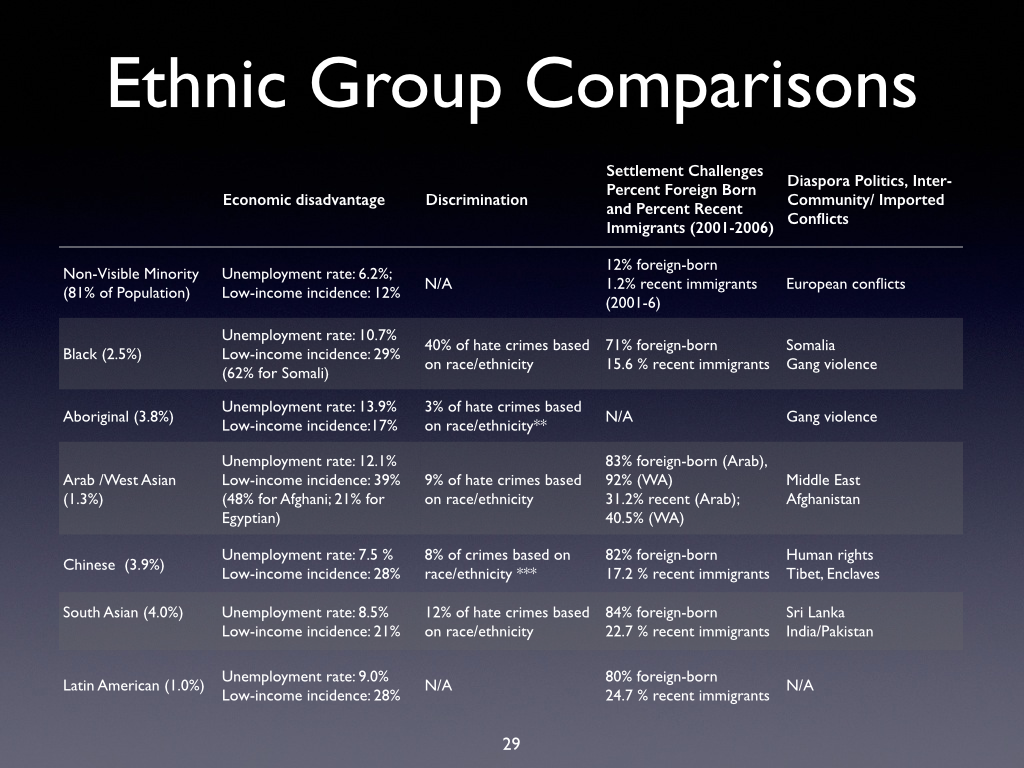
Ethnic Community Comparisons

From Policy Arrogance or Innocent Bias: Resetting Citizenship and Multiculturalism

Jon Kay takes the easy route out on faulting Carol Goar on her terminology, “racialized,” but ignores the broader, and more uncomfortable question she raised regarding inclusiveness and participation (Toronto is diverse but not as inclusive as it could be):

“Racialized Torontonians” as they call themselves?

Here’s a question for readers who live in Toronto: Do you know a single ordinary person — someone who is not either an activist, or enrolled in feminist film studies at Ryerson, or a “diversity consultant” hired by governments and big companies — who routinely refers to herself or anyone as a “racialized” person?

To be more specific, have these words ever escaped anyone’s lips within the 7,124 square kilometers of the Greater Toronto Area: “As a racialized Torontonian, I’m supporting Argentina over Germany in the World Cup final.” “As a racialized Torontonian, that shade of eye shadow really doesn’t go with my skin tone.” “As a racialized Torontonian, I’m having trouble finding a restaurant that serves authentic soul food.”

I suspect that most ordinary Torontonians would be utterly confused if Ms. Goar insisted on addressing them as a “racialized” person in a restaurant or store. They might assume she was taking some kind of ethnic census. If pressed to describe themselves through the lens of race-obsession, they might more simply respond: “If you really want to know, I’m half-black.” Or, “I’m Sephardic Jewish with a quarter Latino.” Or “I was both in The Philippines.” Or perhaps many might just avoid eye contact and say, “I’m a Canadian who lives in Toronto.”

Jason Kenney questioned the use of the term “racialized” along with “white power” and “oppression.” Grant and contribution proposals that included these terms, or websites of applicants with these terms, were routinely rejected.

While the underlying policy rationale was overdue – given Canada’s increased diversity, integration challenges within and among communities were equally significant – this change downplayed equity aspects of multiculturalism.

Jonathan Kay: Stop calling people ‘racialized minorities.’ It’s silly and cynical | National Post.

Cruel to take health care away from refugee claimants – Globe and Star Editorials

Harper Flesh WoundNot much support for the Government on the refugee claimant healthcare cuts, starting with the Globe’s editorial:

The problems with the federal cuts to refugee health care begin with the rationale used by government to introduce them in the first place: cost, deterring false refugee claims and equity – the idea that refugees are receiving better health care than Canadians. The court found the government wrong on all counts.

Citizenship and Immigration Minister Chris Alexander defended the cuts by saying they would save taxpayers $100-million over five years. The calculation was always suspect. It never factored in hidden costs, such as those incurred by neglecting certain health conditions as a result of no coverage. Mr. Alexander consistently argued that any refugee with a serious illness could still turn to hospital emergency rooms, as if that came at no cost. The government also argued the cuts would reduce the number of bogus refugees coming to Canada simply to access the country’s health care. Ottawa’s decision to penalize potential offenders by depriving every claimant in that category of health care is a kind of collective punishment. A court of law presumes innocence until guilt is proven. When it comes to refugee claimants, Ottawa should at least extend the same benefit of the doubt.

The Federal Court ruling reverses the government’s dumb cuts to refugee health care. There’s a legitimate concern about bogus refugee claimants abusing the system. This health care policy, a weapon that has now come back to wound its creator, was never the right way to deal with the problem.

Cruel to take health care away from refugee claimants – The Globe and Mail.

Predictably, from the Star:

While the Canadian Medical Association cheered the ruling as “a victory for reasonable compassion and a big step for natural justice,” Citizenship and Immigration Minister Chris Alexander intends to appeal. A less obtuse government would have been shamed into retreat, given the string of humiliating court defeats the Conservatives have suffered over Harper’s clumsy attempt to shoehorn an unqualified judge onto the Supreme Court, his hugely flawed law-and-order agenda and his unlawful bid to change the Senate. But this government is shameless. Alexander has even attacked Ontario for trying to plug the gap, accusing officials of coddling “bogus claimants” and “fraudsters.”

Federal Court rightly strikes down Harper’s refugee health-care cuts: Editorial

And prior to the Federal Court ruling, from the Calgary Herald (not just the suspect Toronto media):

A national day of action was held Monday by health-care professionals, people one doesn’t usually associate with protests and public forms of advocacy. The federal government should live up to its obligations and reinstate medical coverage for all refugees — not just those with the greatest chance of having a legitimate claim. If it wants to protect taxpayers, the government can do so by handling refugees claims in a timely fashion and sending those who are found lacking back home as quickly as possible. But under no circumstances should refugees — many of them already victims of abuse — be made to needlessly suffer.

Editorial: Reinstate refugees’ medical coverage

And Jon Kay in the National Post:

The moral relativist tries to blur the line between us and them. The punitive moral absolutist, on the other hand, paints the line stark and thick, and turns politics into a game of inflicting symbolic cruelties on the people on the wrong side of it. Thus, Tory criminal-justice policy consists of finding new and gratuitous ways to make life harsher for convicts — including taking away their rights to receive visitors, and eliminating widely lauded prison-work programs. Canada is one of the safest countries in the world, and has been getting safer for decades. But prisoners — like diabetic migrants — have no politically influential constituency, so tightening the screws on them scores well at poll-driven Tory brainstorming sessions.

When it comes to performing the same stunt on migrants, the irony is that the current Immigration Minister, former ambassador to Afghanistan and UN official Chris Alexander, has done more than just about any other Canadian to help the population of one of the most destitute nations on earth. Yet now that he is back on Canadian soil, he has been tasked with a policy aimed at denying health benefits to vulnerable people who have come to our shores.

Canada’s valuable post-9/11 work in Afghanistan — building schools for girls, and creating a democracy — was a powerful rebuke to the moral relativist idea that no system of values is better than any other. But as last week’s Federal Court ruling demonstrates, not every issue should be treated with the same aggressive us-vs.-them spirit.

Jonathan Kay: The refugee health-care decision lays bare Harper’s creed — punitive moral absolutism
Jonathan Kay: The politics of genocide

Jonathan Kay on genocides and the related policies and controversies.

The International Holocaust Remembrance Alliance refers to the Holocaust as “unprecedented” in its thoroughness and industrial approach, but that human suffering and killing is universal, whatever the specifics of the genocide or atrocity. Kay is on the same page; Yad Vashem sessions focus on the stories of individual lives, not just the horror of the numbers:

And herein lies the great paradox of memorializing genocides qua genocides: The whole exercise always is cast as one conducted for the victims and their suffering. Yet by agonizing and fighting over the semantics of genocide, we systematically ignore the way these victims actually die: as individuals full of individual grief and pain and love and loss. Everything else is arid semantics.

Jonathan Kay: The politics of genocide | National Post.

Jonathan Kay: The space between the hijab and niqab is where our anxieties lie

Jonathan Kay on the contrast between the hijab and the niqab, following the experience of a young non-Muslim woman wearing a hijab for a week. I think he largely has it right on the contrast between the hijab being compatible with integration, the niqab not:

One of the effects of the niqab is that it strips away all of the informal social cues that we typically rely on when we talk to people: the smiles, raised eyebrows, furrowed brows and such that tell us if our jokes are funny or not, our stories interesting or not, our presence welcome or not. The Burqa signals to the non-burqa-wearer that, to the extent he is capable of arousing any emotion at all, it is of the negative variety. In such a situation, most of us non-burqa folks are likely to put on a nervous smile, say something harmless, and get any necessary social or commercial interaction over with as quickly as possible so as not to induce the fear of sexual predation that, the niqab’s existence implicitly signals, is but thinly suppressed in all of us.

Since 9/11, all Western societies have become obsessed with the way Muslim women dress. (Indeed, in parts of Quebec, it has become a sort of full-blown neurosis.) But Rawhani misunderstands the issue if she thinks that this is really about the hijab. It is about our basic, socially felt human need to see the faces  of those we interact with. The fact that we politely tolerate those who live behind masks bespeaks Canadian civility. But it does not mean the underlying practice is in any way healthy or desirable.

Jonathan Kay: The space between the hijab and niqab is where our anxieties lie | National Post.

Jonathan S. Ostroff: Standing with Israel, but rejecting conscription | National Post

Reinforces much of the points made by Jonathan Kay (Shariah with a Jewish face), including the similarities with Muslim (and other) fundamentalism (e.g., expressions like “rampant immorality”):

Ben-Gurion and the other founders of the secular state of Israel wanted the army to be a melting pot for immigrants from all over the world. Haredi Jews did not, and still do not, want to be melted down. Living in an environment of rampant immorality and lack of commitment to Jewish observance is toxic to their youth. And yes, Haredim believe that marriage is between a man and a women; they do not want to serve in an institution that enforces the acceptance of homosexuality. Religious Zionists who consider it a great virtue to serve in the army complain that more than 20% of their youth loose their religious commitment during their service.

This is why many Haredi parents here in Canada and the United States refuse to send their sons to live in dorms in a co-ed secular universities. This is why Haredim have separate schools, separate newspapers, no television, no unfiltered Internet. They spend hundreds of millions of dollars a year on education systems that isolate their children from secular culture.

Jonathan S. Ostroff: Standing with Israel, but rejecting conscription | National Post.