ICYMI – Bricker and Ibbitson: There are divisions in every part of the country. Is Canada at the breaking point?

Valid critique:

…Both Conservative and Liberal governments contributed to some of the challenges facing Canada today. But it was Mr. Trudeau who oversaw the greatest policy failure of modern times, by letting the immigration system spin entirely out of control.

As with so many aspects of the Trudeau legacy, the intentions were honourable: to grow Canada’s population and secure its future through increased immigration. There were arguments for and against the decision to almost double the intake of permanent residents to 500,000 a year. But there was no excuse for letting the number of temporary foreign workers and international students skyrocket, along with the number of people seeking asylum. Suddenly there were three million non-permanent residents in Canada, competing with younger native-born workers for jobs and housing. For the first time in a quarter century, polls showed that most Canadians believed Canada brought in too many immigrants.

Public support for immigration and multiculturalism has been Canada’s great competitive advantage, creating a diverse yet peaceful society of old and new Canadians living and working together in harmony. But by flooding the country with newcomers, the Trudeau government broke the consensus in favour of high levels of immigration and undermined our unique social contract. The damage to the country’s harmony and its future prospects could be incalculable….

Source: There are divisions in every part of the country. Is Canada at the breaking point?

Ibbitson & Bricker: We must not allow immigration to become a major cultural concern for Canadians

Perspective and a warning by Ibbitson and Bricker:

…Put all this together and the difference between Canada and the two largest members of the Anglosphere becomes stark. While Canadians still focus primarily on the impact of new arrivals on housing and social services, many conservative Americans see immigrants as a cultural threat, while Britons possess a race-and-culture-based hierarchy of who is most welcome.

Within Canada, Quebec is always sensitive about language and identity. But compared to the U.S. and Britain, the cultural backlash toward immigrants in Canada is still relatively muted. The central concern is the ability of governments to manage the flow. 

That has enormous political consequences….

But confidence in Canada’s immigration system has been shaken by the belief that the system is out of control. In response, the federal Liberals have announced cuts to the level of permanent residents, temporary foreign workers and international students allowed into Canada, while taking steps to expedite the asylum claim process.

The risk of resentment remains. If political leaders are unable to do what it takes to restore confidence in this country’s immigration system, we could see in Canada what we are seeing elsewhere: whites resenting non-whites; rural residents estranged from urban; ideologies hardening and polarizing; and resentment toward immigrants becoming the dominant political issue.

You have only to look south or east to see what happens after that.

Source: We must not allow immigration to become a major cultural concern for Canadians

Ibbitson: Sir John A. Macdonald & The Apocalyptic Year 1885 places the former PM’s many imperfections within the context of the times

Of note. The importance of historical context:

…First Nations in the West were starving in the 1870s and 80s. The bison on which they depended had been hunted almost to extinction. Many native people fled into Canada to escape a hostile American government that provided no aid.

Macdonald, Dutil demonstrates, did everything in his power to prevent starvation, making himself minister of Indian affairs to co-ordinate relief efforts. He provided supplies and instructors to encourage Indigenous farming and offered rations to thousands in need.

“The whole theory of supplying the Indians is that we must prevent them from starving,” Macdonald declared. Spending on relief efforts became one of the largest items in the federal budget – twice what was spent on agriculture, immigration, penitentiaries or the post office.

“There is no evidence that food was withheld to kill Indigenous people, as some would charge 150 years later,” Dutil concludes. The very opposite is true: “Even with the financial crash in the fall of 1883 and the economy in deep depression, Macdonald spent aggressively on food.” His government was harshly criticized by the Liberal opposition for what that party considered lavish overspending on First Nations relief.

The Macdonald government initiated the infamous residential-school system. There is no question that the prime minister sought to assimilate First Nations within the settler culture. There is also no question that this attitude enjoyed near-unanimous support among non-Indigenous Canadians. Macdonald and his peers believed assimilation offered the most hopeful future for the first peoples.

“Canada joined the rest of the American hemisphere as it opened a shameful chapter in its history, despite its good intentions,” Dutil writes….

Source: Sir John A. Macdonald & The Apocalyptic Year 1885 places the former PM’s many imperfections within the context of the times

Ibbitson: With human rights chief debacle, the Liberals continue their string of blunders

Unfortunately accurate:

…On Monday, Mr. Dattani agreed to resign. The Trudeau government’s slipshod vetting process had once again turned what looked like an innovative choice for an important position into an embarrassment.

I say “once again” because hiring, discovering and then backtracking has become something of a pattern with this government’s appointments.

There was the unfortunate decision to ask the Community Media Advocacy Centre to conduct anti-racism seminars. Everything was going fine until reports surfaced that Laith Marouf, a senior consultant at the centre, had posted vile antisemitic comments on Twitter. The government cancelled the contract.

Then there was the famous case of Julie Payette, Prime Minister Justin Trudeau’s choice for governor-general in 2017. On paper, she looked perfect: an engineer, scientist and former astronaut. But a proper background check would have revealed past accusations of workplace harassment. After similar complaints surfaced at Rideau Hall and following an investigation ordered by the government, Ms. Payette resigned.

The Liberals’ missteps extend beyond poor hiring decisions…

Source: With human rights chief debacle, the Liberals continue their string of blunders

Ibbitson: Pierre Poilievre makes his case for dismantling what the Trudeau government has built

Of note and very likely (employment equity excerpt):

…Mr. Poilievre said he wanted to live in a country where people pay lower taxes and are burdened by fewer rules, but also where they “have freedom of speech, where they’re judged on their merits, not their ethnicity, gender, sexuality, etc., where parents have ultimate authority over what their kids learn about sexuality and gender, where we go after criminals not after hunters and sport shooters, where we rebuild our military to have strong standing in the world.”

The Liberal agenda of promoting diversity within the public service – gone. Protections for gender-diverse youth – gone. Efforts to combat discrimination in the criminal justice system – gone.

Pretty much every major element of the Liberal environmental, social and justice agenda – gone….

But there is a reason the Conservatives are so far ahead in the polls. Things don’t feel right. Even the most fervent supporter of open immigration (and I am one) is alarmed by the out-of-control flood of people coming into the country. Inflation and high interest rates have lowered the standard of living for millions of people. The regulatory environment has become far too complex. And the Liberals have failed to persuade most of us that they get all this and are working to fix it….

Source: Pierre Poilievre makes his case for dismantling what the Trudeau government has built

Ibbitson: The Liberal’s immigration policies have accomplished the opposite of what was intended 

Indeed, how ironic (and irresponsible):

…Maybe the next budget will dedicate itself to improving productivity growth by cutting back on immigration. Nothing would surprise anymore.

There is a final irony to all of this. Since the days of the Laurier government in the late 1800s, the Liberal Party has been the party that supported immigration and that immigrants supported.

But an online survey in December by Leger of 2,104 adults who arrived in Canada within the past 10 years (margin of error within 2.1 percentage points, 19 times out of 20) found that four-in-10 newcomers believe Canada brings in too many immigrants.

The Conservatives are now as popular as the Liberals with newcomers. There would be a certain irony if the Liberal Party’s wide-open immigration policies caused immigrant voters to contribute to its defeat.

Source: The Liberal’s immigration policies have accomplished the opposite of what was intended

ICYMI: Ibbitson: Canada’s foreign policy and its domestic politics on Israel’s war against Hamas are shifting

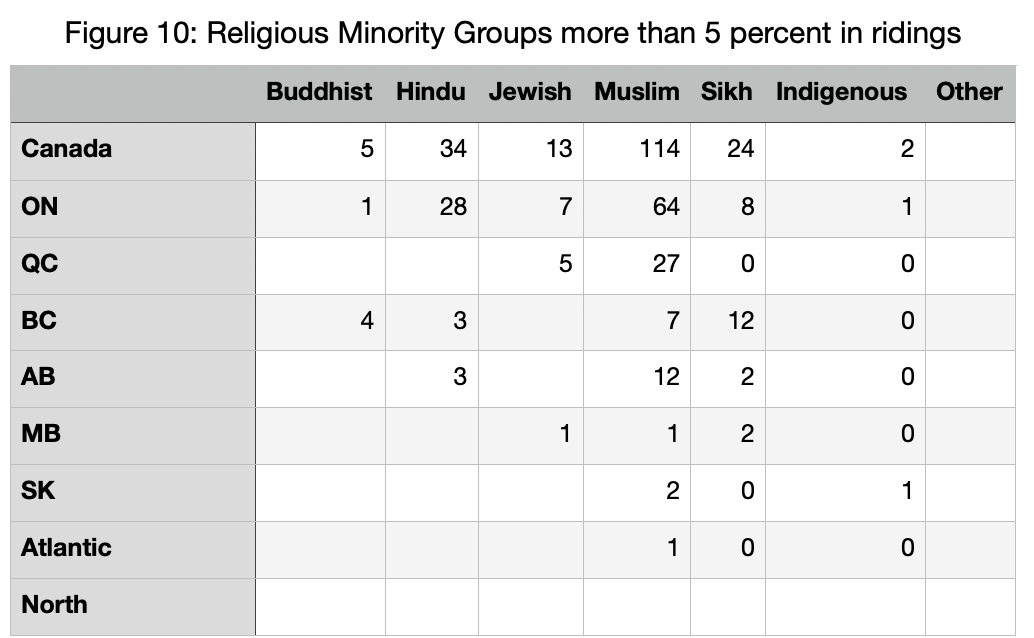
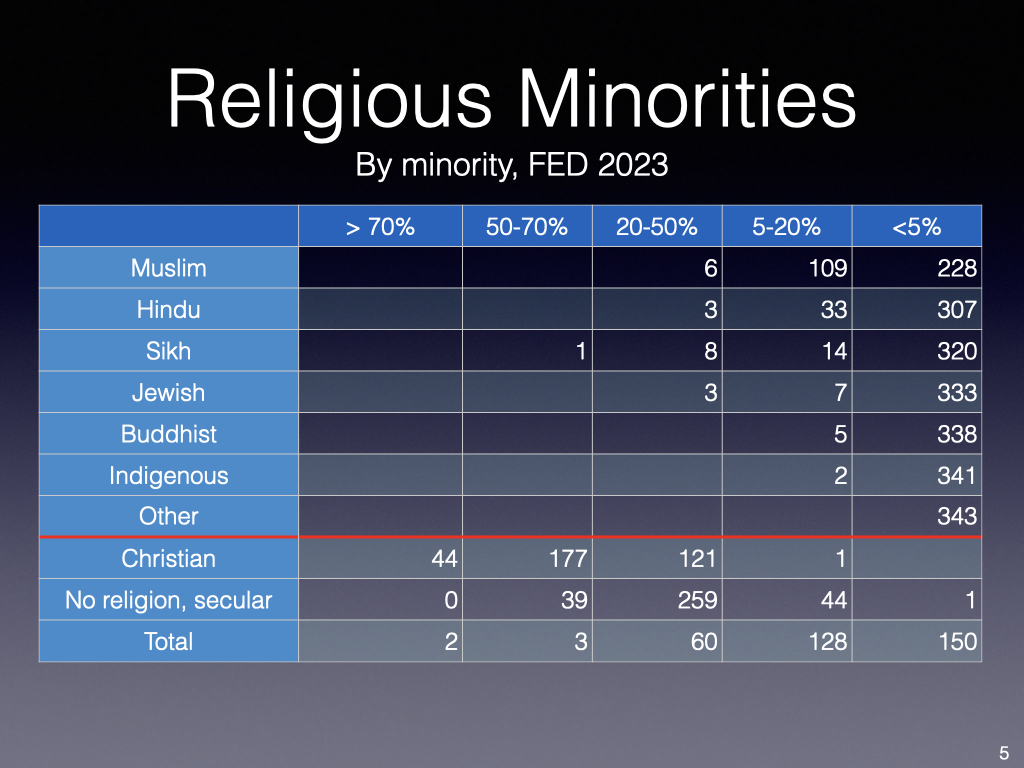
Indeed. Riding demographics highlight the relative importance of religious minorities, particularly the contrast between Canadian Jews and Canadian Muslims:

….The Liberals have tried to keep both Jewish and Muslim constituencies onside. But as last week’s vote suggests, they increasingly accord a high priority to the rights of Palestinians and to the Muslim community in Canada.

As with other religious communities, Muslims are hardly monolithic. Someone who comes to Canada from Senegal may have different values and priorities than a Canadian who comes from Syria or Pakistan or Indonesia.

And the plight of Palestinians in Gaza may not be the only issue influencing Muslims, who struggle with inflationinterest rates and housing affordability as much as other voters.

Many new Canadians come from societies that are socially conservative. Some Muslim voters may be uncomfortable with the Liberal Party’s strong support for the rights of LGBTQ Canadians.

Finally, Muslim voters for whom supporting the rights of Palestinians is the ballot question may be drawn more to the NDP than the Liberals.

Regardless, the days of Liberal/Conservative bipartisan consensus in support of Israel are over. This is the new lay of the land.

Source: Canada’s foreign policy and its domestic politics on Israel’s war against Hamas are shifting

Ibbitson: Liberals trying to play both sides in Gaza conflict

Definition of middle of the road: road kill!

The table below highlights the number of ridings with more than 5 percent religious minorities, highlighting just how many more ridings have significant Muslim populations compared to Jewish populations.

The Liberals find themselves caught between an Israel/Conservative rock and a NDP/Palestinian hard place. And they don’t seem to have a solution, other than to placate both sides, which is no solution at all.

Source: Liberals trying to play both sides in Gaza conflict

Ibbitson: All of us could do with a check of the words we’re using

Indeed. 13 ridings are more than 5 percent Jewish compared to 114 who are more than 5 percent Muslim, hence the tension within the Liberal party:

Justin Trudeau has been stalwart in supporting Israel during the current crisis, despite divisions within the Prime Minister’s Liberal caucus. Pierre Poilievre’s Conservatives are unequivocally pro-Israel. The NDP, though more ambiguous in its position, also condemned the horrific attacks by Hamas of Oct. 7.In

But Canada is changing, politically and demographically. Some who defend the rights of Palestinians use language that is plainly antisemitic. People are saying hateful things during pro-Palestinian demonstrations. For supporters of Israel and of Jews everywhere, the future darkens.

words we use should reflect on their own words as well.

Source: All of us could do with a check of the words we’re using

Ibbitson: The Liberals must fix the housing crisis, before it undermines support for immigration

Indeed. But ramping up housing is harder than ramping up immigration, given the complexities and time lags. So unlikely Minister Fraser will be able to show concrete results before the election, begging the question why not pausing planned increases in immigration to allow housing etc to start catching up:

In last week’s cabinet shuffle, Prime Minister Justin Trudeau promoted Sean Fraser, one of his government’s rising stars, from immigration to housing. His job in this new portfolio is to fix the problem he contributed to in his old one.

Mr. Fraser must find a way to ease this country’s critical housing shortage, a problem the Liberal government is stoking by bringing in more than a million newcomers a year to Canada.

High levels of immigration bring growth, energy and confidence to our country. But they also bring problems. Mr. Fraser must fix the worst problem of all, or risk undermining the Canadian experiment.

In 2022, Canada welcomed 437,000 new permanent residents. Add in temporary foreign workers, international students and other non-permanent residents, and you have a population that is now growing by more than a million people a year, or 2.7 per cent, by far the highest growth in the G7. Today, we are 40 million people.

Statistics Canada estimates that “such a rate of population growth would lead to the Canadian population doubling in about 26 years.” Given that Japan, South Korea and most European countries are declining, or soon will decline, in population – thanks to low birth rates and little or no immigration – Canada a generation from now could be one of the larger developed countries, equal to or even ahead of GermanyFrance and Britain in population.

These new arrivals help ease labour shortages caused by retiring baby boomers. In 2010, 14 per cent of Canada’s population was 65 or older. Last year, it was 19 per cent. By 2030, it will be around 23 per cent.

The shortages are made worse by Canada’s falling total fertility rate (TFR), which reached a record low of 1.4 children per woman in 2020 – far below the replacement TFR of 2.1 children per woman.

Those who argue that Canada should increase its birth rate rather than rely on immigration to stabilize or grow the population are just wrong. HungarySingapore and the Nordic countries have adopted natalist policies to get their fertility rate up to 2.1. They and others have failed. Governments should always support women who want to have children and still preserve their career path. But that is a matter of social equity.

In most respects, then, this Liberal government’s policy of expanding Canada’s already robust immigration policy has been a good thing. But it also contributes to an acute housing shortage. A recent TD Bank report predicts that, if current trends continue, the gap between housing supply and demand could reach 500,000 units through 2025.

For Mr. Fraser’s part, “I can tell you that, 365 days a year, I will choose the problem of having to rapidly build more houses because so many people want to move to my community over losing schools and hospitals because so many people are leaving,” he told Maclean’s magazine when he was still immigration minister.

Now “the problem of having to rapidly build more houses” is his to solve.

Because he’s a Liberal, Mr. Fraser will likely approach the problem through a combination of regulations and incentives. He would be wise to also steal Conservative Leader Pierre Poilievre’s approach: require municipalities to loosen restrictions on development as a condition of receiving grants.

In truth, everything is needed: converting vacant office buildings to condominiums, densifying existing neighbourhoods, increasing the supply of subsidized housing and, whether you like it or not, permitting suburban sprawl.

Thus far, Mr. Poilievre has avoided calling for limits to immigration. He recently told journalists that immigration targets should be “driven by the number of employers who have job vacancies they cannot fill with Canadians, by the number of charities that want to sponsor refugees, and by families that can reunite and support their loved ones here.” That could easily get you to a million new arrivals, permanent and temporary, a year.

Much is at stake. If Canadians attribute unaffordable housing to high levels of immigration, they may demand cutbacks.

That would be tragic. Whatever the challenges, new Canadians enrich this country. By coming here, they vote their confidence in Canada’s future and help to realize that future.

We should welcome a million new arrivals a year. We just need to find places for them to live.
Source: The Liberals must fix the housing crisis, before it undermines support for immigration