‘Birth tourism’ could become election issue in B.C. riding considered ‘ground zero’

Not seeing much resonance outside of Richmond and it does not appear that the CPC is wedded to its policy resolution given their immigration critic Michelle Rempel’s comments (Michelle Rempel Garner on Twitter: “3/ I would hope that all …https://twitter.com › michellerempel › status):

On the streets of Richmond, an immigration topic on people’s lips for years has been “birth tourism.”

The practice — where pregnant women travel to a foreign country to give birth, thereby guaranteeing their baby automatic citizenship — has been rising steadily in the city, whose hospital is considered “ground zero.”

Under Canadian immigration law, birthright citizenship is law. But some in the city say people are increasingly taking advantage.

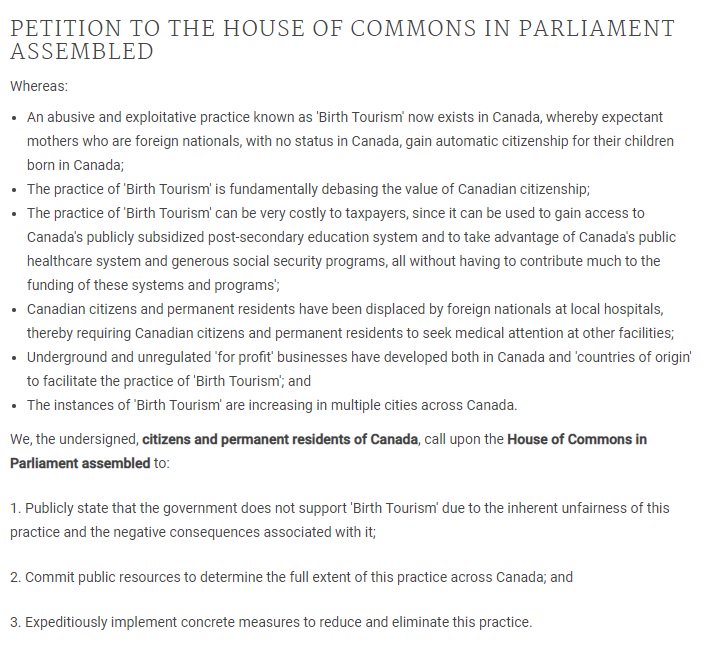
One woman, Kerry Starchuk, has made it her mission to bring an end to birth tourism. She has submitted two online petitions to the federal government since 2016, arguing more needs to be done to clamp down on the practice.

“It is undermining our citizenship,” she said. “Everyone comes through the front door and they work very hard to come here. This is undermining the system.

“People are lying to border guards and not saying why they’re coming here, and coming to stay at places that are unregulated. If we want a healthy community, everyone needs to contribute to being on board.”

Starchuk says several homes in Richmond are being advertised on Chinese websites and Instagram accounts as so-called “baby houses,” where families can rent rooms in advance of their hospital visit.

“We have given the wrong messages by not addressing the issue, so now there are even more operators bringing birth tourism into Richmond,” she said.

Starchuk’s first petition was sponsored by Alice Wong, the longtime Conservative MP for Richmond Centre, and gained more than 8,800 signatures — 5,100 of which came from B.C.

A second petition in 2018 was signed over 10,800 times, again with a majority coming from B.C.

That petition’s sponsor was Liberal MP Joe Peschisolido, whose riding of Steveston-Richmond East sits just east of Richmond Hospital and contains several neighbourhoods where “baby houses” have popped up.

“Birth tourism undermines both the integrity of our immigration system, as well as the integrity of our health care system,” he said. “It’s a business, but it’s an illegitimate business.

“What you have are unscrupulous businesspeople who are making money off our generosity … and that has to stop.”

The petition called on Ottawa to not only declare it doesn’t support birth tourism and study its full extent and effects, but also move towards policies that would dismantle businesses that promote the practice.

Peschisolido says the government in the process of adopting all three of those requests, but admits it’s taking time.

“We have to quantify it and come up with numbers to see what it is, what’s occurring, what kind of problems are involved,” he said. “Then we have to come up with a plan to shut down the industry, and that’s what we’re in the process of doing.”

Numbers increasing

While Statistics Canada data has reported relatively small numbers of births by nonresidents based on birth registrations — just 313 across Canada in 2016 — new studies have shown birth tourism could be much more widespread.

A 2018 Policy Options study that looked at the number of births through hospital discharge data from the Canadian Institute for Health Information (CIHI) found 3,223 cases that same year, more than five times the number from Statistics Canada.

Andrew Griffith, a fellow of the Canadian Global Affairs Institute who was behind the report, says that number has only continued to increase, to 3,628 in 2017 and 4,100 in the last fiscal year, which ended in March.

“That represents a 13 per cent increase year over year, which is quite significant,” he said, while noting the number still represents less than two per cent of all births in Canada.

Griffith acknowledged the data includes all births to nonresidents, including those temporarily living in Canada on student visas, and it’s difficult to tell in each case whether birthright citizenship was a motivating factor.

The CIHI information shows while B.C. may actually lag behind Ontario in the number of births to nonresidents — 689 in 2017, compared to more than 2,000 in Ontario — Richmond Hospital continues to outpace all other hospitals in the country.

In 2017-18, the B.C. hospital saw 469 births to nonresident mothers, accounting for more than 21 per cent of all births there. The next closest figure comes from Scarborough and Rouge Hospital in Ontario, with 163 nonresident births, representing 9.5 per cent of total births at the hospital.

Griffith’s report recommended financial action against nonresidents attempting birth tourism to discourage it, such as hospitals requesting substantial deposits from nonresidents.

Peschisolido says all options are being considered, but pointed to a $52-million government investment meant to help RCMP crack down on “baby houses” as a “good first step.”

Campaign issue

An Ipsos poll conducted in January for Global News found more than half of Canadians surveyed either tend to agree or strongly agree that Canada is too welcoming to immigrants.

In March, an Angus Reid Institute poll suggested 64 per cent of Canadians disagree with the country’s birthright citizenship laws, with 60 per cent calling for stricter laws against birth tourism.

But responses to Starchuk’s two petitions have suggested Ottawa has no plans to get rid of the law, despite admitting birth tourism is a problem that needs addressing.

“While there may be instances of expectant mothers who are foreign nationals who travel to Canada to give birth, requiring that a parent be a citizen or permanent resident in order for their child to acquire citizenship through birth in Canada would represent a significant change to how Canadian citizenship is acquired,” then-immigration minister John McCallum said in response to the 2016 petition, which was ultimately rejected.

Current Minister of Immigration Ahmed Hussen made similar points in response to the 2018 petition, but pledged to study the issue more closely.

Peschisolido, who was first elected to the new Steveston-Richmond East riding in 2015, says he plans to make the issue a key promise in his re-election bid.

“If I’m blessed and fortunate enough to be re-elected … I’m going to be pushing very hard to not only undermine birth tourism, but ultimately stop it and eliminate it,” he said.

Conservative candidate Kenny Chiu and Green candidate Nicole Iaci did not make themselves available for interviews.

At their most recent convention, Conservative Party members vowed to bring an end to birth tourism.

In a statement, NDP candidate Jaeden Dela Torre said the problem is concerning as it related to the health care system, but said any policies that crack down on birth tourism must come with careful considerations.

“We must not use this issue as a way to divide Canadians and fan the flames of racism and xenophobia,” she said.

“We’re reviewing all facts to come up with a fair and compassionate solution that protects health care services for all Canadians.”

Starchuk says she’s been in touch with many of the candidates, but has yet to see the action that Peschisolido has promised.

“I don’t trust anyone right now, because nothing has been resolved,” she said. “It’s a growing issue, but I haven’t seen anyone do anything.”

Source: major issue in the lead up to the Canadian elections
British Columbians Troubled by Birth Tourism, Call for Change

Although a less than reliable online survey, overall concerns among all British Columbia residents, whatever their origins, sounds about right:

Many residents of British Columbia are concerned about the practice of “birth tourism”, a new Research Co. poll has found.

In the online survey of a representative provincial sample, 82% of British Columbians believe “birth tourism” can be unfairly used to gain access to Canada’s education, health care and social programs.

“Birth tourism” is the practice of traveling to a specific country for the purpose of giving birth there and securing citizenship for the child in a country that has birthright citizenship.

Canada allows expectant mothers who are foreign nationals to gain automatic citizenship for their children born in Canada.

There have been reports of unregulated “for profit” businesses that have facilitated the practice of “birth tourism”  in Canada. Across British Columbia, 49% of residents say they have followed this issue “very closely” or “moderately closely” over the past year.

More than three-in-five British Columbians say “birth tourism” can degrade the value of Canadian citizenship (66%) and can displace Canadians from hospitals (63%).

An e-petitionendorsed by Joe Peschisolido, the Member of Parliament for the Steveston—Richmond East constituency, is calling on the federal government to commit public resources to determine the full extent of “birth tourism” across Canada. A considerable majority of British Columbians (85%) agree with this proposal.

Seven-in-ten British Columbians (73%) believe Canada should “definitely” or “probably” consider establishing new guidelines for birthright citizenship, while 18% would keep the existing standards.

“There is no substantial variation on these questions when the ethnicity of respondents is considered,” says Mario Canseco, President of Research Co. “We find that 71% of British Columbians of East Asian descent and 75% of those of European descent would like to see some modifications to the current rules for birthright citizenship.”

Source: view the release on our website

‘Birth Tourism’ Is Legal in Canada. A Lawmaker Calls it Unscrupulous.

Good overview of the issues involved and interesting details on the support birth tourism “industry,” My study cited (Hospital stats show birth tourism rising in major cities) and I am quoted along with others:

Melody Bai arrived in Vancouver from China in the late stages of pregnancy with one goal: to give birth to a Canadian baby.

Awaiting her was an elaborate ecosystem catering to pregnant women from China, including a spacious “baby house” where she spent four months, attended to by a Mandarin-speaking housekeeper.

Caregivers offered free breast massages to promote lactation, outings to the mall, lectures on childbirth with other Chinese mothers-to-be and excursions for high tea.

“It’s an investment in my child’s education,” Ms. Bai, a 28-year-old flight attendant, said by phone from Shanghai, months after returning to China with her newborn and passport in hand. “We chose Canada because of its better natural and social environment.”

Ms. Bai is part of a growing phenomenon in Canada known as birth tourism, which is not only generating political opposition, but mobilizing self-appointed vigilantes determined to stop it.

It is perfectly legal.

Under the principle of jus soli — the right of the soil — being born in Canada confers automatic citizenship. But as more pregnant women arrive each month to give birth, some Canadians are protesting that they are gaming the system, testing the limits of tolerance and debasing the notion of citizenship.

In Richmond, a city outside Vancouver where about 53 percent of its roughly 200,000 residents are ethnic Chinese, nonresident mothers account for one in five births at the Richmond Hospital, the largest number of nonresident births of any hospital in the country, according to a recent report.

“Birth tourism may be legal, but it is unethical and unscrupulous,” said Joe Peschisolido, a Liberal member of Parliament in Richmond, who brought a petition against the practice to Ottawa, where the immigration minister, Ahmed Hussen, said he would examine the issue.

The practice underlines how Canada, and British Columbia in particular, has become a favored haven for well-heeled Chinese seeking a refuge for wealth and kin away from authoritarian China.

The issue of birthright citizenship gained global attention in October after President Trump said he wanted to eliminate it, though it is enshrined in the American Constitution.

At least 30 other countries, including Canada, Mexico and Brazil, grant automatic birthright citizenship. Others like Britain and Australia have tightened their laws by requiring that at least one parent be a citizen or permanent resident at the time of the child’s birth.

Indicating that immigration could be an issue in federal elections next year in Canada, the opposition Conservative party this summer endorsed a nonbinding motion calling for unconditional birthright citizenship to be abolished.

In the recent report, from the Institute for Research on Public Policy, Andrew Griffith, a former director general at the government department responsible for immigration, showed that the number of children born to nonresidents in Canada was at least five times as high as previously thought — close to 1,500 to 2,000 annually.

Mr. Griffith argues that Canada intended birthright citizenship for those who wanted to live in and contribute to the country. “Since those engaging in birth tourism have no or barely any real link to Canada,” he said, “the practice is challenging a very Canadian value of fair play.”

With its sprawling Chinese food markets, Chinese-language newspapers and large number of caregivers speaking Mandarin, Richmond has become ground zero for birth tourists from China.

About two dozen baby houses are in operation. Visits to about 15 addresses showed that some operate openly while others work under licenses as tour agencies or present themselves as holiday rentals. Some are in homes. Others are in apartments. Many are booked through agents and brokers in China.

In a visit to one, the Baoma Inn, a modern house across from a park, a woman in the late stages of pregnancy could be seen in a second-floor window. A young man who answered the door confirmed that the inn was a baby house before another angrily slammed the door.

But during a telephone call in Mandarin inquiring about the Inn’s services, a man said it offered a one-stop package including “guaranteed appointments” with “the No. 1 obstetrician in British Columbia,” who spoke Mandarin and had “a zero accident rate.”

Customers usually stay for three months, he said, including one month after the birth, to allow time to apply for a passport for the newborn and to recuperate, as is the Chinese custom.

He added that his agency had seven sales offices in China. The bill for a three-month stay at a two-bedroom apartment, not including meals and prenatal care, is about 25,000 Canadian dollars ($18,331).

“The women all go back to China,” he said. “They don’t enjoy any social benefits from the Canadian government and don’t need it.”

Bob Huang, who with his wife runs Anxin Labour Service, a birthing center in the nearby city of Burnaby, said he was frequently contacted by agents in China who wanted a 50 percent commission on every successful referral. He said he preferred to post his own ads on local Chinese classifieds websites.

Some Richmond residents say birth tourism is undermining the community’s social fabric.

Kerry Starchuk, a self-described “hockey mom” who spearheaded the petition championed by Mr. Peschisolido, documents baby houses in her neighborhood and passes the information on to the local news media and city officials.

On a recent morning, she received an anonymous tip on Facebook that as many as 20 pregnant “birth tourists” from China were being housed in a nearby modernist high rise.

Rushing to her minivan, she drove to a parking garage beneath a Chinese supermarket. She then hurried outside to case out a nearby building, suspiciously eyeing a pregnant Chinese woman walking by. After entering the building, Ms. Starchuk was foiled by a locked stairwell, adding the high rise to her list for another day.

Ms. Starchuk complains that birth tourists bump local mothers from maternity wards, a concern echoed by some local nurses, and get access to public services without paying taxes.

She also said the so-called “anchor babies” threatened to burden Canada by emigrating and studying here, and sponsoring their parents to become permanent residents.

Some first- and second-generation immigrants in Richmond say birth tourists have an unfair advantage by jumping the immigration queue.CreditAlana Paterson for The New York Times

The issue has become conflated with resentment in the Vancouver area against soaring housing prices, which some residents blame on an influx of wealthy Chinese.

But Ms. Bai, who had her baby in Vancouver in February, said that given the hefty price she had paid to give birth here — 60,000 Canadian dollars, including housing and hospitalization — she was subsidizing the Canadian health care system and contributing to the local economy.

“My child won’t be enjoying any Canadian health benefits, as we are living in China,” she said.

Since her son is Canadian, however, she and her husband, a pilot, could save about 150,000 Canadian dollars on tuition fees at an international school in Shanghai.

After gaining fluency in English and Western culture, her son could also later attend a Canadian university at the discounted local rate. Eventually, the entire family could emigrate to Canada.

Some first- and second-generation immigrants oppose birth tourists for jumping the queue.

“I don’t think it is fair to come here, give birth and leave,” said Wendy Liu, a Richmond resident of 11 years, adding that she had been repeatedly harassed after Ms. Starchuk mistakenly put her house on a list of birth tourism centers.

Birth tourism at Richmond Hospital recently came under the spotlight because of a so-called “million dollar baby.”

A nonresident, Yan Xia, gave birth there, racked up a bill of 312,595 Canadian dollars in maternity and neonatal care for her newborn because of complications, and then absconded without paying the bill, according to a civil claim the hospital filed at British Columbia’s Supreme Court in April, six years after Ms. Xia gave birth.

Including six years’ worth of interest, Ms. Xia’s bill would amount to about 1.2 million Canadian dollars.

Yet another petition on birth tourism

Likely a political response to the tensions in Richmond, where over 20 percent of live births are to non-resident mothers and positioning given the Conservative party resolution calling to limit birthright citizenship to offspring of Canadian citizens or permanent residents.
Working on an article with more accurate and. spoiler alert, higher numbers which should be out later this month or early November:

Pressure builds to close ‘birth tourism’ loophole for getting citizenship

Interesting coming from a Liberal MP:

Liberal MP Joe Peschisolido is optimistic that he can persuade federal ministers to curb so-called birth tourism, as pressure for action mounts in B.C.

“We are reaching a tipping point,” he said. “Nurses have told me that this is displacing folks from giving birth in Richmond.”

The number of babies born to foreign nationals at Richmond Hospital rose to 384 last year from just 18 in 2010 and now accounts for about 20 per cent of all deliveries, according to Vancouver Coastal Health. Under Canadian law, babies born here get Canadian citizenship regardless of their parents’ citizenship.

An entire industry of citizenship brokers and maternity tourism businesses are profiting from this “illegitimate business model,” said Peschisolido, who represents Steveston-Richmond East. “A whole slew of folks are complicit in this.”

Peschisolido plans to present a parliamentary e-petition — which calls for an end to this “abusive and exploitative practice” and “concrete measures” to eliminate the birth tourism —  to federal Immigration Minister Ahmed Hussen and Public Safety Minister Ralph Goodale.

In response to birth tourism, Australia and New Zealand changed their laws, granting citizenship to babies only when at least one parent is a citizen or a legal resident.

“Birth tourism is wrong and it undermines our immigration system and our health care system,” said Peschisolido. “The reason there are more than 8,000 signatures is that it violates people’s sense of fairness.”

Non-resident births account for two per cent of the 44,000 babies born in B.C. each year.

Non-residents are required to pay the costs associated with their care and the vast majority of these patients pay these fees without issue, said Laura Heinze, who speaks for the B.C. Health Ministry.

“The ministry in no way endorses or supports the marketing of maternity tourism,” she said. “Matters relating to immigration are the responsibility of the federal government.”

Pregnant women who come to Canada specifically to have a child with Canadian citizenship are not breaking the law, but they could be misleading immigration officials about their reasons for visiting Canada.

“If a person, including an expectant mother travelling to Canada, provides false information or documents, IRCC will refuse their application and that person could also be inadmissible to Canada for five years,” according to the federal Immigration, Refugees and Citizenship department.

This is the second time that the petition’s author, Kerry Starchuk, has tried to get the attention of the federal authorities. Her first petition launched in 2016 also gathered more than 8,000 signatures.

A report by Canadian immigration officials recommended changes to citizenship law to then-immigration minister Jason Kenney in 2014.

No action was taken by that Conservative government, but the number of foreign citizens coming to B.C. to give birth in order to secure Canadian citizenship for their child has risen dramatically since then.

People have until July 17 to sign the current petition.

Starchuk became concerned about growth of birth tourism after trying to greet new neighbours with cookies and came to realize the house was being used as accommodation for women from abroad who were about to give birth.

“I’ve done my part being a good neighbour, but this is exploiting the system,” she said. “They are not here to be my neighbours and I’m not OK with that.”

A Vancouver Sun investigation in 2016 found more than two dozen so-called baby houses were providing services and accommodation to birth tourists in B.C.

“These people are jumping the queue when people are waiting to immigrate,” she said. “I don’t see how being born here like this justifies citizenship.”

Petition supporter Gary Liu said the practice of birth tourism is generally “despised” in the immigrant community.

“People who have worked hard to learn the language and raise their families — and everyone has their own struggles and stories — they feel like this is a quick pass for some people,” said Liu, who has lived in Canada for more than 20 years.

Liu believes more rigorous application of existing rules by Canada Border Services Agency and enforcement of zoning bylaws against baby houses would minimize the practice.

Canada and the United States are the only G-7 nations that grant automatic citizenship for babies born in-country to foreign nationals. Critics complain that so-called “anchor babies” become a legal foothold in Canada to gain immigration access for the rest of their families.

Source: Pressure builds to close ‘birth tourism’ loophole for getting citizenship