Black and Griffith: Visible minority women are still sidelined in competitive ridings

Our latest. Conclusion:

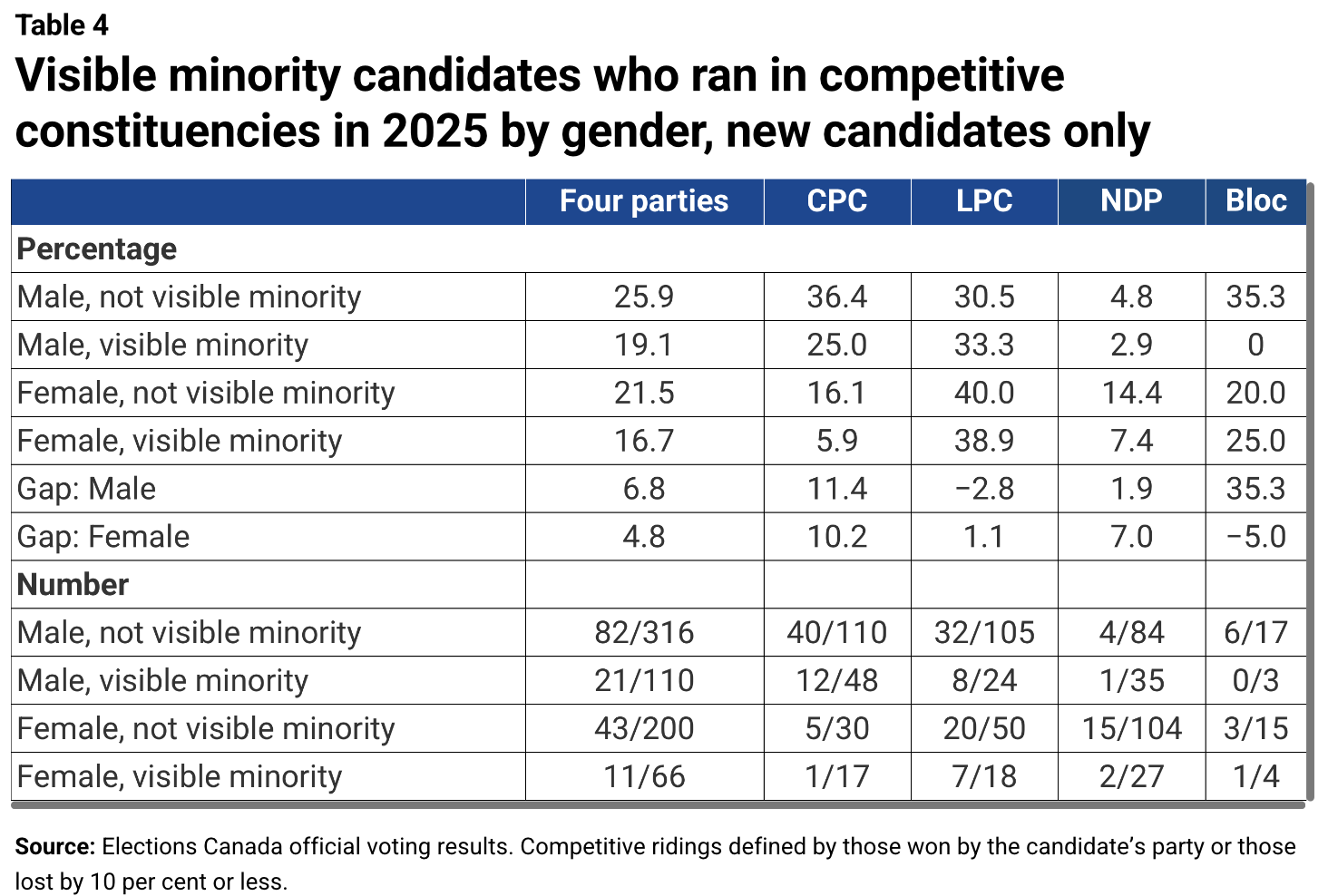
…In other words, party candidate selection incorporates affinity effects that give preference to visible minority candidates for all major parties in these ridings. Given this, it is less surprising that studies of election outcomes indicate that affinity effects are less important than “candidate competitiveness, Canada’s first past the post electoral system, and local context,” Elections Canada says, because those effects are effectively baked in at the candidate nomination stage.

This indicates positive discrimination for visible minority candidates in these ridings and the possible converse in ridings with lower numbers of visible minorities, largely rural ridings.

While one can make the crude case that nominating more visible minority women candidates would allow federal political parties to tick off two diversity boxes at once, the evidence indicates that this is not the case: women visible minority candidates do indeed have a higher percentage chance of being sacrificial lambs. This suggests they do experience biases in the political process across two fronts, as both women and visible minorities.

To encourage improved representation, the political parties should adopt a transparency approach similar to Senate Bill S-283 would require each party to provide annual information on the policies and programs they have enacted to increase the representation of designated groups (women, visible minorities, Indigenous Peoples and persons with disabilities).

This could be accomplished by the chief electoral officer administering a voluntary self-identification questionnaire to nominated candidates, thus allowing for post-election reporting on candidate and MP diversity.

Canada’s federal political parties may resist this transparency-based approach, but its use in federally regulated industries and the public service for close to 30 years has proven effective.

Source: Visible minority women are still sidelined in competitive ridings

Do Canada’s most powerful federal posts reflect the country’s diversity?

My latest, with Jerome Black, examining which benchmark should we use regarding visible minority representation in political institutions: overall population or citizenship-based population:

The inclusion of Canadians from visible minority groups in the country’s major political and socio-economic institutions is an important indicator of the success that Canada can claim as a multicultural nation, and ultimately a measure of the nature and distribution of power and influence within the country. But how to properly assess the level of inclusion for particular groups?

Where data exist, this is a straightforward task. To contextualize whether genuine integration and inclusion have occurred requires identifying the percentage of the overall Canadian population that the visible minority group occupies, and comparing that number to the group’s representation in a particular sector. A small or non-existent gap between the two percentages would suggest a more positive interpretation about the incorporation of visible minorities while a larger deficit would imply the opposite. Still, the analysis can be done using different population benchmarks. (Note that the term visible minority is used here to match the language used by Statistics Canada in the collection of census and other data.)

We wanted to take a close look at the overall percentage of visible minority candidates and MPs over the last three general elections; and the percentages per visible minority group. We also wanted to see what percentage of appointed officials (senators, judges, Governor in Council (GiC) appointees and public servants) were from visible minority groups.

There are two benchmarks used here – one is using the overall population, and the other is using the portion of the population that are citizens. The latter’s importance stems from the requirement that the candidates of political parties hold citizenship.  Similarly, the requirements for most political appointments and public service hiring are citizenship-based. While GiC appointment requirements vary by organization, given residency, knowledge and experience requirements for full-time positions, citizenship would appear to be the default criterion…

Continue Reading: Do Canada’s most powerful federal posts reflect the country’s diversity?