Ottawa pilots ‘name-blind’ recruitment to reduce ‘unconscious bias’ in hiring

This pilot will provide some real world data to the existing blind cv studies that have been conducted by Oreopoulos and Reitz.

Wisely, the government has chosen to pilot this in a number of departments with different representation challenges, as shown in the table below:
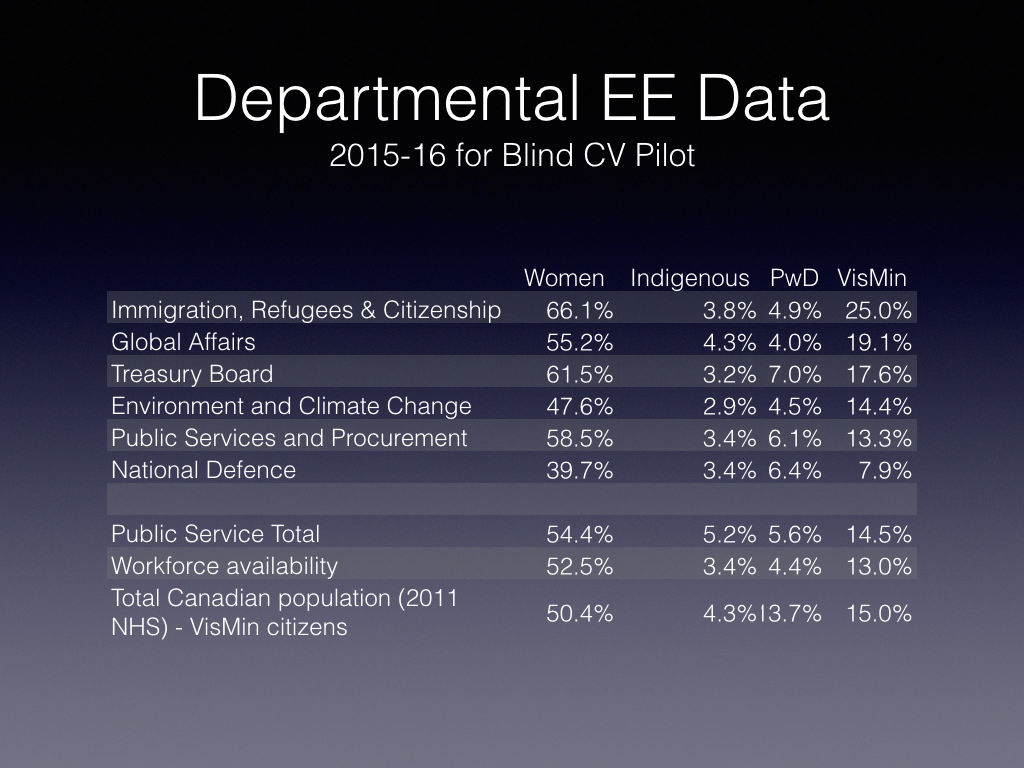
As the government has largely met the goal of being representative of the population it serves, implicit bias may be less of a factor in the government sector. Representation is somewhat less at more senior levels, where implicit bias is likely less of an issue given that candidates are known.

It would be ironic indeed if the pilot, intended to test for bias against visible minorities, would show a bias for visible minorities, given some of the “over-representation” in some departments. In any case, a valuable exercise.

Ottawa has launched a pilot project to reduce biases in the hiring of federal civil services through what is billed “name-blind” recruitment, a practice long urged by employment equity advocates.

The Liberal government’s move came on the heels of a joint study by University of Toronto and Ryerson University earlier this year that found job candidates with Asian names and Canadian qualifications are less likely to be called for interviews than counterparts with Anglo-Canadian names even if they have a better education.

“It’s not just an issue of concern for me but for a lot of people. A number of people have conducted research in Canada, the U.K., Australia and the U.S. that showed there is a subliminal bias in people reading too much into names,” said Immigration Minister Ahmed Hussen, who first delivered the idea to Parliament last year as a rookie MP from Toronto.

“Name-blind recruitment could help ensure the public service reflects the people it serves by helping to reduce unconscious bias in the hiring process.”

Some companies in the private sector, including banks and accounting firms, have already adopted the practice, which removes names from application forms in order to stop “unconscious bias” against potential recruits from minority backgrounds.

In the United Kingdom, the government now requires name-blind applications for university admissions service and other applications for organizations such as the civil service, British Broadcasting Company and local government.

U of T sociology professor Jeffrey Reitz said the initiative is an important step forward but cautioned officials they must consult independent experts in developing the process and reviewing the results to make sure it is done correctly.

To conduct name-blind screening, he said, recruiters must remove any information on a resumé that would reveal the ethnicity of the person, such as name, birth place and membership in an association before coding the candidates in the talent pool.

“If the government is serious about it, they need to make the process transparent and allow researchers to look at the new procedures and the results,” said Reitz, a co-author of the Canadian study on name discrimination against Asians.

Debbie Douglas of the Ontario Council of Agencies Serving Immigrants said she hopes the pilot could benefit other minority groups, given studies have shown that white English- and French-speaking able-bodied women have been the primary beneficiaries of current employment equity programs.

“We hope as the government moves proactively to ensure diversity in hiring it will review the existing program and strengthen it to ensure the intentional inclusion of racialized and indigenous job seekers,” said Douglas.

Treasury Board President Scott Brison, who championed Hussen’s initial idea, said he welcomed the opportunity to explore new ways of recruiting talent for the public service.

“A person’s name should never be a barrier to employment. Diversity and inclusion in the workplace is critical to building an energized, innovative and effective public service that is better able to meet the demands of an ever-changing world,” said Brison at the launch of the pilot at Ryerson Thursday.

The six departments participating in the pilot include Department of National Defence; Global Affairs Canada; Immigration, Refugees and Citizenship Canada; Public Services and Procurement Canada; Environment and Climate Change Canada; and the Treasury Board Secretariat. A report on the pilot is expected in October.

Using data from a recent large-scale Canadian employment study that examined interview callback rates for resumés with Asian and Anglo names, U of T and Ryerson researchers found Asian-named applicants consistently received fewer calls regardless of the size of the companies involved.

Although a master’s degree can improve Asian candidates’ chances of being called, it does not close the gap and their prospects don’t even measure up to those of Anglo applicants with undergraduate qualifications.

Compared to applicants with Anglos names, Asian-named applicants with all-Canadian qualifications had 20.1 per cent fewer calls from organizations with 500 or more employees, and 39.4 per cent and 37.1 per cent fewer calls, respectively, from medium-sized and small employers.

Source: Ottawa pilots ‘name-blind’ recruitment to reduce ‘unconscious bias’ in hiring | Toronto Star

Gloomier future seen for Canadian immigration

IRCC analysts are asking many of the right questions:

With 35 per cent of male newcomers returning home and a growing middle class in developing countries less inclined to migrate, an internal government review is calling the future of Canadian immigration into question.

The report by Immigration Refugees and Citizenship Canada also points to the challenge of reconfiguring an immigrant-selection system in a rapidly changing labour market where a growing number of jobs are temporary and there’s “increasing mismatch” of available skills and the skills in demand.

“What changes, if any, does Canada want to make to its current ‘managed migration,’ ” asked the 23-page study, titled Medium-Term Policy: Balanced Immigration and stamped “for internal discussion only.” “To what extent is the current overall immigration level appropriate and/or necessary?”

With major changes made in the last decade under the former Conservative government, legal and immigration experts are calling on Immigration Minister John McCallum to have a “national conversation” on the future of Canadian immigration.

“Ottawa must take a step back to do a review of the whole immigration program and reach a national consensus in moving our country forward as a nation-building exercise rather than as an economic imperative,” said Debbie Douglas of the Ontario Council of Agencies Serving Immigrants.

“The Liberals have good political instincts and like to be seen as doing more on the immigration front. It’s the right time to take a look at what is working and what is not working in the system.”

The new government has already announced reviews of certain immigration programs involving temporary foreign workers and the Express Entry processing system, but critics say such reviews must be done in a holistic manner rather than a piecemeal fashion.

“This is the most thoughtful brief (on Canada immigration) I’ve seen in 10 years,” said Queen’s University immigration law professor Sharry Aiken. “It’s asking all the right questions that are useful starting points for a wide-ranging discussion of the future of our immigration system.”

The internal report, obtained by the Star, also devotes attention to the estimated 2.8 million Canadian citizens — 9 per cent of the population — who live abroad, including a million people in the United States, 300,000 in Hong Kong and 75,000 in the United Kingdom.

Some 35 per cent of male immigrants to Canada return home, many within the first year. Between 1996 and 2006, the annual exit rate for citizens born in Canada was 1.33 per cent compared to 4.5 per cent for naturalized citizens.

“There has been a rather negative view of these expatriate Canadians, as they have been regarded as evidence of ‘brain drain,’ Canada’s lack of competitiveness in retaining high-skilled professionals and business leaders, and our insufficient success in integrating new arrivals,” the report noted. “Canada could choose to take a more proactive stance with expatriates.”

Measures implemented by other countries include: extending voting right to expats, providing non-resident representation in the national legislature, facilitating business and research networks, doing outreach to communities abroad to promote ties as well as creating tax treaties with other countries to facilitate work abroad.

The report also points to the greater emphasis the former Tory government put on selecting economic immigrants based on in-demand occupations in a so-called “project economy” marked by limited length of employment based on the duration of a contract or project.

“This environment makes it a significant challenge to target occupations and industries that are priorities for addressing through immigration,” it said.

While the report forecast does mean potentially lower immigration to Canada in the longer term, University of Toronto professor Jeffrey Reitz said global migration is still driven by “inequality” from poor to rich countries.

Although Ottawa introduced the Express Entry system in 2015 to let employers pick prospective immigrants from a pool of candidates to ensure newcomers are quickly employed, Reitz said the uptake of candidates outside the country has been small.

“Anything that improves the employment situation contributes to immigrant retention, but there is an aspect of retention in the family class. When you lose your job and you have no family, you move. A support group gives people a reason to stay,” explained Reitz, the director of ethnic, immigration and pluralism studies at U of T.

Hence, the immigration report raised the question over the strict differentiation of “economic” and “social” immigration in the current system, which channels applicants into the skilled and nonskilled streams.

“Regardless of how their application was accepted, immigrants make many contributions to Canadian society; economic migrants make social contributions; social immigrants make economic contributions,” it said.

“Given the somewhat artificial distinction between social and economic immigration, there may be grounds for giving greater weight to ‘non-economic’ criteria and on criteria related to the success of subsequent generations.”

Ryerson University professor John Shields said recent immigrants are caught up in the same “new economy” faced by young Canadians entering the workforce.

“All immigrants including the refugee class contribute to the society economically. They pay dividends economically in five, ten years as integration is a long-term process that can take a lifetime,” said Shields, whose research focuses on labour markets and immigrants.

“Recent immigrants and young Canadians face a different kind of roadblock from those who are already established in Canada. The issue we need to deal with is creating higher quality employment in Canada and educate Canadian employers of the values of one’s work experience from somewhere else.”

Source: Gloomier future seen for Canadian immigration | Toronto Star

Employers Likely to Always have a Limited Role in Immigrant Selection – New Canadian Media – NCM

Interesting interview with UofT professor Jeffrey Reitz on the Express Entry immigration employer-driven approach:

“Nobody has had success” with this sort of employer-driven immigration system to produce large-scale immigration, the academic who has been tracking immigration trends in Canada and globally for four decades, said.

The book [Controlling Immigration: A Global Perspectivehas a chapter devoted to Canada, and in this Reitz writes: “Indeed, the Australian government has greatly reduced visa opportunities for international students and is reviewing its selection policy more generally.

”Overall, he writes in the book, “… it is far from clear that the new policy directions [in Canada] will actually improve the prospects for and impact of immigration.”

The UofT professor points out that while the jury is still out on the key question of net economic gain, Canadian newcomers can be expected to reduce income inequality mainly because they tend to be employed in high-skills jobs rather than at the lower end. “Immigrants compete for more highly skilled work in Canada, so the labour market impact is at levels of employment higher than the impact of relatively less-skilled immigrants in the United States.”

Income inequality has been a hot topic of political debate in both the U.S. and Canada in recent months.

Reitz also attempts to mathematically calculate the extent to which immigrant credentials are discounted in Canada: “[I]mmigrant skills in terms of both education and work experience have only about two-thirds of the value of corresponding skills held by native-born Canadians, and occupational under-employment is a significant reason for this imbalance.” This is based on a statistical calculation made by labour market analysts on the return on investment (ROI) that Canadians gain from every additional year of education.

Studies have shown that while mainstream Canadians gain five per cent in added earnings for every year of education, newcomers boost their average pay by just 3.5 per cent. “Some analysts have noted a decline in return for foreign experience as well, although no explanation for this trend has been found.”

Employers Likely to Always have a Limited Role in Immigrant Selection – New Canadian Media – NCM.