For the first time the faces of Japanese Canadian veterans who fought in the First World War are on display on the streets of Vancouver after a century largely unrecognized.
A community historian spent more than 15 years digging through archives, tracking down descendants and uncovering heroic acts to bring this group of forgotten soldiers’ stories to life and push for the recognition she says they deserve.
“These were young men who gave their whole lives and no one remembers them,” Debbie Jiang told CBC News.
“I feel like I’m bringing back to life that person and their names that would otherwise be unknown.”
Jiang calls it a “travesty” that a dark chapter in Canadian history overshadowed their service and kept their stories hidden not only from the public, but in many cases their families, too.
During the Second World War, Canada labelled all Japanese Canadians including veterans “enemy aliens” and forced thousands in B.C. into internment camps, seized their property and sold their belongings.
Kelly Shibata says it wasn’t until he spoke to Jiang that he started learning more details about his grandfather’s remarkable military career.
“That is the mystery of all of it — we had virtually no information about his time in the military,” Shibata said.
His grandfather, retired private Otoji Kamachi, was part of a distinct group of Japanese Canadian soldiers who enlisted during the First World War in Canada’s military…
Good reminder of our history and the lasting memories:
Leaning forward in her wheelchair to look over a massive photo album, Sue Kai delves into memories from decades ago. Kai, 96, and her son, Brian, pore over snapshots of her past, some dating back to the moment her life was irrevocably changed.
Kai was 16 years old, and living with her family in the downtown Vancouver home her father built with his own two hands, when it happened.
“One Sunday everybody is going crazy: ‘Bomb bomb bomb bomb,'” said Kai. “I said, what’s a ‘bomb bomb bomb bomb?’ Then they said ‘Pearl Harbor.'”
From the name, Kai thought it was a fancy beach, not the American naval base in Hawaii that had just been bombed in a surprise attack by Japan on Dec. 7, 1941. But warnings from the people around her quickly told her that wasn’t the case.
“Then I heard, ‘Now, you better go inside because they’re going to shoot you.'”
Shortly after Japan’s attack on Pearl Harbor, Prime Minister William Lyon Mackenzine King ordered the internment of Japanese Canadians living in coastal B.C., citing fears of sabotage or co-ordination with Japan. Many of them had been born and raised in Canada.
Nearly 21,000 Japanese Canadians and their families were forced to leave their homes and livelihoods, and in many cases their, families. They lost most of their belongings and any sense of life they had known.
Kai is among several of the last generation of internment camp survivors who now, decades later, find themselves reunited at Yee Hong Centre for Geriatric Care in northeastern Toronto. After the Second World War, the federal government forced the interned Japanese Canadians to leave the country or re-settle further east in Canada. Many chose to move to Toronto, where they rebuilt their lives from scratch.
Some, like Kai, never spoke much with their children about what happened back then.
“There were times when my parents didn’t want to talk about it and when that happened they spoke Japanese. Since I couldn’t understand it, that was sort of hidden to me,” Kai’s son, Brian, explained.
A thwarted life
Brian started interviewing his mother over the last few years to create a record of her past. But only recently has she revealed the depths of her anger and the degree to which the internment thwarted her life.
“I was mad. I was mad,” she admitted. “I planned to go to university.”
“I didn’t realize that university was a possibility for her,” Brian said, in surprise. “I guess because of the war I just knew she couldn’t go, but the fact that she actually entertained thoughts of going is news to me.”
“That’s the first time I actually heard her say the word ‘mad’ to the fact that she had to be moved into internment camps, so I think I’ve learned a few things already,” he said.
Separated from her family
After the attack on Pearl Harbor, Sue Kai, her mother, and her younger brother were shipped to Kaslo, B.C., roughly 200 kilometres east of Kelowna and 450 kilometres from their home in Vancouver. They were separated from the rest of their family and cut off from the outside world.
“No newspaper, no radio, no nothing. We were completely … we didn’t even know what was going on with the war. It’s terrible to be cut out,” Kai said, “And then all the mail, if you got it, was censored. C-E-N-S-O-R … it’s all black. So if I got a letter from my brother, half of it was all cut out, because my brother complained.”
Because Kai was a high school graduate, she was recruited to become a teacher in the community. One of her former students, Yoshiye Suyama, 90, now lives in the same Scarborough long-term care home, and wasn’t shy telling her former teacher what she thought of her.
“Oh, you used to be such a strict teacher,” Kai recalled being told. “Well, I didn’t realize it. But, I think it’s better to be strict, and we always have a good laugh.”
“I was a little brat,” Suyama said.
Suyama was 11 when she was forced to move to Kaslo. While she said she has some happy memories of living in the town and playing in the woods, she remembers not wanting to leave her New Westminster home.
“We left everything,” she said. “All I remember is ‘I don’t want to go.'”
“We only moved because they kicked us out. ‘J**s out!’ when the war started,” she said, using a racist term that was commonly used against Japanese people at the time. “We had to leave. We couldn’t say ‘yes’ or ‘no.'”
Suyama’s daughter, Debbie Katsumi, says her mother didn’t speak much about that time. But now she is learning more about the experiences from other families at her mom’s long-term care home.
“I like to learn as part of the chit chat,” Katsumi said. “It’s enriching.”
Too painful to relive
Herb Sakaguchi, 97, also didn’t discuss his internment with his children. He was 17 when he was sent to Slocan, B.C., an hour east of Kaslo.
Sakaguchi lost more than his freedom — he lost his family home in Kitsilano. The Canadian government sold the homes and businesses of interned Japanese Canadians, including the contents of their houses.
“What can you do? One guy against a whole government,” Sakaguchi said, slumped in his wheelchair. “It’s just done. They did it. We got evacuated. I’m still around. Mad as hell, but what can I do? It’s finished now.”
“It was not something that we talked about,” said his daughter, Jane Zielinski. “I just think that it was maybe too painful for them to relive those memories.”
“It’s painful for me to think about what they must have gone through. If I put myself in that position and think, ‘how would I have felt?’ Just being told to leave, pack a bag, leave everything behind and relocate with a lot of other people,” she said.
“It was really just a token because they lost cars, everything they owned, because they could only carry so much,” Brian Kai said.
“The family received a very small amount for owning a piece of property in downtown Vancouver, which probably is worth millions of dollars now. It’s very hard to put a price on it because it was a house that my grandfather built with his own hands.”
Starting over
Despite all the loss they experienced, Sue Kai, Sakaguchi and Suyama spoke extensively about how happy they are with how the lives they had to rebuild turned out after the internment ended. All three are proud of the families they raised.
While Kai laments not going to university because of the internment, she is proud that both her sons and all her grandchildren have university degrees and were able to achieve what she could not.
And, Sakaguchi believes had it not been for the internment and his forced migration to Toronto, he might never had met his wife.
“It’s the best thing that happened,” he joked. “Some guys would say, ‘you nut!'”
Not much new here in terms of the substance of former PM Trudeau and his Cabinet’s position but nevertheless of interest:
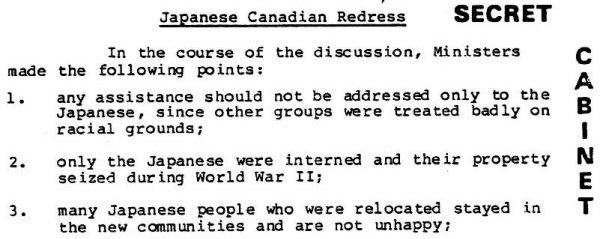
The cabinet of then-Prime Minister Pierre Trudeau opposed compensation for interned Japanese-Canadians because they didn’t seem unhappy, say secret documents.
The declassified documents, obtained by Blacklock’s Reporter, said the cabinet was concerned about the precedent it would set to give cash to people whose property was seized.
“Any assistance should not be addressed only to the Japanese since other groups were treated badly on racial grounds,” cabinet agreed at a confidential April 18, 1984 meeting.
The National Association of Japanese Canadians had sought for years settlement of claims over the seizure and forced sale of property in 1942.
About 22,000 Japanese, including Canadian citizens, were removed from the BC coast after the Pearl Harbour attack and taken to the interior, Alberta, Manitoba and northern Ontario.
The wartime cabinet invoked the War Measures Act and seizing more than $152.4 million worth of fishing boats, real estate and automobiles owned by Japanese-Canadians.
Then-Multiculturalism Minister David Collenette in a censored 1984 report to cabinet proposed a settlement of claims.
“Many Japanese people who were relocated stayed in the new communities and were not unhappy,” said Cabinet Minutes.
“A nation cannot go back and wipe out the past, it should look forward. A more general approach should be taken, if anything is to be done.”
“All minorities will feel they should have a right to redress. Any resolution in the House of Commons should not be related to a single group.”
Cabinet said instead of compensating Japanese-Canadians, “other ways should be looked at, for example endowing chairs at universities,” said Minutes.
“In concluding, Ministers expressed the wish that the Minister (of Multiculturalism) look at the issue again and have it discussed in the cabinet committee on social development.”
Trudeau, Sr. at the time also publicly opposed any apology or compensation for the wartime internment.
“I’m not inclined to envisage questions of compensation about acts which have maybe discoloured our history in the past,” Trudeau told the Commons.
“I’m not sure where we would stop in compensating.”
The Liberal cabinet lost re-election five months later without settling the issue.
When Prime Minister Brian Mulroney was elected, in 1he 988 formally apologized for the wartime internment and approved $21,000 in compensation to some 6,000 surviving internees.
“All Canadians know apologies are inadequate,” Mulroney said at the time.
Japanese were interned under a 1942 order that demanded “all property situated in any protected area of British Columbia belonging to any person of the Japanese race be delivered up” for sale by federal agents.
Japanese-Canadians did not regain the right to vote until 1949.
Hidden away in British Columbia’s North Shore mountains are the remnants of a Japanese-Canadian logging camp, shrouded by forest and veiled from memory after it was apparently abandoned because of internment during the Second World War.
Since 2004, Vancouver archeologist Bob Muckle has been visiting and excavating the site; almost everything had been swallowed by the forest and has been gradually and carefully uncovered. There are as many questions as answers, still, but Muckle has a theory that it was an oasis of Japanese culture, on the fringe of Vancouver, decades ago, that was heretofore unknown.
Sherri Kajiwara of the Nikkei National Museum in Burnaby, B.C. says there is no record, yet, of anyone remembering living there, or remembering that their ancestors resided there, although there were plenty of Japanese-Canadians in Canada at the time.
“By the 1940s the community was very established and spread across metro Vancouver and the province,” Kajiwara said.
More than 1,000 artifacts have been collected at the site, researchers say.Bob Muckle
Her museum is putting together an exhibit about the history of Japanese-Canadian internment, and one of the main characters is Eikichi Kagetsu, a successful businessman who had logging rights in the area where Muckle found a settlement.
Muckle’s involvement with the camp began as a search for an area where he could teach his Capilano University students about proper excavation. He found one, a logging camp, by the looks of it, since there were bits of saw blades around. But, the excavation soon revealed it “was not really a typical logging camp at all.”
A typical camp, Muckle explained, would have bunk houses and a mess hall for the men working there. This one has 14 locations that were, to Muckle’s eyes, houses. There is also evidence of a shrine, a garden space and a water reservoir system.
“The most significant find is evidence of what may be a Japanese bathhouse,” Muckle noted. “Very few bathhouses have been excavated outside of Japan.”
Though he doesn’t “have the smoking gun yet,” Muckle’s hypothesis about the origin and life of the camp is that Japanese-Canadians moved to the logging camp around 1918, and remained there even after logging activity ceased. He was most recently on-site for several weeks in May and June.
“In the Vancouver area, where we are, in the 1920s and ’30s there was pretty explicit racism against both Chinese and Japanese, so this would’ve been an escape from that.”
Here they lived, with the men commuting into Vancouver for work, Muckle suspects, until February 1942, when they would have left for internment camps, a policy put in place during the Second World War that relocated families from the B.C. coast.
The evidence for the timing, and reason, for the camp’s abandonment, even in the absence of clear artifacts from the 1940s, is that the departure seems to have been reasonably orderly. Everyone there just walked away, leaving behind clocks, watches, pocketknives, dishes and stoves. There are about 1,000 artifacts in total: beer bottles and teapot pieces and evaporated milk cans, suggesting the presence of children.
“I think (internment) explains why we have so many personal items left behind,” Muckle said. “The dishes tend to be in really good condition, which you wouldn’t expect if people were normally abandoning their site.”
And, some items were hidden, such as a valuable stove secreted away off-site and parts of an early-1900s camera that were inside the walls of the bathhouse.
“I’m thinking this is probably my last season there,” he said. “I’m going through the process right now of figuring out what’s going to happen to all the artifacts.”
Certaintly, some of them are going to go to Kajiwara’s museum. For her part, she’s heard from a number of people about the settlement, as it has received more press, including someone from Japan. “It’s really been quite remarkable that the word has gone out sort of far and wide,” she said. “We’re starting to slowly collect names.”
“That whole generation really didn’t talk about the experience for decades and it’s only now, it’s only recently, that the stories have started to be revealed or shared,” she said. “It will be interesting to see if we can track down any of the descendants.”
Good research and reminder of this historic injustice:
Judy Hanazawa says the federal government sold her family’s fishing boats and homes while her parents were in internment camps during the Second World War, but what hits hardest is seeing a 70-year-old letter from her father disputing a government cheque for $14.68.
Hanazawa had never seen the letter until recently, but the Vancouver resident said reading it conveys the sense of betrayal her father must have felt losing family possessions and having to start over with almost nothing after he was held in a camp in British Columbia’s Interior.
“My dad, in writing this letter, was really intent on being dignified in how he approached the government,” Hanazawa said. “He pointed out to them the value of these belongings was much more than he received. For him it was a lot to write this, to point out that this was not really right.”
The Feb. 10, 1947, letter to the federal Office of the Custodian in Vancouver includes a list of Hanazawa family items — a Singer sewing machine, record player, dresser and other household items — with an estimated value of $224.95. The letter also lists a Japanese doll, worth $10, and includes a reward for its return.
Geniche Hanazawa’s letter is one of 300 letters discovered in a federal archive written by Japanese Canadians protesting the sale of their homes, businesses and heirlooms while held in internment camps during the Second World War.
Historian Jordan Stanger-Ross of the University of Victoria came across the letters while researching federal archives as part of a project examining the dispossession of Japanese Canadians. The Landscapes of Injustice is one of Canada’s largest humanities research projects.
He said many Japanese Canadians were prepared to accept being sent to internment camps during the war, but losing everything was not expected. The federal government promised to keep the homes and businesses for internees, but the policy changed during the war and the properties were sold.
The letters reflect the sense of loss and betrayal Japanese Canadians felt towards the government for selling off their possessions and life’s work without consent, he said.
“They wrote these really remarkable letters, some of them are long and lay out life stories of migration to Canada, building a home, building a business, raising children,” said Stanger-Ross. “Some of them are very short and just say, ‘I received your cheque, which I tore up.’ ”
Authors of the letters include the Victoria owners of a successful dry cleaning business, an internee whose cousins died in France serving Canada during the First World War, and a man who put two of his Canadian-born children through medical school.
“We have many letters from people just shocked at the price for which both their land and personal belongings and businesses had been sold,” Stanger-Ross said.
About 22,000 Japanese Canadians were sent to internment camps in Canada from 1942 until 1949.
“Readers of these letters tend to pause and contemplate what it would mean for me to lose my home, my business, lose the opportunity to educate my children in my community and really lose the dream of multiple generations that have built lives here in B.C.,” Stanger-Ross said.
The letters are also set to become part of an online historical exhibition called Writing Wrongs at the Nikkei National Museum and Cultural Centre in Burnaby, B.C. The exhibit is scheduled to open in 2019.
Museum curator Sherri Kajiwara said Japanese Canadians were prepared to do their time in internment, but losing everything was not part of the deal.
“The thing I find with the letters is the unbelievable politeness and eloquence,” she said. “The language is so painfully polite; basically saying, ‘kindly, please, stop it. You are not allowed to sell my belongings.’ “
While I would disagree that Japan has come to terms with its wartime atrocities (sharp contrast to Germany), Welch’s concern regarding the divisiveness of this proposal is valid (just as the Canadian Vietnamese community was split over Bill S-219 – Backward Bill Passed, but Vietnamese-Canadians Move Forward – New Canadian Media):
In recent years, China has fanned the flames of anti-Japanese sentiment, partly for instrumental reasons (an external enemy enhances national cohesion and regime legitimacy), and partly because many Chinese honestly believe that Japan is nostalgic for its imperial, militarist past, and continues to pose a latent threat to the mainland. It is hardly surprising that they do. Their government keeps telling them so. Chinese citizens are fed a steady diet of anti-Japanese propaganda in the press and in the form of late-night television dramas depicting the heroic struggle of Chinese soldiers against barbaric wartime Japanese invaders. The Nanjing Massacre figures heavily in these anti-Japanese narratives.
In fact, the government of Japan has long ago—and many times—acknowledged and repented of the country’s imperial sins. Only a handful of arch-nationalist cranks refuse to do so, and they speak only for themselves. Today, Japan is among the least militarist countries in the world. Most Japanese today see their own government as the primary source of their wartime suffering. Since 1945, Japan has been a responsible and constructive member of the international community.
One finds ample evidence of lack of empathy in Japan as well, where China’s anti-Japanese propaganda is seen as part of a larger geopolitical project to impose Beijing’s hegemony. With few exceptions, Japanese fail to appreciate the extent to which anti-Japanese sentiment in China can be attributed to a combination of ignorance and regime insecurity. But the Japanese government does not respond by demonizing China. Instead, it calls for greater cooperation and communication on issues of mutual interest, while hedging its bets through more-or-less-standard balance-of-power politics.
These two efforts to single out the Nanjing Massacre for commemoration effectively endorse and encourage Chinese misperceptions of Japan. They ask the people of Ontario and the people of Toronto to inflame and take sides in a dangerous clash of national egos. They work against, not for, stability in East Asia. This is not the Canadian way. Canadians are peacemakers and bridge-builders, not pawns in others’ domestic and geopolitical games.
At the same time, and at least as importantly, these two efforts threaten to undermine harmony here at home. More than 100,000 Ontarians have roots in Japan, and more than 700,000 have roots in China. Nothing good can come from fanning the flames ethnic hatred—except, perhaps, for cynical politicians who care only about the relative number of their constituents in their districts with Chinese or Japanese ancestry.
Finally, these measures are dangerous precedents. By taking sides in one case, Queen’s Park and Toronto City Council would effectively invite others to do the same. Ontario, in general, and Toronto, in particular, have more diverse populations than anywhere else in the world. There are not enough days in the calendar to commemorate every historical atrocity that drives an ethno-nationalist grievance.
Let us hope that our politicians see the wisdom of avoiding this particular minefield before the damage is done. No one could possibly object to commemorating the innocent victims of war; but if we are to do so, let us make the commemoration inclusive, in true Canadian fashion, rather than divisive.
Good and harrowing series of photos (have chosen just two):
Last week was the 75th anniversary of the Japanese attack on Pearl Harbor. Amid commemorations of the Americans killed in the attack, as well as the brutal war that followed, also came a solemn remembrance of how the United States interned coastal Japanese-American populations that it wrongly believed were a dangerous fifth column.
A similar tragedy, of course, played out in wartime Canada. In a country with an established tradition of respecting civil liberties, wartime hysteria led to 21,000 people of Japanese descent being forcibly removed from a 100-mile “defence zone” along the British Columbia coast.
But that’s only part of the story. The National Post has combed through archives across the country to unearth these rare photos of one of the darkest hours in modern Canadian history.
Beginning in March 1941 — eight months before the attack on Pearl Harbor — Japanese-Canadians were required to obtain these identity cards, which have been recently featured as part of the museum exhibition Registered. Something to note on these cards is that issuers felt the need to stamp them with the words “Canadian born.” It would have been understandable for the owners of these cards, both of them Canadian citizens, to see that stamp as a kind of insurance policy in case of war with Japan. But ultimately, 75 per cent of those interned were Canadian citizens, including many who could not speak Japanese or had fought for Canada in the First World War. With no similar mass internments taken against Italian- or German-Canadians, it was clear to them that this was motivated by a belief that Japanese were racially incapable of loyalty. As U.S. Secretary of War Henry L. Stimson summed it up, “their racial characteristics are such that we cannot understand or trust even the citizen Japanese.”
Joy Kogawa has noticed reviewers of her new bookof memoirs have not touched arguably the most controversial section of her intimate exploration of betrayal and hope.
Reviewers have focused instead on the way the Vancouver-raised author of Obasan and The Rain Descends dealt with her Japanese-Canadian family being sent to an internment camp, the bombing of Nagasaki and how her father was a pedophile.
However, Kogawa, 81, has been publicly forthright for decades about those shame-filled realities.
The most cutting-edge section of her book, titled Gently to Nagasaki, digs into horrors most Canadians and ethnic Japanese want to deny — Japan’s war atrocities.
The peace activist’s memoirs describe her painful relatively recent discovery of the extent of the slaughters and mass rapes committed by the Imperial Japanese army.
It was while Japanese troops were killing millions of Asians and others that Canadian governments in 1942 sent many Japanese-Canadians, most of them from B.C., to internment camps.
Following her family’s ordeal in camps in the Kootenays and Alberta, Kogawa gained wide attention for helping lead the campaign that culminated in Ottawa’s 1988 apology and compensation to 20,000 Japanese-Canadians.
The many honours eventually bestowed upon Kogawa included the 2006 establishment of Vancouver’s Kogawa House, where the family had lived until 1942. It’s now a residence for writers.
But Kogawa has not allowed adoration to stop her pursuit of the authentic. Her mission seems to be to move beyond denial on all fronts: regarding internment camps, racism, global warming, her priest-father’s sexual crimes and her relatively recent discovery of Japanese war monstrosities.
“Love and truth are indivisible,” Kogawa says.
Her wise aphorism has had unpleasant consequences, though. Since most Canadians who don’t want to offend ignore Japan’s grisly war history, Kogawa acknowledged in an interview from her residence in Toronto that she’s had to “face the rage” of many.
“It’s cost me some really good friendships.”
Whether in Toronto, Vancouver or Japan, Kogawa said, many people, including ethnic Japanese, “just don’t believe” the atrocities occurred. They’d “rather die” than have the reality exposed.
“Or they feel I’m betraying them by talking about it. But it takes the truth to get to reconciliation.”
28 years after, Kariya, one of the negotiators for the apology, reflects:
What heinous crime was committed that necessitated such harsh treatment with no recourse to justice? The War Measures Act was employed to infringe human rights and property title and brand these people enemy aliens. Although the cloak of national security was used to justify the government actions, no evidence has ever been found of sabotage or espionage on the part of any Japanese-Canadian.
Canada was at war with Japan, Italy and Germany. But the same actions were not taken against all residents of Italian and German descent. Why Japanese-Canadians? The instigation and motivation was racism and economic opportunism led by a small number of politicians and other interest groups who used the Second World War as a cover to whip up hysteria and manipulate government to destroy a vibrant, peaceful and contributing community.
Only a few institutions of society opposed the mass uprooting, suggesting it was wrong and unjust. Municipal governments, political parties, labour unions, service clubs and mainstream churches either led the charge or passively stood by. Only the Cooperative Commonwealth Federation Party and some evangelical churches said it was wrong.
Could this happen again? I don’t think so. The Japanese-Canadian community helped draft the emergency Measures Act (successor to the War Measures Act) and today we have a Charter of Rights and Freedoms. But as we see in the current U.S. election campaign, the ugliness of racism can emerge in seemingly legitimate circumstances.
The only other group of people treated racially in this manner in B.C. with far more devastating impacts and horrors were First Nations peoples. And despite progress in health, education and economic development, are we really dealing with the very difficult fundamental subject that a past mentor, the late James Gosnell, Nisga’a leader, named 40 years ago, as “the Land Question.”
My father and mother never got their house, fishing boat or possessions back. The Custodian of Enemy Alien Property was supposed to keep all confiscated private properties in trust for later return, but instead these were almost all immediately sold off. It was heart breaking to have my father point out to a twelve year old me, “that boat named Marine K used to be ours.”
In 1988 symbolic individual compensation of $21,000 was awarded to surviving internees. But of course, title, property, possessions, lives and communities could not be returned.
I expect reconciliation with First Nations in B.C. will not see all former lands and resources returned. But we can pick up the pace to resolve the injustices through negotiation.
Let me say, I have never felt prouder to be a Canadian than when Prime Minister Brian Mulroney turned to us in the House of Commons Gallery that September day in 1988 and introduced us Japanese-Canadians and then proceeded to read the government’s apology.
Jordan Stanger-Ross, Eric Adams and Laura Madokoro on some of the lessons from WW II Japanese Canadian interment (for those who have not read it, Joy Kogawa’s novel Obasan captures the reality):
The wartime fates of people of Japanese descent in North America have recently returned to headline news. The National Association of Japanese Canadians, which in the 1980s led the Redress movement, called last year for the repeal of Bill C-51 (the complex omnibus legislation dealing with surveillance, information sharing among government agencies and various new terrorist-related crimes) by reminding the government of what then-prime minister Brian Mulroney called its “solemn commitment” that the mistreatment of Canadians in the name of security would “never again in this country be countenanced or repeated.”
In the fall, NDP Leader Tom Mulcair explicitly compared Bill C-51 to the Orders-in-Council of the 1940s, which curtailed the rights of Japanese Canadians. In the United States, Donald Trump indicated that the mass internment of Japanese Americans during the war may have been the correct policy, shortly before calling for “a total and complete shutdown of Muslims entering the United States.”
Jan. 19, 1943, is therefore a date worth remembering. The forced sale of Japanese-Canadian property marked a moment in Canada’s past when racism, misunderstanding and fear wrapped themselves in misguided notions of security and in the formal language of the law. Other and nefarious agendas could be pursued in a political atmosphere clouded by fear. We live with the legacy of those decisions today – the lost property, livelihoods and connections of a generation of Canadians, the eradication of a downtown neighbourhood in Vancouver, the painful memories of lives dispossessed.


 Multicultural Meanderings