Pope gets political in Italy’s debate on citizenship for immigrants

Not totally surprising:

While in the United States, the concept that the Vatican might influence public policy is outrageous, in Italy, the relationship between politics and the Catholic Church is like a well-made cappuccino: The espresso and milk foam may seem separated at first, but once you drink it, they blend into one.

Popes theoretically handed in their temporal power almost 150 years ago, but their voice and opinions still hold considerable weight in public discourse, which, in Italy as well as in many parts of the world these days, is centered around the immigrant crisis.

In the past, Pope Francis has been hesitant, if not downright opposed, to using his hefty popularity to intervene directly in matters of Italian public policy. But while the pope remained quiet as Italy’s parliament passed a law on de facto-couples, which critics say opened the road towards gay marriage, he was vocal on a recently proposed law concerning citizenship to the children of long-term immigrants.

The legislation is based on the concept of ius soli, which establishes citizenship depending on where you are born and not ius sanguinis, requiring a blood lineage, and would offer citizenship to the children of immigrants born in Italy who have completed at least five years in the Italian school system.

Under Italy’s current ius sanguinis system, it’s difficult and somewhat rare for the children of immigrants to the country to acquire citizenship. Under a ius soli standard, it would become much easier.

The country’s senate is currently at a standstill on the law, with opposing parties entrenched in a battle where no political blows are spared.

At the weekly general audience Sep. 27, Francis extended his arms wide toward St. Peter’s square and called faithful to welcome migrants and refugees.

“Just like this,” the pope said, “arms wide open, ready for a sincere, affectionate, enveloping embrace.” He then praised the work done by the civil organizations involved in collecting signatures in order to push the ius soli legislation forward.

This wasn’t the first, nor most adamant time the pope publicly expressed his support for the legislation, causing distress and outrage on the part of those who strongly oppose it. Matteo Salvini, leader of the populist right-wing party Northern League tweeted that if the pope “wishes to apply the law in his State, the Vatican, he can go ahead. But as a Catholic, I don’t believe Italy can welcome and sustain the entire world. To God what is of God and to Caesar what is of Caesar. Amen,” to which he added his staple hashtag ‘stoptheinvasion.’

The pope had used the same quote from the Gospel in an interview with sociologist Dominique Wolton, where he stressed how “the lay state is a healthy thing,” but Francis’s recent statements on the ius soli show that when the topic is close to his heart, he is not willing to back down.

…A chorus of priests, bishops and cardinals joined in their support of the ius soli legislation, with Bishop Nunzio Galantino, secretary general of the Italian Bishop’s Conference (CEI), saying that if a way was found to accelerate things with regards to the rights of same-sex couples, “the same attention should be given to the rights of Italians left without citizenship.”

“The Vatican doesn’t vote,” the bishop clarified, “but the Church is bound to call out the heart of the matter.”

On Sep. 25 the president of CEI, Cardinal Gualtiero Bassetti, also joined the ranks in favor of the controversial law, adding that while welcoming immigrants is an important first step, “there is another responsibility, promulgated over time, that has to be tackled with prudence, intelligence and realism.”

Many reporters spotted a difference of expression between Francis’s “open arms” approach and CEI’s call to caution, but Vatican Secretary of State, Cardinal Pietro Parolin, quickly shot them down.

“You can welcome people with open arms, but also with prudence,” Parolin told reporters Sep. 27, before taking part in Rome’s Lateran University’s conference sponsored by the pontifical organization Aid to the Church in Need on the situation facing Christians in Iraq’s Nineveh Plains area.

“The fundamental thing is welcome, because they are our brothers and sisters,” Parolin said. The prelate said that in the context of this “very intense Italian political debate,” it’s best if the Vatican sticks with “recalling principles.”

“What’s important is that these people not just be welcome but integrated, so that they can be inserted in a positive way into the fabric of our society,” Parolin said.

Source: Pope gets political in Italy’s debate on citizenship for immigrants
Roma Culture 101: Opening Minds With Song, Talk and Laughter – The New York Times

Good initiative:

For one week in August, a group of students in Lanciano, a hilltop town near the Adriatic Sea, sang songs, played music, danced, ate and went on field trips.

But this was no ordinary summer camp. This was the second annual Roma Summer School, a full immersion in Romani culture.

And so the roughly dozen participants — including “gadji,” or women of non-Roma origin — learned basic expressions in Romanés, the Romani language spoken in Abruzzo; gobbled up Roma cuisine; and were invited into Romani homes.

And they graduated with a better understanding, and appreciation, of the Roma and their struggles, returning home with a message of appreciation and integration.

At least that was the organizers’ intent.

“Only by sharing, understanding, drinking, eating and being welcomed by Roma families do you begin to have encounters on an equal footing,” explained Santino Spinelli, the ebullient director of the school. “That’s how you overcome the negative stereotypes and the widely held preconceptions and prejudices against Roma.”

Mr. Spinelli is arguably Italy’s best-known Roma personality, or at least the most famous Italian who admits to being a member of an often vilified group.

On stages elsewhere, he goes by the name Alexian, the accordion-playing leader of a Roma musical group that, he proudly says, has “played for three popes.”

As a musician, he has helped promote Roma culture, but he has also wanted to find a way to dispel persistent anti-Roma prejudice.

Last spring, Mr. Spinelli was at the seaside in San Vito Marina, taking a stroll after lunch, and the idea came to him: Why not have an intercultural school where Italians could meet Roma families and see for themselves what the Roma were really about?

“I am trying to get people to know the unknown side of the Roma, the families that are integrated, the Roma who work, who are honest, who have lived here for centuries but continue to preserve their culture,” he said.

The course emphasized Roma culture, but it unavoidably touched on modern social issues and preconceptions — like the notion that Roma are a nomadic people who feel at home living in filthy insalubrious camps.

Nothing could be further from the truth, he said.

“Roma have been living in houses in Abruzzo since the 14th century,” said Mr. Spinelli, who owns a lushly decorated villa just outside Lanciano that he shares with his aging parents, his children and his wife, Daniela De Rentiis, who coordinated the logistics of the school (and cooked tirelessly).

Camps do exist, but the Roma who live there are merely the latest wave of Romani refugees escaping persecution and war in their countries of origin, he said.

“The Roma’s presumed vocation to nomadism has been the result of repression and persecution throughout Europe,” he said. “Running away is not a choice; it’s called forced mobility.”

And the camps that have been created by city governments to house these refugees — mostly from the Balkans — negatively reinforce the myth of a wandering people.

“They’re really an example of racial segregation, a crime against humanity,” Mr. Spinelli said. “As an Italian I am ashamed of this treatment.”

During the week, the students visited museums and a fairground run by Roma, ate with Roma families, and went on outings.

Italy PM says citizenship bill to make Italy safer – Xinhua

Coming to terms with reality:

Granting citizenship to children born in Italy of immigrant parents is the right thing to do and will make Italy safer, Italian Prime Minister Paolo Gentiloni said Saturday.

The so-called “ius soli” (“law of the soil” in Latin) bill has become a hot-button issue after last Sunday’s local elections which saw strong gains by the rightwing, anti-immigrant Northern League across Italy.

In remarks at a televised forum organized by La Repubblica newspaper in the northern city of Bologna, the center-left prime minister rebutted opponents of the bill.

The ius soli bill, which is supported by center-left parties and the business sector, would grant citizenship to children born in Italy of foreign parents, and to kids who have spent at least five years in the Italian school system.

Its opponents — the rightwing Northern League party and the euro-skeptic Five Star Movement — claimed it will give potential extremists a legal foothold in Italian society, that it is tantamount to an “ethnic substitution”, and that it is “an unvotable mess”.

“I know a part of parliament and of public opinion looks upon (the ius soli bill) with diffidence,” Gentiloni said. “We musn’t pretend they don’t exist.”

The prime minister explained that citizenship implies rights but also duties, and that is in the interests of the country to include children who are already Italian in everything but their passport, and who will grow into productive members of the society.

“We musn’t allow room for the notion that…we underestimate the significance of our culture and our identity,” Gentiloni said. Granting citizenship to children born in Italy is a sign of strength, not weakness, he added.

The prime minister also replied to those who “agitate the spectre of a threat to our security in a wholly unjustified way”. Counter-terrorism experience teaches that the only way to root out and prevent radicalism is social inclusion, not marginalization and discrimination, Gentiloni said.

“To those who stoke such fears, we must say extending citizenship to these children…is not just a matter of conscience and civil rights, but also one of security,” Gentiloni said.

“The time has come to consider these children as Italian citizens to all effects,” the prime minister said. “We owe it to them, it is the right thing to do, and I hope parliament (approves the bill) very soon, in the coming weeks.”

The ius soli bill was first proposed by an immigrant rights campaign called Italia Sono Anch’Io (I Also Am Italy), which gathered 200,000 signatures on a petition to parliament in 2011-2012.

Supporters of the bill argue that it grants rights to children who are already de facto Italians, boosts Italy’s aging population, and contributes to the national economy by giving them a reason to stay in the country, work, consume and pay taxes.

Source: Italy PM says citizenship bill to make Italy safer – Xinhua | English.news.cn

Italy’s casual racism is out of place in town where migrants are helping economy

Two examples, one bad, one good:

It is an aging country with towns and villages emptying of their young, and a country where racism is never far below the surface. When it explodes, it is often tolerated.

It is also a country with tens of thousands of potential new citizens sitting on its doorstep. With a few exceptions, however, Italy is very reluctant to try to integrate them.

Sulley Muntari has been around. He’s 32 and has played for several top Italian teams as well as teams in Britain. He’s also played for Ghana’s national team 84 times.

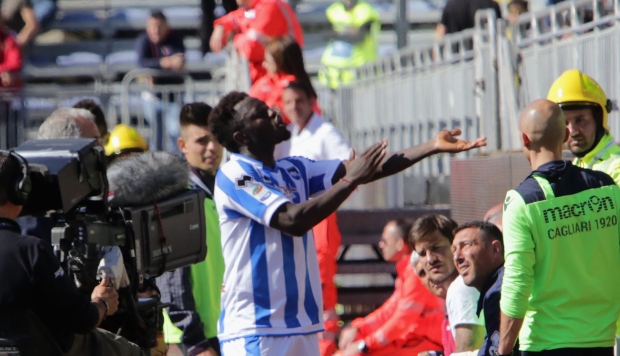
He knows how the game is played in Italy, he knows the corrosive power of fans called “ultras” and their penchant for racist abuse. But in early May he snapped. He had appealed to the referee to do something about the unrelenting chants. The referee did nothing. So Muntari left the game.

Sulley Muntari — Italian soccer player

Sulley Muntari of Pescara remonstrates with football fans during a Serie A match April 30 in Cagliari, Italy. (Enrico Locci/Getty)

For this, the Italian soccer federation suspended him for a further game. It said the abuse was minor, coming from a minority of just 10 or 15 fans.

Meanwhile, in the mountains of the south, the town council of Sant’Alessio rents out eight apartments which house 35 migrants — an Iraqi Kurdish family, and people from Nigeria, Mali and Senegal.

The town gets up to 45 euros ($70 Cdn) a day for each migrant from the national government to house, feed and help train them. There are vocational classes and legal and medical aid.

The mission began as humanitarian aid, Mayor Stephano Calabro said. “But there are significant economic benefits, too.”

The subsidies are helping to keep the town’s dying shops and services alive.

Most migrants aren’t so lucky. Over the years, people on the southern island of Lampedusa have worked heroically to rescue and welcome thousands of new arrivals who risked their lives in the sea crossing.

But now at least 170,000 migrants languish in makeshift government camps, waiting for months, even years, while their asylum requests work their way through the slow, tortuous, complicated bureaucratic process.

Source: Italy’s casual racism is out of place in town where migrants are helping economy – World – CBC News

Italy’s ‘Cultural Allowance’ For Teens Aims To Educate, Counter Extremism : NPR

Interesting approach.

One of the best initiatives of the Institute for Canadian Citizenship gives every new Canadian a one-year pass that provides free access to over 1,000 cultural and historical sites.:

Few things inspire more loathing in the hearts of high school students than the words “extra homework.” But as Florence Mattei hands out a pamphlet to her homeroom class at the Southlands School in Rome, she tells them they may want to give this assignment a chance.

“Who would like to read what it’s about?” she asks the room full of 18-year-olds.

A senior named Alessio translates from Italian into English: “For the people born in 1998 there is a 500-euro bonus that you can spend on cultural things, such as going to the cinema, visiting museums and this kind of stuff.”

He stares at the page in disbelief. But it’s true. Starting this month, Italy is offering its 18-year-old residents the equivalent of $563 to spend on culture, from concert tickets, books and museum admission to other qualifying events.

To get the money, they need to register online and download an app.

“Do we want to try?” says the teacher. “Yeah? So get your phone.”

Youth unemployment in Italy is nearly 40 percent in a country that’s been struggling economically for years. So the free cash is a welcome surprise for teens like Daniele Montagna, who knows where he is going to spend his first.

“On the concert of JB — Justin Bieber!” he rejoices.

And he can. The program doesn’t distinguish between pop culture and highbrow culture.

The Italian government is hoping the program will educate kids born in Italy as well as integrate a growing population of foreign residents, dissuading alienated youths from following radical Islam.

Prime Minister Matteo Renzi first announced the so-called Culture Bonus last November after the Paris massacre, when Islamist terrorists killed 130 people inside a theater and outside on the streets.

“They destroy statues, we protect them,” he said in a speech at the time. “They burn books, we’re the country of libraries; they envision terror, we respond with culture.”

But some question whether exposing young Muslims to, say, Lady Gaga will really endear them to Western culture.

“There is a chance that Lady Gaga is exactly what’s going to make somebody angry,” says Barak Mendelsohn, a senior fellow at the Foreign Policy Research Institute in Philadelphia and an expert in combating extremism. “That doesn’t mean that they buy into your values. We’ve seen radicals trying to take advantage of the welfare state, funding themselves while building bombs.”

He points to the Paris attackers. French authorities estimate they collected more than 50,000 euros in unemployment benefits — even while at least one of them had a job.

“They don’t have any ideological obstacle in taking money from Western countries,” Mendelsohn adds.

Source: Italy’s ‘Cultural Allowance’ For Teens Aims To Educate, Counter Extremism : Parallels : NPR

Where’s the Outrage Over Nun Beachwear? – The Daily Beast

Indeed:

Go to any public beach in Italy and chances are you’ll eventually see a woman wearing a veil and long skirt. But she likely won’t be a Muslim in a version of the controversial burqini. She will almost certainly be a Catholic nun in her summer habit either watching children in her care or, God forbid, just enjoying some sun, which is considered a human right here in Italy, where the sea defines the majority of the borders.  

No one in Italy would dare blink an eye at the sight of a habit-wearing sister at the seaside or even in the water

“We have nuns on the beach all the time,” Marco Beoni, a barista at a coffee bar along the sea near Sabaudia, about an hour south of Rome, told The Daily Beast. “They go in the water in their skirts and sit on blankets just like everyone else. Who cares what they are wearing. What’s the problem?” 

 In fact, most Italians are at odds with edicts at several French beach resorts banning women wearing the burqini (also spelled burkini), as the modest full coverage swimwear is called. Even Socialist Prime Minister Manuel Valls has waded into the debate in Paris, declaring the wearing of the burqini is “not compatible with the values of France and the Republic.”

Italy’s interior minister, Angelino Alfano, himself no great fan of immigration or integration of non-Italians into the country, said he thought France was making a mistake by banning the burqini. “We aim to avoid certain prohibitions that can be interpreted as provocations that could trigger retaliation towards Italy,” he said when asked if Italy would follow France in banning what has been interpreted as religious wear on the beach. “After all, the ‘French model’ of integration has not yielded great results.”

It should be no surprise at all that the Catholic Church, for its part, doesn’t see any problem whatsoever with modest swimwear. The head of the Italian bishops, Monsignor Nunzio Galantino said that caution is understandable, but only when tempered with common sense. 

“It’s hard to imagine that a woman [in a burqini] who enters the water is there to carry out an attack,” he told the daily Corriere della Sera in a far-reaching interview on the topic. “I can only think of our nuns, and I think of our peasant grandmothers who still wear head coverings.” 

Making an analogy with the wearing of a cross or a kippah, Galantino said, “The freedom to be granted to religious symbols should be considered on a par with the freedom to express one’s beliefs and to follow them in public life. And, let me tell you: I find it ironic that we are alarmed that a woman is overdressed while swimming in the sea!”

Will Italy finally bring its #citizenship laws into the 21st century?

Not an easy political debate to have in the current mass migrant context:

Fred Kuwornu, an Italian-Ghanaian director, has been waiting for years for this moment. In 2011, he made a documentary called 18 IUS SOLI. Screened at film festivals across the world, including Venice, it called for Italian citizenship to be made available to people born in Italy to foreign parents.

Now it’s more than cinema; the Italian Senate is debating this very possibility.

That’s if politics and the migrant crisis don’t get in the way.

<p>Hundreds of thousands of people born in Italy to non-Italian parents could soon be eligible for citizenship if changes to the country's nationality laws are passed.</p>
Hundreds of thousands of people born in Italy to non-Italian parents could soon be eligible for citizenship if changes to the country’s nationality laws are passed.(www.ilprimatonazionale.it)

“The issue is very complex. I believe that today it is not possible to be just a citizen of the country your parents are from or where you were born,” Kuwornu tells Equal Times.

Currently, Italian citizenship is largely based on jus sanguinis which relates to having Italian ancestry.

According to the current law, No.91 of 1992, children born in Italy to non-Italian parents must apply for Italian nationality between their 18th and 19th birthdays. They can only apply if they have lived in Italy continuously for their whole life. Even in a country notorious for its lengthy bureaucratic practices, the process is particularly long and complicated.

The new ‘tempered’ law would base citizenship on the principle of jus soli (or the right to citizenship based on one’s place of birth) or on cultural participation (at least five years of education after the age of 12 in Italy) – jus culturae.

In accordance with jus soli, children born in Italy to non-EU citizens (one of whom has to have a resident’s permit) will be eligible for Italian citizenship.

A November 2015 report from the Ministry of Public Education revealed that there are more than 805,000 young people of school age born in Italy to foreign parents, although it is not clear whether all of these students would be eligible for citizenship under the new rules.

“The tempered jus soli seemed to be the best compromise. I do, however, hope that this law will be approved quickly,” says Kuwornu, whose documentary promoted legislative change through community screenings, discussions and cultural initiatives.

It may yet be some time before the law is passed, however. The Chamber of Deputies approved it on 13 October 2015 with 310 votes in favour, 66 votes against and 83 abstentions, but it still awaits a vote in the Senate, where lawmakers held a hearing on the subject on 30 March 2016.

Anti-immigrant sentiment

What complicates the process are elections – for the mayor of Rome on 5 June and other administrative balloting – amidst a certain amount of hostility towards the new law.

Against the backdrop of the migrant crisis, populist politicians across Europe have helped to stir anti-immigrant sentiment. In Italy, the Lega Nord (Northern League) has drawn thousands of protesters in their demonstrations against immigration.

Supporters fear that failure to passed the jus soli law now could add years of second-class citizenship for many second-generation immigrant youth.

The new law has also been criticised by pro-immigration groups that see it as less-inclusive compared to the ambitious 2011 campaign ‘I’m Italy too’ (L’ Italia sono Anch’ io), supported by many Italian associations.

Source: Will Italy finally bring its citizenship laws into the 21st century? – Equal Times

‘Submission’ to Islam: Critics Slam Cover-Up of Rome’s Nude Statues for Iran’s President

The challenges in finding a balance in protocol.

Personally, while serving halal food is one thing, a more balanced approach would be to pick another venue without the statues and make wine optional rather than automatically served.

And Iranians sometimes show more flexibility than expected. While working in Tehran in the late 80s, I was sometimes offered food and tea during Ramadan given that the obligation to fast did not apply to me as a non-Muslim:

Italian opposition politicians have lashed out at a decision to cover up classical statues ahead of a visit by Iranian President Hasan Rouhani to a world-famous Roman museum, for fear of offending his Muslim sensibilities.

Nude statues among the historical collections at the Capitoline Museums were hidden behind large white panels when Rouhani visited on Monday for a meeting with Prime Minister Matteo] Renzi. The museum said the prime minister’s office requested the cover-up.

Italian media also reported that no wine was served during an official dinner for Rouhani.

“The level of cultural subordination of Renzi and the left has exceeded all limits of decency,” declared right-wing politician Giorgia Meloni, who served as Youth Minister in a previous Silvio Berlusconi cabinet.

Writing on her Facebook account, she wondered what Italy could expect next – the covering of St. Peter’s Basilica “with a huge box” when the emir of Qatar visits next week?

Rouhani’s European tour, his first since the lifting of sanctions under the nuclear deal, promises to open up billions of dollars in business deals, including a major order for Airbus aircraft. At a ceremony held in the Capitoline Museums on Monday, Rouhani and Renzi oversaw the signing of contracts worth up to $18.3 billion.

“Renzi was clearly keen to avoid offending his new business partner,” the Italian news site The Local commented of the statue cover-up.

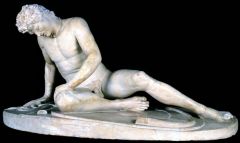
The Dying Gaul, one of the historical statues at Rome’s Capitoline Museums. (Photo: Musei Capitoli)

A lawmaker in Berlusconi’s Forza Italia party, Luca Squeri, described the concealing of the historical statues as “a sign of excessive zeal.”

“Respect for other cultures cannot and must not equal the negation of ours. This is not respect, it is the cancellation of differences or, worse still, submission,” the ANSA news agency quoted him as saying.

Source: ‘Submission’ to Islam: Critics Slam Cover-Up of Rome’s Nude Statues for Iran’s President

Italy creating ‘Italian Islam’ by making new religion in line with ‘Christian tradition’

While the focus on integration is welcome, it appears to be one-way with the obligations only on Italian Muslims and not also on the ‘mainstream’ in facilitating integration, or a more inter-faith or multi-group approach:

Italy is setting up a council of “Italian Islam” that claims to be bringing the religion into compliance with the country’s “Christian and humanist tradition”.

The reason for the controversial creation was not made clear in a statement by interior minister Angelino Alfano, although he did say provinces “concerned with immigration” would be involved.

Announcing the move on Tuesday, he said the Council of Relations with Italian Islam would be an advisory body aiming at furthering integration.

“The Council will be responsible for providing opinions and making proposals on issues concerning the integration of people of Islamic culture and religion in Italy,” Mr Alfano said.

“Respect and co-operation between cultural and religious identities in Italy must constitute the basis for a dialogue that enriches democracy, promoting the aims of peace, social cohesion and unity, and that fosters a community of those who…intend to contribute to the peaceful development and prosperity of our country, in full compliance with our laws and our Christian and humanist tradition.”

The Interior Ministry said Islamic leaders, experts and professors would be working towards “the formation of an Italian Islam”.

Source: Italy creating ‘Italian Islam’ by making new religion in line with ‘Christian tradition’ | Europe | News | The Independent

A Torontonians journey to the heart of Italian politics

Interesting example of dual loyalties: being in a foreign parliament representing expatriates:

“It’s a highly precarious political situation,” she [Francesca La Marca] says. “There’s always drama and controversy – but that’s Italy for you.”

Ms. La Marca grew up in west-end Toronto admiring Bob Rae and Jack Layton, but she was immersed in Italy’s dramatics from her earliest years. Her Sicilian-born father was active in Italy’s Socialist Party, and together they followed the latest developments from a fractured country that is perpetually critical of its political status quo.“

Like many Italian-Canadians, he had a strong sense of nostalgia,” she says. “He wanted to see Italy more just and more efficient.”

The dual citizen found the same desire welling in her as a worldly Toronto teenager in the 1990s when she watched her Sicilian contemporaries marching in the streets to protest the murder of crusading judges by the all-powerful Mafiosi – a transformative moment that prompted many Italians in her generation to enter politics and seek a culture shift, including the 39-year-old Prime Minister Renzi.

That level of political engagement, she says, marks a key difference from Canada.

“You look at Italian TV shows, you can’t get away from the constant debates. Politicians are there talking about issues and members of the public are putting them on the hot seat, and asking them very direct questions.

“I think it comes down to a different history and culture Italians are always on the streets conversing and arguing. They realize they have to fight to get somewhere, while we’re a more sheltered country that’s made up of different cultures, so we’re focused on getting along and getting things done.”

No matter how Italian she might feel in the more reticent parts of Toronto, her strong sense of Canadianness takes over in the unrepressed Italian system.

“There has to be a way to work effectively without all this excess,” she says. “Many people have this impression that Italy is very laid back and nothing gets done. Instead, it’s quite the opposite – really long hours, lots of meetings, and it’s not uncommon to finish at 10 or 11 at night. The stereotype of Italians being big talkers, meaning everything drags on and on, is absolutely true.”

She hopes to bring some Canadian efficiency to the competitive Italian political style by focusing on issues specific to the expatriate voters who elected her last year: She helps people obtain dual citizenship, get better access to health care when they return to Italy for extended periods, and source funding for teaching Italian language and culture in North America.

A Torontonians journey to the heart of Italian politics – The Globe and Mail.