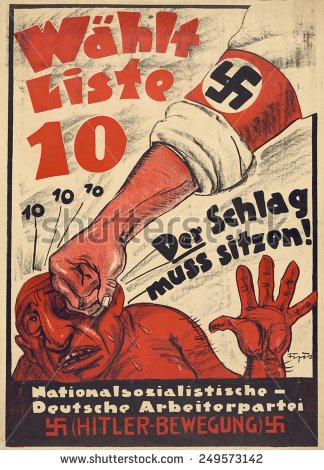
Indeed. Reminder of messaging and posters under the Nazis regarding Jews:
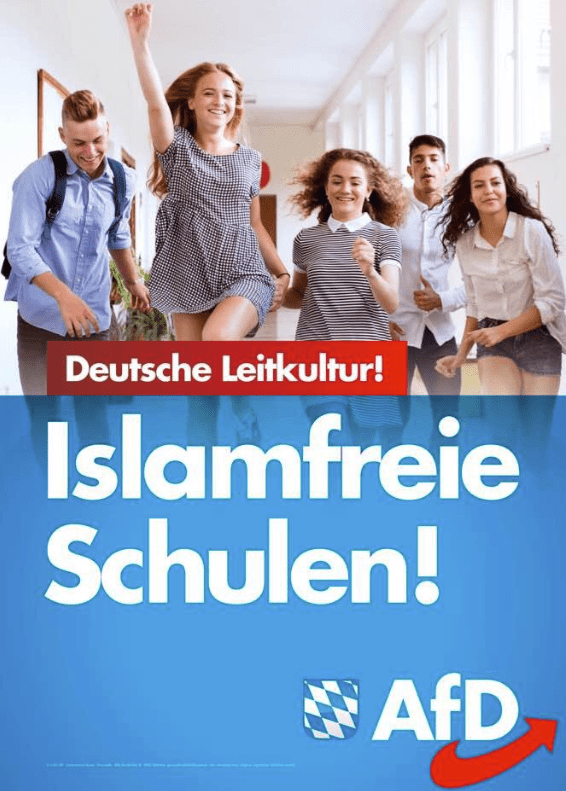
The far-right Alternative for Germany party released a new campaign poster last week with a slogan promising “Islam-free schools” beneath a photo of smiling white schoolchildren.
Alternative for Germany, also known as AfD, released the posters in the midst of its election campaign in the southern German state of Bavaria. Recent polls show the party is on track to win the third-largest share of the vote as it saps votes from the traditional conservative party aligned with German Chancellor Angela Merkel.
But as AfD rallies voters ahead of Bavaria’s elections next month, the party is under intense public and political scrutiny for its links to neo-Nazi organizationsand role in encouraging far-right riots in recent weeks.
AfD’s Bavarian anti-Islam posters have added to the backlash against the party. A German teachers’ associations called the posters dangerous, and an Austrian member of the European Parliament accused the party of promoting fascist rhetoric and racially segregated schools. A British hate crime monitoring group also denounced the poster, tweeting, “Welcome to the new face of fascism.”
AFD
Alternative for Germany’s new poster, vowing “Islam-free schools!” and promoting “dominant German culture.”
AfD claims that the posters are not calling for barring Muslim children from schools, Germany’s Der Spiegel reports, but are opposed to Islamic education in schools and face veils. But some Germans on social media criticized the posters for echoing Nazi-era discrimination against Jewish students, HuffPost Germany reported.
The party has a history of anti-Islamic propaganda, and during last year’s national elections it worked with a conservative American ad agency to create a controversial series of posters, including one reading “Burkas? We prefer bikinis” and another with a photo of a pregnant white woman with the tagline “New Germans? We’ll make them ourselves.”
Although AfD is often careful to distance itself from more politically toxic extremist groups and violent rhetoric, it has repeatedly provoked scandals after its officials made statements downplaying the Holocaust or siding with far-right activists. After anti-migrant riots erupted after the killing of a German man in the city of Chenmitz two weeks ago, a prominent AfD official marched with the founder of anti-Islamic extremist group PEGIDA in a demonstration against migration.
While AfD is still shut out of governing in Germany, its success has caused traditional right politicians to swing farther right in hopes of winning back voters, especially prevalent in Bavaria, where the Merkel-allied Christian Social Union is losing support and increasingly embracing anti-immigration, anti-Islamic views.
CSU leader Horst Seehofer nearly brought down the German government this year after demanding tighter border controls, and more recently he called immigration the “mother of all political problems” and said he would have joinedfar-right anti-migrant protests were he not an elected official. Bavaria’s CSU premier ordered that crucifixes be hung in all government buildings, and the party last year drafted a law banning full-face veils in public places.
Much like in several other countries where establishment parties mimic the far right, most recently Sweden, the CSU’s shift hasn’t worked, and the party is expected to lose its absolute majority government in a state where it once dominated.
Ongoing French struggles with integration approaches. While there are obviously serious problems of Islamist extremism, France also needs to deal with failures of economic integration and ongoing discrimination:
French President Emmanuel Macron will review a new report that lays out proposals to reform Muslim society in France and create a “French Islam.”
The report’s author, Hakim El Karoui, who is the nephew of former Tunisian Prime Minister Hamed Karoui, has called for “a system with men, money and financing to combat [radicalization],” Politico reported. He proposes funding this regulatory system by taxing halal foods, while also restricting religious financing from abroad.
“There are activists on one side and nobody across to say something else. [The Islamists] have an influence that goes well beyond their number of followers,” El Karoui told Europe 1 Radio on Monday.
Speaking to BFM TV, the report’s author also warned that young French Muslims often learned about Islam via social media, where extremists often had a strong presence. He further raised concerns about preachers and mosques funded by religiously conservative foreign nations, such as Saudi Arabia.
In France, many politicians and analysts have long drawn attention to the “parallel society” arising within the country’s Muslim population. At the same time, France’s strict laws separating religion from the state prevent the government from interfering directly to oversee what is presented in mosques. Some politicians, such as far-right leader Marine Le Pen, have capitalized on a wave of terror attacks and anti-Semitic murders to urge the government to police mosques and crack down on extremist clerics.
A public call was made by several leading political figures in April to strike verses in Islam’s holy book, the Koran, that call for punishing and killing Jews, Christians and nonbelievers, The Atlantic reported. While the manifesto did not specifically say the verses should be removed from the text, many Muslims saw the open letter as an attempt to alter their sacred text, which led to significant backlash.
El Karoui also emphasized this week that only a small fraction of France’s Muslim population turned to extremism.
“There are many Muslims who are going to eat halal, women who are going to be veiled, but who are not Islamists in the sense that they do not think that the ideological political project of the Islamists is better or more important than that of the Republic,” he said, according to France 24.
Earlier this year, Macron indicated a plan to address the tensions arising in the country and to create an “Islam of France.” French Muslim leaders had also called for reforms, but efforts made by previous governments had proved unsuccessful. Under the leadership of former President Nicolas Sarkozy, France tried to create a central Islamic religious authority recognized by the state, as was done with France’s Jewish population during the time of Napoleon Bonaparte, according to Politico. But the representative council failed to maintain popular support, primarily because of significant differences among Muslims hailing from many different countries.
It remains to be seen whether or not the new report will lead to government action. Some politicians have already criticized the proposals.
Bruno Retailleau, a senator for the right-leaning Les Républicains party said that creating “an Islam of France” would “not protect the French from radical Islam,” Politico reported. He also argued that it could weaken the devoutly secular nation’s “republican pact.”
The fact that Thilo Sarrazin doesn’t have a high opinion of Arabs and Turks is no secret ever since his bestseller Deutschland schafft sich ab (Germany Abolishes Itself) was published in 2010. At the time, the book’s controversial theses on integration and immigration had sparked a heated debate in Germany.
In the book, the former Berlin senator of finance and former member of the executive board of the Bundesbank claimed that Muslim immigrants had educational deficits and refused to integrate. While Sarrazin already explained why he perceived Muslims as a threat to Western societies in his previous book, he did not deal explicitly with the religion of Islam.
He now tackles the religion more directly in his new book, Feindliche Übernahmen (Hostile Takeover; no English version available).
His initial question — to determine if Islam plays a role in the violent acts of Muslims — is understandable considering the world’s current events. Trying to find out if the religion itself has anything to do with the lower level of education, the lower rate of innovation and the weak economic development of certain parts of the Islamic world are also legitimate discussion points, which are also being debated by many Muslims.
However, the author’s claim that his book provides a sober and impartial study of Islam quickly proves to be an empty assertion.
Absurd presumptions
He explores Islam through the Quran, which he claims to have read in its entirety. Even though this approach sounds correct, his claim to be able to determine the core statements of Islam by reading the Quran without any knowledge of Arabic or theological background is an absurd presumption. Sarrazin openly admits that his analysis “exclusively” follows his own “direct understanding of the text,” as if the Quran were really to be understood without taking into account the context of its origin and the history of its reception.
He ignores everything that doesn’t fit into his own interpretation. He does not discuss the ambiguity of the text nor its poetic dimension. Instead of looking at the Quran as a whole, he takes individual excerpts out of context and reorganizes them under selected themes.
The “religious content” of the Quran is “very simple, the guidelines for the faithful are therefore very clear,” writes Sarrazin. His conclusion: The Muslims’ holy book is obsessive about questions related to sexuality, and it is full of hatred for unbelievers and calls for violence.
“If you take it literally, it leaves little room for misunderstanding,” writes Sarrazin about the Quran. His reading does not see a separation of politics and religion in Islam as possible. “The more literally one takes the Quran, the clearer it appears that the world’s governance can only find its legitimacy through God,” he writes. Like many other Islam critics, Sarrazin picks up one of the Islamists’ core arguments; he presents their interpretation of the Quran not only as a conclusive view, but also as the exclusive one.
A distorted picture based on prejudice
Sarrazin also ignores the fact that the political ideology of Islamism is a product of modernity and that its interpretation is rejected by a great majority of Muslims. He does not say a word about the moderate versions of mystical Islam prevailing in most Muslim countries.
It may appear contradictory that he should adopt the radical reading of the Islamists as the “true” version of Islam, but that is necessary to support Sarrazin’s concept, in which he condemns Islam in its entirety as an “ideology of violence in the guise of a religion.”
His portrayal of Islam is a caricature that has more to do with his own prejudiced views than with the beliefs guiding the lives of the majority of Muslims.
Beyond his study of the Quran, he tries to provide an appearance of objectivity though quotes, numbers and statistics, but the book’s goal remains clear: to confirm his preconceived ideas. His description of the history of Islamic culture as an 800-year-long decline reveals his downright malicious urge to deny Muslims anything positive.
Pitiful bigotry
Anyone who has ever been to Istanbul, Granada or Cairo can only be astonished to read Sarrazin’s declaration that “an independent Islamic building culture never developed.” Anyone who knows Iran’s impressive Naqsh-e Jahan Square in Isfahan, a UNESCO World Heritage Site, can hardly agree with his statement that Muslims do not know anything “about urban planning with axes and public spaces.”
He also reveals an almost astounding ignorance when he claims that Muslims, “apart from a few fairy tales,” have never developed their own literature — as if poets such as Hafis, Saadi or Mevlana had never existed.
Revealing the full force of his deeply Eurocentric perspective, he cites the lack of symphonic orchestras as evidence of the cultural backwardness of the Islamic world. He apparently cannot imagine that there are other concepts of culture and beauty than the ones developed in Europe. Instead of appreciating the richness, complexity and elegance of the ornaments on carpets, tiles and facades created in Muslim countries, he only sees the absence of portraits and sculptures. You can almost feel pity for Sarrazin for such narrow-mindedness.
No interest in finding solutions
Throughout the book, it is clear that he only takes into account anything that fits into his preconceived world view. He avoids mentioning that the credibility of the statistics he uses has been questioned — that would ruin his narrative. Beyond all the figures on birth rates, levels of education and economic performance, it’s his basic thesis that appears the most questionable, in which he claims that all the Muslims’ social and economic problems can be blamed on their religion — or as the second part of his book’s title states: “How Islam Impedes Progress and Threatens Society.”
Hardly a Muslim bases his actions primarily or even exclusively on Islam. But even if Islam were the cause of all problems, what would be the solution? That all Muslims give up their culture and their faith? That’s not likely.
Sarrazin does not present a solution to this dilemma, as he is not even interested in finding solutions. His whole book shows that he is not concerned with helping shape peaceful coexistence, but rather with the strict separation of peoples and stopping the immigration of Muslims.
Ulrich von Schwerin works as a freelance correspondent for various media in Istanbul. In addition to Turkey, he also focuses on Iran. His political science PhD dissertation was about Iranian cleric and dissident Ayatollah Montazeri.
Green-domed mosques still dominate the skyline of China’s “Little Mecca”, but they have undergone a profound change – no longer do boys flit through their stone courtyards en route to classes and prayers.
In what locals said they fear is a deliberate move to eradicate Islam, the atheist ruling Communist Party has banned children under 16 from religious activity or study in Linxia, a deeply Islamic region in western China’s Gansu province that had offered a haven of comparative religious freedom for the ethnic Hui Muslims there.
China governs Xinjiang, another majority Muslim region in its far west, with an iron fist to weed out what it calls “religious extremism” and “separatism” in the wake of deadly unrest, throwing ethnic Uygurs into shadowy re-education camps without due process for minor infractions such as owning a Koran or even growing a beard.
Now, Hui Muslims fear similar surveillance and repression.
“The winds have shifted” in the past year, said a senior imam who requested anonymity. “Frankly, I’m very afraid they’re going to implement the Xinjiang model here.”
Local authorities have severely curtailed the number of people over 16 officially allowed to study in each mosque and limited certification processes for new imams.
They have also instructed mosques to display national flags and stop sounding the call to prayer to reduce “noise pollution” – with loudspeakers removed entirely from all 355 mosques in a neighbouring county.
“They want to secularise Muslims, to cut off Islam at the roots,” the imam said, shaking with barely restrained emotion. “These days, children are not allowed to believe in religion: only in communism and the party.”
More than 1,000 boys used to attend his mid-sized mosque to study Koranic basics during summer and winter school holidays but now they are banned from even entering the premises.
His classrooms are still full of huge Arabic books from Saudi Arabia, browned with age and bound in heavy leather. But only 20 officially registered pupils over the age of 16 are now allowed to use them.
Parents were told the ban on extracurricular Koranic study was for their children’s own good, so they could rest and focus on secular coursework. But most are utterly panicked.
“We’re scared, very scared. If it goes on like this, after a generation or two, our traditions will be gone,” said Ma Lan, a 45-year-old caretaker, tears dripping quietly into her uneaten bowl of beef noodle soup.
Inspectors checked her local mosque every few days during the last school holiday to ensure none of the 70 or so village boys were present.
Their imam initially tried holding lessons in secret before sunrise but soon gave up, fearing repercussions.
Instead of studying five hours a day at the mosque, her 10-year-old son stayed home watching television. She said he dreamed of being an imam, but his schoolteachers had encouraged him to make money and become a communist cadre.
The Hui number nearly 10 million, half the country’s Muslim population, according to 2012 government statistics.
In Linxia, they have historically been well integrated with the ethnic Han majority, able to openly express their devotion and centre their lives around their faith.
Women in headscarves dish out boiled lamb in mirror-panelled halal eateries while streams of white-hatted men meander into mosques for afternoon prayers, passing shops hawking rugs, incense and “eight treasure tea”, a local speciality including dates and dried chrysanthemum buds.
But in January, local officials signed a decree pledging to ensure that no individual or organisation would “support, permit, organise or guide minors towards entering mosques for Koranic study or religious activities”, or push them towards religious beliefs.
“I cannot act contrary to my beliefs. Islam requires education from cradle to grave. As soon as children are able to speak we should begin to teach them our truths,” he said.
“It feels like we are slowly moving back towards the repression of the Cultural Revolution,” he said, referring to a nationwide purge from 1966 until 1976 when local mosques were dismantled or turned into donkey sheds.
Other imams complained authorities were issuing fewer certificates required to practise or teach and now only to graduates of state-sanctioned institutions.
“For now, there are enough of us, but I fear for the future. Even if there are still students, there won’t be anyone of quality to teach them,” one imam said.
Local authorities failed to answer repeated calls seeking comment but Linxia’s youth ban comes as China rolls out its newly revised Religious Affairs Regulations.
The rules have intensified punishments for unsanctioned religious activities across all faiths and regions.
Beijing was targeting minors “as a way to ensure that faith traditions die out while also maintaining the government’s control over ideological affairs”, said William Nee, a China researcher at Amnesty International.
Another imam said the tense situation in Xinjiang was at the root of changes in Linxia.
The government believed that “religious piety fosters fanaticism, which spawns extremism, which leads to terrorist acts – so they want to secularise us”, he said.
But many Hui are quick to distinguish themselves from Uygurs.
“They believe in Islam too, but they’re violent and bloodthirsty. We’re nothing like that,” said Muslim hairdresser Ma Jiancai, 40, drawing on common stereotypes.
Sitting under the elegant eaves of a Sufi shrine complex, a young scholar from Xinjiang said his family had sent him alone aged five to Linxia to study the Koran with a freedom not possible in his hometown.
“Things are very different here,” he said with knitted brows. “I hope to stay.”
Lurking in the background of a Saudi-Moroccan spat over World Cup hosting rights and the Gulf crisis is a more fundamental competition for the mantle of spearheading promotion of a moderate interpretation of Islam.
It’s a competition in which history and long-standing religious diplomacy gives Morocco a leg up compared to Saudi Arabia, long a citadel of Sunni Muslim intolerance and ultra-conservatism.
Saudi Arabia is the new, baggage-laden kid on the block with Crown Prince Mohammed bin Salman asserting that he is returning the kingdom to a top-down, undefined form of moderate Islam.
To be sure, Prince Mohammed has dominated headlines in the last year with long-overdue social reforms such as lifting the ban on women’s driving and loosening restrictions on cultural expression and entertainment.
Yet, Prince Mohammed has also signalled the limits of his definition of moderate Islam. His recurrent rollbacks have often been in response to ultra-conservative protests not just from the ranks of the kingdom’s religious establishment but also segments of the youth that constitute the mainstay of his popularity.
Just this week, Prince Mohammed sacked Ahmad al-Khatib, the head of entertainment authority he had established. The government gave no reason for Mr. Al-Khatib’s dismissal, but it followed online protests against a controversial Russian circus performance in Riyadh, which included women wearing “indecent clothes.”
The protests were prompted by a video on social media that featured a female performer in a tight pink costume.
In a similar vein, the Saudi sports authority closed a female fitness centre in Riyadh in April over a contentious promotional video that appeared to show a woman working out in leggings and a tank-top. A spokesman for the royal court, Saud al-Qahtani, said the closure was in line with the kingdom’s pursuit of “moderation without moral breakdown.”
Saudi sports czar Turki bin Abdel Muhsin Al-Asheikh said “the gym had its licence suspended over a deceitful video that circulated on social media promoting the gym disgracefully and breaching the kingdom’s code of conduct.”
To be sure, the United States, which repeatedly saw ultra-conservative Islam as a useful tool during the Cold War, was long supportive of Saudi propagation of Islamic puritanism that also sought to counter the post-1979 revolutionary Iranian zeal.
Nonetheless, Saudi Arabia’s more recent wrestle with what it defines as moderate and effort to rebrand itself contrasts starkly with long-standing perceptions of Morocco as an icon of more liberal interpretations of the faith.
Established three years ago, Morocco’s Mohammed VI Institute for Imam Training has so far graduated 447 imams; 212 Malians, 37 Tunisians, 100 Guineans, 75 Ivorians, and 23 Frenchmen.
The institute has signed training agreements with Belgium, Russia and Libya and is negotiating understandings with Senegal.
Critics worry that Morocco’s promotion of its specific version of Islam, which fundamentally differs from the one that was long prevalent in Saudi Arabia, still risks Morocco curbing rather than promoting religious diversity.
Albeit on a smaller scale than the Saudi campaign, Morocco has in recent years launched a mosque building program in West Africa as part of its soft power policy and effort to broaden its focus that was long centred on Europe rather than its own continent.
In doing so Morocco benefits from the fact that its religious ties to West Africa date back to the 11th century when the Berber Almoravid dynast converted the region to Islam. King Mohammed, who prides himself on being a descendant of the Prophet Mohammed, retains legitimacy as the region’s ‘Commander of the Faithful.’
West African Sufis continue to make annual pilgrimages to a religious complex in Fez that houses the grave of Sidi Ahmed Tijani, the 18thcentury founder of a Sufi order.
All of this is not to say that Morocco does not have an extremism problem of its own. Militants attacked multiple targets in Casablanca in 2003, killing 45 people. Another 17 died eight years later in an attack in Marrakech. Militants of Moroccan descent were prominent in a spate of incidents in Europe in recent years.
Critics caution however that Morocco is experiencing accelerated conservatism as a result of social and economic grievances as well as an education system that has yet to wholeheartedly embrace more liberal values.
“Extremism is gaining ground,” warned Mohamed Elboukili, an academic and human rights activist, pointing to an increasing number of young women who opt to cover their heads.
“You can say to me this scarf doesn’t mean anything. Yes, it doesn’t mean anything, but it’s isolating the girl from the boy. Now she’s wearing the scarf, but later on she’s not going to shake hands with the boy . . . Later on she’s not going to study in the same class with boys. Those are the mechanisms of an Islamist state, that’s how it works,” Mr. Elboukili said.
Mr. Elboukili’s observations notwithstanding, it is Morocco rather than Saudi Arabia that many look to for the promotion of forms of Islam that embrace tolerance and pluralism. Viewed from Riyadh, Morocco to boot has insisted on pursuing an independent course instead of bowing to Saudi dictates.
Morocco refused to support Saudi Arabia in its debilitating, one-year-old economic and diplomatic boycott of Qatar but recently broke off relations with Iran, accusing the Islamic republic of supporting Frente Polisario insurgents in the Western Sahara.
Moroccan rejection of Saudi tutelage poses a potential problem for a man like Prince Mohammed, whose country is the custodian of Islam’s two holiest cities and who has been ruthless in attempting to impose his will on the Middle East and North Africa and position the kingdom as the region’s undisputed leader.
Yet, Saudi Arabia’s ability to compete for the mantle of moderate Islam is likely to be determined in the kingdom itself rather than on a regional stage. And that will take far more change than Prince Mohammed has been willing to entertain until now.
Inside Berkeley’s Qal’bu Maryam, Tuli Bennett-Bose was preparing for jummah, the Friday prayer service. At 18, Bennett-Bose was a recent convert to Islam, and still working out the intricacies of dress and ritual that come with being an observant Muslim. “I’m a half-jabi,” she joked as she rewrapped her rust-colored hijab to frame her face. Sometimes she prefers to let her head covering reveal some of her silver pixie cut. On this afternoon, she was covering all of her hair because of the service, and also because it was raining.
Qal’bu Maryam — Arabic for “Maryam’s heart” — opened in Berkeley in April 2017. The mosque represents a stark departure from orthodox Muslim tradition, welcoming LGBTQ congregants, allowing women to lead prayers and deliver sermons (called khutbahs), and encouraging all genders to pray shoulder to shoulder. Bennett-Bose stumbled upon the congregation online and was drawn to its inclusivity. “I know that I was meant to be Muslim,” she says. “But I also knew that I was gay before I converted.” Although many mainstream strains of Islam shun homosexuality, Bennett-Bose took the shahada, the Muslim declaration of faith. Soon after, she visited Qal’bu Maryam.
Neither Qal’bu Maryam nor its founder, Rabia Keeble, who converted to Islam 15 years ago, have been universally welcomed within the East Bay’s Muslim community. Some faith leaders criticize the congregation for its deviation from traditions that have been in place for millennia. Abdullah Ali, an assistant professor at nearby Zaytuna College, the first accredited Muslim undergraduate university in the country, has little love for Keeble’s “particular project.” Men and women praying side by side “is definitely not the instruction given by our prophet,” he says, referring to the hadith, or the sayings of Prophet Muhammad. “The instruction was very clear, and we know what prayer looked like at this time: Women pray behind men.”
More important, Ali says, Qal’bu Maryam was founded with the explicit intention of being “provocative” and, in particular, of antagonizing people who are committed to traditional Islamic teachings. “They want to challenge what they consider to be orthodoxy,” he says.
On that point, he won’t get much argument from Keeble. An Ohio-raised woman (she declines to share her age), Keeble came to the faith in 2003 and lives by a “no tolerance for bullshit” policy, doling out grand, confrontational statements that often rankle whomever she’s debating. “What I did started a conversation,” she tells me of Qal’bu Maryam’s founding. “Men and women need to learn together. This will end misogyny within the religious sphere.”
Keeble is a self-proclaimed “third-wave black feminist and womanist” whose daily getup includes hijab, eyeliner, and bright lipstick. Central to her mission is to reconcile Islam with contemporary feminism; it’s on this point that she encounters the most resistance. Both she and Ali believe the two worldviews can and do coexist. How they achieve it, however, is very much a point of contention.
Feminist Islam is not a new concept. While Europe suffered through the Dark Ages, women in Arabia benefited from inheritance, consent as a requirement for marriage, and education. Muslims frequently cite the Prophet’s wife, Khadija, an independent businesswoman, as evidence of the faith’s feminist principles in action.
“Feminists are not anti-Islam. We want the fulfillment of what the Prophet, peace be upon him, started before his death,” Keeble says. Ali agrees that Islam can be consistent with feminist ideology, but he points to liberation feminism, which “accepts that men and women are fundamentally different and that men have often belittled the importance of women.” “Equality feminism” of the type practiced by “people like Rabia Keeble” is not compatible with Islam, he says. “Equality feminism is focused on attempting to equalize the degree of influence and level of authority between men and women to the extent that we completely ignore biological differences.”
For Ali, the hadith was never to be taken as a sign of women’s inferiority, “just as leading the prayer was never taken as a sign of political power.” Instead, he says, the practice is rooted in principle: “The Prophet told the people, ‘Pray as you see me pray.’ And we know that the norm is that he was always leading prayer during his lifetime.” For that reason and others — for instance, the fact that Keeble thinks women can pray while on their periods, a practice considered taboo by Ali and others—he looks upon Qal’bu Maryam as a prayer space, not a mosque. It lacks the sanctity, he says, that a mosque deserves.
It’s exactly that inequality, in Keeble’s eyes, that has hurt Muslim women and caused them to have shallower relationships with their faith. Because of male dominance in mosques, “it is very difficult for women to approach the imam after sermons to ask questions,” she explains.
Fighting for her congregation has been draining for Keeble. Earlier this year, she took a month-long leave from the mosque to regroup; aside from dealing with “so-called volunteers who were all talk and no show,” she was “physically worn out” from handling outreach and logistics alone. She was also attending speaking engagements, creating and distributing weekly advertisements, and scheduling Friday speakers. During her period of reflection, she refocused on Qal’bu Maryam’s mission, paying particular attention to the sermons being delivered there. “I wanted to focus on the use of gendered language specifically. I have to ask myself, Is this language that honors women?”
Interesting and relevant historical and social context:
With attacks on Jews in Germany increasing, DW spoke with the renowned theologian Reuven Firestone, about the complex relations between Islam and Judaism, and how Muslims and Jews could be brought closer together.
Deutsche Welle: There are studies that claim that the religion of Islam is essentially against Judaism? Do you agree with this theological position?
Reuven Firestone: Islam emerged in an environment in which major religions already existed. The birth of a new religion is always seen as a critique of the old religions. Its very existence is a statement that says, “Well, the old religion is not good enough; otherwise why would God reveal a new scripture that corrects or nullifies what is currently practiced?” So the followers of established religions always resent the newcomer.
At the time of Islam’s birth in Arabia in the seventh century, all established religions resented it and attacked its prophet. The Quran records their criticisms and their attacks, and it replies with attacks of its own, criticizing Jews and Christians and believers of the local religions, whom it calls “mushrikun,” or “those who join” other deities with God — i.e., polytheists.
So, yes, the Quran does contain negative references to Jews, but not only about them. It talks negatively about other threatening communities (I should add that it also contains positive references to Jews and Christians, although not to polytheists). The important point is that the Quran and the early Muslims did not criticize Jews exclusively.
We must not forget that the same scenario played out with the emergence of Christianity. The Jews resented those who claimed that Jesus was the Messiah, and especially that he was God’s incarnation. And the New Testament criticizes Jews in response to attacks on the new community.
Similarly, the Hebrew Bible (Old Testament) slams the older religions that were clearly against the Israelites.
During the early phase of Islam, Muslims and Jews coexisted peacefully. When did the rifts begin to appear, and were the reasons more political than theological?
As I said, there were always tensions between Muslims and Jews over the authority of their respective faiths. It was both a political matter and a theological issue. When Islam became the dominant power, like all pre-modern and non-democratic powers, it privileged the people it identified as its own over all others. Therefore, while Jews (and Christians) were considered citizens of the Muslim world and protected by the law of the land (including religious law, the Sharia), they were given a second-class status that was defined by restrictions in position, prestige and freedom. How this actually worked out in history varied from time to time and place to place. In some situations, Jews were treated essentially as equals, but in others they were persecuted severely.
Explanations such as mine should be understood in a context. Keep in mind that minority communities were not treated equally under law or custom in pre-modern, non-democratic regimes. All historians agree that, on average, Jews suffered more under Christian rule than they did under Muslim rule.
The Prophet Muhammad’s time in exile in the city of Medina provides some great examples of Muslim-Jew coexistence, but at the same time violent conflicts marred their ties. How do you see that phase of Islam, and do the events in Medina, in which the Jewish tribe of Qurayza was said to have betrayed Muhammad, shape present day “Muslim anti-Semitism”?
The tensions, and the violent conflict that eventually broke out between Muhammad and the Jews of Medina, have become points of heavy stereotyping on both sides. A separation between the two communities has grown over the years. Jews were accused of betraying their equal religious and civil status in Medina by trying to aid an enemy intent on destroying Muhammad, and even of trying to assassinate him. As a result, the Jewish communities of Medina were forcibly exiled, and one Jewish community was massacred.
Many Jews and Christians point to this period as a prime example of what they consider the fundamentally violent behavioral norms exhibited by Muhammad that are established in Islam. Many Muslims point to this as a prime example of how Jews are, by nature, deceitful, corrupt and can never be trusted.
There are mixed accounts of those events, and we have no Jewish versions of the story. What is tragic about this is that an incident a millennium and a half ago has become a tool for some radicals in both communities to try to vilify and defame the other.
Although both Judaism and Islam are Abrahamic religions, why do they appear to be so far apart?
Actually, Judaism and Islam are essentially quite close in many ways. In fact, most religious scholars consider them closer to one another than either is to Christianity. The theology of divine unity in Judaism and Islam is understood in Christianity through the Trinitarian nature of God. Jews and Muslims agree that this is simply impossible to accept. Even the theological terminology between Judaism and Islam is quite similar. For example, iḥūd in Hebrew and tawḥīd in Arabic are linguistically related terms that refer to the same essential nature of the absolute unity of God.
What needs to be done to bridge the gulf between Muslims and Jews? What inspirations can be taken from the religious texts?
The tension between Muslims and Jews today cannot be resolved simply by taking inspiration from the sacred texts. Both Judaism and Islam are great and complex religious civilizations. The sacred texts have been read in a variety of ways by people through the ages. One can cite texts that inspire fear and hatred in both religious traditions, and one can cite texts that inspire appreciation and love.
The core of the conflict between Muslims and Jews is a willingness to be manipulated by fear. Fear allows people to draw false conclusions that would not otherwise be possible. All people, with very few exceptions, strive to do good and avoid evil. We must check our impulse to draw negative conclusions based on fear and rumor. Both the Bible and the Quran emphasize that one should not succumb to the fear brought about by evil, but one should only fear God.
Reuven Firestone is the Regenstein Professor in Medieval Judaism and Islam at the Hebrew Union College – Jewish Institute of Religion, which has campuses in Cincinnati, Ohio, New York, Los Angeles and Jerusalem. Firestone has written over one hundred scholarly chapters and articles and eight books, with translations into many languages. Having lived with his family in Israel, Egypt and Germany, he regularly lectures in universities and religious centers throughout the United States, Europe, the Middle East and Asia.
It was a warm June day in a northern German village, and I was talking to a Syrian friend outside a local shop. I had just bought some ice cream and offered to share it, but my friend refused. He was observing Ramadan: no food or drink until after sunset.
“If you had found asylum at the Arctic Circle instead of Germany,” I asked, “would you have starved by now?” It wasn’t an entirely academic question. In our village on Germany’s Baltic shore, the sun doesn’t set in summer until around 11 p.m.
My Syrian friend chuckled at the question about the Arctic Circle — where the summer sun never fully vanishes — but insisted: The law is the law; it’s what the Prophet Muhammad commands.
But wouldn’t the prophet be content if you observed, say, Damascus time? I wondered.
He chuckled again: No, this wouldn’t be what he had said.
The exchange left me with mixed feelings. I felt great respect for my friend’s willpower and the idea of Ramadan: to experience deprivation in order to stir empathy with the poor. What startled me, though, was his refusal to question religious commands and at least try to align them with reason without reducing their moral purpose.
This is an anodyne example, but it relates to a conundrum facing Germany as a country. To many non-Muslim Germans, the comparatively high significance that many Muslims attach to divine laws raises the question of to whom all the immigrants and refugees who have come to us in recent years would rather pledge allegiance and loyalty: the state that took them in, or Allah? Are the newcomers really convinced of the blessings of an open, liberal society, or are they just happy to seize its advantages?
The new German minister for the interior, Horst Seehofer, recently addressed this fear with a sentence that was meant as a reassurance to voters: “Islam does not belong to Germany.” With this Mr. Seehofer, who is also the chairman of the conservative Christian Social Union party, is rejecting an opposite claim made back in 2010 by Christian Wulff, then the president, and subsequently by Chancellor Angela Merkel. One of Mr. Seehofer’s party colleagues, Alexander Dobrindt, went even further: “Islam, no matter the form, does not belong to Germany.”
Their provocation is calculated to create a backlash against the naïveté and carelessness of those who have tried to make space for Islam as a part of German culture — a position conservatives think has been dominating public discourse for too long.
What a splendid idea: Counter leftist simplification with rightist crudeness! If there is one thing that doesn’t belong to a enlightened nation like Germany, it is a deliberate coarsening of a debate where a maximum of nuance is needed.
On the surface, of course, there’s an obvious tension between the largely secular, liberal traditions of German culture and those forms of Islam that, for example, place religious law over secular law. But that’s also a moot point: Muslims have been living here in large numbers since the 1960s, and now Germany’s six million Muslims make up roughly 6 percent of the population. The problem is that the way Germany has dealt with them is a history of mistakes.
The first mistake, the one conservatives made, was to believe that the early “guest workers” brought from Turkey in the 1960s, to make up for a labor shortage, would eventually go home again. The second mistake, the one the left made, was to embrace all foreigners, whatever their values. After Sept. 11, more or less all sides have made a third mistake, the failure to ask painful questions about how to reconcile Islam with an pluralist, secular democracy.
Apathy, illusions and false tolerance have left important issues unaddressed for half a century. That has now turned to hostility: Many Germans just don’t believe that Islam is compatible with Western values.
And yet the fact that there are many liberal observant Muslims living in Germany suggests the opposite. These are the people who speak out against false dogma, the overly literal reading of the Quran, and anti-Western teachings. The problem is their small number and the hostility they encounter from fellow Muslims here in Germany.
In a representative survey conducted by the University of Münster in 2016, 47 percent of Turkish immigrants and their descendants said that it was more important for them “to abide by religious commands than by the laws of the country I live in.” Some 32 percent said that Muslims should try to re-erect a social order like the one during the lifetime of the Prophet Muhammad. And 50 percent said there was “only one true religion.”
These are troubling figures. While giving divine laws priority over worldly laws does not necessarily mean rejecting democracy (many Christians and Jews would subscribe to the same statement), the apparent longing of so many Muslims for an authoritarian rather than an open society is shocking. Their intolerance for those of other beliefs matches a political attitude that surprised this country one year ago: Of the roughly 700,000 Turkish Muslims in Germany who participated in the constitutional referendum in Turkey last April, 63 percent voted in favor of granting President Recep Tayyip Erdogan unilateral powers.
This contempt for liberalism is a real problem, but rhetoric like Mr. Seehofer’s will only make things worse. It will compound a feeling, already widespread among Muslims, of not belonging to Germany anyway. The sentence “Islam does not belong to Germany” is a gift to radicals who hold an obsessive, binary, West versus Islam worldview.
So how do we move on? Instead of prolonging the mistakes of the past, the secular majority in Germany should make clear two things to their fellow Muslim citizens. Yes, Muslims belong here — but belonging brings with it expectations. Being a citizen means, first and foremost, upholding the values and laws that make this country so attractive. The secular majority must learn how to convey this expectation in a clear yet civil manner.
Germans struggle with this because they are uncomfortable, for historical reasons, with making such demands of religious minorities. The problem, in other words, is not just politicians who wield stupid slogans. It is also the majority of nonpopulist Germans who are shy about expressing the terms of participation in a pluralist society.
Germany’s new minister of interior, Horst Seehofer, has stirred up debate about the role of Islam in Germany.
In an interview with the German newspaper BILD Seehofer said: “Islam is not a part of Germany. Germany has been influenced by Christianity. This includes free Sundays, church holidays and rituals such as Easter, Pentecost and Christmas. However, the Muslims living in Germany obviously do belong to Germany.”
This statement conflicted with the position of German Chancellor Angela Merkel. Merkel said, even though Germany has been influenced mainly by Christianity and Judaism, there are more than four million Muslims in the country, they “belong to Germany and so does their religion.”
Konstantin von Notz, member of the opposition Green party, protests, “The statement of Interior Minister Seehoher is complete nonsense. Germany cannot afford such behavior in the important questions of integration.”
“Freedom of religion is a fundamental right guaranteed to everyone by our constitution,” said Andreas Nick, a member of Merkel’s Christian Democratic Union. “Individuals should be judged by their behavior which of course needs to comply with the laws of the land — no more, no less.”
Apart from members of Seehofer’s Christian Social Union, only the far-right Alternative for Germany, or the AfD, agreed with his statement. The AfD’s spokesman Jörg Meuthen told NPR that he himself had made similar statements many times before. He maintained that Seehofer was simply not credible on the subject, and the interior minister’s remarks should be viewed as “a populist attempt” by the CSU to take votes from the AfD “ahead of the Bavarian elections in October this year.”
“Islam is definitely part of Germany: millions of Muslims live in Germany and have become citizens of this country,” Mouhanad Khorchide, head of the Center for Islamic Theology at the University of Muenster, told NPR. “We cannot differentiate between Islam and Muslims. According to the German constitution there is no religion without the individual.”
Khorchide expressed concern about the consequences of Seehofer’s interview. “Such statements polarize the German society,” he said. “Instead of talking of a ‘we,’ which would include Muslims, the conversation now distinguishes between Germans and Muslims. For many Muslims this creates a feeling of being unwanted and unwelcomed. Many of them are second or third generation residents, and Germany is their home.”
An expert on Islamic law, Mathias Rohe, believes the whole debate to be meaningless. “Of course Germany has been influenced by Christianity – but no one ever doubted that,” he said. “No Muslim has ever questioned the Christian history of Germany or demanded a change in that understanding.”
It would make more sense, he said, for people to “concentrate on the considerable number of concrete issues” that will need to be addressed in Germany in the coming years.
Some valid points (e.g., on polygamy, FGM), less so with respect to the hijab:
The usual gusto accompanied International Women’s Day on March 8, with enlightened people of both sexes commending the strides we have made. Women debated our roles in this day and age, and how our lot can be further improved.
Needless to say, even after decades of public conversations on women’s rights, their plight in undeveloped nations has not changed much. In fact, in this politically correct era there are some nominal Western feminists who say too little about the suffering of third world women.
As always, developed countries have fared better. The biggest news is the #MeToo movement, which has prompted public conversations on sexual harassment faced by women in various settings, but especially the workplace. Actions bring reactions, however; while the movement has raised awareness on these issues, some employers may now fear to hire women because they anticipate sexual allegations.
There were already issues specific to Canadian women, such as workplace discrimination and lack of comparable wages — an issue our prime minister addressed at Davos. Accounting for missing and murdered aboriginal women is an enduring problem, as are violence and abuse in these communities.
Radical ideologies also turn many Muslim women into victims, even in Canada. This is most offensive to me, as a Muslim woman. Feminist groups, who usually expound a leftist worldview, have often defended discriminatory practices in the name of a “new feminism.”
An opinion piece by Nakita Valerio on the CBC website states that “New feminism is based on the understanding that there is nothing inherently liberating about one expression over another. Rather, the liberation is in a woman’s choice and part of modern gender equality rests on the acceptance of diverse womanhood on her own terms, regardless of one’s background.”
Really? So, by extension, there is nothing inherently constraining in any expression of womanhood. Therefore, a woman who is self-assured, economically independent and capable of making career choices is no more liberated than one who lives her entire life according to the whims of her husband? A woman who “chooses” to let her husband take a second wife because her religion permits it, and then suffers all the consequences of a polygamous union, is as liberated as one who rejects such an arrangement as repugnant?
Let’s extend this argument. Submission to the requirements of one brand of Islam has convinced some women to support the heinous practice of female genital mutilation. Their understanding of religion has brainwashed them into considering this beneficial. Such a procedure subjects them or their daughters to pain and poor health. Are they more liberated because they have defined their femininity in these terms?
Clothing matters less than mutilation. The niqab and hijab may be “mere” pieces of cloth, but the expectation that women will wear them remains an important issue. The requirement is rooted in patriarchy, and it is hard to accept that any woman who “chooses” to wear these garments has somehow defined her womanhood in a liberated way.
The new feminists have regressed if they do not call out such practices with the fervour of #MeToo. Their silence endorses a way of thinking which keeps countless women in permanent submission.
Next International Women’s Day it would be encouraging if the women’s movement redefined some of its goals as universal rather than relative. Culture can never be an excuse.
The far-right Alternative for Germany party released a new campaign poster last week with a slogan promising “Islam-free schools” beneath a photo of smiling white schoolchildren.

 Multicultural Meanderings