Experts: Yes, Anti-Refugee Rhetoric Helps ISIS – The Daily Beast

Unfortunately, not understood by so many:

President Obama said Sunday that by rejecting and vilifying Syrian refugees, Republicans (and Democrats who are going along with them) are doing the terrorists’ work for them.

“Prejudice and discrimination helps ISIL and undermines our national security,” Obama said. This sounds like a political talking point, but if you speak with the independent academics who actually study the mentality and motivations behind terrorism, it turns out Obama is correct.  Broad anti-Muslim suspicion and rhetoric is not only anti-American, it helps the terrorists!

I spoke with a number of our nation’s top academics who study the pathology and psychology of terrorism in general and ISIS in particular. Every single one agreed that the anti-Syrian refugee policies and rhetoric help ISIS.

“There is no place for bigotry in effective counterterrorism,” Professor James Forest, the director of the graduate program in security studies and interim director of the Center for Terrorism and Security Studies at UMass Lowell, told me. “Terrorist groups like al Qaeda and Islamic State thrive when they can exploit the vulnerable seams within a society, when they can exacerbate prejudices.”

Arie W. Kruglanski, professor of psychology at the University of Maryland, has written about how ISIS recruitment strategy is based on psychology, not theology.  And within that context, Kruglanski told me: “The refugee debate could fuel the bitterness and sense of grievance of young Muslims anywhere and could be used by ISIS propaganda machine to enhance anti-US sentiment and boost recruitment.”

“Counterterrorism tries to do two things,” explained Professor Max Abrahms, a political scientist at Northeastern University who studies terrorism. “You try to neutralize existing terrorists and you try to not breed new ones. The surest way to breed new ones is if you’re indiscriminate—for instance, punishing non-violent, moderate Muslims.”

In fact, Abrahms noted he thinks an attack like the one in Paris, from so-called homegrown terrorists, is less likely “because the American Muslim population is much happier, better integrated and does better financially.”

A more moderate Muslim population yields a smaller share of extremists and better relations with law enforcement—which explains why Muslims helped law enforcement prevent one out of every two al-Qaeda related plots against the U.S. since 2009.

“We need to cherish the support and moderation of the American Muslim community,” says Abrahms.

Source: Experts: Yes, Anti-Refugee Rhetoric Helps ISIS – The Daily Beast

After the terror: A time for calm reflection, not policy on the fly – The Globe and Mail

Paul Heinbecker, in his call for reflection, notes an important aspect of Canada’s strength:

Fifth, as for Canada, we, like others, cannot be defeated by terrorists but we can grievously harm ourselves if we scare ourselves into sacrificing too much liberty and dignity for security.

In a world rent by xenophobia, Canada has stood out as a successful society that has profited from refugee flows and immigration better than any other country has done. We can do it again this time with Syrian refugees. We are rare in our capacity to integrate foreigners into our society and to make the consequent diversity a strength.

The example we set is heartening to many people abroad who admire what we achieve and who aspire to the same for their own societies. Our cosmopolitanism is an extraordinary strength that anchors our well-being in a global sea of instability. We should take the time to ensure that our domestic- and foreign-policy choices do not put it at risk.

Source: After the terror: A time for calm reflection, not policy on the fly – The Globe and Mail

Q&A with Phil Gurski: Why we should be horrified, but not shocked, at Paris

Good, detailed interview. For those interested, Phil’s blog is well-worth following (Borealis Threat and Risk Consulting) My selected quotes, with last point on refugees particularly worth noting:

Q: We’ve seen Canadians go off to join ISIS, and we’ve seen Canadians inspired by ISIS. What is the allure?

A: It’s multiple. Some are simply horrified by what the Assad government is doing: they’re killing their own people with barrel bombs, there are people starving, refugees, families being slaughtered. Some of them buy into the ideology that the West isn’t a good place to live for a Muslim, and that a true Muslim has to leave and go to an Islamic country—and what better country than Islamic State, because they’ve established a caliphate. The caliphate is a draw—even if it’s fake, even if it’s not real. They can claim: ‘We have territory. We have a regime. We have a system of laws. We have a system of banking.’ They can say: ‘Look, we are the true Islamic State, and if you a true Muslim you should come and join us.’ For some people, it can just be a sense of adventure. And for some people, there is also a sense of the end of time. The Islamic State is big on apocalyptic messaging, and some people are inspired by it. ‘If I’m going to die, what better place to die than on the battlefield where good finally defeats evil?’

Q: What is the lifespan of this Islamist threat facing the west?

A: Let me get my crystal ball out. I’ve always said this threat had 20 to 50 years left in it—and now I’ll say 10 to 40, because I’ve been saying this for ten years now. It’s not going away. We certainly saw the al-Qaeda threat appear to wane post-9/11 because of the invasion of Afghanistan. We kind of mopped up al-Qaeda—we thought—and then the Islamic State came. Where did the Islamic State come from? The invasion of Iraq. So these things can come from directions you don’t anticipate. The ideology doesn’t seem to be on the wane. The ideology seems to be quite strong. Whether or not the Islamic State is going to last another six months, I have no idea. The attacks in Paris may lead to an incredible international response that just decimates these sons of bitches, but the ideology will still be there—and that is the thing that’s worrisome. If the ideology is still existing and still appealing to some people—for whatever reason—then you can get the next stage.

Q: Reports have surfaced today that at least one of the Paris attackers may have arrived amid the wave of refugees fleeing war-torn Syria. Poland is now saying it will not accept Syrian refugees in light of the Paris attacks, and some believe Canada, poised to resettle 25,000 Syrian refugees by the end of the year, should rethink its plan. What do you say to those people?

A: From my perspective, they are abusing a tragedy for their own purposes. I’ve said it on my blog quite frequently: we have to do it right, and CSIS is the agency responsible for screening refugees under its legislative mandate. It will be a challenge to do that, but I have every confidence in the job that CSIS does. The vast majority of people who were radicalized in Canada and took part in plots in Canada were born and raised here. They didn’t come here through the immigration system, so shutting the doors does not preclude radicalization. To me, I find it an unfortunate and hateful response to what happened in Paris. Is it possible that one [terrorist] is going to come through? Absolutely. As I said, you can’t expect perfection from our security and law enforcement agencies. But this country was built on immigration, and saying we can’t [bring in refugees] because of an attack on Paris is unjustified.

Source: Q&A: Why we should be horrified, but not shocked, at Paris

Pentagon’s take on ISIS fight nothing like Canada’s campaign rhetoric

Contrast between measured and political language, the latter used to install fear and division:

The leaders of the Liberal and New Democratic parties, Stephen Harper tells his election rallies, are such a couple of timorous wet smacks that they can’t possibly be trusted to shield Canadians from the evil that constantly bears down upon us all.

“Justin Trudeau and Thomas Mulcair are so wrapped up in some form of twisted form of political correctness that they won’t even call jihadist terrorism what it is,” Harper told cheering supporters in Sault Ste. Marie this month.

“If you cannot even bring yourself to call jihadist terrorism what it is, then you cannot be trusted to confront it, and you cannot be trusted to keep Canadians safe from it.”

So, to summarize, and I’m using the words of the prime minister here, ISIS is a barbaric, fanatic, radically violent bunch of jihadist terrorist murderers. And they threaten Canadians every single day. And fighting them begins with calling them all those things, and if you can’t call them those things, you aren’t a fighter.

Now, here are the words of Christine Wormuth, the under-secretary of defence at the Pentagon, in testimony to Congress last week:

“While not 10 feet tall,” she told the Senate armed services committee last week, ISIS “remains a thinking enemy that adapts to evolving conditions on the battlefield.”

Wormuth, of course, is not running for office, and it is her job to take a clear-eyed view of her adversary.

She is tasked by President Barack Obama to help lead the military offensive in which Canada has been a proud participant, to use Stephen Harper’s words again.

Wormuth and the two top American generals who flanked her in the hearings tried to focus on the coalition’s meagre gains, but couldn’t obscure the utterly bleak reality that has emerged in the year since Obama announced the offensive.

Just a few days earlier, the outgoing chairman of the joint chiefs, Gen. Martin Dempsey, described the situation as “tactically stalemated.”

Senator John McCain, former naval commander, chairman of the armed forces committee and easily the Republican party’s reigning expert on war, used more pungent language.

“It seems impossible to assert that ISIL is losing and that we are winning. And if you’re not winning in this kind of warfare, you are losing. . . It’s an abject failure.”

McCain, like Wormuth and the generals, didn’t bother with any of the jihadist-murderer-terrorist-barbaric-fanatic-radical references Stephen Harper says a leader must make in order to protect the nation.

Source: Pentagon’s take on ISIS fight nothing like Canada’s campaign rhetoric – Politics – CBC News

Un Montréalais à la rescousse des esclaves sexuelles de l’EI

Good initiative:

Steve Maman, un homme d’affaires montréalais, a lancé une campagne de financement pour libérer des esclaves sexuelles des griffes du groupe armé État islamique (EI). Ce vendeur de voitures a été inspiré par Oskar Schindler, qui avait sauvé 1200 juifs pendant la Deuxième Guerre mondiale, et dit avoir déjà réussi à libérer 128 enfants en huit mois.

C’est en cherchant à faire des affaires en Irak que le Montréalais dit avoir rencontré le révérend Canon Andrew White, qui vivait en Irak jusqu’en novembre dernier. Grâce aux contacts sur le terrain de son ami, il a eu l’idée de sauver des femmes et enfants kidnappés par l’EI. Celles-ci étaient vendues comme esclaves sexuelles.

«Nous avons commencé en janvier dernier en aidant à sortir trois familles chrétiennes d’Irak alors que Daesh [le groupe État islamique] se rapprochait dangereusement de leur village, explique M. Maman en entrevue avec La Presse. Ces familles ont été relocalisées à Ankara et nous tentons de les parrainer pour qu’ils viennent s’installer au Canada en tant que réfugiés.»

Ce Montréalais d’origine marocaine de confession juive séfarade dit avoir financé les premières opérations de sauvetage de sa poche. Les intermédiaires sur le terrain sont depuis parvenus à négocier pour libérer des enfants et des jeunes filles, principalement âgées de 17 à 22 ans, affirme M. Maman. «Selon un rapport des Nations unies, des enfants peuvent devenir esclaves sexuels dès l’âge de 8 ou 9 ans», précise-t-il avant d’ajouter qu’il en coûte entre 2000 et 3000$ pour libérer un enfant et le ramener dans sa famille.

Un Montréalais à la rescousse des esclaves sexuelles de l’EI | Annabelle Blais | Le groupe État islamique.

ISIS Enshrines a Theology of Rape – The New York Times

Sick:

The systematic rape of women and girls from the Yazidi religious minority has become deeply enmeshed in the organization and the radical theology of the Islamic State in the year since the group announced it was reviving slavery as an institution. Interviews with 21 women and girls who recently escaped the Islamic State, as well as an examination of the group’s official communications, illuminate how the practice has been enshrined in the group’s core tenets.

The trade in Yazidi women and girls has created a persistent infrastructure, with a network of warehouses where the victims are held, viewing rooms where they are inspected and marketed, and a dedicated fleet of buses used to transport them.

A total of 5,270 Yazidis were abducted last year, and at least 3,144 are still being held, according to community leaders. To handle them, the Islamic State has developed a detailed bureaucracy of sex slavery, including sales contracts notarized by the ISIS-run Islamic courts. And the practice has become an established recruiting tool to lure men from deeply conservative Muslim societies, where casual sex is taboo and dating is forbidden.

A growing body of internal policy memos and theological discussions has established guidelines for slavery, including a lengthy how-to manual issued by the Islamic State Research and Fatwa Department just last month. Repeatedly, the ISIS leadership has emphasized a narrow and selective reading of the Quran and other religious rulings to not only justify violence, but also to elevate and celebrate each sexual assault as spiritually beneficial, even virtuous.

“Every time that he came to rape me, he would pray,” said F, a 15-year-old girl who was captured on the shoulder of Mount Sinjar one year ago and was sold to an Iraqi fighter in his 20s. Like some others interviewed by The New York Times, she wanted to be identified only by her first initial because of the shame associated with rape.

“He kept telling me this is ibadah,” she said, using a term from Islamic scripture meaning worship.

“He said that raping me is his prayer to God. I said to him, ‘What you’re doing to me is wrong, and it will not bring you closer to God.’ And he said, ‘No, it’s allowed. It’s halal,’” said the teenager, who escaped in April with the help of smugglers after being enslaved for nearly nine months.

ISIS Enshrines a Theology of Rape – The New York Times.

Refugees Describe Life Under ISIL | Al Jazeera America

Haven’t seen much detailed reporting like this:

In the Syrian capital of the Islamic State in Iraq and the Levant’s self-declared caliphate, Raqqa, the group’s extreme interpretation of Sharia law is enforced through extraordinary punishments, including death. The list of potential violations is long and reminders of the consequences of crossing the groups are on constant display, with executed and beheaded men displayed in public squares and roundabouts, their crimes often detailed in notices pinned to their corpses.

And even so, some say the chaos and destruction that characterizes most of Syria after four years of war is such that the comparative calm in Raqqa resulting from ISIL’s strict governance actually offers a respite.

Those who recently fled from Raqqa to Turkey describe a new form of governance taking root as ISIL, also known as ISIS or Daesh, continues its effort to entrench itself into the social fabric of the capital. Despite daily bombardment from U.S.-led coalition airstrikes on the city, ISIL has managed to expand its reach both geographically and socially, taking control of even the minute details of everyday life.

The group has restored electricity supply, painted road signs, imposed taxes, implemented a new education system and operates a highly functional — albeit punitive and brutal — judicial system. The organization now controls about one-third of the country, and rules over millions of people across Syria and Iraq. The group has commandeered oil refineries and gas fields in the desert terrain, helping to finance its operations.

ISIL police battalions made up of mostly foreign fighters patrol the streets in 4×4’s and on foot, also setting up checkpoints across the city to inspect identification documents and report any violations to the strict code. Residents must provide tax receipts, proving they have paid the mandatory portion of their agricultural or retail dividends to the state, in order to cross.

Refugees Describe Life Under ISIL | Al Jazeera America.

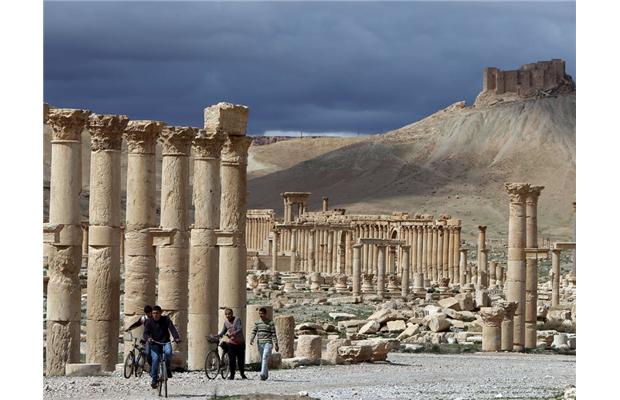
Syria warns 2,000-year-old city is in danger of being ISIL’s next cultural atrocity

PalmyraSad. Another one of the places I visited many years ago and is a world cultural and historical treasure:

A Syrian official called on the international community Thursday to protect the 2,000-year-old ruins of the ancient city of Palmyra, now threatened by the advance of the Islamic State of Iraq and the Levant. Fighting between ISIL and Syrian government forces has come within 2 km of the 2,000-year-old UNESCO World Heritage Site, which once attracted thousands of tourists to its towering Roman colonnades and temple to the god Baal. If Palmyra falls into ISIL’s hands,

Syria warns 2,000-year-old city is in danger of being ISIL’s next cultural atrocity.

How afraid should we be of Islamic State? 

Good piece by Mitch Potter in the Star regarding the over-blown hyping of the  threat and risks of ISIS:

Yet even here, some researchers doubt those risks match up with the warnings, given that the number of Canadians known to have joined ISIS is barely enough to mount a decent hockey game.

“The Islamic State is a threat to Canada — but it is wildly overblown,” says Amarnath Amarasingam, a Social Sciences and Humanities Research Council of Canada postdoctoral fellow who co-directs a study of Canadian foreign fighters at the University of Waterloo.

“By our count, there are about 60 Canadians who went to fight, of which 15 are already dead. And not all are with the Islamic State — some are fighting for the Kurds, some are fighting for the Free Syrian Army, for nationalist reasons, not as global jihadists who would present a threat to Canada.”

A similar low-threat assessment for Europe emerged this week in a research paper for Holland’s Clingendael Institute of International Relations, which concluded that, “although concerns have run high following the recent attacks in Paris, the threat of violence carried out by foreign fighters to Europe, while present, is largely overstated.”

Co-author Daniel Byman, a professor of security studies at Georgetown University, goes further in his assessment, emphasizing that while Europe must provide “ongoing resources to security and intelligence services to keep the threat low,” it should also “avoid reactive policies such as systematic prosecution and imprisonment of returnees.

“Some returnees must be imprisoned immediately and others monitored, but governments should also channel resources towards community-led programs emphasizing the rehabilitation and reintegration of returned fighters,” Byman writes.

In the Canadian context, it is difficult to imagine the general public embracing such a nuanced approach when the government itself, with more than a little help from the media, is sounding the direst of warnings. But that too is addressed in the Clingendael recommendations, which urge governments to “take care not to overstate the threat of foreign fighters and take steps to reassure citizens that the risk is real but limited.”

To the University of Waterloo’s Amarasingam, that’s the missing piece in Ottawa’s approach to the problem: we get all the warnings, minus the reassurance.

“I understand what the government and CSIS and the RCMP are trying to do,” says Amarasingam. “They want to ensure that in the unlikely event that Canada ever experiences an attack like 9/11, it won’t tear apart the fabric of our society and have us turn on each other.

“They want to plant the seed of possibility in our consciousness to prepare us. But when you raise those warnings — when you say ‘We’re not a multicultural haven immune from this; we are at risk’ — you also need to temper that message and provide the context that the risk of that kind of attack on the streets of Toronto is actually quite low.

“That’s a key piece that Canadians aren’t getting. And the consequence is that the fear is ramped up out of proportion to the actual risk.”

via How afraid should we be of Islamic State? | Toronto Star.

Michael Bliss: What the West’s long struggle with communism tells us about the battle with Islamic terrorism

Michael Bliss on some of the lessons of history in combatting communism as applied to ISIS, and the need for appropriate caution:

As a historian I have all sorts of skepticism about simplistic notions that history repeats itself or that the lessons of history are easy to discern and apply, but I do believe that the experiences we have had in the past have to be drawn upon as we consider options for dealing with recognizably similar problems in the present and future. Surely the success of ISIL in Iraq and Syria in 2014 has real parallels with the coming to power of Bolshevism in Russia in 1917. Surely the history of the struggle against Communism in the 20th century supplies us with some markers for dealing with the spectre of Islamic terrorism in the 21st century.

One “lesson” from this past is to be careful not to underestimate the strength and appeal of a radical, messianic movement with deep cultural roots. Like Bolshevism, ISIL has immediately become engaged in a hugely complicated, multi-faceted set of local wars as it tries to consolidate its power. Like Bolshevism it is utterly and appallingly ruthless in its cold-blooded determination to create what it calls the new caliphate. And, also like Bolshevism, the ideology of apocalyptic revolution is proving to be a kind of magnet for true believers everywhere, who make pilgrimages to ISIL territory to fight for their great cause. This should not surprise us. Nor should we be surprised that ISIL-spawned or affiliated Islamic fundamentalist movements are active in many other countries, and might well succeed in taking power in other failed states, ranging from Libya and Yemen through, most worrisomely, Nigeria, and perhaps Afghanistan and even Pakistan. We are dealing at one and the same time with a territorially-based mini-state leading a boundariless international movement.

Given this situation, it’s perhaps no wonder that a coalition of the enemies of ISIL quickly formed and became active in trying to degrade and destroy it. Here the haunting danger is of a repetition of the failed Allied intervention in the Russian Revolution, a destructive fiasco characterized by our almost complete ignorance of a far-off area of the world, strategic incoherence in the face of social collapse and revolution, and the West’s naive habit of claiming moral high ground.

So far, the signs seem to be that we in the West are again stumbling blindfolded into a vastly complex and chaotic situation with only simplistic, confused and uninformed ideas of our objectives and interests. As with the Allied interventions in Siberia, in which Canada played a significant role in the hope of showing off its potential as a young nation, and actually only showed an almost pathetic naivité, there is a distinct possibility that in the short, medium, and long terms we will succeed only in making things worse.

Admittedly, the situation is changing so quickly that it’s quickly becoming almost impossible to keep track of it — particularly as the chaos in Yemen seems to be forcing moderate Islam to become militarily engaged for the sake of its own survival. There is a real danger that the situation might evolve into a great civil war been Shiite and Sunni Muslims.

Generally, it’s probably wise to be cautious in situations in which it might seem like a good idea for the West to wage war against Islamic fundamentalism. We should remember how enthusiastic anti-Communists tended to overreach themselves, from the Korean peninsula through the Bay of Pigs and into the swamps of Vietnam. Already the West has stumbled dreadfully in Afghanistan and in the unbelievably disastrous American invasion of Iraq. With our NATO partners we Canadians were enthusiastically complicit in what we now realize was also a disastrous demolition of order, perhaps even of civilization, in Libya. And yet we still listen to voices urging us to do it all over again, and have just begun airstrikes in Syria without legal justification.

Here at home, jihadist terrorism poses about the same minimal threat to Canada as the international Communist movement did after 1917. We have to think seriously about issues of internal security, but we have to see them in perspective.

Globally, however, the problem is real. Given the appeal of Islamic fundamentalism to even a minuscule fraction of more than a billion Muslims, it is hard to believe that jihadism will be a passing movement, even if it does happen that ISIL is crushed. It’s at least as likely that it will continue to strengthen and spread, take hold of other countries and possibly become caught up in horrendously catastrophic wars and revolution. The prospect is very scary, and almost anything could happen. In fact in some ways Islamic fundamentalism is more alarming than Communist fundamentalism or the other totalitarian movement we had to defeat, Nazi fascism, because its religiously-rooted glorification of suicide makes terrorism, even nuclear terrorism, more feasible.

The West’s long-term strategy against the spectre of Communism was twofold. Militarily the West learned that containment of Communist expansionism was more likely to succeed than futile attempts at conquest. Thanks to the reciprocal restraint that the Communists themselves learned to adopt, for many years there was tacit co-existence between the two great ideological camps, odious as this prospect was to the true believers on both sides.

During periods of coexistence, both sides had to address the root cause of most forms of social disorder, which is people’s inchoate but powerful desire for a better life. As the 20th century wound on, utopian Communism proved corrupt and unworkable in daily life, materialistic capitalism proved flexible and productive, and the Red threat to the economic and social systems of our societies waned and then imploded on itself. As the title of a famous anthology by former Communists put it, theirs had been the god that failed. But, to slightly change the metaphor, it had been a social experiment that probably had to be tried.

I’ve made here an extended argument hinging on an analogy between revolutionary Communism and revolutionary Islamic fundamentalism, and of course it has many limits. But if nothing else our history with the Bolshevik revolution of 1917 and the rise of ISIL in 2014 underlines the importance of our realizing how much we need to know about cultures and regions of the world that are profoundly foreign to ours. And how we need to think clearly and carefully about power, its uses, both at home and abroad, and its limitations. Good intentions — the best intentions — are never enough. Understanding the limits of our knowledge, understanding context and contingency, knowing how hard and chancy it is to impose our will on the future, is at least a starting point.
Michael Bliss: What the West’s long struggle with communism tells us about the battle with Islamic terrorism