Four Reasons to Keep Allowing Refugees into Canada

I don’t find these arguments terribly convincing.

Travel restrictions by themselves only slow down the spread of viruses like COVID-19. But at a time where “planking the curve” is a priority to assist our healthcare system handle current and anticipated increased demand, it is one tool that government’s have. Implementing widespread screening at airports was not terribly effective during SARS (“health theatre” just like “security theatre.”)

While some migrants will, of course, find a way, the numbers will likely decrease, reducing the potential additional burden on healthcare (and the IRB).

And and the recent MPI study, Coronavirus Is Spreading across Borders, But It Is Not a Migration Problem, shows, while travel restrictions have limited effectiveness in the containment phase, they are more effective in the mitigation phase in which we find ourselves.

Is the policy immoral? Or does it strike a reasonably balance between protecting Canadian residents and asylum seekers who arrive at official border crossings? Is Canada a “classist society, partially determined by citizenship status.” Of course it is, citizenship does have meaning. But Canada’s implementation of all travel restrictions is inclusive: citizens, Permanent Residents, and immediate family members who fall into neither category.

One can, as many have, that the measures are illegal, as is the STCA with the US. In the current context, not sure such arguments would prevail, in particular given the large number, and ever increasing number, of COVID-19 cases in the USA and the lack of effective US policies to contain the pandemic.

We are all in this together, but there are better and more comprehensive ways to support international cooperation than simply focusing on irregular arrivals:

On Friday morning, Prime Minister Trudeau announced that the government would restrict the movement of people across our borders as an unprecedented measure to stop the spread of COVID-19. Starting this Wednesday, asylum seekers who cross the border at unofficial ports of entry — known as irregular migrants — will be arrested and handed over to American authorities.

This is a marked departure from the government’s previous position. Just a day earlier, the government promised that it would continue to allow people to cross into Canada, ensuring they screen and isolate anyone who crossed the border for two weeks in federal facilities.

While it’s important to acknowledge that we are facing a pandemic, and every decision is difficult and crucial, closing the border to irregular migrants is not the answer. This policy is ineffective, immoral and likely illegal.

1. The new policy is ineffective

Public Safety Minister Bill Blair said that while asylum seekers do not represent a higher public health risk, the efforts required to monitor and isolate them would be difficult during these trying times.

Indeed, welcoming and monitoring migrants while in quarantine requires resources, but it will also require many resources to monitor the closed border and co-ordinate the return of these migrants with the U.S. How many resources will we actually free up by this policy?

Most importantly, this won’t stop the spread of COVID-19.

The World Health Organization hasn’t recommended closing borders to curb COVID-19. Instead, it has instructed countries to ensure appropriate screening measures are in place at ports of entry and to promote thorough hygiene practices and social distancing.

If Canada was to follow the advice of WHO we would conduct an individualized assessment of every person entering the country, move them to a temporary shelter facility, and be asked to self-isolate. This process would be just as, or more, stringent than those in place right now for Canadian and American citizens. And it’s what Trudeau had previously announced Canada would do.

Furthermore, this policy won’t stop migrants from making their way into Canada. As we’ve seen time and time again in Europe, closing the border doesn’t stop migration, it just makes it more dangerous. Migrants won’t abandon their hopes of reaching safety simply because a government tells them to. Rather, they will be pushed to take clandestine routes into Canada.

In this new policy, migrants who make it into Canada will not be quarantined for 14 days, increasing the risk of spreading the virus. Once they are in Canada, they’ll be forced to live underground and will be too afraid to seek medical attention if sick, further exacerbating the spread.

If anything, closing known border crossing points like Roxham Road will put the health of Canadians at greater risk.

We also can’t forget, COVID-19 isn’t happening in a vacuum. This is a global pandemic, and pushing migrants out of Canada won’t stop COVID-19, it will just move it somewhere else. Migrants will be left to wander through the U.S., trying to find safety, and potentially spreading the virus throughout communities.

European Union sources have said that refusing entry to anyone is not considered an appropriate preventive measure, because “the virus would spread further since those potential patients would keep moving in the region without being treated.” European Union experts are instead urging countries to have systematic checks for all arrivals.

Back in January, at the beginning of the COVID-19 outbreak, WHO warned that closing the borders could actually spread the virus more quickly. WHO spokesman Christian Lindmeier said that by closing official border crossings, countries can “lose track of people and cannot monitor (their movement) anymore.”

2. The new policy is immoral

The government of Canada is capitalizing on the chaos of COVID-19 to push through a policy that oppresses the most vulnerable. It is taking advantage of a global pandemic to pander to xenophobic and racist fears.

Sealing the border to irregular migrants reaffirms that ours is a classist society, partially determined by citizenship status. This policy implicitly states that citizens deserve the safety and comfort of Canada, but migrants do not.

Minister Blair characterized turning away migrants as a step toward closing the border for all but “essential” travel. What travel is more “essential” than seeking refuge?

It’s worth noting that the border closure exempts international students and temporary foreign workers and Canada is still allowing American citizens into Canada. These many exceptions illustrate that the border closure isn’t about blocking non-Canadian citizens, but seizing this moment of panic to turn our backs on irregular migrants, a plan the government has long been musing.

3. The new policy is likely illegal

Aside from this policy being immoral, there’s a good chance that the new policy is illegal, and human rights and refugee groups in Canada have been quick to condemn it.

In its press release, the Canadian Association of Refugee Lawyers said, the new policy “is unnecessary and unjustified, and it puts refugees at risk.”

Alex Neve, the Secretary General of Amnesty International Canada, condemns closing the border, noting that “refugees and migrants face considerable risks in the face of the pandemic and are frequently demonized and ostracized as public health threats.” Neve said that “turning refugee claimants over to U.S. border control officials at a time like this violates international law and is just plain cruel.”

Under international law and the 1951 Refugee Convention, Canada has an obligation to allow asylum seekers to launch a refugee claim and have their case heard. By automatically returning all irregular migrants to the U.S., we are ignoring international law and shirking our obligations.

In addition, human rights organizations have fervently opposed the Safe Third Country Agreement for decades now, arguing that the U.S. is not a safe place for refugees.

In the U.S., asylum seekers are prevented from making a refugee claim if they wait more than one year, are often denied access to counsel, and are detained while their claims are assessed. In recent years, the situation has only worsened. Trump has held migrant children in cages, implemented the Muslim ban, housed migrants in tent cities, barred asylum claims based on domestic violence and gang violence, and ripped babies from mothers’ arms.

Canada may also be violating its obligations of non-refoulement — which stipulates that countries cannot return asylum seekers to a country where they would risk persecution — by sending migrants back to the U.S.

There is a very real possibility that the U.S. will send migrants back to countries where they could face persecution. The Trump administration has brokered agreements with El Salvador, Honduras and Guatemala — countries from which countless refugees flee — mandating migrants to apply for refugee protection in those countries on their journey to the U.S. The U.S. already has an established practice of sending migrants back to Guatemala, where Indigenous people and women, in particular, face extreme rates of violence. All of this violates the international obligations to not return asylum seekers to persecution, and Canada will now be complicit in these “chain pushbacks.”

Given these bilateral agreements, and the fact that the U.S. government is still conducting raids and deporting people during the COVID-19 pandemic, Canada cannot argue that sending migrants back to the U.S. is in line with our legal obligations.

The government has emphasized that this measure will only remain in place during the COVID-19 crisis, but we should take this with a very large grain of salt. The Safe Third Country Agreement was created during the aftermath of 9/11, when it may have seemed reasonable. But the panic of 9/11 is long gone, and the agreement still remains. It’s very likely that this policy will also stay in place permanently. As Justin Mohammed from Amnesty International Canada said, “History demonstrates that when we see the rollback of certain human rights, the unwinding of that action has been very difficult.”

4. We’re all in this together

As Canada and other countries around the world close their borders in an effort to contain the spread of COVID-19, IOM reminds us that, “it is critical that such measures be implemented in a non-discriminatory manner, in line with international law, and prioritizing the protection of the most vulnerable.”

We are in unchartered territory. It’s understandable that Canada wants to do everything it can to protect its country from a deadly virus, but it doesn’t have to be one or the other: we can protect Canadian health while at the same time upholding human rights and protecting asylum seekers.

As always with human rights, it’s a balancing act. As we make difficult decisions to combat this pandemic, we cannot lightly compromise human rights and must account for every competing factor. Just as we balance the freedoms of assembly, association and religion of Canadian citizens against their right to life and health, we must also balance the right to life, liberty, and security of the person of irregular migrants.

As Eric Paulsen has written, we must implement public health measures “in a way that is justifiable in line with international standards. Any limitations on our rights must be necessary, proportionate and in the pursuit of a legitimate aim.”

Canadian citizens are scared, but so are migrants. Migrants face the same health threats from COVID-19 as citizens.

The world is at war, but for the first time in history, the entire world is fighting a common enemy. Let’s use this moment to embrace unity and care for one another.  [Tyee]

Source: ow.ly/tlVs30qsz3V

The End of the (Roxham) Road: Leuprecht on “Seeking coherence on Canada’s border migration compact” and some fundamental flaws

Reading Christian Leuprecht’s recent above study for MLI one statement caught my eye in particular, his assertion that:

“…. the timing and implementation of actual changes in regulations initiated by President Trump, which have expanded the remit of migrants who are now at risk of deportation, appear to have had little effect on the flow of irregular migrants crossing into Canada.

This study is skeptical of Trump as the arsonist: his policies are merely an accelerant on a slow-burning fire. A series of factors had affected migration from the United States to Canada prior to the 2016 US presidential election. However politically expedient, misidentifying Trump as a causal rather than an intervening variable is problematic insofar as it leads to a misinformed prescription, such as simply waiting out the current US presidential administration in the mis- guided belief that Trump and his policies are merely an aberration.”

As evidence, he cites the study by Craig Damian Smith, Changing U.S. Policy and Safe-Third Country “Loophole” Drive Irregular Migration to Canada, which states the contrary:

“The Trump administration’s decision not to extend a long-standing Temporary Protected Status (TPS) designation for some 46,000 Haitians was the catalyst for the drastic increase in asylum claims in Canada in 2017. In April 2017, just 140 Haitians crossed into Canada at Roxham Road. The following month, the number increased to 1,355, and to 3,505 that June. Roughly half of the 6,500 Haitians who arrived during the April 2017 – June 2019 period examined, were U.S. residents, with the rest arriving from Haiti and third countries, particularly Brazil. Thus an announced U.S. policy change resulted in roughly 7.5 percent of all Haitians in the United States with TPS choosing Canada rather than risking deportation, moving to a third country, or remaining unauthorized in the United States.”

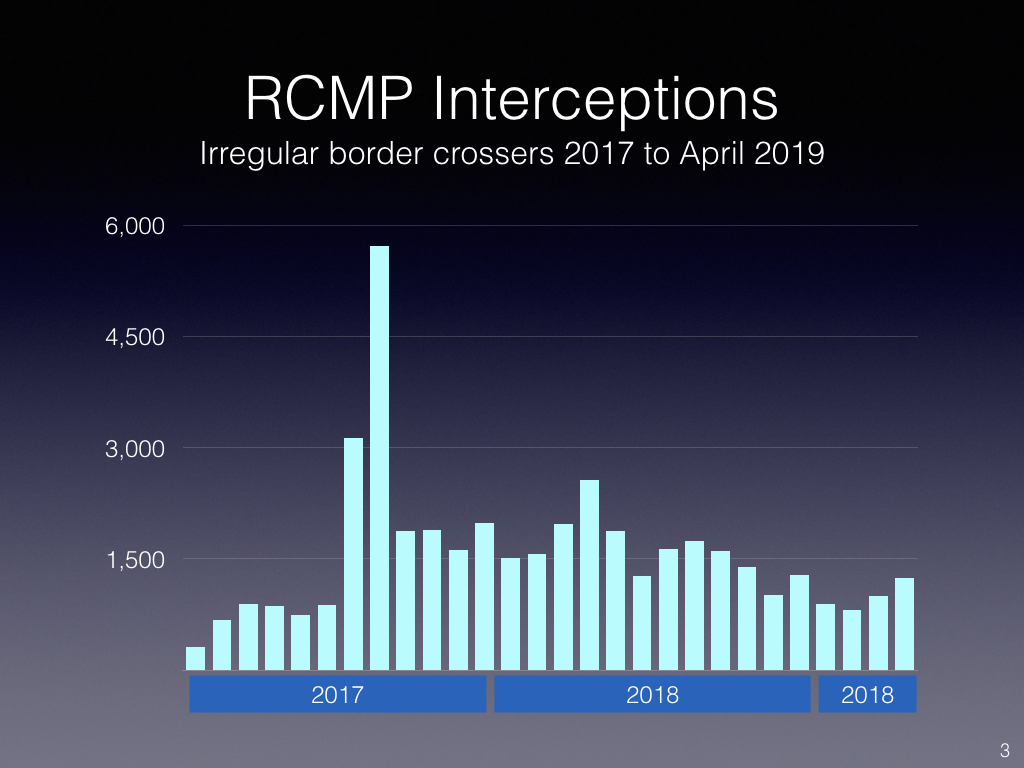
The various other measures, that Leuprecht cites as pre-Trump reasons for the spike (“electronic Travel Authorization (eTA) for visa-exempt nationals, cracked down on human traffickers, used enhanced technology to reduce fake passports, and improved intelligence sharing on at-risk travellers”) are more germane to the overall influx of irregular arrivals rather than the almost quadrupling that occurred between June and July 2017 (RCMP interceptions) and which have since stabilized as per the chart below (“the new normal”):

The following chart looks at overall inland claims (regular and irregular), again highlighting the post-Trump impact:

A marked increase in irregular border crossers, especially outside of official ports of entry, has put Canada’s immigration and refugee system under scrutiny and fuelled an emotionally charged debate with important policy implications for Ottawa, the provinces, and Canada-US relations: Who should qualify for asylum, or refugee protection, under domestic and international law? Proponents defend migrants’ unequivocal legal entitlement to lodge a claim as a refugee in Canada; critics deem these irregular crossings to be an end-run around Canada’s refugee system by breaking – or at least abusing – the law.

In an immigrant country with a checkered history of immigration policy, to champion the underdog migrant who actually makes it to Canada is par for the course. However, this lenient attitude has effectively turned irregular migration into a back door to Canada: A disproportion- ate number of refugee claims by irregular migrants turn out to be unfounded yet few rejected claimants ever end up being deported.

A disproportionate number of refugee claims by irregular migrants turns out to be unfounded.

On one hand, irregular migration is a function of a complex interplay of domestic, bilateral, and international factors. On the other hand, the Canadian dislike for US President Donald Trump has given rise to a narrative that attributes the surge in irregular migration to the outcome of the 2016 US presidential election. However convenient and appealing, simplistic explanations also tend to be wrong or, as this study explains, at least inchoate. This study lays out the myriad aggravating political factors in the US that predate the Trump administration.

At the same time, Canada has implemented the electronic Travel Authorization (eTA) for visa-exempt nationals, cracked down on human traffickers, used enhanced technology to reduce fake passports, and improved intelligence sharing on at-risk travellers. While these measures have reduced the number of irregular migrants arriving by air and sea, they have made crossing by land from the US much more attractive for those who prefer Canada as a destination. Contrary to claims that most of those who are crossing are taking flight from the Trump regime, about two-thirds of asylum seekers crossing irregularly into Canada by land actually enter the United States legally on a visa for the sole purpose of making their way to Canada. By way of example, Saudi nationals have obtained American visas at the embassy in Riyadh under false pretense, intent on entering Canada to claim asylum.

Between 2016 and 2017 irregular migration into Quebec, primarily from New York state across the now infamous Roxham Road, surged by 230 percent. Although not wholly without precedent, these numbers are nonetheless high by historical standards. Through September 2019, 12,080 irregular migrants had been apprehended by the RCMP out of 46,165 total claims, or 26.2 percent of claims, in 2019. The 2019 numbers are a decline from the RCMP apprehension of roughly 20,000 irregular migrants in each of the two previous years, although at a rate of 1,200 a month in the fourth quarter, the final tally for 2019 will probably range around 15,700. It appears to be a case of squeezing the snake: total claims from all sources are running close to 6,500 a month in the third quarter of 2019 compared to 4,900 a month during the same quarter in 2018.

Canada’s migratory regime is based on a social contract. Recent trends challenge the integrity, sustainability, and legitimacy of that social contract because they undermine the cornerstones of Canada’s migratory regime writ large, and especially its approach to refugees:

  • the legitimacy of a well-administered migration policy that is grounded in the rule of law and preserves the integrity of Canada’s borders;
  • the successful political and economic socialization and integration of migrants; and migration’s collective benefit in fostering Canadian prosperity.

How, then, is Canada to confront the phenomenon of global migration in a way that respects the rule of law while preserving the legitimacy of domestic migration regimes?

As challenges to the integrity of border management and policy have compounded over the past 25 years or so, binational and bilateral cooperation between Canada and the United States has expanded incrementally. After all, open borders depend on extensive cross-border cooperation for their effectiveness and legitimacy. This is the premise that informs a sustainable approach to irregular migration across Canada’s land border between ports of entry.

The government is currently exploring extending the Safe Third Country Agreement (STCA) beyond ports of entry to cover the entire land border. This is a better option than unilaterally suspending the STCA, as some commentators have prescribed. Yet, given the disproportionate number of refugee claims at inland offices, extending the STCA to cover the land border is un- likely to solve the migration problem facing Canada.

This study lays out a cooperative strategy with the aim of sustaining a coherent border-migration compact that includes:

  • weighing the costs and benefits of changing Canada’s STCA with the United States;
  • obviating the need to cross between ports of entry by reinstating the “Direct Back” provision under Section 41 of Canada’s Immigration and Refugee Protection Regulations, which would allow claimants to lodge their claims for refugee status from the United States;
  • enhancing current bilateral and binational administrative, intelligence and enforcement cooperation; and
  • acquiring better data to drive (more) informed and timely decision-making.

The cumulative effect of both regular and back-door immigration risks undermining popular support for migration altogether. Polling data suggest that trend is well underway. These targeted measures are designed to reinforce confidence in Canada’s commitment to managing its borders, the integrity of the refugee migration system, the prospects of the political and economic integration of migrants, and consequences for the country’s prosperity as a whole.

Source: https://macdonaldlaurier.ca/files/pdf/20191108_MLI_ROXHAM_ROAD_Leuprecht_PAPER_FWeb.pdf 

Changing U.S. Policy and Safe-Third Country “Loophole” Drive Irregular Migration to Canada

Good in-depth study:

Nearly 50,000 asylum seekers entered Canada irregularly via land crossing from the United States over a two-year period beginning in spring 2017—contributing to a doubling in the overall number of asylum requests seen in 2016. Most make their way into Canada via Roxham Road, an unofficial crossing at an otherwise unremarkable country road along the New York-Quebec border.

The surge in asylum filings is the result of a few factors, perhaps most notably U.S. policy changes that have made the United States less hospitable and growing recognition of a “loophole” in the 2004 Canada-U.S. Safe Third Country Agreement (STCA). While the treaty was designed to manage asylum-seeker processing by requiring individuals to apply for protection in the first of the two countries entered, it allows those who reside in or transit through the United States to claim asylum in Canada if they enter between official ports of entry.

Box 1. Methodology

This article presents findings from semi-structured interviews with 290 asylum seekers from more than 50 countries, with a representative sample by country of origin. They had been in Canada from a period of only a few days up to two years. Interviews were conducted from December 2018 to October 2019. They took roughly one hour, and were conducted in the respondent’s language of choice at shelters and community organizations in Toronto, Hamilton, Ottawa, and Montreal.

Recruitment took place using posters and communication through social workers and volunteers. Respondents were identified by their first name only, and offered the choice to use a pseudonym. No identifying or contact information was collected.

Interviews were also conducted with two dozen lawyers, social workers, civil servants, and personnel from government and law enforcement in Canada and the United States.

The majority doing so, according to research undertaken by the author and his research team, only briefly transited the United States before crossing into Canada. Around 60 percent of the 290 asylum claimants interviewed—from a diverse mix of countries including Haiti, Nigeria, Colombia, and the Democratic Republic of the Congo (DRC)—had spent an average of five days before moving on to Canada. The remainder had lived in the United States for an average of six years.

The increase in asylum seekers has proven a politically and morally fraught issue for the Trudeau government in the lead-up to the October 21 federal election, offering opposition parties and civil-society groups on the right and left alike reason to criticize the centrist Liberals in power. It also has placed new scrutiny in Canada on the Safe Third County Agreement, criticized by conservatives for its role in fostering more asylum claims and on the other side of the spectrum by lawyers and refugee-rights advocates who question whether the United States remains a “safe” country.

This article, which draws from the first year of the “Understanding Emergent Irregular Migration Systems to Canada” research project, presents findings from interviews to explore asylum claimants’ motivations for claiming asylum, information sources, and experiences along their journey and after arrival. It also analyzes the effects of the recent arrivals on Canada, especially regarding the political implications. The goal is to fill a research gap by providing empirical evidence for the drivers of irregular migration to Canada.

U.S. Policy Change as a Driver of Migration to Canada

Increasing irregular arrivals to Canada may be attributed to many factors, including (mis)information spread about the STCA “loophole” through social networks and international media. Insights from interviews with asylum claimants suggest that U.S. policies are a major driver of irregular migration to Canada—though the relationship is not always linear. An increase in arrivals after change in U.S. policy is not unprecedented: discrepancies between U.S. and Canadian refugee determinations in the 1980s led to a “border rush” of predominantly Central and South American asylum seekers. The ensuing backlog in Canada’s asylum system led to the creation of the country’s Immigration and Refugee Board (IRB) and motivated Canada to seek an STCA in the first place.

Causes of the Recent Uptick in Asylum Seekers

The Trump administration’s decision not to extend a long-standing Temporary Protected Status (TPS) designation for some 46,000 Haitians was the catalyst for the drastic increase in asylum claims in Canada in 2017. In April 2017, just 140 Haitians crossed into Canada at Roxham Road. The following month, the number increased to 1,355, and to 3,505 that June. Roughly half of the 6,500 Haitians who arrived during the April 2017 – June 2019 period examined, were U.S. residents, with the rest arriving from Haiti and third countries, particularly Brazil. Thus an announced U.S. policy change resulted in roughly 7.5 percent of all Haitians in the United States with TPS choosing Canada rather than risking deportation, moving to a third country, or remaining unauthorized in the United States.

Figure 1. Number of Asylum Seeker Claims on Roxham Road, April 2017-June 2019

Source: Data provided to the author by Immigration, Refugees, and Citizenship Canada (IRCC) under a memorandum of understanding.

A commensurate number of TPS recipients from countries other than Haiti have not sought asylum in Canada, even as the Trump administration has also moved to end designations for Salvadorans, Hondurans, Nicaraguans, and others. The lack of similar movement may owe to a number of factors, including the fact that U.S. courts have at least temporarily blocked the upcoming terminations. Obama-era Department of Homeland Security (DHS) officials, advocates, and asylum seekers interviewed also noted that Latino immigrants are more politically organized and committed to resisting Trump administration policies.

Still, more than 300,000 people risk losing TPS in early 2020, and in an environment of hostility toward asylum seekers and unauthorized immigrants, more may aim to cross irregularly into Canada, particularly if it appears the courts will not continue being a brake on Trump administration immigration actions.

Table 1. Temporary Protected Status (TPS) Populations in the United States and Expiry Dates

Note: A grant of Temporary Protected Status (TPS) provides recipients protection from removal from the United States, as well as work authorization.
Source: D’Vera Cohn, Jeffrey S. Passel, and Kristen Bialik, “Many Immigrants with Temporary Protected Status Face Uncertain Future in U.S.” Pew Research Center FactTank blog, March 8, 2019, available online.

Beyond the initial rush of Haitians in mid-2017, many others have made the journey after being in the United States for only a short period of time. Roughly 60 percent of respondents used the United States only as a transit state, spending an average of five days. They learned of the crossing from a range of sources, often through social media, YouTube, or word of mouth. Some early respondents, mostly from Nigeria, were reticent to admit that they had planned to come to Canada, and said they had no knowledge of Roxham Road before arriving in the United States. These respondents also offered similar, almost verbatim reasons for asylum. The researchers thus revised their interview structure to focus on the source of information for the Roxham Road route. Several described purchasing asylum narratives from “story sellers” or “travel agents,” typically based on persecution for gender and sexual orientation. While these types of claims are long-standing, narratives also included Donald Trump’s anti-migrant pronouncements and the specter of family separation as the reason for spontaneous transit to Canada. Thus, decisionmakers in Canada must now contend with U.S. policy in assessing claims.

However, most respondents planned to use Roxham Road from the outset. “My husband had Canada in mind for years. He wanted to do it legally, like fill out the forms online. But once he heard about Roxham Road he decided to send us,” said Hadiza, a 39-year-old woman from Niger. “It was a difficult decision. It was me and three kids. My husband had to stay behind. He sent us first and maybe he can come later.”

For these migrants, the unlikelihood of protection contributed to their choice not to remain in the United States. Roughly 20 percent had been denied visitor or skilled immigrant visas to Canada but were able to obtain or already had U.S. visitor visas. Several, predominantly from the DRC, Angola, and Pakistan, said they obtained visas by bribing U.S. consular officials. Restrictive U.S. asylum procedures, more open visa regimes, and corruption thus impact asylum claims in Canada.

Roughly 40 percent of respondents had resided in the United States for a period of years, mostly unauthorized residents who had overstayed a visa or received a negative asylum decision. Unlike many who transited through the United States in days, this group explicitly stated that their reasons were directly tied to U.S. policies.

“This word ‘illegal’ is weird to me, even if I use it about myself,” said Derrick, a 22-year-old from Gabon. “Every day people tell you to go back to your country, that if you’re struggling you should just go. That’s not a life. I’m not a criminal, I don’t hurt people. I just want to work and study.”

Among respondents’ fears were the threat of workplace immigration enforcement operations or law enforcement status checks. The most common catalysts for the decision to use Roxham Road were that a relative or community member had been incarcerated or deported, or that they were running out of funds or appeals in lengthy U.S. asylum procedures. Several said they abandoned claims because of a 2018 policy to schedule new cases in immigration court before older ones, a “last in, first out” policy DHS implemented to deal with the rapidly rising Central American caseload. Regardless, most reported a growing fear from the Trump administration’s anti-immigrant discourse, more frequent discrimination, and anxiety about the fate of their children should they be apprehended. Finally, around 3,500 U.S. citizens had crossed the border during the April 2017-June 2019 period, according to Immigration, Refugees, and Citizenship Canada (IRCC), signaling the displacement of mixed-status households with unauthorized immigrant parents and U.S.-citizen children.

Many who arrived in late 2018 or in 2019 had actively researched Roxham Road, which had garnered significant media attention in 2017, often through online searches and conversations with community members, but considered it a last resort. Interview questions asked respondents who resided long term in the United States where Canada ranked among options including return to their country of origin, relocation to a third country, or move elsewhere in the United States, particularly a sanctuary jurisdiction. Most were incredulous about the notion of returning to their country of origin, but would have preferred to remain in the United States were it not for the Trump administration. Canada offered the simplest and safest option.

Transnational Border Crossers

Irregular migration to Canada rapidly became more transnational after receiving attention from mainstream and social media. By late 2017, Nigeria overtook Haiti as the top country of origin, and the number of nationalities diversified significantly.

Table 2. Top 20 Countries of Origin of Roxham Road Asylum Claimants, April 2017- June 2019

Source: IRCC data provided to the author under a memorandum of understanding.

For most who transited the United States over a short period of days, the decision to seek asylum in Canada has less to do with U.S. policy and more to do with finding a solution for a precarious situation. To take one example, many claimants who are considered Yemeni, Palestinian, or Sudanese in official data were born and lived in Saudi Arabia. “Saudi-ization” policies—aimed at increasing the share of native-born Saudis in the workforce—resulted in the termination of these workers’ residence permits. For Yemenis, this means risk of deportation to a country with which they have no connection and one experiencing a humanitarian emergency. Many Palestinians would be rendered stateless. Respondents coming from these types of situations relayed how their social networks were abuzz about the U.S. route to Canada as early as May 2017, offering a new means to fulfill pre-existing desires for mobility.

While those with financial means often fly to the United States, an increasing number, predominantly from Africa, undertook multimonth and even multiyear overland journeys from Brazil, through Central America, to the United States. This comports with global findings that the first people in irregular migration systems are often those with the capital to move quickly, while those with fewer resources take more precarious routes.

The less well-heeled or those unable to secure U.S. visitor visas recounted harrowing danger, including violence and extortion by state security services, criminals, and smugglers; capsized boats on the coast of Colombia; horrific experiences in the Darien Gap jungle in Panama; predation from gangs in Mexico; and waiting in dangerous conditions at the U.S. border. “The jungle in Panama was very, very hard. You’re walking past dead bodies. You spend ten days or two weeks. You have to walk through rivers, over mountains. There are snakes and bandits… You walk for days, from the time the sun comes up until it goes down, and you sleep wherever you lay,” said Naomi, a 22-year-old from Angola. “If a child dies, the parent leaves it behind. If your husband dies, you leave them behind. Because if not, it’s you who will be left behind. It was the most difficult thing I’ve ever done.”

(Mis)Information and Social Networks 

Social networks play a strong role in would-be migrants’ decision-making. In the case of Nigerian claimants, for example, Pentecostal churches play a key role planning travel and social connections once in Canada. Refugee claimants from Yemen, Colombia, and a range of African states receive detailed instructions from community members who have already arrived. Some respondents said U.S. aid organizations encourage people to move on to Canada after release from detention.

As in other irregular migration corridors, misinformation and rumors seem to have a strong influence. Whispers of impending enforcement actions in the United States served as a catalyst for several respondents. More often, rumors are spurred by minority-language media and are amplified and distorted through social media. These often have some basis in fact. Recent arrivals reported rumors that the Canadian border will be closed if the Conservatives win the October election, spurring people to hurry on their journeys.

When Trump announced a ban on refugees from certain Muslim-majority countries within days of taking office Prime Minister Justin Trudeau tweeted: “To those fleeing persecution, terror & war, Canadians will welcome you, regardless of your faith. Diversity is our strength #WelcomeToCanada.” A number of respondents cited this juxtaposition as a prominent example that Canada was “saving” refugees from the United States. “I was hearing a lot of things about the Prime Minister of Canada. My friend told me they’re welcoming people there. And I thought ‘this is the place I’m supposed to go’,” said Bilal, 25, from Yemen.

It would be disingenuous, however, to claim a tweet was the direct catalyst for migration. The irregular movements to Canada instead owed in a broader sense to the erosion of protection and retreat from norms of asylum in the United States, against which people measured their chances in Canada.

Interviews illustrate that claimants had accurate information about the route, yet little knowledge of the asylum process in Canada. Respondents were surprised by the scale of the flow, wait times for hearings, not immediately receiving housing, and the difficulties in finding child care and work. And while only a few respondents said they would have made a different decision, interviews and DHS data suggest that over the past two years dozens or hundreds of asylum seekers had either returned to their country of origin or used smugglers to re-enter the United States.

A Surprising Lack of Criminality at the Border

In comparison to other irregular migration corridors—and indeed on other legs of the journey—there is remarkably little criminality at the U.S.-Canada border. The route existed long before Roxham Road made headlines. It generally consists of transit by bus or private car to Plattsburgh, New York, and taxi companies transporting people to the border. Individuals with large families or health issues, or those who fear interactions with U.S. immigration enforcement, use a network of private drivers. None of this activity amounts to smuggling under U.S. or Canadian law, and there is very little evidence of abuse while people move within the United States.

A small number reported intimidation by taxi drivers in Plattsburgh. In the early days, taxi companies overcharged for the 25-mile drive to Roxham Road. In May 2019, the New York attorney general convicted the owner of one company of systematically overcharging. This trend has abated, and most respondents relayed either no meaningful interactions or acts of kindness from drivers, who calm agitated people and explain the process at the border.

The most significant exploitation is in Canada, particularly by immigration consultants and lawyers. In several cases—in collaboration with agents in the United States—consultants from migrants’ national or linguistic community convinced individuals to come to Canada. Such consultants offer a “full-service” fee, including transportation to the border, access to a safe house in Canada (which is unnecessary), and promises to circumvent Immigration and Refugee Board (IRB) wait times (which is not possible). They then extract as much money as possible before abandoning claimants. Other respondents, primarily from Latin America, have reported lawyers charging exorbitant rates for paperwork that could be covered by legal aid organizations. As Nadya, a 35-year-old woman from Colombia, explained: “The agent charged us $1,500, and put us in touch with a lawyer in Canada, [who] said it was $6,000, then $1,500 each to get a work permit. He said could get us work and we could pay him back. Once we got to Montreal there was a group of Latino lawyers, [who] explained we would get free legal aid. We asked, ‘How much do we have to pay [for] a work permit?’ It’s then we realized he was trying to take advantage of us.” Finally, there is some evidence that Mexican and Nigerian claimants arrive owing debts for passage and are immediately recruited to work under the table for temporary labor agencies.

These types of exploitation pale in comparison to the abuse and danger reported along irregular migration routes elsewhere around the globe. Most interviewees reported positive experiences with Canadian officials and consider the system fair despite long wait times. Understood in a global context, claiming asylum in Canada remains a safe process.

Impacts on Canada

The backlog at Canada’s IRB, a tribunal that hears refugee claims, had grown to more than 79,000 cases as of August 2019, with average wait time of two years for first hearings. A 2019 auditor general’s report found that wait times could increase to five years by 2024 if the number of claims remains constant. The increase has strained shelter capacity in major cities, particularly Montreal and Toronto. Polling by the Angus Reid Institute suggests that while most Canadians remain in favor of welcoming refugees and asylum seekers, they overestimate the number of refugees present, see irregular migration as a crisis, and those entering at Roxham Road as “queue jumpers” or “bogus refugees.” Attacks on shelters and demonstrations against housing asylum seekers in Toronto, and far-right protests at shelters in Montreal and on the border in Lacolle, Quebec have occurred.

The opposition Conservative Party of Canada has accused the government of losing control of the border. In late 2018, the party took a page from the playbook of Europe’s far-right populists, claiming the Global Compact for Safe, Orderly, and Regular Migration would mean ceding sovereignty to the United Nations. The Ontario Progressive Conservative Party refused to cooperate with the federal government over shelters and housing for asylum seekers, and made the unprecedented move of canceling legal aid for refugee claimants, which is a crucial part of the asylum process. The goal was to foster chaos in the lead-up to the election and shift the burden to Quebec, a crucial electoral battleground.

It has also been expensive. After lobbying from the legal and advocacy community, the federal government announced CAD $26.8 million in funding to address the legal aid shortfall. The 2018 budget allocated $72 million for capacity-building at IRB, and the 2019 budget an additional $1.2 billion over five years. Providing shelter space for asylum seekers has cost cities somewhere in the range of $150 million. The political challenge is that effective policy requires administrative solutions, while critics can mobilize narratives of economic migrants gaming the asylum system as a result of uncontrolled borders.

The government has sought to balance capacity building with restrictive policies. In 2018 it created a new Minister of Border Security and Organized Crime Reduction, appointing a tough-on-crime ex-police chief from Toronto. It also changed the Immigration and Refugee Protection Act to prevent asylum shopping by denying access for people who previously sought protection in the United States, Australia, New Zealand, or the United Kingdom. The change was roundly criticized by refugee-rights advocates and has caused significant uncertainty for both asylum seekers and the legal community. Officials interviewed on the condition of anonymity confirmed it is a pre-emptive measure in case of U.S. policies that might spur more migration, particularly in the lead-up to the 2020 U.S. presidential election.

Loophole or Safety Valve?

Much of the asylum debate in Canada has been about closing the STCA “loophole.” The left-leaning New Democratic Party and many academics, lawyers, and refugee advocates have called for Canada to suspend the accord, on grounds the United States is no longer a safe country for asylum seekers. Amnesty International and the Canadian Council for Refugees are challenging its constitutionality. The Conservative Party has taken the opposite position, promising to extend the agreement to what has been long heralded as the “world’s longest undefended border.”

Applying the agreement between ports of entry would require vast new funding for federal police, who would be tasked with apprehending and detaining thousands of people. The result would create more criminalized smuggling markets, make migrants vulnerable to trafficking, create precarious undocumented populations, and push people to more dangerous routes. It would also fundamentally damage Canada’s global identity.

On the other hand, suspending the Safe Third Country Agreement would likely result in more asylum claimants, given peoples’ decisions have been significantly affected by ever-more hardline U.S. policies and rumors of more open Canadian ones.  Those arriving at regular ports of entry would still increase IRB backlogs. And the move would likely backfire politically, with voters potentially rewarding anti-refugee political platforms, as in Europe and the United States.

Restrictive policies are unlikely to stem the flow of people, and Canada has no leverage in negotiations with the White House over the STCA. Likewise, unilaterally suspending participation in the accord risks riling the U.S. government at a time when the Trump administration is limiting access to asylum and attempting to compel other states to take on the responsibility for hosting refugees.

While perhaps counterintuitive, the status quo with regards to the Safe Third County Agreement is a viable option. Roxham Road is well managed. The Royal Canadian Mounted Police (RCMP) and Canadian Border Services Agency (CBSA) conduct routinized security screening and first-line admissibility checks. The majority of interviewees took pains to mention they were treated humanely, in sharp contrast to experiences at other borders. Volunteers who monitor the crossing relayed that while there were instances of intimidating behavior by the RCMP in 2017, they are now rare because of the standardization of procedures, permanent infrastructure, and observation by volunteers. People arrive safely, and without criminal networks.

While politically fraught in the current context, Canada receives a small number of asylum seekers in comparison to other refugee-receiving countries. It has an established and well-funded settlement sector, and refugee-status determination procedures are largely fair. Staying the course until the 2020 U.S. elections would allow for capacity-building and long-term planning that bucks the global trend of reactionary policies in liberal democracies.

Acknowledgments

This article is part of a research project, “Understanding Emergent Irregular Migration Systems to Canada,” funded by the Social Sciences and Humanities Research Council and hosted by the Centre for Refugee Studies at York University and the Global Migration Lab at the Munk School of Global Affairs & Public Policy, University of Toronto.

Irregular asylum claims in Canada drop nearly 50% from last year

Ironic, given the government’s plan to close the STCA loophole for those entering Canada outside regular border posts. And of course, still too early to see if this trend continues for the balance of the year:

The number of asylum-seekers crossing the border “irregularly” into Canada has slowed compared to early last year.

Statistics published by the federal government show the RCMP apprehended 3,944 irregular migrants between official border crossings in the first third of this year.

That’s a 48-per-cent decline compared to the more than 7,600 irregular border crossers intercepted between January and April 2018.

Despite this, Darrell Bricker of the polling firm Ipsos Public Affairs says data shows Canadians are increasingly concerned over immigration levels in Canada, due in large part to the influx of irregular migrants.

He and other experts who took part in an immigration summit in Ottawa last week are warning against rising populist sentiments that could harden Canadian attitudes against newcomers.

Fen Hampson, executive director of the World Refugee Council, says a key concern is that the public doesn’t differentiate between refugees and economic immigrants — and that Canadians may not realize Canada’s refugee influx is nothing compared to the migrant crises facing other countries.

Source: Irregular asylum claims in Canada drop nearly 50% from last year

Nearly half of Canadians support deporting people who are in Canada illegally, poll finds

Not surprising, one of the factors that underlies overall Canadian support for immigration is that the public perceives this as managed and controlled. Irregular arrivals undermine that trust:

Undocumented immigrants in the United States are fleeing to Canada. But Canadians may not want them, a new survey finds.

Nearly half of Canadians support “increasing the deportation of people living in Canada illegally,” according to a Reuters/Ipsos poll released Monday.

The same share said they supported sending migrants that crossed from the United States right back over the border, while just 36 percent said Canada should accept them and let them apply for refugee status.

Read more:Trump, tighter air travel rules behind surge of refugees at Canada-U.S. border, experts say

The popular sentiment could pose a challenge to Canadian Prime Minister Justin Trudeau, who champions a pro-refugee and pro-immigration policy as a stark foil to U.S. President Donald Trump.

Trump’s anti-immigrant “build-a-wall” rhetoric helped launch him into the White House, but since getting there, he has faced significant political backlash and legal scrutiny over his policies.

The debate is spilling over into Canada, where Trudeau is taking a political hit for keeping his country’s door opento refugees and immigrants.

Forty-six percent of poll respondents disagreed with how Trudeau is handling immigration, while 37 per cent agreed.
The poll shows the national debate on immigration is heating up. Nearly a quarter of Canadians believe immigration-control is a leading national issue, compared to 19 per cent in a December poll.

Some 40 per cent thought accepting those fleeing from the United States could make Canada less safe.

Undocumented immigrants began fleeing to Canada in record numbers after Trump’s political rise.

In 2016, 1,222 fled the United States to Quebec alone, a five-fold increase.

Source: Nearly half of Canadians support deporting people who are in Canada illegally, poll finds | Toronto Star

With number of immigrant detainees growing, border agency explored holding them in prisons

Officials doing their job to find possible solutions to one of the consequences of a change in policy:

In a letter to Correctional Service commissioner Don Head, Portelance noted the border agency was assessing options for “increasing its capacity” and wanted to explore the prison service’s “expertise and facilities to hold immigration detainees.”

The border agency holds people who are considered a flight risk or a danger to the public, and those whose identities cannot be confirmed.

It has also become easier to detain newcomers. Federal changes to the Immigration and Refugee Protection Act allow officials to hold people 16 or older who enter Canada as part of an “irregular arrival” — a group whose origins are unclear or a case where criminal human smuggling is suspected.

An internal border agency background memo notes the organization has three immigration holding centres across Canada, but relies on provincial jails in other locations to house higher-risk detainees.

“In some cases, the provinces have indicated their intention to cease holding detainees in the long-term or limit how many individuals can be held within their facilities,” the memo says.

It adds that the federal government’s “current legislative agenda concerning immigration matters and the potential for an increase in the daily detained population” make discussions with the prison service necessary.

The documents, prepared in early 2012, were recently released under the Access to Information Act.

Neither the border agency nor the prison service would make anyone available for an interview. However, in emailed answers to questions, the agencies confirmed that discussions about use of federal prisons took place.

The border agency did an internal review of options for the detention program that was presented to the organization’s executive for approval early this year, said agency spokeswoman Line Guibert-Wolff.

“As a result of this process, in February 2014, the CBSA decided that federal correctional facilities would not be used to hold immigration detainees.”

With number of immigrant detainees growing, border agency explored holding them in prisons