Federal agencies fumble privacy safeguards on asylum system revamp, risking refugee data

Sigh….:

Three government agencies that partnered on a $68-million project to revamp Canada’s asylum system failed to complete mandatory privacy safeguard tests for years while the project was being implemented, CBC News has learned. 

The lack of privacy protections raises “red flags,” lawyers say, and may have put refugee claimants’ data and applications at risk.

Immigration, Refugees and Citizenship Canada (IRCC), the Canada Border Services Agency (CBSA) and the Immigration and Refugee Board (IRB) worked together on the “asylum interoperability project,” which would transform the asylum system into a more efficient digital one and address the ever-growing backlog of pending asylum applications, which currently sits at more than 290,000.

Earlier this year, CBC reported that the project, which launched in 2019, had been prematurely shut down in 2024 in what CBSA called an “unexpected” move.

Now, documents obtained through access-to-information legislation show there were “outstanding” privacy impact assessments (PIA) for the project, which was quietly scrapped when it was only 64 per cent complete.

According to a government digital privacy playbook, a PIA is a “policy process to identify, assess, and mitigate potential privacy risks before they happen.”

“All these steps need to be completed before the launch of the initiative,” that guide says.

Even though the interoperability project has now been scrapped, it implemented changes to how data is collected digitally and used — meaning that the completion of PIAs remains an essential part of that risk identification process, said  Andrew Koltun, an immigration and refugee lawyer who also practices privacy law.

The departments told CBC over email, however, that the privacy assessments are still incomplete. IRCC said it’s currently drafting its portion of the PIA and expects it to be done by the end of 2025.

The fact they still aren’t finished, Koltun said,  raises “a lot of red flags.”

Source: Federal agencies fumble privacy safeguards on asylum system revamp, risking refugee data

$68M project to secure, revamp Canada’s asylum system shut down unexpectedly, documents show

Complex cross organization IT project. Responded to clear need for common platform across silos, even if only partially successful.

Not convinced by arguments against such projects by advocates as current systems and approaches make asylum system more costly with more complex management and oversight.

Advocates continuing to argue for “more resources” are simply denying reality:

A $68-million project led by Immigration, Refugees and Citizenship Canada (IRCC) that was meant to revamp Canada’s outdated asylum system and enhance the integrity of the country’s borders was quietly shut down last year — an “unexpected” move for some in the government because it was only partly completed, internal documents show. 

Now, some critics fear the outcomes that were achieved may be more harmful than beneficial for people seeking protection in Canada.

IRCC’s “asylum interoperability project” began in 2019 and was supposed to wrap up by 2022. It came during a surge of asylum seekers entering Canada, putting pressure on an already struggling system that relied heavily on paper files. Its launch followed calls for major reform.

The main goals of the project was “to transform the asylum system” into a digital one, automate data and create real-time information sharing between three departments — IRCC, Canada Border Services Agency (CBSA) and the Immigration and Refugee Board of Canada (IRB).

If these tools are so effective and being implemented, then why do we still have this backlog?- Wei Will Tao, immigration and refugee lawyer

It also hoped to “enhance integrity, security and deterrence within the asylum system,” while improving efficiency and service to claimants, documents show.

It allocated about $48.4 million to IRCC, $15.5 million to CBSA and $3.8 million to the IRB over several years to meet these goals, an internal document shows. IRCC said it had used 75 per cent of its allocated funds.

Through access to information documents, CBC News has learned the project was abandoned in February 2024 after it failed to get another extension from the Department of Finance. 

But just months after prematurely halting this project, then Immigration minister Marc Miller told the House of Commons immigration committee: “I want to reform the system. It’s not working in the way it should.”

At the time, he said Canada’s asylum and refugee system was still struggling due to volume and inefficiency.

According to records obtained by CBC, about 64 per cent of the interoperability project was accomplished. IRCC either scrapped or “deferred” the rest of the tasks to future major IT projects.

“The decision to close the project was unexpected,” reads a 2024 CBSA briefing note.

The latest IRB data shows a backlog of 288,198 pending applications as of last month — a historic high that’s nearly tripled since June 2023, when the interoperability project was well underway.

“The first question is, if these tools are so effective and being implemented, then why do we still have this backlog?” said Wei Will Tao, an immigration and refugee lawyer.

Automation, online portal among goals achieved

All three departments operate their own IT systems, “causing program integrity risks” and delays, a project document reads.

While incrementally rolling out improvements until its shutdown in 2024, the project faced “capacity issues,” “black-out periods” in IRCC’s internal application processing tool Global Case Management System (GCMS), and a “downgrade” in priorities which led to delays past its 2022 finish date, records say.

The project still managed to build an online refugee application process, and automated case creation, data entry and admissibility checks, according to documents. For IRB hearings, the project also allowed more real-time information exchange between departments.

The process to detain and remove people from Canada was also “enhanced,” according to a CBSA briefing note, citing the ability to automatically cancel valid work or study permits when a removal order is issued, among other improvements. 

But there were several wish list items the project couldn’t make happen — like a CBSA officer portal and online applications for pre-removal risk assessments (an application for people facing removal from Canada.)

Another task that was skipped — a function to “view notes associated with a claim in one place,” which would have helped officers’ workflow, CBSA records show.

In a closing note, one government official noted that “the project did deliver on every benefit identified but not all to the depth it aimed to.” 

IRCC declined an interview. The department didn’t specify which tasks it was unable to complete, but said in an email those may be part of future projects. IRCC has hundreds of millions of dollars allocated to digital modernization in the coming years.

Impacts felt, but questions remain

“The actual project itself and the fact that there’s huge funding … that came to us as a bit of a surprise,” said Tao, who’s part of a collective of experts monitoring AI and technological advances in Canada’s immigration system.

Tao said he didn’t “want to deny the positivity” of some digital advancements. But he raised questions around transparency, the kind of information being exchanged between the three departments and how it’s being used by each partner — especially because the IRB is an arms-length, independent tribunal.

“What if there’s information that’s being transmitted behind the scenes that we’re not a party to, or that could implicate our clients’ case without us knowing?” asked Tao, founder of Heron Law Offices in Burnaby, B.C.

Despite multiple followups, the IRB did not respond to CBC’s requests for information. IRCC wrote to CBC that the IRB maintains its adjudicative independence.

“We do have serious concerns about this interoperability — being yes, an efficiency tool and a way for things to be streamlined — … [but] is our ability to contest these systems being altered, or even perhaps barriered, by these tools?” Tao asked.

“Digitization is not the answer,” said Syed Hussan, spokesperson for the Migrant Rights Network. “These so-called streamline mechanisms are actually making life harder for people.”

Hussan said the digital-focused application system has “caused immense havoc” for some people with technological barriers. He also questions the “enormous focus” on sharing private information between agencies and the oversight of that.

“What is framed as a technical step forward is actually a series of policies that make it harder for refugees to gain protection,” said Hussan. “It’s part of a broader turn rightward towards Trump-like policies in the immigration system.”

Hussan said what the system actually needs is more resources for settlement organizations and claimants who need protection.

“Instead there’s actually just mass firing of federal civil servants as well as underfunding of settlement agencies and money being put into these digitization projects — which largely seem to be about streamlining removals rather than ensuring rights,” Hussan said.

Canada enforced more removal orders in the past year than in any other 12-month period since 2019 — 18,048 in the 2024-25 fiscal year, according to CBSA data.

Source: $68M project to secure, revamp Canada’s asylum system shut down unexpectedly, documents show

Globe editorial: The refugee crisis needs a new approach, not just more money 

Nice shout out to Rob Vineberg and his recommendation:

….Part of that new thinking must be abandoning the rigid rule that cases are heard in the order in which they are filed. That first-in-first-out approach combined with the soaring volumes creates the incentive for false claims. Much better, then, to hear new claims first and reduce that incentive.

Similarly, the conceit that the IRB must hear all refugee claims needs to end. Claims cannot be ignored, of course. But Robert Vineberg, a former director general of Citizenship and Immigration Canada, has made the eminently sensible suggestion that the Department of Immigration, Refugees and Citizenship should first examine cases, approving those claims that are clearly genuine. Only those that were borderline or headed for rejection would proceed on to the IRB.

That would fulfill the obligations laid down in the Singh judgment, since any rejected claimant would have the benefit of an oral hearing. And no claimant would protest about an expedited approval.

Ottawa must act to reduce the claims backlog before today’s crisis becomes tomorrow’s collapse. Otherwise, a future government may find its only option is the even more radical step of using the notwithstanding clause to suspend the effects of the Singh ruling. That would be a stunning epitaph for the Liberals’ mismanagement of the immigration system.

Source: On the Brink: The refugee crisis needs a new approach, not just more money

Ministers urged to explain how they will prevent a surge in asylum seekers from U.S. after Trump election

Suggests major increase in funding for the IRB along with some process re-engineering will be needed. Nothing reduces public support more than the perception that immigration is not being well managed as we have seen over the past two years:

Federal ministers came under pressure from MPs Thursday to explain how they plan to prevent an influx of asylum seekers from the United States after the election of Donald Trump, as a senior official at the Immigration and Refugee Board disclosed it now takes almost four years for asylum claims to be processed.

Roula Eatrides, deputy chairperson of IRB’s refugee protection division, told the Commons immigration committee Thursday that it now takes 44 months for a refugee claim to be dealt with after being referred to the board. She said the IRB has a record backlog of about 250,000 cases.

On Wednesday, immigration lawyer Richard Kurland told The Globe and Mail that because asylum claims take so long to process, undocumented migrants facing deportation from the U.S. may try to find a safe haven and “buy time” in Canada, though he said few are likely to have their claims approved.

During his campaign, Mr. Trump promised to conduct the largest deportation in American history of people living there illegally. On Thursday, Mr. Trump said he will move forward with that pledge. “Really, we have no choice,” he told NBC News. There are an estimated 11 million undocumented migrants in the U.S.

The RCMP’s national headquarters confirmed Thursday it has a plan to deal with a predicted influx of migrants, informed by its experience of a surge during the first Trump presidency…

Source: Ministers urged to explain how they will prevent a surge in asylum seekers from U.S. after Trump election

Canada’s refugee system is overwhelmed by skyrocketing claims. What can Ottawa do to reduce backlogs?

It starts with reversing some of the visa waivers or relaxed requirements for source countries that are experiencing a major increase along with some of the post-arrival suggestions mentioned by lawyers. And while some will not like it, AI should be part of the triage process:

Canada’s refugee system has been the envy of the world. It’s recognized as being orderly, fair and efficient when compared to any other western country.

But as the number of asylum seekers keeps surging here — and with the queue and processing times getting longer, the beleaguered system is in desperate need of a rethink to save it from spiraling out of control and being clogged up in endless backlogs.

“It didn’t take long for me to realize with the team that we needed to maintain our ability to render fair decisions despite the growing intake,” Manon Brassard, who was appointed as the chair of the Immigration and Refugee Board a year ago, told a Senate committee in June. “We need to do something about that.”

In 2023, the country’s largest independent tribunal received 138,000 new claims, up by 129 per cent from the year before and by 136 per cent in 2019, before the pandemic halted international travels and slowed the inflow. In the first three months of 2024, already 46,700 claims were lodged, with a total of 186,000 cases in the queue.

In the spring, the federal government tried unsuccessfully to ram through some much-needed changes to the asylum system through an omnibus bill that it said were necessary to streamline the process and tackle a growing backlog.

Those changes would have simplified the initial registration of a refugee claim; imposed “mandatory conditions” and timelines that claimants must follow to avoid their cases from being deemed abandoned; and allowed immigration officials to hold on to a file before referring it to the refugee board for hearing. 

Immigration Minister Marc Miller told the Star in a recent interview that the status quo is unsustainable.

“It was unfortunate,” he said of the foiled reforms carved out of the budget bill amid complaints by advocates for the lack of consultation. “Those amendments were fair in nature, and they were intended to accelerate some of the processing.”

Miller said he has some decisions to make in the coming months and is not ruling out reintroducing the proposed changes in a new bill.

The refugee board’s dilemma

Despite an extra $87 million in federal funding over two years — and new rules to crack down on irregular migration through U.S. land border — the refugee board only has the capacity to process 50,000 claims a year. With more than 186,000 cases pending, it would take almost four years to clear its inventory, even if new intakes were halted.

And the board is not going to get more money. As part of the federal budget cuts, the tribunal must reduce spending by $8.3 million this year, $10.5 million in 2025 and $13.6 million in 2026 and beyond.

Without the proposed legislative changes, the tribunal has few tools at its disposal.

“Money is part of the solution, but it’s not the only solution,” Brassard, who declined the Star’s interview request for this story, told senators in June. “We need to improve the way we do things.”

The board is developing a plan, known as “Horizon 26-27,” to streamline its operations and processes with the help of technology and automation, but few details are available. The aim is that by next March it will be able to process 80 per cent of claims within two years, as opposed to the current 37 months.

Critics urge for greater efficiency 

Critics say that while the board does need more decision-makers, it must also improve efficiency, and the government could help take some of the asylum seekers out of the queue by providing them with alternative pathways.

The tribunal already has policies to expedite less complex claims, such as those that appear to have solid evidence and are from clearly troubled countries.

Brassard told the Senate committee that the board has a task force to review cases — covering Afghanistan, Iran, Pakistan, Turkey and Venezuela — for quicker processing and about a third of the claims go through the screening.

However, immigration lawyer Robert Blanshay said even if an asylum seeker is selected for less complex screening, the case is still required to go before a refugee judge for a decision.

He said the board could hire trained administrative staff to review cases and interview claimants to make a record for the adjudicator to just sign off on, to save time and resources for formal hearings.

“On paper, it has been implemented, but it’s been severely underutilized,” said Blanshay, vice-chair of the refugee and litigation committee of the Canadian Bar Association’s immigration section.

Immigration lawyer Maureen Silcoff, who served as an adjudicator on the refugee board in the 1990s, said there used to be refugee protection officers — neutral parties — tasked with interviewing claimants where credibility was the only concern.

“You had an opportunity to ask questions and get clarification about some points that might be troubling you and could be resolved,” she explained. “The member (adjudicator) who signed off on the decision did so with more comfort.”

Silcoff said it’s worth bringing back the eliminated administrative position and triaging cases into three streams based on complexity: those requiring a full hearing, an interview if there are a few questions, or just a paper review for the most solid claims.

Aviva Basman, president of the Canadian Association of Refugee Lawyers, said the current asylum process is complicated and cumbersome, and the online portal, launched in 2021, takes a long time to fill out, especially when a claim involves multiple applicants.

Currently, foreign nationals can seek asylum at port of entry or make an inland claim after entering the country. However, there continues to be inconsistent and confusing information, for example, about deadlines to file documents, depending on the entry point into the refugee system. 

The less complex file review process is also somewhat unclear, which discourages counsel from even making an attempt because it requires substantial resources to make a case.

“What you have is a complicated, cumbersome refugee claim process where a lot of people are having a hard time,” said Basman. “Having simpler, streamlined processes would be a good thing.”

Alternative pathways for refugees

In addition to adequately resourcing asylum processes, a recent international report recommends governments alleviate pressure on their refugee determination systems by providing safe, orderly alternatives through resettlement programs and regular immigration pathways.

“Narrow- or short-sighted policies that focus on only one piece of the puzzle are likely to merely push the problem elsewhere,” warned the report by Washington-based Migration Policy Institute and the Robert Bosch Stiftung, a German foundation

Silcoff said Ottawa could expand on initiatives that offer immigration status to asylum seekers employed in fields with labour shortages, such as a one-time program during the pandemic that granted permanent residence to asylum seekers working in health care and a current pilot that resettles skilled refugees abroad to fill in-demand jobs here. 

“That could be a win-win,” said Silcoff. “It meets our labour market needs and it helps relieve the pressure from the refugee board.”

Source: Canada’s refugee system is overwhelmed by skyrocketing claims. What can Ottawa do to reduce backlogs?

Regulator extends deadline for immigration consultants facing new rule

Of note:

Immigration consultants have been granted a last-minute reprieve by their regulator from meeting a looming deadline in order to continue their practice before Canada’s Immigration and Refugee Board.

On Friday, the College of Immigration and Citizenship Consultants extended the July 1 deadline for a new licensing requirement by one year to allow current consultants time to enrol in the new specialization course and sit for the qualifying exam.

The move, in consultation with senior officials at the refugee board, avoids operational disruptions at the board and saves consultants’ clients from having to scramble to find new legal counsel to represent their cases.

“In supporting the motion, the Board (of directors) considered that the public interest is served with respect to the need for a vulnerable and at-risk client group to proceed with scheduled hearings before the IRB in a timely fashion,” the college said in a statement to the Star.

“This new date will ensure that all those currently enrolled in one of the program pathways and those who enrol promptly will have the opportunity to complete the program requirements … before the new deadline.”

The deferral of the enforcement of the new rules came after some refugee claimants raised concerns about going before the board without legal representation, or with new representation unfamiliar with their files, because their current consultants would not be able to meet the deadline.

Since the college started offering the 4 1/2-month-long specialization course last August, there have been only two qualifying exams held. Of the 38 specialization courses scheduled — each with 35 spots available — since August, 17 of the cohorts will have completed the classes on or before July 1.

Last week, the college added more exam dates in the coming months to accommodate the needs and said it was in consultation with the refugee board to explore moving the deadline.

IRB data showed 105 consultants who will not meet the new requirement until the fall had “active” cases — some with multiple files — to be heard in July and August.

Kerry Molitor, who has been among a group of consultants raising concerns, said she was grateful the regulator listened to their voices and recognizes the interests of their clients, who are the most vulnerable and desperately need proper legal help.

“Now we can keep our existing clients and help new clients who need representation before the refugee board without worrying about having to abandon them in the middle of their proceedings,” said Molitor.

“The uncertainty was causing everyone a significant amount of stress and now we can move forward together.”

Source: Regulator extends deadline for immigration consultants facing new rule

GUNTER: Liberals to make immigration to Canada much easier

Actually, IRCC can largely meet the increased levels through the current approach of transitioning temporary residents in Canada, primarily students and workers, to permanent residency, as we are seeing currently. And the changes are more about interpretation of the rules, than wholesale elimination. Sloppy and tendentious:

The Trudeau Liberals are planning to remove nearly all grounds the Immigration department uses to exclude applicants, the Toronto Sun has learned.

It has been the Trudeau government’s goal since 2020 to increase Canada’s intake of immigrants and refugees by nearly one-third to 400,000 annually.

How they plan to achieve this elevated level is outlined in an internal draft document sent to immigration and refugee judges — documents that have been exclusively shared with the Sun.

In an email sent to staff and adjudicators on Sept. 20, Richard Wex, the Liberals’ appointee as chairperson and chief executive officer of the Immigration and Refugee Board of Canada, laid out a massive expansion of the reasons immigrants can be allowed to enter and stay in Canada.

Under the new guidelines, contained in a document marked “Draft” and covered by solicitor-client privilege, civil service officers who do an initial screening of immigration and refugee claims, plus the immigration and refugee judges who hear appeals of the officers’ decisions, are instructed to accept any applicant who has an “intersectional” claim.

Intersectionality is defined as two or more of “race, religion, indigeneity, political beliefs, socioeconomic status, age, sexual orientation, culture, disability, or immigration status,” that “impact an individual’s lived experience of discrimination, marginalization or oppression.”

No longer will claimants need to prove, for instance, that they face torture or death if forced to return to their home countries. Nor will they have to satisfy the UN’s definition of a “refugee.”

Now, if they merely claim they have been discriminated against or persecuted for being poor and old, or Indigenous and holding political views targeted by some developing country’s strongman, in the Liberals come.

One of the principal tasks of the immigration officers and judges is to determine whether a claimant is telling the truth.

The Trudeau Liberals have that covered, too.

Chairperson Wex instructs his staff and judges to remember that trauma — whether physical or emotional — can cause people to recollect information or incidents incorrectly. Therefore, if applicants provide evidence that turns out to be false, it may not be because they’re lying.

Rather they might just be misremembering due to the lingering stress caused by a trauma. Don’t exclude them.

Staff and adjudicators are instructed to give applicants the benefit of the doubt. Unless the officer or judge involved has incontrovertible proof an applicant is lying, the claimant should be admitted. His or her claims of discrimination are to be accepted by default and his or her application approved.

Their falsehoods might just be the side effect of some traumatic experience that is impeding the applicant’s ability to provide evidence that would benefit him or her.

Wex describes a traumatic event as one that elicits “intense feelings of fear, terror, helplessness, hopelessness, and despair” that is perceived “as a threat to the person’s survival.”

Adjudicators must employ “a ‘Do No Harm’ approach” during hearings, to lead with “compassion, cultural humility, and patience in order to avoid retraumatization” of an applicant.

These new rules render examining refugees’ claims pointless.

Adjudicators, essentially, must now say yes to everyone who makes it to Canadian soil and claims (not proves, merely claims) they are a victim of two more of a broad range of abuses — some invisible and mild.

Already, 22 of just over 300 adjudicators already admit 100% of the claimants appearing before them. (The median acceptance rate across the country is about 70%.)

Accepting 100% of claims is an impossibly high rate, unless these 22 judges are deliberately looking to admit anyone and everyone. Most of the 22 are Liberal appointees. Now it would appear they are to be the models for all the other adjudicators.

ching this video on http://www.youtube.com</a>, or enable JavaScript if it is disabled in your browser.</div></div>

Claimants, on average, wait two years for their cases to be heard. During that time, their medical, dental, and even internet is paid for by taxpayers. Sometimes, their housing and food, too.

And now there’s almost no chance they will be sent out of Canada because what applicant and his or her immigration lawyer isn’t going to be capable of thinking up some “interconnectedness” of discriminations or “trauma,” or both?

That’s how the Liberals intend to turn 300,000 or so immigrants a year into 400,000 almost overnight.

Just get rid of all the rules and — presto — a boom in newcomers.

How long do you think it will take for word to get out around the world that Canada, which is already one of the countries most open to immigration, is removing all barriers and throwing the doors open wide?

Source: GUNTER: Liberals to make immigration to Canada much easier

As Canada eases COVID-19 border restrictions, advocates say refugees’ travel is ‘essential’

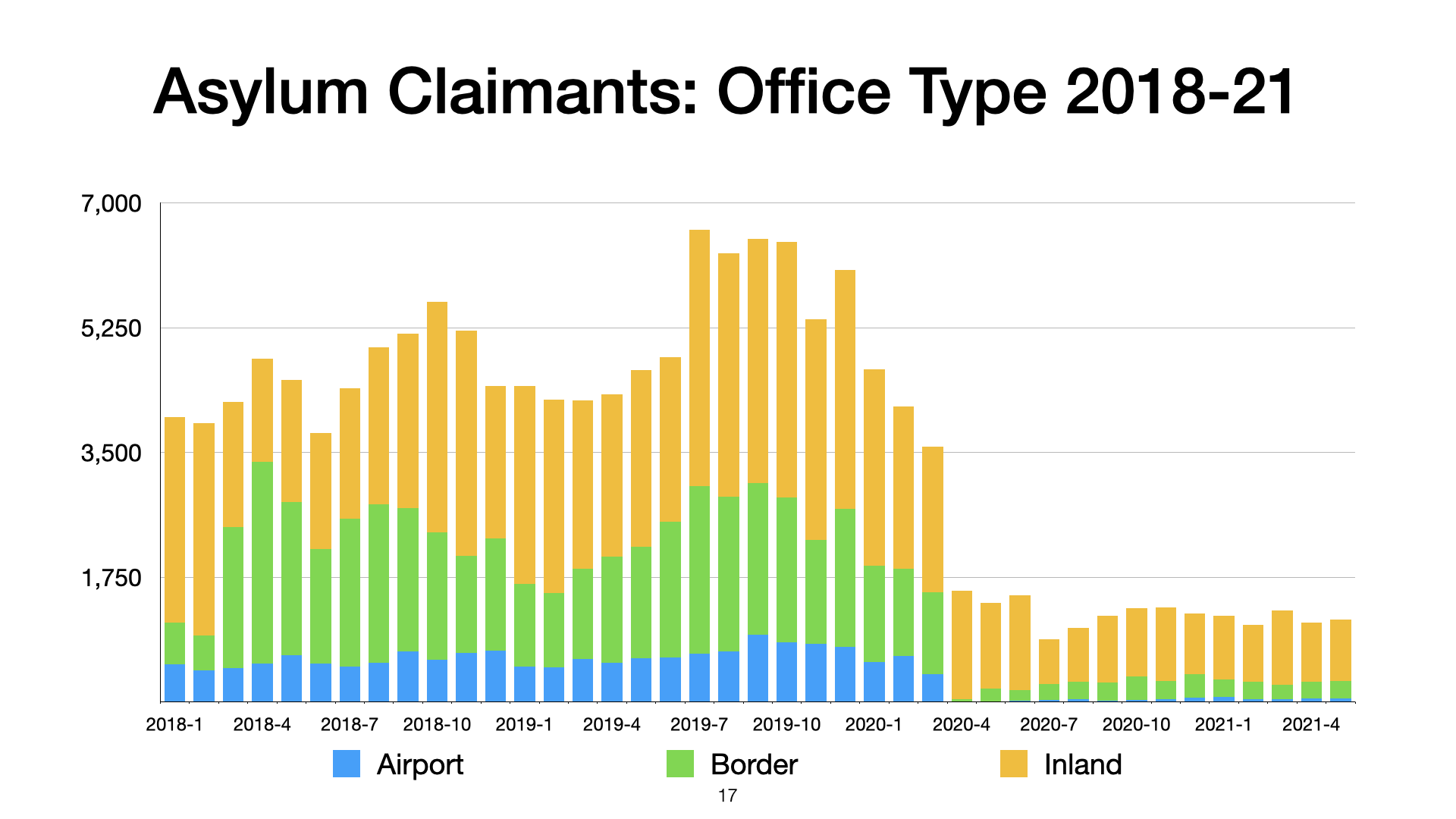
Covid-19 immigration effects - Key Slides - May 2021 Draft.017On the good news side, the IRB backlog declined dramatically, with new claims falling by 68% and the backlog by 30%.

The progressive reduction in travel restrictions and requirements should allow for a more normal flow, with less concern for the irregular arrivals at non-official border posts given the Biden Administration’s approach:

Thanks to COVID-19 outbreaks in jails, immigration detainee Apollinaire Nduwimana was released from a U.S. prison in late April last year, after being held among convicted criminals for almost three years.

The asylum seeker from Burundi tried to head north for protection at Roxham Road in Quebec last October. But he didn’t know Canada had closed the border to refugees.

He was immediately intercepted, sent back to America and detained at the Clinton jail in Pennsylvania. He was threatened with deportation to his homeland despite assurances from Ottawa to let him return once COVID travel restrictions were lifted.

As of July, Nduwimana was one of 450 asylum seekers “directed back” to the U.S. since March 21, 2020, when Ottawa closed the border to non-essential travels. Although there have been exemptions, seeking asylum isn’t one of them.

With Ottawa slowly easing its travel restrictions, and border rules with the U.S. up for renewal on Wednesday, advocates say the federal government’s first order of business should be reopening the door to asylum seekers and sponsored refugees, the most vulnerable migrant group during the pandemic.

“Refugee travel is essential, we know that no one chooses to be a refugee,” said Maureen Silcoff, president of the Canadian Association of Refugee Lawyers. “Refugees can in fact enter and quarantine. So that really should have been the starting point.”

According to the latest UN Refugee Agency report, 1.5 million fewer people fled their homelands in 2020 than forecast, but the world’s displaced population still edged to a record 82.4 million by the end of last year, up from 79.5 million in 2019.

That’s because, it said, asylum seekers were unable to cross borders, with 164 countries imposing travel bans, and 99 states, including Canada, making no exception for people seeking asylum.

In total, only 34,400 refugees were resettled to third countries in 2020, down 69 per cent from 107,800 the year before. Today, 1.4 million refugees are awaiting resettlement.

Amid the chaos, the Immigration and Refugee Board of Canada is the rare beneficiary of the border closure.

Last year, the number of new claims fell 68 per cent to 18,500, from 58,378 in 2019. These were mostly from those within Canada who entered legally and later decided to seek asylum, or who came to the border before the lockdown or belonged to one of the exemption groups.

The slowdown allowed the board to reduce its backlog, which fell 30 per cent to 65,000 by the end of June, from 91,300 in March 2020, as refugee judges moved hearings online and adapted to new health protocols in offices.

Nduwimana first arrived in the U.S. for asylum in 2017 but was detained until his release in April 2020.

Thanks to interventions of advocates on either side of the border, he is one of nine asylum seekers who have been issued a “national interest exemption letter” to return to Canada on a later date after he was turned back at the border.

But it’s not without hassles because there are no bilateral policies to ensure these “direct-back” asylum seekers will be released from detention or spared from deportation to come back to the border.

“I am not a criminal but I was detained with people convicted of murder and rape,” said Nduwimana, 41, who fled political persecution in Burundi, an East African country where human rights violations are such that Canada suspends all removals to that country.

“Canada has the obligation to protect asylum seekers. Instead they sent me back to a country that’s not safe for refugees,” added the former church pastor and university language instructor, who almost got deported in January before a U.S. court intervened.

Upon his release in March from another jail in upstate New York, he entered Canada at Fort Erie and had his 14-day mandatory quarantine at a Niagara hotel. He is now awaiting his proceedings.

Silcoff said Nduwimana’s case shows refugee travel can coexist with public health measures and the current refugee ban can be lifted.

Despite public fear that Canada would see another surge of asylum seekers once the border reopens, Silcoff believed that’s unlikely under the new White House administration. Since Joe Biden became president in January, Washington has reversed many Trump-era anti-migrant, anti-refugee policies.

Temporary protected status has been granted to migrants currently in the U.S. from major refugee source countries such as Haiti, Venezuela and Yemen. In June, the U.S. restored the possibility of asylum protections for women fleeing domestic violence in other countries as well as for families targeted by violent gangs.

“It’s a different climate,” said Silcoff. “It’s hard to know what the future would bring but we know that Canada is able to handle fluctuations in numbers of asylum seekers.”

During the pandemic, Ottawa has also rolled out several measures that involved asylum seekers and failed refugees in Canada, such as releasing immigration detainees with less serious immigration violations and suspending deportations at the peak of the pandemic.

Another positive during this global public health crisis is the special program that grants permanent residence to asylum seekers who work in health care and essential jobs during the pandemic, said Janet Dench of the Canadian Council for Refugees.

“So there have been some good parts,” she said.

In June, the immigration department also announced plans to expedite the processing of permanent residence applications of people who have been granted asylum in Canada, with a new target of 45,000, up from 23,500.

That commitment will help someone like Mohammed Jadallah, who fled to Canada for asylum from Gaza via the U.S. in 2018 and has since been separated from his wife and five children.

When war erupted between Hamas militants in Gaza and Israel earlier this year, with bombs raining down on his homeland, the 41-year-old Toronto man could only console his family helplessly from afar, on a computer screen.

Although he was granted protected status in Canada in October and immediately applied for permanent residence, the process was set to take an average of 39 months.

“There was an airstrike in our neighbourhood in Rimal. The building that’s just 200 metres from ours was flattened,” said Jadallah, a rebar detailer, whose family struggles with food and fuel shortages.

“As a parent, you try to protect your children. It’s so hard when you can’t do nothing for them.”

Until he receives his permanent residence, Samaa, 37, and their children — Nidal, 15; Asil, 12; Mustafa; 9, Ali, 8; and Yusuf, 5 — cannot join him in Canada.

Dench said that speaks to the need to do away the bureaucracy that requires accepted refugees to go through all the hoops to apply for permanent residence.

“It will cost us less if we give them permanent residence more quickly because then it makes it easier for them to upgrade their skills and to reunite with their family and to contribute more fully,” she said. “If you’ve been vetted and accepted as a refugee, you should be automatically a permanent resident.”

During the pandemic, the resettlement of overseas refugees in Canada has also come to a halt due to border closures and the reduced processing capacity by the International Organization for Migration, the UN and local Canadian visa posts — except for the most vulnerable who require emergency resettlement.

As of the end of October, only 2,879 resettled refugees landed in Canada since March 18, 2020, including 1,603 sponsored by community groups, 1,262 by the federal government, and 14 through a joint public and private sponsorships. Another 40 arrived under the “urgent protection” program.

In 2021, Ottawa has set a target to bring in 36,000 sponsored refugees, but only 1,630 had arrived by the end of April, according to a report by Reuters. Last year, the target was 31,700 but only 9,200 made it, leaving 22,500 spots unfilled.

Critics ask: Will Immigration Minister Marco Mendicino allow the unused spots to carry over in coming years when international travel is back to normal?

“It’s 65,000 who are in the queue essentially, who are waiting to travel,” said Brian Dyck, national migration and resettlement program co-ordinator of the Mennonite Central Committee Canada. “And that queue has never been longer than now. Their applications are going in but there are none that are going out.”

Those who managed to come during the pandemic, he said, had their proof of permanent residence in hand on or before March 18, 2020.

While the task to bring in a huge number of sponsored refugees in a short time appears daunting, Dyck said that’s doable, as shown in how Canada and Canadians successfully brought in 25,000 Syrian refugees in a matter of months in 2015 and early 2016.

“I think that the government has learned how to use a variety of networks to process sponsorship applications in different ways,” he noted..

And there’s been no shortage of public support during the pandemic, said Dyck, whose office has continued to receive a lot of inquiries from people looking to sponsor refugees even without promoting the idea.

Torontonian Marika Elek and her sponsorship group, Beach Cares, submitted a private sponsorship application in January to bring a Syrian family of five to Canada from Lebanon.

“I remember what happened in 2015 and 2016 when there was a real surge of refugees coming in, and people managed to handle that,” said Elek, whose family was sponsored here by the Canadian government in 1957 from Hungary when she was a girl.

During the pandemic, she and some 350 sponsors got together online and officially launched The Private Refugee Sponsor Network to “connect, learn and share” information and provide free training to help each other problem-solve in anticipation of the border reopening.

“We have people who are ready to welcome them.”
Source: As Canada eases COVID-19 border restrictions, advocates say refugees’ travel is ‘essential’

Canada begins accepting Hong Kong pro-democracy activists as refugees

Welcome and likely the start of a future wave:

Canada has begun accepting Hong Kong pro-democracy activists as refugees, a sign that this country is opening its doors to those fleeing Beijing’s crackdown on civil rights in the former British colony.

In a Sept. 1 letter, the Immigration and Refugee Board of Canada notified a married couple from Hong Kong, both in their early 30s, that the refugee protection division has determined they are “Convention refugees” and their claims for asylum have been accepted.

Under Canadian law, a “Convention refugee” refers to the United Nations Convention relating to the Status of Refugees and is defined as someone who cannot return to their home “due to a well-founded fear of persecution based on race, religion, political opinion” or other factors.

The Globe And Mail spoke to the Hong Kong couple, who originally arrived in Canada last December, but is withholding reporting certain details of their cases because they fear retribution against themselves or families back in Hong Kong by agents of the Chinese Communist Party. The Globe is also granting them confidentiality for the same reason.

The Hong Kong man, 33, who has been accepted as a refugee, said he was a very active protester in the pro-democracy movement in the Asian city, including with a well-known political party that put pressure on the local government to implement universal suffrage. He and his wife, 30, also took to street protests in 2019 amid mass demonstrations that followed efforts by Hong Kong’s leadership to enact legislation that would allow extradition to mainland China.

The man said he was on the front lines of demonstrations in 2019 and ran a warehouse to produce defensive equipment for protesters. He said he was at one point detained by Chinese authorities – they were not wearing uniforms – and Hong Kong police followed him and searched his home, but he was never charged.

He said near the end of his time in Hong Kong, fearful for his safety, he ended up hiding in a cave under a building.

Now, with asylum in Canada, he said: “It feels now like I no longer need to hide, and I am finally somewhere I can live safely.”

He said he is very thankful for Canada’s decision, a country he said shares common values with Hong Kongers.

Immigration lawyer Richard Kurland, who is not representing them, said he believes these two Hong Kongers are among the first pro-democracy activists to be granted asylum. He said he believes a few others may have already obtained refugee status as well.

“These are the first of a small number,” Mr. Kurland, based in Vancouver, said. “This is like the starter’s gun.”

He said accepting refugees from Hong Kong, however, is an indictment of the Asian city’s justice system, which still retains the legacy of institutional frameworks from Britain, despite Hong Kong’s 1997 handover to China under a one-country, two-systems formula.

“By implication, the Canadian refugee determination system has put the Hong Kong judicial system into disrepute. The person has no internal flight alternative, and cannot reasonably rely upon Hong Kong’s judicial structure for protection.”

The Globe reported earlier this year that close to 50 Hong Kongers – many of whom took part in the massive demonstrations that began last year – have already applied for asylum in Canada, citing harassment and brutality at the hands of police in Hong Kong and fear of unjust prosecution.

Conservative foreign-affairs critic Michael Chong said Canada must do more than just “accept a handful” of asylum seekers from Hong Kong, where a harsh new security law was imposed by Beijing this summer – one that criminalizes dissent and opposition.

“Processing a handful of asylum claims from those fleeing Hong Kong is not commensurate to the crisis that is unfolding there,” he said. “Canada needs to do more to provide a path for those seeking asylum from the imposition of China’s draconian new national security law.”

Mr. Chong said Canada should work with allies, such as Britain, to admit many more Hong Kongers fleeing. There is no reason why Canada couldn’t follow the British lead by offering a path to citizenship to Hong Kong residents, he said.

Hong Kongers coming to Canada would enrich the country because “they are highly educated” and would provide immense economic benefit, he added.

Avvy Go of Toronto’s Chinese and Southeast Asian Legal Clinic said it’s urgent to act now to help the people of Hong Kong.

“The situation is getting worse. More and more people have been arrested. It is clear the Hong Kong government is not going back down. … We need [to] act now before they arrest more people and their passports are seized,” she said.

Mr. Kurland said he still expects a surge of immigration from Hong Kong and more refugee claims. Canada has not yet unveiled special measures to facilitate migration from Hong Kong. He said Ottawa appears to be keeping this in abeyance until “things turn urgent and you see a wave of claimants from Hong Kong.”

Former Liberal justice minister Irwin Cotler, an international champion of human rights, urged the Trudeau government to grant asylum to any Hong Kong resident seeking to escape China’s draconian national security law.

“I wouldn’t be limiting it to two. This has been such a serious assault on democracy for the national security legislation that impacts on everyone … and puts anyone in Canada who supports them at risk so we need to have a response that says we are here to protect those who we are able to protect and to facilitate their coming to Canada,” he said.

The Hong Kong couple accepted as refugees received the support of a Canadian group called New Hong Kong Cultural Club.

Source: https://www.theglobeandmail.com/politics/article-canada-starts-accepting-hong-kong-activists-as-refugees/

Canada is releasing immigration detainees at ‘unprecedented’ rates amid COVID-19 fears

Seems like calls have been listened to. Will see if the opposition raises this as a question period or committee issue:

The number of immigration detainees held in provincial jails and immigration holding centres across Canada has dropped by more than half since COVID-19 was declared a global pandemic, according to data provided to Global News.

And recent decisions from the Immigration and Refugee Board of Canada(IRB), the administrative tribunal that presides over immigration refugee matters, show how fears over COVID-19 are playing a significant role in some rulings to release immigration detainees.

On March 17, there were 353 immigration detainees held in provincial jails and immigration holding centres across Canada, according to data from the Canada Border Services Agency (CBSA).

By April 19, that number dropped by more than half to 147 detainees, 117 of whom were being held in provincial jails. The remaining 30 were held in one of Canada’s three immigration holding centres located in Toronto, Laval, Que., and Surrey, B.C.

“We would never normally see such a dramatic drop in detention (detainees) in such a short period of time. That’s unprecedented,” said Swathi Sekhar, an immigration and refugee lawyer based in Toronto.

A number of legal and advocacy groups have been calling for the release of immigration detainees and people held in jails and prisons who are not deemed risks to public safety due to the rising number of COVID-19 cases in these facilities, and the conditions there that make it difficult to isolate and control the spread of infection.

The majority of the immigration detainees held in jails are located in Ontario, which has been grappling with COVID-19 cases in its correctional facilities. Thousands of inmate in Ontario jails have been released in recent weeks as the province grapples with the outbreak.

Thirty-three of the 117 immigration detainees held in provincial jails as of April 19 were detained at the Maplehurst Correctional Complex in Milton, a combined maximum-security jail for remanded prisoners and a medium/maximum-security jail for convicted offenders serving sentences of less than two years.

Foreign nationals and permanent residents can be detained — sometimes indefinitely — by CBSA officers if the person is deemed unlikely to appear for an immigration proceeding like a hearing, if the person is deemed a threat to public safety or if the person’s identity is under question. Most detainees are held on the grounds that they are unlikely to appear for proceedings or because of questions over their identity.

Immigration detainees are held on administrative and not criminal grounds like a typical jail or prison inmate. Immigration detainees can be held in one of Canada’s three immigration holding centres, which resemble medium-security prisons, or in provincial jails across the country, depending on the circumstances of their case, or if there is no immigration holding centre in that part of the country.

Last month, the Canadian government enacted an emergency order under the Quarantine Act that prohibits entry by individuals into Canada for the purpose of claiming refugee protection.

“This new order has reduced the number (of) asylum seekers remaining in Canada or being detained,” a CBSA spokesperson said in an email. “Also, since a lot of our admissions into (immigration holding centres) or provincial facilities are directly related to traveller volumes, it is not unexpected to see the overall number of admissions go down.”

“CBSA officers are asked to focus efforts to explore all viable alternatives to detention for all cases, where there is no public safety concern.”

Recent detention review decisions provided to Global News from the IRB show how COVID-19 is being factored into determining whether or not to release someone from immigration detention.

One IRB decision from April 3 involves a Colombian man who had been detained in the Toronto immigration holding centre since Jan. 23 because he was deemed a danger to the public and unlikely to appear for his removal from Canada to Colombia. However, he was released on a bond in large part due to the risk of being exposed to COVID-19 while in detention. He was ordered to abide by a number of strict conditions as part of his release.

The IRB decision-maker, Jacqueline Swaisland, stated that the man, Angelo Rincon, has a history of non-compliance with immigration laws “at least in three countries” and has also violated criminal laws in Canada and the United States. This includes a conviction for possessing a controlled substance for the purpose of selling, another conviction related to a number of break-and-enters in the Greater Toronto Area last year and possession of property obtained by crime.

The decision-maker said that while Rincon was deemed a danger to the public due to his criminal history, “I find the danger that you pose to be at the low end of the spectrum” because of the limited sentences he had received for his convictions, his “stated remorse under sworn testimony” and “the fact that there has been no violence in the commission of any of the offences you have been involved in…”

In determining whether to release Rincon from detention, Swaisland stated that Rincon had already been held in detention for more than two months, something that weighs in his favour, and “with respect to anticipated length of detention [it’s] agreed by all parties that at this point it is unknown because of the COVID-19 pandemic.”

“And it could be long given Canada is currently not enforcing removals and given that Columbia is not permitting the repatriation of even (its) own nationals and it is not clear how long that will go on for given the current COVID-19 pandemic,” Swaisland stated.

Last month, the CBSA temporarily halted deportations of people whose refugee or immigration claims had been rejected, with the exception of serious criminal cases that will be evaluated on a case-by-case basis.

The decision goes on to note that Rincon’s counsel provided “significant documentation” on the risks that someone in detention faces and his own fears associated with his potential exposure to the virus in the facility due to an underlying condition. TVO reported last month that an employee at the Toronto holding centre had contracted COVID-19 and had been in self-isolation.

“I find that the risk that you face are not at the same level of detainees in correctional facilities (particularly) given that there is such a limited number of the detainees currently being housed at the immigration holding centre, 15 as of today and given the significant steps that are being taken to reduce the risks to individuals being detained at the holding centre currently,” Rincon’s decision states.

“(But) even though the immigration holding centre is taking significant precautions, they are not perfect. And you still have a high risk of exposure and significant restrictions on your ability to self-isolate in a manner that the documentary evidence seems to suggest that is required with this virus.”

COVID-19 is also cited in an IRB decision from March 30 involving a Chilean woman who had been detained at the Toronto immigration holding centre since March 17 because she was deemed unlikely to appear for her immigration proceedings. The decision states that the woman may be released from detention as long as she abides by a number of conditions, including living at a shelter and reporting regularly to the CBSA.

Her identity and some of the details of the decision are redacted, as she has a pending refugee claim, which is subject to privacy rules. The decision notes that the woman’s refugee claim is on hold for the time being, and proceedings will resume “once the pandemic is addressed and the Immigration and Refugee Board begins to hear and process claims again.”

“You are now waiting for your (refugee) hearing which under normal circumstances can be a long process and everything is delayed now due to the pandemic,” the decision-maker, Julia Huys, said to the woman.

Huys goes on to describe the elevated risk of exposure to COVID-19 among detainees.

“I am taking note that the conditions in the immigration holding centre may be better than provincial jail but I find only slightly,” Huys said.

“So detained people will come into contact with many others including detainees, other detainees, guards, staff, and movement in and out of people … from the immigration holding centre. And I am also taking very seriously the fact that there has now been a case of COVID-19 at the immigration holding centre with one of the staff.”

An IRB spokesperson said in an email to Global News that it’s “open to decision-makers to consider any relevant factors in determining whether detention is justified, including COVID-19 and its potential risks to detained individuals.”

The IRB also noted that its immigration division is “entertaining requests from parties for early detention reviews, for example to consider alternatives where the person detained may have a vulnerability that places them at elevated risk from the virus or any cases with an alternative to detention.”

Source: Canada is releasing immigration detainees at ‘unprecedented’ rates amid COVID-19 fears