Douglas Todd: The Wild West in B.C. housing is mostly over, but the devastation goes on

The naïveté of political leaders at all levels of government. Fortunately, Canada shut down its immigrant investor program but inexplicably, Quebec maintains its program despite it largely being a backdoor entry to elsewhere in Canada. David Ley’s latest book and analysis featured:

The New York Times told the world about B.C.’s unusually grim housing crisis last decade when it ran articles with headlines such as the “Housing Frenzy that Even Owners Want to End” and “The Wild West of Canadian Political Cash,” which looked at developers’ outsized influence on governments.

Those years of out-of-control, largely unregulated property investments, which caused drastic unaffordability in Metro Vancouver, are captured in bold, and sometimes painful, detail in a new book by David Ley, a University of B.C. geography professor emeritus.

His immaculately researched book, Housing Booms in Gateway Cities, looks into how the unparalleled movement of transnational capital and people into cosmopolitan Vancouver, Sydney, Hong Kong, Singapore and London led to skyrocketing housing prices and rents.

Ley’s extensive sections on the Vancouver region add up to a cautionary tale. He outlines the dark consequences of the blind faith that Canadian and B.C. governments put in libertarian, growth-at-any-cost ideology.

The book comes with three propositions: That financial deregulation has made housing a bigger investment than ever, that “gateway” cities are especially attractive to foreign capital and exaggerated prices, and that local wage earners are being left behind.

“Conventional housing market explanations are no longer adequate in gateway cities where ‘fundamentals’ must be rescaled to include immigration, offshore investors and the role of the global real estate industry,” Ley says

While the geographer looks at how times have changed in recent years, with housing becoming more regulated, at least in B.C., it’s crucial to follow Ley’s analysis of the political decisions that contributed to Metro Vancouver (and Victoria) ending up in this sorry mess. A recent Angus Reid poll found “three quarters of Vancouver tenants could not afford to buy, or never expected to be able to buy, a home.”

A significant part of the problem goes back at least a decade, to when the federal and B.C. governments were desperate to attract foreign capital. Politicians of all stripes were jetting off on Asia-Pacific trade missions, while Ottawa ramped up an immigration scheme that eagerly welcomed rich people — in a way that especially affected Metro Vancouver.

The business immigration program, by which the wealthiest could gain entry by “investing” in Canada, brought 200,000 people to Vancouver alone, says Ley. They had tens of billions of dollars to pump into the economy, with the heftiest portion channelled into the “asset” of housing.

Large Vancouver property developers, along with those in London and Sydney, opened scores of sales offices in East Asia to serve business-class immigrants and other affluent transnationals. The director of marketing at Vancouver-based Westbank said, “China is now a big part of this business … right now I have a rule when we talk about projects, if the Chinese market doesn’t want it, I have no interest in it.”

Royal Pacific Realty, specializing in China and Asia-Pacific investors, grew to 1,200 staff, notes Ley. And Macdonald Realty acknowledged 21 per cent of sales of Vancouver properties worth $1 to $3 million went to purchasers from mainland China. In 2016, the B.C. dwellings of investor-immigrants from China were valued on average at $3.3 million, over twice the value of Canadian-born residents.

While the federal Conservatives shut down the investor-class immigration program in 2014, the doggedly free-market B.C. Liberals, especially the minister responsible for housing, Rich Coleman, remained gung-ho on funnelling more offshore cash to the housing industry.

Coleman, Ley writes, went so far as to make “the remarkable claim” that Vancouver prices were “pretty reasonable,” even though they were far more unaffordable than even pricey London and Singapore. Coleman also refused to publish figures on foreign investment, adding he had no control over it.

Meanwhile, the B.C. Liberals chose condo marketer Bob Rennie as their chief fundraiser, welcoming tens of millions of dollars in donations from the development industry, far more than from any other sector.

According to Ley, when the NDP defeated the economically libertarian B.C. Liberals in 2016, it was largely because of housing.

The trouble is, the damage from that era carries on to this day.

As Ron Butler, the Vancouver-raised president of one of Canada’s largest mortgage companies, says: “The most important thing to understand about foreign capital is it never goes back.” No matter if the money comes from China, Iran or the Middle East, Butler says, once here “it just sloshes around,” mostly in real estate.

Seven years ago the NDP began bringing in regulations, such as the speculation and vacancy tax, to restrict housing demand, foreign and domestic. The NDP also drastically reduced the ability of developers, including from offshore, to donate to political parties.

For a few years after 2017, the NDP’s regulations helped to cool prices, says Ley, whose earlier book was titled Millionaire Migrants.

But then, in 2020, with almost bizarre effect, COVID-19 hit. With interest rates hitting rock bottom and Ottawa printing new stimulus money, Ley says house prices again heated up. The NDP’s relatively mild tax interventions to reduce investor demand weren’t strong enough. Prices are again stratospheric.

Still, in recent years, federal, provincial and municipal governments are at least starting to share some common ideas, Ley says.

They’re recognizing investors are overwhelming wage earners in the housing market. They are recognizing that “in major cities, real-estate investment has become global” and that a “freewheeling” market is vulnerable to tax fraud and money laundering. They also recognize that new housing and rental “supply” must be affordable, and that “taxation is one appropriate vehicle to manage speculative demand.”

As a result, in some ways, the libertarian Wild West housing days are over, at least in B.C., which has been more proactive in regulating housing than the Liberals in Ottawa.

Even though higher interest rates are slowing down the market, Demographia continues to rank Vancouver the most unaffordable city in North America. And with all that transnational cash still sloshing around, investors have come to own almost half of the condos in Vancouver.

Metro Vancouver’s housing market is so abnormal, so unequal, that a recent Angus Reid poll found two-thirds of regional respondents defying conventional consumer thinking and not wanting house prices to rise.

Those respondents included many homeowners who actually want prices to fall, even though it goes against their own financial self-interest. Such homeowners don’t want to see a younger generation unfairly locked out of decent shelter.

Source: Douglas Todd: The Wild West in B.C. housing is mostly over, but the devastation goes on

Foreign Investor Immigrants Stymied By Restrictive U.S. Border Entry Rule

Even though not a great believe in the value of investor immigration, still notable these restrictions under USMCA:

Foreign investors investing in the United States today are being stymied by a U.S. immigration border policy that is preventing them from looking after their businesses in the country. The policy is particularly aggravating to Canadian investors, but is also a problem for other foreign investors that are not visa exempt, that is, from countries where the applicant must apply for a B-1/B-2 visitor’s visa to come to the USA. The relevant rule could be easily changed by U.S. Customs and Border Protection (USCBP) through a policy directive. The question is what useful purpose does the current policy serve if it is needlessly interfering with foreign investments in the United States?

The Problem

The problem has arisen largely due to the Covid-19 pandemic. Foreign investor appointments for E-2 treaty investor visas under the USMCA, formerly the NAFTA free trade agreement, are taking an inordinate period of time to schedule. Indeed, at one point, consular officials in the past were even unable to say how long it would take to get interviews for E-2 visas. This left foreign investors having to come to the U.S. in some other way until they could finally get their E-2 visas. While applying for a change from visitor to E-2 status inside the U.S. is a possibility, some time ago the Consul General at the Toronto Consulate advised U.S. attorneys to avoid that option, implying such applications are likely to be denied. It appears that U.S. officials saw resorting to a change from business visitor to E-2 status inside the U.S. as playing the system because processing of E-2 visas are normally in the purview of U.S. Consulates abroad. So the only reasonable way has been to enter the U.S. as business visitors.

The key snag is the limitation in the amount of time that E-2 investors are allowed to stay in the U.S. in visitor status. Current border policy is to grant a maximum of six months. Indeed, the policy is to refuse entry to business visitors who have already been physically present in the U.S. for six months in any year.

Unwritten Policy Rule

In a previous Forbes article I described the rule as follows:

“For Canadians, one of the issues that often arises is whether the visitor has already spent more than 183 days in a year in the USA. U.S. Customs and Border Protection (USCBP) officers have been enforcing what Ira Kurzban, the Dean of American immigration attorneys and author of the authoritative book Kurzban’s Immigration Law Sources, diplomatically calls an “unwritten rule” that visitors may not spend more than 183 days in any year in the USA. Written or not, the USCBP custom at the U.S.-Canada border is to prevent visitors from entering in most cases when it is determined that the visitor has already accumulated 183 days of U.S. physical presence in the last year.

The rationale for the rule comes from the way USCBP officers assess visitors coming to the U.S. As a general rule, such officers consider the following elements in making a decision about allowing a visitor to enter the U.S. Firstly, is the applicant a security threat? Secondly, is the applicant a criminal? Thirdly, is the applicant working illegally in the U.S.? Finally, is the applicant really living in the United States permanently but only saying he is visiting? A convenient way of implementing the policy considerations raised by such thinking is to prohibit visitors from entering the U.S. for more than 183 years in any year. After all, how many people can live without earning income for six months or more?”

Serious Hardships

Until visa wait times at the U.S. consulate in Canada are reduced to reasonable levels, however, this rule is imposing serious hardships on E-2 investors. To qualify for E-2 visas, investors have to make more than a marginal commitment of their funds into the United States. Usually this takes the form of a purchase of a business, a hotel for example. Sometimes it takes the form of a start-up where the investor hires employees or commences offering products or services. Whatever the form taken, foreign investors want to be able to be where their money is to be on top of what is going on.

What is needed is for the USCBP to realign its policy with the needs of investors and with the processing times of the U.S. consulates abroad, including the ones in Canada. At the present time, scheduling interviews at U.S. consulates in Canada for E-2 visas for example, are taking at least eight months or more. Applying the current USCBP 180-day policy means that Canadian investors can be shut out of the United States for at least two months or more while awaiting approvals. Clearly these investors need to be granted more than six months time in the U.S. under these circumstances. In the normal course of events the USCBP has the authority to grant business visitors up to one year’s time on an entry. So why not grant these investors such approvals?

A False Alternative

It is true that such investors can apply to extend their visitor’s status for another six months from inside the U.S. But that is a needless extra hardship that is fraught with uncertainty and possible unpleasant future consequences while the investor awaits a ruling. Why put the investors in that position?

What E-2 Visitors Can Do

While business visitors are constrained in what they can do while being in the United States, still such a visitor is at least entitled, “to examine or monitor potential qualifying investments” so as to be ready to apply for an E-2 visa. True, the investor must behave as a business visitor and is “precluded from performing productive labor or from participating in the hands-on management of the business.” Still, there is a list of things such a visitor can do. For example, a business visitor can observe the conduct of business, negotiate contracts, undertake study incidental to the purpose of the stay, consult with clients or business associates, participate in conventions, conferences, or seminars, make phone calls, give employees instructions, take clients to their cars and even engage in commercial transactions outside of gainful employment. The key is no “hands-on-work” and no salary being paid. This can all work if handled properly.

Being Reasonable For A Change

Assuming the USCBP officers applied a more reasonable time frame policy for business visitors dealing with E-2 investments by matching visiting times with likely consular processing times of E-2 visa application, and assuming officers were reasonable in how they viewed what these investors are doing while complying with their periods of authorized stay, these headaches could be avoided and a more reasonable business-friendly environment could be created for E-2 investors.

Why not give it a try?

Source: Foreign Investor Immigrants Stymied By Restrictive U.S. Border Entry Rule

Ontario to accept 100 immigrants after each invests $200,000 in local companies

Hard to see that this will work any better than other investor immigration programs in terms of contributing to the economy:

Ontario is planning to accept 100 immigrants in the next two years under a program allowing foreign entrepreneurs to apply for immigration to the province after they invest a minimum of $200,000 in its economy.

Labour Minister Monte McNaughton says the government will focus on attracting international entrepreneurs to Ontario communities outside the Greater Toronto Area.

He says these entrepreneurs will be nominated for immigration under the province’s economic immigration program after they start a new business or purchase an existing one in Ontario.

McNaughton says the new initiative will cost the government $6 million, but it will be recovered through fees paid by immigrants who are coming to the province to start or buy businesses.

He says the province is expecting at a minimum $20 million in business investment generated through this immigration stream.

The previous Liberal government in Ontario had founded this stream in 2015 but only two immigrant investors have been nominated using it since then.

“I see immigration as one of the key economic drivers of Ontario’s growth,” McNaughton said. “There’s an opportunity to create new businesses outside of the GTA, to create more jobs for people across the province.”

McNaughton said the program will help with the recovery of the Ontario economy after COVID-19 pandemic.

“We have to be aggressive as we build back better out of the pandemic to recruit entrepreneurs to Ontario,” he said.

Last month, Ontario called on the federal government to double the number of immigrants allowed under the Ontario Immigrant Nominee Program — from 9,000 to 18,000 a year — a program aimed at boosting the skilled workforce.

McNaughton said the province is facing a significant labour shortage that has been intensified by the impact of the COVID-19 pandemic.

Source: Ontario to accept 100 immigrants after each invests $200,000 in local companies

Douglas Todd: Time to end ‘honour system’ in Quebec’s immigrant-investor scheme

Good reminder of the scam that is the Quebec immigrant investor program and good for Richard Kurland for obtaining and analyzing the data that highlights just how much it is a scam.

Just as Quebec unduly benefits from the 1991 immigration accord that provides Quebec with greater funding per immigrant than other provinces, one that remains a fixed percentage of total settlement funding, irrespective of Quebec immigration levels, meaning that as Quebec decreases its immigration intake under the Legault government, the imbalance increases.

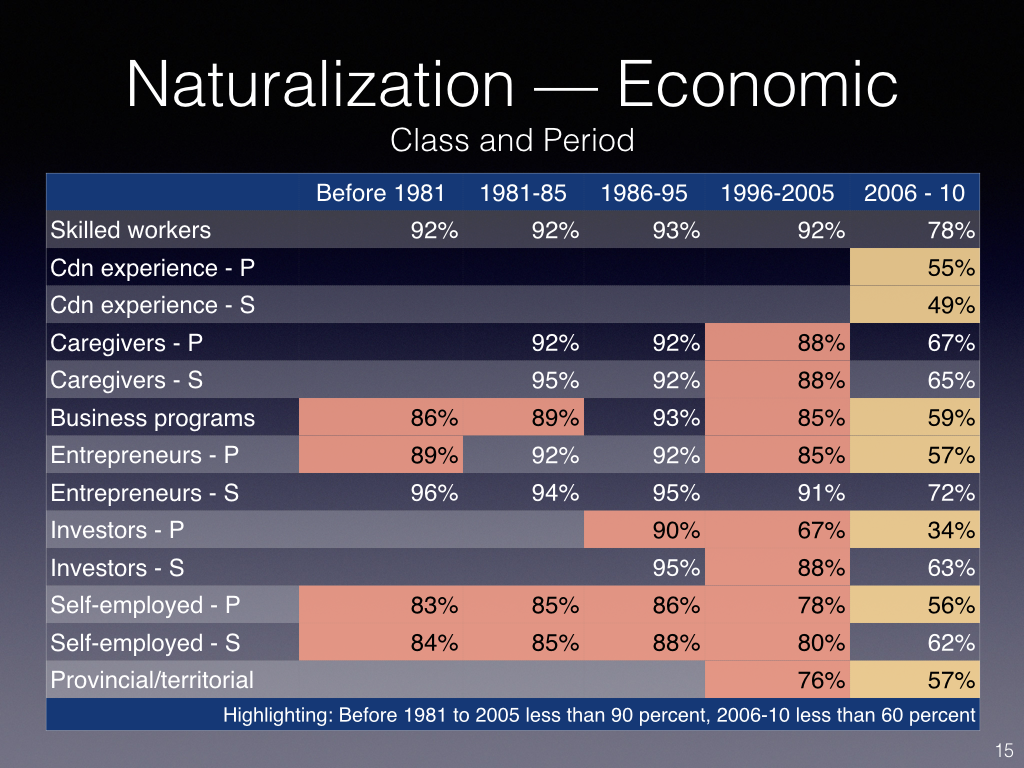
And good for the Conservatives under Jason Kenney for cancelling the federal program. When I analyzed citizenship data by immigration category, the lowest incomes (LICO prevalence) were reported by business immigrants as shown in the chart below (grouped under “Entrepreneur etc):

It’s time for Ottawa to end the honour system that allows nine of 10 wealthy immigrants to renege on their promise to live in Quebec.

Federal immigration officials have released information showing 91 per cent of the tens of thousands of applicants approved by Quebec’s Immigrant Investor Program in recent years have been exploiting a loophole in the plan, which critics consider a “cash-for-passport” scheme.

The Quebec program’s glaring flaw also illustrates a wider problem for the country and its provinces, says Vancouver immigration lawyer Richard Kurland.That is, Ottawa does not seem interested in trying to make all would-be immigrants to Canada follow through on residing in their declared “intended province of destination.” There are taxation measures that could be introduced, Kurland said, that could ensure more immigrants follow through on their stated commitments.

Even though Quebec’s immigrant-investor program is set to re-open this summer, after being temporarily suspended to deal with a backlog of more than 5,000 applications, critics don’t want to see it start up again under the same rules.

“There are two reasons Quebec’s program has been a failure, leading to abuse of the system,” says Burnaby immigration lawyer George Lee, whose clientele is predominantly from China.“It’s freezing cold in Quebec in the winter, so (many) people from Asia find the weather intolerable,” said Lee.

“Secondly, language-wise, there’s a problem. Most people in China learn English rather than French. As a result, many of Quebec’s investor immigrants don’t ever even fly into Montreal or Quebec City. They just use the Quebec program as a bridge to get to English-speaking cities in Canada.”

Kurland, who obtained six years of recent data on the more than 25,000 investor immigrants and family members who have never fulfilled their stated promise to reside in Quebec, said a simple new tax measure would likely stop the exploitation.

All Ottawa has to do is delay granting permanent resident status to newcomers to Quebec (or any other province) until they file an income tax return as a resident of their declared province of destination, said Kurland, who has frequently travelled to Ottawa to advise Parliament on immigration policy.For his part, Lee realizes that residents of Canada have mobility rights under the Charter of Rights and Freedoms. But, like Kurland, he believes Ottawa could find ways to go further to ensure compliance to regional residency commitments than a misused honour system.

Lee worries Quebec doesn’t want to reform its immigrant-investor program.

“Quebec’s happy with the scheme,” he says, because the province gets substantial amounts of money injected into its coffers without having to provide new arrivals and their families with taxpayer-funded medical care, social services and education.The data obtained by Kurland under an access to information request shows that in 2017 only 342 of the 5,015 people approved under Quebec’s investor category actually had a primary residence in the province.

In 2018, just 518 of the 6,064 people approved were found to be living in Quebec. And up until October of last year, only 528 of the 4,136 approved were residing in the that province.


This chart shows over six years how nine of 10 applicants and their dependents approved as permanent residents under Quebec’s immigrant-investor program did not reside in Quebec. (Source: Immigration, Refugees and Citizenship Canada, via Richard Kurland)

The investor scheme has not been the only immigration program that provides unusually large financial benefits to Quebec. Because of a 1991 funding accord, Ottawa also provides Quebec with roughly four times as many taxpayer dollars to settle each of its immigrants as B.C., Ontario and several other provinces receive.

Meanwhile, an internal federal immigration document, also obtained by Kurland, acknowledges growing criticism of “golden-passport” schemes such as the one that remains in Quebec, the only Canadian province ever granted separate immigration powers.

The Immigrant, Refugees and Citizenship Canada report from 2019 reveals that four of five of the foreign investors who give or loan various amounts of money to a Pacific Rim country (or its regional jurisdictions) in return for a visa or passport are from China.

Most such investors simply want “peace of mind, a way out when the home country is experiencing turmoil,” says the IRCC report, which grew out of an international conference in Miami on “citizenship-by-investment programs.”

The immigration report refers to how the federal Conservatives cancelled Canada’s long-running national investor-immigrant program in 2014. The government of the day found few of the wealthy applicants ever invested in businesses in Canada or paid a significant amount of federal income tax.

Source: Douglas Todd: Time to end ‘honour system’ in Quebec’s immigrant-investor scheme

Is It Time To Revive Canada’s Federal Immigrant Investor Program? – Immigration – Canada

Short answer: no it is not. And Singer conveniently omits the major reason for the program’s termination: no real benefits to Canada (see the IRCC evaluation Evaluation of the Federal Business Immigration Programhttps://www.canada.ca › ircc › ircc › english › pdf › pub › e2-2013_fbip):

As the US hikes investment limits for the EB-5, Canada should consider reviving the suspended Canada Immigrant Investor Program.

As the US implements a massive 80 percent hike in minimum investments for the EB-5 program, it is an appropriate time to question the rationale behind Canada’s decision to completely ignore investment immigration. 

The Canada Immigrant Investor Program was one of the most sought-after investment immigration programs in the world when it was terminated in June 2014. 

Reasons for its termination included:

  • High demand from wealthy investors.

  • Spiraling real estate prices due to the influx of foreign funds into the sector. 

  • Lack of real benefits to the Canadian economy, and 

  • Disquiet over sale of permanent residence status and, indirectly, Canadian citizenship.

Source: Is It Time To Revive Canada’s Federal Immigrant Investor Program? – Immigration – Canada

Why it’s time to restart the federal immigrant-investor program

No, it’s not (apart from creating business for immigration lawyers, some increased pressures on the housing market and some increased consumer spending. It is striking when looking at Canadian immigration data, that the incomes of primary applicants under the previous investment programs, based on tax data, are less than refugees since 1996.

I have not been able to find a Quebec government evaluation of its investor immigrant program on their website so it is hard to substantiate or refute Silverstone’s claim that it has pumped “billions” into the Quebec economy. We do know, however, that most of these immigrants end up elsewhere and pay little to know tax (Opinion | Study reveals awfulness of Canadian investor immigration):

These are exhilarating times for Canadian immigration. Ottawa announced last December that it would be accepting more than one million immigrants over the next three years, with an increase in 2018 to 310,000 from the previous 300,000 annually, followed by a further increase to 330,000 in 2019 then to 340,000 in 2020.The Province of Quebec, which essentially runs its own immigrant selection process, is, however, reducing its intake by some 20 per cent.

The large majority of these new entrants to Canada will be in various economic categories. In particular, the federal government’s new global talent stream, with its quick-processing turnaround time, and enhancement of the startup visa program, are becoming very useful mechanisms for recruiting and retaining international high-tech talent.The express entry stream, which brings skilled workers to Canada, broke a record in 2018, with almost 90,000 invitations to apply issued. This represents an increase of nearly 4,000 over the previous record set in 2017. Immigration authorities are also promising to clear some of the backlog in the family-reunification class, including the families of the much-needed live-in caregivers. The rules for obtaining Canadian citizenship have also been significantly relaxed.

With the national unemployment rate at a 40-year low 5.6 per cent, immigration is on its way to being an ever-more significant factor satisfying the Canadian labour market. It’s the major factor in Canada’s population growth, which rose by about 1.4 per cent last year. About 71 per cent of this growth is as a result of immigration.

However, processing immigration applications as well as refugee claims does not come cheap. The 2018 federal budget supports increased immigration levels to the tune of $440-million, with an additional $173-million for asylum seekers. The government’s pre-election budget earmarked $1.18-billion over five years to “accelerate” the claims process and to “facilitate the removal of failed asylum claimants.”

Quebec’s immigrant investor program 

Since its inception in 1986, the Quebec immigrant investor program has pumped billions of dollars into the Quebec economy. Quebec’s is a passive investment program. This means that potential immigrants must ante up $1.2-million for a period of five years, after which the money is returned in full but without interest. The prospective investor must establish a minimum personal net worth of $2-million and be able to demonstrate the legal provenance of the funds. They also have to be able to show at least two years of business management experience. The vast majority of the thousands of immigrant investors come from China and elsewhere in Asia, with some from the Middle East. Quebec charges a substantial application fee. The program is well run and has proved to be an economic winner.

Although the program is administered by the province, investors and their families must satisfy federal security and medical standards. One of the criticisms is that the bulk of successful applicants do not maintain their residence in Quebec, but rather flow to other parts of Canada, primarily southern Ontario and British Columbia. Quebec has responded to this by adding an intent to reside in the province proviso, but, in practice, inter-provincial mobility will really not be restricted.

Restarting the federal investor program 

Canada’s federal immigrant investor program was terminated in 2014. It is time for it to be restarted. An immigrant investor program geared toward job creation in economically challenged areas of the country should be implemented now. Such a program could require an active investment of $1-million, with perhaps a lower amount geared toward areas of higher unemployment. This money would be risk capital directed toward private-sector enterprises with job creation as an essential component. The Canadian stream should, of course, include all necessary checks to ensure the legitimate source of the funds as well as to determine the net worth of the applicant.

Borrowing from the EB-5 conditional-visa system in the United States, the Canadian plan should provide for the creation of regional centres, which would enable the private sector in any given area to participate constructively in the allocation of the investment by the foreign applicant. Regional centres in the U.S. bring together investors and local and regional entrepreneurs and economic development officials to ensure the best use of funds. Studies have found that, in the U.S., immigrant investor capital has played a key role in financing several large projects in areas as diverse as New York and Las Vegas.

In the Canadian context, the regional centre would always have as its focus the creation of at least two permanent jobs per investor. Substantial application fees and a security deposit, along with strict monitoring of the investment, will keep away tire kickers and fraudsters, and the regional centre must be prepared to provide complete transparency with regard to the investment process and allocation of resources. In addition, it should be tasked with assisting the immigrant investor as well as other classes of immigration, including refugees, by providing integration and employment services in order to ensure that newcomers build successful lives in this country. Refugees could be major beneficiaries of the job-creation component of a rejuvenated immigration investor program.

Alternatively, the government could just reinstate the discontinued federal immigrant investor program as it was, basically mimicking Quebec’s passive investment initiative. Either way, an essential element that would maximize chances for success would be a firm undertaking by the federal government that applications would be handled in a timely fashion. Serious overseas investors are not going to wait four and five years to have their applications processed.

A typical immigrant investor arriving with a family in a struggling area of the country will be serious and motivated. The investor, having paid perhaps $30,00 in application fees, along with a risk capital investment of a million dollars—and spending perhaps nearly that amount again in dwelling costs, clothing, schooling, vehicles, and many other needed expenditures—will surely be an asset rooted in his or her chosen community. This, combined with the establishment of a viable commercial enterprise and the creation of employment opportunities, produces a winning situation that could economically and socially boost many Canadian locales, especially those outside Montreal, Toronto, and Vancouver—that attract the bulk of new immigrants.

Ramping up to receiving 10,000 families annually could generate billions and create 20,000 jobs. Now is the time to act and get new money into our system before we lose more highly desirable investor immigrants to other jurisdictions.

Source: Why it’s time to restart the federal immigrant-investor program

Cyprus launches redesigned citizenship by investment program

I always find these puff pieces advertising citizenship for sale revealing:

“We congratulate the Government of the Republic of Cyprus, and more particularly the Ministries of Interior and Finance, for their prudent work which took into consideration industry requirements and standards, the sensitivities, psychology and motives of the investors, the need for transparency and the need for ease of assessment of the applications.”, commented Armand Arton, President of Arton Capital, a leading global financial advisory specialised in investor programs for residence and citizenship.

Under the new program, it is no longer needed to form groups of 5 or more investors, the upper threshold on the required investment for single applicants has been halved to €2.5 million, more safeguards for the investors are introduced, while main applicants can secure citizenships for dependent parents.

The redesigned program seeks to retain the exclusive nature of the Cypriot passport, currently ranked 12th by the Passport Index. The speed of processing remains one of its unique features, currently unmatched by other EU countries competing to attract foreign direct investments such as MaltaPortugalHungary or Bulgaria. Within 3 months, qualified investors can be granted Cypriot citizenship approval, which makes it the fastest CIP in Europe. The speed, simplicity and the inclusion of dependent parents are the driving indicators of Cyprus’ updated ranking on the Arton Index, the industry benchmark of global citizen programs, where it scores 74 points, out of 100 and claims the pole position by a EU country.

Cyprus places an emphasis on the genuine ties with investors, ensuring that they maintain a permanent housing unit bought at a minimum of €500,000+VAT and held for the duration of their lifetime. The immediate needs of applicants are also addressed, as citizenship applicants are given a Residence Permit until they secure their passport.

“The new changes, Cyprus’s unique geographic location, Mediterranean climate and sound economic recovery provide ideal investment opportunities for new citizens of Cyprus,” added Arton.

Given that the economy of Cyprus is setting new records in recovery and is now an example of sound economic management, investors are expected to keep flocking to the island in increasing numbers. Values of property aimed at the local market have been stabilized, while the values of high-end, seaside properties geared toward the foreign market have been rising right through the crisis.

“The Government clearly aims toward further reduction in the unemployment rate, which has been deescalating sharply over the past months, and a reduction in non-performing loans, which are gradually becoming less of a problem.“, Arton concluded.

With offices in Cyprus and around the world, Arton Capital have been quietly driving the industry innovation through its sough-after sovereign advisory practice, vast certified partner network and bespoke investor relations.

Source: Cyprus launches redesigned citizenship by investment program

Will investors shell out cash for Egyptian citizenship?

The mark of desperation when a country decides to sell its citizenship:

The Egyptian government has recently proposed a draft law to amend the country’s nationality law. It would give investors the right to apply for citizenship after living and investing in Egypt for five years. The bill has caused controversy and dispute both within parliament and among the public. While some Egyptians argue it will encourage investment and help the country’s financial recovery, others maintain that nationality is not something that should be sold.

The draft law was submitted to the Cabinet by Egyptian economist Sameh Sidqi earlier this month. It would amend Presidential Decree No. 89 of 1960 on Entry, Residence and Exit of Foreigners and Law No. 26 of 1975 Concerning Egyptian Nationality. The government announced Aug. 2 that it was being discussed in the Egyptian State Council.

Speaking to Al-Monitor, Sidqi said, “The bill grants Egyptian nationality to foreigners who deposit $500,000 [in foreign currency] in an Egyptian bank. If nationality is granted, the sum may not be refunded. The foreigner shall obtain nationality within five years, but if the application is rejected, the sum may be retrieved.”

He said that approving this bill “requires amending the clause related to nationality in the Egyptian Constitution, as well as another clause of the Investment Law, so that any investor who deposits the required sum may be granted Egyptian nationality if he or she meets the conditions set by the Cabinet.”

Sidqi argued that more than 5 million expatriates now reside in Egypt, and they include Iraqis, Syrians and Libyans, in addition to 4 million Sudanese living in Egypt since the era of Sudanese President Gaafar Nimeiri. Like Egyptians, these expatriates benefit from subsidies on oil, electricity, bread and other food supplies.

“Such legislation is applied in many countries that encourage foreign investment, including the United States and Canada,” Sidqi added, indicating that he had previously presented this proposal to the Dubai government when working as an economic adviser during the international financial crisis a few years ago. Although the proposal was initially approved, he said, the number of expatriates that would be granted Emirati nationality exceeded the Emirate’s native population, leading the Dubai government to reject the proposal.

Sidqi pointed out that at least 100,000 of the foreigners living in Egypt with no criminal records wish to obtain Egyptian citizenship. This means that the state could potentially benefit from billions of dollars without recourse to loans subject to terms from the International Monetary Fund (IMF).

Egypt is currently negotiating a $5 billion loan with the IMF in order to cover growing budget deficits as a result of the decline in tourism and tourism revenues.

Sidqi further said that his proposal has already been approved by the Cabinet and has now been submitted to the State Council and parliament for ratification.

According to Sidqi, the opposition claims that the bill would grant citizenship to anybody in return for money. However, this not the case, he argued, as competent authorities shall conduct background checks on all applicants, including their relatives up to a fourth-degree kinship.

Sidqi added that to obtain Egyptian nationality, applicants must submit a certified list of all the countries they traveled to in the past 10 years, noting that the Egyptian government reserves the right to withdraw citizenship, without prior notice, from any applicant convicted of a crime against honor, spying for a foreign country against Egypt or if the applicant obtained another citizenship.

Source: Will investors shell out cash for Egyptian citizenship?

Citizenship for sale: Savory & Partners Press release on Dominican Republic Citizenship

Press release reprinted in its entirety:

Following Prime Minister Roosevelt Skerrit’s announcement yesterday at the annual Dominica Government Budget Address, the current pricing thresholds for its popular citizenship-by-investment program will remain unchanged for 2016, Savory & Partners, a Dubai based Dominica Government Approved Citizenship Agent can exclusively reveal.

With this recent announcement, Dominica citizenship will continue to start from $100,000 and therefore remain as the least expensive of all the Caribbean citizenship programs, in most instances as much as half the cost of its peers.

During his Budget speech the Hon. Mr Skerrit outlined that the economic citizenship program has raised more than USD $200 million dollars, surpassing all expectations.  The funds raised from the program have been a major source of funding in the recovery efforts raised after tropical storm Erika.

The cost of Dominica citizenship starts at $100,000 for a single person and $200,000 for a family of four persons.

·         $100,000 for a single applicant;

·         $175,000 for applicant and spouse ;

·         $200,000 for applicant, spouse and up to 2 children below the ages of 18 years old;

·         $50,000 for any additional dependents of the main applicants other than spouse (unchanged)

In addition, Dominica offers selected real estate investments to qualify for the its passport. The minimum investment required for real estate is $200,000, covering a family of 4.  With a minimal difference between the real estate and donation option, this incentivizes applicants to invest in Government Approved projects in the country of their second citizenship.  Already more than one 5-star hotel brand has committed to build resorts on the island with other residential and hotel resorts for investors to choose from. Some are in the form of shares, other offer freehold title deed and after a period of 5 years the real estate may be sold and the applicant retains their citizenship.

Jeremy Savory, CEO & Founder of the British family-owned Citizenship by Investment advisory firm Savory & Partners observed” This announcement is extremely positive as it keeps second citizenship accessible for a greater share of the region’s population seeking a second passport. In particular single applicants, or families with children over 25 who would be double, triple or multiple applications it is a cost-effective alternative to other citizenship by investment jurisdictions. Over the last 12 months we have successfully processed almost 100 high quality applications in anticipation of a price increase, so this extension will come as welcome relief to those who were concerned they could not submit their application before the 1st August 2016.”

At the end of 2015, Savory & Partners hosted an exclusive dinner for prominent members of the UAE business community who held Dominica citizenship where The Prime Minister The Hon. Mr Skerrit addressed guests on investment opportunities available in his country and the importance of developing reciprocal business relationships between Dominica citizens in the Middle East and around the globe. This private by invitation-only event was attended by over 60 VIP businesspersons together with His Excellency, Dr Vince Henderson, the Permanent Representative and Ambassador of the Commonwealth of Dominica to the United Nations and His Excellency Ambassador Mr Emmanuel Nanthan, Director of the Citizenship by Investment Unit (CBIU).

The Dominica Citizenship by Investment Program has been in effect since 1993, making it one of the oldest and most established second passport programs in the world. After a rigorous investigation that takes up to 3 months, successful applicants are granted the citizenship of the Commonwealth of Dominica Citizenship. The passport allows visa free travel to over 127 countries including the United Kingdom & Schengen. A member of the British Commonwealth, Dominicapassport holders may stay for up to 6 months in the UK and 3 months in European countries. The passport also provides investors with increased business and banking opportunities, significant tax advantages and family security and safety. The Government of Dominica accepts applications only from Government Approved Agents such as Savory & Partners in Dubai.

Savory & Partners is a British family-owned company with roots reaching back as far as 1794 when the Savory family were the pharmacists to the British Royal Family. The pharmacy division of the family business closed and is now part of the Melbourne University Medical University in Australia. However today the company has established itself as a leading second citizenship firm in the Middle East with Authorized Agent status granted by the Governments of DominicaGrenada, and Antigua and Barbuda. Savory & Partners are trusted by governments around the world to source individuals of the highest caliber. By providing the highest level of service through experience, knowledge and trust, a successful application is guaranteed.

Source: Savory & Partners: Cost of Second Citizenship to Remain Unchanged

Quebec [investor] visa program one of world’s most attractive: Think-tank [MPI]

Good comparative analysis:

Quebec’s cash-for-visa program, considered by critics as a factor in Vancouver’s housing affordability crisis, is one of the most generous investor-luring programs in the world, according to a U.S.-based think-tank.

The Migration Policy Institute, which analyzes global migration policies, completed a 2014 study that concluded investor programs are enticing in theory, but have results that are “modest at best.”

The study was published the same year that the Canadian government, then the Conservatives, shut down the national cash-for-visa program.

The federal program had offered immediate permanent resident status – and therefore immediate entitlement to Canada’s social program network and protection under the Charter of Rights – in return for an $800,000 investment in a government bond over a five-year period.

But Quebec has continued with its program, using identical financial criteria, and in 2015 accepted in a record number of applicants.

The program’s continuation has caused tension because while Quebec gets the lion’s share of the financial benefits, more than 80 per cent of new arrivals under the Quebec program settle immediately in Toronto or Vancouver – where critics say they play a role in fuelling the red-hot housing markets.

The institute’s founder, Demetrios Papademetriou, said it’s no surprise investors line up to use the Quebec program when there are similar schemes in the U.S., the United Kingdom, Australia, New Zealand and many European countries.

“It’s is among the most generous, particularly when you compare how desirable it is to make it to Canada,” Papademetriou said Tuesday in an interview from Washington, D.C.

Here is how the programs compare:

• Quebec: Requires a $800,000 bond investment for five years, with the interest (currently about $50,000) going into provincial government coffers. The investor, who must prove he or she has assets worth at least $1.6 million, gets immediate permanent resident status.

• United States: This program requires investors to put US$500,000 in a potentially risky corporate endeavour, meaning applicants can and sometimes do lose their investment. In return, the investor gets a temporary resident card and after two years can seek permanent residence status.

• United Kingdom: Requires applicants to invest two million pounds ($3.4 million Cdn.) in a government bond or stocks in return for a three-year resident visa that can be extended for another two years, followed by the possibility of obtaining permanent resistant status. One of the UK’s restrictions, however, prevents investors from putting their money into real estate.

• Australia: Requires a $1.5-million investment in a company, but the investor must also be under 45 years of age, have assets of $2.25 million, have a “vocational level of English-language” proficiency, and proof of business experience. Australia has other programs for older investors, though these have greater restrictions. For instance, those over age 55 can’t have dependents.

• New Zealand: Limits applicants to age 65 or younger, requires they can speak English and make a $1.5-million investment in a five-year government bond. They must also prove they intend to settle there, and have the ability to do so.

• France: Allows investors to live there for up to 10 years by investing at least 10 million euros ($14.4 million) in “industrial or commercial assets” in France. Other European countries are less stringent.

Germany: Requires a one million euro investment that will create at least 10 jobs, but applicants must also prove they have health insurance and enough money to support themselves. Only after holding a five-year residency permit, and showing they can speak German, can they apply for permanent residency status.

Papademetriou said many countries rushed into the programs starting in the 1980s but have since toughened restrictions or, in the Canadian government’s case, cancelled the program after realizing the benefits were marginal.

One of the issues touching Vancouver, he said, is not unusual among countries that have launched investor programs and then faced pressures due to an influx of money, especially from Asia.

“When you have hyperinflation in housing, and you have the local population not getting on first step ladder to owning a home, that creates additional resentment.”

Pressure to end investor programs is often countered by financial interests that benefit, he said.

Lawyers and consultants, such as those acting as brokers in the Quebec program, “make a lot of money out of these things.”

Source: Quebec visa program one of world’s most attractive: Think-tank | Vancouver Sun