The latest October numbers for Permanent Residents, asylum seekers and study permits (international students). Unfortunately, the data tables for temporary residents have not been updated since August, and citizenship not since June.
Permanent residents
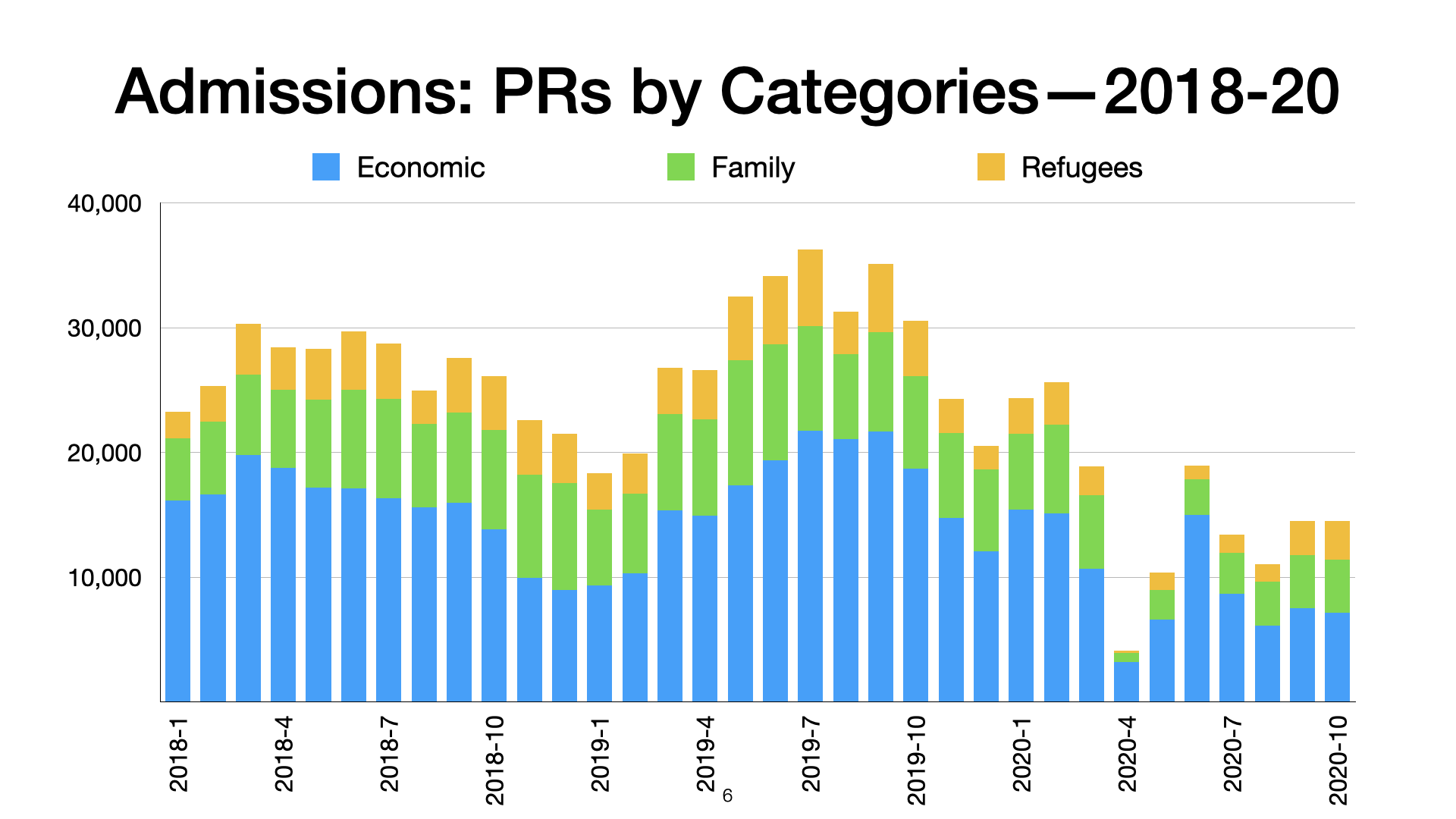
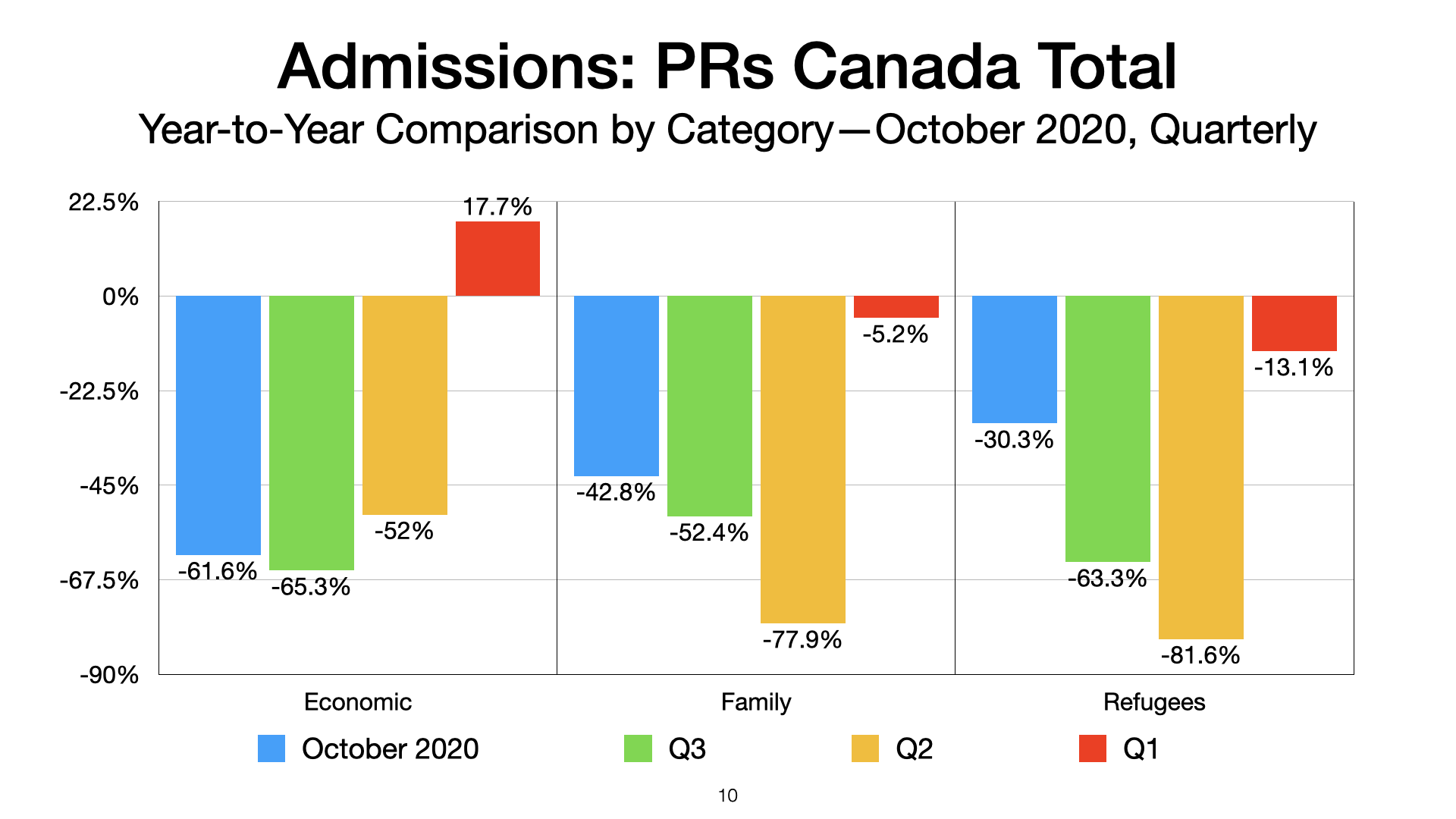
Overall, permanent resident admissions are down by 51.8 percent in October 2020 compared October 2019, and 42.9 percent year to date. Family and refugee categories have declined more than the economic category.
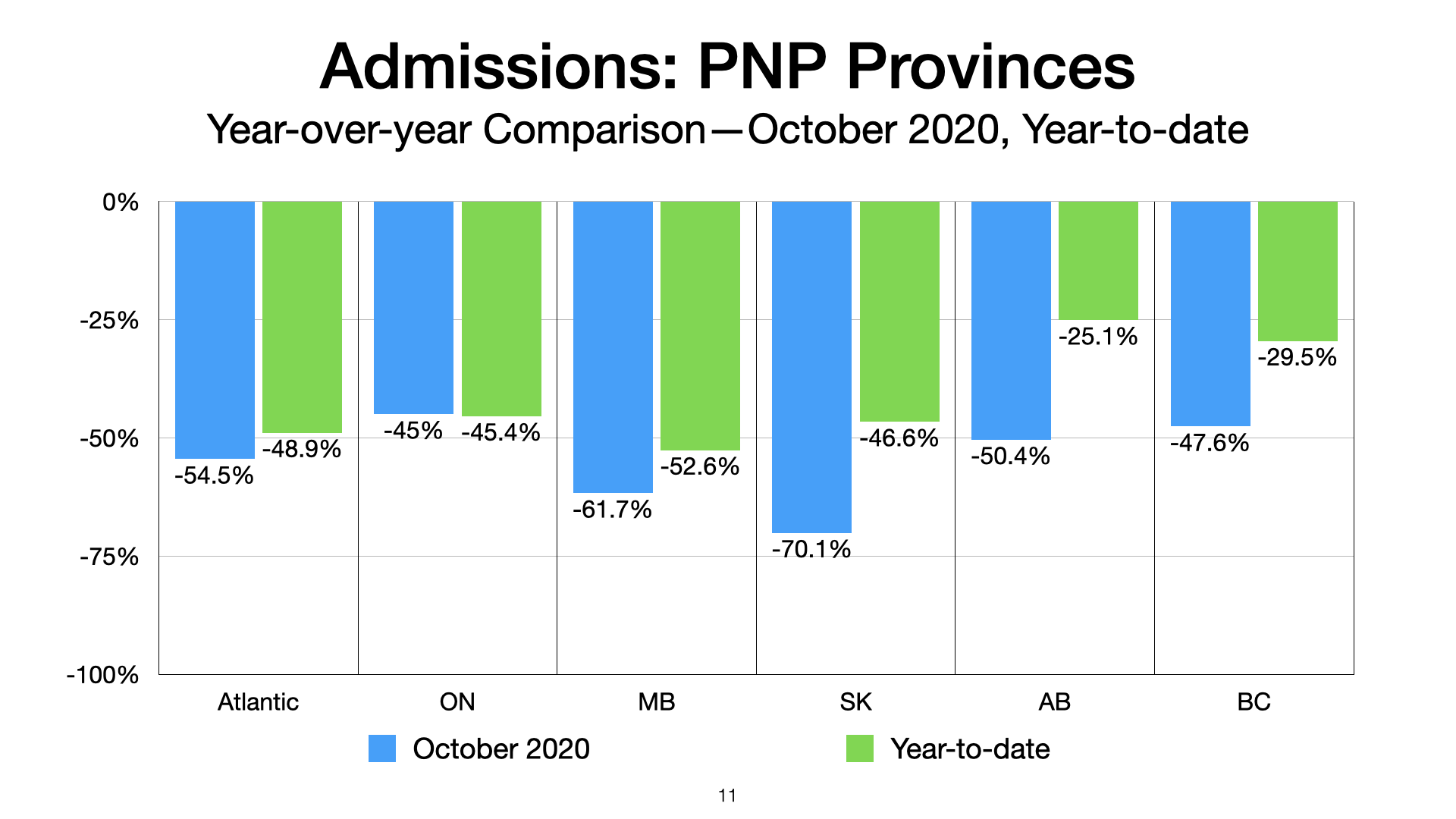
With respect to Provincial Nominee Program, declines have been less in Alberta and British Columbia than other provinces.
Transition from temporary residents to permanent residents account for close to 40 percent of total admissions in 2020 year to date, with the post-graduate work program and the International mobility program being relatively less affected that international students and the temporary foreign worker program (note some double counting between these programs and overlap with the Provincial Nominee Program).
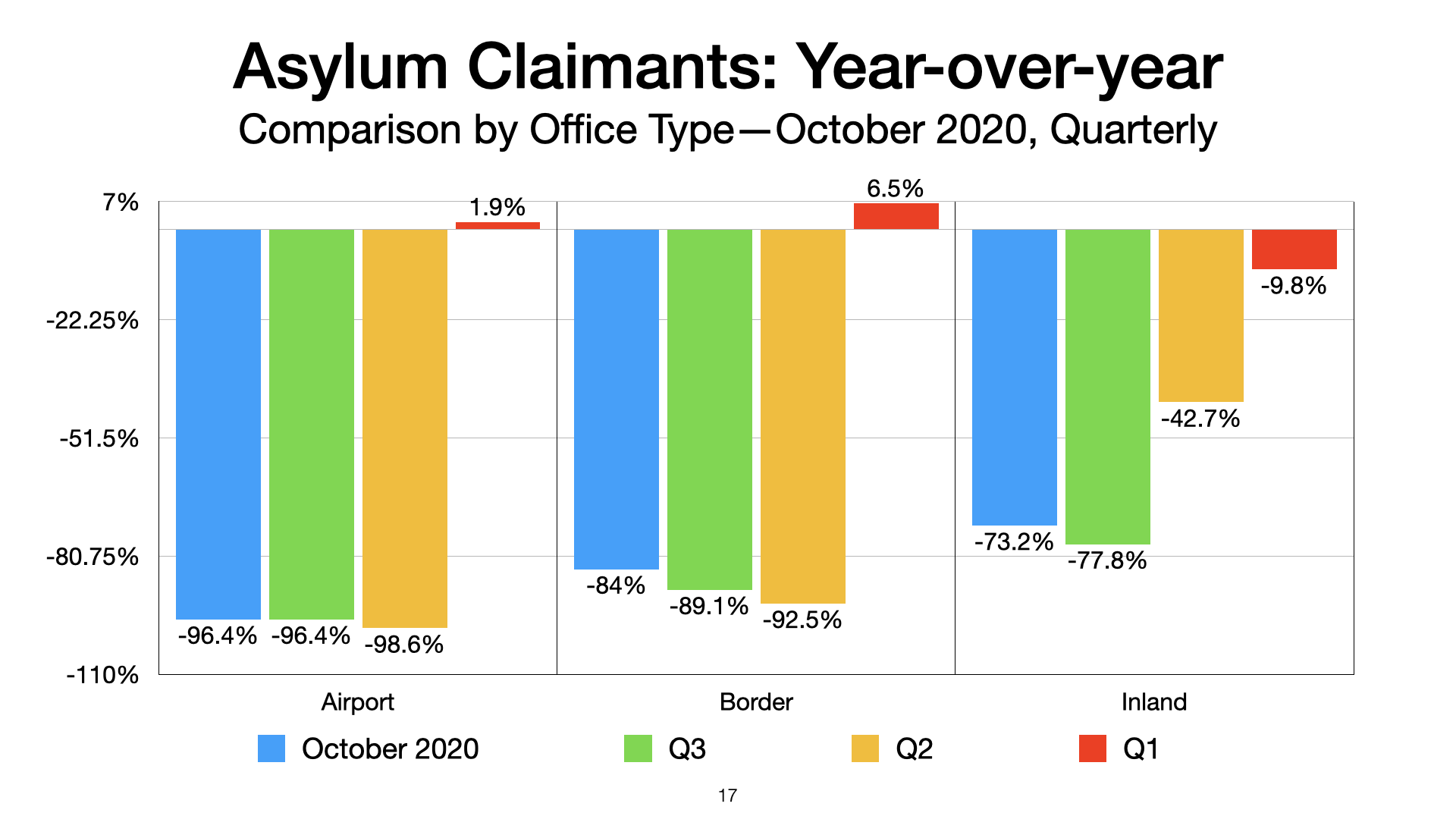
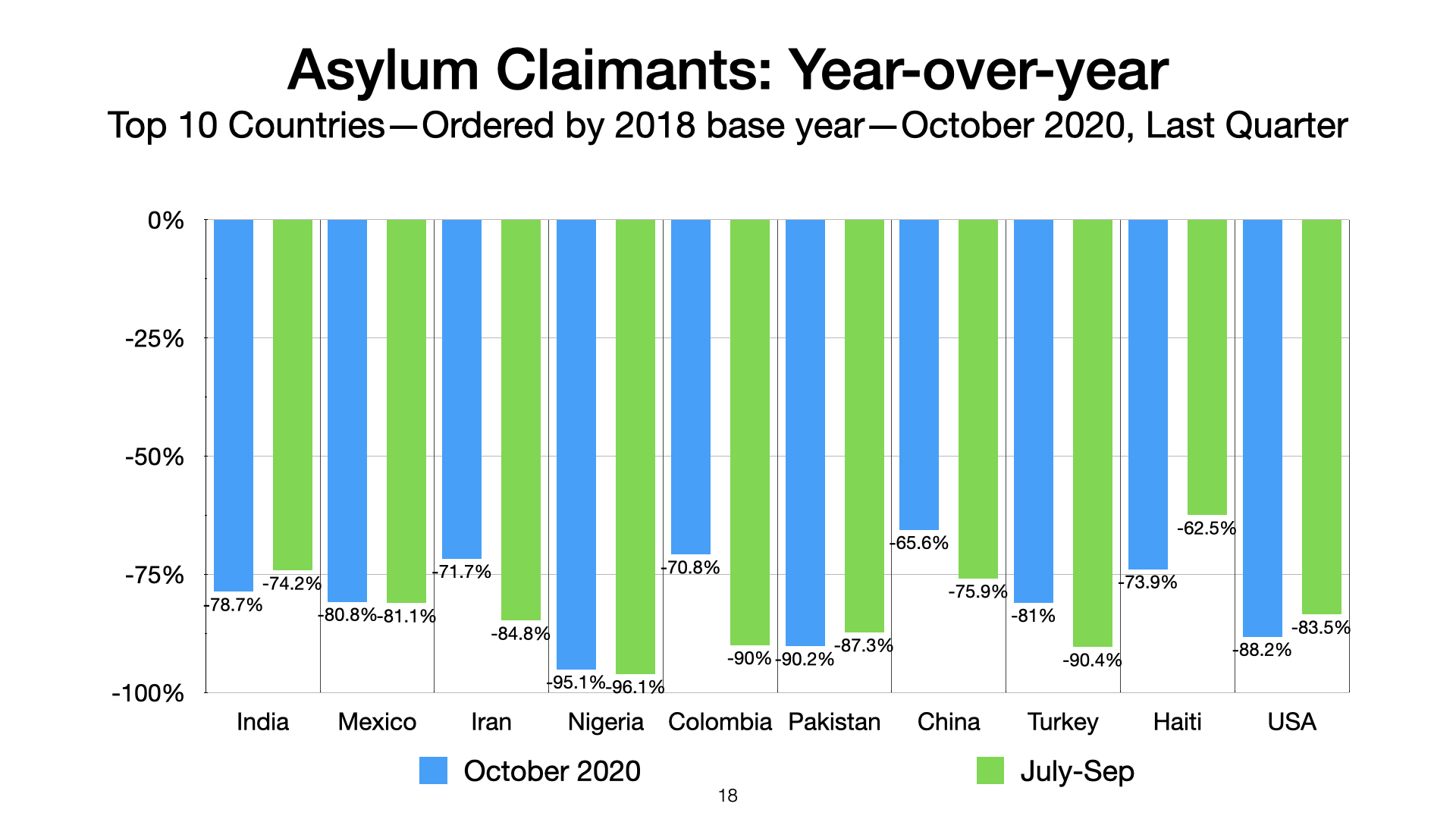
Asylum claimants have declined dramatically given travel and border restrictions (particularly airport arrivals), from an average of over 5,000 a month in 2019 to an average of less than 1,300 April to October 2020. Inland claims accounted for 56 percent of all claims in 2019, and for 81 percent April to October 2020.
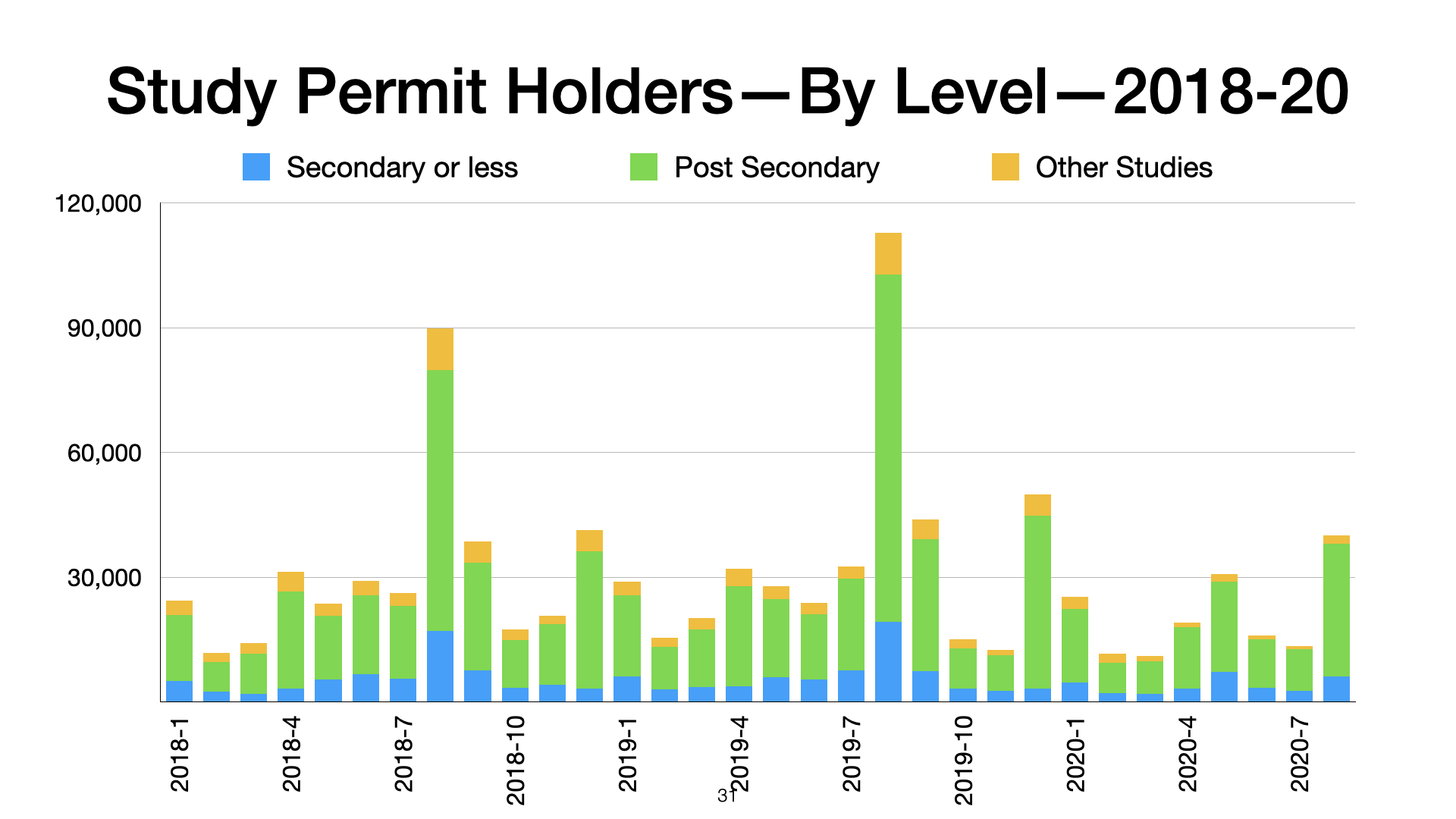
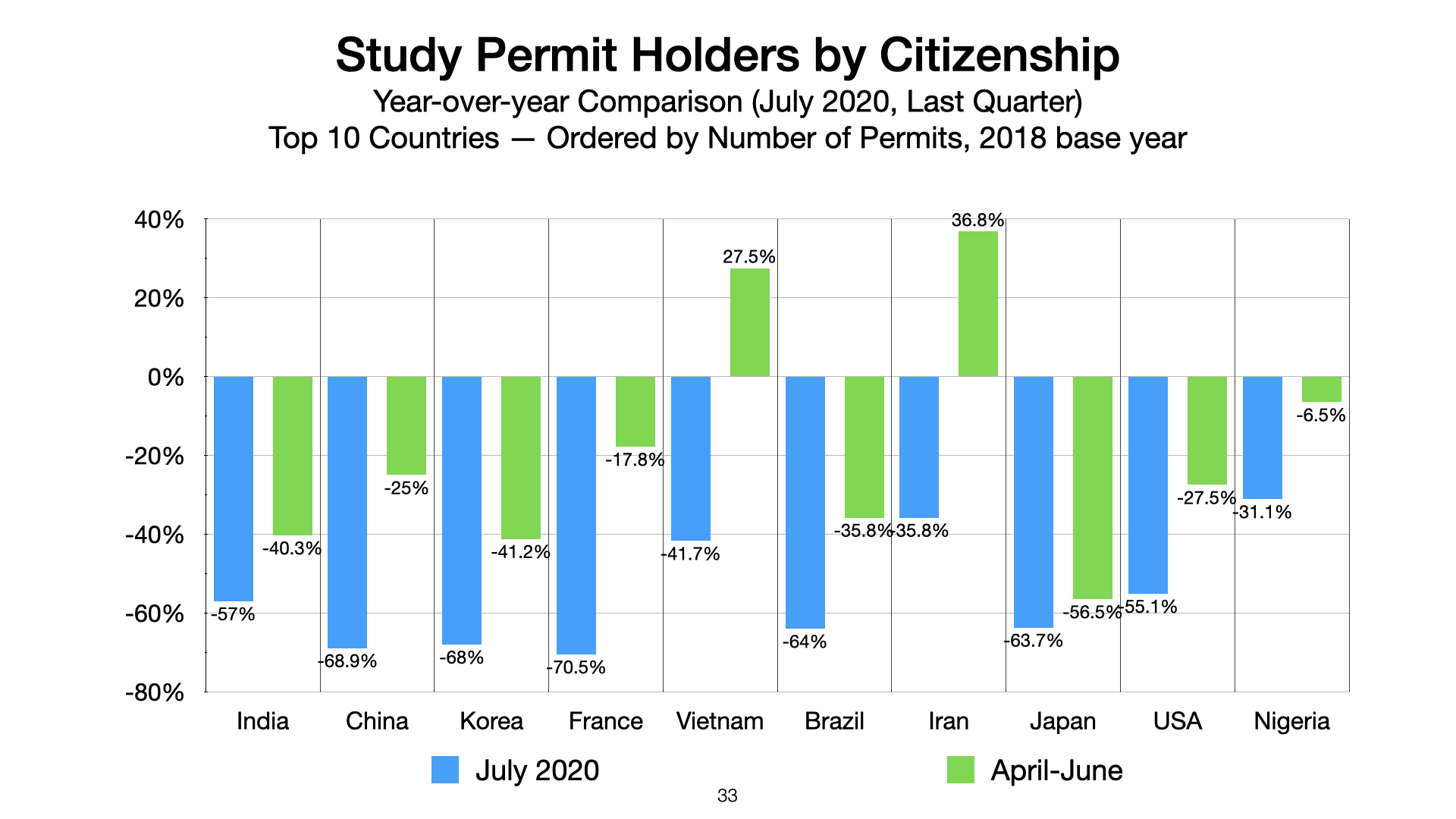
International students (study permit holders have declined from an average of 35,000 per month in 2019 (with summer seasonal peaks) to 27,000 April to October 2020, with some variation among countries of origin (citizenship) year to date as well as by province of destination.
More on the decline of the attractiveness of study in the USA under the Trump administration. Will see over the next few years the degree to which that changes under a Biden administration:
Nikita Chinchwade moved from India to the U.S. last fall to get a master’s degree.
“It had been a dream of mine for a very long time because of the quality of education here,” she says.
The U.S. has historically been a top destination for international students. At last count there were more than a million. They’re attracted by the high-tech facilities and opportunities for research; the easy, nonhierarchical interaction between faculty and students; and the open, social environment on campuses.
But this year, in a survey of more than 700 colleges and universities, the Institute of International Education found total international enrollment plummeted 16% between fall of 2019 and fall of 2020. Statistics on new international students was even grimmer — a 43% drop. Tens of thousands have deferred enrollment.
“We’ve never had a decrease like that,” said Allan Goodman, who heads the Institute of International Education. But he added that he believes the numbers will go back up once the coronavirus pandemic passes, predicting “surges of students” enrolling. “What we do know is, when pandemics end, there’s tremendous pent-up demand.”
While the pandemic is an obvious reason for the decline, some experts point out that international student enrollment has been declining since 2016.
All this has serious consequences for higher education. To put it simply: These students bring in a lot of money.
Before the pandemic, international students contributed about $44 billion a year to the U.S. economy, says Rachel Banks, senior director for public policy and legislative strategy at NAFSA: Association of International Educators, citing an analysis from the 2018-2019 school year. And those students support about half a million jobs.
“They typically pay higher tuition rates than domestic students do,” Banks says. “And in some instances, they’ll even pay more than out-of-state students would. So schools certainly would feel that directly.”
These students contribute more than money, bringing social and cultural diversity to U.S. campuses.
“Everybody is learning from each other. So you want to cast your net as wide as you can,” says Martin McFarlane, director of international student services at the University of Illinois at Urbana-Champaign. The campus has among the highest number of international students of any university in the U.S., more than 10,500.
McFarlane says higher education is all about an exchange of ideas: “We are so interconnected globally that if you are cutting yourself off from that, you’re doing yourself a disservice.”
A Duke University study found that domestic students who engaged with international students enhanced their self-confidence, leadership and quantitative skills. U.S. undergrads were also more likely to “appreciate art [and] literature,” “place current problems in historical perspective” and “read or speak a foreign language.”
The United States has long recognized the long-term benefit to hosting these students in terms of influence and magnifying the country’s diplomatic “soft power.” A recent study shows that the U.S. educated 62 of last year’s world leaders. And research has found that international students develop a trust with their host countries, which also leads to future visits and future business interactions.
About half of international students come to the U.S. to study in the STEM fields: science, technology, engineering and math. A 2017 analysis found that foreign nationals, for example, make up 81% of full-time graduate students in electrical engineering, 79% in computer science and 59% in civil engineering.
Alexis Abramson, dean of the Thayer School of Engineering at Dartmouth, worries about having fewer international students in the STEM fields. “We’re all very concerned that the U.S. will lose its competitive edge,” she says. “Engineers and scientists invent things and innovate and solve a lot of the most pressing problems facing our world.”
A recent survey of 500 U.S. university officials found several reasons for fewer international students, including the visa process and high tuition costs as well as the political climate and feeling “unwelcome.” For the first time, a main reason listed was “global competition.” In stark contrast to the U.S. declines over the past few years, the U.K., Canada and Australia have seen enrollment spikes.
Banks of NAFSA isn’t surprised. She says the Trump administration has made it harder to study in the U.S. through its anti-immigrant rhetoric and policies. Competitor countries, she adds, are stepping in to fill the void, “falling over themselves to say, ‘Look, the United States doesn’t want you, but we do!’ ”
Arvind Ganesh always wanted to study in the United States. He’s 22 and originally from Chennai, India. But when the time came to make a decision for graduate school, he chose Canada. “The education expense is one thing; the cost of living is another,” he explained. The U.S. also has “the problem of security to international students. I’m talking about racial bias.”
Students like Ganesh have contributed to double-digit increases in Canada. It has lower tuition costs, generous work-study policies and clear pathways to permanent residency and citizenship.
The U.K., America’s biggest competitor for international students, is also trying hard to recruit more, with an ambitious goal of 600,000 students by 2030. As part of its Study UK effort, officials have relaxed policies so students can stay and get more work experience after they graduate.
Ganesh starts classes in a month and is excited about making friends and learning about Canada. He’s not too worried about culture shock, saying he has heard Canadians are very friendly. “Even though it’s a very cold country, but you still feel warm when you feel people are welcoming and embracing.”
He says that’s what makes a different country feel like a home away from home.
Not surprising and warranted with respect to the curbs:
Ted Mitchell, president of the American Council on Education (ACE), has written to United States President-Elect Joe Biden and Vice President-Elect Kamala Harris on behalf of 43 US university associations calling on them to move to ensure that American colleges and universities are “once again, the destination of choice for the world’s best international students and scholars”.
To accomplish this aim, Mitchell says the Biden administration should move to:
• Withdraw the proposed regulations that would limit an international student’s ‘duration of status’ and create a fixed duration of admission. Mitchell says there is no evidence to suggest that such a restriction is required or that the issues raised cannot be addressed through the existing Student and Exchange Visitor Program.
“The amount of time the Trump administration proposes to give students is less than the average amount of time it takes an international student to complete his or her education. Such a policy is not fair to international students or institutions,” Mitchell says.
• Withdraw the interim final rules and the proposed rule that make it harder and more expensive for individuals to receive H-1B visas. These new requirements imposed by both the Department of Labor and the Department of Homeland Security were finalised without allowing for public comment, Mitchell says.
“The business and higher education communities vigorously oppose the proposed rules, and two lawsuits have already been filed to block them. In addition, the proposed rule regarding subject caps will make it difficult for recent international students graduating from US institutions to participate in the H-1B programme.”
• Make clear that the Optional Practical Training (OPT) programme remains in place as it was at the end of the Obama administration. The Trump administration’s constant signalling that it might change OPT created a serious disincentive for students to enrol in post-secondary education in the United States, Mitchell says.
Most international students see the OPT programme as a transitional stage to obtaining an H-1B visa. More than 5,000 assistant professors and over 1,700 research associates hold H-1B visas, according to an online visa tracker. The H-1B visa programme is one of the very few pathways for foreign-born researchers to remain in the United States on a long-term basis.
The demands are among a list of steps that Mitchell says “could and should” be undertaken quickly by the new US administration once it is sworn in in January.
In the open letter, ACE President Mitchell says: “First and foremost, we welcome and applaud the announcement that the Biden administration will move quickly to reinstate the Deferred Action for Childhood Arrivals (DACA) protections that the Trump administration repealed.
“We hope that your administration will take steps to make the DACA protections permanent and will work with you to support whatever measures are necessary to accomplish this worthy goal.”
An estimated 450,000 undocumented immigrants are college students and about half of those are eligible for the DACA programme.
In addition to DACA, Mitchell said the associations believe that the Biden administration should take immediate action in a number of areas to terminate, revise or replace a number of decisions that the Trump administration has put in place regarding higher education.
He called on the Biden administration to work with all stakeholders to address “aspects of the Title IX regulations [the law against sex discrimination in education provision] that are deeply problematic and that micromanage campus processes in an inflexible manner and undermine college and university efforts to effectively, fairly and compassionately address the problem of campus sexual assault”.
In particular, Mitchell said, the administration “should eliminate the mandate for a live hearing with cross examination, which could have a chilling effect on the willingness of survivors to come forward and raises serious concerns about re-traumatisation”.
Foreign gift reporting requirements
He also demanded a halting of the expanded reporting requirements, including the new Information Collection Request (ICR) and Notice of Interpretation (NOI) on Section 117, which relates to conditions of transparency and reporting of institutions’ foreign gifts or contracts worth US$250,000 or more.
The higher education associations regard the new interpretation imposed by the Department of Education as part of an effort to expand those reporting requirements beyond existing requirements. The ACE letter says the Higher Education Act prescribes the information that institutions are required to disclose, and, in the absence of a regulation, the Education Department has no authority to impose new requirements beyond those in statute.
The letter also accuses the Trump administration of launching “politically motivated” investigations of higher education institutions conducted by political appointees. Examples given include investigations launched by the department’s Office of the General Counsel of “racism at Princeton” and “academic freedom at UCLA”.
Mitchell said: “The [Education] Department’s response to instances of insufficient institutional reporting should have focused on reporting remediation to enhance the intended transparency rather than launching investigations that forced institutions to invest scarce resources in responding to burdensome document requests that sought information beyond the statutory authority.”
Limits on the effectiveness of student aid
Mitchell called for the withdrawal of the interim final rules regarding the eligibility of higher education students for funds under the Coronavirus Aid, Relief and Economic Security or CARES Act. Mitchell said this rule “contradicts congressional intent as to which students should be eligible for the Higher Education Emergency Relief Fund and limits the effectiveness of such aid”.
In order to “enhance the integrity” of student aid programmes, he called on the Biden administration to rewrite the rules to protect the risk to students and taxpayers and ensure that students’ financial aid eligibility is limited to “quality programmes”.
The letter calls for the reinstatement of Obama-era guidance on the use of race in admissions and the immediate termination of the Department of Justice’s “unprecedented demand that Yale University cease any consideration of race in its admissions practices”.
Mitchell says: “There is no evidence that Yale is in violation of Supreme Court decisions that bear on this issue.”
Similarly, ACE calls on the Department of Justice to withdraw its support for the plaintiffs in Students for Fair Admissions v. Harvard.
“The trial and appellate court decisions, both of which found for Harvard, have established a clear and compelling record that Harvard is in no way violating the law,” Mitchell says.
The letter also calls for the repeal of the Executive Order on Improving Free Inquiry, Transparency and Accountability at Colleges and Universities and the portion of regulations related to that order included in the Education Department’s 23 September 2020 final rule, “Direct Grant Programs, State-Administered Formula Grant Programs…”
Mitchell said: “Colleges and universities are committed to free inquiry and academic freedom. It is improper for federal officials, including those at the Education Department, to insert their own political judgments about what speech should or should not be permitted on campus.
“In fact, federal law specifically prohibits the Education Department from interfering in academic matters.”
Mitchell also demanded the repeal of the president’s Executive Order on Race and Sex Stereotyping. “Needless to say, colleges and universities are totally opposed to race and sex stereotyping, but the executive order is sweepingly overbroad and has chilled the implementation of critical diversity training programmes that ensure more respectful and productive work and learning environments,” Mitchell writes.
We shall whether there is a quick bounce or some longer-term scarring of the US as an attractive destination:
Just as recent articles have suggested that ‘kangaroos can bounce’ to reflect the potential resurgence as a favoured international student destination of Australia post-pandemic, there is every reason to believe the US eagle can soar under a Biden administration.
In his acceptance speech as president-elect, Joe Biden said: “For American educators, it’s a great day for you all”, and that must include higher education institutions looking to regain their place as the favoured destination for international students. While there’s new hope and opportunity, it will be important to reflect on recent lessons and the changing world if the recovery is to last.
The good news is that President-Elect Biden was part of the administration that saw international student numbers rise 44.9%, from 623,119 to 903,127, between 2009-10 and 2016-17. A repeat of that performance would see enrolments grow to 1.26 million by 2025 from the 2018 base of 872,000.
But there are three key steps that need to be taken – building recognition of the economic value of international students, ensuring understanding of the part they play in securing global soft power and getting the basics of visa and post-study work right.
The creeping malaise of anti-science, alternative facts, reinvention of history and downright lying in recent years should be a sobering wake-up call for institutions. Their connection with the broader population and, perhaps ultimately, their place in society is challenged and nowhere more so than in the US.
It is time to get serious about integration with communities, better communication, making sure that graduates get jobs and developing the country’s understanding of universities as generators of wealth.
Economic benefits and soft power
International students contribute US$41 billion to the US economy and support more than 450,000 US jobs, but that story needs telling in the good times rather than waiting for the bad.
In a 2016 report for NAFSA, Giovanni Peri and Gaetano Bassoestimated that the 10 states with the most international students – which, in addition to New York and California, include heartland states such as Ohio, Illinois and the swing states of Michigan and Pennsylvania – stand to gain nearly US$8.3 billion in wages and US$283 million in state taxes.
There are millions of jobs at stake for all Americans, including those who voted Republican, but the role of universities and their precarious financial future hardly registered on the election landscape.
US universities also need to point out more aggressively the ‘elephant in the room’ that is China. The ability of the US to dominate global economics and build strategic alliances is partly based on the soft power it is able to exercise through having US-educated leaders in government and industry around the world.
Universities have helped the US into a position of power, but this has been eroded in recent years to the extent that the competition see an opportunity to strike.
In 2018 Wang Huiyao, founder and president of the Center for China and Globalization, was explicit about the country’s ambition. He said: “We are still lagging behind the US on soft power … There are more than 300 world leaders, including presidents, prime ministers and ministers around the globe that graduated from US universities, but only a few foreign leaders that graduated from Chinese universities, so we still need to exercise effort to boost academic exchange and educate more political elites from other countries.”
China’s long-term goal is to host 500,000 students by 2020 and it had reached 490,000 by 2017. It is currently the third most popular destination of study after the US and the UK and is within striking distance of the latter (it is expected to surpass the UK in the near future).
The increasing quality of institutions and range of courses, often taught in English, have seen nearly 50% of international students in China now enrolled on degree programmes, including 75,800 graduate students.
Post-study work opportunities
The wider benefits of attracting international students and the way in which they support America’s global influence are two important factors and better communication of these is called for. But this requires long-term campaigns to win the hearts and minds of policy-makers and the public. More immediate benefit can come from simple wins in visa administration, work visas and post-study work opportunities.
Being able to work after completing a degree has been a driver of growth in Australia, Canada and the UK, and Optional Practical Training is an American version that, since 2008, has allowed students a 29-month post-study work period. Critically, the Obama administration expanded the number of eligible fields of study by about 90 to 400 in 2012. The numbers in the programme exploded from 94,919 in 2012-13 to 175,695 by 2016-17.
While international students may not be at the top of Biden’s priority list and COVID-19 and reducing spiralling unemployment will undoubtedly take priority, one would think that Biden will be quick to relax travel restrictions and issue orders to be far more welcoming to international students, given they contribute US$41 billion to the US economy and support more than 450,000 US jobs.
Other visa priorities include:
• Increasing acceptance for student F1 visa applications. The 2019 student visa refusal rate of 35% is currently continuing to undermine recruitment.
• Rescinding July 2020 guidance issued by immigration authorities which says that foreign students will no longer be able to stay in the country if their courses move fully online in the autumn.
• Rescinding the proposed policy that, if enacted, would limit international student visas for those born in countries associated with high visa overstay rates to either two or four years.
A ‘soaring eagle’ is not good news for the other dominant English-speaking study destinations. The US has always been the preferred destination for most international students who can afford to study there. It’s likely that Australia will remain highly competitive because of its proximity to Asia, the largest market of international students, but Canada and the UK are almost certain to feel the pressure of a resurgent US.
But there is good news all round for students when it comes to making the case for international higher education. The US could join the list of countries with well-ranked universities that are developing increasingly benevolent post-study work regimes, more flexible visa policies and innovative routes to study.
They will also find smart institutions providing evidence of the return on investment for the degree by giving data-backed evidence of graduate career outcomes, both in country and for those returning home.
Louise Nicol is director of the Asia Careers Group. This piece forms part of a series in University World News, which last month featured “Canada, the squeezed middle”, which was preceded by “Australia, the comeback kid”. Within each article, Asia Careers Group aims to provide insight on the prospects for the world’s four largest destinations for inbound international students. Later this month we will be looking to the future of international higher education in the UK post-Brexit.
Will be interesting to follow, particularly with respect to backlogs and processing (hopefully citizenship as well):
Separated family members, approved permanent residents unable to travel to Canada, and others are speaking up in the House of Commons as witnesses in a study on Canadian immigration.
Canada’s Standing Committee on Citizenship and Immigration is conducting a study that will examine the impact of COVID-19 on the Canadian immigration system over the course of no more than eight sessions. Once the study is complete, the committee will report its findings to the House. The government then has 120 days to table a comprehensive response, however, they are not obligated to make any change in policy.
This particular study will look into the following issues relevant to the coronavirus impact on Canadian immigration:
Application backlogs and processing times for the different streams of family reunification and the barriers preventing the timely reunification of loved ones, such as denials of Temporary Resident Visas (TRVs) because of section 179(b) of the Immigration and Refugees Protection Regulations, and the ongoing closures of Visa Application Centres;
Examine the government’s decision to reintroduce a lottery system for the reunification of parents and grandparents; to compare it to previous iterations of application processes for this stream of family reunification, including a review of processing time and the criteria required for the successful sponsorship;
TRV processing delays faced by international students in securing TRVs, particularly in francophone Africa, authorization to travel to Canada by individuals with an expired confirmation of permanent residency, use of expired security, medical, and background checks for permanent immigration.
While House is in session, the committee is meeting at 3:30 p.m. on Mondays and Wednesdays. The next meetings are scheduled for November 16, and 18. Immigration minister, Marco Mendicino, has been invited to appear before the committee on November 25 and December 2.
How travel restrictions are affecting immigrants’ mental health
Among other early findings, the mental health of immigrants and their Canadian family members was examined in two scenarios relating to family separation.
Faces of Advocacy is a grassroots organization established to reunite families in Canada during COVID-19 travel restrictions. They say they are directly responsible for the exemption on extended family members, which was announced on October 2.
The group indexed the mental health of 1,200 members at the end of August. They used validated mental health rating scales for depression, anxiety, and post-traumatic stress in civilians. The results are not diagnostic, but offer a glimpse into the mental health effects that have resulted from travel restrictions.
Despite 49 per cent of respondents reporting they have never been diagnosed with mental illness, just over 69 per cent would screen positive for symptoms of clinical depression. In addition, 16 per cent of respondents had a history of self harm or suicidal thoughts prior to the travel restrictions, but after family separation this nearly doubled to 30 per cent.
Spousal Sponsorship Advocates was established during the pandemic. It is as another grassroots movement, created to advocate for the accelerated reunification of families with ongoing spousal sponsorship applications in Canada.
Their survey took a mental health snapshot of 548 respondents, who had been separated from family for months or even years at a time. Of these, a reported:
18 per cent have suicidal thoughts;
22 per cent had to stop working;
70 per cent have anxiety and 44 per cent generalized anxiety;
35 per cent started having panic attacks;
78 per cent have periods of severe depression;
76 per cent have severe energy loss;
57 per cent now have physical pain;
52 per cent gained or lost weight abnormally;
85 per cent have sleep problems.
The mental state of expired confirmation of permanent residence, or COPR, holders was also mentioned. These are people who were approved for permanent residence, but were not able to travel to Canada before their documents expired. As a result, many are unable to come to Canada without an authorization letter from Immigration, Refugees, and Citizenship Canada, and they have already upended their lives in their home country. The evidence includes a series of tweets that are intended to show the “pains, agony, [and] mental torture” experienced by COPR holders.
Good discussion of the changing and possibly declining comparative advantage of Canadian university education for international students, with a credible recommendation to focus on employability post-graduation:
With Canada announcing the opening of its borders on 20 October, no one can fail to be impressed by its meteoric rise in the realms of international education. But past gains are no guarantee of future success and the shifting tides of international student mobility can rapidly change direction.
There has been plenty of talk over the years about some United Kingdom universities being in the ‘squeezed middle’ of being relatively small and not academically top rank. They tend to rely on their reputation as places that are friendly, very welcoming to students and not the most demanding on entry requirements. It begins to sound like a caricature of the Canadian approach to international marketing.
In terms of global ranking, the United States and United Kingdom are streets ahead of Canada in globally ranked institutions and even Australia has 22 in the Times Higher Education or THE World University Rankings top 300 compared to Canada’s 14.
We are beginning to see Canadian institutions under financial pressure in provinces such as Calgary and Alberta opening up to talks with private pathway providers. But the marketing machine continues to offer easier visa channels, post-study work opportunities and routes to citizenship – none of which is a sustainable advantage if other countries choose to compete.
Canada’s rise
The Canadian success story is worth reviewing. Between 2014 and 2018, the number of international students in Canada increased by 68%. In 2018, a total of 721,205 international students at all levels studied in Canada – the largest number ever.
Canada has moved into third place globally behind the United States of America and Australia.
Total income from international students increased from CA$1.25 billion in 2009-10 to CA$2.75 billion in 2015-16. The CA$1.5 billion increase almost exactly offset the CA$1.7 billion fall in combined federal and provincial government funding over the same period.
International student fees now account for 12% of operating revenue and 35% of all fees collected by institutions and that percentage is increasing. Already some large institutions – including the University of Toronto – are receiving more money from international student tuition fees than they are in operating grants from their provincial governments.
In terms of diversity, Canada’s student population is almost twice as dependent on India, accounting for 56% of international students compared to 22% from China, as the US, UK and Australia, where these positions are reversed.
The post-COVID reality
Considering borders reopening and this glowing report card to date, why should we predict trouble ahead for Canada?
• The prospect of a Biden-Harris administration will make the US far more popular.
• The UK seems to have been the main beneficiary (if there is one) of COVID-19, taking market share from all major English-speaking markets (Australia, Canada and the US).
• Australia will not rest on its laurels after losing out on a full academic cycle and will return to the market stronger and more determined to grow, especially in emerging markets.
• Market dependency on India and China, which account for more than 75% of Canada’s international student population. India’s economy contracted by 23.9% in the three months to the end of June, making it the worst slump since 1996 and the worst impacted economy in Asia. This combined with trade tensions with China could spell trouble ahead.
• A lack of jobs due to the global recession may lessen the attractiveness of Canada in terms of post-study work and a route to immigration.
With the UK on the move, Australia hungry to get back in the game and the US possibly resurgent if Biden wins in November, Canada may only have a six-month window to differentiate its offer.
In order to maintain its meteoric rise and fend off the prospect of increased competition from English-speaking counterparts, it would be worthwhile for EduCanada and their partners to think strategically about how they will differentiate and maintain their growth during and following the global pandemic.
Our top tip is to focus on employability, both for students that remain in Canada (the majority of whom are from South Asia) and those who return home. With robust data on international graduate outcomes, Canada would be the first nation to put employability at the heart of their National Inbound International Student Recruitment campaign and lead the pack in terms of evidencing the return on investment of a Canadian degree.
Louise Nicol is director of the Asia Careers Group.
Downtown Vancouver might never look or feel the same, as scores of its English-language schools now sit empty with metal security gates across their doors. Many will never reopen.
B.C.’s once ultra-popular, private English-language schools, which last year enrolled 70,000 to 100,000 students, are concentrated in the city’s core. Each year language students from around the globe enlivened downtown cafes and street life, as well as rental and homestay units through the West End and Yaletown.
Most Canadians don’t give much thought to the often-overlooked English- and French-language industry, but if they did they would recognize COVID-19 has ravaged this formerly booming sector as badly as it has crippled airlines and international tourism.
The health measures brought in in March to secure borders against travellers who could carry the coronavirus into Canada caused upwards of 100 language schools in B.C. alone to close their doors to in-person classes. Some struggle just to offer low-cost online instruction to students spread through mostly Asia and Latin America.
Officials with Languages Canada, an umbrella group for more than 200 registered schools, forecast this summer that three of four of its member schools could be forced to permanently shutter. In Metro Vancouver alone, Languages Canada says their students, almost all from outside the country, were pumping more than $500 million a year into the economy.
Global Village Vancouver gone
More than 23 registered language schools across the country have already permanently packed it in, including Vancouver’s decades-old Global Village Vancouver. And that number doesn’t include the closings at many smaller private schools that are not registered with Languages Canada.
“Metro Vancouver has the most private language schools of any Canadian city. And many of them are never going to open again,” says Lorie Lee, a former language-school owner who has served on federal government trade missions and advisory panels who now works with a company called Guard.me that provides health insurance to international students.
“Not only do these schools employ many teachers and staff, the students stay with host families and rent apartments and spend money in restaurants and on car leases and trips to Whistler. That’s not to mention the schools themselves rent large amounts of space downtown.”
One-third of them, almost always financed by their parents, want to gain permanent resident status in Canada, Lee says. Another cohort aim to get English under their belt so they can be eligible to apply to a Canadian or American university.
Those who belong to a third group want to improve their English because it will enhance their careers in their homelands, Lee says. Many others seek adventure, learning a bit of English along with skiing, partying and hiking in a beautiful province.
Unlike public language schools, which are subsidized by taxpayers, private language businesses, especially those in Vancouver, are stuck having to pay high rents on five-year leases they normally can’t get out of. A typical monthly rent for a school downtown, Lee says, runs about $50,000 a month.
“These schools have had no students since March, so that’s eight months of no income and many are going into debt. Those schools closing will have an economic impact on other businesses, not to mention on the host families that relied on the international students to pay their mortgages.”
The second big dilemma is that language-school students are often in a different immigration category from the 642,000 people who last year were in the country on study-work visas so they could attend public institutions like the University of British Columbia, Simon Fraser University and Kwantlen Polytechnic.
Only a minority of private language-school students obtain such long-term study-work visas to be in Canada, Lee says. Most tend to be here on visitors’ visas, which last less then six months.
That means that Prime Minister Justin Trudeau’s unprecedented move to reopen the border to foreign students on Oct. 20 is of only limited help to most language schools, since the bulk of their students will not be eligible.
Gonzalo Peralta, head of Languages Canada, has said Ottawa’s policy decision extends a lifeline to some private language schools. But Lee stresses that “even with Ottawa opening the gates, there are still going to be problems.”
It’s all having a little-discussed impact on Metro Vancouver. In 1991, when Lee first shifted from teaching English at UBC to launching her own school in Vancouver, her market research showed there were only seven private language schools in the city. “But,” she says, “when I sold my school in 2011 there were approximately 200 private language schools in Vancouver.”
Even though critics have condemned the way some private language schools are shoddily run and some Canadian economists worry they contribute to bringing more low-skilled workers into an already modest-wage job market, Lee generally remains a booster.
She’s excited that language schools bring so many students from Brazil, China, India, Vietnam, Japan, Mexico and South Korea. Four of five head to Ontario or B.C. This province has more than 50 schools registered with Languages Canada, the vast majority being private, employing about 2,000 staff and teachers until COVID-19 hit.
And, as Lee clarifies, Language Canada’s registered schools are only the tip of the language-industry iceberg. There are scores more non-registered private language schools in Metro Vancouver that, until the pandemic, served tens of thousands of pupils.
Glimmers of hope
Some publicly funded language schools and the larger private ones will likely be able to hold out until the end of the health crisis, Lee says. But even they are struggling just to keep afloat by offering online courses, only charging $99 a week. “Meanwhile, think of how expensive their rents are.”
There are glimmers of hope for some schools, Lee suggests, but their survival will likely rely on further easing up of immigration policy, border restrictions and COVID-19 safety rules, which restrict how many students will be allowed in language classrooms at one time.
Even though it’s frustrating to Lee, she recognizes why most Canadians rarely think about the plight of private language schools and their impact on the country.
Will continue to watch application and admission statistics to assess the return:
Canada will begin allowing international students into the country on Tuesday, but it may take weeks before they arrive in significant numbers.
Travel restrictions are being lifted on Oct. 20, allowing foreign students to enter Canada if their post-secondary institutions’ COVID-19-readiness plans are approved by a provincial or territorial government. Universities, colleges and language schools are required to have a plan to quarantine students for 14 days.
Since March, international travel restrictions have limited entry into Canada for most non-essential travellers.
The return of foreign students is a relief for Canada’s post-secondary schools, with universities potentially losing as much as $3.4 billion this year, due mainly to the drop in international students, Statistics Canada reported earlier this month.
Tuition fees paid by foreign students have become an ever-bigger source of revenue for universities. The average tuition paid by an international student this year is $32,041, almost five times what a Canadian student pays. And the number of foreign students in Canada has tripled in 12 years to more than 640,000, generating roughly $22 billion a year in economic activity in Canada, according to federal estimates.
“This could be in the billions of dollars of loss this year alone,” said Denise Amyot, president and CEO of Colleges and Institutes Canada, which represents 135 post-secondary institutions.
Amyot said the return of international students will benefit rural colleges, in particular, where there are seldom enough domestic students to fill classes. Foreign students are also important because many decide to settle in Canada and are often trained for occupations that are short of workers, she said.
“Those are potential immigrants for our country,” Amyot said. “If they know the language, they have studied here, and they have Canadian experience, they make really well-prepared Canadians.”
With the fall semester well underway, Immigration, Refugees and Citizenship Canada (IRCC) spokesperson Shannon Ker told iPolitics that amendments to travel restrictions that kick in Tuesday “should result in a gradual movement of international students to Canada.”
Many foreign students are arranging to arrive before the winter semester starts in January, said Bryn de Chastelain, chair of the Canadian Alliance of Student Associations.
“I’m not sure if we’ll see a huge influx starting tomorrow, but I think, over the next few months, we will start to see kind of a slow trickle begin to pick up,” de Chastelain said.
Ker said it’s too hard to guess how many students will arrive in the weeks ahead, but it would depend on how many decide to study online from their home countries and the number of institutions that have their readiness plans approved. But a spokesperson for Ontario’s Ministry of Colleges and Universities says it has given 12 publicly funded schools the green light so far.
IRCC has yet to publish the list of schools — known formally as “designated learning institutions” — whose plans have been approved, although its website says it will be available by Oct. 20.
Students arriving in Canada must undergo the same screening and quarantine as any other traveller.
But the students’ arrival may be delayed because Canadian visa-application offices abroad are short-staffed due to the pandemic, Amyot said. That includes those in India, where most foreign students attending Canadians colleges and institutes come from.
International students require two stages of permits in order to study in Canada. Stage 2 includes biometrics, a medical exam, and a criminal background check that often require physically going to a visa office.
“That will become a barrier, because they need those biometrics to travel to Canada,” Amyot said.
The IRCC’s Ker said that, since March 15, more than 121,000 study permits have been issued, of which 10,000 are initial study permits and 111,000 are study permit extensions. In most cases, applicants approved for an initial study permit are abroad, whereas applicants approved for a study permit extension are already in Canada.
According to de Chastelain, foreign students have received “next-to-no financial support” from Ottawa during the pandemic. He said the federal government should help students struggling financially, and cover some expenses for digital technology as most classes move online. One idea de Chastelain proposes is reallocating unspent funds from the $9-billion student-aid package announced in April.
Despite the pandemic, most international and out-of-province students still prefer to live near the schools they’re attending, he said.
Will have major impact on universities who have counted on this revenue source:
After being inundated with news about the worsening coronavirus pandemic and rising tensions between China and the West for months, Beijinger Joe Gao was compelled to make a difficult decision regarding his six-year-old daughter’s future education.
Rather than pay 300,000 yuan (US$44,000) in annual tuition for her, as he does for her nine-year-old brother who is studying at an international school in the capital, Gao has had to change his plans and is now looking to send his daughter to a public school in mainland China.
“Until this summer, I had been working hard with the aim of earning enough to send both of them abroad for secondary school. But things change so fast, and so we must, too,” he said. “I’m not that rich like a tycoon with strong anti-risk capabilities. I think the economic uncertainty, the pandemic and the growing negative perception of China are actually scaring many middle-class families of my kind.”
“If China and the West face a long-term confrontation into the future, trade between China and the [Association of Southeast Asian Nations] will increase, and studying in developed Asian areas would be safer for, and more friendly to, Chinese,” he said.
Gao is not alone in his rationalisation. A large and growing number of Chinese parents are cancelling or at least suspending plans to send their children to study abroad – a strong signal that wealthy and middle-class Chinese families are becoming less interested in sending their kids to study overseas.
About 81 per cent of affluent Chinese families whose children study foreign curriculums and take foreign examinations have decided to postpone plans to send them abroad for undergraduate or graduate studies, according to a survey released last month by Babazhenbang, an education start-up with a database of more than 400 schools preparing Chinese students for overseas high schools and colleges.
Among 838 respondents, the survey found that worries about the pandemic (82.6 per cent) and possible discrimination due to political tensions (60.9 per cent) were the top reasons for the postponements, followed by personal financial difficulties (43.5 per cent) and the fading advantages for overseas-trained talent in the domestic job market (21.7 per cent).
When all is said and done, the pandemic and increasingly rigorous visa checks could end China’s overseas schooling boom end much earlier than expected, according to Cao Huiying, founder of Babazhenbang.
“A lot of parents, especially among those middle-class families in second- and third-tier cities in China, have reconsidered and put their children back into the domestic education system,” she said.
Liu Shengjun, head of the China Financial Reform Institute, a Shanghai-based research firm, also pointed to the combination of factors leading to a rethink about overseas education options for Chinese families.
“Under the impact of the epidemic and the deterioration of Sino-US relations, which may last for years, there is expected to be a decline in both the number of Chinese students studying overseas and Chinese shopping abroad,” Liu said. “But the size of the decline cannot be predicted at this time.
“I think this trend will contribute to China’s domestic education market, but not sufficiently enough to offset weak domestic spending.”
According to a 2017 report by Union Pay International, Chinese students abroad spent more than 380 billion yuan (US$55.7 billion) annually — 80 per cent of which was on tuition and daily expenses.
Public concern among wealthy and middle-class mainland Chinese increased after the US confirmed last month that it had revoked more than 1,000 visas held by Chinese graduate students and research scholars. Escalating tensions between China and Australia have also fuelled concerns.
The two countries had been among the top overseas schooling destinations for Chinese students until recently.
“Last year, more than 90 per cent of our graduates applied only to American universities, while all graduates this year applied to more universities outside of the United States than American ones,” said Lion Deng, a counsellor with the international department of the Affiliated High School of Guangzhou University.
“All parents think the current conflict between China and the US is a direct and intense head-on collision that cannot be resolved in the short-term. Risks such as visa checks, as well as political and diplomatic uncertainties, are very likely to affect [students’] lives in college. It will definitely have a big impact on curbing their desire to educate their children in the United States,” Deng added.
“The number of students from our school applying for admission to high schools in the United States this year has dropped by 75 per cent compared with last year.”https://www.youtube.com/embed/JXH-zllz-Q0
Jade Zheng, who owns several flats in Shenzhen and runs a cafe, originally planned to send her seven-year-old son to Canada for school next year or the year after, and she had hoped he would adapt to the Western environment at an early age.
“In March, we decided to keep him in Shenzhen to study until at least high school, and currently we are going to delay the plan until he is an undergraduate,” she said. “The news is getting worse and worse, and we are feeling increasingly insecure, and [we feel] that things are getting out of control with regard to investing and living outside of China.”
Zheng’s brother and his wife sold their only apartment in 2018 and raised 5 million yuan (US$733,400) to send their son to high school and college in the US. “They were very happy back then but now are very worried about the safety of the 16-year-old boy,” Zheng said. “Additionally, the apartment they sold is now worth 8 million yuan.”
“Even if my son studies abroad, I hope he will return to Shenzhen to live in the future, because in the next 10 or 20 years, Shenzhen will definitely have more vitality and better prospects than any other areas, in terms of economic development,” Zheng added. “Maybe it would be a good idea to just go to college in Shenzhen in the future.”
Similar sentiment was echoed by Alice Chen, whose 18-year-old daughter started this autumn at a US Ivy League university but is studying remotely from Beijing due to the coronavirus.
“Our children born after 2000 are very different from us,” Chen said. “They feel that New York and London are not much different than Beijing and Shanghai. And they are satisfied with China’s economic development with a strong Chinese national identity.”
For many rich Chinese families and their children who have no plans to stay in the US or to visit for an extended period in the future, negative sentiment in the US about China is no longer important to them, Chen said.
“Their generation believes that China’s economy and society are better than most other countries,” she said. “When a company or a country becomes very strong, it will definitely be contained by competitors.”
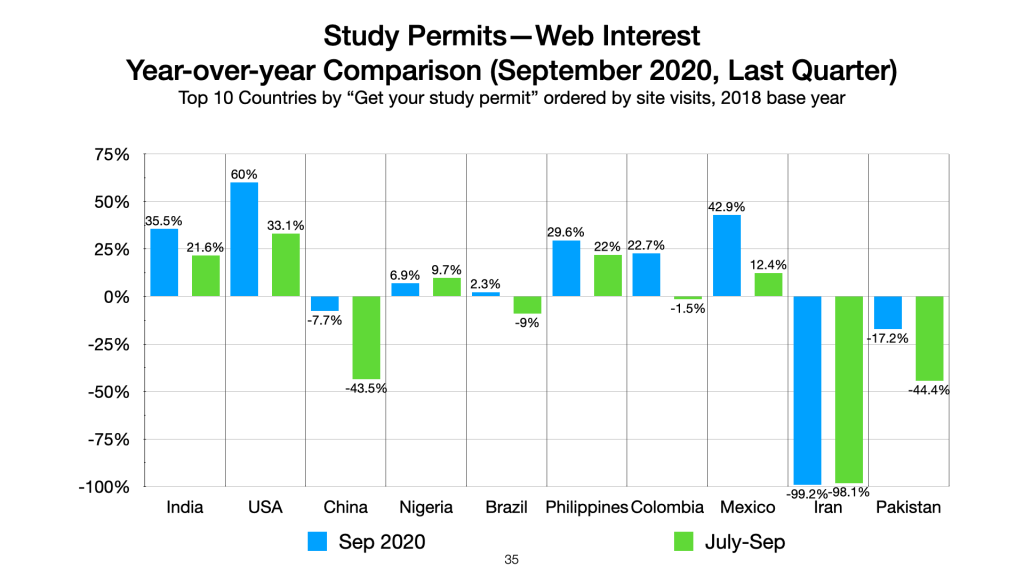
While Canadian study permit data to date does not show a significant increase, web data on “Get your study permit” shows an increase as seen in the chart below:
Looking at Canadian study permit data, no major difference between the There may be some major shifts under way in international student mobility patterns. The current upheavals in the United States higher education landscape appear to be driving greater numbers of US students to consider full degrees abroad.
US universities and colleges were on the ropes prior to the COVID-19 pandemic, with many institutions already facing shrinking enrolments, budget crunches and stagnating public funding. Add COVID-19 to the mix and the challenges only get worse for US higher education. The cracks in the system are growing into chasms and the landscape may be forever changed.
From reassurance to panic
Over the past few years an energetic debate has emerged among educational leaders regarding the tenuous nature of US higher education. The range of opinions fall along two extremes: reassurance and panic.
On the reassurance end, some are arguing for maintaining the status quo, offering polite mollifications that enrolment fluctuations and changes in disciplinary offerings are perfectly normal and there will be hardly any permanent disruption to higher education as we have known it.
On the panic end, some are questioning the long-term viability of ‘bricks and mortar’ institutions and are calling for a broad rethinking of US higher education.
Indeed, these are challenging times for higher education in the US and pressure to act is growing. Already this year, a number of institutions have closed, including Urbana University, MacMurray College, Robert Morris University, Concordia University Portland and Marlboro College, and more are expected.
Already, international students have begun to turn away from the US. According to the Institute of International Education (IIE), the number of new international students choosing to study in the US has been declining since 2015-16. Unfriendly national rhetoric, frequent and punishing shifts in immigration policy and fears for safety and security in the US, along with increasing international competition, are channelling student flows away from the US, particularly to the UK, Canada, Australia and New Zealand.
A future recruitment market?
Not surprisingly, it appears that a growing number of US students are beginning to show greater interest in pursuing study outside of the country. And why not? US students and their families are under tremendous strain. The rising cost of education and student debt, increasing scrutiny about the time needed to complete a bachelor’s degree and the ever-shifting nature of industry-driven qualifications combine to create a sense of considerable uncertainty for US students.
Moreover, the country’s chaotic response to the COVID-19 pandemic and the questionable promise of residential instruction going forward are awakening in students the need to consider other viable alternatives.
Dissatisfaction with racial justice and a generally increased awareness of the importance of global engagement are among other reasons pushing students to consider foreign study. The obvious question is not if, but when the US will become a robust market for recruiting prospective degree-seeking students.
Heading abroad
According to IIE, about 340,000 US students studied abroad in 2017/18 as part of their respective home university degree studies. Compared to China and India, both countries that account for the largest proportion of degree-seeking international students, there has been little attention given to international degree-seeking mobility among US students. Because each country collects data differently, it has been challenging to ascertain an accurate and consistent accounting of US students seeking full degrees abroad.
According to UNESCO, about 86,500 US students were studying abroad in 2017, which is about 15% higher than what was reported just five years earlier. In 2013, IIE conducted a comprehensive survey on US students enrolled in degree-seeking programmes abroad and reported that there were more than 46,500 students.
Through its Project Atlas initiative, IIE has continued observing degree-seeking enrolments and in 2018 tallied more than 53,000 students from the relatively few countries that reported such enrolments. Still, IIE observes steady year-on-year increases, especially among graduate students pursuing degrees in specialised STEM (science, technology, engineering and maths) fields.
The majority of US students abroad in 2018 were studying in Anglophone countries, of which the UK (16,805) and Canada (13,035) were the top hosting countries, followed by France (6,264) Germany (4,242), China (3,333), Australia (2,875), New Zealand (2,405), Spain (2,030), Denmark (1,248) and Japan (757).
Despite the lack of reliable data, various advisory organisations are emerging with hopes of capitalising on student interest by building the case for why and how US students should pursue full degrees abroad.
Study.EU is one such organisation that provides an extensive online database with information on English-taught degree programmes throughout Europe. According to Study.EU, US students make up the second-largest group of users on the website, after Indian students. This continues in spite of a long list of closed borders for US citizens in response to the COVID-19 pandemic.
The factors encouraging US students abroad
Affordable Degrees Abroad is another organisation that appeals to prospective US students by emphasising the relative affordability and high academic quality of international degrees. Affordable Degrees Abroad has identified several factors that appear to be driving US students to consider full degrees abroad.
1. Affordability. Affordability is a significant factor for US students. Compared to the US, many international institutions are considerably more affordable, with a significant number under US$17,000 a year. Some institutions charge under $3,000 a year which is practically free by US standards. US students may even use US federal financial aid at more than 400 international institutions.
2. High-quality education. In the past the perceived educational quality of international degrees was questioned by some US parents, students or employers who were not familiar with global education. With the increasing popularity of global university rankings and other indicators of institutional reputation and prestige, uncertainty is being replaced with admiration and respect.
3. Timespan to degree completion. Many degrees abroad are shorter. For example, some undergraduate degrees abroad can be completed in three years and graduate degrees in one to two years. Shorter time to degree completion further bolsters the case for affordability.
4. Language of instruction. The number of English-taught degrees has grown dramatically around the world, even in countries where English may not be the primary language. For example, Germany now offers more than 1,600 programmes taught in English.
5. Career readiness. As international business and global operations have increased so, too, have demands for employees with international savvy. Earning a foreign degree, while once perceived by some US employers with suspicion, can be an asset today. Additionally, many countries have attractive post-study work visas that allow for students to gain valuable work experience before returning.
6. Health, safety and security. The US response to the COVID-19 pandemic has revealed something that was present all along: it can be safer to live in another country with less crime, fewer gun deaths and stronger public health systems than in the US. A growing refrain is: “I want to send my kid somewhere that is handling COVID better.”
7. Racial injustice and inequality. The growing Black Lives Matter movement against racial disparities and injustice in the US has elevated a critical conversation. The legacy of racial inequalities, harsh political rhetoric and violence has left many students of colour, in particular black students, wary. For some, the promise of studying abroad in a more accepting and welcoming environment is attractive.
8. Political instability. The growth of nationalism and isolationist rhetoric, coupled with the anxieties of the current US election season, have created tensions and unease across the US. For some students, pursuing an international degree can be a way to achieve a solid education in a less fractured country.
The right message and the right strategy
There are challenges, of course, that discourage US students from pursuing full degrees abroad, notwithstanding language and cultural issues. Of particular importance is ensuring that US students are prepared for the level of independence needed to succeed. US institutions generally have more robust campus and student service infrastructures compared to international institutions. Students must be prepared to navigate different cultural and academic systems.
Although the US has largely been viewed by international recruiters as a non-degree market for outbound mobility, things may be changing. International institutions seeking to increase and further diversify international student enrolment, particularly from North America, might want to reassess the US market and begin positioning themselves accordingly.
Although the sheer size, scope and complexity of the US education system can be daunting, those institutions with a compelling message, a clear value proposition and an informed strategy will likely find greater receptivity among US students than ever before.
Dr Anthony C Ogden is managing partner of Gateway International Group, a global organisation seeking to accelerate international learning and engagement by assisting institutions and organisations around the world to succeed in a new era of higher education. For more information, click here. Denise Cope is president of Affordable Degrees Abroad through which she offers guidance to US students seeking affordable undergraduate or graduate degree options abroad. She also helps international universities formulate strategies for the US student market. For more information, click here.





 Multicultural Meanderings