Quantifying antisemitic attitudes in Britain: the ‘elastic’ view of antisemitism | British Politics and Policy at LSE

I have quoted the entirety of  Daniel Staetsky’s post on antisemitism, and the nuances and different degrees of intensity. While he applies this analysis to antisemitism, the same approach can, and should, I believe, be applied to other forms racism, bias and prejudice:

Surveys of attitudes towards Jews have repeatedly shown that antisemitism in the UK remains relatively low when compared to other European countries. The last decade alone has seen at least 15 such surveys, all of which tell us that antisemitic attitudes in the UK are rather low in prevalence (around 10% of adults can be characterised as antisemitic) and that the trend in attitudes is stable.

Yet we know from the previous surveys of Jewish population that nearly 50% of British Jews perceive antisemitism to be a problem in the UK. How does one explain this dissonance? To begin to answer this question we propose a novel concept of an ‘elastic’ view of antisemitism. We develop this concept on the back of a large survey of antisemitic attitudes in Britain, conducted in the late 2016 and early 2017 by the Institute for Jewish Policy Research.

In line with the previous surveys of attitudes towards religious groups, we found that an unfavourable opinion of Jews is, distinctly, a minority position in Britain. In response to the question ‘Please tell me if you have a very favourable, somewhat favourable, somewhat unfavourable or very unfavourable opinion of’ [ Jews , Muslims, Hindus, Christians], 2.4% said that they have very unfavourable opinion of Jews, 3% have somewhat unfavourable opinion, and together these groups comprise 5.4%.

Further, we found that an unfavourable opinion of any religious group is distinctly a minority position in Britain. The most favourably seen group is Christians, perhaps unsurprisingly so, given the Christian heritage on Britain. The least favourably-seen group is Muslims: about 15% declared that they have strongly unfavourable or somewhat unfavourable opinion of this group. Jews and Hindus feature in-between.

We experimented with different response possibilities to the favourability question in order to test the sensitivity of our findings to the way the question is asked. Typically, survey questions include some ‘opt-out’ possibilities which could be used by people without strong opinions, people who have difficulty responding, and people who are not eager to reveal their true feelings. This led us to the decision to split the sample into two sub-samples, with half of our respondents being asked exactly the same question as before but with fewer opt-out options. A certain degree of sensitivity was revealed. Still, we found that only 2.4% of the population hold very unfavourable opinions towards Jews and 10.2% – somewhat unfavourable, together comprising 12.6%, raising the probability of Jewish encounter with unfavourable opinions from 1 in 20 (as a 5.4% level of unfavourability would suggest) to about 1 in 8.

Figure 1 casts the findings obtained so far in a graphic form and introduces the concept of an ‘elastic’ view of antisemitism that will pave the way-eventually- to understanding Jewish anxieties. The circle represents the population of Great Britain.

The proportion holding a favourable or neutral opinion of Jews is very dominant numerically – about 87%. The proportions holding unfavourable opinion are in warm colours:

  • 1)  2.4%: hard core negativity towards Jews (in strong red), a level repeatedly seen irrespective of the type of response schedule used;
  • 2)  3.0%: softer negativity (dark pink), a level of ‘somewhat’ unfavourable opinion obtained when many opt-out options were available, and
  • 3)  additional 7.2%: best thought of as latent negativity (light pink)-expressed only under a less ‘generous’ response schedule, in terms of response options available.

At the core of an ‘elastic’ view is the notion that one cannot measure the prevalence of antisemitism using just one number. All three figures appearing in Figure 1 are meaningful in their own right. The power of these figures is their capacity to capture the different intensities of negativity towards Jews. From the Jewish point of view, Jews come in contact with the entire spectrum of negativity towards them, and more often than not, they will have an imperfect knowledge about which part of the spectrum any given antisemitic view arises. It can arise from the segment holding a very weak and hesitant form of negativity towards Jews. However, there is only so much that a given Jew can do in the course of regular social interaction to clarify this.

An ‘elastic’ can be developed further. Attitudes in general, and anti-Jewish attitudes in particular, are not limited to simple emotional characterisations. In practice, we also offered our respondents a selection of specific negative statements about Jews. All of the statements have been known to resonate with Jews as antisemitic from previous surveys. Ideas around excessive and sinister ‘Jewish power’, ‘Jewish exclusivity’, ‘Jewish wealth’ and ‘Jewish exploitation’ (of other people-for economic or political gain) are the most common antisemitic ideas, but they are not widely prevalent among the British. In their strong form they are held by about 2% of the population, in their weaker form-by additional 10% or so. The most offensive and extreme forms of Holocaust denial are especially rare.

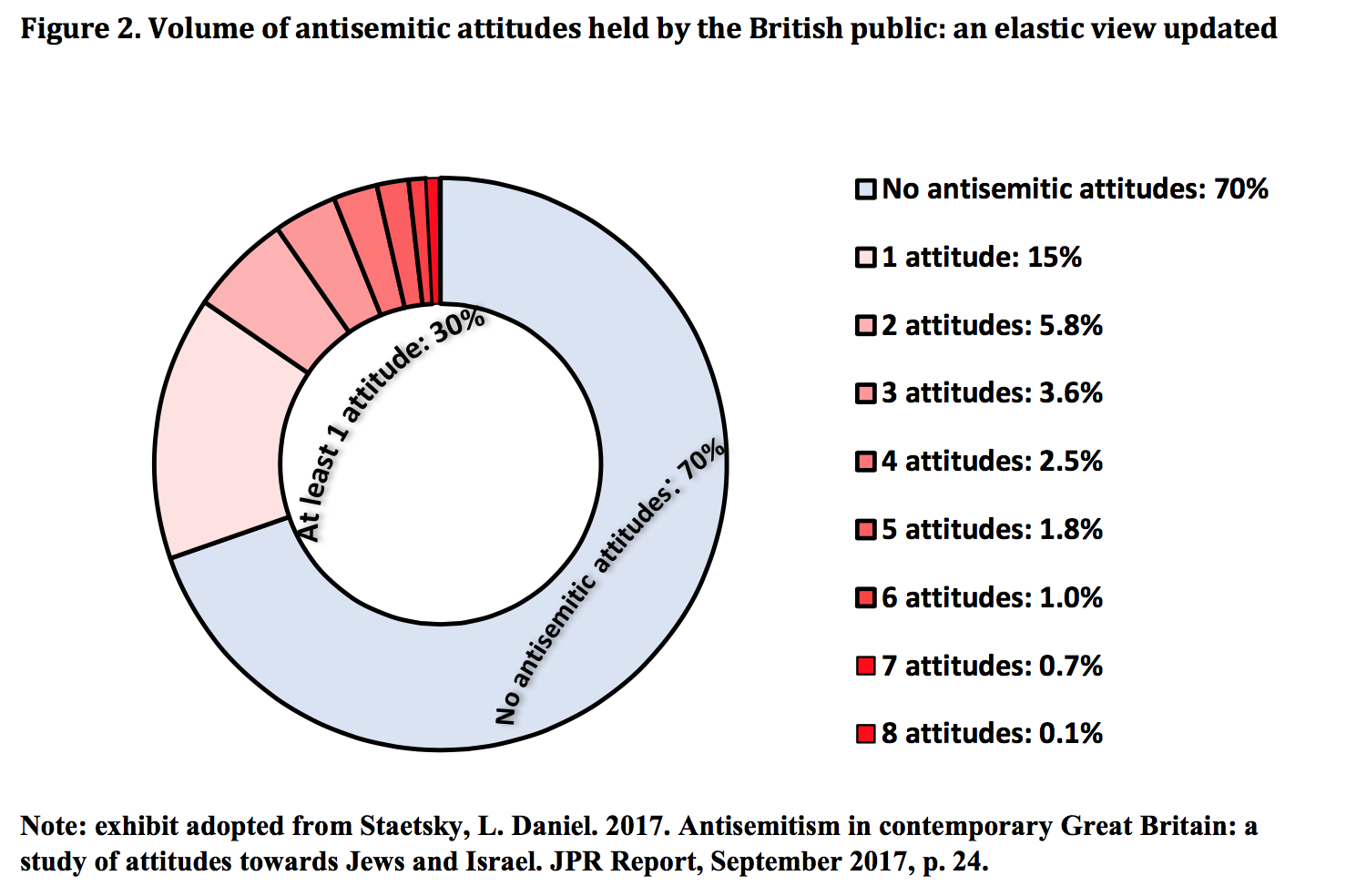
At the next step we collated these results into a single index of antisemitism, where each respondent who agrees strongly or somewhat with any of the negative views receives a score of 1 in relation to that particular view. We then sum across the responses to different questions and obtain a total score for this individual. The maximal number of antisemitic attitudes that one can hold is eight, which would effectively mean that an individual holds both an unfavourable view of Jews and endorses all specific antisemitic statements (seven in number, in this context). The minimal is one – which signals endorsement of just one attitude.

The distribution of this new variable-which we call the Antisemitism Index is set in Figure 2.

Note that:

  • 70% of British population did not endorse a single antisemitic attitude.
  • Holding 6-8 antisemitic attitudes is very low in prevalence, affecting about 2% of the population. This figure is remarkably similar to the levels of hardcore antisemitism captured by the favourability question (2.4%).
  • About 15% of British adults hold two or more antisemitic attitudes to some degree at least. Beyond this boundary are a further 15% who either strongly agree with, or tend to agree with just one such attitude. Accounting for all groups endorsing at least one attitude brings the total prevalence of antisemitic attitudes, at different intensities, to 30%.

How is this 30% best understood? Categorically, 30% does not represent the proportion of antisemites in society. Only a small proportion of them can be called antisemitic in a political sense of this word. What it represents instead is the level of diffusion of antisemitic ideas and attitudes, and the extent to which these ideas permeate society. With this we make a shift from counting antisemites to quantifying antisemitism, which may appear subtle, but it is very important for a proper understanding of Jewish anxieties.

This analysis suggests that while strong antisemitism is a marginal position in British society, antisemitic ideas are not. These ideas can be held with and without open dislike of Jews, and they are present to some extent in one third of Britons. In day-to-day life, the frequency of Jewish people’s encounters with antisemitism is determined not necessarily by the small minority of hardcore antisemites, but rather by much more widely diffused elements of attitudes that Jews commonly consider to be antisemitic. Thinly scattered and weakly held antisemitic attitudes matter, because they are more prevalent than strong attitudes, so the probability of an encounter is higher.

To sum up the most important lesson from the elastic view – the hardcore prejudice towards Jews is rare, but encountering some degree of prejudice is much more common, and, as a result, that kind of prejudice is more visible and more impactful when Jewish lives are concerned. In many instances, those expressing such views may not even realise that a particular comment or remark might be experienced by Jews as offensive or upsetting, but they can impact significantly on the perceptions, sense of comfort and safety, and, ultimately, the quality of life for Jews in Great Britain.

_____

Note: you can read the full report on which the above draws here.

Source: Quantifying antisemitic attitudes in Britain: the ‘elastic’ view of antisemitism | British Politics and Policy at LSE

ICYMI- No room for complacency: The Economist on #Antisemitism

Good overall assessment, picking up on the Institute for Jewish Policy Research covered in an earlier post (Over a quarter of British people ‘hold anti-Semitic attitudes’, study finds – BBC News):

ALL over Europe, there is concern about an increase in anti-Semitism, and deliberation over how to respond. Earlier this month the Parisian home of a 78-year-old Jewish community leader was attacked by intruders who shouted: “You are Jews, where is the money?” Along with his wife and son, the man was taken hostage, beaten and robbed, in what the government acknowledged was “an act …directly related to their religion”. Around the same time, the former head of a school in Marseille made waves by saying that when he was in charge he would advise Jews against enrolling, for fear of harassment.

Meanwhile the Vatican recently co-organised a symposiumin Rome on anti-Semitism and minority rights in the Middle East, at which Tony Blair was the main speaker. The former British prime minister declared:  “There is anti-Semitism in the East, but also in the West. There are manifestations in European countries, and also in the United Kingdom.”

So how bad are things in Mr Blair’s homeland? On the face of things, Britain is a relatively good place to be Jewish. When anti-Semitic feelings across Europe are compared, the UK tends to do well. But a new study by the London-based Institute for Jewish Policy Research gives an unusually nuanced picture of opinion in Britain.

It found that hard-core anti-Semites, who “express multiple anti-Semitic attitudes readily and confidently”, amounted to 2.4% of the population, while a further 3% could be described as “softer” anti-Semites, expressing somewhat fewer negative views. To probe their opinions, respondents were invited to react to propositions like “Jews think they are better than other people” or “The interests of Jews in Britain are different from….the rest” or “Jews have too much power in Britain…”

The study said that there was a “much larger number of people who believe a small number of negative ideas about Jews but…may not be consciously hostile or prejudiced towards them”. It found that 15% of Britons agreed at least in part to two or more anti-Semitic propositions, with a further 15% agreeing at least in part to one of them. The researchers’ interpretation was cautious:

“This emphatically does not mean that 30% of the population of Great Britain is anti-Semitic…Rather the 30% figure captures the current level of the diffusion of anti-Semitic ideas in British society, and offers an indication of the likelihood of British Jews encountering such ideas.”

The report also tackled the sensitive question of how far hostility towards Jews is linked with negative feelings towards Israel. It found the two mind-sets to be correlated, but not co-extensive. Thus 86% of those British people who hold no anti-Israel attitudes hold no anti-Semitic views either; but among those who hold a large number of anti-Israel attitudes, only 26% are completely free of anti-Semitic feelings.

Still, there clearly are people who are strongly critical of Israel, but not anti-Jewish, and a somewhat smaller contingent who harbour anti-Semitic sentiments but have no particular gripe with the Jewish state. As the report puts it, “anti-Semitism and anti-Israel attitudes exist both separately and together.”

Meanwhile Germany this week joined Britain, Austria and Romania in adopting a working definition of anti-Semitism drafted last year by the International Holocaust Remembrance Alliance, a Berlin-based body. It says:

“Anti-Semitism is a certain perception of Jews, which may be expressed as hatred toward Jews. Rhetorical and physical manifestations of anti-Semitism are directed toward Jewish or non-Jewish individuals and/or their property, toward Jewish community institutions and religious facilities.”

The definition is controversial. It has been criticised by some British Jews on the political left who argued that it could muzzle legitimate criticism of Israel, and by a leading British barrister who concluded after studying the text, and the accompanying guidelines, that it was both too narrow (it might fail to capture some anti-Jewish conduct) and too broad, in the sense that free speech over the Middle East, for example in universities, might be curtailed.

In its recommendation on how to apply the definition, the IHRA tries to give an idea of how far, in its view, disapproval of Israel can reasonably go. It says that “manifestations [of anti-Semitism] might include the targeting of the state of Israel, conceived as a Jewish collectivity. However, criticism of Israel similar to that levelled against any other country cannot be regarded as anti-Semitic.”

The European Jewish Congress, which styles itself as the “sole political organisational representative of European Jewry”, hailed the German move as “vitally important”. It would help to change a state of affairs where “astonishingly, anti-Semitism used to be defined by the perpetrator not the victim”.

Source: No room for complacency

Over a quarter of British people ‘hold anti-Semitic attitudes’, study finds – BBC News

Despite the headline, a more nuanced poll and study than most on antisemitism or other forms of racism and prejudice:

More than a quarter of British people hold at least one anti-Semitic view, according to a study of attitudes to Jewish people.

The Institute for Jewish Policy Research said the finding came from the largest and most detailed survey of attitudes towards Jews and Israel ever conducted in Britain.

But it said the study did not mean that British people were anti-Semitic.

Researchers also found a correlation in anti-Jewish and anti-Israel attitudes.

The study found a relatively small number of British adults – 2.4% – expressed multiple anti-Semitic attitudes “readily and confidently”.

But when questioned about whether they agreed with a number of statements, including “Jews think they are better than other people”, and “Jews exploit holocaust victimhood for their own purposes”, 30% agreed with at least one statement.

Despite this, the researchers said they found that levels of anti-Semitism in Great Britain were among the lowest in the world.

A spokesman for the Community Security Trust, which has recorded high levels anti-Semitic crime, said: “We believe the new findings, data and nuance in this study will help us to work even more effectively with partners inside and outside the Jewish community to tackle this problem.”

The report said about 70% of the population of Britain had a favourable opinion of Jews and did not hold any anti-Semitic ideas or views.

Muslim views

The IJPR’s researchers questioned 5,466 people face-to-face and online in the winter of 2016/17 – 995 of these were Muslims, although a smaller number of Muslims were included in the statisticians’ nationally representative sample.

They found more than half of Muslims (55%) held at least one anti-Semitic attitude.

Dr Jonathan Boyd, director of the IJPR, said: “Our intention here was not to make any broad generalisations about the Muslim population and their attitudes towards Jews.

“There does seem to be some relationship between levels of religiosity in the Muslim population and anti-Semitism.”

The institute said it wanted to promote an “elastic view”, making a distinction between people who are clearly anti-Semites, and ideas that are perceived by Jews as anti-Semitic.

In December 2016 the government adopted an internationally recognised definition of anti-Semitism: “a certain perception of Jews, which may be expressed as hatred toward Jews”.

Questions on Israel

The researchers also questioned people about their views on statements about Israel and the conflict with the Palestinians.

Their report said fewer than one in five people questioned (17%) had a favourable opinion of Israel, whereas about one in three (33%) held an unfavourable view.

The report said: “The position of the British population towards Israel can be characterised as one of uncertainty or indifference, but among those who hold a view, people with sympathies towards the Palestinians are numerically dominant.”

Dr Boyd said: “Anti-Israel and anti-Jewish views exist both together and in isolation.

“The higher the level of anti-Israel attitudes measured, the more likely they are to hold anti-Semitic views as well.”

The study also revealed that anti-Semitic attitudes were higher than normal among people who classified their politics as “very right-wing”.

Among this group they were two to four times higher than among the general population.

The researchers said the prevalence was considerably higher among right-wingers than on the left.

Rabbi Charley Baginsky, from the Liberal Judaism movement, said: “The report is important for helping us understand where the anxiety comes from within the community at large and for understanding why anti-semitism seems to be the prevailing discourse within the community.

“We must be really careful that it does not come to define us and that we celebrate the positive interactions with society at large.

“What is arguably more important … is to educate and interact, to be more outward facing and open to discussion than inward facing.”

Source: Over a quarter of British people ‘hold anti-Semitic attitudes’, study finds – BBC News