New Trump-Miller Strategy Clashes On Immigration And Innovation

One of many:

The Trump administration’s National Security Strategy document appears to bear the strong influence of Stephen Miller and assumes America can gain the benefits of immigration without admitting immigrants. The document, released Dec. 5, criticizes immigration but welcomes innovation and economic growth, which immigrants contribute to, and praises merit but opposes allowing companies to hire immigrants if they are the best fit for a position. The strategy document encourages other countries to open their markets while the United States maintains tariffs to protect favored industries. It also criticizes America’s allies in Europe and minimizes the role of NATO such that a Russian government spokesperson said the strategy is “largely consistent with our vision.”

A Contradiction On Merit And U.S. Immigration Policy

The National Security Strategy document’s immigration references show the significant influence of White House Deputy Chief of Staff Stephen Miller. The document criticizes admitting even the most highly skilled individuals to the United States. 

“Competence and merit are among our greatest civilizational advantages: where the best Americans are hired, promoted, and honored, innovation and prosperity follow,” according to the strategy document. “Should merit be smothered, America’s historic advantages in science, technology, industry, defense and innovation will evaporate. The success of radical ideologies that seek to replace competence and merit with favored group status would render America unrecognizable and unable to defend itself.”

However, in a glaring contradiction, the document goes on to declare that hiring a foreign-born person, even if they are talented and the best person for the job, would be wrong. “At the same time, we cannot allow meritocracy to be used as a justification to open America’s labor market to the world in the name of finding ‘global talent’ that undercuts American workers. In our every principle and action, America and Americans must always come first.”

That sentiment is consistent with the administration’s immigration policy, which has sought to tilt the playing field against foreign nationals to prevent their hiring in the United States. (That does not mean companies won’t shift resources and hire high-skilled foreign nationals and place them in other countries.) H-1B temporary visas are often the only way for high-skilled foreign nationals to work in the United States long term. The administration has imposed a $100,000 fee on the entry of new H-1B visa holders from outside the United States, making them prohibitively expensive to hire. The Labor Department will propose a rule to raise the prevailing wage requirement with an expected aim of pricing H-1B visa holders and employment-based immigrants out of the U.S. labor market.

Source: New Trump-Miller Strategy Clashes On Immigration And Innovation

Globe editorial: Canada’s much-touted labour shortage is mostly a mirage

Good to see some serious (and belated) questioning by the Globe. Unlikely that the government will change its approach of appeasing business and other interests rather than focussing on medium- and longer-term impacts on productivity:

No one takes orders at the Burger King in the rest stop off of Ontario’s Highway 401 near Port Hope. Instead, there’s a large touch screen that customers use to select and pay for their Whoppers and fries.

Source: Canada’s much-touted labour shortage is mostly a mirage

A new look at immigrants’ outsize contribution to innovation in the US

Yet another study:

The United States has long touted itself as a nation built by immigrants. Yet there has never been a precise measure of immigrants’ contribution to the country’s economic and technological progress. Around the time that President Donald Trump was moving to curb employment visas for skilled foreigners, economist Rebecca Diamond and a team of researchers set out to examine this unresolved question.

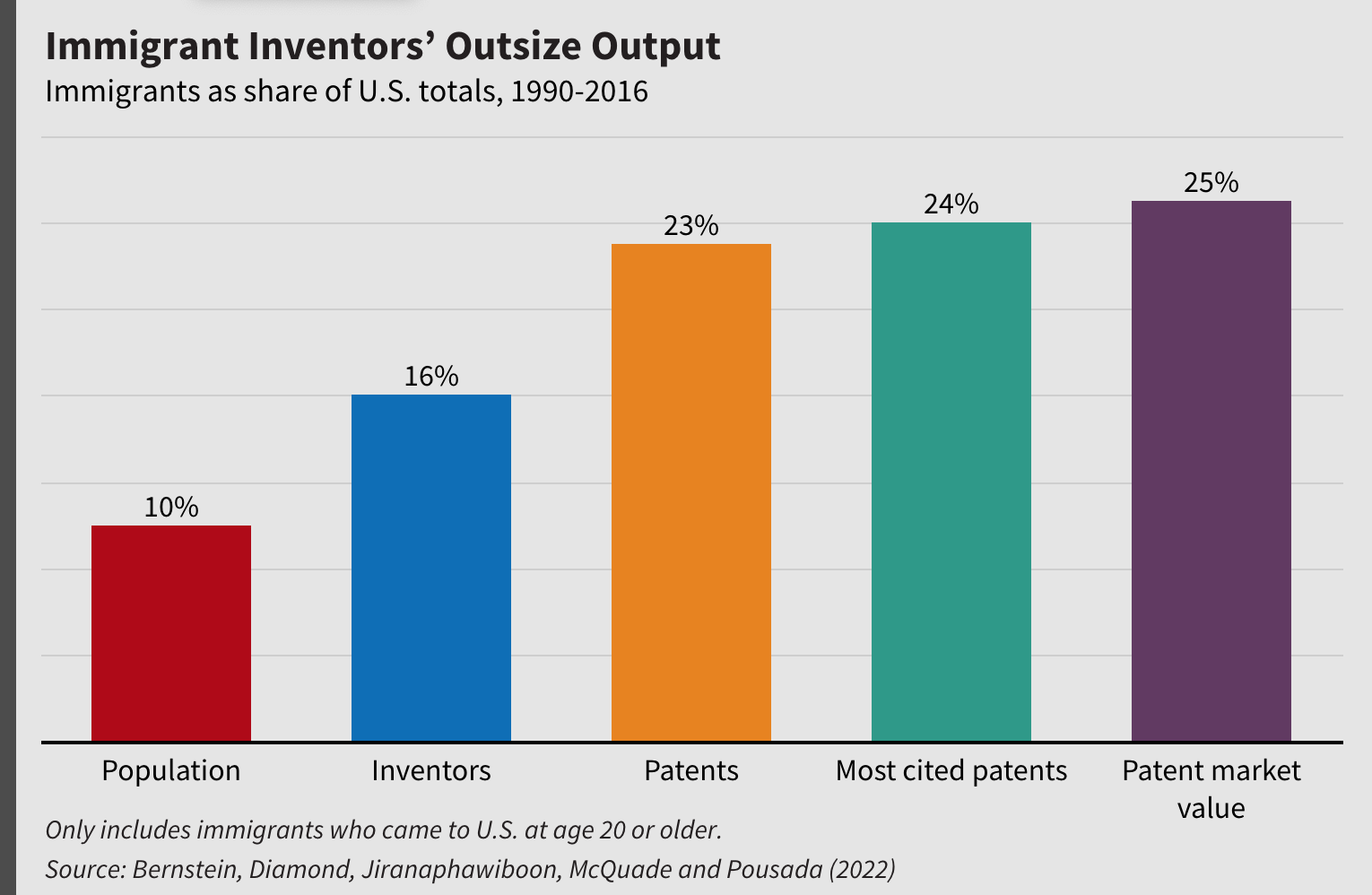
To find the answer, the researchers looked at the output of nearly 880,000 Americans who patented inventions between 1990 and 2016. They found that immigrants made an outsize contribution to innovation in the U.S. While they comprised 16 percent of inventors, immigrants were behind 23 percent of the patents issued over these years.

It wasn’t just a matter of quantity: The share of patents immigrants produced was slightly higher when weighted by the number of citations each patent received over the next three years, a key measure of their quality and utility. Moreover, immigrants were responsible for a quarter of the total economic value of patents granted in that period, as measured by the stock market’s reaction to new patents.

“The high-skilled immigrants we have in the U.S. are incredibly productive and innovative, and they’re disproportionately contributing to innovation in our society,” says Diamond, a professor of economics at Stanford Graduate School of Business and senior fellow at the Stanford Institute for Economic Policy Research (SIEPR).

Past research has indirectly pointed to the sizable role immigrants play in American innovation. Studies have shown that immigrants represent nearly a quarter of the U.S. workforce in science, technology, engineering, and mathematics and more than a quarter of the nation’s Nobel Prize winners. But this study, described in a recent working paper, is the first time economists have used patents to directly measure the output of foreign-born innovators living in the U.S.

The data was clear: “The average immigrant is substantially more productive than the average U.S.-born inventor,” write Diamond and her colleagues, Shai Bernstein of Harvard Business School; Timothy McQuade of UC Berkeley’s Haas School of Business; Abhisit Jiranaphawiboon, a former predoctoral fellow at SIEPR and now a Stanford PhD student; and Beatriz Pousada, a PhD student at Stanford and SIEPR Dissertation Fellowship recipient in 2022-23.

The researchers took a unique approach to their work. They started with a database of 300 million adults who had lived in the country between 1990 and 2016 and then used Social Security numbers to identify those who had immigrated after age 19. (The first five digits of a Social Security number encode the date it was issued; U.S.-born citizens typically receive their numbers at birth or in childhood.) Using names and address history, they matched individuals in the database to those listed as inventors with the United States Patent and Trademark Office. (When patents had multiple authors, each got credit for a proportional share.)

The researchers found that immigrants generate patents across a broad swath of sectors, including computers, electronics, chemicals, and medicine. They also discovered that, while all inventors reach peak productivity in their late 30s and early 40s, immigrants decline from that peak at a slower rate than U.S.-born inventors over the rest of their careers, a disparity that remains unexplained.

The immigrant innovation gap

Diamond believes there are several potential reasons for the innovation gap between immigrant and native-born inventors. One is brain drain: “There’s likely a pretty strong positive selection in terms of the types of people from every country that end up as high-skilled professionals with U.S. visas,” she says.

Another factor is cross-border collaboration: The researchers observed that foreign-born inventors are more likely to work with inventors based in other countries and cite foreign technologies in their patents. “Different pools of knowledge get imported by immigration, and diversity in background is good for innovation,” Diamond says.

Diamond and her team also found evidence that immigrant inventors are more likely to live in innovation hubs, such as Silicon Valley or Boston, and to work on patents in cutting-edge technology sectors. Still, the researchers estimate that these two factors explain just 30 percent of the gap in patent output.

Immigrant inventors’ contributions go beyond their own work — they also make their native-born collaborators more productive, the researchers discovered. To arrive at this finding, Diamond and her team identified inventors who died before they turned 60 and examined the output of people who had co-authored a patent with that individual before their early death. Compared to a control group of inventors that did not lose a collaborator, surviving inventors produced 10 percent fewer patents after the death of their co-author. The effect was larger for inventors whose deceased co-author was an immigrant — their productivity declined by 17 percent. This gap persisted even after the researchers controlled for a number of factors, such as the productivity of the deceased inventors.

“At the end of the day, we weren’t really able to explain the gap,” Diamond says. “It seems there’s something special about being an immigrant. Their knowledge has these huge external effects on who they work with, and what they know impacts what their collaborators can produce in the future.”

Diamond believes these findings have direct implications for policymakers who want to maintain the nation’s role as a technological trailblazer. “Understanding the forces that make the U.S. one of the most innovative and productive countries in the world is important,” she says. “The U.S. has done an amazing job of attracting the best and the brightest immigrants. Any policy that would revamp the visa process might want to consider how big a deal immigrants are in our innovation output.”

Source: A new look at immigrants’ outsize contribution to innovation in the US

Immigration Policies Threaten American Competitiveness

Interesting Harvard Business School alumni survey regarding perceived undermining of US competitiveness by Trump administration policies:

It is no secret that immigration has reshaped American innovation. Immigrants are the backbone of America’s most innovative industries, provide a quarter of our patent applications, and are numerous among our science and engineering superstars.

Taken from World Intellectual Property Organization data (Miguelez and Fink, 2013), Figure 1 shows that America received more than half of migrating inventors from 2000-2010.

Figure 1: Migration of inventors, 2000-2010


Immigrants can be found in times of success and times of crisis. Examples include:

  • Among the American companies leading the race toward a vaccine to end the COVID-19 pandemic is Moderna, a Cambridge company with an immigrant co-founder and an immigrant CEO.
  • Another firm already conducting vaccine trials is Inovio Pharmaceuticals of Plymouth Meeting, Pennsylvania, led by cofounder J. Joseph Kim. Kim, who came to the United States from South Korea at age 11 without speaking English, was among the pharmaceutical leaders who briefed President Trump on vaccine development in March.

The flow of global talent responsible for bringing these innovators to American shores has been a substantial driver of business creation. As I discuss in my book The Gift of Global Talent, skilled immigration is the world’s most precious resource.

Talent flows to where it’s needed

But talent is movable, and the United States must cherish and protect its prized position at the center of the global talent flow. At a time of crisis when fear is used to shift blame onto outsiders, America is at risk of signaling to global innovators and entrepreneurs, and the promising students who will one day become them, that they cannot have a future here.

Talent flows to where it is most productively utilized and welcome, and while the destination of choice has long been the United States, other countries are increasingly challenging America’s dominance.

“TALENT IS MOVABLE, AND THE UNITED STATES MUST CHERISH AND PROTECT ITS PRIZED POSITION AT THE CENTER OF THE GLOBAL TALENT FLOW.”

By some metrics, their efforts are succeeding. Between 1990 and 2010, America’s share of college-educated migrants within the Organisation for Economic Cooperation and Development nations fell from about 50 percent to 40 percent.

Our recent research captures business leaders’ rising anxiety about America’s complacency in competing for this talent and the negative impact on America’s competitiveness that could result. We surveyed(pdf) thousands of Harvard Business School alumni for their views on immigration.

Our alumni were overwhelmingly supportive of skilled immigration. Over 90 percent said that foreign skilled workers have a positive effect on the US economy, and 87 percent believe that the United States should allow more highly skilled immigrants to move here to work and live (see Figures 2 and 3).

Figure 2: Net agreement for belief statements about immigration
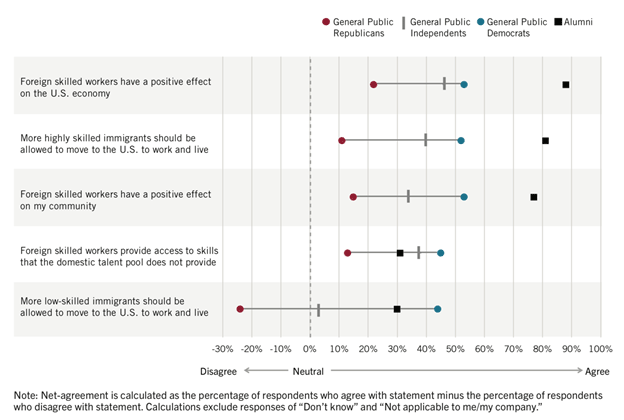


Figure 3: Alumni views of immigration system and politics

Alumni also confirmed the importance of foreign skilled workers to their companies’ ability to compete. Nearly one in four said that at least 15 percent of their companies’ US-based skilled workforce was foreign born. Alumni expressed that immigrants were critical for developing better products and services, increasing the quality of innovation, and reaching international customers.

Our alumni warned us, however, that this important competitive advantage is at risk. A majority believe the current political rhetoric around immigration is harming their organization’s ability to attract foreign skilled workers. Nearly 60 percent blamed the US immigration system for causing project delays. And over two-thirds reported that their companies’ operations would be harmed if denied access to foreign skilled workers.

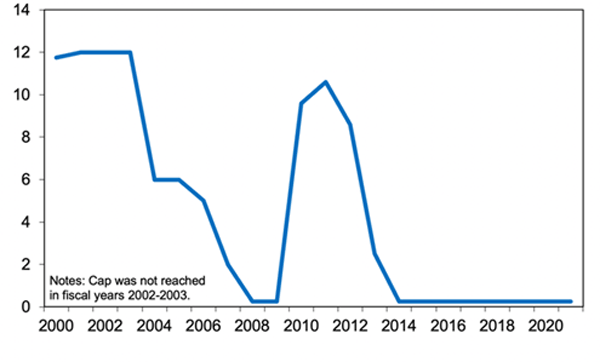
Because immigration is often a political third rail, there are many reasons to be skeptical that the United States will soon find a broad solution. In fact, when it comes to skilled immigration, our research shows more support for minor changes to the current system than for more fundamental reforms. Over two-thirds of alumni supported increasing the number of new H-1B visas issued each year by at least 50 percent. For much of the past decade, H-1B visas have run out within a single week (see Figure 4). Despite even the COVID-19 pandemic, the government received 275,000 applications in March of this year for the 85,000 slots in fiscal year 2021.

Figure 4: Months to reach H-1B visa cap by fiscal year

Structural changes, such as adopting wage ranking for awarding H-1B visas in place of today’s lottery system, did not achieve much support among our alumni. The gap between alumni believing the existing immigration system is harming their businesses and alumni only supporting incremental change is surprising to us. It is unclear whether this reveals a lack of knowledge or actual uneasiness about the policies themselves.

American competitiveness at risk

Either way, the stakes get higher in times of crisis: the recent H-1B visa lottery would have given the same chances to a critical researcher being recruited by Moderna and Inovio (or J&J and GlaxoSmithKline) as it would have to a software code tester working at an outsourcing company.

“WHILE WE MAY TEMPORARILY CLOSE BORDERS AS WE FIGHT COVID-19, BUSINESS MUST ARTICULATE JUST HOW DISASTROUS CLOSING OUR BORDERS LONG-TERM WOULD BE.”

One striking finding was that our alumni were in broad agreement over increasing the allocation of employment-based immigrants within the overall US immigration pool. When asked what share of total immigration to the United States should be employment-based, alumni on average proposed to quadruple today’s 12 percent share. When we surveyed a representative sample of the general public on this same question, we found a similar result—they proposed to triple the share of employment-based immigrants. That result held across all political affiliations, with both Democrats and Republicans proposing to increase the employment-based allotment.

Implementing such a shift could be quite politically controversial depending upon technique, especially if policies shifted visas from family-based channels and diversity programs rather than creating new employment-based visas. But we believe there is a path forward. We can build momentum by getting started with simpler actions like wage ranking H-1B applicants and creating immigrant entrepreneur visas. These quick wins can be stepping-stones towards further reform by proving that we can change our system for the better, despite decades of intransigence.

Most importantly, business leaders should get involved and share the burden with policymakers and academics to educate voters and build support for these policies that ultimately benefit America’s business community.

While we may temporarily close borders as we fight COVID-19, business must articulate just how disastrous closing our borders long-term would be. Some of the recent political rhetoric to halt all immigration, even if later scaled back in practice, endangers the image of America as a welcoming beacon to the next generation of scientists and entrepreneurs. Other countries are creating innovative new programs to attract talent and threaten our competitive advantage, while our government issues executive orders and espouses rhetoric that undermine our promise to the world’s brightest.

Our position at the center of global talent flows is now at risk. Business has both the pressing need, and the capacity, to accept this responsibility. It should.

About the Author

William R. Kerr William Kerr is the D’Arbeloff Professor of Business Administration at Harvard Business School.

Source: Immigration Policies Threaten American Competitiveness