ICYMI: Some Colleges Have More Students From the Top 1 Percent Than the Bottom 60. Find Yours. – The New York Times


Students at elite colleges are even richer than experts realized, according to a new study based on millions of anonymous tax filings and tuition records.

At 38 colleges in America, including five in the Ivy League – Dartmouth, Princeton, Yale, Penn and Brown – more students came from the top 1 percent of the income scale than from the entire bottom 60 percent.

38 colleges had more students from the top 1 percent than the bottom 60 percent

STUDENTS FROM … THE TOP 1%
($630K+)
BOTTOM 60%
(<$65K)
1. Washington University in St. Louis 21.7 6.1
2. Colorado College 24.2 10.5
3. Washington and Lee University 19.1 8.4
4. Colby College 20.4 11.1
5. Trinity College (Conn.) 26.2 14.3
6. Bucknell University 20.4 12.2
7. Colgate University 22.6 13.6
8. Kenyon College 19.8 12.2
9. Middlebury College 22.8 14.2
10. Tufts University 18.6 11.8
These estimates are for the 1991 cohort (approximately the class of 2013). Rankings are shown for colleges with at least 200 students in this cohort, sorted here by the ratio between the two income groups.

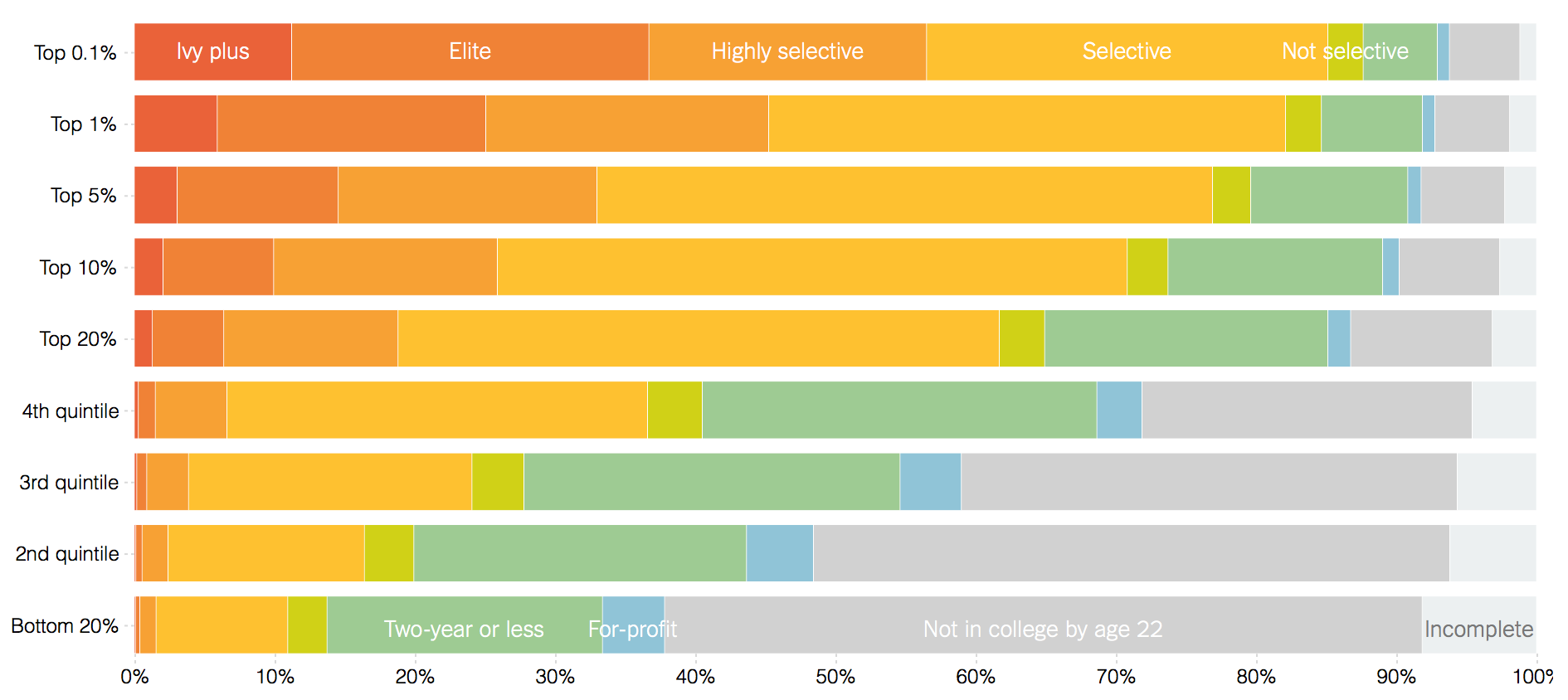
Roughly one in four of the richest students attend an elite college – universities that typically cluster toward the top of annual rankings (you can find more on our definition of “elite” at the bottom).

In contrast, less than one-half of 1 percent of children from the bottom fifth of American families attend an elite college; less than half attend any college at all.

Where today’s 25-year-olds went to college, grouped by their parents’ income

About four in 10 students from the top 0.1 percent attend an Ivy League or elite university, roughly equivalent to the share of students from poor families who attend any two- or four-year college.

Colleges often promote their role in helping poorer students rise in life, and their commitments to affordability. But some elite colleges have focused more on being affordable to low-income families than on expanding access. “Free tuition only helps if you can get in,” said Danny Yagan, an assistant professor of economics at the University of California, Berkeley, and one of the authors of the study.

The study – by Raj Chetty, John Friedman, Emmanuel Saez, Nicholas Turner and Mr. Yagan – provides the most comprehensive look at how well or how poorly colleges have built an economically diverse student body. The researchers tracked about 30 million students born between 1980 and 1991, linking anonymized tax returns to attendance records from nearly every college in the country.

We’re offering detailed information on each of more than 2,000 American colleges on separate pages. See how your college compares – by clicking any college name like Harvard, U.C.L.A., Penn State, Texas A&M or Northern Virginia Community College – or search for schools that interest you.

At elite colleges, the share of students from the bottom 40 percent has remained mostly flat for a decade. Access to top colleges has not changed much, at least when measured in quintiles. (The poor have gotten poorer over that time, and the very rich have gotten richer.)
White Economic Privilege Is Alive and Well – The New York Times

Good analysis:

Is the white working class losing economic ground because of policies intended to improve the lives of black people? Anxiety and resentment among some white voters about those policies certainly seemed to benefit Donald Trump’s campaign last year, with its populist, ethno-nationalist message.

The problem with this belief is that it is false. The income gap between black and white working-class Americans, like the gap between black and white Americans at every income level, remains every bit as extreme as it was five decades ago. (This is also true of the income gap between Hispanic and white Americans.)

In 2015 — the most recent year for which data are available — black households at the 20th and 40th percentiles of household income earned an average of 55 percent as much as white households at those same percentiles. This is exactly the same figure as in 1967.

Indeed, five decades of household income data reveal a yawning and uncannily consistent income gap between black and white Americans across the economic spectrum. Fifty years ago, black upper-class Americans had incomes about two-thirds those of white upper-class Americans, while the black middle class — those in the 60th percentile — earned about two-thirds as much as its white counterpart. Those ratios remain the same today.

The Income Gap That Won’t Close

These numbers should shock us. Consider that in the mid-1960s, Jim Crow practices were still being dismantled and affirmative action hardly existed. Yet a half-century of initiatives intended to combat the effects of centuries of virulent racism appear to have done nothing to ameliorate inequality between white and black America.

Conservatives like Charles Murray tend to blame either social welfare programs for sapping initiative and keeping black people poor, or black people themselves for being less intelligent than whites, or a “pathological” culture that now manifests itself in the white working class as well.

But the historical pervasiveness and contemporary persistence of racism in America offer more than adequate explanations for what should be considered a scandalous state of affairs in regard to race-based economic inequality.

Many black children, for example, attend schools that once again are as segregated as they were in the 1960s, and they are far more likely to become trapped in a prison-industrial complex that the scholar Michelle Alexander has called “the new Jim Crow.”

Research by the sociologist Devah Pager in 2009 also found that black job applicants for low-wage jobs receive callback interviews or job offers at half the rate of equally well-qualified white applicants and that black and Latino applicants with clean records “fare no better” than white applicants just released from prison.

It is important to remember the extent to which the civil rights movement led by the Rev. Dr. Martin Luther King Jr. was focused on economic injustice. Indeed, A. Philip Randolph and Bayard Rustin, who planned the March on Washington that culminated with Dr. King’s “I Have a Dream” speech, organized the event primarily to highlight and protest what they called “the economic subordination of the American Negro.”

And Dr. King’s Poor People’s Campaign, which he was organizing at the time of his murder, was an even more explicit argument that racial and economic justice are inextricably linked.

None of this is intended to minimize the legitimate anxiety felt by white families at a time when wages for low-wage workers have declined and middle-class incomes have stagnated, even as the economy has boomed and upper-class incomes have soared. Between 1980 and 2014, the post-tax income of the bottom 50 percent of the population grew by 21 percent, while that of the top .01 percent grew by 424 percent.

But over that same time, black working- and middle-class households have seen their incomes stagnate in exactly the same fashion as those of their white neighbors — and from a base that was and thus remains little more than half as large.

A genuine populist movement would unite working- and middle-class Americans of all backgrounds, rather than dividing them by exploiting false beliefs about the supposed loss of white economic privilege.

The winners and losers of globalization, Branko Milanovic’s new book on inequality answers two important questions: Corak

Miles Corak’s review of Branko Milanovic’s Global Inequality: A New Approach for the Age of Globalization makes interesting reading, particularly  the section on immigration:

If we really can get into this global mindset that he is asking us to adopt, then we might think more creatively, and perhaps less dogmatically, about a series of challenges that we face as citizens of individual nations. There are a number of examples in the last chapter, but perhaps the most striking deals with citizenship and migration, examples that cut at the very core of the approach.

There remains a huge boost to incomes depending upon where an individual lives, and this creates big incentives for migration from poorer to richer countries. American politics has long been struggling with meaningful immigration reform, driven by the large inequalities between countries but also formed, informed, and misinformed by the large inequalities within the country.

The refugee crisis now afflicting Europe is partly geopolitical but also deeply economic. Better lives are to be had if one can make it to Germany or Sweden. “Physical walls between jurisdictions,” Milanovic tells us, “are being built, in part, because there is a huge financial wall between being and not being a citizen of a rich country.” In his view, this is because our national politics ties us to a binary notion of citizenship. He speculates that Americans and other citizens of the rich countries might be more amenable to immigration if there were what he calls an intermediate level of citizenship, a level that would have less economic value than full citizenship because it would entail higher taxation, less access to social services, or perhaps an obligation to return to the country of origin.

In other words, put aside the idea of a “path to citizenship” as a right. Americans have tolerated a de facto inferior form of residency, but in a way that keeps many immigrants and their children in the shadows. Milanovic is advocating bringing them out of the shadows through, for example, a legally administered program for temporary foreign workers, giving migrants the right to work in the country but also the obligation to return home.

This is something actually done in Canada, but the policy went afoul politically because it made the competition for jobs between natives and migrants more transparent. It may be a policy particularly appropriate to the European Union, where the walls are something more than metaphorical. This is context that Milanovic probably has in mind. But it is hard to imagine how much traction a temporary foreign-worker program, or the other variants he suggests, would have in the U.S., because the perception that immigrants compete for jobs and lower wages of the native-born will still bite.

Indeed, at the same time, Milanovic makes clear that he feels the “great middle-class squeeze” is not over, and will likely lead to more polarization in rich societies and their politics. This will not only ensure immigration policy will continue to be challenging, it may also be all the more troubling for policy directed to equality of opportunity.

In the coming years, the observed differences in the skills and abilities between the top echelons and everyone else will not be that great, with chance, family background, and inheritances playing a bigger role in allocating incomes. “The new capitalism will resemble a big casino, with one important exception: those who have won a few rounds (often through being born into the right family) will be given much better odds to keep on winning.” If this is so, then it will be harder and harder to sustain the story that inequality is somehow the precursor of opportunity, offering rewards and incentives for the more productive among us to contribute to higher growth and incomes for all. And the status quo will become politically less and less sustainable.

Source: The winners and losers of globalization, Branko Milanovic’s new book on inequality answers two important questions | Economics for public policy

The unbending arc: America’s race gap is stuck | Brookings Institution

Richard Reeves on the ongoing economic gap between white and black Americans:

America is in danger of becoming stuck, with insufficient social, geographical, or economic mobility. That’s the claim I made in a recent essay for Esquire magazine, a collaboration between the magazine and Brookings. (You can read the whole package here.)

Poverty persists across generations, too. Half of the black children born on the bottom rung of the income ladder (the bottom quintile) will stay there as adults. A boy who grows up in Baltimore will earn 28 percent less simply because he grew up in Baltimore. Sixty-six percent of black children live in America’s poorest neighborhoods, compared with six percent of white children.

Recent events have shone a light on the black experience in dozens of U.S. cities. Behind the riots and the rage, the statistics tell a simple, damning story. Progress toward equality for black Americans has essentially halted. The average black family has an income that is 59 percent of the average white family, down from 65 percent in 2000. In the job market, race gaps are immobile, too. In the 1950s, black Americans were twice as likely to be unemployed as whites. And today? Still twice as likely.

In part this reflects geographical separation, too. While the degree of segregation by race has reduced slightly in recent years, as shown by my colleague William Frey, black Americans are still likely to live in areas of concentrated income poverty, and to be Stuck in Place, as the title of Patrick Sharkey’s influential book puts it.

Race gaps in wealth are perhaps the most striking. The average white household is now thirteen times wealthier than the average black one. This is the widest gap in a quarter of a century. The recession hit families of all races, but it resulted in a wealth wipeout for black families. In 2007, the average black family had a net worth of $19,200, almost entirely in housing stock, typically at the cheap, fragile end of the market. By 2010, this had fallen to $16,600. By 2013—by which point white wealth levels had started to recover—it was down to $11,000. In national economic terms, black wealth is now essentially nonexistent.

Half a century after the passing of the Civil Rights Act, the arc of history is no longer bending toward justice. A few years ago, it was not unreasonable to hope that changing attitudes, increasing education, and a growing economy would surely, if slowly, bring black and white America closer together. It is now clear that time and economic growth alone will not heal the racial divide.

Source: The unbending arc: America’s race gap is stuck | Brookings Institution

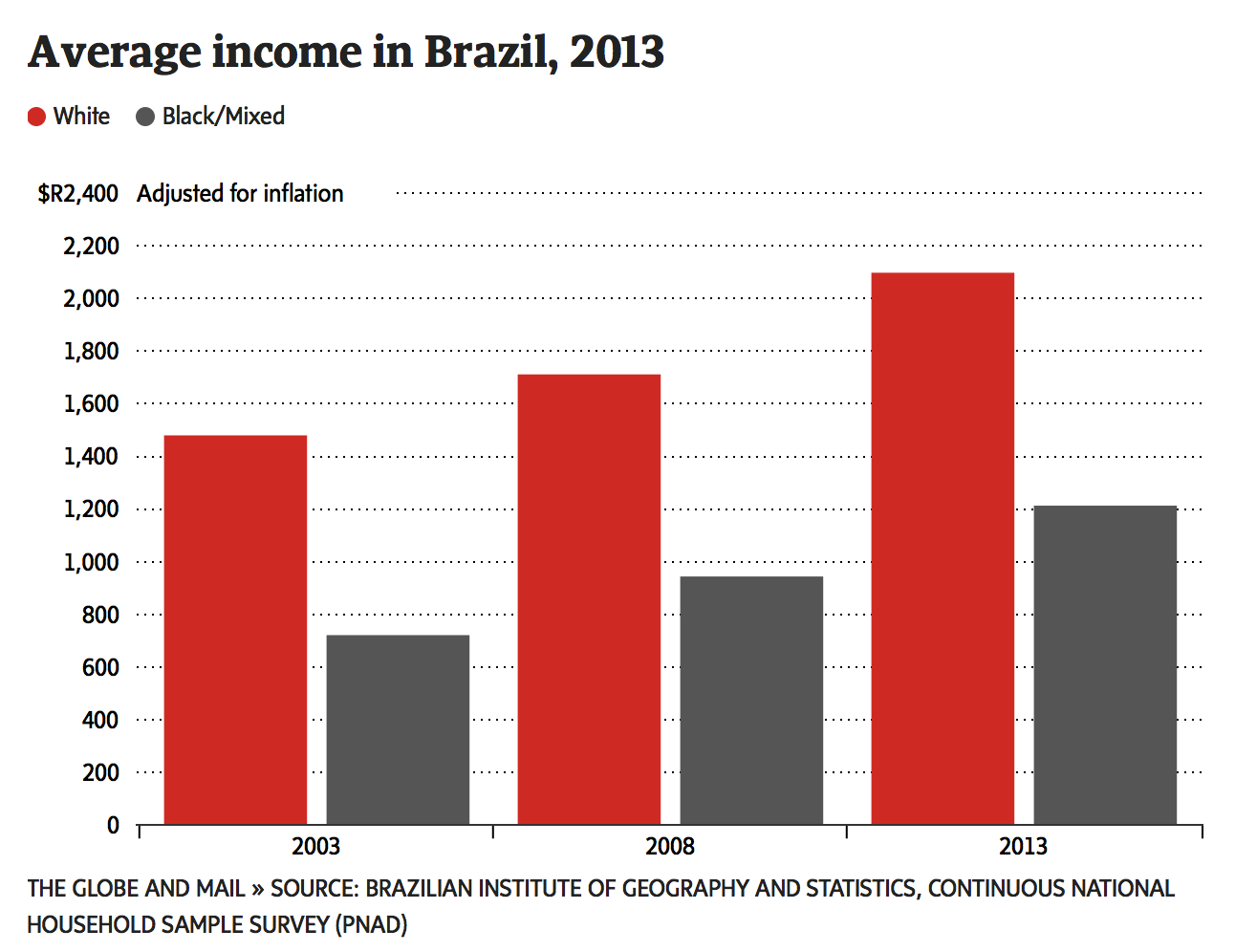
Brazil’s colour bind: How one of the world’s most diverse countries is just starting to talk about race

Brazil’s_colour_bind__How_one_of_the_world_s_most_diverse_countries_is_just_starting_to_talk_about_race_-_The_Globe_and_MailGood, in-depth profile of Brazil by Stephanie Nolen, its history of slavery, its national myth of colour blindness, racial inequality and efforts to acknowledge and address these legacy issues:

Even as the former slave owners set about diluting the country’s blackness, they also went to work on their cover story. In the Brazilian creation myth – the country’s version of Canada’s “cultural mosaic” or the U.S. “melting pot” – the country is a democracia racial, a racial democracy. This official story was built on the idea that from the day slavery ended, Brazilians of all colours were equal. After all, there was no segregation, no apartheid, no Jim Crow. Glossing over the massive disparities between the former owners and the newly freed slaves – who had no education, land or assets – the Brazilian elite, almost entirely white, declared the country uniquely equal and, in effect, postracial.

“It was ‘invisibilization,’” says Marcelo Paixão, who is black and a professor of economics at the Federal University of Rio de Janeiro. “The discourse was that we don’t have race in Brazil, so you don’t have race problems in Brazil, and you don’t need to discuss the inequality.”

The first census after the end of slavery, in 1890, asked not about race, but about colour: Citizens were asked if they were white, brown, black, yellow or caboclo – a Portuguese word for those with some indigenous ancestry, more commonly known here as being vermelha, or red. Over the next years, racial identity was steadily replaced with considerations of colour. In 1976, the national statistics institute, seeking to hone the precision of the census, surveyed thousands of Brazilians about what word they themselves used – and came back with a list of 136. They included terms such as amarela-queimada (burnt yellow), canela (cinnamon) and morena-bem-chegada: very nearly morena, a word for brown.

On some level, it was a progressive ideology, notes Prof. Paixão – it allowed for nuance instead of clear-cut indicators of racial purity. It also resulted in a more genuinely mixed culture, although that mixture is the outcome, in part, of appropriation. Cornerstones of black culture – such as samba music and the martial art capoeira, practised in secret by slaves – have been thoroughly co-opted into Brazilian identity.

But within that culture, and that society, there was an ineluctable hierarchy of what were to be considered racial traits. The dominant idea, propagated by whites, and eventually accepted by many black and mixed-race people as well, he explains, was that the “white” part of the mix brought a European rationality, while Africans brought happiness and creativity, a positive outlook – he ticks off adjectives and rolls his eyes. The more white that one was, the more of the “valuable” characteristics one had. To be whiter was to have a better chance of getting a job, and of earning more in that job. To be whiter, in other words, was to have it easier. Brazil became what is sometimes called here a “pigmentocracy.” (Prof. Paixão is among the fewer than five per cent of faculty members at the Federal University who are black.)

Brazil’s colour bind: How one of the world’s most diverse countries is just starting to talk about race – The Globe and Mail.

See How the Wealth Gap Between Whites and Non-Whites Is Getting Wider | TIME

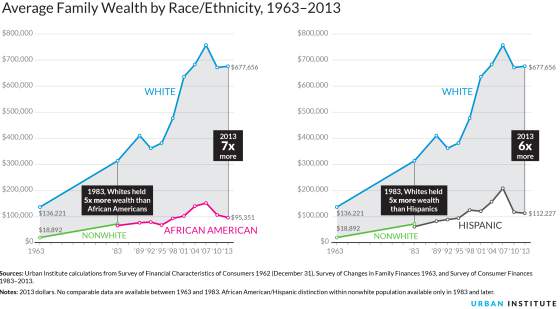
wealthbyrace-avg1Not completely surprising but still striking nevertheless:

The average white family accumulated $677,656 in total assets in 2013, more than six times that of Latino families and seven times that of African-American families, according to a new study that shows ethnic minorities slipping behind in the post-recession economy.

The Urban Institute released a series of graphics that shows the wealth gap between white and non-white families widening from a multiple of five in the early 80’s to multiples of six and seven by 2013.

See How the Wealth Gap Between Whites and Non-Whites Is Getting Wider | TIME.

Toronto’s income gap continues to widen, finds U of T expert

Not new, but better documented by David Hulchanski than done earlier:

Between 1970 and 1990, average incomes jumped significantly in only about 13 per cent of Toronto’s 500-plus “census tract” neighbourhoods.

Slightly more, 19 per cent, saw incomes drop significantly, while most Torontonians, in 67 per cent of the census tracts, saw earnings change only modestly.

Expanding the time frame to 1970 to 2012 exposes a dramatic shift.

Middle-income communities across the city began to evaporate. Neighbourhoods with relatively stable average income shrank by more than half, to 32 per cent of the census tracts.

The percentage of neighbourhoods where residents’ average incomes skyrocketed more than doubled. At the same time, the percentage of neighbourhoods where people were getting much poorer also doubled.

Yorkville, which transformed from downtown hippie haven to posh shopping district favoured by the jet set, saw the biggest surge in average incomes. Part of Thorncliffe Park, which became a landing pad for newly arrived immigrants, saw the biggest income drop.

When the city snapshot is narrowed to only 2012, just under half of Toronto is considered low-income — well under the $46,666-per-year average — while 21 per cent is high-income and only 30 per cent is middle.

“What I call City No. 2 — the middle-income city — is simply disappearing,” Hulchanski says.

Gentrification is only one of the root causes, he says, listing provincial and federal policy changes since 1990 that he believes were intended to further enrich society’s top earners.

This can also be mapped against visible minorities, many of whom are low-income in Toronto.

Of course, this is not just a Toronto issue as part of worldwide trend towards greater inequality.

Toronto’s income gap continues to widen, finds U of T expert | Toronto Star.

A “Sticky” Situation: Persistent Gender Gap

Gender gapsInteresting US study and chart showing persistence of the gender wage gap, increasing by level:

This is what economists call the “sticky floor” theory of the gender wage gap. Women make very close to men coming out of college, but as men climb the corporate ladder, female salaries stick to the ground. Consider that women account for 49 percent of the bottom 99 percent of earners, but just 11 percent of the 1 percent, and just 9 percent of the top 0.1 percent of earners, according to one recent paper.

A “Sticky” Situation « The Dish.

Canada becomes more unequal, but good policies could halt that: TD Bank

When the banks start worrying about rising inequality ….

But author [TD Economist] Craig Alexander says rising inequality is bad for the economy – both because it leaves lower income people with less to spend and because it stalls opportunity for children and youth.

“Inequality has risen and it is a concern, because it actually can hamper investment in human skills, it can hamper economic growth. There’s an increasing body of literature that shows that elevated levels of inequality is not just bad for individuals, it’s bad for your economy and your society,” he said in an interview with CBC’s Metro Morning.

He calls for smart policies that improve Canadian productivity and social mobility, among them:

  1. Investing in policies that improve productivity.

  2. Investment in skills training.

  3. Reviewing the tax and income distribution systems.

  4. More means testing on programs to shift support to families more in need.

  5. Improving policies around education, early childhood education and health.

Canada becomes more unequal, but good policies could halt that: TD Bank – Business – CBC News.