India’s surprise about-face on farming laws a ‘monumental moment’ for diaspora in Canada

Of note given the Indo-Canadian activism on the proposed farming laws:

A sudden announcement by Indian Prime Minister Narendra Modi to withdraw the highly contentious farm laws in that country is being met with cautious optimism by many diaspora Indians in Canada. But some say they won’t feel relief until the laws are formally repealed.

The surprise move comes over a year after Modi’s Bharatiya Janata Party government instituted the laws, first by ordinance and then passing them without consultation with either farmers’ unions or state governments.

The farm acts sparked a year of massive protests in India — at times deadly — during which tens of thousands of farmers took part in a movement to march to the capital.

Demonstrations were also held in Canada, including rallies in front of the Indian consulate in downtown Toronto, where hundreds turned out in solidarity with Indian farmers, who were in many cases their own family and friends.

Opponents of the laws said they meant an end to guaranteed pricing, forcing farmers to sell crops to corporations at cheaper prices and leave them with no right to take disputes with those corporations to court, with conflicts instead settled by bureaucrats.

Friday brought an about-face from Modi, who promised that the laws will be repealed beginning in December.

“I want to say with a sincere and pure heart that maybe something was lacking in our efforts that we could not explain the truth to some of our farmer brothers,” he said in a televised speech.

“Let’s us make a fresh start.”

‘A crack’ in the edifice

At the Shromani Sikh Sangat Temple in Toronto’s east end, Gurshan Singh, who comes from a farming family, was wary of the announcement.

“I don’t consider it done yet because the prime minister has announced that it will be repealed but the procedure still has to happen,” Singh said in Punjabi, speaking to CBC News through an interpreter.

Singh said his entire village went out to protest against the laws.

“People were martyred … people lost their children,” he said.  And while some 700 people are believed to have died in the process, he said he’s thankful his own family is safe.

“I’m happy,” he said. “But I’m still not sure.”

For Sanjay Ruparelia, a professor of politics and public administration at Toronto’s Ryerson University, the sudden news is part of a much larger story about the rise of autocracy in India over the last seven years.

“I think a lot of people are wanting to see whether this movement now has made a crack in that edifice,” he said.

But farmers have good reason to be skeptical after the lengths the government went to sideline protesters, going so far as to suggest they had been infiltrated by Sikh separatists, he said.

“There’s no truth to these claims. The government just wanted to delegitimize and undermine the protests, and that really inflamed the situation and sowed even greater distrust among the farmers’ unions,” said Ruparelia.

“They already felt that they weren’t consulted on these laws, they already felt that the laws would harm their interests and now they were being painted as terrorists and anti-national forces.”

In recent years, opposition parties have won victories in some state elections but have been unable to “really weaken the dominance of the party and particularly its Hindu nationalist program,” he said.

In that sense, he says, this victory could be a turning point, Ruparelia said.

‘You can’t subtract the politics out of it’

Between a perceived mishandling of the COVID-19 pandemic, the controversial farming laws and civil society groups being maligned, trust in India’s federal government is fractured, Ruparelia said. And with elections coming up in two important states — Punjab and Uttar Pradesh — the government may well have feared it might lose its grip on power.

As for the impact in Canada, he says, the reaction here is sure to be divided.

“There are many, many citizens and residents of Canada who are part of the larger diaspora with very strong connections to the parts of the country, which have really led this movement,” he said.

Jaskaran Sandhu, director of administration with the World Sikh Organization, agrees.

“You can’t subtract the politics out of it,” said Sandhu. “At the end of the day it’s hard to trust Modi, it’s hard to trust someone who has been fighting you tooth and nail for a year … it’s hard to trust a government that refused to consult with you from the beginning.”

Over the past year or so, Sandhu says he’s watched the the protests through the eyes of his own friends and family on the ground, while focusing his own efforts in Canada on advocacy. One of his own initiatives, he says, was to co-found and launch the platform Baaz News, which made it a priority to shine a light on farmers’ stories.

Sandhu says he awoke to dozens of messages from family and friends sharing congratulations over the move on Friday morning.

“This is an underdog story. To see them victorious, it’s hard to put it into words,” he said. “I think it’s a monumental moment for the diaspora.”

But amid that sense of victory is also trepidation.

“No one’s getting up and leaving just yet.”

Source: India’s surprise about-face on farming laws a ‘monumental moment’ for diaspora in Canada

In India and Canada’s international student recruiting machine, opportunity turns into grief and exploitation

Good long read, raising policy questions about why IRCC’s policies and procedures have effectively allowed this kind of systemic exploitation to occur along with the complicity of private and some public institutions:

A giddy Mani strides into the offices of Grey Matters, an education consultancy in Chandigarh in the Indian state of Punjab, with his mother at his side, several boxes of sweet milk cake in tow.

Mani’s student visa to Canada has just arrived, and he’s here to show his gratitude. The 18-year-old presents a gift-wrapped sweet box to the consultancy’s founder, Sonia Dhawan, who urges him to offer it first to the idol of the elephant-faced Hindu god Ganesha, mounted next to the Canadian and American flags. The reigning motif here is the maple leaf – it’s pinned to the walls of the counselling cubicles, on colourful flyers in every corner and even on a little golden brooch on Ms. Dhawan’s blazer. After a little pooja ceremony celebrating the arrival of his visa, which will allow him to study at a private university in downtown Vancouver, Mani distributes sweets to everyone in the room, grinning from ear to ear.

Grey Matters, which sees 7,000 to 8,000 students each month at its 56 locations in India, is one of many such centres in Chandigarh’s sprawling Sector-17 market, a hub of retail stores and education institutes that has become known as a one-stop shop for young Indians itching to begin their adult lives abroad.

Businesses like this all over the country send tens of thousands of Indian students like Mani to Canada each year – 105,192 were enrolled in Canadian universities and colleges in the 2018-2019 school year, the most recent period for which data are available. They promise a new life, jobs, houses and prosperity and – ever since the federal government introduced a series of programs in 2009 that opened the gates more widely to Indian students – a chance at the ultimate prize: Canadian citizenship.

But for many, the dream doesn’t mesh with the reality.

A few hours’ drive west, in Punjab’s Moga District, known for its expansive wheat and rice paddy fields, Joginder Singh Gill is trying to get through a conversation about his son Lovepreet without crying. Three years earlier, Lovepreet had felt the same elation as Mr. Singh when he received his student visa: a ticket out of a humble rural life and local public education. But this past April, the 20-year-old, who lived in Brampton and was studying hotel management at nearby Centennial College, jumped in front of a train.

“People said all sorts of things about why he died. Some said he may have started doing drugs, some said he may have joined a gang. But I know my son. It must have been serious. I suspect it had something to do with money,” said Mr. Gill.

The grieving father has tried to find answers but doesn’t have the resources to travel to Canada to get them. His son’s death reflects the sobering reality of what can happen to international students here. They arrive with few supports, discover that well paying work is hard to get, struggle in school because of language skills, and cram into substandard housing because it’s all they can afford. Some struggle through their education and eventually establish lives here, but for others, like Lovepreet, the challenges are insurmountable.

Sheridan College – a public college in Brampton, Ont., that’s so well known in India it’s referenced in Punjabi hip hop – pulled back on its aggressive growth strategy for international students in 2018 after the city officials and community advocates raised the alarm about the lack of social infrastructure to support these students. A local funeral home has called what it’s seen lately a crisis: It handles four to five international student deaths each month – almost all of them suspected suicides or overdoses. In a major study on international students conducted at a post-secondary institution in Western Canada, a faculty member said landlords provide international students with “basically a hole in the ground that students may be willing to take for any cost.”

Government support for postsecondary education in Canada has stalled for more than a decade, so many colleges and universities have made up the difference by recruiting international students, who are often charged tuition that is four times as high as domestic students. From the 2007 school year to 2018, international student revenues ballooned from $1.5 billion to $6.9 billion, according to a report from Higher Education Strategy Associates. Some schools grew their share of international students by more than 40 per cent from 2013 to 2020, according to federal government data.

India has become the top source country, in large part because it’s home to a growing middle-class population with relatively high levels of proficiency in English.

Bringing Indian students to Canada has become a lucrative business spanning two continents. In India, there are language schools, recruiters, immigration consultants and lenders, all of whom have profited handsomely from the study-abroad craze. Once students arrive in Canada, post-secondary institutions, landlords, immigration consultants and employers profit from their growing presence.

But the status of these students – residents, but not immigrants; workers, but only allowed up to 20 hours of employment a week; tenants, but often not leaseholders – means they fall between the cracks, say advocacy groups.

“Everyone has a little piece of this setup. And by having a piece, everyone is blind to the whole picture,” says Gurpreet Malhotra, the executive director of Indus Community Services, a non-profit in Peel Region.

The majority of the students his group works with live in Brampton – a city where nearly half the population is of South Asian origin – including the L6P area in the northeast, which is becoming a magnet for international students due to its supply of basement rentals and easy access to many of the area’s postsecondary institutions. The pandemic made clear that in Peel Region, international students are the most vulnerable people, he says.

A damning report published this fall by Mr. Malhotra’s agency put it bluntly: international students’ “psychological and physical well-being is neglected at the expense of capital gain.”

When Ms. Dhawan launched Grey Matters 25 years ago, Australia was where Indian students wanted to study. But over time the preference shifted to the U.S., then the U.K. Now “Canada is all the rage,” she says. She credits this largely to the Student Partners Program, which Stephen Harper’s Conservative government launched in 2009 to streamline the application process for Indian students, specifically, who wished to study at a few dozen participating Canadian colleges.

In just a year, the government was already celebrating its success: The approval rate for applications from Indian students had doubled. And while the program later expanded to include Chinese international students as well, the overwhelming majority of Chinese students here are enrolled at Canadian universities (83 per cent). The vast majority of Indian students, meanwhile, are registered at colleges (73 per cent). Students and recruitment businesses interviewed by The Globe say this is because most Indian students want to come to Canada to live rather than learn, and registering in a college program offers a cheaper and faster path to settling here (after landing in Canada on a student visa, they can get a postgraduate work permit and start logging the employment hours necessary to apply for permanent residency and, down the road, Canadian citizenship).

As the destinations have shifted for Indian students looking to study abroad, so too have the cities they’re departing from.

Firmly rooted in the agricultural belt of North India, Patiala, a city in the southeast of Punjab, is surrounded by billowing fields of wheat, maize, paddy and sugarcane. It is also a growing industrial hub. But a drive through the city suggests the aspirations of its residents lie elsewhere. “Study in Canada” billboards sit atop buildings, “Settle Abroad” posters are plastered on long stretches of electrical poles and local papers are filled with ads for prep courses for IELTS, the English proficiency test students must score well in to gain acceptance into Canadian colleges and universities.

It used to be that students came from the bigger cities in India, often with a degree under their belts and some measure of worldliness. Now, they are coming in increasing numbers from smaller municipalities and farming villages too, often departing right after finishing high school, say consultants in India and advocacy groups in Canada interviewed by The Globe.

Seeing limited opportunities for their children in their own country, rural families in India – particularly Punjab – are pushing them to seek a better life overseas; in 2018, 150,000 students left the state to study abroad, according to government figures. Some students who come into Grey Matters are so inexperienced the company offers instructions on how to board a plane or use the washroom on a flight.

From Patiala, the wide road narrows to a single, tarred lane flanked by paddy fields that leads into the village of Mandour, where Narinder Singh grew up.

His family sent him to Canada in 2017, where he registered in a hotel management program at St. Clair College in Windsor, Ont. Like many international students enrolled at colleges across Ontario, he did distance education and lived in Brampton. The city is home to the largest Punjabi diaspora in Canada and offers a soft place to land: There’s easy access to gurdwaras, restaurants that serve familiar food and grocers that stock Maggi, India’s beloved instant noodles. And at this point, if a young person wants to make the journey from Punjab to Canada, chances are high they have a cousin or acquaintance from their hometown there already who can help navigate life in a new country.

There are also plenty of postsecondary institutes in Brampton itself. Sheridan, Algoma University and Canadore College – all publicly funded – have campuses in Brampton. The city is also home to more than 60 private colleges, many tucked into strip malls and plazas. At Broadway Consultants, a study-abroad consultancy in Patiala, 80 per cent of students choose to go to Brampton because there are so many private colleges in the city, which are seen as more affordable and easier to gain admission to with a lower language proficiency score. “It’s not the degree they are after, but a route to a better life and money,” says Broadway’s executive director, Baljinder Singh.

The day Narinder left his village for Canada, he wore a shiny black tuxedo and slicked his hair back. He was one of the first to make the journey, and in the subsequent years, many of his cousins and neighbours followed.

In the house next door, Narinder’s cousin Charanveer is eager to join his cousins in Brampton. He’d been working at a factory in Patiala earning just $136 each month with no benefits. He quit and now spends four hours a day in English preparation classes while also pursuing an undergraduate degree at a local college, with the hope that it might help his admission chances.

But he’s not as starry-eyed as many students are about life in Canada because Narinder has been straight with him about the challenges. “It’s not that life is easier in Canada – Narinder says he is struggling too,” he says. “Settling down is difficult in another country, plus you have to think about saving up and working on future plans. But what makes a difference is that he is earning good money, which he couldn’t have done here.”

Mani’s expectations of life in Canada were coloured by the WhatsApp profile pictures of fellow villagers who had left to study abroad. Some had Niagara Falls as the backdrop, others posed in front of newly purchased cars or large houses. Once he left his village of Chak Sarai in Punjab, he imagined he would move into a palatial home and spend weekends exploring his new country’s natural beauty.

When he first arrived to begin a program at Centennial College in Toronto, a school where about 40 per cent of the international student population is from India, he briefly lived with a family member in Brampton before he found a rental. All he could afford was $350 a month for a shared room in a rundown apartment that housed seven others. He found the experience dehumanizing: Insects infested the living space and the water would get cut off without notice. Complaints to the landlord about the state of disrepair were rarely addressed.

Rentals like this, the listings for which explicitly target students, dominate the local online classifieds in the Canadian cities where Indians on study permits have settled. In Brampton, which has a massive shortage of purpose-built rentals, the surge in the student population has created a lucrative but dangerous underground economy.

In 2019, Brampton logged almost 1,600 complaints about illegal secondary units, many of them in basements. The city’s fire inspectors have been called to overcrowded rooming houses where mattresses have been found on every possible surface, including the kitchen floor. It’s a perennial issue discussed at Brampton city council with no easy solution.

To live on campus was unthinkable for many of the Indian international students the Globe and Mail spoke to – a luxury only domestic students could afford. In Brampton, Sheridan has limited on-campus housing that can cost more than twice as much as students pay for space in a rooming house. On its website, the college links to a portal that lists vetted rentals – the hope is that students will choose these safer options over the cheaper but more crowded and unsafe accommodation advertised in online classifieds or community bulletin boards. But with only a few dozens options listed in the database, it doesn’t come close to addressing the issue, which is why Sheridan, whose international student population swelled by 34 per cent from 2015 to 2017, pumped the brakes on growth in 2018, capping the number of international students they admit.

“We have focused that decrease on our campus in Brampton precisely because the communities we serve and the partners we value raise concerns about social infrastructure,” says Janet Morrison, Sheridan College’s president.

Every semester, Mani would scramble to pay his college fees by borrowing money everywhere he could: $3,000 from the loan his parents took out after putting up their farmland as collateral, $2,000 from a relative in Vancouver, $1,000 that he’d take out on a credit card. If there was more owed, sometimes he’d ask his parents for more.

He felt he needed to maintain the illusion he was thriving, just like all those students whose WhatsApp avatars he’d seen before leaving India. He didn’t spend a dollar on anything new for himself for the first two years he was in Canada, but then, just before his first trip home, he bought a Reebok track suit and a new pair of Adidas sneakers. He knew he had to play the part.

When he was in Canada, the loneliness was crushing. Sometimes all it took was seeing a parent cuddling their child on the bus or a family walking together in a mall, and Mani would feel depressed – the memories of being that close to family seemed so far away.

“Sometimes I felt like I was physically living but psychologically dead,” he says.

He went twice to see a counsellor whose services were available through Centennial College, but the counsellor was white and only spoke English. The college has a student support program through a private insurance company that provides students with mental health counselling in more than 100 languages, but it’s not available in person.

“When you’re lonely, you don’t want to speak from the brain, you want to speak from the heart, right?” Mani says. “If I’m talking in Punjabi to you, I’m going to be talking more from my heart.”

When Harjot Sarwara walked into the Chandigarh offices of ESS Global, a recruiter looked at his résumé and pointed out that since he’d completed his education in India six years earlier, gaining admission could prove trickier – he wouldn’t qualify for the Student Partners Program that so many students entered on and he would have to pay more money upfront.

The recruiter told him if he wanted to go to Canada, he could get him admission into a sales program at a college in B.C. It didn’t matter that Mr. Sarwara’s background was in mechanical engineering and that he’d worked as an AutoCAD drafter.

ESS Global charged him $500 to get the offer of admission from the school and then told him he needed to pay another $25,000 for his first year there, as well as three months of living expenses. He researched and calculated that those costs should total about $17,000 and asked what the other charges were for.

“This is the package – do you want to take it or leave it?” the recruiter asked him. Mr. Sarwara declined.

Later, he spent $1,700 to have a lawyer help him gain admission to another school, but the application was rejected when he didn’t provide the correct paperwork.

The extent of the recruitment machine was driven home even further when another agent – whom Mr. Sarwara understood to be a subcontractor working for a recruiter employed by CDI College, a private career college – took $1,700 from him to get him admitted to the career college’s campus in Montreal.

In an industry the size of India’s, with so many players, addressing exploitation in the recruitment process is difficult. There are roughly 5,000 to 6,000 IELTS centres in Punjab alone offering coaching for students who will take the standardized English test, according to The Tribune, an English newspaper based in Chandigarh. In 2018, Niagara College retested hundreds of international students who were suspected of providing fraudulent IELTS scores on their language admission tests, since so many were struggling in class due to poor English skills.

In an e-mail, Julie Lafortune, a spokesperson for Immigration, Citizenship and Refugees Canada, said in 2019 it paid for an ad campaign in India designed to educate prospective students about fraudsters working as immigration agents or recruiters and discourage those who had been rejected from continuing to apply.

Mr. Sarwara finally got admission to CDI College to study web design, and his family took a loan of $20,000 to pay for it. After two and a half years, he found himself routinely asking his parents to wire him more cash to keep up with his expenses.

He learned quickly that the way a career college operates is quite different from the publicly funded postsecondary institutions. Many programs had classes on weekends only, which freed up students to work during the week.

In his first few days in class, he was stunned to see that nearly every other student was also Indian. Most were teenagers and seemed woefully unprepared for the basics of the course. “You know what they used to say to me? ‘Brother, save my file. I don’t know how to save a file,’” he says.

Last December, the Quebec government temporarily barred 10 private colleges from issuing a certificate required by international students to get a student visa to Canada while it investigated their admissions practices and operations. This caused chaos for thousands of students in India, whose applications and acceptances were in limbo for several months, even after the suspension was lifted.

Gurpreet Malhotra, the executive director of Indus Community Services, says he’s come to see private colleges in Canada as being in the business of immigration, not education.

“The colleges are getting easy money, and the students are getting an easy way to get to Canada.”

In 2020, Khalsa Aid Canada, the domestic chapter of an international NGO, alongside One Voice Canada, an advocacy group for international students, conducted a survey of 303 international students (98 per cent of whom were from India). They found 30 per cent suffered from clinical or major depressive disorder, and 60 per cent “suffered from poor well-being.”

The grim results of this have become starkly clear in the past four years to Kamal Bhardwaj, director of Lotus Funeral Home and Cremation Centre in west Toronto, a facility preferred by many South Asians for its culturally specific services. He said he handles four to five international student deaths a month, many of which he suspects are suicides or overdoses (deaths from unnatural causes go through the coroner’s office, he explained, and he’s not privy to those results). One of the recent cases he handled was that of Prabhjot Singh, an international student from Punjab who was living in Truro, N.S., when he was stabbed to death outside a friend’s home. The incident sent a chill through the Indian international student community across Canada, which raised nearly $100,000 to send Prabhjot’s body back to his family in India through Mr. Bhardwaj’s company.

About a year before he stepped into the path of an oncoming train, Lovepreet Singh told his family he’d finished his education and found work, but the details of his life in Canada were always unclear.

“He was clearly struggling financially … and kept asking us to send him money. I sent what I could. But if he had only talked to us, we would have figured a way out of this,” his father says.

Lovepreet’s education put his family $50,000 in debt, most of which has now been paid off through community fundraising following his death.

“I keep wondering how alone my bachcha [child] would have been. I keep thinking of all the things he must have suffered alone. I wish he had people with him to tell him he was going to be all right,” his father says.

The news of Lovepreet Singh’s death received little mainstream media coverage, but it spread like wildfire in Brampton’s student community. One Voice Canada counted 10 publicly reported international student suicides in the past year, four of which were in Peel Region.

A group of Punjabi community organizers hosted a kirtan – a Sikh prayer meet – both as a memorial for Lovepreet and as a forum for students to open up about their struggles, most of which seemed rooted in financial stress and instability.

Nearly every current or former international student The Globe and Mail spoke to complained about the 20-hour-per-week limit on work hours imposed on student visa holders. But the federal government has this limit in place for a reason: Students are expected to actually be pursuing studies while here on a study permit.

Some adhere to the restriction and fall deeper into debt trying to cover their tuition and living expenses; others keep their heads above water by taking on extra shifts illegally.

The work is easy enough to find through temporary agencies, Mr. Sarwara explains, but the downside is they often take advantage of students and underpay them. During a tough three-month period in Montreal, an agency paid him only $9.50 an hour instead of $13.50, Quebec’s minimum wage.

Pandemic-related job losses carried a sharper sting for international students, since they didn’t qualify for the Canadian Emergency Response Benefit that helped so many others who were laid off stay afloat. Sheridan College distributed more than $1-million in bursaries to students in the first year of the pandemic to help fill some of those gaps. Local non-profit Punjabi Community Health Services frequently fielded desperate calls from students fearing eviction and directed a large portion of their 2020 budget to providing them with grocery gift cards or cash so they could eat and pay rent.

Some students who reached out had been kicked out of their homes, forced to sleep in their cars or on friends’ couches, says Manvir Bhangu, the manager of health programs with the non-profit. Usually, many of these Sikh students would be able to seek support at the local gurdwara, but pandemic restrictions made that impossible.

Ms. Bhangu’s agency received reports that at one house in the L6P area, a woman who was running a short-term rental for newly arrived international students to quarantine in was threatening to withhold their passports (which she’d required them to turn over when they checked in) if they didn’t pay her. Once, in the middle of the night, Ms. Bhangu had to electronically transfer money to a landlord to keep them from kicking a student out on the street.

She says her agency didn’t just want to distribute handouts, but to empower students by offering résumé-writing workshops and job interview training. The reception of this kind of assistance has been less enthusiastic, she says.

“I’m finding that a lot of them are not willing to change their situations,” she says. “A part of me doesn’t want to believe it, but maybe they’re just like, ‘Okay, I can get free money. So why am I going to work?’ I’m sure a lot of them are traumatized by the work environments they’ve been in, so they’re like, ‘I don’t want to do this. I’m just waiting for this to be over and I can go back home.’”

Community concerns can be constructive, but more often they are hostile. At a plaza across the street from Sheridan College’s Brampton campus, a popular hangout for international students, signs forbid loitering. In 2017, a brawl between two groups of international students fuelled animosity toward the population, who were labelled as violent troublemakers by local news outlets and on social media. Other residents have complained the students don’t assimilate well – that they wear chappals (casual slippers) out in public, that they only spend time with other international students, that they don’t speak enough English.

Arshdeep Singh, who came to Brampton from Fatehgarh Sahib in Punjab in 2017 to study at Centennial College, has picked up on the immigration status hierarchy that operates in his city. “If you are a citizen, you are at the top,” says Mr. Singh, now a long-haul truck driver. “If you are a permanent resident, you are treated better than others. If you are here on a work permit, they know you are desperate. You won’t be treated as an equal. If you are a student, you are at the very bottom of the food chain.”

Mr. Singh and others who spoke to The Globe say some students don’t feel comfortable turning to the older, more established Punjabi immigrants in the community for support when they’re struggling. Students are often mocked for living in basements, but then treated with suspicion if they start to live more comfortably. If they get a car, a necessity for many jobs in a city as sprawling as Brampton, they’re chastised for living beyond their means, Mr. Singh says. The support network for international students is largely made up of other international students navigating the same challenges.

Navneet Kaur, 26, has become a surrogate mother to her five roommates in Brampton, all of whom are current or former students living away from home for the first time. She can’t get through a conversation without shouting instructions to her younger housemates. “Turn off the stove!” she yells to one in Punjabi. “Don’t run down the stairs, you’ll hurt yourself!” she says to another.

Ms. Kaur was already a fully qualified engineer before she enrolled at Canadore College in North Bay, Ont., and says every one of the 180 students in her graduating class at Amritsar College of Engineering now live in Canada. Her parents wanted her to stay in Amritsar and get married, but she wanted something more and chose a life in Canada, inspired largely by depictions of the country that had permeated local pop culture.

“I’m not going to lie, I picked Canada because all these Punjabi singers kept singing about Canada as this great place,” she says. “Punjabi music today is more about Canada than it is about Punjab.”

Life here has turned out to be different from what those songs promised. Ms. Kaur works at a Lululemon warehouse in Brampton. She likes the work she does, but more than half her monthly income is sent back to her parents. “Sometimes, it feels like I’m part of a machine,” she says.

Sheridan College’s Janet Morrison wants students like Ms. Kaur to come here with clear eyes about life in Canada, not just the fantasies promoted in pop culture. On the ground in India, the college has been operating a pre-departure program to teach students what is expected of them, what life is really like and where they can go for support. There are mock lectures to attend, sessions on the cost of living and advice about their housing options. Sometimes, if a prospective student doesn’t seem like they’ll be a good fit at Sheridan or has aspirations that don’t align with the programs on offer, Sheridan staff will refer them to other institutions in Canada.

But Ms. Morrison knows that work on the India side isn’t enough. This winter, Sheridan is convening a summit with municipal leaders in Peel Region, including public health, police and fire services, to look at how to tackle issues related to international students, with housing as one of the top priorities.

Mr. Malhotra, of Indus Community Services, says if the federal government is bringing so many students here as part of a larger economic and immigration strategy, they have a responsibility to better support them.

“The reason Canada set this up is so that we can grab an immigrant young. They’re going to have children, set up a house, all that kind of stuff and become part of the Canadian society,” he says. “If that’s the goal, you want them to have as positive an experience settling as possible.”

Source: https://www.theglobeandmail.com/canada/article-india-canada-international-student-recruitment/

Canada, Australia embrace more Indians but US passport remains the most coveted

Australia highest on per capita basis:

India regained its position as the top country of origin of the newly naturalised citizens of the Organisation of Economic Cooperation and Development (OECD) countries in 2019, following a sharp increase in the number of Indians granted citizenship of Canada and Australia. India had lost that position to Mexico in 2017.

More than 1.56 lakh individuals surrendered Indian citizenship for more powerful passports of the OECD countries in the pre-pandemic year, a recent report from the 38-country economic bloc said.

The number of Indians who secured Canadian and Australian citizenship rose 61 percent, faster than the 28 percent rise in the Indians getting citizenship in any OECD country.

Yet, more Indians secured the US passport than the combined total of those who acquired the Canadian or the Australian passport that year. A total of 63,578 Indians became naturalised US citizens in 2019, the highest since 2008 when nearly 66,000 individuals did.

At 31,329, the number of Indians securing Canadian citizenship was the highest since 2006. A large number of highly skilled Indians, particularly techies, rushed to apply for residency in the vast but thinly populated country after the Justin Trudeau government that came to power first in 2015 eased migration rules.

Australia conferred citizenship to 28,470 Indians, perhaps a record number for any year, the latest edition of the International Migration Outlook, published annually by the OECD reported.

The UK was the fourth most sought after passport among Indians but at 14,680, the number of new citizens of Indian origin in Britain was the lowest since 2008.

The OECD data also shows that 40 percent of the 1.56 lakh who surrendered their Indian passports in 2019 had become US citizens, while 20 percent chose Canada, 18 percent Australia and 10 percent the UK.

Despite the large intake of Indians as citizens of the US, they were just 8 percent of all the foreigners who became American citizens that year.

In contrast, Indians were 22 percent of those who gained Australian citizenship and 13 percent of the newly naturalised Canadians.

New Zealand, Italy and Germany were also among the top countries where Indians took up citizenship. Nearly 4,800 Indians became citizens of New Zealand in 2019, the third consecutive year that more than 4,750 Indians acquired the nationality of the island nation in the Pacific Ocean.

About 4,700 became Italians that year but the numbers getting Italian citizenship had halved since 2016. Other OECD countries that granted citizenship to 500-1,000 Indians in 2019 were Sweden, the Netherlands, Portugal and Ireland.

The COVID stop 

The report also showed a sharp rise in the flow of Indian migrants, including students to the UK. About 92,000 Indians moved to the UK in 2019, nearly 50 percent more than in the previous year.

The flow of Indians into the UK has been on the rise since 2017, the year the Theresa May government formally began the country’s exit from the European Union.

In all, 3.94 lakh Indians migrated to OECD nations in 2019. Not surprisingly, the flow of Indians to Canada also gained that year, with 85,600 individuals migrating to the North American country. The US, Germany and Australia also received a large flow of Indian migrants during the year.

China continued to be the top country of origin for international migrants in the OECD, with their numbers rising from 4.30 lakh to 4.66 lakh. Romania was in the third position.

The OECD said that it expected a 30 percent drop in the flow of migrants due to the pandemic in 2020 to about 37 lakh, the lowest since 2003. The data on the flow of migrants to all OECD nations was not available when the report was published.

The impact on permanent migration was estimated to be much higher. It said that there was a sharp drop in all categories of migration—family migration, inter-company transfers, temporary labour and students.

Study permits issued by the US and Canada were estimated to have dropped 70 percent and those by the OECD EU countries by 40 percent.

Source: Canada, Australia embrace more Indians but US passport remains the most coveted

#COVID-19: Comparing provinces with other countries 21 July Update, India unreported cases

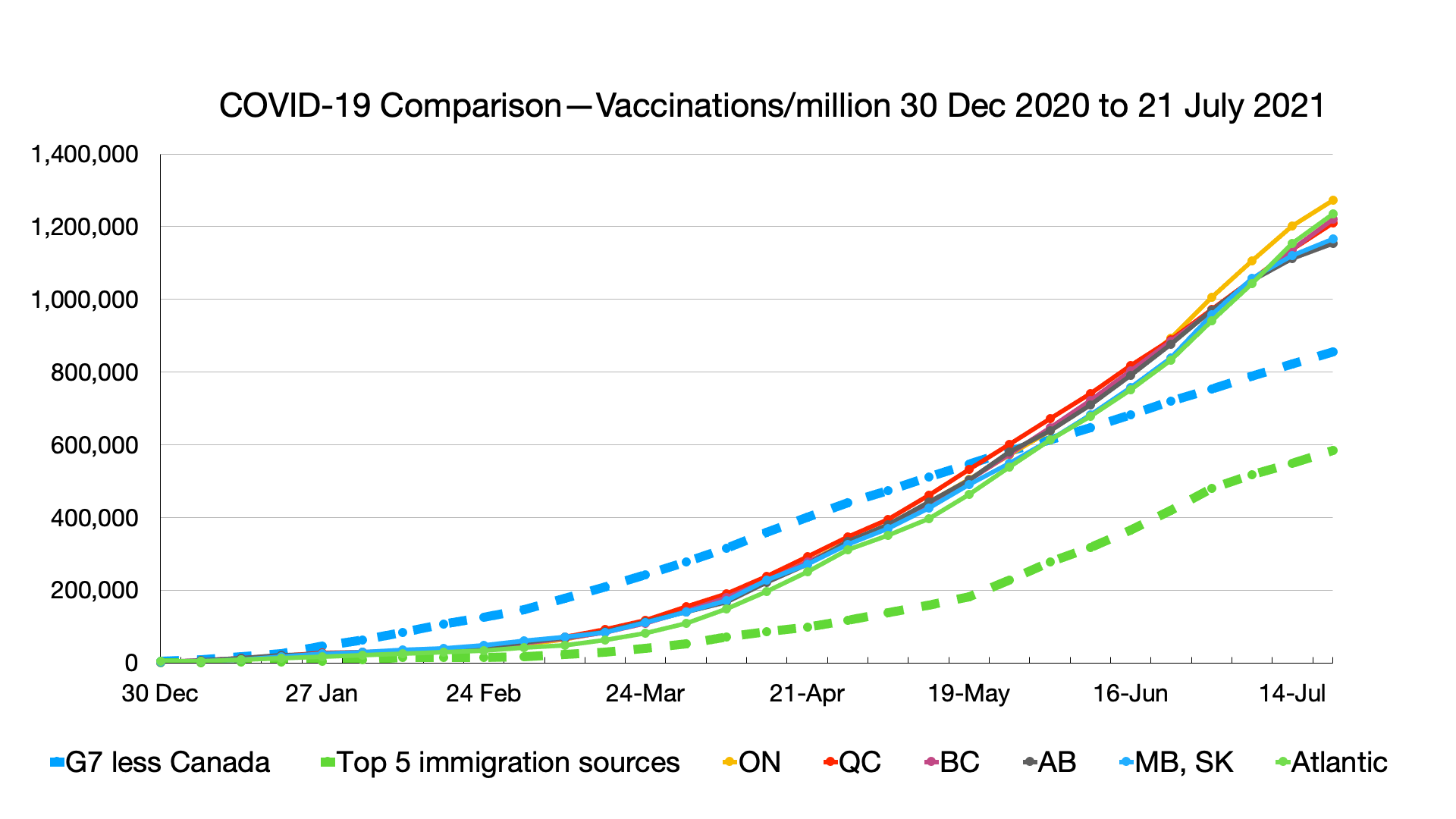
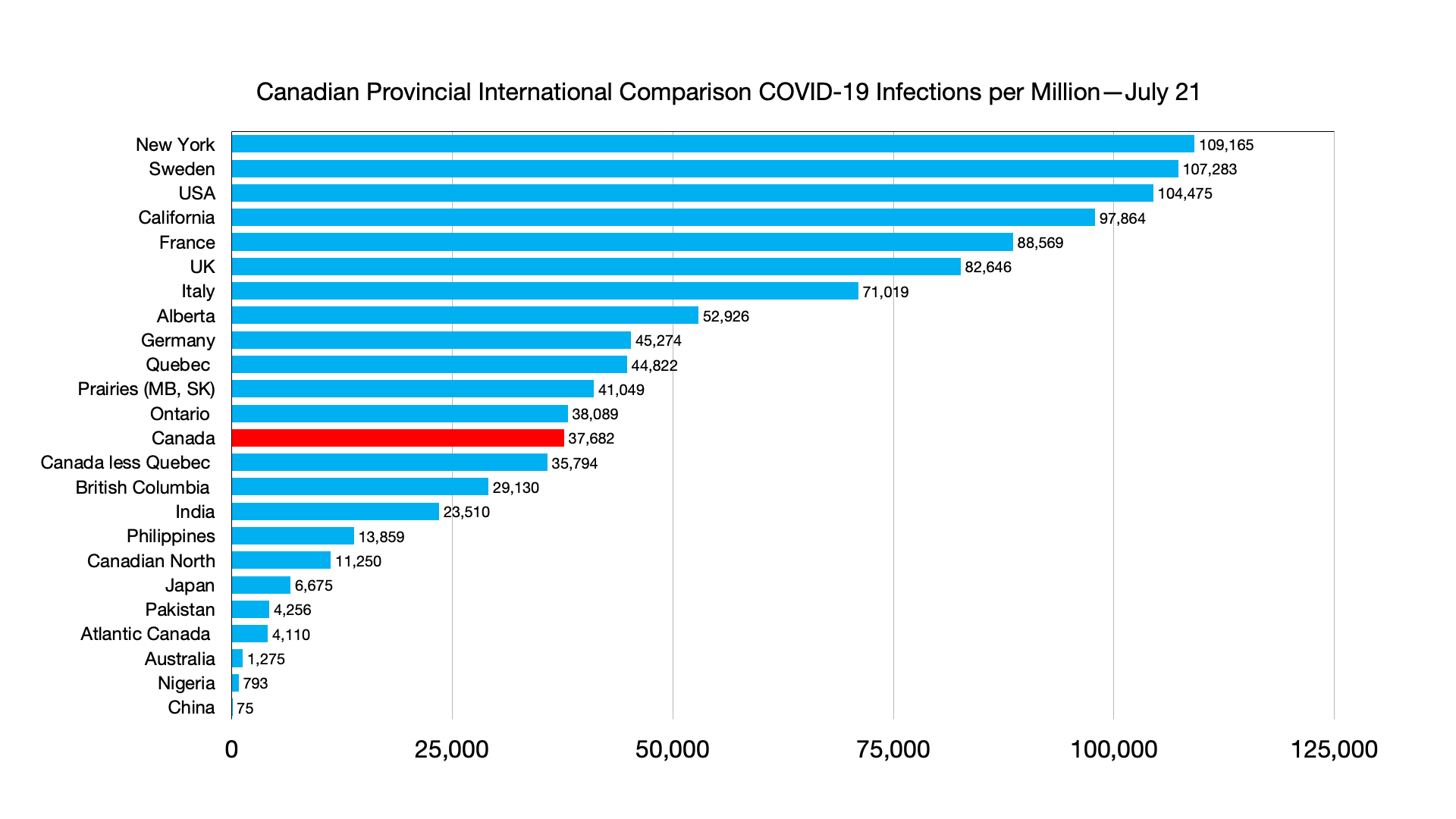
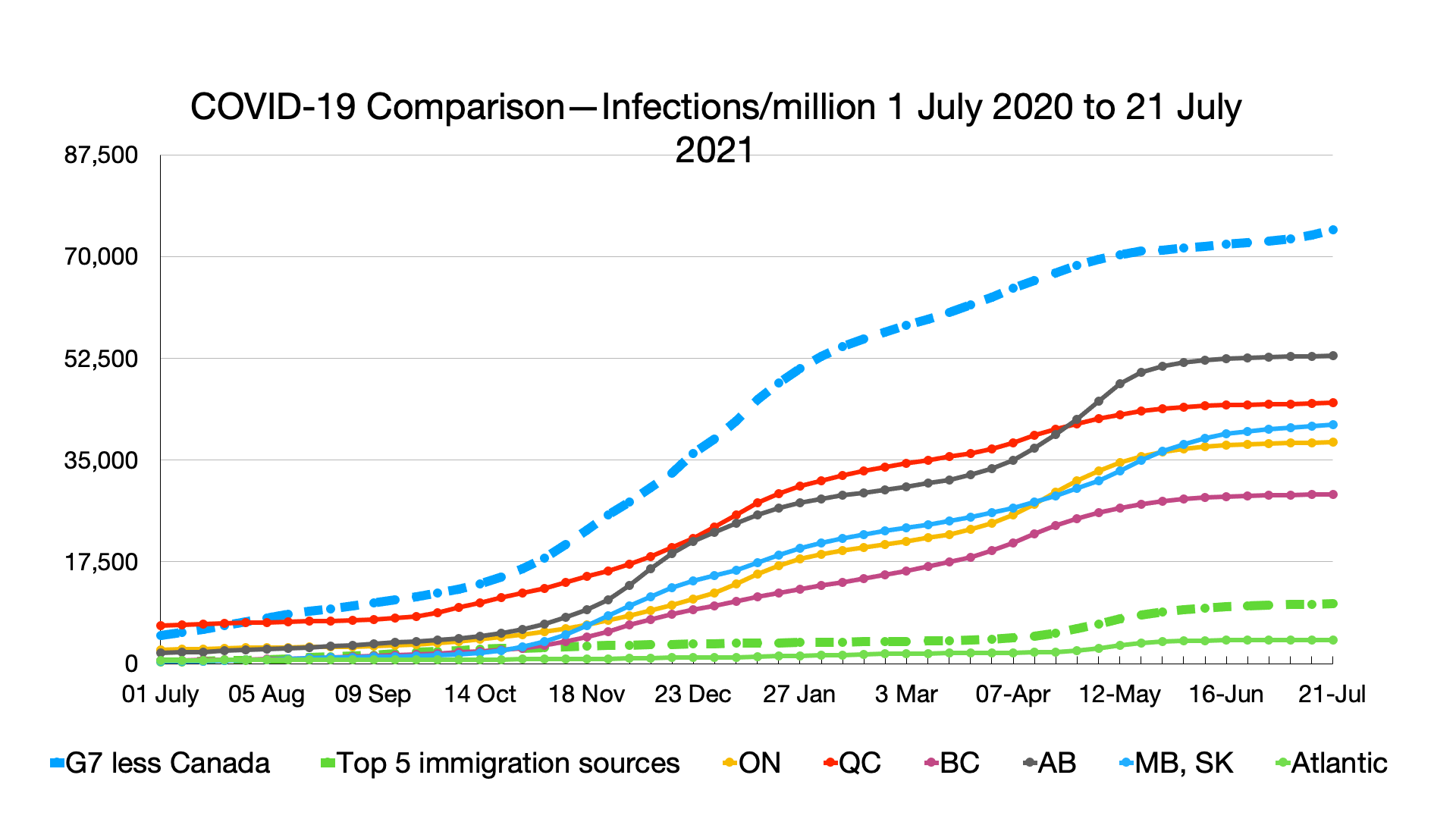
The latest charts, compiled 21 July as overall rates in Canada continue to decline along with increased vaccinations (Canadians fully vaccinated 51.7 percent, higher than USA 49.2 percent and and just behind UK 54.2 percent).

Vaccinations: All Canadian provinces ahead of USA and EU countries.

Trendline charts

Infections: No significant change but slight uptick in G7 less Canada given increased infections in UK and USA.

Deaths: No significant change.

Vaccinations: Captured above, with steady gap between Canadian provinces and G7.

Weekly

Infections: No relative change.

Deaths per million: No significant change.

Interesting and relevant analysis of India’s under-counting of COVID-19 cases:

India’s excess deaths during the pandemic could be a staggering 10 times the official COVID-19 toll, likely making it modern India’s worst human tragedy, according to the most comprehensive research yet on the ravages of the virus in the south Asian country.

Most experts believe India’s official toll of more than 414,000 dead is a vast undercount, but the government has dismissed those concerns as exaggerated and misleading.

The report released Tuesday estimated excess deaths — the gap between those recorded and those that would have been expected — to be between 3 million to 4.7 million between January 2020 and June 2021. It said an accurate figure may “prove elusive” but the true death toll “is likely to be an order of magnitude greater than the official count.”

The report, published by Arvind Subramanian, the Indian government’s former chief economic adviser, and two other researchers at the Center for Global Development and Harvard University, said the count could have missed deaths occurring in overwhelmed hospitals or while health care was delayed or disrupted, especially during the devastating peak surge earlier this year.

“True deaths are likely to be in the several millions not hundreds of thousands, making this arguably India’s worst human tragedy since Partition and independence,” the report said.

The Partition of the British-ruled Indian subcontinent into independent India and Pakistan in 1947 led to the killing of up to 1 million people as gangs of Hindus and Muslims slaughtered each other.

The report on India’s virus toll used three calculation methods: data from the civil registration system that records births and deaths across seven states, blood tests showing the prevalence of the virus in India alongside global COVID-19 fatality rates, and an economic survey of nearly 900,000 people done thrice a year.

Researchers cautioned that each method had weaknesses, such as the economic survey omitting the causes of death. 

Instead, researchers looked at deaths from all causes and compared that data to mortality in previous years — a method widely considered an accurate metric. 

Researchers also cautioned that virus prevalence and COVID-19 deaths in the seven states they studied may not translate to all of India, since the virus could have spread worse in urban versus rural states and since health care quality varies greatly around India. 

And while other nations are believed to have undercounted deaths in the pandemic, India is believed to have a greater gap due to it having the world’s second highest population of 1.4 billion and its situation is complicated because not all deaths were recorded even before the pandemic. 

Dr. Jacob John, who studies viruses at the Christian Medical College at Vellore in southern India, reviewed the report for The Associated Press and said it underscores the devastating impact COVID-19 had on the country’s under-prepared health system. 

“This analysis reiterates the observations of other fearless investigative journalists that have highlighted the massive undercounting of deaths,” Jacob said.

The report also estimated that nearly 2 million Indians died during the first surge in infections last year and said not “grasping the scale of the tragedy in real time” may have “bred collective complacency that led to the horrors” of the surge earlier this year.

Over the last few months, some Indian states have increased their COVID-19 death toll after finding thousands of previously unreported cases, raising concerns that many more fatalities were not officially recorded.

Several Indian journalists have also published higher numbers from some states using government data. Scientists say this new information is helping them better understand how COVID-19 spread in India.

Murad Banaji, who studies mathematics at Middlesex University and has been looking at India’s COVID-19 mortality figures, said the recent data has confirmed some of the suspicions about undercounting. Banaji said the new data also shows the virus wasn’t restricted to urban centers, as contemporary reports had indicated, but that India’s villages were also badly impacted.

“A question we should ask is if some of those deaths were avoidable,” he said.

Source: https://apnews.com/article/business-science-health-india-pandemics-334c326d86efa73a0631bf7cb6e3f92e?utm_source=Sailthru&utm_medium=email&utm_campaign=MorningWire_July20&utm_term=Morning%20Wire%20Subscribers

She Said She Married for Love. Her Parents Called It Coercion.

More disturbing trends:

Manmeet Kour Bali had to defend her marriage in court.

A Sikh by birth, Ms. Bali converted to Islam to marry a Muslim man. Her parents objected to a marriage outside their community and filed a police complaint against her new husband.

In court last month, she testified that she had married for love, not because she was coerced, according to a copy of her statement reviewed by The New York Times. Days later, she ended up in India’s capital of New Delhi, married to a Sikh man.

Religious diversity has defined India for centuries, recognized and protected in the country’s Constitution. But interfaith unions remain rare, taboo and increasingly illegal.

A spate of new laws across India, in states ruled by Prime Minister Narendra Modi’s Bharatiya Janata Party, or B.J.P., are seeking to banish such unions altogether.

While the rules apply broadly, right-wing supporters in the party portray such laws as necessary to curb “love jihad,” the idea that Muslim men marry women of other faiths to spread Islam. Critics contend that such laws fan anti-Muslim sentiment under a government promoting a Hindu nationalist agenda.

Last year, lawmakers in the northern Indian state of Uttar Pradesh passed legislation that makes religious conversion by marriage an offense punishable by up to 10 years in prison. So far, 162 people there have been arrested under the new law, although few have been convicted.

“The government is taking a decision that we will take tough measures to curb love jihad,” Yogi Adityanath, a Hindu monk and the top elected official of Uttar Pradesh, said shortly before that state’s Unlawful Religious Conversion Ordinance was passed.

Four other states ruled by the B.J.P. have either passed or introduced similar legislation.

In Kashmir, where Ms. Bali and Mr. Bhat lived, members of the Sikh community have disputed the legitimacy of the marriage, calling it “love jihad.” They are pushing for similar anti-conversion rules.

While proponents of such laws say they are meant to protect vulnerable women from predatory men, experts say they strip women of their agency.

“It is a fundamental right that women can marry by their own choice,” said Renu Mishra, a lawyer and women’s rights activist in Lucknow, the Uttar Pradesh state capital.

“Generally the government and the police officials have the same mind-set of patriarchy,” she added. “Actually, they are not implementing the law, they are only implementing their mind-set.”

Across the country, vigilante groups have created a vast network of local informers, who tip off the police to planned interfaith marriages.

One of the largest is Bajrang Dal, or the Brigade of Hanuman, the Hindu monkey god. The group has filed dozens of police complaints against Muslim suitors or grooms, according to Rakesh Verma, a member in Lucknow.

“The root cause of this disease is the same everywhere,” Mr. Verma said. “They want to lure Hindu women and then change their religion.”

Responding to a tip, the police in Uttar Pradesh interrupted a wedding ceremony in December. The couple were taken into custody, and released the following day when both proved they were Muslim, according to regional police, who blamed “antisocial elements” for spreading false rumors.

A Pew Research Center study found that most Indians are opposed to anyone, but particularly women, marrying outside their religion. The majority of Indian marriages — four out of five — are arranged.

The backlash against interfaith marriages is so widespread that in 2018, India’s Supreme Court ordered state authorities to provide security and safe houses to those who wed against the will of their communities.

In its ruling, the court said outsiders “cannot create a situation whereby such couples are placed in a hostile environment.”

The country’s constitutional right to privacy has also been interpreted to protect couples from pressure, harassment and violence from families and religious communities.

Muhabit Khan, a Muslim, and Reema Singh, a Hindu, kept their courtship secret from their families, meeting for years in dark alleyways, abandoned houses and desolate graveyards. Ms. Singh said her father threatened to burn her alive if she stayed with Mr. Khan.

In 2019, they married in a small ceremony with four guests, thinking their families would eventually accept their decision. They never did, and the couple left the central Indian city of Bhopal to start a new life together in a new city.

“The hate has triumphed over love in India,” Mr. Khan said, “And it doesn’t seem it will go anywhere soon.”

In Bhopal, the capital of Madhya Pradesh state, the B.J.P.-led government passed a bill in March modeled after the Uttar Pradesh law, stiffening penalties for religious conversion through marriage and making annulments easier to obtain.

The government is not “averse to love,” said the state’s home minister, Narottam Mishra, “but is against jihad.”

Members of Kashmir’s Sikh community are using Ms. Bali’s marriage to a Muslim man, Shahid Nazir Bhat, to press for a similar law in Jammu and Kashmir.

“We immediately need a law banning interfaith marriage here,” said Jagmohan Singh Raina, a Sikh activist based in Srinagar. “It will help save our daughters, both Muslims and Sikhs.”

At a mosque in northern Kashmir in early June, Ms. Bali, 19, and Mr. Bhat, 29, performed Nikah, a commitment to follow Islamic law during their marriage, according to their notarized marriage agreement.

Afterward, Ms. Bali returned to her parents’ home, where she said she was repeatedly beaten over the relationship.

“Now my family is torturing me. If anything happens to me or to my husband, I will kill myself,” she said in a video posted to social media.

Source: https://www.nytimes.com/2021/07/20/world/india-interfaith-marriage.html?action=click&module=In%20Other%20News&pgtype=Homepage

Drastic drop in COVID infected international flights in May

Of note:

Transport Canada’s decision to ban passenger flights from India appears to have had an impact.

While numbers are always updated as new cases are diagnosed, data posted online by Health Canada as of Tuesday shows only 113 flights landing at Canadian airports last month carried passengers infected with COVID-19.

That’s compared to 288 flights counted in April — 66 of which were direct flights from India’s capital of Delhi.

Federal Transport Minister Omar Alghabra halted passenger flights from India and Pakistan for 30 days as of April 22, as well as adding additional restrictions on travellers arriving from India via connecting flights — including requiring a negative PCR COVID-19 test taken at the last port of entry before entering Canada.

This all but halted passenger traffic from both countries, as laboratory tests that typically require 24 hours can’t be accommodated during airport stopovers usually only lasting a few hours.

As many travellers from India had been connecting through Middle Eastern airports like Dubai, Abu Dhabi and Doha, infected passengers on those flights likewise saw big drops — just four from the United Arab Emirates last month compared to 35 in April.

Initially meant to last 30 days, the flight ban was extended last month to June 22.

During the first part of the pandemic, India typically only saw a handful of infected flights landing at Canadian airports each month.

All that changed in mid-February with a spike of infected flights coinciding with that country’s devastating variant-fuelled second wave.

Pakistan, meanwhile, has never been a significant factor, with Health Canada only reporting five such flights in April.

The United States was Canada’s largest source of infected flights last month, seeing 23 planes land with at least one passenger testing COVID positive — that’s compared to 49 in April.

Paris and Doha, Qatar, tied for second place with 11, followed by 10 from Guatemala, eight each from Frankfurt and Panama, seven from Istanbul, six from Amsterdam and five from Mexico City.

Toronto saw the most arrivals last month with 49 compared to 167 in April; followed by Montreal with 43 versus 57 in April; 14 in Vancouver compared to 42 in April; and six landing in Calgary compared to 19 the month previous.

Top sources of international flights with COVID-19 infected passengers in May (April’s total in parentheses)

1. USA: 23 (49)
2. Doha: 11 (21)
3. Paris: 11 (16)
4. Guatemala: 10 (4)
5. Amsterdam: 6 (12)
6. Frankfurt: 8 (13)
7. Panama: 8 (4)
8. Istanbul: 7 (18)
9. Mexico City: 5 (5)
10. Kingston, Jamaica: 3 (8)

Source: Drastic drop in COVID infected international flights in May

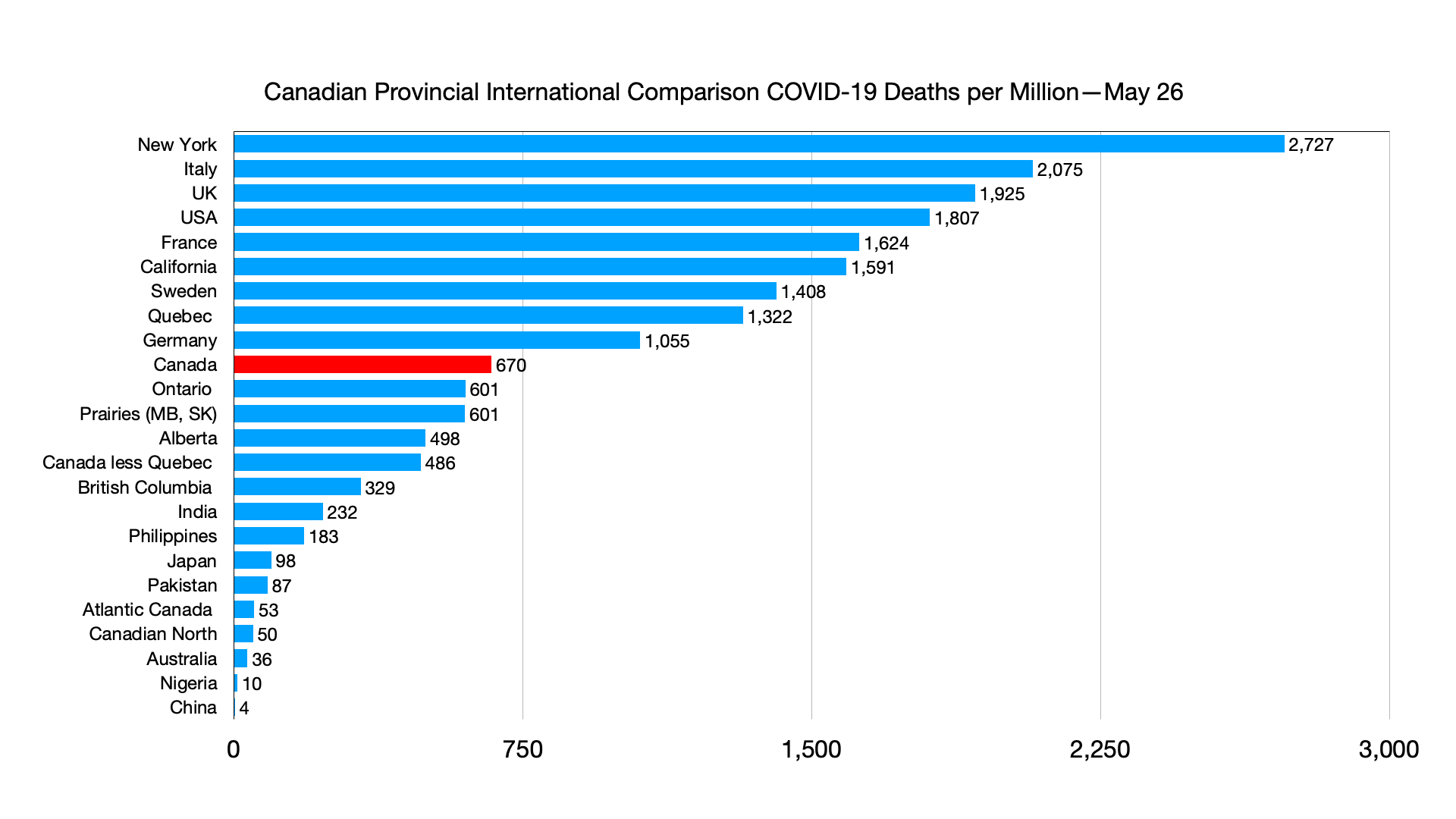
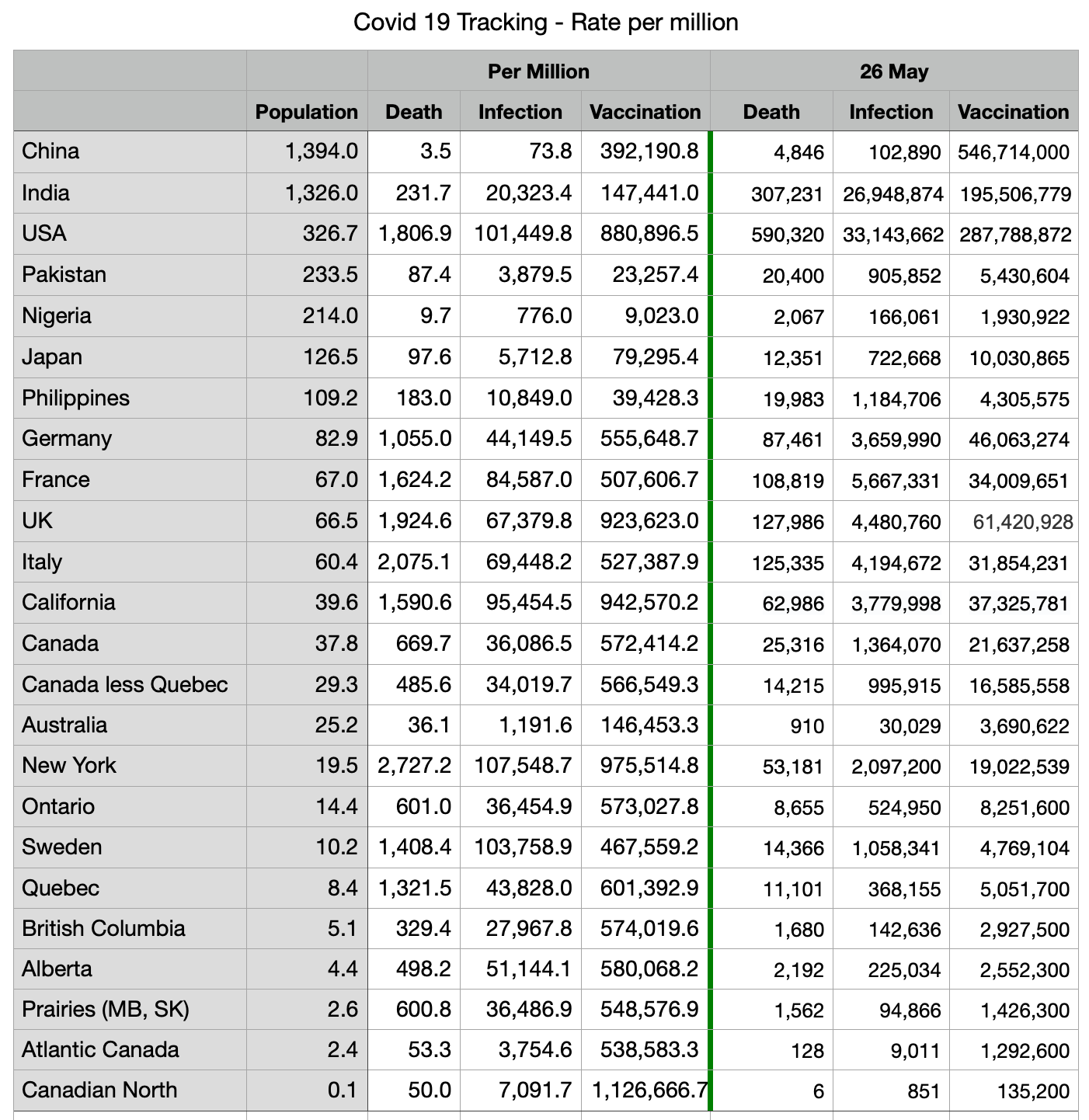
#COVID-19: Comparing provinces with other countries 26 May Update

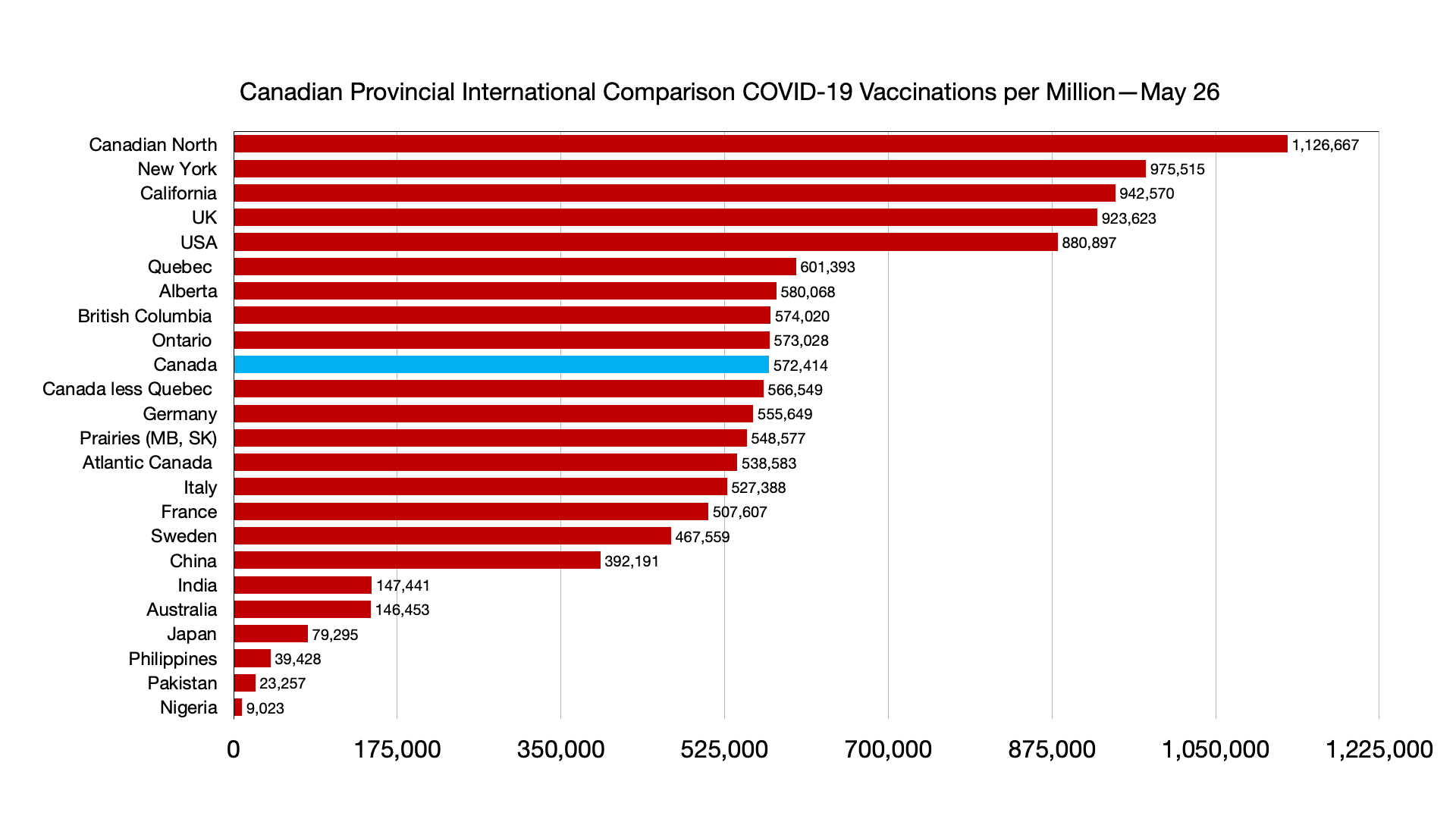
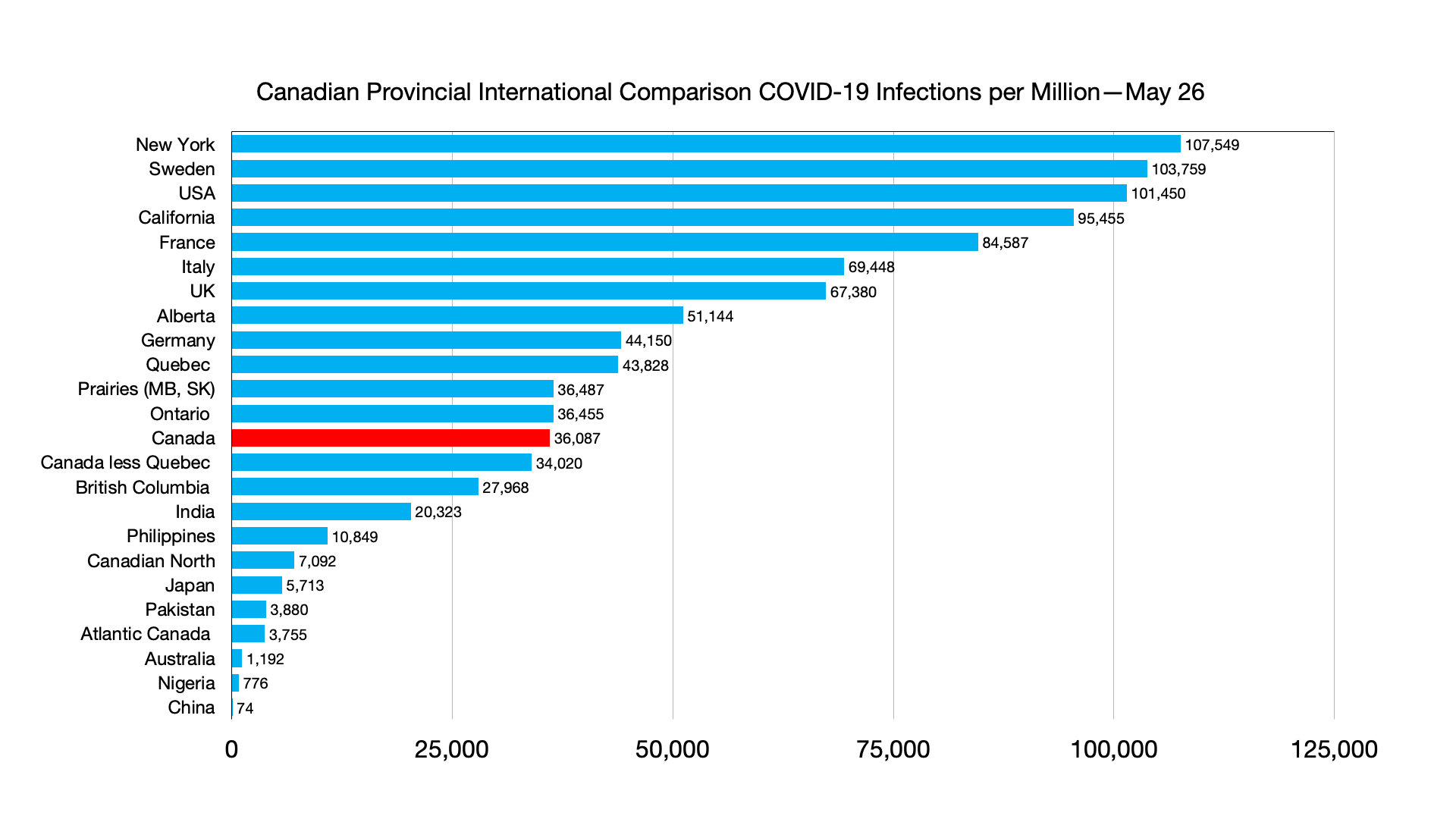
The latest charts, compiled 26 May as overall rates in Canada continue to come down along with increased vaccinations.

Vaccinations: Minor relative changes, with Alberta moving ahead of British Columbia and Ontario, Atlantic Canada ahead of Italy and France.

Trendline charts

Infections per million: Alberta levelling off and upsurge in Manitoba is resulted in Prairie rate marginally more than Ontario.

Deaths per million: No significant change.

Vaccinations per million: Canadian vaccination rates have largely caught up to G7 less Canada with Quebec ahead.

Weekly

Infections per million: Prairies ahead of Ontario, driven by Manitoba.

Deaths per million: No relative change.

India

While there is undercounting in all countries as analysis of above average deaths indicate (e.g., The Economist’s Tracking covid-19 excess deaths across countries), this article on India is of particular interest.

The official Covid-19 figures in India grossly understate the true scale of the pandemic in the country. Last week, India recorded the largest daily death toll for any country during the pandemic — a figure that is most likely still an undercount.

Even getting a clear picture of the total number of infections in India is hard because of poor record-keeping and a lack of widespread testing. Estimating the true number of deaths requires a second layer of extrapolation, depending on the share of those infected who end up dying.

In consultation with more than a dozen experts, The New York Times has analyzed case and death counts over time in India, along with the results of large-scale antibody tests, to arrive at several possible estimates for the true scale of devastation in the country.

Even in the least dire of these, estimated infections and deaths far exceed official figures. More pessimistic ones show a toll on the order of millions of deaths — the most catastrophic loss anywhere in the world.

India’s official coronavirus statistics report about 27 million cases and over 300,000 deaths as of Tuesday. The country’s response to the pandemic has been further complicated this week by a cyclone that is battering India’s eastern coast, with winds of more than 95 miles per hour.

Even in countries with robust surveillance during the pandemic, the number of infections is probably much higher than the number of confirmed cases, because many people have contracted the virus but have not been tested for it. On Friday, a report by the World Health Organization estimated that the global death toll of Covid-19 may be two or three times higher than reported.

The undercount of cases and deaths in India is most likely even more pronounced, for technical, cultural and logistical reasons. Because hospitals are overwhelmed, many Covid deaths occur at home, especially in rural areas, and are omitted from the official count, said Kayoko Shioda, an epidemiologist at Emory University. Laboratories that could confirm the cause of death are equally swamped, she said.

Additionally, other researchers have found, there are few Covid tests available. Families are often unwilling to say that their loved ones have died of Covid. And the system for keeping vital records in India is shaky at best. Even before Covid-19, about four out of five deaths in India were not medically investigated.

Source: https://www.nytimes.com/live/2021/05/26/world/covid-vaccine-coronavirus-mask

After Australia Banned Its Citizens in India From Coming Home, Many Ask: Who Is Really Australian?

Valid questioning:

When Ara Sharma Marar’s father had a stroke in India in early April, she got on the first flight she could from her home in Melbourne, Australia to New Delhi.

She had planned to return to Australia, where she works in risk management at a bank, on May 14. But then her government banned her from coming home. Australian Prime Minister Scott Morrison announced on April 27 that travelers from India—including citizens—were barred from the country. The government emphasized that anyone who tried to come home would face up to five years in jail and a $50,000 fine.

“It’s immoral, unjustifiable and completely un-Australian because, you know, Australia prides itself saying that we are multicultural, we embrace all cultures, we welcome everyone,” she says.

Morrison faced a furious backlash from many corners from the country—especially from Australians of South Asian ethnicity, many of whom said the ban was racist—and quickly backed down. On May 15 the first repatriation flight from India landed in Darwin. But around 9,000 Australians remain stranded in India and the saga has revived the debate about what it means to be Australian—a longstanding, at times acrimonious, national conversation driven by the country’s ever-changing demographics.

Today, there are more foreign-born Australians than at any time since 1893, when Australia was still a British colony. Migrants make up 30% of all Australians, and Indian-born Australians are the second-largest group. (British immigrants remain the largest foreign-born population, with people from China in third place). Immigration is now the main driver of population growth in several states and migrants are a significant driver of economic growth. But some immigrants say they aren’t always accepted in a country that once closed its doors to non-Europeans.

“Many Anglo-Celtic Australians still believe that we are but guests in this country and that to acknowledge us as equals they will somehow lose their Australianism,” says Molina Asthana, co-founder of advocacy group Asian Australian Alliance. “Does being Australian mean you have to be light skinned, blond, love your barbies, brekkies and beers?” she asks.

‘Fortress Australia’ strands citizens overseas

Several countries, including the U.S., restricted flights from India or tightened quarantine rules on travelers coming from the country as a devastating second wave hit it. But Australia’s total ban on arrivals from India follows a pandemic policy of imposing of some of the strictest COVID-19 border controls in the world.

Australia bans nearly all non-residents from traveling to the country, and those who are able to enter must quarantine for 14 days in a hotel. Caps on international arrivals have prevented tens of thousands of Australians from returning from overseas during the pandemic. The hashtag #strandedaussies has been used hundreds of times on social media, and some have started referring to the country as “Fortress Australia.” One group of Australians is taking a complaint against the Australian government to the United Nations Human Rights Committee for not allowing its citizens to return home.

Nevertheless, the controls are very popular. A poll in conservative newspaper The Australian found that 73% of voters supported international borders remaining closed until at least mid-2022. That’s likely because the policies—along with swift, strict lockdowns when cases pop up—mean that the country has had remarkable success against COVID-19. With a population of 26 million, it has recorded fewer than than 30,000 coronavirus cases and just 910 deaths. Life appears normal. Employees have returned to their offices. Thousands of mostly maskless fans packed into a Melbourne stadium to watch the Australian Open in February and the following month saw tens of thousands of not-so-socially-distanced revelers attend the LGBT+ celebration Sydney Mardi Gras.

Authorities justified the blanket ban on arrivals from India as necessary to protect public health; India is facing a devastating second wave of COVID-19 and a variant first identified there—which scientists say is likely more infectious and better at evading human immune systems—is being detected across the Asia-Pacific. Australia’s chief medical officer Paul Kelly said on May 7 that the ban was explicitly linked to Australia’s limited quarantine capacity.

But many Australians of Indian descent feel singled out because the Australian government has not barred citizens returning home from other countries with large outbreaks. “Why weren’t these steps taken when it was America or U.K.?” asks Sharma Marar, who believes that the government has failed all of its nationals stuck overseas. She says that she is suffering from panic attacks and having trouble sleeping as the result of the stress of not being able to return home.

Kim Soans-Sharma, who remains stuck in Mumbai, India after she traveled there in January following her father’s death, says the ban has made her feel “unwanted.” That’s something she has never felt in Perth, Australia, which she’s called home since 2013. She adds that vitriolic comments from some Australians on social media showing no sympathy for other citizens like her stuck in India have been hard to bear.

“At this stage, I’m not proud to call myself an Australian,” she says.

How Australia became an ‘immigration nation’

Australia’s rising diversity in recent decades follows the expressly racist White Australia Policy that prevented migration by non-Europeans for much of the 20th century. When it became clear that immigration from Britain couldn’t provide the necessary population growth, more migrants from continental Europe were allowed, and the policy was slowly eased after World War II. The first step towards dismantling it was made in 1966, when the government allowed migration based on what skills people could offer Australia, instead of race or nationality. The White Australia Policy was then formally renounced in the early 1970s, and the government officially embraced multiculturalism.

However, the topic of immigration has been used as a political football for decades, with some successive governments unsupportive of migration. Many who arrive in Australia are skilled migrants, and some economists say that the country’s 27-year recession-free streak would not have been possible without immigration. A report by the research institute the McKell Institute calls the country “the world’s most successful” multicultural society. “Australia has truly embraced multiculturalism following an approach of integration between the different ethnicities and cultural groups where the dominant and minority groups are expected to respect each other’s cultures,” it says.

There are some tensions, however. Concerns over immigration have sparked a nativist movement, including a right-wing populist political party with an anti-immigration platform that has had minor success at the polls. A 2020 report on social cohesion released by the Scanlon Foundation, a foundation focused on fostering social cohesion in Australia, found that a large majority of Australians think that having a multicultural society makes Australia better, but 60% of people agreed with the statement that “too many immigrants are not adopting Australian values.” The report also noted substantial negative sentiment towards immigrants from Africa, Asia and the Middle East.

In one 2019 survey, more than two-thirds said that Australia did not need more people. The same year, Morrison announced a cap on permanent migration at 160,000, a cut of 30,000 a year, to address crowding in cities that has increased real estate prices and caused congestion. “This plan is about protecting the quality of life of Australians right across our country,” he said.

Like in many places in the world, immigrants in Australia have faced racism as the result of the pandemic. The Asian Australian Alliance has received 530 reports of COVID-19-related racism since April 2020. When a COVID-19 surge hit Melbourne in mid-2020, representatives from a Muslim migrant community spoke out about being unfairly blamed. In March, Australia’s race discrimination commissioner Chin Tan called for a new national anti-racism framework to address prejudice against Asian-Australians related to the coronavirus pandemic and the legacy of “hatred” towards Muslims.

Asthana, of the Asian Australian Alliance, says the India travel ban is emblematic of the racism that migrants can face in Australia. “Whether it is overt racism or unconscious bias, most migrants have been at the receiving end of discriminatory treatment,” she says. “Only the communities change over time, from Greek and Italian to Chinese, then the Vietnamese, Indian and African and now back to the wider Asian Community during COVID.”

Tim Soutphommasane, Australia’s former race discrimination commissioner, says that Australia’s multicultural diversity is not represented yet in its major institutions. “It’s not yet there among our leaders of politics, government, and business. Nor is it there among the faces you see in the national media,” he says. “So that can feed into a sense within our elite political, business and media circles that being Australian is still essentially being Anglo-Celtic or European.”

Other experts say that what it means to be Australian is shifting along with its demographics. “Australia is a settler country,” says Catherine Gomes, an ethnographer at RMIT University in Australia, with a “social and cultural identity, that keeps on changing. Those identities start to adapt, according to how demographics are also changing.”

But for some Australians, those changes aren’t coming quickly enough. Despite the lifting of the ban, Sharma Marar says she won’t forget being barred from coming home.

“I think the scars of these policies and what has been done in last few weeks,” she says, “will live with us forever.”

Source: After Australia Banned Its Citizens in India From Coming Home, Many Ask: Who Is Really Australian?

Is Australia’s India travel ban legal? A citizenship law expert explains and a critique of the ban

The lack of a charter with mobility rights compared to Canada:

There is a growing public and political outcry over the federal government’s sudden decision to ban Australians from coming home from India.

But as everyone from Indian community leaders to human rights leaders, famous cricketers and Coalition MPs calls on the government to rethink the policy, is it legal? Is a High Court challenge an option?

What is citizenship?

In terms of common law, citizenship is a relationship between an individual and their nation, where each owes fundamental obligations to the other. In broad terms, the citizen’s job is to be loyal to the nation. The nation’s job is to protect its citizens.

Last year, a record number of people pledged allegiance to Australia and became citizens. The largest group of new citizens were Indian migrants, with over 38,000 becoming Australians in 2019-20.

Now, under the Australian government’s tough new travel ban, 9,000 Australians remain stranded in India, which is currently battling a deadly COVID-19 second wave and oxygen and vaccine shortages.

Some were granted permission to travel to India to see dying relatives or attend funerals. Others travelled there pre-pandemicand have since been unable to return to Australia.

Despite having done nothing wrong, these Australians have been left unprotected by a government that has failed to hold up its end of the citizenship bargain.

How does the travel ban work?

The ban makes it unlawful for anyone, including Australian citizens, to enter Australia if they have been in India in the past 14 days. It was made under sweeping powers conferred on federal Health Minister Greg Hunt by the 2015 Biosecurity Act.

Section 477 of the act allows Hunt to issue “determinations” imposing any “requirement” that he deems necessary to control the entry or spread of COVID-19. These determinations cannot be disallowed by parliament. Thanks to a provision aptly known as a “Henry VIII clause”, they also override any other federal, state or territory law.

If a person breaches the travel ban, for instance by transiting through a third country, the Biosecurity Act states they may face criminal penalties of five years imprisonment, a $66,000 fine, or both (even if Prime Minister Scott Morrison says jail time is unlikely).

Hunt says the ban is a “temporary pause”. It will lapse on May 15. However, if he deems it necessary, he could use his broad powers to reintroduce it, or impose similar restrictions.

As political pressure builds to remove the ban early, the government says it is “constantly” reviewing it.

Is the ban legal?

Another basic principle of citizenship is citizens may freely return to their countries. Under common law, this stems from the Magna Carta. It is also an important principle of international law, enshrined in the Universal Declaration of Human Rights, and the International Covenant on Civil and Political Rights.

In March, two Australians stranded in the United States took their case to the United Nations Human Rights Committee. They argued government policies blocking their return contravene international law.

The committee has not reached a decision, but in April it asked Australia to ensure their prompt return, noting they faced “irreparable harm”.

What about our domestic law?

Whether the ban is legal under Australian domestic law is a different question. Although the Department of Home Affairs says Australian citizens can “apply for an Australian passport and re-enter Australia freely”, there is no codified right of return under Australian law. This sets us apart from many countries that have a bill of rights, and include this right.

A High Court challenge is an option, but there is no clear path to success.

The High Court has said little on the subject. A 1908 case suggests citizens may have a common law right to return to Australia, provided this has not been taken away by parliamentary law. The Biosecurity Act of course thoroughly displaces any such right.

Due to the deep links between citizenship and the right of return, it has been suggested citizens may have an implied constitutional right to enter Australia. There is no case law on this yet — just a single, vaguely worded sentence in a 1988 High Court case — and there are good reasons why it might be a difficult case to argue in Australia.

Implied rights must be derived from the text and structure of Australia’s Constitution, which says nothing about Australian citizenship, and little about the relationship between the government and the people, besides providing for democratic elections.

Does it breach the Biosecurity Act?

Another argument might be the travel ban is unlawful on the grounds Hunt failed to comply with the conditions for making a determination under section 477 of the Biosecurity Act.

These conditions require him to be satisfied, before imposing the ban, that it was “likely to be effective” in stopping the spread of COVID-19, “appropriate and adapted” to this purpose, and “no more restrictive or intrusive” than the circumstances required.

Importantly, it is Hunt personally who must be satisfied of these conditions. This means if he reached that conclusion on reasonable grounds, he has not broken the law, even if a different approach might have been available.

Yesterday, Chief Medical Officer Paul Kelly’s advice to Hunt in advance of the travel ban was released. Kelly’s advice emphasises the significant risk quarantine leakage poses to the Australian community and says a travel ban on arrivals from India until 15 May would be effective, proportionate and limited to what is necessary.

In light of this, it seems likely that a court would see the determination as a reasonable exercise of Hunt’s power.

Beyond the law, what about moral arguments?

But, legality aside, let’s return to the idea that Australia has a fundamental responsibility to protect its citizens. In February 2020, Hunt acknowledged this, pointing to two related national priorities: to contain the virus and protect citizens at home, and protect and support Australians abroad.

There may be circumstances in which these priorities conflict with each other. But it is hard to see the conflict in this situation. Quarantine and effective contact tracing have seen those within Australia substantially protected against COVID-19. We have not needed blanket bans on returns from the US, the United Kingdom or other countries that have experienced virus surges.

Kelly’s advice points to potential strain on quarantine, and Morrison has said the ban ensures that “our quarantine system can remain strong”. But the federal government could protect more people in Australia and abroad (not to mention ease pressure on countries experiencing COVID-19 strain), if it worked to bring citizens home while devoting more resources towards strengthening the quarantine system.

Yet the government has resisted this, despite a clear constitutional power over quarantine, the recommendations of public health experts and a national review.

Meanwhile, 9,000 Australians in India are anxiously waiting for a change to the law, which would at least legally permit them to try and return home.

Source: Is Australia’s India travel ban legal? A citizenship law expert explains

Strong commentary by Tim Soutphommasane, former Australian race discrimination commissioner, arguing against the ban:

It has come to this: a government pulling up the drawbridge on its own citizens trying to make it home. Last week’s announcement of a ban on return flights from India marks a drastic escalation of “fortress Australia”.

Yes, it isn’t the first time during the pandemic that Australia’s borders have been closed to people arriving from certain countries deemed high risk. This happened, for example, with China in February 2020.

But this new measure goes beyond a temporary closure of borders. It also involves harsh criminal penalties imposed on people seeking to return from India, including fines and even imprisonment.

There’s something seriously wrong about this. Citizenship is meant to guarantee its bearers certain rights and liberties. The right to vote. The right to expression. The right to live without interference. The right to enter one’s country.

Clearly, we can’t take our basic rights and liberties for granted. It’s no exaggeration to say that this policy undermines the very status of citizenship. The principles of democratic liberalism are under assault.

After all, citizenship means little if you can’t exercise your right to return to Australia in a time of need. Liberal democracy is diminished when your government doesn’t protect you when you’re in present or impending danger.

On every Australian passport, there is a page that bears a request of other governments and people that they “allow the bearer, an Australian Citizen, to pass freely without let or hindrance and to afford him or her every assistance and protection of which he or she may stand in need”. Those words now ring hollow. How can we expect people abroad to do that, if our own government won’t do the same to its citizens?

Equal citizenship

Closer to home, this move inserts some doubts as to whether all citizens can presume they enjoy equal citizenship.

It hasn’t escaped many of us that there have been different standards of treatment given to citizens and residents returning to Australia during this pandemic. Last year, when Covid was rampaging through the United States, the United Kingdom and Europe, the government took no step to close our borders to those places, let alone impose criminal penalties on those arriving from there.

The government says it has introduced this policy based on medical advice. Yet, according to the commonwealth chief medical health officer, Paul Kelly, “no advice was given” in relation to the imposition of fines or jail terms for those seeking to circumvent the India travel ban. Moreover, numerous leading public health experts have questioned why a ban has been introduced.

It wouldn’t be the first time an Australian government has engaged in cynical racial dog whistling. As the Australian Human Rights Commission has stated, the government “must show that these measures are not discriminatory and the only suitable way of dealing with the threat to public health”. Because right now they do look discriminatory. And they are far from the only way to deal with any public health threat.

Here’s how we should be dealing with things. There remain about 35,000 Australians stranded overseas, including about9,000in India. We – and by we I mean the government that acts in our name – must act urgently to bring these Australians home, wherever they are. The way to do that is obvious: charter flights to bring them back, and create dedicated quarantine facilities across the country to make sure it happens safely.

How breathtaking it is that this hasn’t yet happened. We are more than one year into the pandemic. There has been plenty of time to think this through, make plans and deliver.

A choice between two Australias

Then again, you can understand why government hasn’t done this. This pandemic has confronted us with a choice between two Australias: between being an open, confident, internationalist country and being a closed, fearful, parochial nation. Increasingly, it seems as though people are choosing the latter.

There has been a strange acceptance of, maybe even enthusiasm for, a retreat into a hermit nation. Our politicians know all too well that closing borders and imposing lockdowns seem to bring some solid electoral payoffs: just ask Annastacia Palaszczuk and Mark McGowan.

For too many people, including those who may like to consider themselves progressive, border closures have become a fetish. It was weird enough that the pandemic was generating a competition among some premiers to close borders to other states. Now we’ve got to the point where we’re happy to have our national borders closed off to our own people and fellow citizens. At least some of them, anyway.

Covid has confirmed some timeless political truths. Amid threat, fear is a formidable beast to counter. And in tough times, minorities very rarely fare well. Covid has generated a significant rise in anti-Asian racism. Consider too, the disproportionate impact the pandemic has had on migrants and international students.

But now the government is taking things into dangerous territory. Citizenship has been the bedrock of Australia’s multiculturalism: whatever background you’re from, you can be assured formal membership of the community. This latest move signals that, in the eyes of government, some of us are more Australian than others.

Tim Soutphommasane is a political theorist and professor at the University of Sydney. He was Australia’s race discrimination commissioner from 2013 to 2018

Source: Criminalising citizens returning from India signals some are more Australian than others

Forgetting Citizenship: Australia Suspends Flights from India

Interesting arguments given that Australia is often cited as the model in Canada. That being said, Australia has been much more serious than Canada in its quarantine requirements and enforcement for all groups, not just South Asians:

As India is being devastated by COVID-19 at a daily rate of 400,000 cases, Australia has taken the decision to suspend all flights coming into the country till mid-month. The decision was reached by the Morrison government with the blessing of the State Premiers and the Labor opposition.

Not happy with banning flights from India, the Morrison government promises to be savage in punishing returnees who find ways to circumvent the ban (for instance, by traveling via a third country). Citizens who breach the travel ban can face up to five years imprisonment and fines up to $51,000. “We have taken drastic action to keep Australians safe,” explained the Treasurer Josh Frydenberg. The situation in India was “serious”; the decision had only been reached after considering the medical advice.

According to a statement from Health Minister Greg Hunt, it was “critical the integrity of the Australian public health and quarantine systems is protected and the number of COVID-19 cases in quarantine is reduced to a manageable level.”

The decision fails to carry any weight. It did not take long for more alert medical practitioners to wonder why the approach to India was being so selectively severe. Health commentator and GP Vyom Sharma thought the decision“incredibly disproportionate to the threat that it posed.” Sharma is certainly correct on this score in terms of international law, which requires the least restrictive or least intrusive way of protecting citizens.

Then there was the issue of the previous policies Canberra had adopted to countries suffering from galloping COVID-19 figures. A baffled Sharma wondered, “Why is it that India has copped this ban and no people who have come from America?” Former race discrimination commissioner Tim Soutphommasane seconds the suspicions. “We didn’t see differential treatment being extended to countries such as the United States, the UK, and any other European country even though the rates of infection were very high and the danger of its arrivals from those countries was very high.”

The Australian Human Rights Commission has also asked the federal government to justify its actions. “The government must show that these measures are not discriminatory and the only suitable way of dealing with the threat to public health.”

In the face of such behaviour, aggrieved citizens are left with few legal measures. Australia, among liberal democratic states, is idiosyncratic in refusing to adopt a charter of rights. Down Under, parliamentarians are supposedly wise and keen to uphold human rights till they think otherwise. (Human rights, the argument goes, would become the fodder of lawyers and judges, interfering with the absolute will of Parliament and the electors.) The Australian Constitution is hopelessly silent on the issue of citizenship. Left at the mercy of legislative regulation, Parliament and the executive can be disdainful towards their citizens without consequences.

One avenue remains the Geneva-based UN Human Rights Committee. On April 15, the UNHRC ruled on the case of two petitioners of FreeAndOpenAustralia.org (formerly StrandedAussies.org) that the Morrison government had to “facilitate and ensure their prompt return to Australia.”

Represented by the notable sage of international law Geoffrey Robertson QC, the petitioners argued that Australia was in breach of Articles 12(4) and 2(3) of the International Covenant on Civil and Political Rights. The first article provides that no one shall be arbitrarily deprived of the right to enter his own country; the second provides for “effective” remedies to be granted to those whose rights and freedoms have been breached under the ICCPR. The petitioners also freely admitted that they had no issue with quarantining for 14 days on returning to Australia.

In the words of Free and Open Australia spokesperson Deb Tellis, the Commonwealth should “use its power to expand quarantine facilities, and end travel caps that are being dictated by the states. There are thousands of our fellow citizens suffering [the] loss of their relatives and loss of their jobs.”

The government has preferred a meaner, penny-pinching approach in coping with quarantine, reducing flights when needed rather than expanding facilities to accommodate a greater number of infected arrivals. The hotel quarantine system continues to receive effusive praise from Australian Prime Minister Scott Morrison as being 99.99 percent effective. But it is impossible for him, and his ministers, to conceal the fact that they do not trust, and are unwilling, to use other facilities and expand existing ones.

Since last November, there have been 16 COVID-19 leaks across the cities of Melbourne, Sydney, Brisbane, Adelaide, and Perth from quarantine hotels. At this writing, another quarantine leak is being reported in Western Australia, involving the now customarily infected hotel security guard and the inevitable seepage into the community. The problem of airborne transmission continues to plague, as does the uneven provision of personal protective equipment. No national standard of quarantine has been formulated throughout the country, with each state adopting its own approach. Audits of the ventilation systems in many such hotels remain sketchy.

Western Australian Premier Mark McGowan, who recently imposed a lockdown of the Perth and Peel areas and may well do the same thing over the next few days, suggested that the Commonwealth be generous with some of its facilities. Why not use the RAAF Curtin Air Base, or the immigration detention centres of Yongah Hill and Christmas Island? “It’s kind of staring us in the face and there are things that could assist, it’s just that the Commonwealth doesn’t want to do it.”

The evidence so far is that facilities such as Howard Springs in the Northern Territory tend to work. It features single-storey cabins, segregated air conditioning systems, outdoor veranda space, and, in the vicinity, a fully functioning hospital. No leaks have been recorded. And location is everything: distant from densely populated areas. This government, however, is miserly on the issue of quarantine, an obligation it has transferred without constitutional justification to State premiers who fear both the virus and its electoral consequences.

Source: Forgetting Citizenship: Australia Suspends Flights from India