Explained: The ‘values test’ that immigrants to Quebec, Canada must now pass

Interesting that the test is getting picked up in Indian media:

Quebec, Canada’s largest province, will soon require potential immigrants to take a “values test” as part of a new policy. Quebec is the only province in Canada where French speakers are in a majority.

“Effective January 1, 2020, a new selection condition related to the learning of democratic values and Québec values expressed in the Québec Charter of Human Rights and Freedoms will come into effect in order to promote better integration of immigrants into Québec society,” a statement issued by Quebec’s immigration department said.

According to Canada statistics, there are over 22,000 (includes non-immigrant, immigrants and non-permanent residents) Indians in Quebec, and as of 2016, there were about 17,800 Indian immigrants (those who have Canadian citizenship) living in Quebec.

What is the values test?

The values test for immigrants was an election promise made by the ruling Coalition Avenir Quebec party. It will apply to immigrants in the “qualified worker” or “economic” category. Coalition Avenir Quebec is a rightwing nationalist and autonomist party that has been in power in the Quebec provincial government since 2018.

On Wednesday, the Montreal Gazette reported that Immigration Minister Simon Jolin-Barrette refused to make public the questions that would be asked in the values test, but released a sample of five questions out of a potential pool of about 100 drafted by a private consulting firm that the government has hired.

Candidates will be asked a total of 20 Multiple Choice Questions (MCQs) and will need to secure 75 per cent marks in order to pass. The test will last 90 minutes, and will be unsupervised, which means that candidates can take it remotely even from their homes.

While making the announcement, Jolin-Barrette said that the questions would not be very much tougher than those the immigrants answer to qualify for Canadian citizenship.

Candidates can prepare for the test by taking online tutorials in the language of their choice at no cost.

In case the candidate fails the test, he/she can retake it after a period of two weeks. If the candidate fails twice, he/she will need to take a course prescribed by the Minister in Quebec or take the test a third time and renounce to obtain the learning attestation by participating in the course. The candidate needs to take the test within 60 days following the date of the Minister’s request.

What questions were asked in the released sample?

The sample includes questions such as:

a) In Quebec, women and men have the same rights and this is inscribed in law. True or False

b) Choose the illustration or illustrations that indicate who is allowed to marry in Quebec. The illustrations depict: two men, two women, and one man, two women, a man and a woman, and two men and one woman

c) Identify which situations involved discrimination. A job refused: to a pregnant woman, to a person lacking the required diploma and to a person because of their ethnic background

d) Since March 27, 2019 by virtue of the secularism of state law, all new police officers may not wear religious symbols. True. False.

d) What is the official language of Quebec? French, Spanish, English, French and English.

What is the Quebec Charter of Human Rights and Freedoms?

The values test is based on the democratic values mentioned in the Quebec Charter of Human Rights and Freedoms.

As per the charter, “In exercising his fundamental freedoms and rights, a person shall maintain a proper regard for democratic values, state laicity, public order and the general well-being of the citizens of Québec. In this respect, the scope of the freedoms and rights, and limits to their exercise may be fixed by law.”

The Quebec charter was unveiled in 2013, with the aim of creating a secular society.

How has the idea of a values test been received in Canada?

An editorial in Le Journal De Quebec said: “I’m wondering. Here in Quebec, how many would pass this test of values? And how many disagree with the values that are presented as common to all Quebeckers? I am not sure that these values are shared by as many people as we think. I suspect that the results would be surprising, if not disturbing, depending on the language spoken, the religion of age and sex.”

Another editorial in the La Presse took a different line: “Whether we agree with the CAQ’s (Coalition Avenir Quebec) measures of identity or not, one thing remains: immigration is a two-way street. The host society has a responsibility, the newcomer has one too. The attestation of apprenticeship of Quebec values respects this principle.”

Source: Explained: The ‘values test’ that immigrants to Quebec, Canada must now pass

Immigration NZ partnership visa policy labelled ‘racist’ [spouses]

Main issue in Canada appears to overall delays although Canada also faces challenge in determining whether a relationship is “genuine and stable” or just for immigration purposes:

Indian migrants are angry at a sudden, and unexpected, change to the interpretation of immigration rules, which is barring their spouses from moving to New Zealand.

Newsroom has reported extensively on the delays in the processing of partnership category visas. Now, New Zealand residents and citizens, mostly from India and other South Asian countries, are having their visas processed.

But dozens, if not hundreds, of these partnership visa applications are being declined, as they don’t meet Immigration New Zealand’s (INZ) new interpretation of the partnership test.

These changes come under a Government that’s now making significant changes in immigration policy, after two years of continued strong migration and residency application that outstripped lowered targets.

But those in the Indian community are angry with the changes, with some being forced to sell up, pack up, quit their jobs and move back to India.

Others talk about hopelessness, financial and mental health issues, as well as stress put on new marriages and relationships.

And one immigration lawyer has labelled the sudden and unexpected change racist.

Change to pragmatic policy

Since 2009, following a ruling from the ombudsman, INZ has taken a somewhat pragmatic approach to granting partnership visas to those from India, who commonly engage in non-resident Indian (NRI) marriages.

These marriages are not the same as a traditional arranged marriage, but usually come about through a conversation between parents, extended families, and the parties looking to marry.

It isn’t uncommon for the pair to meet for the first time upon their engagement.

Those familiar with Indian culture, who spoke to Newsroom, said this was common practice, and did not reflect negatively on whether the relationship was genuine, or whether it would last.

However, it did create a difficulty for immigration officers applying the test to determine whether the partnership was “genuine and stable”.

Immigration instructions for partnership applications not only require INZ to determine whether the couple is genuine, and the relationship stable, but that the couple is “living together” in the same home at the time of the application.

This is often impossible for the sponsor partner who is working or studying in New Zealand.

While the New Zealand-based partner will often visit India for a few weeks or months at the time of the marriage and for brief holidays, it is often not possible to live with their new spouse long-term.

In the past, if INZ was not satisfied the couple had enough evidence to meet the relationship test, they would often grant a temporary visitor visa, which allowed the pair to live together in New Zealand, with the view to later apply for a partnership visa.

However, in the past fortnight, those applying for visas, and others working in the sector, say this workaround has been effectively removed as an option.

A stricter interpretation of immigration instructions is stopping those partners from gaining a temporary visitor visa, because they did not meet those specific tests, including having a strong enough incentive to return to their own country and prove their primary reason for travel was as a visitor.

While INZ said general short-term visitor visas would still be looked at on a case-by-case basis, those impacted say the approach from INZ has changed.

They say this more hardline interpretation of the instructions has left many from India, and other countries, with no path to joining their spouse.

While it’s hard to draw a trend from such a recent change in policy interpretation, the percentage of all approved applications for patrons of New Zealand residents or citizens was slightly down last month to 88.7 percent (from an average of 89.8 percent over the previous eight months). For applications where the applicant held an Indian passport, that approval percentage was at 77.4 percent last month (from an average of 91.2 percent over the previous eight months).

Policy ‘racist’, ‘Eurocentric’

Immigration lawyer Alastair McClymont said INZ was no longer looking for a pragmatic solution, and was instead strictly applying the policy.

He had written to senior managers at INZ and Immigration Minister Iain Lees-Galloway, but unless INZ changed its interpretation of how to apply its partnership tests, things weren’t looking good for applicants and their partners.

“I don’t know what to advise my clients either, I don’t know what they can do, apart from quitting their jobs, leaving their homes, selling up and going and living in India with their partner,” he said.

“This is why I’ve said that it is racist, at its core – it’s determining what kind of relationship someone can have. And it’s a European relationship, not an Indian relationship.”

“It’s really almost like saying: there is only one kind of partnership we recognise and that is a European, Kiwi-type marriage, and if you don’t enter into a relationship of that type, you can’t bring your partner to this country.”

The immigration instructions were “completely Eurocentric”, he said, adding that it sent a message that unless someone was married “the white, Kiwi way” they wouldn’t be able to get a visa.

“This is why I’ve said that it is racist, at its core – it’s determining what kind of relationship someone can have. And it’s a European relationship, not an Indian relationship.”

Since the change in policy a couple of weeks ago, McClymont’s practice has dealt with more than two dozen clients affected.

McClymont said while he was speculating, it was convenient the changes came at a time when INZ was under pressure to clear the massive backlog of partnership visa applications.

Last month, Newsroom reported New Zealand residents and their partners were suffering mental health issues, with some returning to India due to lengthy delays in visa processing.

High application volumes, coupled with the closure of offshore processing offices, had led to a massive backlog in the processing of partnership visa applications, particularly those coming from India.

In response, INZ has recruited more staff to its Mumbai and Hamilton offices, with 28 officers processing applications in Mumbai, and 140 in Hamilton working on partnership visa applications alone. INZ planned to expand to 170 in the coming months.

INZ business and specialist visa services national manager Peter Elms said INZ was working to provide certainty to applicants and their partners and was continuing with its recruitment drive.

Average visa processing times for partners of New Zealanders is currently nine months.

An angry community

While McClymont suggested the visa application backlog could be the driving force, National Party MP Kanwaljit Singh Bakshi said he believed it was an effort by the Government to curb immigration numbers.

While both New Zealand First and Labour campaigned on cutting immigration at the 2017 election, the number of people coming into New Zealand have remained high, and the number of people applying for residency was outstripping the Government’s lowered planning range.

“There is a lot of anger and people are frustrated.”

Bakshi said the Government needed to be upfront about plans to change immigration policy, and consult communities rather than making decisions from their Wellington offices.

The current approach from INZ showed a lack of sympathy, he said.

Bakshi was overseas when he got the call from his parents to tell them they had found him a good match.

The first time he met his wife was on their engagement, and they’ve been happily married for 30 years.

The latest changes to the INZ interpretation of the partnership instructions had caused worry within the Indian community, Bakshi said.

“There is a lot of anger and people are frustrated.”

INZ’s Elms said the department was mindful of cultural complexities and sensitivities when dealing with visa applicants.

“However, INZ must observe immigration policy as set by the Government.

“Immigration officers must consider all applications, regardless of the applicant’s background or country of origin, against the guidelines set out in immigration instructions,” he said.

“An immigration officer must be satisfied the applicant meets these instructions. It is also the responsibility of applicants to satisfy the immigration officer that the requirements of immigration instructions have been met.”

‘Our lives are on hold’

About a dozen people contacted Newsroom to share their experiences, many of whom had waited months to be assigned a case officer, only to have their applications declined within days.

Others had been declined multiple times.

Many of these people received the same reasoning from INZ: “We are not satisfied that you meet immigration instructions V3.10 as you have not demonstrated that you and your partner are living together in a genuine and stable relationship.”

While most who contacted Newsroom were from India, others had partners from Egypt or Thailand.

Ankur Shokeen married his wife in January and she applied for a partnership visa in February. Their case was assigned to an officer early last month, and declined three weeks later.

INZ told the pair while they had been married for 10 months, they had spent just a month together, and therefore did not meet the test.

Gagandeep and Jaspreet (who did not want their surnames used) were married last year and applied for a partnership visa in January, and after almost nine months of waiting to be assigned a case officer, their application was declined on the same day.

They WhatsApp for two hours every day, but have spent a total of five weeks together since their wedding.

Ehsanul (Sunny) Bashar married his wife in May 2016, and has had her visa application declined six times.

They have lived together for four months but that timeframe did not satisfy the requirement, and INZ said their partnership could not be categorised as “genuine and stable”.

Bashar is a New Zealand citizen, living in the country for 24 years, and said he believed this treatment was “unfair and unjust”.

“I wonder do we give up our jobs, our lives, desert our parents in New Zealand, face financial ruin? Is this what Immigration NZ wants?

“If there is a deliberate ploy to reduce numbers (of) migrants why have a policy where we can pay fees and apply for visas multiple times, to get the same negative result?

“Our lives are on hold, pained, traumatised, mentally and emotionally scarred,” he said.
Source: Immigration NZ partnership visa policy labelled ‘racist’

Opinion: It’s time for India to adopt dual citizenship

An issue, particularly for the highly skilled and mobile:

As Abhijit Banerjee’s Nobel Prize was announced, a reporter in Kolkata asked his mother about his citizenship, pointing out that he became a US citizen in 2017. “He travels a lot,” his mother explained.

The Indian passport ranks a poor 86 as of 2019, down from 77 in 2010. This rank signifies how many countries give visa-free entry or visa-on-arrival to the passport-holder. With a large number of poor people, India is one of the world’s biggest sources of illegal immigrants (311 Indians have just been deported from Mexico). Developed countries are not going to give the Indian passport easy access into their airports anytime soon, no matter how much of a world ‘power’ anyone thinks India has become.

It is for this reason that talented and wealthy Indians who travel frequently and live abroad tend to take foreign citizenship. The act of taking foreign citizenship, for most Indians, is not ‘anti-national’ but a matter of convenience. Anyone who has filled up a US or UK visa form will empathise.

Between 2014 and 2017, 4.5 lakh Indians opted for citizenship of another country. As foreign countries offer easy citizenship in exchange for cash and investments, the trend is only set to grow.

It is plain silly for the Indian government to not offer dual citizenship to such Indians. Eighty-five countries in the world offer dual citizenship. India needs to join this long list to avoid embarrassments such as an Indian winning the Nobel Prize but not beingan Indian citizen.


Overseas unCitizen of India

India does offer something called the “Overseas Citizen of India” card. Yet, these “overseas citizens” are not citizens because India doesn’t have the option of dual nationality.

The OCI status amounts to partial citizenship. It removes all barriers to entering, exiting, living and working in India. What it doesn’t allow is the right to vote.

If you don’t like Abhijit Banerjee, think of Akshay Kumar. At some point in his life, the Bollywood actor took Canadian citizenship, probably to enable easy international travel. At another point in his life, he decided to re-brand himself as a great nationalist from an action hero, because that was the flavour of the season. As people questioned how his nationalist credentials could go hand-in-hand with his Canadian citizenship, Akshay Kumar claimed it was an honorary citizenship, a lie that was nailed. 

Had India allowed Akshay Kumar to call himself a dual citizen, vote in elections, have an Indian passport alongside his Canadian passport, what would happen? Would the heavens fall? Would it cause climate change?

It is an emotionally difficult decision for most people to give up their Indian passport, often for easier international travel or to pay lower taxes or benefit from the social security services in countries where they live. For both taxation and national pride, it would help India to let Indians have dual citizenship.

Addressing intricacies

Narendra Modi and Donald Trump recently addressed thousands of Indian Americans in Houston, Texas. Some in the crowd must have had Indian passports and some must have had American passports. For neither Modi nor Trump, there seemed to be any conflict of interest. For both leaders, the crowd could have dual allegiance, to both India and the United States, at the same time.

No wonder a recent survey has shown that Indian Americans are in favour of dual citizenship. However, Vijay Chauthaiwale, head of the Bharatiya Janata Party’s foreign cell, has ruled out the possibility of India granting dual citizenship. “There are a lot of intricacies involved (in dual citizenship). So, I don’t see that happening in the near future,” he has reportedly said.

Many countries have found a way around the technical issues involved. Bangladesh requires its citizens to obtain a “dual nationality certificate” so that it can control who gets to take dual citizenship and under what circumstances. Brazilians can acquire another country’s passport but they must enter and exit Brazil only on the Brazilian passport. Canada actually encourages dual citizenship; the US discourages but allows it. If the concern is security, one can look at Pakistan, which allows its citizens to hold dual citizenship of only 16 other countries, doesn’t let dual citizens run for public office or join the military. Signing dual citizenship agreements with other countries helps prevent its misuse.

Blood ties

There are no ‘intricacies’ that can’t be addressed. The main issue, however, is nationalism. Allowing dual citizenship in India seems unthinkable because it would hurt national pride. Our nationalism is monogamous, it demands exclusive love. But the world is increasingly polygamous. One can love two countries, or maybe three — some countries even allow multiple nationalities.

The countries that allow dual citizenship belong to both the developed and the developing world. They do so because they realise it is the wise choice in a globalised world of easy travel. Narendra Modi often tells ‘Overseas Citizens of India’ that blood ties matter more than the colour of the passport.

Exactly. So why not let people have different passports of different colours. If Akshay Kumar can be a Canadian citizen and an icon of hard Indian nationalism, if Abhijit Banerjee can be a US citizen and still make India proud, it is time for India to accept dual nationality.

It might just also make us go easy on our jingoism.

Source: It’s time for India to adopt dual citizenship

As they build India’s first camp for illegals, some workers fear detention there

The ongoing effects of the Modi government’s citizenship registry in Assam, India:

Across a river in a remote part of India’s northeast, laborers have cleared dense forest in an area equivalent to about seven soccer fields and are building the first mass detention center for illegal immigrants.

Shefali Hajong, a labourer whose name is excluded from the final list of the National Register of Citizens (NRC), poses for a picture at the site of an under-construction detention centre for illegal immigrants at a village in Goalpara district in the northeastern state of Assam, India, September 1, 2019. REUTERS/Anuwar Hazarika

The camp in the lush, tea-growing state of Assam is intended for at least 3,000 detainees. It will also have a school, a hospital, a recreation area and quarters for security forces – as well as a high boundary wall and watchtowers, according to Reuters interviews with workers and contractors at the site and a review of copies of its layout plans.

Some of the workers building the camp said they were not on a citizenship list Assam released last week as part of a drive to detect illegal immigrants. That means the workers could themselves end up in detention.

Shefali Hajong, a gaunt tribal woman from a nearby village, said she was not on the list and will join nearly two million people who need to prove they are Indian citizens by producing documents such as birth and land ownership certificates dating back decades.

If they fail to do so, they risk being taken to detention camps like the one being built. The government says there are hundreds of thousands of illegal immigrants in Assam from neighboring Muslim-majority Bangladesh, but Dhaka has refused to accept anyone declared an illegal immigrant in India.

Shefali, who belongs to the indigenous Hajong tribe, said she was tense because of the situation.

“But I need to fill my stomach,” she said in the local Assamese dialect as she used a hoe to feed stones into a concrete mixer. She and other workers make about $4 a day, which is considered a decent wage in the impoverished area.

She said she didn’t know her exact age and believed it was about 26, adding that she did not know why she wasn’t on the citizenship list. “We don’t have birth certificates,” said her mother, Malati Hajong, also working at the site.

The camp, near the town of Goalpara, is the first of at least ten detention centers Assam has planned, according to local media reports.

“People have been coming here every other day from nearby villages asking for work,” said Shafikul Haq, a contractor in charge of building a large cooking area in the camp.

The mammoth Supreme Court-ordered exercise to document Assam’s citizens has been strongly backed by Prime Minister Narendra Modi’s Hindu nationalist government that came to power in New Delhi five years ago. Critics say the campaign is aimed at Muslims, even those who have lived legally in India for decades.

Many Hindus, mostly poor and ill-educated, are also not on the citizenship list released last week.

BRINK OF CRISIS

“Assam is on the brink of a crisis which would not only lead to a loss of nationality and liberty of a large group of people but also erosion of their basic rights – severely affecting the lives of generations to come,” Amnesty said in a statement.

India’s foreign minister has called the citizenship verification exercise an “internal matter”. An Indian foreign ministry spokesman said those not in Assam’s citizenship roster “will not be detained and will continue to enjoy all the rights as before till they have exhausted all the remedies available under the law.”

The federal government and the local Assam government did not respond to questions about the camps.

From Goalpara town, the camp being built is reached by a leafy, narrow road dotted with coconut trees. A shaky wooden bridge takes vehicles across a small river to the site, overlooked by a cluster of rubber trees.

Government guidelines for detention camps released earlier this year include building a boundary wall at least 10 feet (3 meters) high and ringed with barbed wire, local media reports said.

A red-painted boundary wall encircles the new camp at Goalpara, and green fields and mountains are visible beyond two watchtowers and quarters for security forces built behind it.

The camp will have separate living facilities for men and women, according to workers and contractors.

A.K. Rashid, another contractor, said he is building six of what would be around 17 buildings with detention rooms of around 350 square feet (32.5 square meters) each. Each of the buildings he is making will have 24 rooms, he said, adding drains for sewage were being built along the boundary walls of the center.

G. Kishan Reddy, a federal government official, told parliament in July that the government had published guidelines for detention centers which stipulate the construction of basic amenities like electricity, drinking water, hygiene, accommodation with beds, sufficient toilets with running water, communication facilities and kitchens.

“Special attention is to be given to women/nursing mothers, children,” he said. “Children lodged in detention centers are to be provided educational facilities in nearby local schools.”

WORSE THAN PRISONERS

A senior police officer who declined to be named said the camp would initially be used to house the roughly 900 illegal immigrants who are held at detention facilities in Assam jails.

A group from India’s National Human Rights Commission that visited two of those facilities last year said the immigrant detainees there were in some ways “deprived even of the rights of convicted prisoners”.

India’s top court is hearing a petition for their release.

At the camp site, another woman laborer, 35-year-old Sarojini Hajong, said she wasn’t on the citizenship list either and didn’t have a birth certificate.

“Of course we are scared about what will happen,” she said.

“But what can we do? I need the money.”

Source: As they build India’s first camp for illegals, some workers fear detention there

Liberal backbencher accuses his own government of ‘pandering’ to Sikh separatists

By way on context, Brampton Centre has the lowest percentage of Canadian Sikhs of the five Brampton ridings (7.8 percent), with the other ridings ranging from 13 to 33.8 percent). Other significant religious groups include Muslims and Hindus (8.5 and 9.6 percent respectively, all figures from the 2011 NHS:

MP Ramesh Sangha seemed to place the blame on Sikh Canadian cabinet ministers and other MPs, noting that Trudeau supports the status quo in India

South Asia-related politics is again causing turbulence for the Liberal government, as one of its own MPs charges that his party has been “pandering” to Sikh separatists, threatening Canada’s relations with India in the process.

Ramesh Sangha, who represents Ontario’s Brampton Centre riding, delivered the surprising critique of his caucus colleagues during a recent Punjabi-language television interview. His comments revive an issue that has been an irritant for Prime Minister Justin Trudeau for more than two years, flaring up during his ill-fated tour of India last year.

Indian officials have previously accused the Liberals of trying to win favour with Canadians pushing for an independent Sikh homeland — known as Khalistan — in the Punjab region of India. Punjab’s state governor even charged that Trudeau’s four Sikh cabinet ministers are Khalistanis. They have strenuously denied the accusation.

It is less expected to hear such complaints from a member of the government itself — two months before a federal election.

“There is no doubt, there cannot be two opinions that the Liberal party is pandering (to) Khalistan supporters,” Sangha said in the interview on 5AAB, a Punjabi-language channel based in Mississauga, Ont. “One thing is for sure, when we raise this issue, it will raise an anti-India slogan or demand the division of India on some ground. In that, ultimately our relations, the Canada-India relationship will certainly develop cracks.”

The interviewer asked if he thought the party had a “soft corner” for Khalistanis. “It does,” he responded.

But Sangha seemed to place the blame on those Sikh Canadian cabinet ministers and other MPs, noting that Trudeau himself has made clear he supports the status quo in India.

“(The prime minister) said in strong words that we don’t want a divided India, we want a united India and we will work for that,” said the MP. “Sikh ministers, MPs of our Sikh brotherhood, these brothers of mine, they have their own … These are their own views and as long as they demand it, it is viewed that they are separatists. When this view surfaces, India also voices its hard view.”

He said his observations were not based on being friends with Capt. Amarinder Singh, the Punjab state governor, but stemmed from his role with a Canada-India parliamentary association.

“I have observed this issue very closely,” Sangha said.

The MP, a lawyer serving his first term in Parliament, could not be reached for further comment Monday.

A statement from Trudeau’s office did not address Sangha’s remarks directly, but firmly denied the government was sympathetic to the Khalistani movement.

“Canada’s position on a united India is unwavering and we are unanimous as a government on this issue,” said the statement. “Canadians have the right to freedom of expression and speech and they have the right to peacefully express their views.”

Sikh-Indian tensions have played an over-sized role in Canadian politics in recent years, thanks in part to the large concentrations of electorally active Sikh-Canadians in several swing ridings in Ontario, B.C. and Alberta. Almost all those constituencies voted Liberal in the 2015 election.

The government of Indian Prime Minister Narendra Modi has voiced concern previously about Trudeau and other Liberals appearing at Sikh-community gatherings that also featured tributes to alleged terrorists, and objected to a 2017 resolution passed by the then Liberal-dominated Ontario legislature that declared a 1984 massacre of Sikhs in India a “genocide.”

Singh, the governor of Punjab, fanned the flames further when he alleged the same year that the four Sikh-Canadian cabinet members were Khalistanis, and refused to meet with one of them, Defence Minister Harjit Sajjan.

Singh did sit down with Sajjan and Trudeau on the prime minister’s state visit to India in February 2018, voicing satisfaction at their strong rejection of the separatist movement.

But the issue caused the Liberals more trouble on that trip when it came to light that a convicted Sikh terrorist, Jaspal Atwal, had been invited to two official functions, including one where he was photographed with Sophie Gregoire Trudeau, the prime minister’s wife.

And yet, government attempts to get tough on alleged Sikh extremists have also proven politically tricky for the Liberals.

The latest edition of an annual Public Safety Canada report on terrorism released in December 2018 mentioned Sikh extremism for the first time, sparking outrage among community leaders who felt the citation tarred the religion as a whole. The report’s wording was later changed to talk about unspecified separatist movements in India.

Punjab governor Singh, in turn, criticized that change, and later accused Canada of “covertly and overtly” supporting Sikh extremists, suggesting India might need to pursue sanctions against this country.

Source: Liberal backbencher accuses his own government of ‘pandering’ to Sikh separatists

Douglas Todd: Over-reliance on students from India and China sparks Ottawa reaction

More on the government’s efforts to diversity source country of students (Trudeau government outlines five-year, $148-million plan to attract more foreign students to Canadian universities):

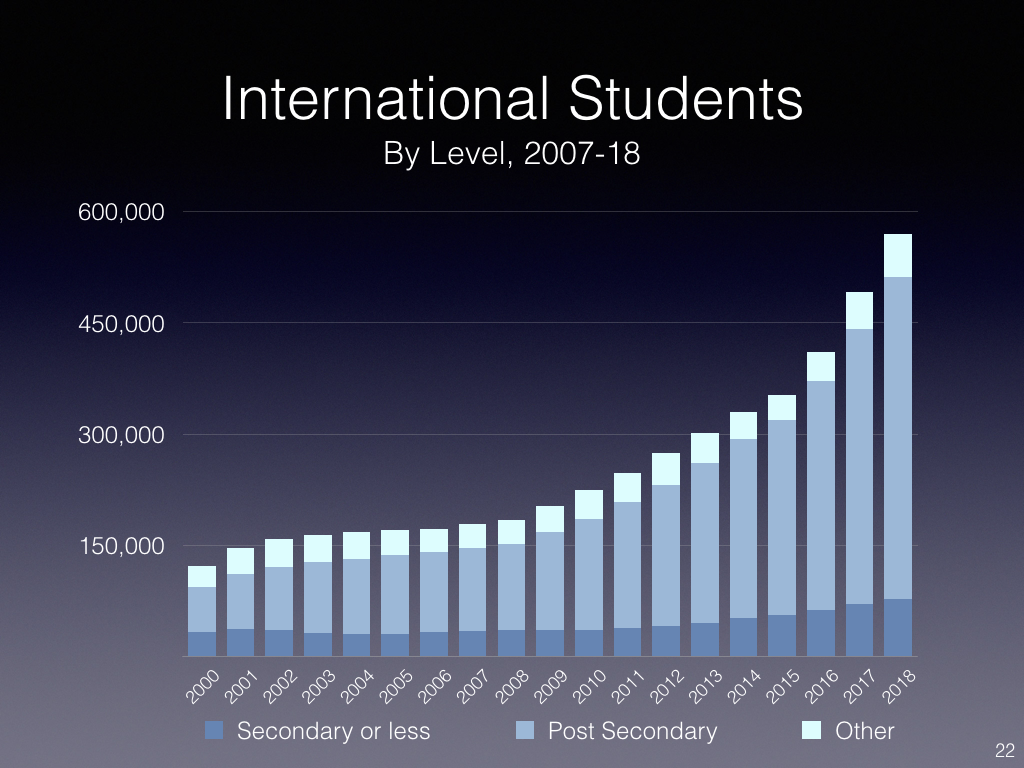
Amid warnings that universities are relying too much on the high tuition fees paid by foreign students, Justin Trudeau’s government has promised to do something about how more than half of the 572,000 international students in Canada hail from China and India.

The Liberal government has announced a new international-student strategy two months before the October election, amidst rising diplomatic tensions and opinion polls showing 90 per cent of Canadians have negative impressions of the government of the People’s Republic of China.

The federal Liberals, who have roughly doubled the number of foreign students in Canada since being elected in 2015, are pledging in carefully worded announcements they intend to adjust the current international demographic ratio, which sees more than half of offshore students coming from China (143,000) and increasingly India (173,000).

A University of Sydney, Australia, professor warned this month that post-secondary institutions in his country and elsewhere risk “catastrophic” financial shortfalls by relying so heavily on students from China, who make up about 40 per cent of the total in that country. One-fifth of the University of Sydney’s budget, for instance, depends on the cohort from China, says Salvatore Babones.

Since Canada and Australia are two of the world’s most sought-after destinations for international students from China, Babones is not surprised the Trudeau government is promising to change the foreign-student ratio by spending $30 million to recruit more young people from countries such as Mexico, Colombia, Brazil, Vietnam, the Philippines, Indonesia, Ukraine, France and Turkey.

“As in Australia, these marketing plans are part of a ‘diversification strategy’ intended to dilute the risk that an adverse event — for example, a suspension in the convertibility of the yuan or a major recession in India — that might suddenly result in a revenue shortfall at universities,” Babones said by email.

“When universities and governments think of international students as a revenue source, these kinds of perverse policies start to seem natural. The proper role of international students is to diversify and enrich campus culture, not to support universities with their tuition money.”

Babones’s report, titled The China Student Boom and the Risk it Poses to Australian Universities, does not focus on how various political tensions could also reduce the number of students from mostly well-off Chinese families who head to English-language schools.

However, an overwhelming majority of Canadians, according to recent polls by Nanos and others, increasingly don’t trust China’s leaders, who in turn, in the midst of a trade war with the U.S. and Canada, are issuing various warnings against their citizens travelling to North America. Some politicians in India, in addition, are also worrying about a student brain drain to Canada.

Stresses are also escalating on some North American campuses because of a flurry of news reports maintaining that some students from China are attempting to intimidate people with roots in either Tibet or protest-filled Hong Kong.

In B.C., Chinese nationals comprise about 40 per cent of the 153,000 foreign students at all levels in the province, most of whom are in Metro Vancouver.

University of B.C. officials confirmed Friday that students from China make up by far their largest international cohort. In the recent school year, UBC enrolled 6,281 students with Chinese citizenship, taking in $184 million from their fees, which are three to four times higher than that of domestic students.

That adds up to 44 per cent of the $414 million collected from all of the 17,200 foreign students at UBC, which has annual revenues of $2.7 billion. Asked if the number of applicants from China is declining, a UBC official said there was sharp growth up to 2019, but that “according to global forecasting trends, it’s possible this growth will slow in future years for a variety of reasons.”

Across the city at Simon Fraser University, officials provided data showing the institution’s 3,078 students from China make up 46 per cent of all international students — who in total paid $126 million in fees in the 2018-19 school year. That is 16 per cent of SFU’s annual revenues.

“We are not over-reliant on international tuition, but we do carefully monitor the situation,” said a senior director of student services at SFU, Leanne Dalton.

Despite the financial vulnerabilities associated with Canadian educational institutions leaning on offshore nationals from China, India and elsewhere, the federal Liberal government has made welcoming more foreign students a major theme in its election campaign.

In addition to saying it intends to recruit more students from beyond India and China, Liberal cabinet ministers toured the country in August to expound on a series of news announcements that foreign students pump $21.6 billion into the economy and “support almost 170,000 jobs for Canada’s middle class.”

Immigration Minister Ahmed Hussen upped the emphasis on the issue by maintaining the total number of foreign students is even higher than 572,000, the figure most often cited in government documents.

“In 2018, more than 721,000 international students studied in Canada,” Hussen claimed in August. The immigration minister’s much larger foreign-student totals surprised and perplexed educational officials contacted by Postmedia, including specialists at the Canadian Bureau for International Education.

If Hussen’s announced new total is accurate, it means that since 2014, when 330,000 international students were in the country, the number has jumped by 391,000. And he is looking beyond China and India to bring in more to boost the GDP.

Source: Douglas Todd: Over-reliance on students from India and China sparks Ottawa reaction

Citizenship list in Indian state leaves out almost 2 million

Increased sectarianism, weaponized:

On Saturday morning, Farid Ali, a farmer dressed in his best sky-blue kurta and a white prayer cap, walked quietly into his village headquarters and received devastating news.

His name wasn’t on the list.

He looked, he waited, his legs began to shake, his dry lips began to move and he prayed there had been a mistake. But his name wasn’t anywhere.

Mr. Ali’s citizenship in India, where he has lived all his life, was now in question, and he could soon be separated from his family and hauled off to a prison camp.

He is one of nearly two million people in northeast India who were told Saturday that they could soon be declared stateless in a mass citizenship check that critics say is anti-Muslim. The news arrived in small, sunlit offices across the state of Assam, where citizenship lists were posted that drew huge crowds. Many walked away shocked and demoralized; others were joyous.

Source: Citizenship list in Indian state leaves out almost 2 million

India government revokes disputed Kashmir’s special status

Will be interesting to see how this is interpreted by the different Indo-Canadian communities in both mainstream and ethnic media:

The Indian government has used a presidential order to revoke the special constitutional status of Kashmir, in a bid to fully integrate its only Muslim-majority region with the rest of the country, the most far-reaching political move on the troubled Himalayan territory in nearly seven decades.

Some political leaders in Kashmir warned in recent days that any such move by Prime Minister Narendra Modi’s administration — through the repeal of the constitution’s Article 370 — will trigger major unrest as it would amount to aggression against the region’s people.

Authorities, meanwhile, have launched a new clampdown in the state of Jammu and Kashmir by suspending telephone and internet services, and putting some leaders under house arrest.

The security measures include thousands of newly deployed soldiers, who are camping in police stations and government buildings in the Indian-controlled portion of Kashmir. The deployment in recent days adds at least 10,000 troops in Kashmir, already one of the world’s most militarized regions.

India also has ordered thousands of tourists and Hindu pilgrims to leave.

The decision to repeal Article 370 will mean an end to restrictions on property purchases by people from outside the Indian state of Jammu and Kashmir, and state government jobs and some college places will no longer be reserved for state residents.

The Muslim-majority Himalayan region has been at the heart of more than 70 years of animosity, since the partition of the British colony of India into the separate countries of Muslim Pakistan and majority Hindu India.

Two of the three wars India and Pakistan have fought since their independence from British rule were over Kashmir.

Pakistan’s Foreign Ministry has rejected the revocation of a special status for the portion of disputed Kashmir that it controls. The ministry said in a statement Monday that under UN Security Council resolutions, India cannot change the status of Kashmir, which is claimed by both India and Pakistan.

The ministry said the people of Pakistan and Kashmir will not accept the Indian action, and Pakistan will “exercise all possible options” to block it.

The scenic mountain region is divided between India, which rules the populous Kashmir Valley and the Hindu-dominated region around Jammu city — Pakistan, which controls a wedge of territory in the west — and China, which holds a thinly populated high-altitude area in the north.

Here are some facts about the region and the constitutional change:

Partition

After partition of the subcontinent in 1947, Kashmir was expected to go to Pakistan, as other Muslim majority regions did. Its Hindu ruler wanted to stay independent, but, faced with an invasion by Muslim tribesmen from Pakistan, acceded to India in October 1947 in return for help against the invaders.

Article 370

This provision of the Indian constitution that provided for Jammu and Kashmir’s autonomy — except for matters of defence, finance, communications and foreign affairs — was drafted in 1947 by the then prime minister of the state, Sheikh Abdullah, and accepted by India’s first prime minister Jawaharlal Nehru. It was, though, only classified as a temporary provision, and in October 1949 was included in the Indian constitution by the constituent assembly.

Article 35A

This was added to the constitution in 1954 under Article 370, and empowers the Jammu and Kashmir state parliament to provide special rights and privileges to permanent residents of the state. It will die with the repeal of 370, which means outsiders will likely be allowed to buy property in the region and state residents will likely lose their control of state government jobs and college places.

Wars

The dispute over the former princely state sparked the first two of three wars between India and Pakistan after independence 1947. They fought the second in 1965, and a third, largely over what become Bangladesh, in 1971.

Divisions

A UN-monitored ceasefire line agreed in 1972, called the Line of Control (LOC), splits Kashmir into two areas — one administered by India, the other by Pakistan. Their armies have for decades faced off over the LOC. In 1999, the two were involved in a battle along the LOC that some analysts called an undeclared war. Their forces exchanged regular gunfire over the LOC until a truce in late 2003, which has largely held since.

The insurgency

Many Muslims in Indian Kashmir have long resented what they see as heavy-handed New Delhi rule. In 1989, an insurgency by Muslim separatists began. Some fought to join Pakistan, some called for independence for Kashmir. India responded by pouring troops into the region. India also accused Pakistan of backing the separatists, in particular by arming and training fighters in its part of Kashmir and sending them into Indian Kashmir. Pakistan denies that, saying it only offers political support to the Kashmiri people.

Indian Kashmir

Governed as the northernmost state of Jammu and Kashmir. It has two capitals, Jammu in winter (November-April), Srinagar in summer (May-October).

New Delhi claims the whole of Jammu and Kashmir as an integral part of India.

Pakistani Kashmir

Consists of the smaller Azad Kashmir (“Free Kashmir”) and the Northern Areas, which also formed part of the state before independence. Pakistan says a UN-mandated referendum should take place to settle the dispute over the region, expecting that the majority of Kashmiris would opt to join Pakistan.

Geography

Parts of Kashmir are strikingly beautiful, with forest-clad mountains, rivers running through lush valleys and lakes ringed by willow trees. The western Himalayan region is bounded by Pakistan to the west, Afghanistan to the northwest, China to the northeast, and India to the south.

Population and area

Ten million in Indian Kashmir and more than three million in Pakistani Kashmir. About 70 per cent are Muslims and the rest Hindus, Sikhs and Buddhists. With an area of 222,236 square kilometres, it is slightly bigger than the U.S. state of Utah and almost as big as Britain.

Economy

About 80 per cent agriculture based. Crops include rice, maize, apples and saffron. The area is also known for handicrafts such as carpets, woodcarving, woolens and silk. Tourism, once flourishing, has been badly hit by the conflict.

Source: India government revokes disputed Kashmir’s special status

Visitors from India face high rejection rates on visa applications

Good analysis of the data and indication that the government is addressing fraud and applying risk management to different applications:

Refusals on visitor applications from India due to fraud and misrepresentation are soaring, which Ottawa and immigration experts say is in part due to unscrupulous “ghost consultants.”

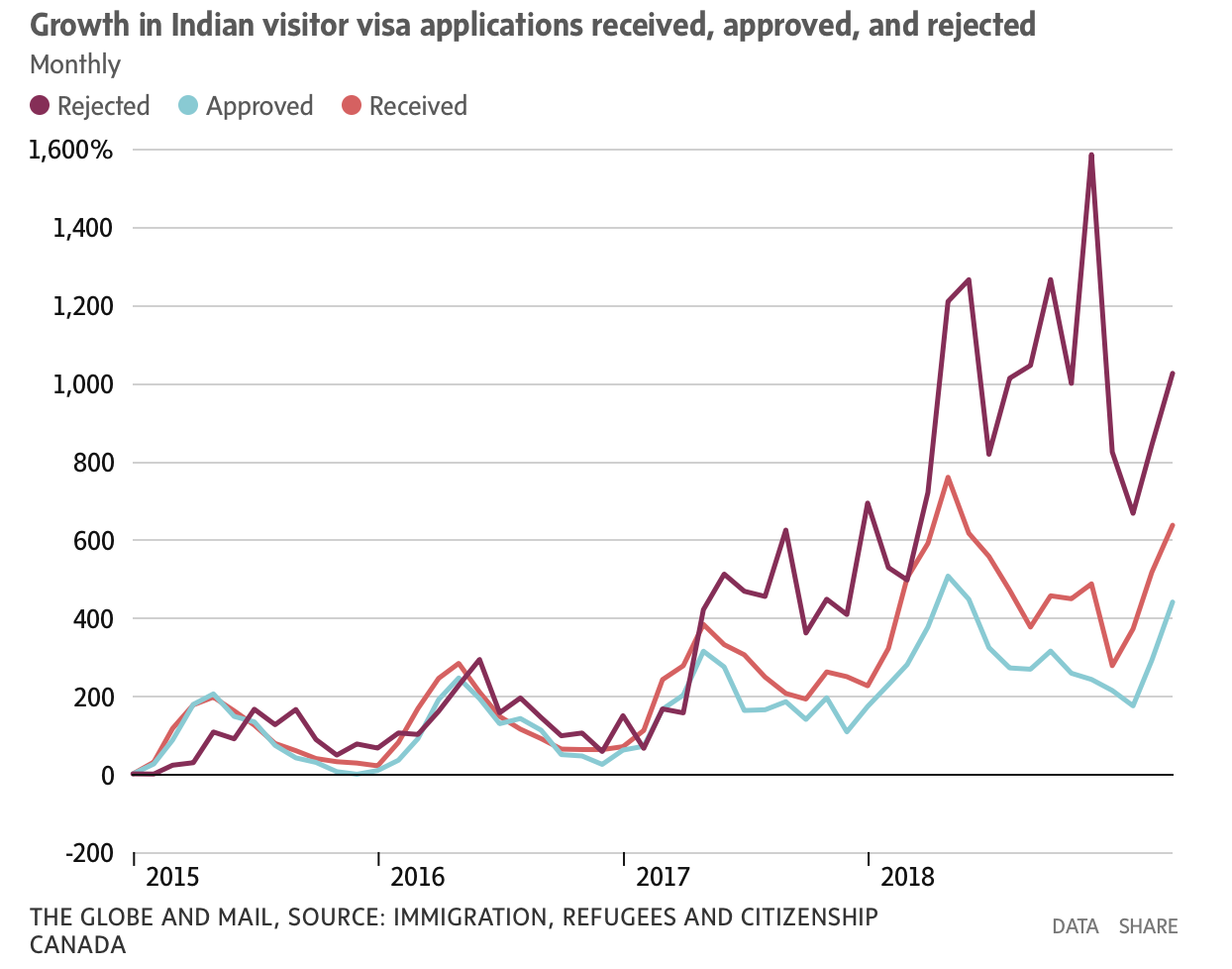
While the number of Indian visitor visa applications has increased significantly, refusals are growing at an even faster clip. Data provided by the federal government show that the percentage of refusals due to an applicant misrepresenting themselves – through fraudulent submissions, for instance – has nearly tripled. In 2017, 0.9 per cent of all Indian visitor visa rejections were for misrepresentation; from January to May this year, the number jumped to 2.5 per cent.

Immigration, Refugees and Citizenship Canada (IRCC) refused 1,477 applications due to misrepresentation in 2017. Between January and May of this year, that number had already reached 3,709. The department could see close to a 500-per-cent increase in fraud refusals by year’s end compared with 2017 if current trends hold.

In response to the increasing number of refusals for Indian applications, in June the federal government rolled out an information campaign targeting Indians applying for visas. The effort includes resources on identifying and reporting fraud throughout the process, including by ghost consultants – unscrupulous, unlicensed immigration consultants.

“We anticipate that this campaign will help address some of the spinoff effects of circulating misinformation, such as high refusal rates and abuse of the asylum system,” Mathieu Genest, a spokesperson for Immigration Minister Ahmed Hussen, said in an e-mailed statement. Mr. Genest said the problem of ghost consultants is “particularly acute” in India.

Bank statements, income taxes, medical files, education histories, funeral home letters and even letters of support from members of Parliament are some of the types of fraudulent documents received by IRCC in recent years. Aside from fraud, Mr. Genest said the government is also seeing an increase in repeat applications from Indians previously denied and an overreliance on paper applications, which take longer to process, but noted that the increase in refusals should not affect legitimate applicants.

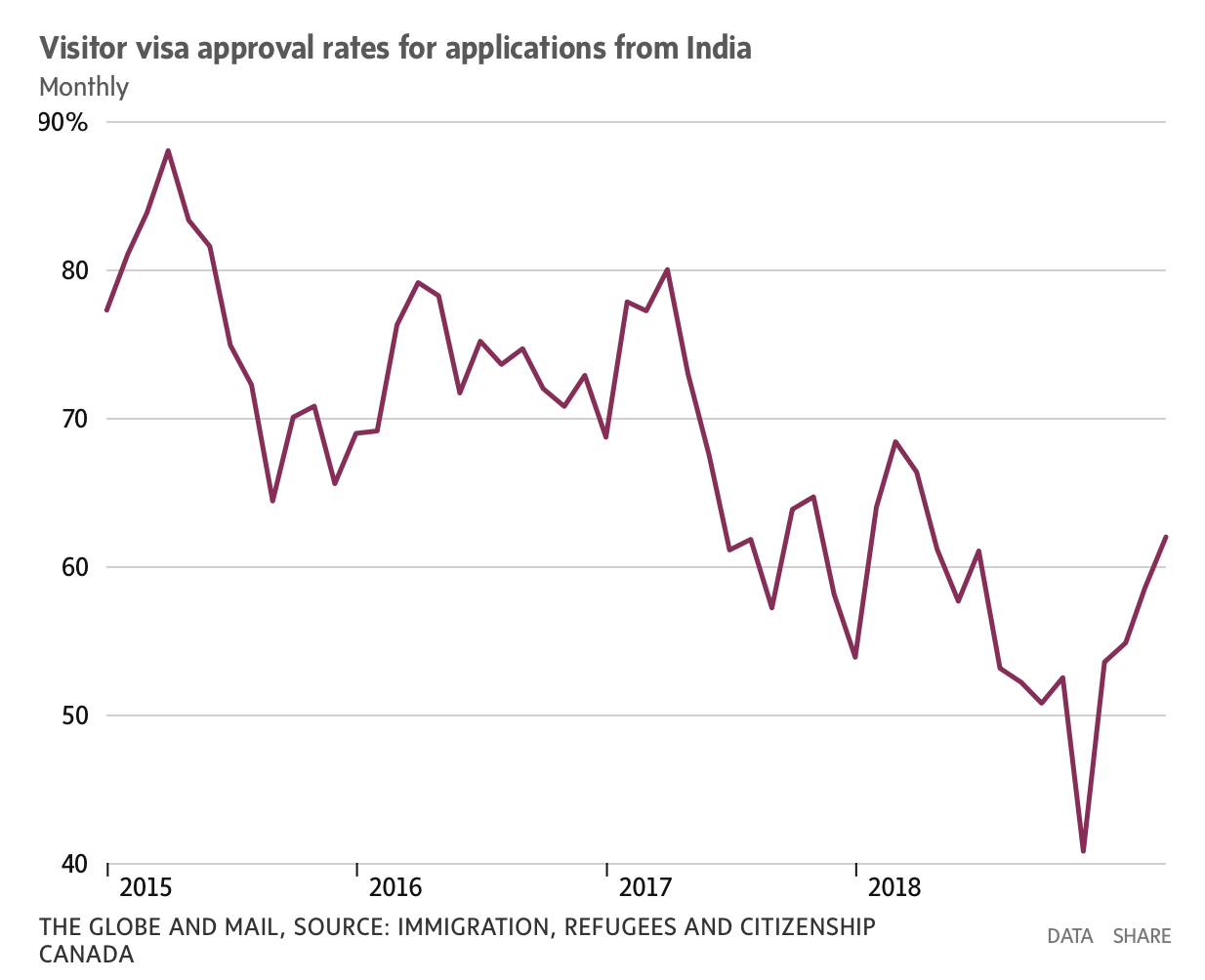
Partly owing to the increase in misrepresentation refusals, approval rates on Indian visitor visa applications have plummeted.

In April, 2015, 88 per cent of visa applications from India were approved – Ottawa received 27,600 applications that month. But by December of 2018, Canadian immigration authorities were receiving more than 58,000 applications each month and approval rates had dropped to 40.8 per cent.

The drop in India’s approval rates comes as the federal government has worked to streamline the visa process. According to documents obtained by The Globe and Mail through access-to-information requests, IRCC is using artificial-intelligence tools to review temporary resident visa applications from China and India as they come in.

Online applications predicted by AI models to be low-risk are sent to an immigration officer for review, simplifying the process. According to IRCC, 30 per cent to 40 per cent of China’s visitor visa applications are are now handled through this streamlined process; however, only 3 per cent to 5 per cent of Indian applications meet that low-risk threshold.

As of April, India was the top source of visitor visa applications to Canada. The country recently surpassed China, where applications have declined in recent months, which some attribute to the continuing diplomatic dispute between Ottawa and Beijing.

According to data from IRCC, Indians submitted 73,457 temporary resident visa applications that month, accounting for nearly a third of the worldwide total. China came in second place, with 46,646 applications.

Visitor visas are required for anyone from a non-visa-exempt country and looking to visit, work or study in Canada. As such, they’re often the first step in the immigration process.

Prashant Ajmera, an immigration lawyer in India who has an office in Montreal, was surprised to hear that the approval rate for visas from India had decreased so dramatically. He said the Canadian government has been touting the growing number of visitors from India, drawing attention to the fact that Canada welcomed nearly 300,000 visitors from that country last year. (There is no cap on how many visitor visas Canada issues each year.)

However, Mr. Ajmera said the Canadian government’s information campaign in India will not solve the problem, as applicants already know about visa fraud and immigration scams.

“They are aware of it but they’re taking calculated risks, most of them,” Mr. Ajmera said. “It’s a very common story.”

He said it would be a better use of Canada’s time to work with other like-minded governments, such as the United States, Britain and Australia, to encourage the Indian government to better regulate its immigration consultants in an effort to stem visa fraud.

One Canadian immigration lawyer thinks that the immigration consultant industry itself may be to blame. Ravi Jain, a Toronto-based immigration lawyer at Green and Spiegel LLP, said that lawyers are taking on clients who first worked with an Indian immigration consultant, only to find that the client’s visitor visa application was riddled with mistakes.

In some cases, unlicensed immigration consultants impersonate applicants throughout the process. “Often times, those people will even make up e-mail addresses. I’m not kidding, they do this,” he said.

Unscrupulous immigration consultants are not the only possible explanation for the decline in India’s approval rates.

Vancouver-based immigration lawyer Richard Kurland said he believes visa fraud, particularly relating to study permits, is the main reason for the decline in the approval rate of temporary resident visas from India. He said study permits are the “number one threat to Canada’s immigration system today” because there is no cap on the number of permits the government can issue, allowing foreign immigration consultants to take advantage of the program.

A recent Globe and Mail investigation revealed that private colleges in Canada are being accused of paying overseas agents to persuade international students that paying tens of thousands of dollars in tuition to study in Canada is the easiest way to get into the country and work toward becoming a permanent resident.

Wrongful detentions, judges’ quotas in the search for illegals in…

Appears to be an ongoing issue, likely to continue under the current Indian government:

Three years ago, police in India’s northeastern state of Assam were looking for a woman named Madhumala Das, who had been declared an illegal immigrant by a local tribunal.

When they reached the village of Bishnupur, they picked up 59-year-old Madhubala Mandal, who was lighting a fire outside her bamboo hut one morning in November 2016.

Mandal, a frail, Bengali-speaking woman who is just over four feet tall, spent over two-and-a-half years in a detention center until she was freed last month following a probe conducted by a new police chief in the area.

In a recent interview in her hut, Mandal said she told the police she was not the person they were looking for, that she was Indian and had documents to prove it. But they did not listen.

Local activists and lawyers say such cases are not uncommon in Assam, where a long-simmering movement against illegal immigrants, particularly Bengali-speaking Muslims, has been fanned by Prime Minister Narendra Modi’s Hindu nationalist government. His ruling Bharatiya Janata Party (BJP) also governs Assam.

BJP’s campaign against people deemed to be foreigners from Muslim-majority and Bengali-speaking Bangladesh, even if they have lived in India for decades, or were born in India but can’t prove it, is about to reach boiling point.

At the end of next month, Assam plans to publish the final version of a register of citizens it has been preparing since 2015. Hundreds of thousands – perhaps millions – are likely to be left off the list – meaning they will have to prove their citizenship, or risk detention like Mandal.

This is unlikely to lead to immediate mass arrests because detention centers are full, and Bangladesh has not agreed to accept the people identified as “foreigners”.

But being a non-citizen carries many penalties, including loss of access to government payments, voting rights, healthcare and state education. People could be quickly marginalized.

And this isn’t only an Assam issue.

Last week, Modi’s top lieutenant, Home (Interior) Minister Amit Shah, who has described Assam’s illegal immigrants as “termites”, said the government intends to go nationwide in identifying and deporting those who don’t have the right to stay.

At the same time, the government has been welcoming Hindu, Sikh and Buddhist migrants, making Muslims feel targeted. Shah said this month that the government wanted to “stop infiltration and push every single infiltrator out of the country”, but would welcome Hindu refugees.

WORSE THAN CONVICTS

When she was arrested, Mandal, a Hindu, was taken to a detention center in the town of Kokrajhar, in western Assam.

A group from India’s National Human Rights Commission that visited that center last year said illegal immigrant detainees there were in some ways “deprived even of the rights of convicted prisoners”.

U.N. experts warned in a statement this month that the citizenship drive in Assam risked rendering millions stateless or in prolonged detention, and that the process “could fuel religious discrimination”, adding that the legal system was discriminative and arbitrary.

The office of the chief minister, the highest elected official in Assam, did not respond to questions sent by Reuters on this story.

Ajoy Rai, a local activist who worked with police to secure Mandal’s release, said there may be many more wrongly detained people in the state.

“Most people are not literate and don’t understand what the documents they have even mean,” he said. “When there are floods or a fire, people lose the documents too.”

Assam, one of India’s poorest states, is ravaged by floods annually, displacing millions, with this year no exception.

Rights activists and lawyers say Assam’s system of ‘foreigners tribunals’, detention centers and its ‘border police’ – a unit in charge of checking illegal immigration – is biased against the poor and against Bengali speakers, who are deemed to be from Bangladesh.

Bengali is the second-most widely spoken language in India, after Hindi. The official language in Assam is Assamese.

A review of orders issued in recent years by Assam’s tribunals – quasi-judicial bodies set up for illegal immigration cases – shows many people of Bengali descent have been declared foreigners because of discrepancies in their names and other details on identity documents.

The tribunal judges’ performance itself, which is evaluated by the government, appears to be at least partly based on the percentage of the people they declare as foreigners, according to their appraisal sheets. Reuters reviewed copies of the appraisal sheets of judges in 79 of Assam’s roughly 100 tribunals.

The documents, which evaluate the judges’ performance over two years until April 30, 2017, show that a majority of judges who declared less than 10 percent of all the people they examined as foreigners got a rating of “may be terminated.”

Despite criticism of the process, Assam is working on setting up some 200 more foreigner tribunals by Sept. 1, growing to around 1,000 eventually, as it scrambles to prepare for the aftermath of the publication of the final register on Aug. 31. Around 245,000 cases are pending at the tribunals, and scores more are likely to be added after the final list is published.

The government has also lowered the eligibility criteria for the post of judges, allowing retired bureaucrats and lawyers with seven years of experience to apply – as opposed to 10 years required earlier.

“It is obvious that these appointments lack judicial independence or adequate separation from the executive, and the judges are being appointed for tribunals with indications that they should lean in favor of declaring people foreigners,” said Sanjay Hegde, a senior Supreme Court lawyer in New Delhi.

There is room for appeal against a tribunal decision through the high court in Guwahati, Assam’s main city, But that court is swamped with some two dozen new cases of illegal immigration each week, said Hafiz Rashid Ahmed Chaudhry, a senior lawyer in Guwahati.

Santanu Bharali, legal adviser to Assam’s chief minister, dismissed criticism that the tribunals were biased or had targets to declare people as foreigners. He said the judges relied on documents submitted as proof of citizenship and the tribunals’ decisions could be appealed.

“CREATE ONE WHOLE TOWN”

Assam is far from ready to deal with the situation if hundreds of thousands of residents are declared illegal.

The six detention centers there are already overcrowded, said Bharali. They held 1,133 illegal immigrants as of May 25, 2019, the government said earlier this month.

Kula Saikia, the chief of police in Assam, told Reuters there was no clarity on what would be done with those who don’t make it onto the citizenship register. He and other officials say they are awaiting orders from India’s Supreme Court, which is supervising the process.

“It’s impossible” to detain hundreds of thousands of more people, said Bharali. “We will have to create one whole town for these people.”

Local activists say the fear of being declared an illegal immigrant has driven at least 25 people to suicide since a draft citizenship list was drawn up in July 2018. Reuters could not independently verify the claims, and the police have refrained from linking the suicide cases to the citizenship verification process.

In the case of Madhumala Das, she was first declared a foreigner by a tribunal in 1988, and a fresh order was passed in June 2016 that led to Mandal’s arrest.

Police said the mistake occurred as there were three women with similar names in Mandal’s village.

“They had to follow the tribunal’s orders and find the person,” said a senior officer at the police station near Mandal’s home.

Madhumala Das had died more than a decade earlier. The border police did not know.

Source: Wrongful detentions, judges’ quotas in the search for illegals in…