Government appointments and diversity – Policy Options

election-2015-and-beyond-implementation-diversity-and-inclusion-042My latest piece in Policy Options, reporting on the Liberal government’s commitment on increasing diversity in government appointments (political, deputy minister, judges and heads of mission) – spoiler alert, it largely has.

Source: Government appointments and diversity – Policy Options

Women in politics: Why Ottawa isn’t quite as equal as we think it is

GiC Baseline 2016.010Good story from the past.

Clearly, current government is determined to do better with GiC and other appointments (see my earlier baseline analysis Governor in Council Appointments – 2016 Baseline):

One day when Penny Collenette was director of appointments for Prime Minister Jean Chrétien, her executive assistant slunk into her office clutching a list. “You’re not going to like this,” she said. Collenette looked at it: 18 people recommended for an advisory group on a sensitive public policy issue. All of them were men.

Before the Liberal government was elected in 1993, they made a campaign promise to appoint more women. When they took office, Collenette asked to see the numbers: of about 3,000 people appointed by governor-in-council — deputy ministers, heads of agencies, Crown corporations, ambassadors, judges, returning officers and commission members — women made up between 26 and 29 per cent. Over the first year or so, Collenette kept an eye on that number like it was a stock ticker. With each list of proposed names, the proportion of women nudged upward, bit by bit.

She knew what this list of 18 men was going to do to the progress they’d made. She had a good relationship with the minister in question — even years later, she won’t say which one — so she called him up to say his department needed to do better. He whined a little, but three weeks later produced a new list: nearly half were women, and a few were Indigenous women, too. By the time Collenette left in 1997, the proportion of women in those posts had reached 39 per cent. “In a way, I suppose it was just naïveté,” she says. “We said we were going to do it, so I thought I guess we’d better do it. And of course, personally I wanted to.”

Two decades on, lagging progress — the ranks of women in top government positions is now lower than when Collenette left — has spurred a raft of highly visible attempts to rebalance the scales in Canadian politics and public service. The blunt, by-the-numbers approach of affirmative action is an imperfect and sometimes controversial way to move the ball forward, but­­ — particularly in politics — it may be the only way to upend the entrenched systems that favour men and overlook women. “That we’re still so far behind on this one suggests there are still some really pernicious ideas about women in politics,” says Melanee Thomas, a professor of political science at the University of Calgary. A large and growing number of countries employ gender quotas in politics, and many have seen dramatic improvements in representation as a result. Canada is well behind, and the country’s ranking on gender equity has been slipping for years. The major roadblock is also where the clearest solution lies: with political parties and nominations. “If parties demanded that this would be different, it would be different,” Thomas says.

Source: Women in politics: Why Ottawa isn’t quite as equal as we think it is

Because it’s 2015 … Implementing Diversity and Inclusion – My latest ebook

because-its-2015_pdf__page_1_of_59_Over the past months, as many of you know, I have been doing a series of articles on the 2015 election, Cabinet and other senior appointments, along with baseline data for the public service, Governor in Council and judicial appointments by which to measure the government’s implementation of its diversity and inclusion commitments.

I have integrated and updated these in mini-book form, available as a free download from:

iPad/Mac version (iBooks)

Windows version (PDF)

I hope you find this compilation and the reference data it provides of interest and use.

The description is below.


——————-

Because it’s 2015 … Implementing Diversity and Inclusion

Canada’s 2015 election provided a sharp contrast between the social cohesion focus of the Conservative party and its use of identity politics, and the Liberal party’s emphasis on diversity and inclusion. This was not only reflected in policy and language but in candidate recruitment, with the Liberals having the largest number of visible minority candidates, although Conservative and NDP numbers also increased.

The overall voting shift to the Liberals was particularly strong among new Canadian voters, reflecting a mix of the overall shift to the Liberals in this election, perceived anti-immigrant bias and identity politics, and lack of support for Conservative restrictive citizenship and immigration policies.

In power, the Liberals implemented their diversity and inclusion commitment through the establishment of a Cabinet Committee on Diversity and Inclusion, Cabinet and Parliamentary Secretary appointments, Ministerial mandate letters and initial Senate appointments. They also set expectations for other senior appointments.

This short book provides data and related analysis with respect to the election results, political representation and leadership positions, and establishes the 2016 baseline for senior public servants, Governor in Council and judicial appointments by which to judge the Government’s implementation.

With over 40 charts and tables, Because it’s 2015 … is an invaluable reference for those interested in Canadian politics and diversity. iPad optimized.

Table of Contents

  1. Introduction
  2. Political Institutions
  3. Public Service Impact
  4. Governor in Council Appointments
  5. Judicial Diversity
  6. Concluding Observations

Diversity and Inclusion Agenda: Impact on the Public Service, Setting the baseline

My article in The Hill Times, slightly updated:

The Liberal government included in its mandate letters to all ministers a “commitment to transparent, merit-based appointments, to help ensure gender parity and that Indigenous Canadians and minority groups are better reflected in positions of leadership.”

While the focus is clearly with respect to political appointments, this commitment will likely extend to the senior ranks of the public service in a renewed emphasis on diversity. Deputy minister appointments are made by the Prime Minister upon the recommendation of the Clerk of the Privy Council. While the Foreign Affairs Minister recommends  ambassadorial appointments or equivalent, largely reflecting public service recommendations, the Prime Minister approves. The PM also has the power to select candidates for high-profile positions. ADM appointments in Canada, on the other hand, are by the public service only. All positions at this level are bilingual.

With this in mind, I have established the baseline for the current representation of women and visible minorities that will allow tracking of progress over time.

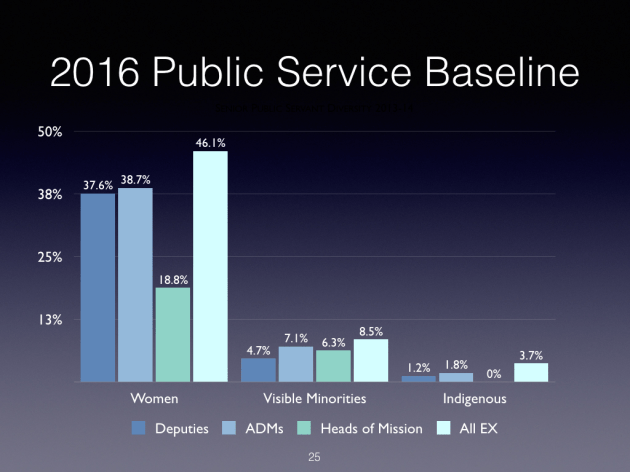
Overall, the Public Service is reasonably diverse with respect to women (54.1 percent), visible minorities (13.2 percent compared to the 15 percent who are Canadian citizens) and Indigenous Canadians (5.1 percent). For the executive ranks, women are almost at parity (46.1 percent) but visible minorities are under-represented (8.5 percent) as are Indigenous Canadians (3.7 percent). All figures are from the Treasury Board Secretariat report, Employment Equity in the Public Service of Canada 2013–14.

To determine representativeness, the government applies a labour market availability (LMA) benchmark (i.e., “the share of designated group members in the workforce from which the employers could hire”).  For ADMs and other members of the EX category,  the respective LMA is 45 percent for women, 7.5 percent for visible minorities and 4.5 percent for Indigenous Canadians.

Arguably, a more appropriate measure of inclusion is derived from comparison to the overall share of the population (or, in the case of visible minorities, the percentage of those who are also Canadian citizens – 15 percent).

However, these aggregate numbers — both actual and LMA — do not give a detailed sense of diversity within the senior ranks of the public service, defined as deputy and assistant deputy ministers (DM and ADM or equivalent).

Ministers and Parliamentary Secretaries are relatively diverse (41 percent women, 21 percent visible minority men or women).  The question is how diverse are those public servants at senior levels, with whom they work.

My information sources are reasonably accurate. For the 85 Deputies, their Associates and equivalents, public sources such as GEDS (the government electronic contact database), the Parliamentary website, cross-checked with PCO Deputy Committee lists, were used for both Deputies and Associate Deputies. This data does not include any of the recent changes announced by the Prime Minister.

For ADMs, Treasury Board Secretariat (TBS) provided official statistics for the 282 officials at the EX-4 or 5 rank for the 2013-14 year in the core public administration (77 organizations),  along with estimated labour market availability.

For senior heads of Mission (HoM), Global Affairs Canada provided a list of the 16 missions whose Ambassadorial and High Commissioner positions are currently classified at the EX4-5 level (these are a subset of the overall ADM numbers).

Some of these positions are over-filled by people at the DM level (e.g.,  Jon Fried at the WTO) or former politicians (e.g., Lawrence Cannon in Paris, Gordon Campbell in London, and Gary Doer in Washington). This data predates the announcement of the two Ambassador-designates in Washington and the UN (New York), both men replacing men.

While the data for gender is reliable, data for visible minorities is less so, given that official reports rely on self-reporting and that there are limits to using names and photos to identify visible minority status. However, this methodology is also used with respect to MP diversity.

Election 2015 and Beyond- Implementation Diversity and Inclusion.001What does the data show? As seen in the chart above, representation of women is relatively close to gender parity, save for Ambassadors and their equivalents (Heads of Mission and other ADM-equivalent officials abroad).

However, visible minorities are less than half of the percentage of those that are Canadian citizens (15 percent) or in the House of Commons (14 percent).

The ‘all EX’ category has more junior executive positions (EX1-3) and thus the greater diversity in these feeder groups suggests that over time, diversity  at more senior levels should naturally increase.

The public service may feel compelled to take a more active approach given the Government’s commitment.

Likely early tests of the Government’s commitment to increased diversity will occur as deputy ministers retire and are replaced along with changes to Heads of Mission over the course of the year.

13 new Deputies have been named to date by the Prime Minister including 6 women (46 percent, reflecting in part the four women: appointed on International Women’s Day!) and one visible minority (8 percent). Future appointments will indicate whether this portends a trend.

By tracking this on an annual basis, along with changes to ADM ranks, progress can be assessed.

Diversity and inclusion agenda: impact on the public service

Mainstreaming Multiculturalism: Implementing Diversity and Inclusion Deck

For those interested, a slightly modified version of the deck I presented to the Centre on Public Management and Policy, University of Ottawa to mid-level government executives, highlighting the key findings of my book, Multiculturalism in Canada: Evidence and Anecdote, the history and evolution of multiculturalism, and the implications and opportunities of the Government’s diversity and inclusion agenda:
Mainstreaming Multiculturalism – Implementing Diversity and Inclusion

Diversity of Senate Appointments – Comparing Chrétien and Harper

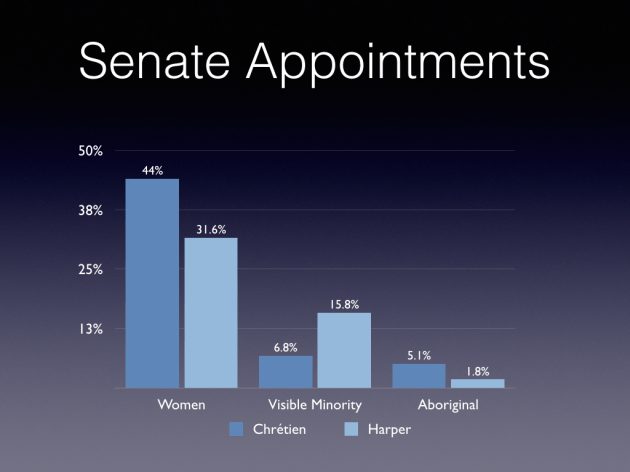
Senate Appointments.001Given the push for gender parity and greater diversity in upcoming Senate appointments (see Trudeau urged to create gender-balanced Senate), I thought it might be interesting to compare the Chrétien and Harper records with respect to diversity.

Chrétien, with his 75 appointments, achieved close to parity for women, with aboriginal peoples slightly over-represented. Visible minorities were under-represented, however.

Harper with his 57 appointments, in contrast, slightly over-represented visible minorities while under-representing women and aboriginal peoples (the fewer number of appointments over a comparable time period reflects his decision to stop appointing senators in response to the Duffy and other scandals).

Will see what PM Trudeau and the advisory body come up with.

John Ibbitson’s take on how gender parity would result in a more ‘progressive’ Senate:

 The other reason Trudeau would want gender parity in the Senate 

Trudeau Cabinet takes diversity, inclusiveness to an unparalleled extent | hilltimes.com

My piece in The Hill Times:

The Liberal government has emphasized its diversity and inclusive language in speeches, in Cabinet, in Cabinet committees, and in Cabinet ministers’ mandate letters. This emphasis has been reinforced by the return of the multiculturalism program to Canadian Heritage. All together, these initiatives represent the mainstreaming of diversity, inclusiveness and multiculturalism to an unparalleled extent.

It starts with the language of Prime Minister Justin Trudeau who regularly emphasizes that: “Canadians understand that diversity is our strength. We know that Canada has succeeded—culturally, politically, economically—because of our diversity, not in spite of it.”

It continues with the creation of the Cabinet Committee on Diversity and Inclusion, with a strong inclusion mandate for indigenous and new Canadians: “Considers issues concerning the social fabric of Canada and the promotion of Canadian pluralism. Examines initiatives designed to strengthen the relationship with indigenous Canadians, improve the economic performance of immigrants, and promote Canadian diversity, multiculturalism, and linguistic duality.”

It is reflected in his choice of ministers: 50 per cent women, 17 per cent visible minority. And is further reinforced in the shared mandate letter commitments for all ministers with two strong multiculturalism-related commitments: “Canadians expect us, in our work, to reflect the values we all embrace: inclusion, honesty, hard work, fiscal prudence, and generosity of spirit. We will be a government that governs for all Canadians, and I expect you, in your work, to bring Canadians together.

“You are expected to do your part to fulfill our government’s commitment to transparent, merit-based appointments, to help ensure gender parity and that indigenous Canadians and minority groups are better reflected in positions of leadership.”

Holding all ministers to account, with PMO tracking of these and other shared commitments (in addition to minister-specific commitments), should ensure greater progress on the two objectives of multiculturalism:  recognition and equality.

It will take some time to see how well these commitments are implemented.

Equally important, the previous government’s weak record on the diversity of judicial appointments (less than two per cent visible minority) will start to be addressed.

Overall, the new government made few changes to how government is formally organized (machinery changes). This was wise given the disruption and turmoil that such changes can entail (e.g., the Martin government’s splitting apart Human Resources and Skills Development and the Department of Foreign Affairs and International Trade in 2004, reversed by the Harper government in 2006).

This makes the return of the multiculturalism program to Canadian Heritage all the more striking, after some eight years at Citizenship and Immigration (now Immigration, Refugees and Citizenship or IRCC).

The original transfer to CIC was largely driven by political reasons given then Immigration minister Jason Kenney’s political outreach role with ethnic groups. However, there was also a policy rationale. Multiculturalism deals with longer-term multi-generational issues (along with ‘mainstream’ visible minority relations) in contrast to the newcomer focus of the immigration, integration and citizenship programs, and multiculturalism could be seen as a logical extension of CIC’s mandate, and was portrayed as such in one of CIC’s strategic objectives, ‘building an integrated society.’

In practice, however, the multiculturalism program withered away at CIC.

When the program moved to CIC in 2008, it had a $13-million budget: $12-million for grants and contributions and 73 full-time positions. The last departmental performance report (2013-14) showed 29 full-time positions (a decline of 60 per cent) with a $9.8-million budget. Money for grants and contributions fell to $7.9-million.

Negotiations over the resources to be returned to Canadian Heritage will be challenging, given the impact may be felt in other program areas in IRCC that benefited from the redistribution of Multiculturalism funds. Moreover, the weakened capacity will require a major rebuilding and restaffing effort.

From a policy perspective, the return of multiculturalism to Canadian Heritage reinforces the overall government diversity and inclusion agenda, as well as the Canadian identity agenda, which fits nicely with Canadian Heritage’s overall mandate.

However, Canadian Heritage Minister Mélanie Joly’s specific mandate letter commitments make no mention of multiculturalism. This apparent oversight may just be to provide the public service time to manage the return of multiculturalism and reintegrate within Canadian Heritage. Furthermore, the lack of a junior minister may make it harder for the multiculturalism program to define its new role within Canadian Heritage and, more broadly, across government.

Joly’s public statements to date have not included any significant references to multiculturalism. Her general orientation, however, has been clear: to promote the “symbols of progressiveness. That was (sic) the soul of our platform.”

Overall, the commitment to a diversity and inclusion agenda, supported by a Cabinet committee and shared ministerial mandate letter commitments, and the rebuilding of multiculturalism back at Canadian Heritage bode well for a more effective inclusion, diversity, and multiculturalism strategy across government.

Source: Trudeau Cabinet takes diversity, inclusiveness to an unparalleled extent | hilltimes.com
ICYMI: Moving past diversity: RBC’s journey to rid its upper ranks of ‘unconscious bias’

Good interview with outgoing RBC CEO Gord Nixon and taking diversity and inclusion to the next level and making people aware of unconscious bias. Well worth reading:

Diversity is about mix. Inclusion is really putting that mix to work for you. This unconscious-bias work, when we started last year, we had (esteemed scholar and co-author of Blindspot: Hidden Biases of Good People) Dr. Mahzarin Binaji come and speak with our senior leadership team and other employees. We really felt it was the next frontier of this work — trying to get to the more subtle issues and the more politically incorrect or more difficult to speak about (because bias is not an easy thing to talk about). We are working to really get people to become self-aware. And I think along with that it’s also realizing that having a bias doesn’t make you a bad person. We all have them. What’s important is recognizing them and then looking for ways to actually mitigate those biases. We’re doing this in a number of different ways. One is just for individuals — influential individuals (people who make important decision in the company). We really had a lot of our senior people go through this awareness building. I hear leaders say, “I was putting together a team to be working with this important client and as I was looking at people I was going to select, I realized that I was actually looking for somebody like me.” That’s often what your natural bias is.

I think maybe to provide a very practical example. Sometimes you find people assuming that a woman with young children won’t accept a promotion that involves travel because you heard about some woman who did it. The answer there is, don’t assume that. Ask the woman if she is interested in being a candidate for a role that involves travel. Our assumptions and our biases get us there automatically. Or, you think, “This is a new immigrant and why is it relevant to understand how they do banking in a different country?”. Actually, it’s very relevant because we have new immigrants coming to this country and understanding how they do banking allows us to serve them better. So, those are the practical aspects, practical issues that we try to address when they actually happen by having good processes.

You need somebody else to be there and stop you and say, “Hey, I think we might have a bias here” and by making this a more common language in our organization — by talking about it and by having the sessions — it gives you permission to have those conversations and it just makes it easier to go there where sometimes you’re not sure or you don’t want to offend people. This just makes it part of how we do business.

Moving past diversity: RBC’s journey to rid its upper ranks of ‘unconscious bias’ | Financial Post.

The report, by RBC and EY, also well worth reading:

Outsmarting our brains: Overcoming hidden biases to harness diversity’s true potential 

Canada must see immigration as a competitive edge – Royal Bank of Canada CEO

Strong message on immigration, diversity and inclusion from the CEO of the Royal Bank of Canada, Gordon Nixon:

Our diverse population is only an advantage to the extent we are inclusive. Full inclusion means everyone feels enabled to bring their perspectives, knowledge and experiences to the table. Diversity, together with inclusion, plays a central role in driving productivity, innovation and growth.

We are building the next phase in the growth of our great country in an era of economic interdependence, shifting demographics and wars for talent. A work force with global experience is a competitive advantage. International experience is an asset to business. Too often, we hear that newcomers with no Canadian experience would be hard to fit into the Canadian work force. In truth, international experiences relate directly to the modern Canadian context.

Business leaders – no matter the size of the company or the industry – should play an active part. A simple place to start is in guiding your company to increase diversity and to be inclusive. We all have and are impacted by systemic and unconscious biases; rather than acting as if they don’t exist, we must find ways to identify them and develop strategies to compensate for them.

Canada must see immigration as a competitive edge – The Globe and Mail.