As a Cultural War Continues to Cause Waves in France, Art Has Become a Lighthouse for Progressive Views

More of France’s “culture war,” this time with respect to the arts sector:

Accused of pandering to the far-right ahead of France’s federal election in 2022, President Emmanuel Macron attempted a balancing act. In January 2021, the leader’s party said it would create a “memories and truth” commission on France’s painful colonial history and war with Algeria. In March, it released a report on the positive contributions of individuals of immigrant backgrounds called “Portraits of France.”

These initiatives are part of a broader effort to find alternative solutions to growing demands for the removal of statues and street names honoring historical figures that are connected to France’s colonial past, including its slave trade. Yet, at the same time, Macron and some of his ministers have been igniting emotions as they publicly denounce forces that they see as stoking so-called “separatism,” including what many see as US-style political correctness and cancel culture—the latter of which is a largely unpopular but growing concept in France—as well as a perceived US-version of multiculturalism.

Recent events within and outside of France have further stoked this fire. The #MeToo movement has been met with uneven hostility. The October decapitation of a teacher who showed cartoons of the prophet Muhammad during a course on free speech has led to a new bill “against separatism,” which aims to combat Islamic radicalism. And the protests in the wake of the murder of George Floyd in the US last year have prompted renewed conversation about the nature of racism in France, and put the country’s old ways of cultural assimilation on trial.

Against this backdrop of a culture war that shows little signs of abating, artistic projects remain a powerful place for progressive discourse in France—even as some factions in the country move to denounce what many have called an “importation” of America’s discourse on identity politics.

Art and Politics

As warring factions argue over how to integrate populations of citizens descended from former colonies, a new resurgent left, notably marked by young people from within the very populations at the center of the issue, has been pushing back against the country’s “universalist” social model, which traditionally downplays—some would say ignores—cultural differences between citizens. The traditional style of governance aims to avoid what is often viewed as an Americanized version of warring ethnic and religious groups.

In a Le Monde editorial from March, supporters of the president’s “Portraits of France” project said that playwrights, filmmakers, and painters should “seize upon these life stories and make works of art out of them that speak to our society and our world.” They added that “by ignoring a part of our shared past, we have made it harder to understand our present and to write our future.”

But these cultural in-roads are not always met with open arms. The executive branch of French government has specifically singled out academia, including the social science fields of post-colonial and intersectional studies, saying that these areas are under risk of influence from radical agendas that are pitting communities against each other. It also announced in February a sweeping investigation into the presence of “Islamo-gauchisme”—a term loosely referring to extreme-left activists who are “complacent” toward radical forms of Islamism or who apologize for terrorism—in universities. As a result, many are worried about censorship in schools and that scholarly research into the darker chapters of France’s history is under threat.

This debate spewed over into the art world when a government-commissioned portrait series of women publicly displayed in March in Paris, which was designed to celebrate diversity by featuring images of professionals from an array of different fields, sparked a vicious response. The photographs in “109 Mariannes” became fodder for controversy due to the inclusion of the young astrophysicist Fatoumata Kébé who was singled out for her headscarf. Angered that Kébé was chosen to emblematize “Marianne,” the personification of the French Republic often seen interpreted in art or on stamps, former spokesperson for the right-leaning Republican party, Lydia Guirou, was among the angry tweeters: “Marianne is not and will NEVER wear the headscarf!”

The sentiment dovetails with a draft bill that the Senate amended this month to forbid chaperones on school field trips from wearing Muslim headscarves. The bill has been strongly criticized for stigmatizing Muslims and called an overreach of France’s already strict secular laws, which forbid the wearing of clearly visible religious symbols in schools, and by civil servants.

The Faces of the Republic

Despite instances of incendiary reactions, the cultural sphere is being won over by a new wave of progressive viewpoints and views are indeed changing. A younger generation has become eager to more openly focus on the topic of race and difference. French citizens of immigrant descent are raising their voices to say that, in practice, their identities are under-represented in a society that discriminates against them for their inherent differences. With a sense of irony, they describe a society which claims to be blind to those differences while demanding that any outward signs of that difference—for example, hijabs—are avoided, to best fit a cultural mold.

“We like the idea of ‘universalism,’ because it’s a kind of utopia… But it’s easier to go to Mars than to the land of universalism,” Nadine Houkpatin told Artnet News. She is co-curator with Céline Seror of a show that includes work by artists from Africa and its diaspora called Memoria: accounts of another History that is on view until November at the Frac-Nouvelle Acquitaine MECA in Bordeaux. Houkpatin notes that while a new generation has indeed been “inspired” by some of the “woke” political ideas stemming from the US, the theorists behind many of these left-leaning ideas are often of French origin.

The curators of the Bordeaux show surmise that, when it comes to discussing these issues through art, people have an easier time accepting more progressive, controversial topics. “I think that through art, we can address these questions that are essential,” said Seror. Art “gives a certain liberty that enables us to express ourselves about these subjects,” she added.

Indeed, it seems that the art world has been somewhat shielded: Responses were overwhelmingly positive to the two shows, despite the debates going on in the public realm. The show at Musée d’Orsay even received a nod from a critic who supports the government’s investigation into academics. “I saw the exhibition, and very much appreciated it,” said Nathalie Heinich, a sociologist who has published work on contemporary art.  She is in favor of the French government’s recent stance against “radical” intellectual currents “that come from elsewhere” and a signatory in an editorial in Le Monde that described them as “feeding a hatred for ‘whites.’”

Pap Ndiaye, the historian and new director of France’s immigration museum, the Palais de la Porte-Dorée, recently told reporters that he too is concerned by the pushback on academia. “It comes at a moment when post-colonial and intersectional questions are beginning to find their very small space in French universities,” he said. “If we stop teaching them, where will the students go?” The Paris museum he oversees is currently showing an exhibit on the immigrant experience that includes 18 artists from Africa and its diaspora—it is a poignant exploration of artistic diversity and it falls on the 90th anniversary of the museum, which infamously opened with an exhibition to celebrate the colonies and included human exhibits.

The title of the show at Ndiaye’s museum, “Ce qui s’oublie et ce qui reste,” which translates to “What is forgotten and what remains,” also seems to ask what traces of this dark past remain in the popular subconscious today. It is on view until July.

While the government and certain factions of the population continue to rail against the universities, art institutions are set to become an increasingly singular voice for pressing questions about post-colonialism in France. “When an artist presents [their work] in a museum that is open to the public, then we can start talking about colonialism, decolonization, and its impact on society,” said curator Seror. “That’s the power of art.”

Source: As a Cultural War Continues to Cause Waves in France, Art Has Become a Lighthouse for Progressive Views

Immigration museum in Paris is harsh and honest but incomplete: Keith Boag

Keith Boag highlights one aspect of France’s failure to integrate immigrants and their children, their portrayal in its national immigration museum:

Displays of books, magazines, pamphlets and buttons catalogue a history of French xenophobia.

There is poignant art representing the loneliness of exclusion and isolation from mainstream society.

It’s a pretty harsh and honest account, but still incomplete.

If there was anything said of the massacre of Algerians by Paris police in 1961, for instance, it wasn’t presented to draw my attention, and I missed it.

Nor was there much emphasis on why France should actually be proud to have immigrants settle here.

Marie Curie, who was born in Poland and became a French citizen, gets some attention. So does the German-born French composer Jacques Offenbach.

But the overall impression from the museum is one of “objectification, stereotyping and silencing,” in the words of Sophia Labadi, a scholar of cultural heritage.

She quotes the writer Ian McEwan to explain why it matters that a museum help us to understand the experiences of other people: “Imagining what it’s like to be someone other than yourself is the core of our humanity. It is the essence of compassion and the beginning of morality.”

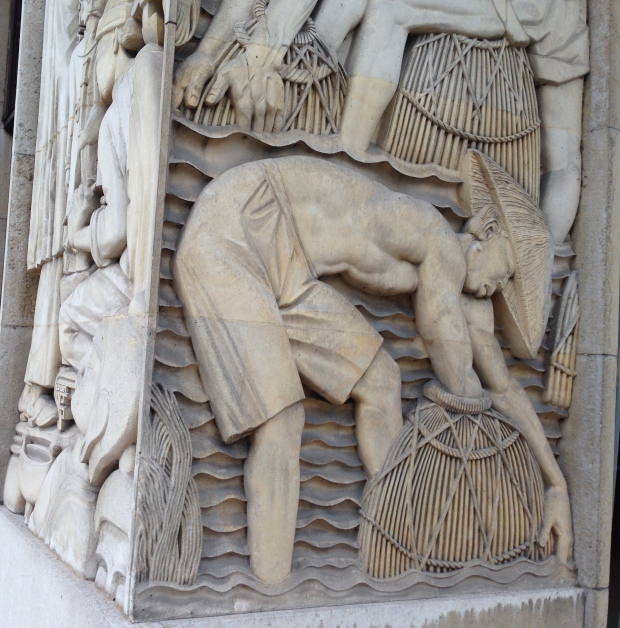
Bas-relief at The Centre for the History of Immigration, Paris

Bas-relief supposedly depicting immigrants’ experiences at the Centre for the History of Immigration. (CBC)

There are ways to do it all this better, writes Labadi. She points to the immigration museum called 19 Princelet Street in London.

There you’ll find overt attempts to put you into the shoes of someone who, for instance, must decide which three possessions — and only three — to take as he or she leaves home for a new beginning in a different country.

There are interactive experiments to uncover the submerged racism hidden inside us.

It’s a teaching museum in modern ways that its French counterpart is not.

On one wall of the National Centre for the History of Immigration in Paris there is text titled “Welcoming Land, Hostile France.”

It reads in part, “In every era, public opinion reinvents the image of the non-integrating foreigner.”

The familiar prejudices

It describes the familiar prejudices: “Too many foreigners, too many competitors for work, bringing disease, potentially delinquent, politically threatening, irreducibly different.”

But then it finishes: “Nowadays more and more people are opening up to diversity.”

Really?

That optimism seems misplaced at the moment. The anti-immigrant National Front party led by Marine Le Pen is on the rise in France.

Here and elsewhere in the Western world political leaders are trying to outbid each other on tough-minded and hard-hearted promises to push back against refugees.

A video by the anti-immigrant group Open Gates that talks of the forced collective suicide of European nations went viral in Europe a week ago before YouTube took it down.

And all that was before the attacks in Paris on Friday.

So if France’s National Centre for the History of Immigration is to help us imagine “what it’s like to be someone else” and discover “the essence of compassion and the beginning of morality,” then it is at best a well-intentioned failure and at worst, not even well-intentioned, just a failure.
Source: Immigration museum in Paris is harsh and honest but incomplete: Keith Boag – World – CBC News