StatsCan: Recent immigrants report greater difficulty making ends meet and are less satisfied with their amount of free time
2024/06/19 Leave a comment
Of note (albeit not surprising):
According to the most recent data from the Survey Series on People and their Communities (SSPC), in April 2024, slightly over 3 in 10 Canadians (31%) found it difficult to meet their financial needs in terms of transportation, housing, food, clothing and other necessary expenses in the past 12 months. During this period of higher living costs, Canadians may also need to work more hours to make ends meet. Indeed, about one-third (31%) of Canadians reported having a high level of satisfaction with the amount of free time they had to do the things they like.
Not all individuals are experiencing this period of economic contraction equally. Recent immigrants, for example, often report experiencing income-related challenges, which may affect their level of satisfaction with free time. Canada has admitted record numbers of immigrants in recent years, and to better understand the experiences of recent immigrants, this release presents an analysis using the April 2024 wave of the SSPC: Social Cohesion and Experiences with Discrimination.
Recent immigrants report having greater difficulty meeting their financial needs during the past 12 months
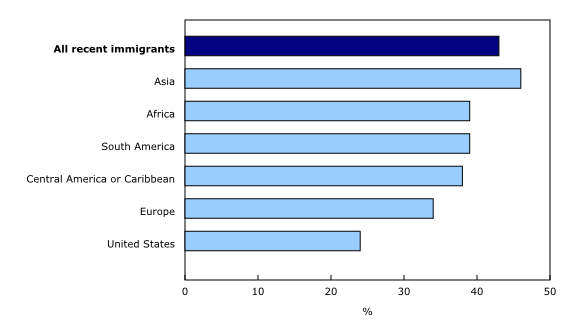
Recent immigrants (defined in this release as those admitted in 2005 or after) often face unique economic challenges in adapting to a new country and were more likely to report having greater difficulty in making ends meet. Specifically, in April 2024, a larger proportion of recent immigrants (43%) reported finding it difficult or very difficult to meet their financial needs over the past 12 months, compared with more established immigrants (29%) and non-immigrants (29%). Similarly, non-permanent residents were more likely to report finding it difficult or very difficult to make ends meet (37%) than non-immigrants.
Not all immigrants share the same economic experiences when arriving in Canada. In April 2024, while newcomers from the United States (24%) and Europe (34%) were the least likely to report experiencing financial difficulty in the past 12 months, newcomers from other regions were more likely to experience hardship during this transition. In general, newcomers arriving from Asia (46%) reported having the highest level of difficulty making ends meet. Some of these differences may be related to category of admission, which was not considered in this study.
Chart 1
Percentage of recent immigrants (arriving since 2005) who reported having difficulty meeting financial needs over the past 12 months, by region or country of birth, Canada, April 2024
Racialized Canadians, especially racialized immigrants, are more likely to report experiencing financial difficulty
Previous studies have shown that racialized Canadians may face greater economic uncertainty and, therefore, may have a more difficult time meeting their financial needs than non-racialized Canadians. In April 2024, West Asian (48%), South Asian (43%), Latin American (42%), Black (40%), Arab (38%) and Filipino (35%) Canadians were more likely to report having difficulty meeting their financial needs in the past 12 months than the non-racialized, non-Indigenous population (28%). In contrast, Chinese Canadians (22%) were the least likely to report experiencing financial difficulty in the past 12 months.
Most of these observed differences are related to also being an immigrant. In April 2024, most Canadian-born racialized people reported having a similar experience as Canadian-born non-racialized people in Canada. For example, 28% of South Asian people born in Canada reported having difficulty making ends meet, the same proportion as the non-racialized, non-Indigenous population. However, nearly half (47%) of South Asian immigrants reported having difficulty making ends meet in the past 12 months. These results highlight the importance of understanding financial difficulty through a lens of intersectional identities, including experiences of immigration.
Recent immigrants are less likely to report having satisfaction with their amount of free time
Economic challenges may lead to work-life balance conflicts, if workers need to work more hours, and potentially reduced satisfaction with the amount of free time available. As of spring 2024, 40% of Canadians who did not report having difficulty making ends meet also reported having a high level of satisfaction with their amount of free time. However, 12% of people who experienced difficulty making ends meet in the past 12 months reported having a similar level of satisfaction.
In April 2024, more recent immigrants to Canada reported having lower satisfaction with their amount of free time than immigrants who had arrived earlier and non-immigrants. In fact, 23% of recent immigrants said that that they had a high level of satisfaction with their amount of free time, compared with 33% of more established immigrants and 32% of non-immigrants. About 27% of non-permanent residents reported having high satisfaction with their amount of free time.
Not all newcomer groups experienced similar levels of satisfaction with their amount of free time. For instance, in April 2024, newcomers from Asia were the most likely to report having financial difficulty and were one of the least likely to report having satisfaction with their free time (22%). In contrast, despite being the least likely to report experiencing financial difficulty, recent immigrants from Europe were among the least likely to report having a high level of satisfaction with their free time, at 20%.
Further, in April 2024, recent immigrants from the United States (32%) were as likely to report having high satisfaction with their amount of free time as non-immigrants. These results indicate that satisfaction with amount of free time may depend on many other factors that were not measured by this study, including work-life balance, cultural perception of free time, family structure and supports, and personal outlook.

 Multicultural Meanderings