Immigrants Feel As Canadian As The Rest Of Us | Jack Jedwab

Jack Jedwab reviews some of the attachment findings of the General Social Survey, contrasting Canadian and foreign-born, along with the particularities of Quebec. Identity is more multifaceted than binary:

Critics of multiculturalism outside of Quebec believe that this undocumented lack of newcomer attachment — however defined — is an integration problem. If attachment to Canada is used as integration criteria, for some Quebec observers the newcomers in the province will appear too well integrated!

But contrary to what some Quebecers assume, those immigrants in the province that possess the strongest degree of attachment to Canada also exhibit a strong sense of attachment to Quebec. It might be said they feel at home in the province and the country, and refuse to see a contradiction in this regard.

You don’t have to live somewhere for a particularly long period of time to appreciate your home. Independent of how long you’ve lived somewhere it may feel as though you’ve always belonged there. Certain immigrants are especially grateful for the opportunity to reside in Canada and this can act as a catalyst for a relatively instant feeling of attachment to the country.

It’s quite possible that the strong initial connection to a place can diminish over time if an immigrant’s expectations are not met. But the same feeling about the country can apply to someone born here across their life cycle.

The 2013 General Social Survey confirms that there is no difference in the level of attachment to Canada between Canadians aged 15 to 24, whether they are domestic (rooted) or foreign-born (less rooted). Surveys repeatedly reveal that the youngest Canadians have the lowest sense of attachment to Canada, but this grows on many of us as we get older. In sum, it is one’s age and not immigrant status that is perhaps the most important predictor of the sense of attachment to country.

Source: Immigrants Feel As Canadian As The Rest Of Us | Jack Jedwab

Study: When It Comes To Identifying As Multiracial, Gender Matters

Interesting large-scale US study on how people present their ethnic identity:

In families where biological parents are of different races and ethnicities, daughters are more likely to self-identify as “multiracial” than sons, according to a new study in the February issue of the American Sociological Review. This is especially true in families with one black parent and one white parent.

“It would seem that, for biracial women, looking racially ambiguous is tied to racial stereotypes surrounding femininity and beauty,” said Lauren Davenport, assistant professor at Stanford University and author of the study. She suggests it may be easier for women to identify with multiple racial groups because they are “cast as a mysterious, intriguing ‘racial other'” as opposed to men, who are more likely to be seen as a “person of color.”

Davenport’s study was based on a sample of more than 37,000 incoming college freshmen across the county who fit into one of three mixed backgrounds — Asian-white, black-white, and Latino-white. Using data from 2001 to 2003, Davenport looked at how these individuals chose to identify themselves.

She found that a higher percentage of women than men self-labeled as multiracial across all three groups. Among black-whites, 76 percent of women identified as multiracial, compared to 64 percent of men in that group. Fifty-six percent of Asian-white women classified as multiracial, as opposed to 50 percent of Asian-white men. And 40 percent of Latino-white women self-labeled as multiracial in comparison to 32 percent of those men.

In addition to gender, Davenport looked at how religion and class affect the way people identify. Multiracial people who don’t have strong religious ties were more likely to identify as multiracial, as well as those from highly affluent neighborhoods.

Overall, those with black and white parents were the most likely to identify as multiracial, and the least likely to describe themselves as white only. Seventy-one percent of black-white study participants identified as multiracial, while only 54 percent of Asian-white and 37 percent of Latino-white participants opted for the same label.

In the paper, Davenport attributed this tendency among people with black and white parents to the “one-drop rule,” more formally known as hypodescent, which structured how part-black individuals were once legally and socially identified in the United States:

Because people in this group have so strongly been expected to identify as black, they are choosing to assert a new identity, one that incorporates both their black and white heritages. It is also likely that, for some, a multiracial label reflects a desire to socially distance and distinguish oneself from blacks.

Davenport says understanding the way people identity themselves racially is crucial for its political consequences. Not only does self-identification shape the American racial landscape, but it also impacts the enforcement of laws, implementation of affirmative action, and allocation of political resources.

But studying multiracial identity can be tricky. The Pew Research Center spent a lot of time last year researching the mixed population of America. Not only did they find that many mixed-race Americans changed how they viewed their racial identity over the course of their lifetimes, but also that self-identification was highly dependent on situational circumstances, others’ perceptions, and personal upbringing.

So does this mean we’ll all start to subconsciously assume that all wealthy biracial women with zero religious affiliations are mixed? Probably not. But if the projection that one in five Americans will be of mixed race by 2050 bears out, we’re going to need to keep understanding how people relate to being multiracial.

Source: Study: When It Comes To Identifying As Multiracial, Gender Matters : Code Switch : NPR

Immigrants more likely to consider Canadian symbols important to national identity

SC - GSS Immigrant Native Comparisons.001

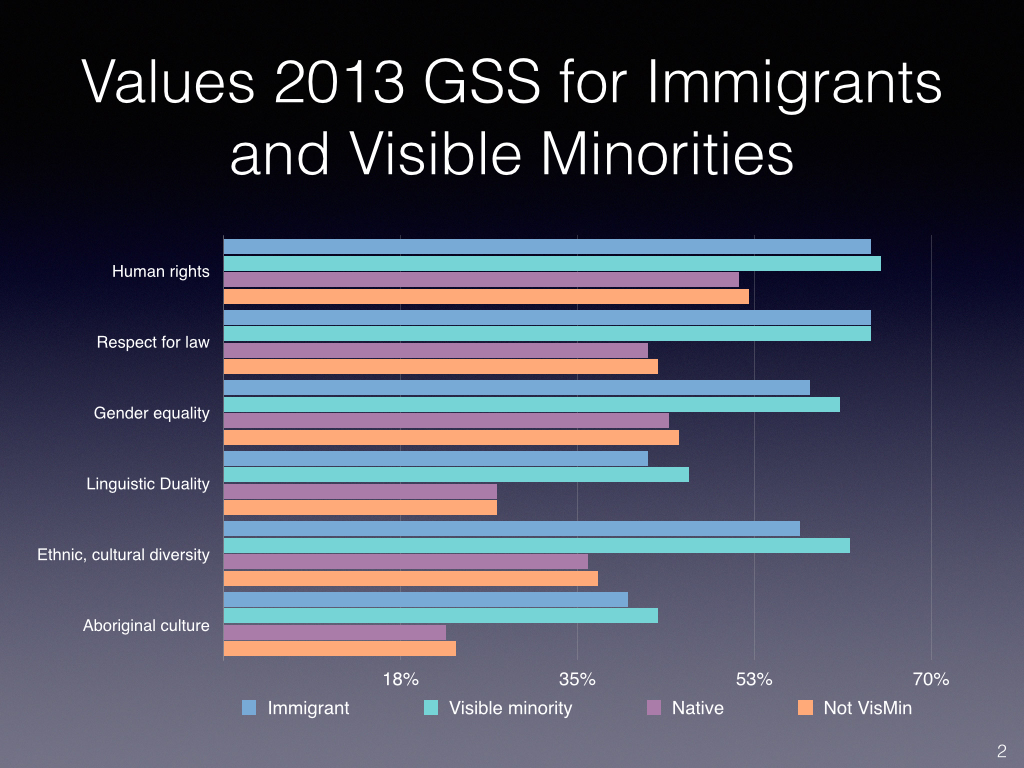
SC - GSS Immigrant Native Comparisons.002Interesting findings from the General Social Survey. For the charts, I have focussed on the contrast between immigrants (first generation) and the native-born and visible minorities (multiple generations but the vast majority first generation) and non-visible minorities.

The key takeaway, and no significant change from earlier surveys, is that for the most part, visible minorities and immigrants have higher level of attachment to Canada than the native-born (in early briefings to Minister Kenney, this type of evidence was cited to indicate that there was no need for major changes to the citizenship program:

The vast majority of Canadians think symbols like the flag and the national anthem are important to Canada’s identity, an expansive survey of opinions by Canada’s national data agency suggests.

More than nine in 10 Canadians surveyed by Statistics Canada said symbols like the Charter of Rights and Freedoms and the flag were important symbols of national identity. Other iconic notions such as the national anthem, the Mounties and hockey were also cited by more than three-quarters of Canadians polled in the agency’s General Social Survey, which asked 27,695 Canadians from all provinces and territories for their views on Canada’s national identity in 2013.

The vast majority of respondents said they believed that Canadians shared specific values. Exactly what those values are, however, is a subject of some debate.

Human rights a major factor

The thing most often cited by those who think Canadians share specific values was the value of human rights, at 92 per cent of respondents. Respect for aboriginal culture (68 per cent) and linguistic duality (73 per cent) also came up a lot.

By and large, immigrants and minority groups were more likely to believe national symbols are very important to Canada’s national identity.

This picture sent out last year by a B.C. RCMP detachment was deemed to be one of the most iconically Canadian images in recent memory. (Royal Canadian Mounted Police)

That gap was especially pronounced when it comes to valuing the importance of the national anthem. When asked about the importance of O Canada, 75 per cent of immigrants viewed it as very important, compared to 61 per cent of non-immigrants.

And all national symbols were viewed as more important by visible minorities than by Canadians at large. The gap was largest in terms of the significance of the charter (82 per cent versus 68 per cent), while the smallest differences were evident for the RCMP (59 per cent versus 54 per cent) and hockey (52 per cent and 45 per cent).

The great frozen game

On the subject of hockey, there’s a gap in how important our national sport is perceived to be between men and women. Half of all men said hockey was important to Canada’s national identity. Only 42 per cent of women said the same.

There was also a gender gap with regards to the belief of whether Canadians even share specific values — never mind what those values may be.

Some 41 per cent of women believed to a great extent that Canadians valued equality between men and women, compared to 53 per cent of men. That gap existed across all age groups, although it was most pronounced among people under 25, where 46 per cent of women said so, but 63 per cent of men did.

Among those over the age of 75, 31 per cent of women said so, compared with 46 per cent of men.

National pride

By and large, Canadians are on the whole proud of Canada’s national identity. That statement is especially true of immigrants, as they “reported a greater feeling of pride in being Canadian and in Canadian achievements,” the data agency said.

There were some geographic differences, however, with people from Quebec feeling generally less proud of Canada’s national identity. Within Quebec, residents of Saguenay had the lowest level of pride in the province, with 52 per cent saying they were either proud or very proud to be Canadian, while residents of Gatineau had the highest levels of pride in Quebec at 76 per cent.

Source: Immigrants more likely to consider Canadian symbols important to national identity – Business – CBC News

How Canadians celebrate their identity — it’s all in the hyphen

On hyphenated identity (or, to use Lawrence Hill’s words, “who among us is not mixed up”):

John Diefenbaker, perhaps the first Canadian public figure to talk extensively about punctuation, was also passionately opposed to hyphenation.

He saw it not as a sign of disloyalty, like Wilson did, but as a manifestation of prejudice: memories of anti-German taunts during and shortly after the First World War launched the Tory prime minister on what he later called a “lifelong attack on hyphenated Canadianism.”

Diefenbaker thought two-part labels were a way of diminishing a group’s membership in the national community. To be “Ukrainian-Canadian” suggested you were less than a full citizen, in his view.

Not everyone shared this interpretation. As Peter C. Newman wrote in The Distemper of Our Times, his political history of Canada in the mid-’60s, many French-Canadians were happy with their hyphens. They saw Diefenbaker’s “One Canada” crusade as a veiled call for assimilation.

As the decade wore on, this celebration of difference spread. Hyphenation, with its way of patching together disparate things, increasingly came to be seen as an orthographic representation of the multicultural Canadian mosaic.

But the hyphen’s hold has been slippery. In the past 15 years, some academics have taken up a renewed critique of the symbol — they call it reductive, even alienating. Minelle Mahtani, a professor of human geography at the University of Toronto Scarborough, says that many of the mixed-race women she spoke to for a 2002 paper rejected hybrid identifiers like “Somali-Canadian.”

“These hyphens of multiculturalism, in effect, operate to produce spaces of distance, in which ethnicity is positioned outside Canadianness,” Mahtani wrote.

Still, for many, the hyphen remains a vital and flexible tool for representing themselves to the world.

In a recent essay for the website The Archipelago, the self-described “first-generation Canadian-Indian-Italian-American” journalist Manisha Aggarwal-Schifellite called herself “a walking hyphen.”

There is a growing crop of Canadians punctuating their identities in novel, personal ways. By 2021, at the current rate of growth, a majority of the country’s population will shade in more than one box when they’re asked about ethnicity, according to a report by the Association for Canadian Studies.

Canada’s future is likely to be hyphenated. That means more bridges, more boundary posts, more magic carpets. For better or worse, it means more knots.

via How Canadians celebrate their identity — it’s all in the hyphen | Toronto Star.

ICYMI: Salman Rushdie on Kazuo Ishiguro: His legendary novel The Remains of the Day resurges – The Globe and Mail

For fans of Salman Rushdie and Kazuo Ishiguro and depictions of the English aristocracy and butlers, Rushdie’s re-review of The Remains of the Day worth a read, along with the reflection of how a great writer can write beyond his context and identity:

With The Remains of the Day, Ishiguro turned away from the Japanese settings of his first two novels and revealed that his sensibility was not rooted in any one place, but capable of travel and metamorphosis. “By the time I started The Remains of the Day,” he told the Paris Review, “I realized that the essence of what I wanted to write was movable … For me, the essence doesn’t lie in the setting.” Where, then, might that essence lie? “Without psychoanalyzing myself, I can’t say why. You should never believe an author if he tells you why he has certain recurring themes.”

Salman Rushdie on Kazuo Ishiguro: His legendary novel The Remains of the Day resurges – The Globe and Mail.

A Conversation with Benjamin Zephaniah on Britishness

Sadia Habib’s interview with British writer, poet and professor with some interesting thoughts on identity, multiculturalism and the role of government, starting with on teaching Britishness:

I don’t like the idea. You can teach things about Britain, and that should be just a general part of education, but to teach British-ness… Now some people say a great symbol of Britishness is the Queen. I don’t. I think a great symbol of Britishness is all the people who have fought against monarchy… the Levellers… the people who fought for freedom… the suffragettes. That’s the tradition that fascinates me. I don’t say to the other people that your one is less important, if that is what you want to do, then let me do my one as well. So what version of Britishness are you teaching?

If you are going to teach it, you have to pick a version of Britishness.If you are the government, and you are telling people how to teach it in schools, you are going to teach one that suits the status quo. As part of your Britishness, are you going to teach about the British people that went to Amritsar and massacred innocent people? I guess most likely not. Are you going to romanticise that? Are your going to teach the real details of slavery? I know you may mention it, but as part of Britishness, as part of where we got where we got today?

Liverpool is part of Britain. Why are certain roads in Liverpool named after slave-drivers or slave-masters? Why have we got banks in this country that were started off during the slave trade and are a part of the great British establishment? Are you going to teach that? I think not. In their version of Britishness, they are probably going to teach that great comedy comes out of Liverpool, and there are banks, maybe on now and then they get it wrong, but on the whole they are alright as they will give you a mortgage eventually! They are going to teach a very sanitized version of the British institutions. So I don’t think you can teach Britishness. And all this stuff where foreigners are expected to swear allegiance to the Queen and all, I think it is bullshit! Sorry for using such words!

Some people are against state multiculturalism. I am as well, oddly enough, because the kind of multiculturalism I am talking about happens organically. I look at my band of musicians: I’ve got an Indian girl on percussion, I’ve got a Chinese guy in guitar, Jamaican, an African, and two English people. I just went out and looked for the best talent. That’s what I got. I remember the first time I met the Chinese guy, and I said to him play a lead piece for me, and he played the guitar, and it sounded kind of Chinese-y. And it was a lead. I said: “God! That’s really good!” One of the other people said: “Oh no, you are getting the tones wrong.” And I said “No, he’s getting them right. That’s working.” That’s what makes our music interesting. That’s what makes our culture interesting. That’s what makes our food interesting. So the kind of multiculturalism I am interested in is the one that happens organically, happens naturally.

A Conversation with Benjamin Zephaniah on Britishness The Sociological Imagination.

Moderate Islam meets Auschwitz | +972 Magazine

Interesting piece on Mohammed Dajani Daoudi, a Palestinian academic who came under considerable controversy for his taking a group of Palestinian students to Auschwitz and whose partnership with Ben Gurion University includes exposing Israeli students to the nakba or catastrophe.

His thoughts on the narratives and identity are pertinent and interesting:

Among Palestinians, his advocacy of Holocaust education for Palestinians is deeply fraught. It is pointless to dismiss this as stalwart Arab anti-Semitism. Jews and Jewish Israelis, too, are almost totally incapable of considering the Palestinian Nakba, because they fear it is primarily a justification for right of return. Similarly, Palestinians encounter the Holocaust first and foremost as the justification for their modern-day oppression – and only secondarily as a matter of history and human suffering….

Indeed, between the evolving bear-hug of Israel-conservative circles and the anger he is causing among many Palestinians, his influence is unpredictable. Dajani’s language has a naivete that is out of fashion in the post-second Intifada, post nth negotiation-breakdown environment: he talks of building bridges instead of walls, and praises the Oslo accords as a psychological breakthrough. He blithely supports two states, because both societies need national and identity realization, he says, as if realities on the ground have not changed over the last 20 years.

Moderate Islam meets Auschwitz | +972 Magazine.

Misunderstanding Canadian Multiculturalism : Joseph Heath

While I would characterize some of the issues differently, a good overview piece on Canadian multiculturalism and Quebec by Joseph Heath of UofT.

The defining debate for the Canadian policy was triggered in 1990, when a Sikh officer in the Royal Canadian Mounted Police (RCMP) requested a modification of the official uniform so that he could wear a turban instead of the traditional Stetson hat. While this created an enormous backlash in English Canada, observers were quick to point out the good news – to wit, that Sikhs in Canada wanted to join the national police force. The accommodation that was being requested – which the multiculturalism policy was broadly understood to license – was quite different from the type of accommodations requested by many Aboriginal groups, or indeed by the province of Quebec, which wanted to opt out of the RCMP entirely and create its own police force.

This revealed an important ambiguity in the concept ‘reasonable accommodation.’ The kinds of accommodations requested by national minority groups, such as French Canadians and Aboriginals, were aimed at changing things so that they would not be required to integrate into majority institutions – that is, so that they could instead create their own, parallel set of institutions. The demand for modification of the RCMP uniform, however, was a sign of an immigrant group wanting very much to participate in majority institutions, and requesting a change in the dominant practices in order to remove a barrier – conscious or inadvertent – to its full integration. The fact that such demands were being made was a sign that the multiculturalism policy was in fact working.

I think he misses some of the nuances between interculturalisme and multiculturalism but is correct that the similarities outweigh the differences (see Table 9: Diversity Paradigms,  Table 10: Multiculturalism/ Interculturalisme Comparison).

Misunderstanding Canadian Multiculturalism : Global Brief.

And some interesting commentary by Heath on a debate between Will Kymlicka and David Miller, on national vs subnational identities:

It is not the case that by adopting a national identity organized around the federal government, immigrants are simply buying into the national-building project of English Canadians. Walking around a major city like Toronto one could get that impression, but that is precisely because there are so many immigrants in those cities. Many older English Canadians are profoundly uncomfortable with the federal project, as witnessed by the fact that the current federal government – which rules, I should note, with essentially no support in Quebec – is very actively trying to undermine it. Thus there is, in Canada, a distinct national identity, at the federal level, which cannot simply be identified with the national identity of either English or French (or, obviously, Aboriginal) national groups. And so to the extent that immigrants gravitate toward that identity, they are not necessarily “picking sides” in the age-old disputes between Canada’s founding peoples.

More thoughts on Kymlika

Blood by Lawrence Hill

I finally got around to reading Blood: The Stuff of Life by Lawrence Hill (author of The Book of Negroes among other books). An incredible read, both in terms of the science and history of the science of blood (and as someone with blood cancer, I thought I knew this stuff!), and how blood plays into our language, culture and identity. Fascinating just how much a drop of blood could determine whether you were deemed white or black (and the range of terms used to describe mixed parentage (e.g., quadroon, octoroon). But the most powerful is his discussion on identity, as per this wonderful excerpt:

If we were not so wedded to the arcane notions of blood, we would be freer to celebrate our various, complex and divergent identities relating to family and notions of talent and ability, citizenship and race. We would be more whole, self-accepting people, and less judgmental of others. In this day and age, who among us is not all mixed up?

…. Let’s drop the idea of what you are not allowed to be, or to do, because of who you are, but encourage each other to look for the good in our blood, and in our ancestry. We should let hatred and divisiveness spill from us as if it were bad blood, and search for more genuine and caring ways to imagine human identity and human relations.

Lawrence Hill on the power of blood – Life – Macleans.ca.