British Family Detained By ICE After Unlawfully Entering U.S. From Canada

Bureaucratic ineptitude and cruelty, that may help some understand what those caught on the Southern border are facing:

A British couple and their 3-month-old son are being detained in a federal immigration facility in Pennsylvania after they say they accidentally strayed across the U.S.-Canada border.

U.S. Customs and Border Protection agents arrested the family for unlawfully entering the country while on vacation in British Columbia. The family said that while driving, they swerved down an unmarked road to avoid an animal.

“This is how the scariest experience of our entire lives started,” wrote Eileen Connors, 24, in a sworn statement shared by immigration attorneys with Aldea — The People’s Justice Center, a pro bono legal clinic in Reading, Pa.

The Connors family was taken into federal immigration custody in Washington state on Oct. 3 and slept on what they describe as “a dirty floor” in a border patrol station. Connors said the family was asked about family members in the United States they could be released to, but instead of being freed they were transferred to the Berks Family Residential Center, outside Reading, on Oct. 5.

There, they say treatment worsened. Connors said that the Berks County-run facility was not equipped to care for such a young child and that normal caretaking items — such as a container of formula and teething powder — have been confiscated. At one point, her baby had no clothes while staff washed the clothes he arrived with.

“This facility is frigid,” said Connors. “The staff here first told us they cannot turn on the heat in the building until the end of next month,” even though temperatures are in the 50s at night.

As a result, her son’s health is suffering, she says.

A few days ago, “[he] woke up with his left eye swollen and teary … also his skin is rough and blotchy,” Connor wrote.

In an echo of events at the U.S. southern border, where parents were separated from their children through a “zero tolerance” policy, the family wrote that in response to complaints about conditions, an ICE employee offered to remove their baby.

“If we wanted, we could sign papers to allow him to be separated from us and taken to some other facility,” Connors said. “We were shocked and disgusted.”

Few safeguards

An ICE spokesman confirmed that the family is in custody at the Berks Family Residential Center but denied any mistreatment.

“BFRC provides a safe and humane environment for families as they go through the immigration process. BFRC supports all sanctioned local, state, and federal investigations into the safety and welfare of our residents,” he said in a statement, adding that reports of abuse or inhumane conditions “are unequivocally false.”

In addition to the couple and their son, the Connorses’ extended family, which includes two other young children, was also taken into custody.

As British citizens, the family was entitled to visit the U.S. without a visa.

“They could just come to the United States with a passport,” said attorney Bridget Cambria, who worked on the civil rights complaint that has been filed on behalf of the family with the Department of Homeland Security. “The reason it sounds silly is because it is silly.”

Instead, Eileen and her husband, David, 30, are locked into an immigration process with few safeguards. People in federal immigration custody are not entitled to legal counsel and even the wrongful arrest of U.S. citizens can take weeks to sort out, as they struggle to prove their identities while in detention.

Other foreign tourists have also found themselves in dire straights. Last June, a French citizen visiting her mother in British Columbia was arrested by U.S. Customs and Border Patrol after jogging on the beach near the border of Vancouver and Blaine, Wash. She was held in federal immigration detention for two weeks.

Unlawful border crossings in the north are also on the rise, with 4,316 people apprehended at the Canadian border in 2018, up from 3,027 the previous year.

CBP has not yet responded to questions about why the Connors family was taken into custody.

Attorneys familiar with the case say they hope the family will be released later in the week, based on communication with the British Embassy.

In her statement, Connors said conditions at the facility slowly improved after she was able to speak to someone from the British Embassy on Oct. 8. Still, she wrote that the experience will haunt them.

“We have been treated like criminals here, stripped of our rights, and lied to,” she said. “We will be traumatized for the rest of our lives.”

Source: British Family Detained By ICE After Unlawfully Entering U.S. From Canada

USA: Federal judge’s ruling upends how ICE targets people for being in the country illegally

Hard to follow all the restrictive changes in US immigration and related policies and the various court challenges and their impact, so found this summary helpful:

In a third defeat in less than a day for the Trump administration, a federal judge blocked it from vastly extending the authority of immigration officers to deport people without first allowing them to appear before judges.

The decision late Friday came before the policy, which was announced in July, was even enforced. The move would have applied to anyone in the country less than two years.

For the record:
1:31 PM, Sep. 28, 2019 An earlier version of this article misspelled U.S. District Judge Andre Birotte Jr.’s last name as Birrote.

The decision came just after a federal judge barred Immigration and Customs Enforcement from relying solely on flawed databases to target people for being in the country illegally.

Early Friday, the administration suffered what would be its first defeat on the immigrant front in less than 24 hours when a federal judge blocked its plan to dismantle protections for immigrant youths and indefinitely hold families with children in detention.

Those protections are granted under the so-called Flores agreement, which was the result of a landmark class-action court settlement in 1997 that said the government must generally release children as quickly as possible and cannot detain them longer than 20 days, whether they have traveled to the U.S. alone or with family members.

In a statement Saturday, the White House responded angrily to the decision to halt its plans for expedited removal of immigrants.

“Once again, a single district judge has suspended application of Federal law nationwide — removing whole classes of illegal aliens from legal accountability,” the statement read in part. “For two and a half years, the Trump Administration has been trying to restore enforcement of the immigration laws passed by Congress. And for two and a half years, misguided lower court decisions have been preventing those laws from ever being enforced — at immense cost to the whole country.”

The American Civil Liberties Union, which had sought the injunction granted just before midnight celebrated the result.

“The court rejected the Trump administration’s illegal attempt to remove hundreds of thousands of people from the U.S. without any legal recourse,” said ACLU attorney Anand Balakrishnan, who argued the case. “This ruling recognizes the irreparable harm of this policy.”

In the first setback Friday for the Trump administration, U.S. District Judge Dolly Gee said new rules it planned to impose violated the terms of the Flores settlement. Gee issued a strongly worded order shortly after, slamming the changes as “Kafkaesque” and protecting the original conditions of the agreement.

Gee wrote that the administration cannot ignore the terms of the settlement — which, she pointed out, is a final, binding judgment that was never appealed — just because leaders don’t “agree with its approach as a matter of policy.”

Barring a change in the law through Congressional action, she said, “Defendants cannot simply impose their will by promulgating regulations that abrogate the consent decree’s most basic tenets. That violates the rule of law. And that this court cannot permit.”

The new regulations would have eliminated minors’ entitlement to bond hearings and the requirement that facilities holding children be licensed by states. They also would have removed legally binding language, changing the word “shall” to “may” throughout many of the core passages describing how the government would treat immigrant children.

The government is expected to appeal.

In the second decision Friday, U.S. District Judge Andre Birotte Jr. issued a permanent injunction barring ICE from relying solely on databases when issuing so-called detainers, which are requests made to police agencies to keep people who have been arrested in custody for up two days beyond the time they would otherwise be held.

ICE is also blocked from issuing detainers to state and local law enforcement in states where there isn’t an explicit statute authorizing civil immigration arrests on detainers, according to the judge’s decision.

The decision affects any detainers issued by an ICE officer in the federal court system’s Central District of California.

That designation is significant because the Pacific Enforcement Response Center, a facility in Orange County, is an ICE hub from which agents send out detainer requests to authorities in 43 states, Guam and Washington, D.C. It is covered by the Central District.

“ICE is currently reviewing the ruling and considering our legal options,” Richard Rocha, an agency spokesman, said in a statement. “Cooperation between ICE and local law enforcement agencies is critical to prevent criminal aliens from being released into our communities after being arrested for a crime.”

Tens of thousands of the requests are made each year to allow ICE agents additional time to take people suspected of being in the country illegally into federal custody for possible deportation. Approximately 70% of the arrests ICE makes happen after the agency is notified about someone being released from local jails or state prisons.

In fiscal year 2019, ICE has lodged more than 160,000 detainers with local law enforcement agencies, according to the agency.

Although police in California do not honor these ICE requests because of earlier court rulings that found them unconstitutional, agencies in other parts of the country continue to enforce them.

The civil case, which has wound its way through years of delays and legal wrangling, has broad implications for President Trump’s crackdown on illegal immigration as the ACLU and other groups sought to upend how immigration officers target people for being in the country illegally.

“I think the decision is a tremendous blow to ICE’s Secure Communities deportation program and to Trump’s effort to use police throughout the country to further his deportation programs,” said Jessica Bansal, senior staff attorney with the ACLU of Southern California.

The class-action lawsuit, which represents broad categories of people who have been or will be subjected to detainers, alleged the databases that agents consult are so badly flawed by incomplete and inaccurate information that ICE officers should not be allowed to rely on them as the sole basis for keeping someone in custody.

The judge agreed with that assessment, finding that the databases often contained “incomplete data, significant errors, or were not designed to provide information that would be used to determine a person’s removability.”

These errors, according to the decision, have led to arrests of U.S. citizens and lawfully present noncitizens. From May 2015 to February 2016, of the 12,797 detainers issued in that time frame, 771 were lifted, according to ICE data. Of those 771, 42 were lifted because the person was a U.S. citizen.

The detainer process begins when police arrest and fingerprint a person. The prints are sent electronically to the FBI and checked against the prints of millions of immigrants in Homeland Security databases. If there is a match — such as someone who applied for a visa or was apprehended by Border Patrol — it triggers a review process, which often culminates with an agent at the center deciding whether to issue a detainer.

Last year, the Pacific Enforcement Response Center issued 45,253 detainers and alerted agents at field offices to more than 28,000 additional people released from law enforcement custody before ICE could detain them.

Trump has singled out police in California and elsewhere for their refusal to honor detainers, using them to highlight what he says are problems with the country’s stance on immigration enforcement and the need to take a more hard-line approach.

In the years since the lawsuit was filed, ICE has amended its policies, saying the changes made the process for issuing detainers more rigorous.

Source: Federal judge’s ruling upends how ICE targets people for being in the country illegally

More Immigrants Know Their Rights Thanks to Trump’s Threats

Ironic. But rights become more important when under threat:

Over the last month, President Donald Trump’s publicizing of large-scale immigration enforcement operations seemed to have the intended result: wall-to-wall media coverage that indicated he was moving to fulfill his signature campaign promise to deport “millions of illegal aliens” from the United States.

But the threat of massive raids has also had a significant, unintended side effect. For the first time, many undocumented immigrants are finding out that when Immigration and Customs Enforcement come to their door, they have rights.

Immigration attorneys, advocates, and organizers in 10 cities across the country told TIME that the highly public threat of ICE raids, communicated directly from the White House, has gotten out the “Know Your Rights” information and prepared immigrant communities in a way that years of previous outreach had not.

“We are now seeing the ‘Know your Rights’ information really working to save people’s lives and teaching them that they have agency,” said Shannon Camacho, who coordinates a rapid response network for immigrants in Los Angeles.

When more than a dozen ICE agents knocked on the door of a family with two children in her community early in the morning last week, the father remained “calm and confident” because he knew what to do, she said. He refused to open the door unless agents presented a warrant signed by a judge and, speaking through the window, declined to give their names. He had video footage from the security camera, and knew to contact the rapid response network for legal help.

“Fifteen ICE agents, for one family,” said Camacho. “They were shaken up from the experience, but we told them ‘You did everything great, you understood your rights as a person here in the U.S. regardless of whether you’re undocumented or not.’’’

Like all legal and immigrants rights organizations who spoke to TIME, Camacho’s group has seen skyrocketing requests for information and “Know Your Rights” trainings. While these efforts existed long before Trump, his rhetoric and the unprecedented media attention to ICE operations has managed to help it break through in ways it hadn’t before.

Before Trump first threatened the raids in a June 17 tweet, the hotline for the Illinois Coalition for Immigrant and Refugee Rights averaged roughly 40 calls a week. In the past week, that jumped to 250 calls a day, the group told TIME, with people requesting information on what to do if agents come to the door and reporting ICE activity in their communities. The group has also seen a “massive increase” in requests to have “Know Your Rights” trainings and workshops, as well as a flood of volunteers, said spokeswoman Cara Yi.

“There’s been such a spotlight put on this, and our elected officials have come out so strong, it’s going to be very difficult at least in the city of Chicago to reach any massive sweep,” said Lawrence Benito, the group’s executive director. “I mean, the Chicago mayor [Lori Lightfoot] was out in the community passing out our ‘Know Your Rights’ and hotline information.”

A few years ago, it would have been unusual to see government officials distributing information on how to evade immigration enforcement officials. Now it has not only become acceptable but expected for Democratic politicians and presidential candidates to share the “Know Your Rights” information on their platforms. Vermont Sen. Bernie Sanders, California Sen. Kamala Harris, Massachusetts Sen. Elizabeth Warren, New Jersey Sen. Cory Booker, former Texas Congressman Beto O’Rourke and New York Sen. Kirsten Gillibrand all shared the American Civil Liberties Union’s “Know Your Rights” page in recent days. The organization’s thread on Twitter laying out the information in multiple languages reached almost 3 million people.

“There’s definitely an energy that’s different now. People are saying ‘We marched, we’re done marching, and now we need to stand up and do something,’” Benito said.

Organizers across the country told TIME that unlike other inflection points — Trump’s election, the travel ban and the family separation crisis last summer — they are seeing people go beyond protest marches to taking action in the face of imminent ICE sweeps, which are meant to target undocumented families who have been issued final removal orders.

Volunteers ran out of “Know Your Rights” pamphlets as they canvassed homes, supermarkets, restaurants, churches and laundromats handing out fliers and providing on-the-spot preparation. Trainings have been bursting at capacity, forcing some to find larger venues. Immigration attorneys said families that previously would have felt helpless in the face of ICE agents at their door now know that they don’t need to follow their orders if they don’t have a warrant signed by a judge. Many have pasted the bilingual fliers to their door, instructing their children on what to do, organizers said.

News stories about attempted ICE arrests increasingly reflected that — for example the New Jersey teenager who refused to open the door to agents when they knocked at 1 am after having seen a “Know Your Rights” post on Instagram.

“We’re seeing a lot of these (attempts) thwarted because no one was opening the door,” said Thomas Kennedy, the political director of the Florida Immigrant Coalition. “It’s encouraging to see that people are taking these lessons and applying them to protect themselves.”

Unlike in the past, in many of the 10 counties in Florida his group canvassed they found people already seemed well prepared in how to handle ICE raids, he said. Kennedy attributes much of that to the shift in local media coverage of these raids, which are targeting families.

“There’s been a lot of sensationalizing of the issue, which spreads fear and anxiety — I mean four or five years ago the headline would have been straight-up ‘widespread immigration raids target illegal immigrants,’” he said. “But now most local news — in English, Spanish, and Creole — also includes ‘Know Your Rights’ information, not just the fear element.”

Americans who oppose Trump’s immigration actions have also been flooding workshops and training sessions on how to support their immigrant neighbors.

“When the initial tweet came out, we organized a training on 48 hours notice and had 200 people show up — more than double the usual turnout,” said Brandon Wu, an organizer with the D.C.-based group Sanctuary DMV. “People are not just outraged but they’re willing to step up and do what it takes in proactive solidarity.” For his group in the Washington, D.C. area, this includes everything from documenting ICE raids they may witness in their neighborhood to accompanying immigrants to court appointments for moral support.

While the Trump Administration’s public threats do “galvanize allies in a way we find really useful, on the other hand it’s hard to overstate the level of fear it puts in the immigrant community,” Wu said. “They’re saying ‘If I leave my house to go to the grocery store I might never see my kids again.’ But if this is what it takes to galvanize people then that’s what it takes, we’re here now.”

Activists say another side effect of the Trump Administration’s constant publicizing of immigration enforcement is that many Americans are, for the first time, taking a close look at the system.

“We are witnessing a surge of support because I think the virulent anti-immigrant rhetoric of this administration is opening many people’s eyes to the horrors of the US immigration system,” said Andrea Mercado, the executive director of New Florida Majority, a progressive grassroots group. “Many people who weren’t aware of the deportation crisis in our country under previous administrations are now motivated and committed to do something.”

The same “Know Your Rights” information has been around for decades, but the way it has broken to the surface over the last two years – and especially in the last month – is giving some advocates whiplash, they say.

“We were having ‘Know Your Rights” trainings 10 years ago,” Madhuri Grewal, federal immigration policy counsel with the ACLU, told TIME. “So it’s amazing that now, as a result of this new level of interest, the U.S. is in this moment where people are really starting to understand our immigration enforcement.”

While there is no consolidated data from across all of the ACLU’s local offices, the significant surge in interest has clearly helped disseminate information more effectively than ever before, and “undocumented communities are much more aware of their rights,” she said, pointing to social media as a main factor. “Teenagers with access to social media are seeing this and sharing it with their parents.”

Source: More Immigrants Know Their Rights Thanks to Trump’s Threats

Trump Refuses to Release Data on Immigration Crackdown – Bloomberg

Never a good sign when governments use press releases rather than regular data releases but in keeping with the Trump administration’s overall approach:

Five days into his presidency, Donald Trump took aim at illegal immigration with executive orders signaling a new era of heavy enforcement. Not only did he threaten to go after undocumented immigrants, many of whom he labeled violent criminals, he also vowed to crack down on so-called sanctuary cities that thwart the federal government’s attempts to round up people who are in the U.S. illegally. The U.S. Department of Homeland Security promised to put out weekly updates that would include information on localities that release immigration violators and the criminal records of those released.

The first reports were filled with inaccuracies and in several instances called out counties for not cooperating with detainer, or detention, requests that were actually sent to other places with similar names. The U.S. Immigration and Customs Enforcement agency had to issue a list of corrections, and soon it simply stopped putting out the reports. For the past 18 months, ICE has also refused to release other key data about its enforcement activity that had been routinely available.

This disappearing data is at the heart of two lawsuits brought against ICE by the Transactional Records Access Clearinghouse (TRAC), a small research group at Syracuse University. As of January 2017, ICE stopped handing over records it had provided under the Freedom of Information Act for years, including any details about how effective Trump’s crackdown has been. If ICE prevails in court, it could give other agencies a legal rationale to deny public access to the vast cache of government data now kept in electronic databases.

At a time when U.S. authorities are separating children from their parents at the border—and then losing track of them—and the president continues to assert that many immigrants are violent criminals, the lack of basic data on government enforcement has created a fog of uncertainty over an already charged issue. TRAC was founded in 1989 by co-directors Susan Long, a statistician, and David Burnham, an investigative journalist, specifically to cut through this sort of political rhetoric by amassing data on federal policy. It uses FOIA requests to pull in 250 million records from various agencies each month, and its website offers tools to help analyze the data. TRAC had long requested and received information on detainers, as well as deportations aimed at removing undocumented immigrants with criminal records. After ICE abruptly stopped providing the information last year, Long and Burnham sued it in federal court in New York to regain access to the detainer data, and then in the District of Columbia over the missing deportation records.

“We have this huge political debate going on in the country over secure communities and sanctuary cities and all the claims that the government is making about how essential this is, and the very data that would allow you to evaluate the program, they’re withholding,” Long says. ICE argues that many of the records TRAC has asked for don’t exist in the form requested and says producing responses would require searching its database, a process the agency claims amounts to creating new records, which isn’t required under FOIA. ICE didn’t reply to a list of questions and a request for comment.

“If they’re going to court to try to keep information hidden about the detainer policy, they’re probably hiding something,” says Peter Boogaard, a former DHS press secretary in the Obama administration. More broadly, transparency has become a function of political convenience, Boogaard says. “They’re happy to say that immigration is causing huge problems, but at the same point, they are not sharing information.”

It’s still possible to track the overall number of detainers ICE issues—about 14,000 a month on average through November 2017. That’s up from the last months under Obama, but much lower than the peak of close to 28,000 in 2011. Left out are details on whether ICE takes custody—or the criminal records of those targeted. Under Obama, TRAC found that even when local law enforcement held an individual under a detainer, more than half the time ICE agents didn’t show up to take custody—and that few ICE detainers targeted serious criminals. That sort of analysis is now impossible to do. “It’s really frustrating to not be able to get a holistic picture of what’s happening,” says Emily Ryo, an associate professor of law and sociology at the University of Southern California, who’s tried with TRAC to get data on detentions. “It really is an important moment for the public to understand what’s happening and for researchers to be able to document what is going on.”

In place of detailed reports, ICE issues press releases describing raids and arrests, citing criminal records of detainees, and complaining about the lack of cooperation from sanctuary cities. “I don’t want bullet-pointed press releases that say some large numbers of people were apprehended over the weekend and here are five examples of how dangerous these individuals were,” says César Cuauhtémoc García Hernández, an associate professor of law at the University of Denver. “I want to know details about the large number of people. I want percentages. I want actual numbers about what kinds of crimes.”

The data García Hernández has been able to cobble together show a reality at least partly at odds with Trump’s rhetoric. In fiscal 2017, a period that covers the end of the Obama administration and the beginning of the current one, the average daily population held in immigration detention centers rose by 3,730 people, an 11 percent increase from fiscal 2016. The average length of stay has also risen, to 43.7 days, up from fewer than 35 the previous year.

The number of prosecutions for immigration crimes fell by more than 10,000, or 15 percent, over the same period. That’s striking given the emphasis the Trump administration has put on prosecuting undocumented immigrants. It’s an incredibly complex system that’s shifting all the time, making accurate data more important than ever. Data from this year that TRAC got using another FOIA request show a jump in prosecutions of border crossers. And the detention system may be nearing its limit: This month, authorities are transferring 1,600 detainees to federal prisons while they await civil court hearings.

The inaccuracies in ICE’s statements about enforcement actions have caused a furor within the agency in recent months. James Schwab, a spokesman for ICE in San Francisco, resigned in March over misleading statements from agency leaders about an ICE raid in Oakland. The bigger implication is how agencies are allowed to draw the line when it comes to producing electronic records, and the distinction between creating a record and just extracting one from a database, according to Sean Sherman, a lawyer at Public Citizen Litigation Group who’s representing TRAC in Washington. “ICE is saying that by basically searching for these electronic records, that constitutes creating new records,” he says. “That just can’t be right, because that’s basically true of all government records right now.” Meanwhile, ICE is withholding data in many more of TRAC’s FOIA requests. Says Long: “We could file a new suit every week, if we were going to aggressively litigate this.”

via Trump Refuses to Release Data on Immigration Crackdown – Bloomberg

The Effect of Trump’s Immigration Crackdown, In 3 Maps – CityLab

Impressive detailed analysis:

As soon Donald Trump took office, his administration started on his primary promise: A crackdown on undocumented immigrants.

On his command, the Department of Homeland Security (DHS) widened the dragnet—targeting, essentially, anyone without papers, even if they had not committed serious crimes. The emphasis shifted beyond the border region, with federal immigration authorities using workplace and other raids to round up undocumented immigrants. Young people who were previously exempt from deportation through Deferred Action for Childhood Arrivals (DACA) also became vulnerable, after the Trump administration announced the end of the Obama-era program.

So, what has the impact of this aggressive approach been so far? Below are three maps that provide answers. The common theme: Local sanctuary policies that limit cooperation with federal authorities seem to be blunting the force of the administration’s actions. Areas with greater local limitations on federal immigration cooperation have seen, in general, smaller increases in arrests—even if they have large immigrant populations.

The first map comes from a recent Pew Research Center report, which analyzed the change in immigration arrests between 2016 and 2017. It finds that between January 20, when Trump took office, and September 30, when the fiscal year ended, Immigration and Customs Enforcement (ICE) arrests went up by 42 percent compared to the same period in 2016. The total arrests in 2017 were also 30 percent higher than the previous year.

While these numbers represent significant increases from recent years, they are not nearly as high as in 2009, when twice as many people were arrested. That initial high number in Barack Obama’s first year in office declined over the duration of his presidency, after he shifted policy to focus on deporting particular categories of undocumented immigrants. It’s also important to note that while the Trump administration is arresting more people, it has not yet been able to deport them at Obama-era levels because of immigration court backlog.

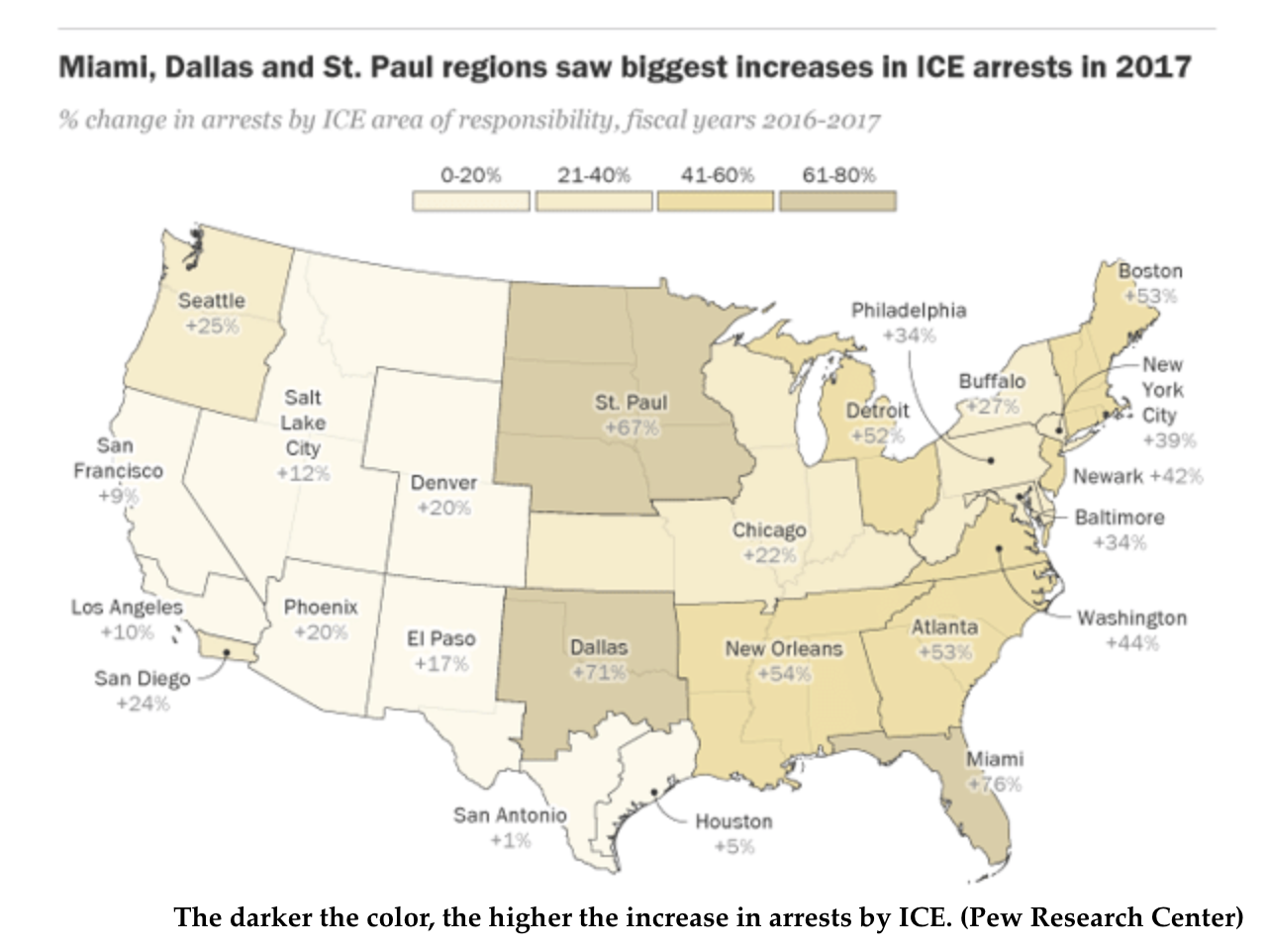
Pew’s report breaks down 2017’s increases in arrests by geography, showing where ICE has been most effective. The agency operates out of field offices in some major cities that cover not just that particular city, but wider “areas of responsibility” that sometimes span multiple states. All of these areas saw increases in arrests in 2017, but the Miami field office, which covers all of Florida, saw the most—a striking 76 percent increase compared to 2016. Dallas and St. Paul were next on the list, with 71 and 61 percent increases, respectively. (Dallas had the highest absolute number of arrests of all field offices.) New Orleans, Atlanta, Boston, and Detroit followed with more than 50 percent increases.

Here’s Pew’s map that colors the areas of responsibility based on the increase in arrests between 2016 and 2017:

The darker the color, the higher the increase in arrests by ICE. (Pew Research Center)

While the concentration of undocumented immigrants certainly drives arrest numbers, it doesn’t completely explain why some areas have had much higher jumps in arrests than others. If it did, immigrant-rich areas near the border, like El Paso and Phoenix, and traditional immigration hubs like New York and Los Angeles, would have all seen much higher increases.

What this map suggests is that local policies matter.

Take Miami, for example. The city renounced its sanctuary city statusafter the Trump administration threatened to withdraw federal funding. (Courts have since blocked that threat.) Attorney General Jeff Sessions praised that decision in a visit last year. Via USA Today:

“We cannot continue giving taxpayer money to cities that actively undermine the safety and efficacy of federal law enforcement efforts,” Sessions said during the appearance at PortMiami. “So to all sanctuary jurisdictions across the country, I say: Miami-Dade is doing it, other cities are doing it, and so can you.”

Miami’s decision to get local law enforcement involved likely helped boost arrests in and around that area, which already has a high concentration of immigrants.

The Atlanta metro area has also seen high increases in 2017 for the same reason. Despite former Mayor Kasim Reed’s defense of sanctuary cities, Georgia state law requires cooperation with ICE—and some of the counties around Atlanta have been quite eager to help. The state also has high penalties for driving without a license, which make it more likely for folks without papers to enter the criminal justice system, and then, the deportation pipeline.There is at least some indication that the Trump administration is trying to have the opposite effect, instead targeting those jurisdictions that have more protective local laws. In September 2017, ICE, focused their raids in localities and cities that have sanctuary policies, saying that the agency was “forced to dedicate more resources to conduct at-large arrests in these communities,” because of these policies. Later, ICE’s director also suggested that the politicians from these cities should face criminal charges for harboring undocumented immigrants. But so far, the effect of that laser focus is unclear—it’s certainly not visible in the aggregate data used for the Pew map.

Local politics have also shifted in the last year, in response to the national immigration agenda. The second and third maps show the current county-level sanctuary policies—and how they have changed since Trump took office. Both come from a new report by the Immigrant Legal Resource Center (ILRC), an immigrants’ rights organization that has been tracking how involved localities have been in immigration enforcement.

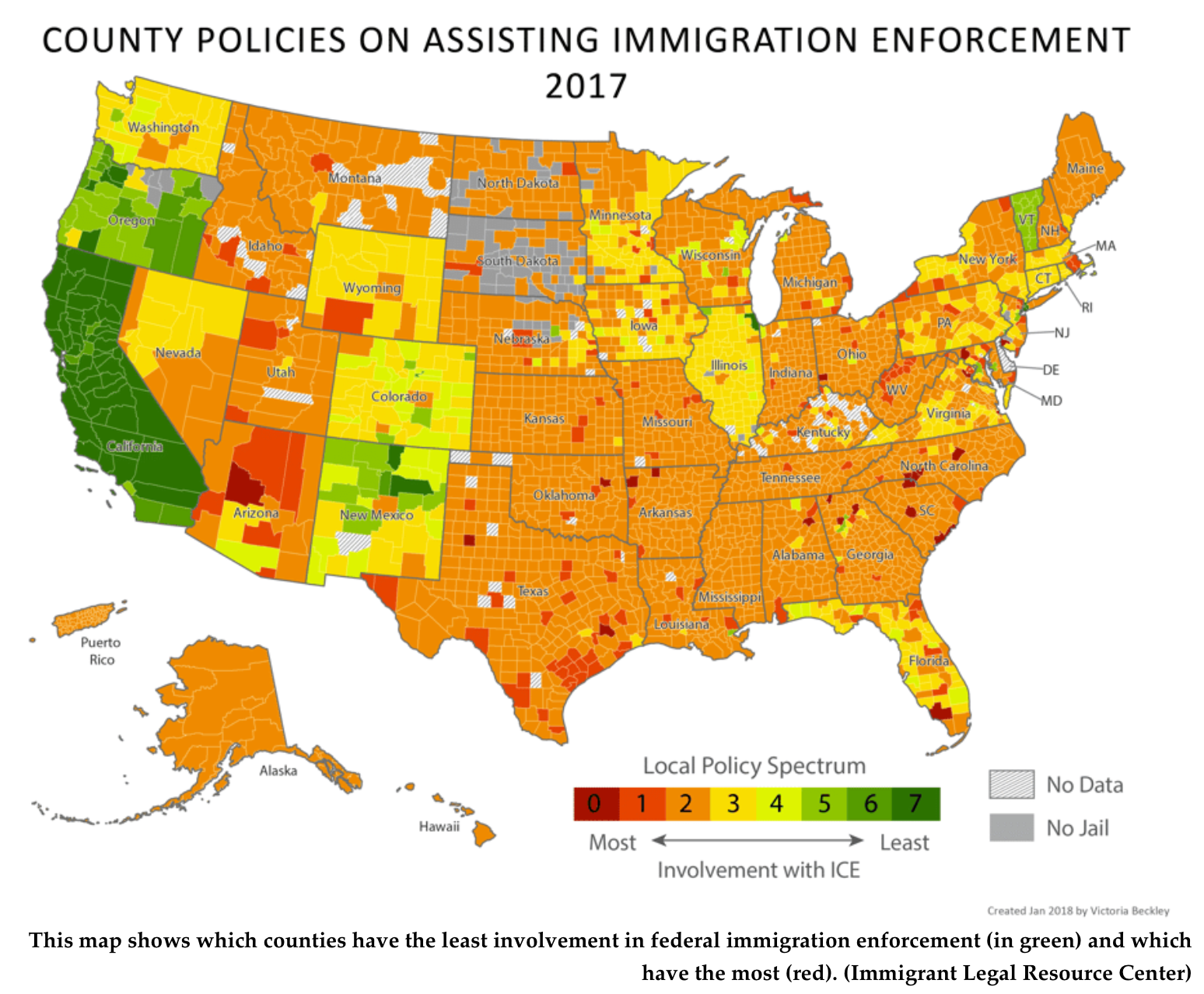
The below map shows the strength of the sanctuary policies in 2017. The places in green are most protective of local immigrant populations—they disentangle policing from federal enforcement. In red are the places that provide the most assistance to federal efforts:
This map shows which counties have the least involvement in federal immigration enforcement (in green) and which have the most (red). (Immigrant Legal Resource Center)
ILRC legal researchers created these rankings based on a seven-point rubric that reflects the spectrum of existing sanctuary policies in 3,000-plus counties. They included policies that limit the use of municipal resources for immigration enforcement, that forbid police from collecting information about immigration status, that ask police to decline ICE’s warrantless requests to detain individuals for extra time, and others. They also looked at whether these localities had agreements with ICE (called 287(g) agreements) to deputize their police officers to do various immigration enforcement duties.ILRC also traced the changes in these policies. And what they noticed was that as the Trump administration doubled down on curbing illegal immigration, some local governments started joining the effort, while others started mounting resistance. According to ILRC’s analysis, 410 localities strengthened sanctuary policies in 2017 (in blue below). Many did so in more than one way. Denver County, Colorado, for example, enacted a law in 2017 that forbids city funds or resources going towards investigation or detention of undocumented immigrants—in the absence of a judicial warrant. It also rules out 287(g) contracts. A quarter of the counties have now put limits on how their police respond to ICE’s “detainer” requests, up from just a handful in 2013. These demands to detain individuals that the federal agency suspects are undocumented for longer than their sentence have been ruled illegal by severalcourts.

Fewer counties went the other way, the report notes (warm colors below). Only around 244 devoted more resources to helping out ICE in 2017. (Note: Local governments with 287(g) agreements have been increasing in the last two years, but in some cases, this move may have been balanced in some other way—by a stop in responding to detainer requests in fear of lawsuits. So counties that entered into new 287(g) agreements on this map below could appear as any color, depending on how weak or strong their original policies were in totality.)

Overall, though, around 74 percent of the counties continue to help ICE out in whatever way it asks, “often without even analyzing whether it is legal to do so,” the report notes.

“There is a great opportunity in 2018 to strengthen and establish new policies that actively protect our immigrant neighbors,” said LenaGraber, staff attorney at the Immigrant Legal Resource Center, in a statement. “And to not spend local resources detaining and deporting our community members.”

via The Effect of Trump’s Immigration Crackdown, In 3 Maps – CityLab

Undocumented Irish Unexpectedly Caught In Trump’s Immigration Dragnet : NPR

Always interesting to see who gets caught when the net is cast so wide. While the Irish man caught is the focus of the story, the overall data is revealing:

The Trump administration has been aggressively deporting foreign nationals home around the globe, from Somalia to Slovakia. Though Mexicans, Central Americans and Haitians make up nine out of 10 people removed from the United States, year-end figures analyzed by NPR show that deportations to the rest of the world have jumped 24 percent.

Some are from formerly “recalcitrant” countries that used to reject U.S. deportees but have now agreed to take them home. These nations include Guinea, Cuba, Bangladesh, Iraq, Vietnam and Afghanistan. Moreover, agents with Immigration and Customs Enforcement, ICE, are arresting more immigrants in the interior of the U.S. who have overstayed their visas.

A case in point — the unauthorized Irish in Boston.

“It’s really indiscriminate. ICE, in their aggressive tactics of detention, are going after the Irish as much as they’re going after any other nationality,” says Ronnie Millar, director of the Irish International Immigrant Center in Boston.

Sitting in the visiting room of the Suffolk County House of Corrections, Dylan O’Riordan, 19, wears a lemon-yellow jail jumpsuit and a bewildered expression on his pale face.

“I was aware how with Trump immigration was going to get a lot harder, but I didn’t pay as much mind to it as I should have, which was my first mistake,” he says.

O’Riordan was born in Galway, Ireland. Both of his parents had lived in Massachusetts before he was born and already had green cards. They brought Dylan from Ireland to the Boston area in 2010 on a visitor’s visa when he was 12 years old. He overstayed his 90-day visa, and began living his life like any other American teenager, though he was unauthorized.

At 19, he had a child with his girlfriend, Brenna, then dropped out of high school and went to work for his uncle’s roofing company. About four months ago, he and Brenna were shopping at a mall when they got into an argument. “It was nothing at all,” he says. “Some woman called the cops, said I was abusing my girlfriend.”

O’Riordan was arrested for domestic assault and battery, but Brenna refused to file charges. The county chose not to prosecute. O’Riordan had no prior criminal record, so the judge let him go.

Immigrants who overstay their visas are at a unique disadvantage compared to immigrants who illegally cross the border. When they apply for their visa, they waive their right to an immigration hearing if they end up staying after their visa expires.

O’Riordan’s lawyer, Tony Marino, points out that his client was brought here when he was a child, but ICE won’t budge.

“Their position has been, well, he waived whatever rights he had when he came,” says Marino. “Twelve year olds don’t waive rights! I’ve never seen anything like it. I can’t wrap my head around it.”

The ICE office in Boston sent a statement to NPR: “Dylan O’Riordan … overstayed the terms of his admission by more than seven years. ICE deportation officers encountered him in Sept 2017 after he was arrested on local criminal charges. ICE served him with an administrative final order of removal.” He is scheduled to be put on a plane to Dublin later this week.

“You look American, you sound American.”

Dylan O’Riordan is not an isolated case. Irish visa overstayers have been swept up in the administration’s nationwide immigration dragnet. Under strict new rules, anyone here illegally is a target — whether they’re convicted of a crime or not. In 2017, ICE deported 34 undocumented Irish, up from 26 the year before. The numbers are tiny compared to the 128,765 Mexicans ejected from the country last year, but in Boston’s closeknit Irish community the wave of arrests is big news.

via Undocumented Irish Unexpectedly Caught In Trump’s Immigration Dragnet : NPR