Why are so many Hungarians deported? A look at Canada’s ‘Unwelcome Index’ 

The Globe continues to impress me with some of its serious evidence-based reporting (e.g., unfounded sexual assault cases by police department) with this being another good example of reporting by obtaining and analyzing data and explaining what it means:

The U.S. government’s determined efforts to restrict immigration and the number of refugees entering the country has invited comparisons with Canada, heralded by some (including The Economist) as a last bastion of openness among Western countries. But Canada has its own apparatus for ejecting the unwelcome; the Canada Border Services Agency is charged with removing people who don’t meet entry requirements.

To understand who Canada deports, and why, The Globe and Mail requested data from CBSA showing total removals by year, broken out by citizenship, the destination to which the person was sent and justifications for these removals. The data shows Canada removed Hungarian citizens in disproportionate numbers over the past few years. The story of those thousands of unwelcome people contrasts with international perceptions of Canada’s warm embrace of foreigners.


The unwelcome

The CBSA ejects thousands of people annually. However, the data doesn’t reveal much about why those people were removed: By far the most common official justification was “non-compliance,” a sweeping category. Fewer than 10 per cent of removals cited criminality, the second most common justification.

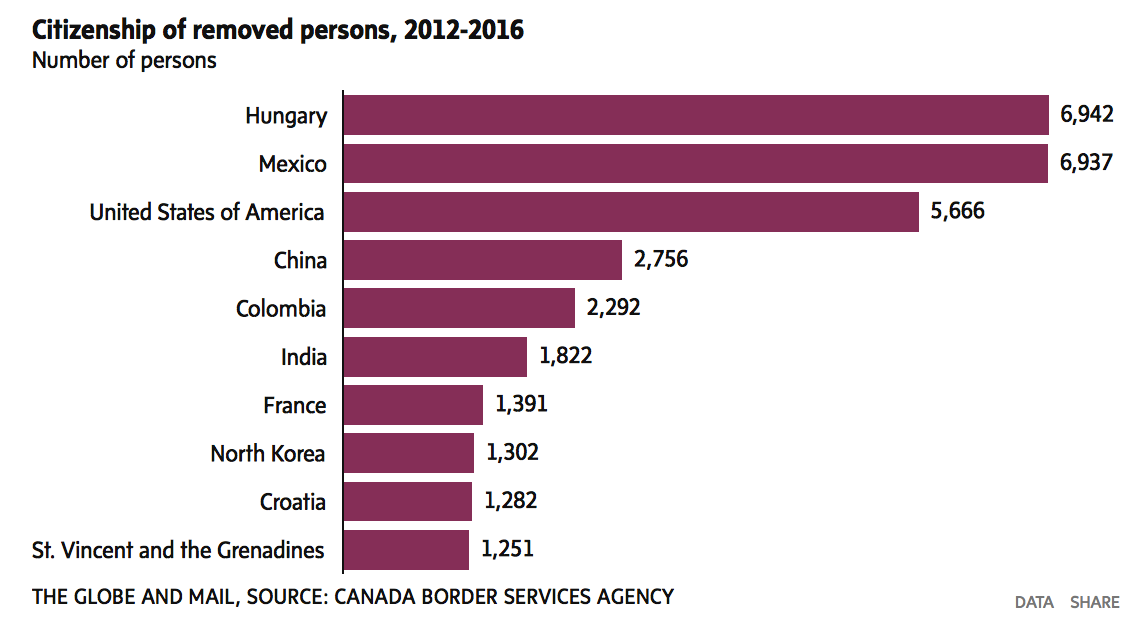
A clearer picture emerges when one examines the citizenship of removed persons: Hungarians topped the removals list during the five-year period from 2012 to 2016.

It is perhaps unsurprising to discover large numbers of Americans and Chinese on the list: Both countries rank among the world’s most populous, and the United States and Canada share the world’s longest border between two countries. Mexico has been a major source of immigrants, and also refugee claimants: The government of prime minister Stephen Harper responded in the late 2000s by imposing new visa requirements on Mexican visitors; removals surged.

Hungary is less populous than those countries, and distant to boot. What gives?

Hungary stands out even more when one compares numbers of removals with numbers of people of the same citizenship accepted as permanent residents. The result is a crude sort of “Unwelcome Index.” Between 2011 and 2015, more than three removal orders were issued for every Hungarian granted permanent-resident status.


Backstory of an exodus

Most Hungarians removed during this period were Roma, explained Sean Rehaag, an associate professor at Osgoode Hall Law School in Toronto who specializes in immigration law. Studying a random sample of 96 decisions of the Immigration and Refugee Board between 2008 and 2012 involving Hungarian claimants, Mr. Rehaag and his colleagues found 85 per cent involved Roma.

Roma comprise Hungary’s largest ethnic minority. There, they encounter “discrimination and exclusion on a regular basis” concerning education, employment, housing, health and much else, according to a 2014 report by Harvard University’s François-Xavier Bagnoud Center for Health and Human Rights. The late 2000s witnessed the rise of right-wing political parties and paramilitaries, accompanied by increasing rhetoric, rallies and attacks directed at Roma. Many Roma sought asylum abroad; thousands arrived in Canada after it lifted visa requirements on Hungarians in 2008.

Gina Csanyi-Robah, a teacher and human-rights activist with Hungarian Roma roots met many applicants in her capacity as executive director of the Roma Community Centre in Toronto, and also at Toronto schools. They fled Hungary because they were “scared that their home was going to be burned down,” Ms. Csanyi-Robah said. “Tired of their children getting beaten up at school and put into segregated classes. Tired of being subjected to verbal, psychological, physical violence when they left their homes.”
 Source: Why are so many Hungarians deported? A look at Canada’s ‘Unwelcome Index’ – The Globe and Mail

Hungary does 180 on migrants amid severe labour shortage

Not completely a 180 given that it is a guest worker rather than immigration approach.

The experience with “guest workers” elsewhere in Europe, particularly Germany, indicates they tend not to return and thus governments are faced with longer-term integration challenges:

Faced with a severe labour shortage, the government is considering plans to invite non-EU “guest workers” to live in the country. “Guest workers” are usually allowed to stay and work in a country for a certain number of years but do not hold citizen rights.

Economics minister Mihaly Varga has supported demands voiced by the country’s Confederation of Employers and Industrialists to allow “hundreds of thousands of migrants from countries outside of the EU” into Hungary, according to Austrian newspaper Die Presse. Estimates predict that the nation will need tens of thousands of migrants to make up for its labour shortage and to prevent negative economic repercussions. However, the draft proposal specifies that the country wants “skilled, culturally integrable guest workers”— most likely implying that Muslims are not welcome.

Experts who know the country believe that the government is trying to avoid a public backlash over trying to attract foreigners by excluding those it considers not “culturally integrable.”

“[T]hey know it will be a hard sell to the Hungarians, given the way the government has staked its legitimacy on being nativist and xenophobic, suggesting that every foreign person who enters the country takes a job away from a native-born Hungarian,” said Holly Case, a Brown University professor focusing on eastern Europe, who added that she did not believe the country’s “guest worker” plans would succeed.

“Based on what’s happened thus far, I think if skilled younger workers have a choice between Hungary and other countries where the xenophobic rhetoric has not been so shrill, they will go elsewhere.”

Hungary’s labour shortage had long been anticipated: Each year, Hungary loses young workers to other EU countries such as Germany or France where wages are much higher. Restaurants and hotels especially have long been struggling to find Hungarians willing to stay.

“Many young Hungarians simply do not see a future for themselves in Hungary,” said Case. “The government has not managed to make staying attractive, in spite of all their nativist ‘Hungary for the Hungarians’ rhetoric.”

Moreover, birth rates in the country have been low for decades. Consequently, like in much of eastern Europe, the nation’s population is declining — and the share of older and retired people among the total population is increasing.

Other European countries, like Germany, face a similar problem which is why German Chancellor Angela Merkel often referred to the possibility that young refugees could ultimately make up for a lack of skilled workers in the country and prevent the collapse of its pension system. Whether or not Germany will become a role model in that regard is still uncertain, though. Since last year, only 30,000 refugees have found jobs — out of more than 1 million arrivals.

Hungarian Prime Minister Viktor Orban has chosen a different course: He supported programs aimed at attracting non-Muslim skilled workers to the country, while at the same time condemning the influx of refugees and provoking strong rebukes from other EU leaders for comments that some considered xenophobic.

“We shouldn’t forget that the people who are coming here grew up in a different religion and represent a completely different culture. Most are not Christian, but Muslim … That is an important question, because Europe and European culture have Christian roots,” Orban wrote in an op-ed published last September.

Calling Orban’s behaviour an example of “borderline political communication,” Gabor Bernath, a researcher at the Hungarian Academy of Sciences, said that the prime minister’s actions were also highly contradictory. “Just one year ago, Orban said [in front of] Arab investors: In Hungary, ‘the culture of respect’ still dominates.”

Source: Hungary does 180 on migrants amid severe labour shortage | Toronto Star

Kelly McParland: Refugee hysteria reaches a new low with plan to search migrants for jewelry

Contrast with Canadian approach striking, as is sad state of conservatism:

Perhaps it had to come to this.

In the squalid competition for the most wretched position on Middle East refugees, Denmark can claim a new low. Having already placed an ad in Lebanese newspapers making clear to asylum-seekers they weren’t welcome, the Danish government is debating a new measure: it wants to seize their jewelry.

In an email to the Washington Post, the Danish integration ministry said the bill — which is expected to pass — would empower officials to search the clothes and luggage of asylum-seekers “with a view to finding assets which may cover the expenses.” Authorities would allow claimants to keep “assets which are necessary to maintain a modest standard of living, e.g. watches and mobile phones,” or which “have a certain personal, sentimental value to a foreigner.”

It is only looking for items with considerable value: for example, the minister of justice said on TV, refugees arriving with a suitcase full of diamonds.

One wonders why a person with a suitcase full of diamonds would need to plead for a place to live, especially one as distant and chilly as Denmark. And while they’re at it, why not search their teeth for gold fillings? But the abject assault on people fleeing the chaos of Syria and Iraq isn’t troubled by simple logic. It’s all about fear, bias and discrimination. Unfortunately, it’s also a cause that has been taken up with enthusiasm by right-wing politicians and ultra-conservative governments, who see political gain to be had in spreading hysteria.

Akos Stiller/Bloomberg

Akos Stiller/BloombergHungary’s Prime Minister Viktor Orban

Conservatism is not about hate, bigotry or exploiting the needy. But its brand is in danger of being permanently tarred by the outspoken braying of demagogues like Donald Trump, or small-minded governments like those in Denmark, Poland and Hungary. The Hungarian government’s response to the flood of people fleeing Syria was to erect a razor-wire fence, accompanied by Prime Minister Viktor Orban’s declaration that Muslims were not welcome and his rejection of European Union resettlement quotas. Hungary’s fence forced others to soon erect their own, as each sought to direct asylum-seekers elsewhere.

The ugliness of discrimination is not lessened by the political gains it sometimes brings.

Poland’s newly-elected right-wing government announced it would refuse to accept the 4,500 refugees assigned it under the quota system, reversing the acceptance of the previous government.

Trump, of course, has assured himself the attention he so openly craves with increasingly loathsome remarks about the purported threat of the refugee hordes. His proposal to ban all Muslims from entering the U.S. — even though the U.S. has millions of honest and patriotic Muslim citizens – has been overwhelmingly denounced, but succeeded in cementing his runaway lead in the Republican presidential sweepstakes.

The ugliness of discrimination is not lessened by the political gains it sometimes brings. The more Trump is attacked, the more support he seems to gain. Orban’s policies were initially reviled, but have been highly popular in Hungary and are now being quietly studied across the EU. Poland’s government was elected on the back of anti-immigrant fervour, and includes a stark anti-Semitic streak.

It’s a trend that should be roundly condemned, and resisted at all costs.  The new Liberal government, of course, has begun accepting — indeed, welcoming — refugees to Canada, and has pledged more aid for those still overseas. Canada’s interim Conservative leader Rona Ambrose has made clear her party welcomes refugees and will continue Canada’s tradition as “a compassionate country and … compassionate people.” The point can’t be made strongly enough, and whoever succeeds Ambrose as leader should ensure it is a bedrock of future policies. There will come a time when the hysteria will subside and people will look back in embarrassment at the ugliness of the debate it has inspired. Canadians should ensure that when that time comes, they won’t be among those with something to regret.

Source: Kelly McParland: Refugee hysteria reaches a new low with plan to search migrants for jewelry

Hungary’s future: anti-immigration, anti-multiculturalism and anti-Roma?

Commentary on Hungary’s increasing anti-immigrant and anti-multicultural policies and practices:

Hungary has recently passed new legislation tightening asylum rules and is now building a border fence along the Serbian border to keep migrants and refugees out. Hungary’s prime minister, Viktor Orbán, believes Hungary cannot cope with any immigration, as it has no experience of ‘multiculturalism’. But Hungary has always been multicultural, with Roma and other minorities making up 10-12% of the country’s citizens.

Viktor Orbán’s campaign against migrants to Hungary was already in full force before he started to build a 4 metre-high fence along the 110-mile border with Serbia. In May this year his government, Fidesz, sent a questionnaire to every household as part of a ‘National Consultation on Immigration’. This included skewed questions clearly linking immigrants to terrorism, such as: “There are some who think that mismanagement of the immigration question by Brussels may have something to do with increased terrorism. Do you agree with this view?” Reportedly costing 1 billion forints (EUR 3.2m), the consultation bizarrely cost far more than any money put aside for managing immigration.

New waves of migration are a contemporary issue for Hungary – Hungary has become a major transit country for migrants. In the last six months alone a reportedly 71,200 migrants entered the country. This article doesn’t question the scale or potential problem this poses for Hungary, what it does question is the speed and force with which Orbán’s governing party Fidesz has taken up an anti-immigration stance, and how this stance is being linked to anti-Roma (or anti-Gypsy) discourse.

This article argues that Orbán’s focus on immigration has emerged and become a diversion from the deep inequalities, extensive oligarchic type of state corruption and daily police and institutional harassment that many Hungarian citizens (whether Roma or not) are currently facing.[1] Racism against Roma – or ‘Romaphobia’ – adds a particular negative political and media sting that further destabilises Hungary’s already intercultural, but frequently divisive, society. Not facing these problems, we argue, will make any new migration flows and the potential for their future integration impossible to deal with.

Hungary’s future: anti-immigration, anti-multiculturalism and anti-Roma? | openDemocracy.

The Hungarian far-right and Islam

Interesting, and conclusion applicable to other situations:

This is a major change in perceptions and narratives on the Hungarian right, and Hungarian imam Ahmed Miklós Kovács has picked up on it as well. Mr. Kovács is a leader within Budapest’s Muslim community and he published a piece on his Facebook profile a few days ago, in which he commented on this dramatic shift:

“We have arrived at a turning point. A few years ago, we Muslims had no problems with the so-called radical right in Hungary, otherwise known as the national side, or the far right, and with its organizations, such as the Sixty-Four Counties Youth Movement (HVIM), the Hungarian Justice and Life Party (MIÉP), Jobbik, the Hungarian Guard, etc. We thought that they were not against us, that they will leave Muslims alone.  What’s more, we thought that many of them even sympathized with us. Some of them even converted to Islam and some in our own circles supported them in elections. In 2010, many of us voted for Jobbik and at the time Gábor Vona referred to Islam as the last bastion of humanity and civilization. But today, all of this has changed drastically. We have now become their main enemy. We have now replaced the Jews and the Gypsies, as prime  targets of their hate.”

Mr. Kovács suggested that Hungarian Muslims feel abandoned, as the same civil rights groups that stand up for Roma rights or speak out against antisemitism, don’t seem interested in protesting Islamophobia. He then proceeded to declare than supporting Jobbik, the Hungarian Guard, HVIM or any other far right movement in Hungary is considered a “haram,” or a deeply sinful, forbidden act for all Muslims. One reader who responded to Mr. Kovács under the name Nour El Huda Boudjaoui, seemed exasperated that Jobbik, which only two years ago had been “a great Arabist” in its outlook, has changed so much.

There is somewhat of a lesson to be learned in all of this. Just because a virulently racist group doesn’t attack one specific demographic (due to political considerations), does not mean that this demographic should believe that they are somehow forever immune to the hate and prejudice espoused by these extremists. Nor does it mean that just because one’s own group is not being attacked, one should not show solidarity with those who are targets, from different cultural, religious or ethnic groups.

The Hungarian far-right and Islam.

Multiculturalism doesn’t work in Hungary, says Orban

More from Hungarian Prime Minister Orban. Never knew coexistence was a bad thing:

“Multiculturalism means the coexistence of Islam, Asian religions and Christianity. We will do everything to spare Hungary from that,” he said in an interview with daily Napi Gazdasag.

“We welcome non-Christian investors, artists, scientists, but we don’t want to mix on a mass scale.”

Orban, whose governing Fidesz party is losing ground in the polls to the far-right, anti-immigrant Jobbik party, has clashed with European counterparts over his isolationist views.

At the European Parliament in mid-May, he criticized as “bordering on insanity” EU proposals for migrant quotas drafted in response to thousands of deaths among asylum-seekers trying to reach Europe across the Mediterranean in increasing numbers.

On Wednesday he called Jobbik dangerous for Hungary “because they offer a constant temptation, an intellectual capitulation to the simplest solutions”, saying his government would strike a conciliatory tone towards voters.

Multiculturalism doesn’t work in Hungary, says Orban – Yahoo News.

BUDAPEST, Hungary: Hungary’s premier rejects immigration, multicultural society

Not new as his messaging has been consistent but nevertheless alarming for Roma and others targeted:

Hungarian Prime Minister Victor Orban denounced multiculturalism and liberalism Friday and vowed to fight a rising wave of migration that he said is threatening to turn his country into a “refugee camp.”

In his annual state of the nation speech, Orban called a multicultural society “a delusion” and defended his conservative government’s attempts to abandon “liberal social policies” that he accused of rejecting Christian culture.

“(A Hungarian) does not want to see throngs of people pouring into his country from other cultures who are incapable of adapting and are a threat to public safety, to his job and to his livelihood,” Orban said.

He was referring to the torrent of migrants who have entered European Union-member Hungary this year, many of them fleeing poverty in Kosovo and seeking to reach Germany and other western nations.

Orban has been criticized in the West for declaring last year that he wanted his nation to be an “illiberal” state and that he considers Russia, Turkey and Singapore to be models of success.

BUDAPEST, Hungary: Hungary’s premier rejects immigration, multicultural society | World | SanLuisObispo.