US restricts visa-free travel for Hungarian passport holders, citing security concerns

Of note. Canada requires an ETA:

The United States imposed new travel restrictions on citizens of Hungary on Tuesday over concerns that the identities of nearly 1 million foreigners granted Hungarian passports over nine years weren’t sufficiently verified, according to the U.S. Embassy and a government official.

The restrictions apply to the U.S. Visa Waiver Program, which allows passport holders from 40 countries to enter the United States for business or tourism without a visa for up to 90 days.

The validity period of travel for Hungarian passport holders under the Electronic System for Travel Authorization was reduced from two years to one year, and each traveler will be limited to a single entry into the United States. They are the only such restrictions among the 40 participating states in the Visa Waiver Program.

A senior U.S. government official said the change followed years of failed efforts by the U.S. to work with Hungary’s government to resolve the security concerns. The official spoke anonymously in order to candidly characterize diplomatic engagements.

Hundreds of thousands of Hungarian passports were issued without stringent identity verification requirements, some of them to criminals who pose a safety threat and have no connection to Hungary, the official said.

Hungary’s government, under the leadership of Prime Minister Viktor Orbán, began offering a simplified naturalization procedure to those claiming Hungarian ancestry in 2011, even if they didn’t live or intend to live in Hungary.

Hundreds of thousands of the at least 2 million ethnic Hungarians living in neighboring countries — primarily in Romania, Serbia and Ukraine — acquired Hungarian citizenship through the simplified procedure.

Critics said the program allowed non-taxpaying ethnic Hungarians residing in other countries to vote in Hungarian elections, giving Orban’s ruling Fidesz party an electoral edge.

The United States earlier recategorized Hungary as a provisional member of the Visa Waiver Program because of the concerns.

Hungary’s government responded to the restrictions Tuesday in a statement from the Interior Ministry.

The statement said the United States had demanded the personal data of ethnic Hungarians abroad with dual citizenship, and that Hungary’s government was unwilling to provide that information in order to protect those citizens’ security.

“This is why President Joe Biden’s administration is now taking revenge on Hungarians,” the statement said.

Source: US restricts visa-free travel for Hungarian passport holders, citing security concerns

Kheiriddin: Abortion policy is the tool. Authoritarianism is the goal.

Of note and interesting parallels among disparate countries:

This week, Mike Pence made it clear: he would ban abortions when pregnancies aren’t viable. The former Vice President, now candidate for the 2024 Republican nomination, expanded on his anti-abortion position, which includes a federal ban at six weeks gestation, such as Iowa has now imposed, and outlawing the sale of mifepristone, an abortion pill that the FDA approved twenty years ago.

“I want to always err on the side of life,” Pence told AP News. “I would hold that view in these matters because … I honestly believe that we got this extraordinary opportunity in the country today to restore the sanctity of life to the center of American law.”

It seems illogical, not to mention inhumane, to outlaw abortion when there is no chance a fetus can be born alive.  One is not saving a life, because that life will end before it comes to term. And one may be taking a life: a non-viable pregnancy can kill the woman carrying it, as evidenced in a recent lawsuit challenging an abortion ban in the state of Texas.

Forcing a woman to carry a fetus fated to die is also psychological torture of the highest order. Every time a stranger asks about her pregnancy, every time she catches a glimpse of her swollen abdomen in the mirror, every time she thinks of the child she wanted but who is not to be, she is made to suffer. There’s nothing Christian about that.

But that does not matter to Pence. He needs to mobilize the votes of the religious right to win the GOP nomination. He has the pedigree: he championed their issues in the White House during the Trump administration and since then only hardened his stance. “I am pro-life and I don’t apologize for it,” Pence told Face the Nation in April. He argued this week that restricting abortion is “more important than politics” and calls it the “cause of our time.”

Share

That’s where the clothes come off the emperor. Pence is no defender of the American Constitution, nor is he a conservative. He is a religious autocrat. Founding father Thomas Jefferson famously declared that when the American people adopted the First Amendment, they built a “wall of separation between the church and state.” Christian autocracy flies in the face of this dictate, basing policy not on evidence, reason, or debate, but on the tenets of a specific faith. It violates the United States Supreme Court’s neutrality test that requires that government be neither the ally nor the adversary of religion.

But the American religious right isn’t concerned about this. It has friends in high places. Domestically, it now has the Supreme Court on its side, as evidenced by its overturning of Roe v. Wade. And internationally, it has a lot of disturbing company.

One of those is Hungary’s Fidesz Party, that came to power in 2010 under Viktor Orban. In 2022, the European Union Parliament condemned Orban for creating an “electoral autocracy” that restricts the rights of the judiciary, LGBT individuals, the press and ethnic minorities.  That same year, Orban set his sights on Hungary’s abortion law. It currently permits terminations up to twelve weeks in cases of rape, risks to the mother’s health, serious personal crisis, or a severe foetal disability. But by decree, the Hungarian government now requires that pregnant women must listen to the foetal heartbeat prior to making their decision, similar to laws enacted in Texas and Kentucky.

This is no coincidence. In 2022, Orban addressed the American Conservative Political Action Conference, proclaimed his nation “the Lone Star State of Europe” and said, “The globalists can all go to hell. I have come to Texas.” (Note to my Canadian readers: Orban’s fandom is not just limited to American Conservatives. Just this month, former Prime Minister Stephen Harper, who now heads the International Democrat Union, called for greater ties between conservative parties worldwide, including the Canadian Conservative Party and Fidesz.)

Iran’s Islamic theocracy is another regime infamously hostile to human rights, including those of women. In September 2022, 22-year-old student Jina Masa Amini was killed while in police custody. Her “crime” was not wearing her hijab tightly enough, in contravention of Iran’s strict religious dress codes. Amini’s death sparked nationwide and then worldwide demonstrations under the motto “Woman, Life, Freedom”. In her home country, more than 500 Iranians were killed in the protests and five sentenced to death between September 2022 and April 2023.

As for abortion, it is illegal in Iran unless a fetus is diagnosed with a genetic disorder or the mother’s life is endangered.  But the government has now upped the ante. In May 2023, Iran’s Center for Population Rejuvenation created a volunteer militia called Nafs (life) to identify doctors and clinics performing abortions, and shut them down. Iranian media have dubbed the group the “[Anti] Abortion patrols analogous to the same type of hijab enforcement units that arrested Amini.

Then, there’s China. In 1980, faced with a rising birth rate, China imposed a one-child policy. Millions of women were forced to terminate additional pregnancies, and due to a cultural preference for male children, hundreds of thousands of girls were aborted, abandoned or killed. In 2016, China repealed the policy due to an imbalance of the sexes and low birth rate, resulting in an aging population and demographic decline.

At first glance, China’s policy appears to be the polar opposite of religious pro-life policies that restrict abortion, but it’s driven by the same principle: removing bodily autonomy from women in the name of the state. China’s goal isn’t religious, but secular: the manipulation of the birth rate to ensure a steady supply of workers and soldiers to carry out the nation’s ambitions. And to ensure that the “right” children are conceived, namely, ethnic Han Chinese.

What all three nations have in common is not piety, but ethnic nationalism. The real drivers for their abortion and fertility policies are low birth rates among “desired” groups, coupled with aging populations.

Iran’s Supreme Leader Ali Khameni has described population growth as one of the “most urgent duties and essential policies of the Islamic Republic as the leading Shia country in the Muslim world.” Pregnancies are being documented to prevent abortion “so that the population of the country could grow.” Hungary is not only making access to abortion more difficult, but decreeing that women with four children will be exempt from paying income tax for life. In China, whose population shrank this year and was surpassed by that of India, companies are paying employees to have children. But according to an Associated Press investigation, China continues to limit births – including by forced sterilizations — among ethnic minorities including the Muslim Uyghur population of Xinjiang. It further seeks to assimilate these cultures to achieve its policy of “ethnic fusion”.

Pence’s anti-abortion policies are right in step with those of these authoritarian regimes. They meld religious belief with white nationalism and state power. It is no secret that a majority of the Christian right in the United States subscribes to the Great Replacement theory, a conspiracy which claims that white America is being deliberately replaced by non-white immigrants.

Theocracies are not pluralist. They favour believers and condemn those who dissent to second class status, or worse. If Americans think Pence would stop at abortion, they are deluded. Any minority – defined by race, belief, gender or country of origin – would be in his administration’s sights.

If the Republican party is to truly preserve the Constitution, if it is to offer a truly conservative political option, it must reject authoritarianism, including Pence’s Christian autocracy. Otherwise, it will become just as statist as the Left that it condemns.

Source: Abortion policy is the tool. Authoritarianism is the goal.

‘Showing his real face’: Outrage at Viktor Orban’s ‘race-mixing’ comments

Speaks for itself (former Canadian PM Harper, chair of the International Democrat Union (IDU), of which Orban’s party Fidesz is a member, has been silent to date on Orban’s authoritarian and xenophobic policies):

Hungarian prime minister Viktor Orban has long posed as a defender of “western civilisation” against outside influences he deems invasive.

The populist has dismissed multiculturalism as an illusion and argued that Christian and Muslims “will never unite” in a single society – a view he has used as grounds for rejecting refugees and strengthening border control.

Now 12 years into his reign and recently emboldened by the biggest election victory in post-Soviet Hungarian history, the Fidesz party leader has again spoken out against diversity, this time shocking even longtime observers with his comments.

In a speech at Romanian university Baile Tusnad on Saturday, he said: “We [Hungarians] are not a mixed race… and we do not want to become a mixed race,” adding that western European countries could no longer be considered nations due to intermingling among Europeans and non-Europeans.

Opposition politicians recoiled at the prime minister’s segregationist tone. Katlin Cseh of the centrist Momentum Movement party tweeted: “To all ‘mixed race’ people in Hungary, whatever this senseless racist outburst means: your skin colour may be different, you may come from Europe or beyond – you are one of us, we are proud of you.

“Diversity strengthens the nation, it does not weaken it.”

She added: “His statements recall a time I think we would all like to forget.”

Guy Verhofstadt, MEP for Renew Europe and a persistent critic of Mr Orban, said the Hungarian leader was “showing his real face because he knows from experience Europe is too weak to confront him”.

Though Hungary remains in the European Union, the republic’s shift to “illiberal democracy” under Mr Orban has grated against the bloc’s stated fundamental principles of freedom, democracy and equality.

Mr Orban’s Fidesz party has grabbed control of around 80 per cent of independent media in Hungary and was this year warned by the EU to respect the rule of law after trying to force through constitutional changes despite judicial opposition.

Former vice president of the European Commission, Viviane Reading, said she feared Mr Orban’s government planned to use the two-thirds majority it won in the April national elections to claim public support for overruling Hungary’s independent courts.

Though the bloc has moved towards a potential funding cut for Hungary, commissioners are yet to bring anything like the fines imposed on Poland for its breaches of judicial independence.

Besides the views of his opponents, Mr Orban’s comments raise questions for American conservatives charmed by the Hungarian leader’s zeal for Christian dominance, which he punctuates with warnings that all other routes spell western decline.

His Romanian speech came a little less than a fortnight before his scheduled appearance at the Conservative Political Action Conference(CPAC) taking place in Texas on 4-7 August, set to be the biggest event in the American right-wing calendar.

The prime minister will share a bill with former US president Donald Trump, right-wing talk show host and former politician Nigel Farage and many of America’s other right-wing darlings including Republican senator Ted Cruz and strategist Steve Bannon, who last week was found guilty of contempt for ignoring a subpoena from the US Congress examining events of 6 January 2021.

Explaining Mr Orban’s invitation to the conference, Matt Schlapp, head of CPAC, said: “What we like about him is that he’s actually standing up for the freedom of his people against the tyranny of the EU.

“He’s captured the attention of a lot of people, including a lot of people in America who are worried about the decline of the family.”

In May, CPAC held its first conference in Europe, choosing Hungary as its host and Mr Orban as a headline speaker.

The prime minister used his speech to promote Hungary as “the bastion of conservative Christian values in Europe” and urged US conservatives to defeat “the dominance of progressive liberals in public life” as he said he had done at home.

The alignment of views appears to have a deep bond between the two conservative movements but experts speculate that it is only superficial and the true appeal of Mr Orban to America’s right-wing lies in his peaceful consolidation of authoritarian power.

Source: ‘Showing his real face’: Outrage at Viktor Orban’s ‘race-mixing’ comments

Falling birth rates are not an existential crisis for Central and Eastern Europe, but an opportunity

Of note:

A growing number of countries – including two in Central and Eastern Europe – are adopting coercive pronatal policies in a bid to make women have more children, a new report has found.


The report, Welcome to Gilead, raises serious concerns about the abuse of reproductive rights by nationalistic governments, echoing the pronatal dystopia of Margaret Atwood’s The Handmaid’s Tale.

The report, produced by UK charity Population Matters, details how right-wing, populist and/or nationalist administrations are stigmatising women who choose to have smaller families as unpatriotic and describes how policies intended to limit women’s reproductive choices are linked to population goals.

“Coercive pronatalism is not simply a manifestation of patriarchy or misogyny but can be a product of political and economic forces entirely indifferent to women, for whom they exist simply as productive or non-productive wombs,” says Population Matters Director Robin Maynard.

“These regimes are instrumentalising women’s bodies to serve nationalistic, economic and patriarchal interests. Violating sexual and reproductive health and rights is never justified. It is imperative we all defend them, wherever they are threatened, and for whatever reason.”

In many countries, leaders fear the impact on their economic and political goals of women choosing to have fewer children.

As a result, the percentage of countries with pronatal policies grew from 10 per cent in 1976 to 28 per cent in 2015, according to the UN’s most recent data.

Not all such policies abuse reproductive rights, but increasing numbers are doing so.

The report examines examples of such restrictions in China, Iran, Russia, and Turkey, as well as the emerging Europe states of Hungary and Poland.

It identifies how politicians in the US and Germany are starting to promote the same agenda and policies.

It details in particular how pronatalism is often linked to a restrictive, patriarchal “pro-family” agenda and the promotion of ethnic nationalism, based frequently on religious orthodoxy and hostility to multiculturalism and immigration.

These motivations include subscription at the highest political level to the “Great Replacement” conspiracy theory that Christian and European culture and civilisation will be extinguished by immigration from Muslim countries and high birth rates among immigrants.

Population Matters Policy Adviser Monica Scigliano, who wrote the report, says: “When people think of coercive population policy, their minds often go to examples like China and India, in which leaders wanted to limit population growth by forcing women to have fewer children.

“Now, however, with birth rates declining and in some cases emigration reversing population trends, that has changed.

“As people continue to choose smaller families, more governments across the world are resorting to coercive tactics, depriving people of their reproductive rights in order to increase their populations.

“In particular, nationalistic agendas can lead to a toxic brand of pronatalism that represents an almost inevitable threat to sexual and reproductive health and rights.”

Hungary and Poland

In Hungary, the right-wing populist government of Viktor Orbán is now inching towards a total abortion ban. Orbán states, “we want Hungarian children. Migration for us is surrender”.

Earlier this year, former US Vice President Mike Pence told a summit in the Hungarian capital Budapest that “plummeting birth rates” represent “a crisis that strikes at the very heart of civilisation”, adding that he hoped the US Supreme Court would overturn the landmark Roe v. Wade abortion ruling.

In Poland meanwhile, the ruling populist and pronatalist Law and Justice party recently increased abortion restrictions, banning abortion on the grounds of foetal abnormalities, which had been the reason for 98 per cent of all abortions in the country. Its law has recently claimed its first victim, a pregnant woman named Izabela who died after being denied an emergency operation because doctors insisted on waiting until they could no longer detect her baby’s heartbeat.

Polish reproductive rights campaigner Antonina Lewandowska, who wrote the foreword to the report, says:

“The Polish pronatalist movement drove doctors into such a state of fear that they would rather let Izabela go into septic shock than terminate the pregnancy earlier and save her life. They are terrified of prosecution and stigma, as the pro-natalist/anti-choice movements would probably eat them alive.

“On the other hand, there is a group of medical professionals that are rather comfortable with the current situation, as it lets them argue that medical negligence happens due to that ‘freezing effect’ of an abhorrent law rather then their own incompetence, mistake or deliberate choice to not provide their patients with necessary medical care – an abortion – due to their personal beliefs.

“In both cases, it is clear – aggressive, fundamentalist pronatalism paved the way for violating human rights in Poland.”

The economic value of older people

Central and Eastern Europe’s demographic decline has until now been presented as an existential problem. But have we been looking at the issue from the wrong perspective?

Even relatively poor countries such as Romania and Bulgaria are currently placing more demands on the renewable resources of their land than it can provide, and lower populations reduce that demand, as well as relieving pressure on biodiversity.

“Romania is one of Europe’s more biodiverse countries, for instance, with great forest cover and wetlands in the Danube Delta – both of value to the world, not just Romania,” Alistair Currie, head of campaigns and communications at Population Matters tells Emerging Europe.

“As it becomes more affluent, it has an opportunity to manage that land and natural environment more sustainably. Agriculture is the primary driver of habitat loss, and where countries aren’t scrambling to feed their populations through intensive agriculture and monocultures, that can give nature a break.”

Fears of labour shortages are often exaggerated because of continued population growth and automation, but Currie suggests that any shortages which do arise can be addressed through measures such as increasing labour force participation, judicious immigration policies, further automation and increasing retirement age.

“Fiscal challenges presented by ageing populations can be solved by pension reform, increasing the productivity of older workers, later retirement, investment in preventative health to reduce associated health care costs, and, where appropriate, equitable increases in tax,” he says.

“One thing that really came out strongly in our research is the economic value of older people. That means things like potentially increasing retirement age – low across much of Central and Eastern Europe. To do that, you do need healthy populations, however, which requires investment in preventative health care.

“Pronatal policies, meanwhile, are not productive. They’re often costly, in the short term they increase the number of dependent children, and in the longer term, they drive up consumption and resource use.”

Source: Falling birth rates are not an existential crisis for Central and Eastern Europe, but an opportunity

EU votes for action over Hungary’s anti-LGBT law

Good. Now if Ottawa could show more political courage with respect to Quebec’s breaches of the constitution and charter:

The European Parliament has voted in favour of urgent legal action over Hungary’s new law banning the depiction of homosexuality to under-18s.

The new legislation breached “EU values, principles and law”, MEPs said.

The parliament added that the law was “another intentional and premeditated example of the gradual dismantling of fundamental rights in Hungary”.

Prime Minister Viktor Orban insists school policy is a matter for Hungary, not “Brussels bureaucrats”.

In a resolution passed on Thursday with 459 in favour, 147 against and 58 abstentions, MEPs said the latest developments in Hungary followed a broader pattern of political censorship.

The parliament urged the European Commission to use a new tool that allows the EU to reduce budget allocations to member states in breach of the rule of law, to ensure that the Hungarian government reverse the decision.

It also urged legal action against Hungary’s right-wing nationalist government at the European Court of Justice.

Critics say Hungary’s new law, which came into force on Thursday, equates homosexuality with paedophilia.

“This legislation uses the protection of children as an excuse to discriminate against people because of their sexual orientation,” EU Commission President Ursula von der Leyen said on Wednesday, calling it “a disgrace”.

“Whatever they do, we will not allow [LGBT] activists into our children’s kindergartens and schools,” Prime Minister Orban responded.

What impact will the new law have?

The new rules introduced by Hungary focus on increasing punishment for convicted paedophiles, but an amendment was passed on 15 June banning the portrayal or promotion of homosexuality among under-18s.

While it could affect sex education and advertising, and even stop TV favourites such as Friends or Harry Potter being broadcast until late at night, there are also fears that vulnerable young people could be deprived of important support.

Teaching sex education in schools will be limited to people approved by the government.

It is not yet clear what the penalties for breaching the law will be.

What other rules has Hungary introduced?

Hungary has introduced a number of similar decisions since Prime Minister Orban took power in 2010.

In December 2020, parliament banned same-sex couples from adopting children.

Earlier the same year, the country passed a law preventing people from legally changing their gender.

Hungary also does not recognise gay marriage.

Mr Orban has been widely criticised in the EU, accused of curbing the rights of migrants and other minorities, politicising the courts and media, and tolerating anti-Semitism. He says he is defending Hungary’s Christian values in a Europe gripped by left-wing liberalism.

Source: EU votes for action over Hungary’s anti-LGBT law

Peculiar Case of Viktor Orban’s Visit to Indonesia

Interesting take:

“We don’t see these people as Muslim refugees. We consider them Muslim invaders,” Viktor Orban, Hungarian Prime Minister.

If the aforementioned interview quote from Bild was well-known among Indonesians and wide-spread among bapak-bapak‘s Whatsapp groups, Viktor Orban would have been welcomed differently in his latest three days visit to Indonesia.

The Hungarian Prime Minister Viktor Orban has been in Indonesia conducting his diplomatic tour in Asia, including his visit to Jakarta and Yogyakarta. This is not his first time landing on Indonesia’s soil as previously he was welcomed by President Joko Widodo (Jokowi) in 2016.

His latest visit to Indonesia is officially stated to strengthen 65 years standing bilateral ties between the two countries, especially by deepening cooperation on economic, infrastructure, trade, health, and people-to-people contact. Orban also attended CDI (Centrist Democrat International), an international centrist and Christian democratic party alliance, Executive Meeting hosted by Muhaimin Iskandar’s National Awakening Party (PKB) in Yogyakarta.

Orban himself is the Vice-President of CDI. Jokowi looked happy with his Hungarian counterpart’s visit as Orban pledged attractive investment and diplomatic commitments. Muhaimin Iskandar also seemed to be pretty much enjoying Orban’s visit, judging from his multiple Instagram stories.

It appeared that nobody really cares about Victor Orban’s erratic political footprints, especially on contentious issues such as multiculturalism, refugees, and Islam. Orban is widely known as the beacon of European populism, a poster boy of the rise of right-wing movements in the West as he staunchly criticizes the European Union’s Immigration policies, refuses refugees, and denounces multiculturalism.

Fidesz, his political party, is associated with anti-Islam and anti-Semitism narratives in Hungary and Central Europe. He repeatedly mentions the danger of multiculturalism and liberalism to Hungarian Culture by referring to the “Muslim refugees invasion” in “mass scale” as an example.

Given his political stance and discourse, it is intriguing to observe how Orban, the proponent of so-called “Christian and Illiberal Democracy”, engages in closer diplomatic partnership with the biggest Muslim nation in the world.

This is not to mention his partnership with PKB, the biggest Islamic party in Indonesia, under the CDI platform. Lest we forget that PKB is strongly popular with its multiculturalism and pluralism notions inherited by Abdurrahman Wahid’s thoughts.

Indeed, strategic and material considerations play profound roles as the main driver of Orban’s intention visiting Indonesia. In 2011, he launched Opening to the East Policy to diversify Hungarian economic ties by paying more attention to Russia and Asian countries.

Although it has been navigated since nine years ago, this ambitious foreign policy direction has not managed to be meaningful as Orban has not fully utilized Hungarian engagement to Asian countries. Visiting Indonesia, then, would be pivotal to spur Hungary’s footing in Southeast Asia.

Under his administration, the central European country has been enjoying the relatively enviable economic performance with an average 4.5 percent gross domestic product growth in the last three years, surpassing most of its neighbors in Europe.

Hungarian industries, infrastructure developments and services have been quite vibrant. It massively provides opportunities for Indonesia to be a strategic partner in trade and investment. Hungary also has advanced and sophisticated water management shown in Budapest and across the Danube river — an important know-how for future Indonesia’s new Capital city plan.

This is aligned with Jokowi’s vision to attract more foreign investment to Indonesia.

Getting closer to Hungary also means that Indonesia might open a new perspective export market to central and eastern Europe. Those regions are not only posed as alternative markets needed for Indonesian economic diplomacy. They also are increasingly pivotal in the geopolitical landscape in Europe.

However, Orban’s negative discourse on Islam and multiculturalism should not be left unnoticed. Orban’s negative discourse has, directly and indirectly, inspired Islamophobic notions in Europe.

Hence, Jokowi must not only take merely on Hungary’s economic and political variables into his account. These increasingly closer ties with Hungary should be used as a means to overcome xenophobia and anti-Islamic sentiment rooted in Hungary and Orban’s mind. Jokowi must follow up on Orban’s diplomatic commitment with efforts to promote interfaith understanding.

Indonesian Ministry of Foreign Affairs shall offer people-to-people diplomacy emphasizing multiculturalism, pluralism, and interfaith dialogues embedded in bilateral economic and political cooperation with Hungary.

The exchange of political and religious leaders is desperately needed to gradually foster a better understanding of Islam and multiculturalism in Hungary. This must be followed by Indonesian Fidesz counterpart, PKB to delve into deeper communication with Hungary.

PKB should have more moral responsibility and be the first loudest voice to speak up against anti-pluralism and Islamophobic to Fidesz through direct contact or using the CDI platform. It is not enough to take Instagram stories and only be a nice host for CDI’s event.

PKB can elevate its level and quality by being the biggest proponent against Islamophobia and anti-multiculturalism, not only in Indonesia but also in the heart of anti-Islamic sentiment. Indonesia rightfully has the legitimacy and credibility to communicate that democracy, pluralism, and religious values are possible to harmonize.

These values are not counter-intuitive with each other as believed by Orban and his party. These, in fact, are proven to be the source of a nation’s strength as demonstrated by Indonesia and it should be demonstrated to Hungary.

Because bilateral cooperation built upon solely on material benefits would not last sustainably, diplomacy must be developed perpetually upon constructive values. There must be efforts to ensure both countries embarking on the right side of history against hatred and xenophobia.

Both Indonesia and Hungary can work together on these constructive values while enjoying better economic cooperation, for the good of both regions, for the welfare of both nations, in the present and the future.

Source: Peculiar Case of Viktor Orban’s Visit to Indonesia

Viktor Orbán trumpets Hungary’s ‘procreation, not immigration’ policy

Sigh. Not one or the other. Policies to assist families with the costs of having and raising children by themselves will not fully address demographic pressures:

Procreate or face extinction: that’s the message from central European leaders to their shrinking populations, as across the region rightwing governments implement so-called “family first” policies to incentivise childbearing.

Hungary’s government is holding an international summit on demography in Budapest this week, being attended by several regional leaders and delegations from dozens of countries in an attempt to trumpet their investment in family policies.

The country’s nativist prime minister, Viktor Orbán, said it was conceivable that Hungary, with a population of just under 10 million that is shrinking due to low birthrates and emigration of Hungarians to EU states further west, could simply disappear.

“It’s not hard to imagine that there would be one single last man who has to turn the lights out,” he said at the opening of the conference on Thursday.

Orbán, who has based his political campaigns in recent years on anti-refugee and anti-migration sentiment, said other European politicians saw immigration as the solution, but he firmly rejected this, tapping into the far-right “great replacement” theory.

“If Europe is not going to be populated by Europeans in the future and we take this as given, then we are speaking about an exchange of populations, to replace the population of Europeans with others,” said Orbán. “There are political forces in Europe who want a replacement of population for ideological or other reasons.”

Orbán’s words were backed up by one of the guests of honour at the summit, the former Australian prime minister Tony Abbott, who saluted the Hungarian leader for having “the political courage to defy political correctness”.

Abbott said dying populations, not climate change, were the biggest threat to western civilisation, and lashed out at Prince Harry and Meghan Markle for recent remarks that they would not have more than two children due to the effects on the environment. “Having fewer children in western countries will hardly make the climate better when so many children are being born elsewhere,” said Abbott.

A fear of rising populations in other parts of the world was the dominant theme during the opening morning of the Budapest summit, despite the presence of delegations from many developing countries. The tone was set by an artistic performance that opened the forum, portraying hordes of people from the south and east advancing on Europe.

“Europe has become the continent of the empty crib whereas in Asia and Africa they face demographic challenges of the opposite type,” said Katalin Novák, Hungary’s minister of state for family, youth and international affairs.

The two-day summit was also attended by Czech prime minister, Andrej Babiš, and Serbia’s president, Aleksandar Vučić, who both said boosting birthrates was a priority for the long-term development of their countries. Vučić said his country was losing the equivalent of the population of a medium-sized town each year. “Serbian people have one expression for negative population growth: the white flag,” he said.

Source: Viktor Orbán trumpets Hungary’s ‘procreation, not immigration’ policy

Seventy-five Years Later, Hungary Still Hasn’t Come to Terms with its Role in the Holocaust

Good long and disturbing read by Anna Porter:

On the 75th anniversary of the extermination of most of Hungary’s Jews—including the Auschwitz deportations, which began in May, 1944—we should also take note of the Hungarian government’s apparent determination to distort the country’s historical record. In some circles, this effort includes even the rehabilitation of Miklós Horthy, the longtime Hungarian Regent who governed Hungary during the Holocaust.

A former admiral and adjutant to the Habsburg Emperor-King, Horthy entered Budapest in dramatic style with his army on November 16, 1919, astride a white horse. His army defeated the ragtag Bolshevik forces that had imposed 133 days of “Red Terror” upon the country, but also inflicted its own “White Terror,” in some ways more brutal than its communist predecessor. Early during Horthy’s rule, Hungary enacted some of Europe’s first 20th-century anti-Jewish laws. Jews were capped at 6% of university admissions, and subsequent measures limited Jewish participation in elite professions to the same benchmark.

Jews also were prohibited from working in the public service and judiciary, or as high school teachers. During World War II, an additional law was passed prohibiting marriage or sex between Christians and Jews, on the grounds that such unions were harmful to the “national soul.”
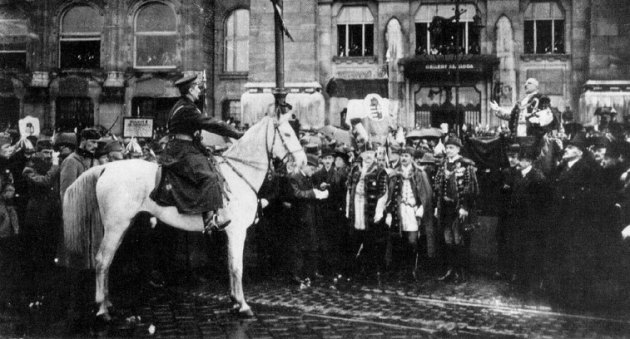
Horthy arrives in Budapest, 1919

Even before Hungary actively rallied to the German war effort, most of Hungary’s young Jewish men had been dispatched to so-called labour battalions, serving unarmed near the front, where they were as likely to be killed by their commandants as by enemy fire. In 1941, the Hungarian army rounded up about 17,000 Jews who couldn’t prove they were citizens, and dumped them across the border into Ukraine, where they were systematically massacred by German death squads. By 1942, labour service had been extended to all Jewish men under the age of 45. All this happened while Horthy—an “exceptional statesman,” according to current Hungarian Prime Minister Viktor Orbán—ran the country.

Meanwhile, Hungary’s participation in the invasion of the USSR led to the extermination of the flower of Hungarian youth. At the 1942 battle of Voronezh and subsequent operations, the underequipped Hungarian 2nd Army was practically wiped out as it launched itself against Russian defences in support of the ultimately disastrous German thrust toward Stalingrad. By late 1944, Russian troops got to the outskirts of Budapest, which suffered through a 50-day siege before Axis forces surrendered on February 13, 1945. Almost 40,000 civilians died during this period, and much of the city was destroyed.

By this time, most of the country’s Jews already had been deported to concentration camps. In all, an estimated 565,000 Hungarian Jews were murdered during the Holocaust. Historical documents show that even some Germans were amazed by the speed and efficiency of the Hungarian government’s co-operation, and by the cruelty of its gendarmerie.

Horthy and Hitler, in 1938

Some of the few elderly Hungarian Jews who survived in the Budapest ghetto can still remember scenes of rats feasting on the unburied dead in Klauzal Square, and the trigger-happy young men guarding the gates. I have spoken to many survivors, including Max Eisen, a Canadian Holocaust educator, who was a young teenager when his family was rounded up and sent to Auschwitz. He still remembers the terror of being crammed into a boxcar, standing-room only, a hundred to a car, with no water, food or sunlight. To this day, Eisen has nightmares about his mother holding his nine-month-old sister during that three-day journey. Most of his family was murdered mere hours after arriving on the platform at Birkenau. His father’s last words to him were: “If you survive, you must tell the world what happened”—which is what Eisen did with his devastating 2016 book, By Chance Alone.

But Horthy, who survived the war and lived till 1957, had different memories to relate. In his Memoirs, he pompously declared of the mid-1930s that “though times had changed considerably since I had been aide-de-camp to His Majesty Emperor Francis Joseph, my concepts of honour, law and justice…had not altered.” Of meeting Hitler in 1936, he wrote: “It was not my task to stand in judgment upon the man who, since he had come to power, had shown nothing but goodwill towards Hungary, and who had sent me an extremely friendly telegram on the 15th anniversary of my entry into Budapest. I decided, therefore, to avail myself of an Austrian invitation to a chamois [goat-antelope] shoot in August, 1936, to seize the opportunity of paying a personal visit to Herr Hitler. The Austrian Chancellor Schuschnigg had offered me the choice between three hunting preserves; I chose Hinterriss, which is famous for its chamois and to which Bavaria affords the only access.”

In concrete terms, the German “goodwill” consisted of allowing Hungary to reclaim parts of historical territories it had lost after throwing in with the losing side in World War I. Horthy’s primary concern was to restore Hungary’s former borders, even if that meant joining the Nazi war effort. As such, his strong nationalism has a certain appeal to modern populists such as Orbán.

In his Memoirs, Horthy uses terms such as “regrettable excesses” to describe massacres of Jews. He claims that he told Hitler, in early 1944, that “a violent solution [to Hungarian Jews] would be contrary to humanity and morals would not only undermine law and order but would have a deleterious effect on production.” He also claimed that in mid-1944—after he had been marginalized by the Germans, who by now were taking direct control of the country—that he did what he could to save the Jews who remained.
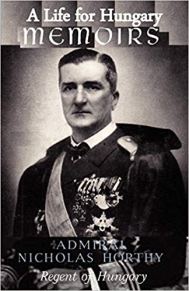
On October 15, 1944, Horthy announced over the radio that he had decided to sign a separate peace treaty with the Allies and withdraw Hungary from the conflict. He talked of the grave injustices inflicted by the 1920 Treaty of Trianon, which had set the fate of Hungary following the First World War. He blamed everyone except himself for the tragedies that had unfolded. His one passing reference to the slaughter of his nation’s Jews was contained in this sentence: “In the shelter of German occupation, the Gestapo tackled the Jewish question in a manner incompatible with the demands of humanity, applying methods it had already employed elsewhere.” It was lost on no one that Horthy was changing sides in the war only after it had become obvious that the Nazis would lose.

Many Jewish survivors recall the forced marches to the Austrian border that began in November, 1944. There were women and children, grandmothers and toddlers. It took more than three days to cover the distance from Budapest. A woman named Aviva told me that those who could not move were shot, and the ditches were lined with bodies. There was no food or shelter. Young Hungarian men stood guard along the route. These were members of the Arrow Cross Party, the far-right Hungarian movement that would run the country from late 1944 to March, 1945.

Near the border, Aviva’s group was joined by a rag-tag group of labour-service men who had been force-marched from the Bor copper mines—more than 300 of them having already been killed. One of the survivors was the young Hungarian poet Mikos Radnoti. He was murdered near Gyor in Western Hungary. When his body was found in a mass grave, his pockets were filled with scraps of paper—his last poems.

Memorial at Liberty Square

Hungary does not deny the fate of its Jews. Indeed, 2014 was declared to be a year of official Holocaust remembrance. But a memorial commissioned by Viktor Orbán’s ruling Fidesz party and erected in Budapest’s Liberty Square has provoked controversy, and even outrage. It presents Hungary in the guise of a thin, languid Archangel Gabriel-like figure being seized upon by a nasty-looking German bronze eagle with outstretched wings and terrifying claws—a symbol plainly meant to suggest Hungary was an innocent party that had been preyed upon by an evil outside force. Historian Krisztian Ungvary has called it a “living horror,” and it has attracted regular protests. But the message is consistent with the larger agenda of Orbán, who wants to promote a new, whitewashed form of national history, according to which the suffering of the Jews was no more nor less brutal than that endured by the entire country under Nazi and then Soviet rule.

Not far from the monument, there is a bronze bust of Horthy at the entrance to a Hungarian Reformed church: At the 2013 unveiling ceremony, leading members of Orbán’s government were in attendance. But also nearby is a monument commemorating the orgy of killing by Hungarian cadres, even as German troops retreated from Budapest under Soviet bombardment in the last months of the war. This year, Hungary’s Jewish community was given permission to bury bones found in the river during the 2016 reconstruction of the Margaret Bridge across the Danube.

During this final spasm of senseless slaughter, thousands of Jews were marched to the Danube and shot, or just pushed into the icy waters to die. It’s important to remember that the killers weren’t German soldiers, but members of Hungary’s own Arrow Cross movement. During my research, I interviewed a survivor—a 4-year old-child at the time—who remembers being taken to the river with his mother. To this day, he thinks it was his childish voice that saved his family when he asked, “Mr. Arrow Cross, when can we go home?” he and his relatives were then ushered out of the line of fire, and he survived to tell the story.
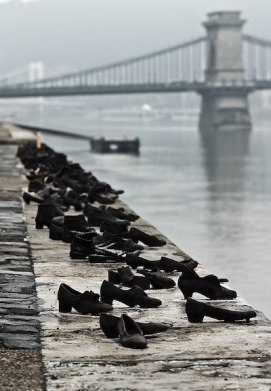
“Shoes on the Danube” memorial

Orbán’s favorite historian, Maria Schmidt, is in charge of the museum known as House of Terror, at 60 Andrassy Boulevard in Budapest. It commemorates both the Nazi terror and the Communist terror, and includes material about Hungarian victims of the Holocaust. Five of the museum’s 17 rooms contain exhibits relating to this subject. But the same historian is also in charge of another, more controversial museum—the House of Fates, which originally had been set to open its doors five years ago. Its initial mandate had been to commemorate the Hungarian experience of the Holocaust. Israel’s Yad Vashem, Washington’s Holocaust Memorial Museum, and the distinguished Hungarian-American professor Randolph Braham (1922-2018) were invited to collaborate. But almost from the beginning, the government’s local appointees reportedly began to push for a new version of the narrative, one by which Hungarians were largely blameless victims of German and Soviet aggression. The whole project fell into limbo, seemingly hostage to opposing historical voices. A Yad Vashem official declared that, from what he’d seen, “visitors to the House of Fates are to be shown and taught that, except for a tiny, criminal and fanatic minority, the citizens of Hungary were essentially blameless for what was inflicted upon their Jewish neighbors.”

As someone who grew up under Hungary’s communist dictatorship, I have a complicated relationship with the past—as my memories of family and friends are intermingled with the fears of saying the wrong thing in a country where judges, schools, the judiciary and the education system were all controlled by the government. And I can see why the country itself also has a complicated relationship with the horrors that its citizens witnessed, endured—and inflicted. But the only way to start healing from these crimes is to acknowledge how they happened.

Source: Seventy-five Years Later, Hungary Still Hasn’t Come to Terms with its Role in the Holocaust

La droite européenne suspend le parti de Viktor Orbán

Overdue:

La droite européenne a décidé mercredi de suspendre le parti du dirigeant populiste hongrois Viktor Orbán de ses rangs, pour une durée indéterminée, à la suite de ses dérapages contre Bruxelles ou l’immigration, deux mois avant le renouvellement du Parlement de Strasbourg.

Le Parti populaire européen (PPE), qui réunit les formations de droite et du centre-droit de l’UE, comme la CDU de la chancelière allemande Angela Merkel ou les Républicains en France, a pris cette décision à une écrasante majorité (190 pour, 3 contre), lors d’une assemblée politique du parti à Bruxelles.

Concrètement, cette suspension signifie que le Fidesz n’aura — jusqu’à nouvel ordre — plus le droit de participer aux réunions du PPE, sera privé de ses droits de vote et ne pourra pas présenter de candidats à des postes, a précisé le président du PPE, le Français Joseph Daul, dans un tweet.

« La présidence du PPE et le Fidesz ont convenu d’un commun accord la suspension du Fidesz jusqu’à la publication d’un rapport par un comité d’évaluation [de ce parti] », selon le texte de compromis adopté.

Aucune durée de suspension n’est mentionnée dans le compromis. Selon l’eurodéputé français Franck Proust qui participait au vote, « une décision sera prise à la remise du rapport des experts, à l’automne ». Ce comité indépendant d’évaluation doit notamment être présidé par Herman Van Rompuy, ancien premier ministre belge et ancien président du Conseil européen.

Avant la réunion, la tension était montée d’un cran. Le gouvernement hongrois avait averti qu’en cas de suspension, le Fidesz « quitterait immédiatement le PPE ».

Mais un compromis a finalement été trouvé, avec la précision que cette suspension avait lieu « d’un commun accord », selon plusieurs sources.

Dans un entretien mercredi à la radio allemande Deutschlandfunk, le président de la Commission européenne Jean-Claude Juncker avait réclamé une fois de plus une exclusion du Fidesz.

« Sa place est hors du PPE », avait affirmé M. Juncker, membre de ce parti mais qui ne participait pas à cette réunion, affirmant que « depuis des années », le Fidesz « s’éloignait des valeurs démocrates-chrétiennes ».

Certains craignaient qu’exclure l’enfant terrible du PPE, une première dans l’histoire de cette formation, la plus importante du Parlement européen, n’ouvre la voie à une scission entre l’Est et l’Ouest du continent.

Risque d’une alliance avec Salvini

Ils s’inquiétaient également de le voir se jeter dans les bras du vice-premier ministre italien et ministre de l’Intérieur, Matteo Salvini, le chef de la Ligue, parti d’extrême droite.

Cela fait des mois que la droite conservatrice se divise sur le cas Orbán.

Mais, en lançant une campagne d’affichage le 19 février contre M. Juncker, le premier ministre national-conservateur hongrois avait dépassé les bornes pour ses détracteurs.

Sous le slogan : « Vous avez aussi le droit de savoir ce que Bruxelles prépare », ces affiches montraient Juncker, ricanant aux côtés du milliardaire américain juif d’origine hongroise, George Soros, et l’accusaient de soutenir l’immigration sur le Vieux continent.

Furieux, treize partis membres du PPE originaires de dix pays différents, réunis autour d’un noyau dur constitué par les pays du Benelux et de la Scandinavie, avaient réclamé début mars « l’exclusion ou la suspension » du Fidesz.

Le chef de file pour les élections européennes du PPE, Manfred Weber, avait également accentué la pression la semaine dernière à Budapest sur Viktor Orbán, devenu une source d’embarras croissant pour l’Allemand qui brigue la succession de M. Juncker.

Le Bavarois avait posé trois conditions pour le maintien du dialogue : l’arrêt de la campagne anti-Bruxelles, des excuses auprès des autres partis membres du PPE et le maintien à Budapest de l’Université d’Europe centrale (CEU) fondée en 1991 par Georges Soros.

Depuis, Viktor Orbán, 55 ans, avait fait retirer les affiches controversées. Il avait présenté ses excuses au PPE, même si elles avaient été jugées insuffisantes.

Mais concernant l’Université d’Europe centrale, sa bête noire, M. Orbán n’avait pas bougé. Cet établissement de droit américain, s’estimant chassé par le premier ministre nationaliste, va déménager l’essentiel de ses activités à Vienne

Source: La droite européenne suspend le parti de Viktor Orbán

Hungary gives tax breaks to boost population, stop immigration

Will be interesting to see if this tax incentive results in a significant shift or not, or is this just more “virtue signalling” to his populist base:

Hungary’s anti-immigration prime minister announced on Sunday that the government would offer financial aid and subsidies for families to boost the birth rate.

Prime Minister Viktor Orban said in his annual State of the Nation speech that the policy was “Hungary’s answer” to population decline, “not immigration.”

“There are fewer and fewer children born in Europe. For the West, the answer (to that challenge) is immigration. For every missing child there should be one coming in and then the numbers will be fine,” he said.

“But we do not need numbers. We need Hungarian children,” he added.

In 2016, Hungary’s birth rate was 1.45 births per women, below the 2.1 replacement rate.

Loans, subsidies, no income tax

The seven-point program includes a loan of 10 million Forint (€31,352/$35,540) to women under 40 who marry for the first time. A third of the loan would be waived after a second child and the entire sum waived after a third child.

Another plank of the program would absolve any woman who has four or more children from paying income tax for life.

The new measures would also provide housing subsidies to families depending on the number of children they have and state support for the purchase of any seven-seat vehicle.

Orban slams EU

Orban also took aim at the European Union ahead of European Parliament elections in May and his nemesis, Hungarian-born American billionaire George Soros.

Read more: EU Parliament votes to trigger Article 7 sanctions procedure against Hungary 

“Brussels is the stronghold of new internationalism, its tool is migration,” he said.

Source: Hungary gives tax breaks to boost population, stop immigration