Deeper Than God: Ronald Dworkin’s Religious Atheism

A good review and overview by Stanley Fish in the NYTimes of Ronald Dworkin’s last book, Religion without God. Some of the argumentation is complex, but treating belief and non-belief as equal rights (freedom of and freedom from religion), and how liberals recreate an ethnical framework, is of interest. Quote:

By “ethical independence” Dworkin means the individual’s independence to decide for himself or herself how to acknowledge the “felt conviction that the universe really does embody a sublime beauty.” One form of acknowledgment might be the practice of theism — traditional religion with its rituals, sacred texts, formal prayers, proscribed and prescribed activities; but the conviction of the universe’s beauty does not, says Dworkin, “suppose any god” as its ground. Once we see this, we are on the way to “decoupling religion from a god” and admitting into the ranks of the religious those who are possessed by that conviction but do not trace it back to any deity. They will be, Dworkin declares, “religious atheists.”

Deeper Than God: Ronald Dworkin’s Religious Atheism

Minister Kenney issues statement on the 25th anniversary of the Canadian Government’s Apology for Japanese Internment during the Second World War

Worth noting, as this was the first major historical recognition initiative by the Canadian government, and important acknowledgement of historical wrongs. Read Obasan by Joy Kogawa to understand the internment and related experience. US government also made comparable acknowledgement.

Statement — Minister Kenney issues statement on the 25th anniversary of the Canadian Government’s Apology for Japanese Internment during the Second World War.

Values Charter: Sovereignists, Amnesty Intl, France

Quiet day. Reflecting the divisions among the sovereignists, those in favour of the Charter are planning their strategy, and aim a cheap shot at Gérard Bouchard:

Des souverainistes pro-Charte se rassemblent à Montréal | Hugo Pilon-Larose | Politique québécoise.

Meanwhile, back to reality with Amnesty International’s public position noting that the proposed Charter limits the fundamental rights of freedom of expression and freedom of religion:

Amnesty International slams Quebec charter for limiting ‘fundamental rights’

And lastly, a good analysis in the Globe about France’s experience with its laicisme approach, including the latest Charter of Secularism at school. The original decision to ban the veil at government schools was subject of considerable discussion and reflection; and was grounded in fears that there was a fair amount of compulsion for teenage girls to wear the hijab (not voluntary). But as these measures are imposed, people opt-out of the government schools, undermining the policy objective of inclusion.

How the French promotion of secularism offers a cautionary lesson for Quebec 

National character on parade | National Post

Nice to see a columnist like Barbara Kay in the National Post taking a broad view across religions on the role and portrayal of women. Far too rare, and the issue is broader than the niqab. While I do not agree with the overall French approach to dress codes of banning in all places, nevertheless reminding that these issues are not particular to one religion, one age group, one particular dress code, is helpful.

National character on parade | National Post.

The Franco-American Flophouse: Dual Citizens in a Secular Society

An interesting take on dual citizenship from a religious perspective. Issue more of a Quebec issue with the proposed Charter, as in the rest of Canada there is space for religious symbols (although we sometimes suffer from political correctness with “holiday trees”).

The Franco-American Flophouse: Dual Citizens in a Secular Society.

Quebec secular charter opposed by Catholic bishops

Not much of interest today.

More opposition to the proposed Charter, this time from the Catholic bishops:

Quebec secular charter opposed by Catholic bishops – Montreal – CBC News.

Une charte inutile, disent les évêques

And the typical government technique of shutting down dissenting voices by appointing more “friends” to the board:

Charte: le Conseil du statut de la femme se dit muselé

Case study highlights conflict between bureaucrats, Minister Kenney on direction of multiculturalism programs – The Globe and Mail

John Ibbitson of The Globe on my book, Policy Arrogance or Innocent Bias: Resetting Citizenship and Multiculturalism. Excellent summary.

As to his suspicion that I was more comfortable with the old ways, initially yes, but my perspective changed as I thought through the issues, and broadening multiculturalism to include all groups, not just mainstream/visible minority relations, and focusing on citizenship integrity (knowledge, language, residency) were all policy changes that I support generally. Implementation and some of the details is another matter as he points out.

As this is behind the insider pay wall, full text below:

Policy Arrogance or Innocent Bias is a case study by Andrew Griffith, who spent four years as Director General for Multiculturalism under Mr. Kenney. He chronicles the conflict between public servants steeped in consensus on how citizenship and multiculturalism programs should be run, and a minister who was determined to transform both the programs and the assumptions on which they were based.

“In many cases, officials had to work through the Kubler-Ross states of grief and loss – denial, anger, bargaining, depression and acceptance – in dealing with the traumatic changes to their role,” Mr. Griffith writes.

Officials relied on surveys and reports to shape policy; Mr. Kenney relied on anecdotal evidence. Officials followed procedures for recommending grants and contributions to non-governmental organizations. Mr. Kenney vetoed most of them.

At root, bureaucrats embraced a set of assumptions laid down in the days of Pierre Trudeau and maintained by every Conservative and Liberal government that followed: Multiculturalism programs should foster mutual tolerance among cultural communities. Citizenship should be easy to acquire, and citizenship classes and programs should emphasize the federal government’s contribution to peacekeeping, the United Nations and expanding civil liberties at home and abroad.

The Harper government saw things differently. As Minister of State for Multiculturalism, and then as Minister of Citizenship and Immigration, Mr. Kenney preferred the word “plurality” to “multiculturalism.” Instead of an emphasis on cross-cultural understanding, he wanted to promote the integration of new Canadians into a socially cohesive society. (“Exactly!” Quebec Premier Pauline Marois might respond.)

Anti-racism programs should focus less on oppression by the majority toward minorities and more on conflicts within and between minority groups, he believed. There should be more outreach to religious groups within each community and greater attention paid to the concerns of the Jewish community.

Citizenship should be harder to acquire, language requirements should be stricter, and new Canadians should hear less about peacekeeping and gay marriage and more about Canada’s military past and the importance of the Queen.

Bureaucrats would produce plans and priorities based on evidence-based research of key concerns within different cultural communities. Nonsense, Mr. Kenney would retort; I talk to these people and that’s not what they’re saying.

Between 2007 and 2011, the Minister delivered 273 speeches and statements: 37 concerned Canadian Jews; Chinese Canadians were the target of 30 and Indo-Canadians of 22. The other seven in the top 10 included Black Canadians, Christians, Muslims, Asian Canadians, Ukrainian Canadians, American Canadians and Ismali Muslims. Mr. Kenney believed he had his finger on the pulse of immigrant communities.

To their surprise, when public officials convened focus groups to test Mr. Kenney’s assertions, they often found that those interviewed reflected the minister’s priorities more than their own research had indicated.

In the best Yes, Minister tradition, officials also found that they could secure Mr. Kenney’s acceptance of a proposal more easily if it was larded with quotes from the Minister’s speeches. Over time, the bureaucrats found ways to satisfy the new boss’s demands while also sliding in a few of their own priorities.

Mr. Griffith’s conclusion is a surprising admission for a former public servant: “All of us, including public servants, have our biases and prejudices, which influence our evidence base, networks, and advice,” he writes. “…Public servants did not have the complete picture and were often too disconnected from the realities on the ground to understand the limitations of their analysis and advice.”

That does not mean that Mr. Kenney in particular or the Harper government in general were without blame. Mr. Griffith’s decries the cutbacks that have degraded the bureaucracy’s ability to create and test policy, the rush to decision and implementation and the mistakes that resulted. And although the language and the judgments are carefully balanced, one suspects that Mr. Griffith still believes the old ways and assumptions were better than the new Conservative ones.

That said, he predicts that because of Mr. Kenney’s reforms, “multiculturalism will, over time, become closer to the original Reform Party objective … of abolishing multiculturalism and strengthening a strong common narrative of citizenship.”

Unless, of course, the Conservatives are defeated in the next election and the universe goes back to unfolding as it should.

Case study highlights conflict between bureaucrats, Minister Kenney on direction of multiculturalism programs – The Globe and Mail.

Charte des valeurs québécoises – Round-up

Starting with some political analysis on how this is playing out on the national and provincial stage. Some good insights on the leadership styles – strengths and weakness – of both federal leaders in Quebec. My own take is that while both ended up in the same place, first mover advantage Trudeau.

On PQ charter, Trudeau and Mulcair take different paths to condemnation – The Globe and Mail.

John Ibbitson of The Globe notes the political challenges and calculations for the government, and why they have hewed to a more cautious approach while being clear on their fundamental opposition:

Can Tories put the heat on Quebec over its secular charter without getting burned?

Andrew Coyne argues that the PQ may have over-reached, and may have as much support in the end as it counted on. And bang on implications and implementation:

But not to worry, the minister responsible, Bernard Drainville, assures us: “It will be done humanely.” But of course. They will not be told to get out in a cruel way, but with care, compassion, or what the minister calls “good old common sense.” It will simply be made clear to these people, as kindly as the occasion permits, that, notwithstanding their years of blameless service, their continued employment is incompatible with Quebec’s common values — that their insistence on wearing the yarmulke or the turban, in accordance with the deepest teachings of their faith, has become a source of “tension” and “division,” and that for that reason they will have to find other work.

Far from certain Quebecers will side with PQ on values charter

Tabatha Southey does a funny yet serious take on the approach, citing her mother, following hair loss due to chemo, reached out to the Muslim Canadian community for help in wearing a scarf elegantly.

The Quebec charter: Maman, qu’est-ce qu’un turban?

 And Maria Mourani, former Bloc MP, who left the party and questions her faith in sovereignty given the divisiveness of the Charte and the implications for her vision of an open, inclusive and independent Quebec. Her action, and criticism of other indépendentistes like her of the Charte, may help Quebec get past the identity politics. One can aim for rural Quebec; one can’t ignore Montréal.

Mourani remet en question sa foi en la souveraineté

And a good summary in The Globe about Quebec’s francophone press reaction, largely negative:

What Quebec’s francophone media thinks of the secular charter 

Lastly, some general opinion pieces. Starting with Conrad Black reminding us of the role the Catholic Church played for most of Quebec’s history in preserving Quebec’s francophone culture and society (he glosses over the less savoury aspects):

Spurning Quebec’s proud Catholic roots

And a couple of opinion pieces (Brian Lee Crowley, André Schutten) that blur the lines between what people wear and performing their job. It is one thing to express one’s faith; it is another thing to expect that one’s duties on the job should accommodate those beliefs.

As public servants, we have an obligation to serve all citizens, and provide the required services of the government. We cannot pick and choose; we can likely however find alternative work within government without such matter of conscience issues. And if we can’t, we should work elsewhere.

Quebec charter wrong in execution, not principle

Who is calling the kettle black over Quebec values?

John Ivison: PQ could learn from Jason Kenney the right way to promote cultural values | National Post

As this is behind the firewall (and it quotes me extensively!), full text below for those who do not have National Post access:

Gérard Bouchard, co-author of the Bouchard-Taylor report on diversity in Quebec, once remarked that Jason Kenney’s reforms to Canada’s multiculturalism policies had brought the Quebec and Canadian models closer — an emphasis on integration over accommodation.

Both Quebec nationalists and Canadian conservatives were suspicious of Pierre Trudeau’s multiculturalism policies — particularly the Liberal tradition of indulging cultural groups just long enough to extract their votes.

In large measure, Mr. Kenney, as Multiculturalism Minister, pursued his own charter of values. But, crucially, he used “soft” policy tools to persuade people to buy into his vision of Canada, rather than the bludgeon of legislation that the Parti Québécois government is proposing in its secularism charter.

As the author of a new book — Policy Arrogance or Innocent Bias: Resetting Citizenship and Multiculturalism — makes clear, Mr. Kenney pursued an unabashed policy of integration (often in the face of opposition from his own public servants).

Andrew Griffith was a director general of multiculturalism at Citizenship and Immigration at a time when significant shifts in policy were being introduced by the Conservatives.

“Kenney did make a major shift towards integration … I would argue he brought multiculturalism back to its roots, as it was always about making various communities more comfortable about integrating into the Canadian ‘mainstream’, while preserving their culture, all within the common framework of Canadian laws [and] regulations,” said Mr. Griffiths.

While placing high value on cultural diversity and religious freedom, he set limits and condemned “extreme” behaviour like honour killings that were not in compliance with Canadian laws, identity and values.

In 2011, he even aligned himself with the Quebec approach when he announced that the niqab would not be allowed at citizenship ceremonies, claiming it was not a religious obligation to wear the veil. The next year, Mr. Kenney introduced a language requirement for citizenship applicants, obliging them to provide objective evidence like test results to prove they could speak either French or English.

Mr. Griffiths said Mr. Kenney’s extensive outreach into ethnic communities gave him credibility to take a broad range of positions.

“My take on him is that it is a very rare minister who can both implement more restrictive immigration, refugee and citizenship policies and yet ‘narrowcast’ to individual communities, addressing their concerns while reinforcing broader pan-Canadian messages.”

Mr. Kenney not only stressed integration into the Canadian “mainstream,” he redefined what that mainstream would look like.

Most famously, he revamped the citizenship guide for new Canadians from a very Liberal “A Look At Canada” to the Conservative-friendly “Discover Canada.”

“I think we need to reclaim a deeper sense of citizenship, a sense of shared obligations to one another, to our past, as well as to the future. In that I mean a kind of civic nationalism where people understand the institutions, values and symbols that are rooted in our history,” he told Maclean’s in 2009.

But the guide cherry-picked those symbols to promote the Conservatives’ preferred narrative, with emphasis placed on the military and the monarchy at the expense of peace-keeping, medicare and gay rights.

The results were not always appreciated internally, particularly among staff who were forced to turn down grant applications from non-governmental organizations they’d supported for years. Mr. Griffiths notes how some demonstrated the initial stages of the Kubler-Ross grief model — denial, anger and depression.

But there is some evidence that the shift in policy worked. A Citizenship and Immigration Canada survey from the 2012 departmental performance report found that 88% of foreign-born, compared to 81% of Canadian-born, respondents reported “feeling proud” to be Canadian.

Not only did foreign-born Canadians demonstrate a higher level of attachment to Canada, they also had a better understanding of what is required of citizens.

Those findings suggest that a balance has been struck between the majority culture and integration of minorities in the rest of Canada; that, in large measure, sensible public policy has ensured that the fundamental values of the majority have been respected, while allowing new Canadians to preserve their food, music, folklore and religion.

One wonders how many Sikhs, Jews and Muslims can say they feel proud to be Quebecers today?

John Ivison: PQ could learn from Jason Kenney the right way to promote cultural values | National Post.

Reaction to Quebec’s values charter

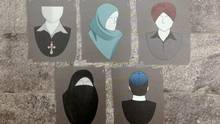
Charte symbolsSo the draft Charte is out with few surprises. Lots of reaction. Starting with what’s in and what’s out:

Would

Bar public sector employees — including everyone from civil servants to teachers, provincial court judges, daycare workers, police, health-care personnel, municipal employees and university staff — from wearing a hijab, turban, kippa, large visible crucifix or other “ostentatious” religious symbols while on the job.

Allow five-year opt-outs from the ban for certain organizations, but not daycare workers or elementary school teachers.

Require that those receiving or providing government services uncover their faces.

Exempt elected members of the Quebec legislature from the regulations.

Amend Quebec’s human rights legislation, the Charter of Human Rights and Freedoms, to specify limits on when someone can stake a claim for religious accommodation.

Wouldn’t

Remove religious symbols and elements considered “emblematic of Quebec’s cultural heritage.” That includes: the crucifixes in the Quebec legislature and atop Mount Royal in Montreal, the thousands of religiously based geographic names (e.g. Saint-Louis-du-Ha! Ha!) and the names of schools and hospitals.

Ban public sector employees from wearing small religious symbols like a ring with a Star of David, earrings with the Muslim crescent or a necklace with a small crucifix.

Eliminate subsidies to religious private schools. The Quebec government currently funds about 60 per cent of the budgets of most of the province’s private schools, including parochial ones.

Ban opening prayers at municipal council meetings, which was recommended by the 2008 Bouchard-Taylor Commission report into cultural accommodation. The Quebec Court of Appeal ruled in May that such prayers do not necessarily violate Quebec’s current human rights legislation.

Eliminate property tax exemptions for churches, mosques, synagogues and other religious buildings.

In other words, some of the deeper aspects of multiculturalism, deeper than the rest of Canada, and arguably less integrative like subsidies for religious schools, would remain, while imposing restrictions on public service employees. And will we have a ‘sartorial’ police measuring the size of ‘discrete’ or small religious symbols?

5 things Quebec’s values charter would do, and 5 it wouldn’t – Montreal – CBC News.

Quebec reveals religious symbols to be banned from public sector

Five key consequences of Quebec’s planned Charter of Values

Reaction in Quebec to the proposal is mixed. While Minister Drainville continues to say with a straight face that the Charte aims at harmony, others disagree, particularly in Montreal, where most of the communities live and work together:

Une Charte au nom de l’harmonie, selon Drainville

Signes religieux: la Charte se bute à un écueil

Mairie de Montréal : unanimité contre la charte des valeurs

Signes religieux – Québec fait fausse route, dit la Fédération des femmes

Charte des valeurs québécoises – Réactions mitigées sur la scène politique provinciale

«C’est une Charte contre les femmes»

Federal politicians have pronounced strongly against the proposed Charte. Particularly striking – and courageous given Quebec politics – that both federal leaders from Quebec, Justin Trudeau of the Liberals, and Tom Mulcair, Leader of the Official Opposition and NDP, have been unequivocal in their defence of human rights and freedoms, as has been Minister for Multiculturalism and Economic and Social Development Jason Kenney, speaking on behalf of the government, although as some have noted, he was less expansive than usual.

Given the Ottawa-Quebec dynamics, and the desire by the PQ to play politique identitaire, this may fit into their game plan to create a wedge issue. But irresponsible politics at best.

How Kenney, Mulcair and Trudeau took on Quebec’s charter of values

Tories gear up for constitutional fight as parties unite against PQ’s charter

Le prix de ses principes

NDP Leader Tom Mulcair denounces Quebec’s proposed charter of values

Some other reaction and analysis in English Canada:

De-valued promises in Quebec

Controversial Quebec charter exemptions based on idea that some religious symbols have become purely secular

Charter of Values hints that Quebec having second thoughts over mad dash for immigrants

And an opinion piece in Le Devoir in favour of laicité:

La laïcité, enfin!

And unfortunately behind Le Devoir’s firewall, an opinion piece by Gérard Bouchard, one of the co-authors of the Bouchard-Taylor report, and one of the more thoughtful thinkers on multiculturalism and interculturalisme around. Interview below:

Le sociologue Gérard Bouchard, professeur à l’Université du Québec à Chicoutimi, a codirigé avec le philosophe Charles Taylor de l’Université McGill la Commission de consultation sur les pratiques d’accommodements reliées aux différences culturelles, en 2007-2008. Il juge sévèrement la proposition du gouvernement défendue par le ministre Bernard Drainville pour « répondre au pluralisme religieux dans un état moderne ».

Si le ministre Drainville vous appelait pour vous demander conseil, lequel lui donneriez-vous ?

Je lui dirais que la façon de poser les termes du débat indispose les libertés fondamentales et risque de produire une fracture sociale. C’est donc une mauvaise façon et nous allons nous faire mal. La sagesse consisterait présentement à couper le projet de réforme en deux. Une partie concerne les accommodements et une autre concerne les signes religieux. Sur les signes religieux, visiblement, le Québec n’est pas prêt à se diriger vers un consensus. À mon avis, cette partie du débat sera un échec. Les Québécois seront très, très divisés. Par contre, sur les accommodements, il y a toutes les chances de réaliser un très large consensus parmi l’ensemble des Québécois, la minorité, comme la majorité. Là, à mon avis, il y aurait la possibilité d’en arriver à une loi.

Et tout irait pour le mieux, tout simplement ?

Non. J’ai une autre inquiétude. En parlant des accommodements, le ministre a amplifié toutes les mauvaises perceptions à propos des accommodements. Il a répandu l’idée que les accommodements portaient atteinte régulièrement à l’égalité hommes-femmes. Ce n’est pas vrai. Aucune étude ne soutient ça. Il a aussi répété qu’il y avait une accumulation d’accommodements déraisonnables consentis récemment. Pas de preuve encore. Pas d’études. Rien pour soutenir ça.

Quel autre élément de la proposition vous semble négatif ?

Au cœur de l’affaire, il y a la volonté de s’en prendre à un droit fondamental qui concerne la liberté de manifester sa religion en public, incluant au travail, dans les postes de l’État ou les institutions parapubliques. C’est reconnu comme un droit fondamental par les deux Chartes, canadienne et québécoise, partout en Occident et par l’ONU. Il est permis de supprimer un droit fondamental. Mais il faut alors s’appuyer sur un motif supérieur. Le meilleur exemple au Québec, c’est la loi 101. Elle restreint ou supprime des droits, par exemple en limitant le droit de choisir l’école de ses enfants. Mais il y avait un motif légitime que même la Cour suprême du Canada a reconnu. Je ne trouve pas de motif équivalent dans le cas présent. Il n’y a pas de proportionnalité entre le droit restreint et les motifs évoqués.

Pourquoi est-ce si grave d’interdire des signes religieux aux fonctionnaires ?

Dire que tous les employés de l’État et des organismes parapublics — et ça fait beaucoup — devraient s’abstenir de porter un signe religieux ne tient pas compte de la réalité profonde de certaines croyances. Pour certains croyants, le signe religieux n’est pas dissociable du credo. En se défaisant du signe, le croyant trahit sa foi. C’est pourquoi jamais un sikh ne va retirer son turban au travail. Voilà pourquoi les sociétés doivent trouver des accommodements, dans la mesure où ça ne nuit à personne, sans nuire au travail.

Qu’auriez-vous souhaité alors ?

Charles Taylor et moi, dans notre rapport, nous recommandions l’adoption d’un régime de laïcité au Québec. Il fallait énoncer les grands principes et les justifier. Il fallait énoncer des règles générales de conduite à l’usage des décideurs des institutions. Ce qui a été dévoilé ne fait pas ce travail, ne décrit pas le régime de laïcité qui dirait les rapports entre les religions et les convictions profondes, qui ne sont d’ailleurs pas toutes religieuses, dans notre société. Le gouvernement a tout de suite sauté à des conclusions qui conduisent à la suppression d’un droit fondamental.

Que pensez-vous du droit de retrait de certaines institutions, pour une période allant jusqu’à cinq ans, inclus dans la proposition ?

C’est une affaire difficile à comprendre. Ce droit de retrait se trouve à défaire ce que le projet est censé faire. Premièrement, le problème juridique de fond reste. Deuxièmement, il va en découler une fragmentation juridique du Québec, d’une municipalité à l’autre, d’une université à l’autre. Une jeune étudiante portant le foulard pourra fréquenter tel cégep, mais pas tel autre. C’est assez surprenant. En général, quand l’État statue sur un droit, il le fait pour l’ensemble de la société. Il paraît très étrange de donner aux citoyens la liberté de respecter la loi et des dispositions de la Charte. Troisièmement, cette option donne à la majorité la possibilité de disposer des droits des minorités. On ne peut pas confier la gestion des droits fondamentaux aux humeurs de la majorité. Imaginez où en serait le droit des homosexuels si on fonctionnait comme ça.

​Gérard Bouchard: «Nous allons nous faire mal»

And lastly, some questions for those in favour of the Charte and laicité absolue:

  1. Is this driven by ideology or unconscious prejudice against people with religious beliefs?
  2. Do you assume greater competence among public servants without religious symbols than those with?
  3. Do you view the wearing of a cross as purely secular or not?
  4. When being treated at a hospital, taking a child to day care or school, or getting on a bus, what assumptions do you make regarding someone wearing a cross, kippa, turban, hijab or other symbol?
  5. Is the issue competence or appearance? Comfort or discomfort?

As someone who has been in and out of hospital for more time than I would like to remember, and has been treated with a variety of doctors and nurses, some with religious symbols, some without, competence trumps appearance and I have not been disappointed. Yesterday, it was a nurse wearing a hijab that did my regular blood work; and it was one of the more painless pokes in recent memory.