Little-Known Federal Software Can Trigger Revocation of Citizenship – The Intercept

Good long read. As AI and automation continue to become more important to manage immigration and other programs, the importance of getting the algorithms and the like becomes more important.

Use of AI in Canada’s visitor visa program provides an example of a measured approach that improves efficiency with appropriate checks.

But as we know from any number of studies, there are consistency and fairness issues with human decision makers as well:

SOFTWARE USED BY the Department of Homeland Security to scan the records of millions of immigrants can automatically flag naturalized Americans to potentially have their citizenship revoked based on secret criteria, according to documents reviewed by The Intercept.

The software, known as ATLAS, takes information from immigrants’ case files and runs it through various federal databases. ATLAS looks for indicators that someone is dangerous or dishonest and is ostensibly designed to detect fraud among people who come into contact with the U.S. immigration system. But advocates for immigrants believe that the real purpose of the computer program is to create a pretext to strip people of citizenship. Whatever the motivation, ATLAS’s intended outcome is ultimately deportation, judging from the documents, which originate within DHS and were obtained by the Open Society Justice Initiative and Muslim Advocates through Freedom of Information Act lawsuits.

ATLAS helps DHS investigate immigrants’ personal relationships and backgrounds, examining biometric information like fingerprints and, in certain circumstances, considering an immigrant’s race, ethnicity, and national origin. It draws information from a variety of unknown sources, plus two that have been criticized as being poorly managed: the FBI’s Terrorist Screening Database, also known as the terrorist watchlist, and the National Crime Information Center. Powered by servers at tech giant Amazon, the system in 2019 alone conducted 16.5 million screenings and flagged more than 120,000 cases of potential fraud or threats to national security and public safety.

Ultimately, humans at DHS are involved in determining how to handle immigrants flagged by ATLAS. But the software threatens to amplify the harm caused by bureaucratic mistakes within the immigration system, mistakes that already drive many denaturalization and deportation cases. “ATLAS should be considered as suspect until it is shown not to generate unfair, arbitrary, and discriminatory results,” said Laura Bingham, a lawyer with the Open Society Justice Initiative. “From what we are able to scrutinize in terms of the end results — like the disparate impact of denaturalization based on national origin — there is ample reason to consider ATLAS a threat to naturalized citizens.”

“From what we are able to scrutinize in terms of the end results … there is ample reason to consider ATLAS a threat to naturalized citizens.”

Some critics believe it’s no accident that ATLAS could go after individual immigrants for flimsy reasons. “The whole point of ATLAS is to screen and investigate so that the government can deny applications or refer for criminal or civil or immigration enforcement,” said Muslim Advocates’ Deborah Choi. “The purpose of the secret rules and predictive analytics and algorithms are to find things to investigate.”

The Department of Homeland Security refuses to disclose to the public how exactly ATLAS works or what rules it uses to determine when an immigrant should be flagged to potentially have their citizenship revoked. This secrecy makes it nearly impossible to tell whether ATLAS is targeting immigrants baselessly or not. The Open Society Justice Initiative this week filed a new FOIA request with DHS and its United States Citizenship and Immigration Services, or USCIS, division seeking details on how the algorithm functions.

The revelations about ATLAS come as policymakers await a review of denaturalization policies that the Biden administration began in February to “ensure that these authorities are not used excessively or inappropriately,” as the White House put it at the time. President Joe Biden came to office promising a more “humane” approach to immigration than former President Donald Trump, who stripped dozens of naturalized Americans of their citizenship. A deadline related to the review came and went in May. Months later, the administration has yet to publish the review or speak publicly about the matter.

ATLAS originates within USCIS, a DHS division with responsibility for granting citizenship and other immigration benefits. USCIS has called the software its “primary background screening system,” but ATLAS appears to be a feature of a larger computer program that helps manage case information on every person in the immigration system: USCIS’s Fraud Detection and National Security Data System, or FDNS-DS. A 2020 DHS assessment of ATLAS’s privacy implications, one of the few public sources of information about ATLAS, shows that when an individual’s information is run through the software — a virtual certainty for any immigrant — ATLAS autonomously scours the databases, including some that contain classified materials.

ATLAS appears to scrutinize not just individual immigrants but also their wider social networks. A 2016 privacy assessment of FDNS-DS said that ATLAS “visually displays linkages or relationships among individuals to assist in identifying non-obvious relationships… with a potential nexus to criminal or terrorist activities.”

Amazon Web Services, the cloud computing division of the large online retailer, was hosting the ATLAS system as of 2020. That arrangement is one of many instances in which Amazon has sold its services to a controversial Homeland Security initiative targeting immigrants. Amazon has faced protests both from the general public and its own employees demanding that the company cease any further anti-immigrant work; the company did not return a request for comment.

USCIS spokesperson Matthew Bourke declined to answer any questions about ATLAS.

Tracking Millions of Immigrants With Potentially Catastrophic Consequences

It’s unknown how many individuals have been denaturalized via ATLAS. But a 2019 USCIS press release gave some sense of the program’s scale, noting that the program that year processed more than 16 million “screenings” and generated 124,000 “automated potential fraud, public safety and national security detections requiring further analysis and manual review by USCIS officers.”

Immigrants come into contact with ATLAS, according to the 2020 privacy assessment, when one “presents him or herself” to the USCIS for some reason, of which there are many; when “new derogatory information is associated with the individual in one or more U.S. Government systems”; or, according to the 2016 privacy document, whenever “FDNS performs an administrative investigation.” This apparently can happen even after an immigration-related decision has been made: Among the FOIA documents shared with The Intercept is a USCIS memo noting that ATLAS is used to detect “fraud patterns in immigration benefit filings … either pre- or post-adjudication,” suggesting that an immigrant could be subjected to algorithmic scrutiny indefinitely after their filing is approved.

Once the system is triggered, ATLAS eventually decides whether to flag the immigrant in question, but it’s unclear exactly how it arrives at that decision. How ATLAS reasons — that is, its decision-making “algorithm” — is secret. And although DHS documents list a handful of data types ATLAS can potentially search, they do not indicate what sorts of personal information ATLAS will churn through to reach its decision.

The 2020 privacy document states vaguely that “ATLAS contains a rules engine that applies pattern-based algorithms to look for indicators of fraud, public safety, and national security concerns,” a process described as “predictive.” It gives little information about these rules but does state that it is permissible to use ATLAS to target immigrants by race and ethnicity in “exceptional instances,” a term left glaringly undefined. The document claims that USCIS protects immigrants from discrimination by “limiting the consideration of an individual’s simple connection to a particular country, by birth or citizenship, as a screening criterion, unless such consideration is based on an assessment of intelligence and risk and in which alternatives do not meet security needs.” Caveats aside, the point is clear: ATLAS could be used to target certain ethnic groups or nationalities in “exceptional circumstances” or should DHS deem it a “security need.” Appealing to murky notions of “national security” and “fraud” is a long-standing tactic of the post-9/11 homeland security apparatus, and one that has historically permitted the state to justify efforts to harass or target marginalized communities in the U.S. under the auspices of public safety.

If ATLAS produces a negative review, the next steps can lead to denaturalization, and a 2019 flowchart included in the FOIA documents provided to The Intercept illustrates how: When ATLAS finds something derogatory according to its secret list of rules, the software sends out a “System Generated Notification,” which is then “triaged” and forwarded directly to FDNS-DS if potentially “actionable.” From there, FDNS determines whether the notification constitutes a “possible criminal denaturalization referral,” and, if so, will “refer to ICE for criminal denaturalization action.” All told, going from an ATLAS notification to criminal denaturalization proceedings takes only four steps on the flowchart.
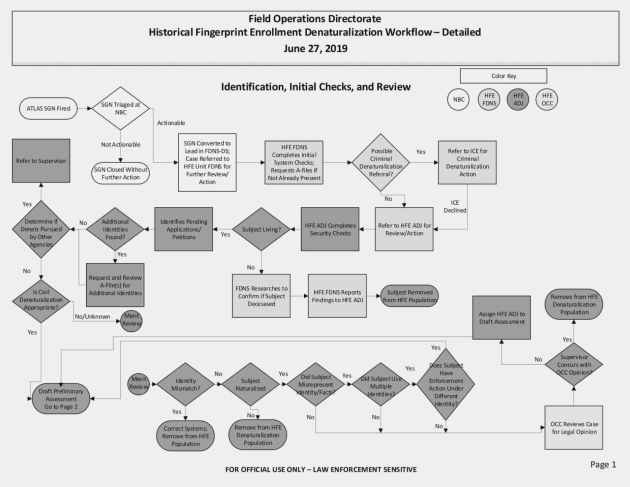
FOIA-flowchart-1

An internal USCIS document shows an ATLAS scan as the first step in identifying cases for denaturalization.

Document: FOIA

A USCIS spreadsheet summarizing the System Generated Notifications created in 2020, also obtained via FOIA litigation, cites 12 different categories of ATLAS alert. Though the meaning of these codes is unclear, the spreadsheet references notifications relating to “DACA,” presumably the Deferred Action for Childhood Arrivals policy that protects some undocumented immigrants from deportation; “DOD,” possibly referring to the Department of Defense; and two different “NS,” or national security, categories whose full names were redacted. Most of the notifications created in 2020 were in the “multiple identities” category, which refers to immigrants deliberately using false aliases.

Legal scholars and technologists have widely criticized attempts to use software to predict national security threats, arguing that terrorism is so statistically rare as to be impossible to foresee by drawing “patterns” from a person’s biography. “Because the rules or factors underlying ATLAS’s screening functionality are unknown, there is no way to assess whether ATLAS is disproportionately flagging certain communities,” Choi of Muslim Advocates told The Intercept. “In fact, the Privacy Impact Assessment for ATLAS states that under certain circumstances, an individual’s country of birth or citizenship could be a screening criterion. As was the case in Operation Janus” — a DHS program that involved a review of past naturalization cases of people from “special interest countries” — “any rule based on country of origin is likely to target individuals from Muslim-majority countries.”

The 2020 privacy document does little to dispel worries that ATLAS is making potentially life-ruining decisions on the basis of bad data. The document states that ATLAS’s output is subject to manual review by the agents who use it; it also notes that the accuracy of ATLAS’s input is taken as a given: “USCIS presumes the information submitted is accurate. … ATLAS relies on the accuracy of the information as it is collected from the immigration requestor and from the other government source systems. As such, the accuracy of the information in ATLAS is equivalent to the accuracy of the source information at the point in time when it is collected by ATLAS.” The document further notes that “ATLAS does not employ any mechanisms that allow individuals to amend erroneous information” and suggests that individuals directly contact the offices maintaining the various databases ATLAS uses if they wish to correct an error. The notion that someone struggling to navigate the U.S. immigration system would have the wherewithal to personally negotiate a correction of the FBI Terrorist Screening Database, or have an opportunity to learn of such an error to begin with, is questionable.

An Opportunity To Stop the Denaturalization Wave

The U.S. government’s use of denaturalization has varied widely over the last century. In the early to mid-1900s, the federal government pursued denaturalization for political, racist, and sexist reasons, even going after U.S.-born citizens. That changed after a 1967 U.S. Supreme Court decision vastly narrowed the potential uses of denaturalization. For nearly five decades afterward, the government brought denaturalization cases only sparingly, usually against accused war criminals and Nazis — up until the Trump presidency.

In September 2017, the Department of Justice announced its intent to denaturalize three men it accused of lying about their immigration histories on their applications for citizenship. It was a loud proclamation of a new front in the Trump administration’s war on immigrants that would lead to nearly double the number of denaturalization cases filed during two years as compared to the number of cases filed from 2004 to 2016, according to a New York Times Magazine investigation.

The infrastructure that helped the Trump Justice Department identify its first targets for denaturalization was years in the making. Under Operation Janus — an initiative that began at the end of George W. Bush’s presidency and continued under former President Barack Obama — the Department of Homeland Security began to digitize fingerprint data for about 315,000 people whose information was missing from a central database, ultimately identifying 1,029 people who had been naturalized after receiving final orders of deportation under another identity. According to a 2016 report from the DHS Office of Inspector General, U.S. Immigration and Customs Enforcement had begun the process of investigating some of those cases to decide whether the individuals should be denaturalized.

“But the Obama administration proceeded with caution, instructing officials only to denaturalize those who appeared to pose a danger to the United States,” writes law professor Amanda Frost in her recent book, “You Are Not American: Citizenship Stripping from Dred Scott to the Dreamers.” “After the Trump administration took over, however, the program grew exponentially.”

In early 2018, the Justice Department wrote in a press release that USCIS “has stated its intention to refer approximately an additional 1,600 for prosecution,” and later that year, USCIS announced the creation of a new office focused on denaturalization. (Asked about the status of that office, Bourke, the USCIS spokesperson, said that once the administration’s review of denaturalization policies is complete, “USCIS staffing will be adjusted accordingly to meet the needs of the agency.”) Ahead of the 2019 and 2020 fiscal years, the Department of Homeland Security asked for $207.6 million to fund, among other things, investigations into hundreds of additional leads under Operation Janus, as well as a review of another 700,000 immigrant files under Operation Second Look, a related program. In early 2020, the Justice Department created a new office to investigate “terrorists, war criminals, sex offenders, and other fraudsters who illegally obtained naturalization” for denaturalization.

ATLAS is a direct descendent of these efforts to simultaneously digitize huge swaths of paper fingerprint records and sift through them en masse in order to find damning inconsistencies. One of the FOIA-produced documents shared with The Intercept, the USCIS memo on that office’s fingerprint digitization strategy, notes that ATLAS “will help to ensure USCIS is aware of cases with multiple identity fraud patterns so that officers can address this potentially derogatory information prior to final adjudication of immigration benefits.”

Several of the documents obtained under FOIA suggest that deportation is the end goal of these recent efforts: A heavily redacted, undated USCIS presentationlists “Removal Proceedings (if Amenable)” as the final step in a denaturalization case, while a flow chart on the “Historical Fingerprint Enrollment Denaturalization Workflow” shows the second-to-last step as “Immigration Removal Proceedings Occur,” followed by a decision by an immigration judge. A 2018 USCIS memo states that a key consideration in settlement agreements is to determine if deportation “is a priority or if denaturalization is sufficient,” noting that deportation “would generally be within the enforcement priorities, where the subject is denaturalized with an admission or finding of fraud.” A 2009 ICE memonotes that in cases in which the Justice Department declines to criminally prosecute someone suspected of “identity and benefit fraud,” that person “must, if legally possible, be administratively arrested and placed in removal proceedings. Several of the subjects have been granted citizenship through naturalization. These cases should be given priority.” Additionally, a USCIS spreadsheetlisting settlement proposals for 10 denaturalization cases in 2018 and 2019 (all of which were rejected) shows that all of the offers included some sort of protection from deportation — either explicitly or through an agreement to maintain permanent resident status.

Denaturalization experts say that putting an immigrant’s paper trail through the algorithmic wringer can lead to automated punitive measures based not on that immigrant’s past conduct but the government’s own incompetence. Experts have long pointed out that using matches against shoddily maintained fingerprints, many collected on notecards decades ago, as evidence of deliberate “fraud” or malfeasance is likely to ensnare and punish innocent people.

According to Choi, in some cases “denaturalization is sought on the basis of the mistakes of others, such as bad attorneys and translators, or even the government’s failures in record-keeping or the failures of the immigration system.” Bureaucratic blundering can easily be construed as a sign of fraud on an immigrant’s part, especially if decades have passed since filling out the paperwork in question. If ATLAS finds that your name doesn’t match a name associated with your historical fingerprint record, you could be fast-tracked for denaturalization without ever realizing that there was an inconsistency in your paperwork, potentially through no fault of your own. “Many denaturalization cases are based on the government’s allegations of fraud, but the government has never substantiated its sweeping justification of fraud prevention to warrant the irreparable harm to American families and society that is caused by denaturalization,” Choi added.

The Justice Department’s denaturalization prosecutions appeared to slow in 2020, when the coronavirus pandemic caused massive delays throughout the judicial system, according to a document obtained by the Open Society Justice Initiative. Another USCIS document obtained by the group, however, shows that there were thousands of cases in the pipeline: As of April 2020, the agency had produced 2,628 “affidavits of good cause,” which are a procedural requirement for initiating civil denaturalization cases, and had assigned 1,265 cases to the USCIS Office of Chief Counsel. Of those, 745 cases were pending with the OCC and 502 had been referred to the Justice Department’s Office of Immigration Litigation. Asked about the current number of cases it is currently investigating or has referred to the Justice Department for prosecution, USCIS referred questions to the Justice Department. Justice Department spokesperson Danielle Blevins declined to comment on the department’s denaturalization caseload.

Under Biden’s February executive order, the departments of State, Justice, and Homeland Security were due to submit a report to the president in early May. The State Department confirmed to The Intercept that it had completed its portion of the review and directed questions about if and when the report would be made public to the White House. Bourke of USCIS told The Intercept that the agency is working with DHS and the Justice Department on the review and that it would “potentially make adjustments following that assessment.” The White House did not respond to questions about the report.

Advocates, meanwhile, have been pushing the administration to dismantle the denaturalization-focused infrastructure built by Trump and to restore the previous status quo of very limited pursuits of denaturalization. In May, Muslim Advocates was the lead signatory among 48 advocacy groups that detailed these demands in a letter to USCIS. The groups recommend that the agency halt its use of ATLAS until completing a “disparate impact review” and publicly release information on the rules ATLAS uses to flag people, demographic information about the people flagged by the system, and the number of screenings and flags, as well as their outcomes.

Sameera Hafiz, policy director at the Immigrant Legal Resource Center, who has been involved in advocacy efforts related to denaturalization for several years, said she wants to see the administration do even more. “Our expectation is that the Biden administration will establish a clear process to immediately restore citizenship to all the individuals stripped of their citizenship during the Trump years and commit to dropping the pending denaturalization cases initiated by Trump,” she said. “Unfortunately, Biden’s immigration enforcement tactics continue to instill fear in our communities — this is one important step the administration must take to begin addressing the harms of the Trump years.”

Source: Little-Known Federal Software Can Trigger Revocation of Citizenship – The Intercept

Homeland Security to share citizenship data with Census Bureau

Not surprising and there will certainly be some data issues as flagged, one’s that the administration will of course dismiss given the intent is more to disenfranchise minority voters and reduce the population count of states with higher numbers of immigrants (legal and other):

The Department of Homeland Security is agreeing to share citizenship information with the U.S. Census Bureau as part of President Donald Trump’s order to collect data on who is a citizen following the Supreme Court’s rejection of a citizenship question on the 2020 Census form.

Trump’s order is being challenged in federal court, but meanwhile, the Department of Homeland Security two weeks ago announced the agreement in a report. It said the agency would share administrative records to help the Census Bureau determine the number of citizens and non-citizens in the U.S., as well as the number of immigrants in the U.S. illegally.

Information to be shared includes personally identifiable data, the Homeland Security document says. Federal law prohibits the Census Bureau from releasing personally identifiable data, and the bureau says in its fact-sheet on privacy, “Your answers can only be used to produce statistics — they cannot be used against you in any way.”

The Census Bureau has promised the data will be kept for no more than two years, and will then be destroyed, according to the agreement. The data will be used to help the Census Bureau create a model estimating the likelihood that each person in the U.S. is a citizen, non-citizen or an immigrant in the country without legal permission.

Among the information Homeland Security will provide is a person’s alien identification number, country of birth and date of naturalization or naturalization application. The department is awaiting word on whether it will be allowed to release information on asylum and refugee applicants, which typically is prohibited from being disclosed.

Because a person’s citizenship status can change often over time, the citizenship data provided by Homeland Security will likely be inaccurate, said Andrea Senteno, an attorney for the Mexican American Legal Defense and Education Fund, one of the civil rights groups challenging Trump’s order in federal court in Maryland.

“The information out there over whether someone is a non-citizen or what type of immigrant status they may be is going to have a lot of holes in it,” Senteno said.

The Homeland Security document acknowledges risks that the Census Bureau will assign an inaccurate immigration status to someone, that people won’t be able to correct mistakes about themselves and that Homeland Security information will be linked inaccurately to data from other sources used by the Census Bureau.

“Linking records between datasets is not likely to be 100% accurate,” the Homeland Security document notes.

Trump ordered the Census Bureau to collect citizenship information through administrative records from federal agencies and the 50 states after the Supreme Court ruled against his administration last summer by deciding that a citizenship question wouldn’t be allowed on this spring’s 2020 Census questionnaire.

The administration had said the question was being added to aid in enforcement of the Voting Rights Act, which protects minority voters’ access to the ballot box. But Chief Justice John Roberts joined the court’s four more liberal members in saying the administration’s current justification for the question “seems to have been contrived.”

Opponents of the citizenship question had argued it would scare off immigrants, Hispanics and others from participating in the once-a-decade headcount. The 2020 Census will help determine how many congressional seats each state gets as well as the distribution of $1.5 trillion in federal funds.

The federal lawsuit challenging Trump’s order to collect the citizenship data claims that the data gathering is motivated by “a racially discriminatory scheme” to reduce the political power of Latinos and increase the representation of non-Latino whites.

As part of the order, the U.S. Census Bureau has asked state drivers’ license bureaus for records, but so far only Nebraska has agreed to cooperate.

Gathering the citizenship data would give the states the option to design state and legislative districts using voter-age citizen numbers instead of the total population, Trump said in the order. The U.S. Constitution specifies that congressional districts should be based on how many people — not citizens — live there. But it’s murkier for many state legislative districts. Opponents fear that using just citizen figures would make legislative districts more Republican-leaning and less diverse.

“Whether that approach is permissible will be resolved when a state actually proposes a districting plan based on the voter-eligible population,” Trump’s order said. “But because eligibility to vote depends in part on citizenship, states could more effectively exercise this option with a more accurate and complete count of the citizen population.”

Source: Homeland Security to share citizenship data with Census Bureau

Ken Cuccinelli Wanted to End Birthright Citizenship and Militarize Border

Revealing background:

Former Virginia attorney general Ken Cuccinelli’s long-rumored role as a top coordinator of the Department of Homeland Security immigration policy finally has an official title. According to an email sent to staff at U.S. Citizenship and Immigration Services on Monday, the longtime border hawk has been named acting director of the agency, whose 19,000 employees orchestrate the country’s immigration and naturalization system.

“We must work hand in hand with our colleagues within DHS, along with our other federal partners, to address challenges to our legal immigration system and enforce existing immigration law,” Cuccinelli wrote in an email to his new colleagues. “Together we will continue to work to stem the crisis at our southwest border.”

The note also previews an escalation of Trump’s crackdown on the asylum system, with Cuccinelli vowing to “work to find long-term solutions to close asylum loopholes that encourage many to make the dangerous journey into the United States so that those who truly need humanitarian protections… receive them.”

As Virginia’s top law enforcement official and in his years serving in the Virginia state senate, Cuccinelli laid a long track of aggressive anti-immigrant policies intended to restrict access to public services, employment, and even citizenship from migrants and their families. That record, combined with his vociferous defense of President Donald Trump on cable news and in conservative media outlets, puts Cuccinelli firmly in line with an administration that has made combating undocumented immigration its top domestic policy goal.

In his new role at Homeland Security, Cuccinelli will be one of the Trump administration’s top bosses on immigration-related matters, a portfolio that has felled other senior administration officials in recent months as the president has grown dissatisfied with stubbornly high rates of illegal entry into the United States.

If his record on immigration issues is any indication, Cuccinelli will embrace that role with relish. While his support for President Donald Trump may be relatively newfound, his championing of hardline Trump-style immigration policies is more than a decade in the making.

Although Cuccinelli first drew national attention during his time as Virginia’s attorney general for his attempts to keep laws against oral sexon the books, he also became a staunch advocate on behalf of aggressive immigration policies in other states. In 2010, Cuccinelli filed an amicus brief in support of S.B. 1070, an Arizona law that allowed police officers to investigate the immigration status of any person arrested or detained by law enforcement based on a “reasonable suspicion” that they were in the country illegally. That same year, he released a legal opinionexpanding a similar policy to include any suspected undocumented immigrant stopped by law enforcement for any reason.

“Virginia law enforcement officers have the authority to make the same inquiries as those contemplated by the new Arizona law,” Cuccinelli wrote in the opinion. “So long as the officers have the requisite level of suspicion to believe that a violation of the law has occurred, the officers may detain and briefly question a person they suspect has committed a federal crime.”

Cuccinelli told reporters at the time that any police officer had the authority to question potential undocumented immigrants “so long as they don’t extend the duration of a stop by any significant degree.”

Those stances on illegal immigration appear tame compared to other proposals that Cuccinelli had backed before becoming attorney general. During his eight years in the Virginia state senate, Cuccinelli was the chief patron—the body’s version of primary sponsor—of a rash of bills targeting undocumented immigrants in the commonwealth.

One proposed law would have allowed employers to fire employees who didn’t speak English in their workplace, and stipulated that any employee so fired would be “disqualified from receiving unemployment compensation benefits.” Another bill would have allowed businesses to sue competitors that they believed to be employing undocumented immigrants for economic damages, plus $500 “for each such illegal alien employed by the defendant.”

In one case, Cuccinelli championed one of Trump’s most aggressive immigration policies before Trump himself did. In a 2008 bill, Cuccinelli urged Congress to call a constitutional convention to amend the 14th Amendment of the U.S. Constitution “to clarify specifically that a person born to a parent who is a U. S. citizen is also a citizen of the United States,” to the exclusion of the children of undocumented immigrants who are born in the United States.

Immigration advocates called Cuccinelli’s appointment as acting head of the nation’s top immigration agency “deeply troubling.”

“Whether Ken Cuccinelli’s appointment is lawful remains to be seen,” said Ali Noorani, executive director of the National Immigration Forum, noting that the appointment appears to sidestep the Federal Vacancies Reform Act. “Cuccinelli’s track record of anti-immigrant stances and statements is deeply troubling. In the end, we need unifying solutions and smart policy on immigration, not further polarization. Cuccinelli’s installation doesn’t bode well.”

Since losing a race for governor in 2013—during which he tried to obscure his record on immigration—Cuccinelli has become a mainstay in conservative media outlets, particularly after Trump’s election. Cuccinelli has called for militarizing the border, blocking all immigrants from Central America to discourage the formation of so-called “caravans,” and once came under scrutiny at CNN after a heated on-air exchange about immigration policy, in which he told contributor Ana Navarro that he was “sick and tired of listening to your shrill voice in my ears.”

Joining the administration in an official capacity is the final step in a long journey from the 2016 Republican primaries. Despite their like-mindedness on immigration, Cuccinelli backed Trump’s staunchest opponent, steering Sen. Ted Cruz’s longshot bid to unseat Trump as the party’s nominee by winning over delegates at the Republican National Convention. Cuccinelli famously threw his credentials to the convention floor in apparent disgust when the convention’s organizers refused to allow a floor vote to challenge Trump’s nomination.

“This is disgusting,” Cuccinelli said at the time.

DHS Sec. Kirstjen Nielsen to Tucker Carlson: Getting Rid of Birthright Citizenship Is ‘on the Table’

Reality will eventually catch up with virtue signalling given the 14th amendment:

Hours after President Trump declared he would “100 percent” close America’s southern border if he can’t make a deal with Congress on border security and immigration, Department of Homeland Security Secretary Kirstjen Nielsen told Fox News host Tucker Carlson that eliminating birthright citizenship is “on the table” as a way to stop the flow of undocumented immigrants and asylum-seeking migrants.

Nielsen, who recently requested additional resources from Congress as border officials aim to quadruple the number of deportations of asylum seekers, appeared on Tucker Carlson Tonight Tuesday evening to discuss the influx of Central American migrants at the southern border, and Carlson immediately began grilling her about what the administration was doing to “fix this.”

At times, it even seemed as if the Fox News host might be gunning for Nielsen’s job as he bombarded her with his own proposed solutions to the border crisis.

What about punishing employers “who are setting the bait in this trap, who are encouraging illegal aliens to come into this country?” he asked. (Interestingly, the president’s own businesses allegedly employed numerous undocumented workers—until they were caught by the press.)

“That is part of the problem,” Nielsen said, adding that steps are already being taken to address just that issue. “We’re looking to do everything we can throughout the system to apply penalties where we can,” she said.

Carlson was not satisfied with that answer. “Well how bout this, why wouldn’t your agency write an executive order, present it to the president, have him sign it and do it tomorrow?”

Nielsen went on to argue that “there’s a debate in Congress” regarding the executive branch on implementing an order like that, prompting Carlson to blast Congress while advocating for more direct executive actions.

“It looks like Congress is not going to act because one party has a vested interest in changing the population and the other party is, in effect, controlled by people who want illegal immigration,” Carlson asserted. “So would there be a downside for the president to act unilaterally on that question or, for example, birthright citizenship? Would you be willing to draft an executive order eliminating birthright citizenship?”

The Homeland Security chief responded that Trump has been clear that it is “all on the table” and he’s serious about shutting down the border.

“Yes, everything is on the table,” she reiterated.

Carlson, after noting that “things seem less under control now” at the border than before Trump was elected, asked later in the interview if the administration would send the military to the border since “it’s really a crisis of that magnitude.”

Nielsen said they “are looking into that” and have sent a request to the Department of Defense, causing Carlson to ask who is in charge and if it would be possible for the commander-in-chief to move “troops to the border tomorrow.”

Source: DHS Sec. Kirstjen Nielsen to Tucker Carlson: Getting Rid of Birthright Citizenship Is ‘on the Table’

‘Morally repugnant’: Homeland Security advisory council members resign over immigration policies

Less impact given appointees under the Obama administration:

Four members of a Homeland Security advisory council have resigned in protest over the Trump administration’s immigration policies, citing the “morally repugnant” practice of separating immigrant families at the border.

Richard Danzig, former secretary of the Navy in the Clinton administration, and Elizabeth Holtzman, a former Democratic congresswoman, were among the group that announced their resignation Monday in a letter to Homeland Security Secretary Kirstjen Nielsen.

The group noted that the Department of Homeland Security did not consult its advisory council before implementing the policy, which separated more than 2,500 children until President Trump reversed his endorsement of the practice amid an international outcry and signed an order instructing the agency to stop doing so.

“Were we consulted, we would have observed that routinely taking children from migrant parents was morally repugnant, counter-productive and ill-considered,” the group wrote. “We cannot tolerate association with the immigration policies of this administration, nor the illusion that we are consulted on these matters.”

Two former Obama administration officials — David Martin, a former DHS deputy general counsel, and Matthew Olsen, who served as director of the National Counterterrorism Center — also signed the letter.

Bill Bratton, a former New York City police commissioner who is vice chairman of the advisory council, thanked the group for their service in an email reply, but he did not respond directly to the criticism.

“Each of you was appointed owing to lifelong dedication to the nation and her people, and, indeed, I can appreciate that each of you sees this resignation as part of that dedication,” Bratton wrote.

Tyler Houlton, a DHS spokesman, said it was “disappointing, but not surprising, that appointees from the previous Administration would resign.”

He added: “It is unfortunate that instead of first bringing their concerns directly to the Secretary in the spirit of an Advisory Committee member, they chose to simply resign four weeks after the Administration ended the practice of concern.”

Advisory council members are appointed by the homeland security secretary to two-year terms. After the resignations, there are 24 members, according to the DHS website. The council meets infrequently, usually no more than twice a year, and includes subcommittees to conduct research and recommendations on DHS policies.

The Trump administration began routinely separating immigrant families who did not have authorization to enter the United States under a new policy that aimed to criminally prosecute all adults who entered the country illegally. To do so, DHS officials said, the administration was required to take away minor children because U.S. law prevents them from being held in adult jails. The agency is struggling to reunite the children with their parents, despite a court order to do so.

In separate letters also sent to Nielsen, Martin and Holtzman also cited objections more broadly to the administration’s immigration policies, including an entry ban on immigrants from several majority-Muslim countries, the pursuit of billions of dollars for a border wall and Trump’s attempts to end a deferred action program for younger immigrants who have lived in the country illegally since they were children.

“These actions have fueled polarization, alienated state and local governments, and moved us much further from a sustainable, effective, and strategically sensible immigration enforcement program,” Martin wrote.

Holtzman, who like Martin was appointed by former DHS secretary Jeh Johnson during the Obama administration, wrote to Nielsen that under Trump, “DHS has been transformed into an agency that is making war on immigrants and refugees.”

In an interview, Holtzman said she did not believe the resignations would have an impact on Trump’s decision-making on immigration. But she added, “I do think it’s important for the American people to see that not everybody connected with the government is a brute, is a lawbreaker and that actually some of us do have a measure of conscience.”

Source: ‘Morally repugnant’: Homeland Security advisory council members resign over immigration policies

U.S. Is Trying to Counter ISIS’ Efforts to Lure Alienated Young Muslims – NYTimes.com

Good piece in the NY Times about US Government efforts to engage American Muslims in countering extremism, with some of the same issues that likely arise in Canada. The last line captures the conundrum:

American officials have been able to identify Americans fighting for the Islamic State or other Syrian rebel groups based on intelligence gathered from travel records, family members, intercepted electronic communications, social media postings and surveillance of Americans overseas who had expressed interest in going to Syria, counterterrorism officials said.

But efforts at countering violent extremism, especially at home, “have lagged badly behind other counterterrorism pillars,” said Michael Leiter, a former director of the National Counterterrorism Center. “It is heartening to see the administration attempt to invigorate those efforts, but it is unfortunate that it has, despite the efforts of many, been so long in coming.”

Government supporters question whether funds will be available to sustain these programs. “The administration has the right framework for doing this, but long-term success will depend on sustainable resourcing to help local government, communities and law enforcement build initiatives that can have impact,” said Quintan Wiktorowicz, a former senior White House aide who was one of the principal architects of the current strategy.

That strategy here at home, called countering violent extremism, has proved much more difficult for American officials to master than the ability of the Pentagon and spy agencies to identify, track, capture and, if necessary, kill terrorists overseas.

Among its efforts, the Department of Homeland Security provides training to help state and local law enforcement officials in identifying and countering the threat, including indicators of violent extremism and “lone wolf” attacks.

The department awarded the International Association of Chiefs of Police a $700,000 grant last year to develop training on how to prevent, respond to and recover from acts of terrorism.

The department has also sponsored exercises in seven cities, including Houston, Seattle, and Durham, N.C., to improve communication between local law enforcement and communities and to share ideas on how best to build community resilience against violent extremism. “We’re raising awareness,” said David Gersten, who was recently named the department’s coordinator for the overall effort.

Carter M. Stewart, the United States attorney in the Columbus area, said he and his staff meet regularly with Somali-American and other community leaders.

But Muslim advocates say there is deep suspicion that, despite all the meetings and the talk of outreach, the government’s main goal is to recruit informants to root out suspected terrorists.

“I don’t know how we can have a partnership with the same government that spies on you,” said Linda Sarsour, advocacy director for the National Network for Arab American Communities.

Indeed, those who met with Mr. Johnson were conflicted, some saying they were pleasantly surprised he had traveled here to put a face on the federal effort, but clearly embittered by their past experiences with the government.

Dr. Iyad Azrak, 37, a Syrian-American ophthalmologist, recounted how he and his family had been forced on numerous trips to Canada to wait for hours at border crossings while inspectors reviewed his records.

“Not once when we’re coming home do they say to me, ‘Welcome home,’ ” said Dr. Azrak, who said he has been a naturalized citizen for six years.

U.S. Is Trying to Counter ISIS’ Efforts to Lure Alienated Young Muslims – NYTimes.com.

Extremist ‘foreign fighters’ may threaten Canada: U.S. top official | Ottawa Citizen

Short reference to outreach programs during the visit of the head of Homeland Secruity,  Jeh Johnson:

Johnson said that in addition to a military mission to crush ISIL in the Middle East, and an intelligence strategy to track foreign fighters, the U.S. is conducting an “outreach” program in U.S. Islamic communities. That program is designed to prevent people from being fooled into recruitment by ISIL’s “slick” propaganda.

“ISIL is a stateless group of depraved criminals —rapists, kidnappers, killers and terrorists who control a territory,” he said. “There is no religion, including Islam and there is no God, including Allah, that would condone ISIL’s violent tactics.”

Extremist ‘foreign fighters’ may threaten Canada: U.S. top official | Ottawa Citizen.

Lorne Gunter, true to form in the Toronto Sun, rails against political correctness in describing ISIS as not Islamic, and implicitly casting a slur on all Muslims as well as political leaders:

Western civilization won’t be defeated by economic collapse or government debt, by an external military force or even its own internal decadence. But it could well be done in by political correctness.

It’s bad enough that U.S. President Barack Obama could stand bare-faced in front of his nation two weeks ago and insist the Islamic State terror group “is not Islamic.”

Huh!? Islam is in their name and behind every murderous, brutal, barbarous act ISIS commits.

There are imams and Muslim scholars who would argue that ISIS is, in fact, the very epitome of Islamic faith put into action. It is possible to debate that those Muslim leaders and ISIS itself are wrong in their interpretation of Islam.

But to insist to the world that ISIS “is not Islamic” is the equivalent of standing in front of a red wall and insisting it is green. It is contrary to what is plainly, clearly, obviously true.

Not sure what I am missing but there seems to be a lot, understandably, talk about Islam-inspired extremism and fanaticism these days.

Why can’t we talk about Muslim fanatics?