ICYMI: The Great Hypocritical Muslim Cover-Up – Majid Nawaz

Majid Nawaz makes valid points regarding Wear Hijab Day:

The fact that it is OK for my fellow Muslims to suggest Wear Hijab Day, yet these same voices are aghast at the mere suggestion of Remove Hijab indicates just how much religious-conservative dogma has engulfed our Muslim communities.

When it comes to Muslims, Western liberals seem perennially confused between possessing a right to do something, and being right when doing it.

For example, American Christian fundamentalists have the right to speak, but non-Muslim liberals routinely—and rightly—challenge their views on issues such as abortion and marriage rights. To do so is not to question their right to speak, but to challenge their belief that they are right when they speak.

Let Muslim women wear bikinis or burqas, liberal societies have no business in legally interfering with the dress choices women make.

To my mind no liberal, Muslim or otherwise, could adopt any other policy toward Muslim religious-conservatives unless they hold a double standard for Muslim peoples as not capable or deserving of liberty. If liberals are comfortable challenging Christian fundamentalist attitudes toward marriage and birth control, then we should be equally as comfortable challenging the Muslim religious-right’s “modesty” theology.

Why is a woman in a headscarf deemed more modest than one without, and what implication does that have in attitudes toward the “honor” of women who do not cover? Only a racism of low expectations would prevent liberals from asking these questions of my religious-conservative fellow Muslims. No idea is above scrutiny, just as no person should be beneath dignity.

In Arabic, the word hijab actually means “screen,” not headscarf. It is used traditionally by Muslims to denote the woman’s attitude and demeanor, not just about her hair, but also toward religious-conservative assumptions. The niqab is the face veil, the jilbab is the long body-gown, and the burqa is the Taliban-style full body covering.

Muslim women wear headscarves called hijab for many different reasons. For some it is simply a religious duty, others believe it to be a sign of “modesty,” some do so as a badge of identity. For them wearing their hijab is like a Muslim flag. And others, still, are forced to do so by their families.

Even when adopted through individual choice, it is the religious-conservative assumption, this modesty theology, that women who do not wear headscarves are somehow sinful, less modest and not pious, that we liberals must critique. For at the root, it is this same attitude that is invoked in honor killings, and heinous acid attacks.

Many non-Muslims simply assume there is only one—conservative—way of being Muslim. But we Muslims are no longer this distant and native other that liberals can afford to homogenize, visit once a year and take holiday snaps with. We are born and raised among you, and Islam is now firmly native to our societies.

Naive non-Muslims need to be aware that their intervention and interaction with Muslims’ intra-religious debate around these issues is not neutral. Liberal Muslim theologians such as Britain’s Usama Hasan and Pakistan’s Javaid Ghamidi argue that the hijab is not a religious duty (fard) at all, but a religious choice (mubah)Then there are progressive Muslim voices such as the late feminist Huda Sha’rawi, who argued that, as it is merely a choice dictated by custom (‘urf), and because that custom has moved on, Muslim women should be encouraged to remove their headscarves. In 1923, in Egypt’s public square, Sha’rawi did just that.

As well as ignoring the damage done by theocracies, it is this internal diversity that World Hijab Day is in danger of obscuring among non-Muslims.

So, yes, let’s have a day devoted to the question of hijab. But let’s not call it World Hijab Day, let’s make it Hijab Is a Choice Day.

Source: The Great Hypocritical Muslim Cover-Up – The Daily Beast
U.S. Supreme Court affirms religious rights in Abercrombie & Fitch case

Reasonable accommodation example. Will see how the lower court rules in terms of the specifics but at least the general principle has been confirmed:

The U.S. Supreme Court strengthened civil rights protections Monday for employees and job applicants who need special treatment in the workplace because of their religious beliefs.

The justices sided with a Muslim woman who did not get hired after she showed up to a job interview with clothing retailer Abercrombie & Fitch wearing a black headscarf.

The headscarf, or hijab, violated the company’s strict dress code, since changed, for employees who work in its retail stores.

Employers generally have to accommodate job applicants and employees with religious needs if the employer at least has an idea that such accommodation is necessary, Justice Antonin Scalia said in his opinion for the court.

Job applicant Samantha Elauf did not tell her interviewer she was Muslim. But Scalia said that Abercrombie “at least suspected” that Elauf wore a headscarf for religious reasons. “That is enough,” Scalia said in an opinion for seven justices.

U.S. federal civil rights law gives religious practices “favoured treatment” that forbids employers from firing or not hiring people based on their observance of religion, Scalia said. The federal civil rights law known as Title VII requires employers to make accommodations for employees’ religious beliefs in most instances. Elauf’s case turned on how employers are supposed to know when someone has a religious need to be accommodated.

The decision does not, by itself, resolve her case. Instead, it will return to the Tenth Circuit Court of Appeals in Denver, which earlier ruled against her.

“While the Supreme Court reversed the Tenth Circuit decision, it did not determine that [Abercrombie & Fitch] discriminated against Ms. Elauf. We will determine our next steps in the litigation,” company spokeswoman Carlene Benz said in an email.

Some business groups said Monday’s ruling will force employers to make assumptions about applicants’ religious beliefs.

“Shifting this burden to employers sets an unclear and confusing standard making business owners extremely vulnerable to inevitable discrimination lawsuits,” said Karen Harned, a top lawyer at the National Federation of Independent Business. “Whether employers ask an applicant about religious needs or not, there is a good chance they will be sued.”

Jenny Yang, chairwoman of the federal Equal Employment Opportunity Commission, praised the court for “affirming that employers may not make an applicant’s religious practice a factor in employment decisions.” The commission had sued on Elauf’s behalf.

As to the protestations of the National Federation of Independent Business, it does not appear to me too difficult to make the assumption that someone wearing a cross, a kippa, a turban or a hijab is likely doing so for religious reasons.

U.S. Supreme Court affirms religious rights in Abercrombie & Fitch case – World – CBC News.

Germany reverses ban on headscarves for Muslim teachers

Progress even if some dissent:

The court in Karlsruhe, ruling on a case brought by a Muslim woman blocked from a teaching job because of her headscarf, said religious symbols could only be banned when they posed “not just an abstract but a concrete risk of disruption in schools.”

“This is a good day for religious freedom,” said Volker Beck, a lawmaker from the opposition Greens.

He argued that headgear worn by devout Muslim, Jewish and Christian women and men was less of a threat to German society than “opponents of diversity” such as the right-wing Alternative for Germany (AfD), neo-Nazis and extremist Muslim Salafists.

Christine Lueders, head of the federal anti-discrimination agency, hailed the ruling for “reinforcing religious freedom in Germany.” With education administered by Germany’s 16 states, she called on local authorities to review the relevant rules.

But the German Teachers’ Assocation (DL) called the ruling “problematic,” saying it undermined the principle of political and religious “neutrality” in schools and public services.

“We fear this ruling could lead to disruption in certain schools if, for example, non-Muslim parents do not agree with their children being taught by teachers in headscarves,” said Josef Kraus, president of the teachers’ body.

Germany reverses ban on headscarves for Muslim teachers – The Globe and Mail.

‘You are not suitably dressed’: Quebec judge refused to hear single mother’s case because of hijab | National Post

Outrageous. Has she made the same ruling for men wearing a kippa or turban? Does she not understand what religious freedom means?

A Quebec Court judge refused to hear the case this week of a single mother trying to retrieve her car because the woman would not remove her Muslim head scarf.

“In my opinion, you are not suitably dressed,” Judge Eliana Marengo told Rania El-Alloul Tuesday, according to a courtroom recording obtained by the Canadian Broadcasting Corp.

“Decorum is important. Hats and sunglasses, for example, are not allowed, and I don’t see why scarves on the head would be. The same rules need to be applied to everyone.”

Ms. El-Alloul testified she was on welfare and the mother of three sons. She was trying to get back her car, which had been seized by the provincial automobile insurance board after one of her sons was caught driving it with a suspended licence.

She told the judge she needed the car to provide for her family. “I’m facing money problems,” she said.

But Judge Marengo refused to hear the merits of the case, citing a regulation governing court decorum that states simply, “Any person appearing before the court must be suitably dressed.”

She noted Ms. El-Alloul had said her hijab was a religious requirement. “In my opinion, the courtroom is a secular place and a secular space,” she said. “There are no religious symbols in this room, not on the walls and not on the persons.”

It seems given the outcry, many feel the same way.

‘You are not suitably dressed’: Quebec judge refused to hear single mother’s case because of hijab | National Post.

In a Case of Religious Dress, US Justices Explore the Obligations of Employers – NYTimes.com

US Supreme Court hearings on religious accommodation (the Abercrombie & Fitch case):

Justice Samuel A. Alito Jr. on Wednesday warned that “this is going to sound like a joke,” and then posed an unusual question about four hypothetical job applicants. If a Sikh man wears a turban, a Hasidic man wears a hat, a Muslim woman wears a hijab and a Catholic nun wears a habit, must employers recognize that their garb connotes faith — or should they assume, Justice Alito asked, that it is “a fashion statement”?

The question arose in a vigorous Supreme Court argument that explored religious stereotypes, employment discrimination and the symbolism of the Muslim head scarf known as the hijab, all arising from a 2008 encounter at Woodland Hills Mall in Tulsa, Okla.

Samantha Elauf, then 17, sought a job in a children’s clothing store owned by Abercrombie & Fitch. She wore a black head scarf but did not say why.

The company declined to hire her, saying her scarf clashed with the company’s dress code, which called for a “classic East Coast collegiate style.” The desired look, Justice Alito said, was that of “the mythical preppy.”

…In response to Justice Alito’s question about the four hypothetical applicants, Shay Dvoretzky, a lawyer for the company, conceded that some kinds of religious dress presented harder questions, but he said the court should require applicants to raise the issue of religious accommodations.

Several justices suggested that an employer should simply describe its dress code and ask if it posed a problem. That would shift the burden to the applicant, they said. If the applicant then raised a religious objection, the employer would be required to offer an accommodation so long as it did not place an undue burden on the business.

That approach, Mr. Dvoretzky said, would itself require stereotyping.

But Justice Elena Kagan said that the approach was the lesser of two evils. On the one hand, it could require an “awkward conversation,” she said. “But the alternative to that rule is a rule where Abercrombie just gets to say, ‘We’re going to stereotype people and prevent them from getting jobs.’ ”

Justice Ruth Bader Ginsburg added that Ms. Elauf had not even known that her hijab was a problem.

“How could she ask for something when she didn’t know the employer had such a rule?” Justice Ginsburg said.

In a Case of Religious Dress, Justices Explore the Obligations of Employers – NYTimes.com.

At Malala’s citizenship ceremony, will she be forced to bare her head? – Sheema Khan

Sheema Khan makes the point regarding the wedge politics of the PM and Minister Alexander regarding the niqab, and in Minister Alexander’s case, the hijab (from someone who should and does know better):

… A few weeks ago, a federal court agreed with Ms. Zunera. However, our Prime Minister, who is campaigning for re-election, said that it was “offensive” to hide one’s face while joining “the Canadian family”. These comments were made in Quebec, where there is strong opposition to the niqab and increasing Islamophobic sentiment. Our Prime Minister chose to pander to these fears.

Citizenship Minister Chris Alexander went further, and tweeted “niqab, hejab, burqa, wedding veil – face coverings have no place in cit oath-taking”. He explained that a hijab can be used to cover the face.

Regarding the burqa issue in the U.K., you have told The Guardian: “I believe it’s a woman’s right to decide what she wants to wear and if a woman can go to the beach and wear nothing, then why can’t she also wear everything?”

Please Malala, ask Mr. Alexander if you will be required to remove your head-cover at your ceremony. And ask Mr. Harper and Mr. Alexander why Ms. Zunera should remove her niqab. Your carry great moral authority and your words will assist Muslim women who are being used as cheap political fodder. We know that you will stand by your principles.

At Malala’s citizenship ceremony, will she be forced to bare her head? – The Globe and Mail.

And Geoffrey Hall’s commentary on the risks the Government is taking:

A sizeable number of Canadians have genuine concerns about Islam. Some may even view certain of its manifestations, including the wearing of a niqab, as un-Canadian. Sure, the Conservatives may be playing on fears and unstated prejudices. But there’s a political risk inherent in dismissing those fears and prejudices without confronting them — in allowing ignorance to fester below the surface and voice itself in chauvinistic bumper stickers.

What happened with the values charter in Quebec? Remember, the Marois government introduced it because it thought it had a winner — and in the early stages of the election campaign, that’s what it looked like. But then something happened: The discussion, dialogue and opposition it provoked brought together individuals and groups from diverse cultural backgrounds — all rallying around the shared value of tolerance. Intended to draw neat lines around what is and isn’t Quebec culture, the charter managed to unite a plurality of Quebecers against it.

Which is what happens sometimes when unspoken prejudices are uttered aloud — people are forced to confront what they think in the daylight of community opinion. Right now, the federal parties are road-testing their messages for the election campaign. The Conservatives, like all the parties, always need issues they can exploit to fire up their base — and going after un-Canadian outliers has worked for them in the past.

But a message intended for core or regional audiences can linger, and turn into a liability in the heat of a campaign. The question now is how far the Conservatives can push the “I love Canada — fit in” slogan before voters tell them to f@*k off.

The risks and rewards of identity politics (pay wall)

Citizenship minister’s office declines to clarify “hijab” reference

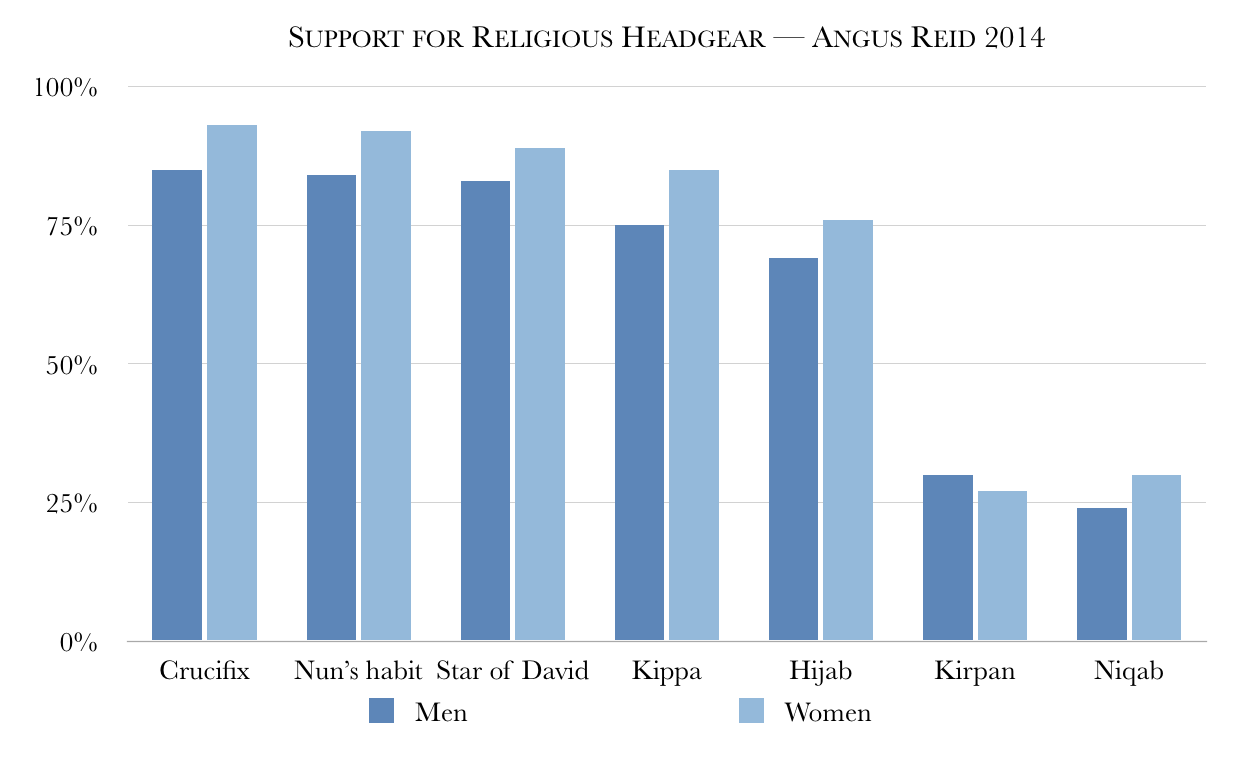
Canadian_Multiculturalism_Integrated_Book_DraftAs noted by John Geddes, Minister Alexander surely knows the difference between a hijab and niqab (mainly worn in Gulf Arab countries) and the burqa (worn in Afghanistan where he lived and worked).

As the above chart shows, Canadians clearly make a distinction between the hijab and the niqab, with the former supported by three-quarters of Canadians, the latter only one-quarter.

Is this part of an emerging Quebec strategy to play on xenophobia? Part of the strategy to play the values card? From another Minister, I might assume an inadvertent slip of the tongue.

And sad to see, after Minister Kenney and the Government, were so strong in their opposition to the PQ’s proposed Charter of Quebec Values:

Based on today’s evidence, you would have been wrong. News that the Conservatives sent out a fundraising email on the topic led to a question from Liberal MP Chrystia Freeland in the House. She focused specifically on how the Tory email mentioned that the government was appealing a judge’s ruling “allowing people to wear the hijab while taking the oath.”

The odd thing about that phrase, which Freeland zeroed in on, is that the word “hijab,” at least in Canada, almost always refers to a Muslim woman’s head scarf that covers only the hair, unlike the “niqab,” which also covers much of the face. Directing her question at Citizenship Minister Chris Alexander, a former diplomat who served in Muslim countries, including Afghanistan, Freeland said, “Surely the minister, of all people, ought to know the difference between a niqab and a hijab.”

But Alexander defended his terminology. He alluded to his experiences “living in a majority Muslim country where the hijab has been used to cover the face of women, just as the niqab and just as the burka has been used under the terrible influence of the Taliban, and other obscure entities, in places like Afghanistan and Pakistan.”

I took that to suggest the government might mean to allow the hijab during the citizenship oath, so long as it wasn’t somehow used to cover the face. To be certain I understood properly, I emailed Alexander’s office for a clarification. The first response said Alexander was referring to “the actual covering of the face during the oath.” Just to be certain, I followed up by asking if, in that case, the hijab would be permitted, if it didn’t cover the face.

Instead of answering that question directly, Alexander’s office forwarded me this statement: “As the Prime Minister said, it is offensive that someone would hide their identity at the very moment where they are committing to join the Canadian family. We are opposed to anything that hides someone’s face when reciting the Oath of Citizenship. We believe the oath should be taken freely, openly and proudly for everyone to hear.”

I don’t think that directly answers my question about the hijab. In fact, I remain puzzled about why Alexander injected such a precise term as “hijab” at all into this already fraught debate. Having used it, though, he should now explain in plain language exactly how he means to be understood.

I assume he means it in a different way than Defence Minister Jason Kenney did, back when he was citizenship minister in 2013, and the Quebec Charter of Values debate was roiling, and he tweeted: ”A child is no less Canadian because she or he wears a kippa, turban, cross, or hijab to school.”

Citizenship minister’s office declines to clarify “hijab” reference.

‘Hipster hijabi’ movement brings high fashion to conservative Islamic clothing

Not surprising that this trend should develop, particularly but not uniquely in the US:

The hipster hijabi movement is the byproduct of a young generation of Muslim women coming of age. It grew organically, spurred in part by social media, and continues to take on new meaning by the women who embrace it.

Summer Albarcha coined her photo-sharing Instagram account “Hipster Hijabis” in 2012, when the teenager from St. Louis, Missouri was just 16. She now has almost 23,000 people following her on Instagram. Her loyal following prompted New-York based label Mimu Maxi, run by two Orthodox Jewish women, to send her one of their popular maxi skirts to model.

The collaboration caused a stir, with many Jewish customers blasting Mimu Maxi for featuring a Muslim woman in hijab. Albarcha says the experience only reaffirmed the universal struggle women of all faiths and backgrounds have when trying to find stylish conservative pieces to wear.

“It came out that our ideas of wanting modest fashion and in promoting it is something really similar and something we have in common between our religions,” she said. “We should both be working together to embrace this idea and expand it.”

There also are challenges from within the Muslim community. Women in hijab wearing eye-catching styles often find themselves at odds with conservatives who say hijab should be about covering a woman’s beauty and concealing it from strangers.

“People are resistant to change and people like to keep things the same,” said fashion blogger Maria Al-Sadek. “It’s just like a stigma to be stylish and resemble Western wear sometimes.”

Last year, a group called Mipsterz, or Muslim Hipsters, made a short video of a group of American Muslim women skateboarding in heels and showing off their ultra-stylish hijabi styles. The video drew mixed reactions, including criticism from people who thought it bent too much toward Western notions of beauty and went against Islamic principles of humility.

‘Hipster hijabi’ movement brings high fashion to conservative Islamic clothing.

Jonathan Kay: The space between the hijab and niqab is where our anxieties lie

Jonathan Kay on the contrast between the hijab and the niqab, following the experience of a young non-Muslim woman wearing a hijab for a week. I think he largely has it right on the contrast between the hijab being compatible with integration, the niqab not:

One of the effects of the niqab is that it strips away all of the informal social cues that we typically rely on when we talk to people: the smiles, raised eyebrows, furrowed brows and such that tell us if our jokes are funny or not, our stories interesting or not, our presence welcome or not. The Burqa signals to the non-burqa-wearer that, to the extent he is capable of arousing any emotion at all, it is of the negative variety. In such a situation, most of us non-burqa folks are likely to put on a nervous smile, say something harmless, and get any necessary social or commercial interaction over with as quickly as possible so as not to induce the fear of sexual predation that, the niqab’s existence implicitly signals, is but thinly suppressed in all of us.

Since 9/11, all Western societies have become obsessed with the way Muslim women dress. (Indeed, in parts of Quebec, it has become a sort of full-blown neurosis.) But Rawhani misunderstands the issue if she thinks that this is really about the hijab. It is about our basic, socially felt human need to see the faces  of those we interact with. The fact that we politely tolerate those who live behind masks bespeaks Canadian civility. But it does not mean the underlying practice is in any way healthy or desirable.

Jonathan Kay: The space between the hijab and niqab is where our anxieties lie | National Post.

Ethan Cox: More Islamophobia in Quebec | National Post

Valid commentary on the tragic case of a women who died when her scarf became caught up in a Montreal metro escalator:

In the case of such a human tragedy, should we not put aside the petty political point-scoring, and the scarcely-veiled racism, for long enough to acknowledge that a woman died, a fact equally tragic no matter what religion she practiced? Ultimately, the responsibility was on the Journal’s editors to exercise restraint, rather than reach for the most inflammatory headline available to them. Instead, they emptied a jerry-can of gasoline all over the tinderbox that is Quebec today, and lit a match. (For those who’d suggest that a complaint to the Quebec Press Council may be in order, no such luck — Quebecor withdrew from that voluntary oversight mechanism several years ago.)

Comments on social media, such as one which celebrated the death and expressed hope it would lead Muslims to learn their lesson about not wearing the hijab in Quebec, are indicative of the prejudice stirred up by this case. Another said simply enough “one less terrorist in Quebec.”

It’s time to take a stand against the creeping scourge of Islamophobia, which is a problem not only in Quebec, where the odious tone of the debate regarding the so-called Charter of Values has put it under a spotlight, but across the country. Because at the end of the day, a scarf is just a scarf, and how it was worn should matter as little as its colour in responding to a tragic accident.

Ethan Cox: More Islamophobia in Quebec | National Post.