Cornellier: De l’huile sur le feu

More Quebec discussions on integration:

Cet été, dans un parc de Joliette, je travaillais mes coups de tennis avec mon lance-balles. Cette machine suscite toujours la curiosité des enfants. Ce soir-là, donc, un enfant de sept-huit ans est entré sur le court pour observer ça et pour m’aider à ramasser mes 75 balles. Nous avons jasé un peu. Il m’a dit s’appeler Mohammed et aller à l’école du quartier. Sa petite soeur est venue se joindre à nous, mais n’a pas pu participer à la conversation puisque, n’ayant pas commencé l’école, elle ne parlait qu’en arabe.

En retournant chez moi, je me disais, rempli d’optimisme, que tout était là : si on veut que l’immigration soit une chance et non une menace pour le Québec, il faut aller à la rencontre des nouveaux arrivants, les accueillir chaleureusement, leur parler, en français, comme à des amis, leur offrir la vie avec nous, qui sommes là depuis un bout, comme une aventure commune. Je n’ai pas peur de Mohammed et de sa petite soeur. Je souhaite, au contraire, les entendre dire « nous autres », en parlant des Québécois, dans dix ans.

Je sais bien qu’on ne fait pas de politique avec de pareils bons sentiments et que l’intégration des nouveaux arrivants ne va pas sans défi. Mon anecdote vise simplement à illustrer que je n’adhère pas à la théorie du « grand remplacement » et que je crois à la possibilité d’une intégration réussie des immigrés, moyennant des compromis de part et d’autre.

Dans Les déclinistes (Écosociété, 2023, 152 pages), l’essayiste Alain Roy, directeur de la revue L’Inconvénient, critique avec sévérité le discours de certains intellectuels opposés à l’immigration, surtout si elle est musulmane. Renaud Camus, Alain Finkielkraut, Éric Zemmour, Mathieu Bock-Côté, Michel Houellebecq et Michel Onfray sont dans sa ligne de mire.

Roy leur reproche de manquer de rigueur intellectuelle, d’ébaucher des scénarios alarmistes au mépris des données statistiques et de n’avoir aucune solution crédible à proposer aux problèmes qu’ils déplorent. Ces essayistes, écrit-il, jettent de l’huile sur le feu en nourrissant l’islamophobie.

Roy vise juste concernant Camus, Zemmour et Houellebecq, quand celui-ci oublie d’être romancier. Voici, en effet, trois trublions prêts à dire n’importe quoi pour se rendre intéressants, même si cela signifie alimenter un climat de guerre civile en France sur le dos des musulmans.

À l’heure actuelle, les immigrés représentent 10,2 % de la population française. Les personnes de culture musulmane représentent environ 8 % de la population. Parmi elles, seulement 25 % affirment être pratiquantes. On est loin du « grand remplacement ».

Au Québec, 3 % des citoyens sont musulmans. Selon le démographe Guillaume Marois (Le Journal de Québec, 4 septembre 2018), si les tendances actuelles en immigration se poursuivent, les musulmans représenteront 14 % de la population en 2061. Dans le scénario improbable où l’immigration de culture musulmane doublerait, les citoyens qui s’identifient à cette confession représenteraient 19 % de la population. Ainsi, Marois conclut que « le Québec n’est pas en voie de devenir une société musulmane », tout en ajoutant qu’il doit demeurer intransigeant envers les manifestations de l’islam politique.

Alain Roy a donc raison de qualifier de délirante la thèse du « grand remplacement ». Ses critiques, cependant, tournent parfois les coins ronds. Roy, par exemple, dit juste en notant que Bock-Côté, qui ne manquera pas de s’en défendre, est plus un polémiste qu’un essayiste, en ce sens que « sa pensée [est] entièrement déterminée par ses prémisses ». Or, c’est aussi le cas de Roy lui-même.

J’en veux pour preuve le traitement qu’il réserve à Finkielkraut. Ce dernier, c’est vrai, a parfois eu des formules malheureuses dans ce débat. Néanmoins, accuser son essai L’identité malheureuse (Stock, 2013) d’islamophobie est injuste. Contrairement à ce qu’affirme Roy, Finkielkraut n’écrit pas que les musulmans sont des « citoyens inassimilables ». Il note que la diversité culturelle se transforme parfois en chocs culturels, mais il ajoute qu’« aucune de ces différences n’est immuable » ou insurmontable. Il souligne, plus loin, que des Français d’adoption, en 1940, ont rejoint le général de Gaulle dans son combat pour la France et cite Lévinas disant que cette dernière « est une nation à laquelle on peut s’attacher par le coeur aussi fortement que par les racines ».

Finkielkraut insiste aussi sur le fait qu’il est « impératif » de ne pas « faire payer tous les musulmans pour le radicalisme islamique ». Avec Claude Lévi-Strauss, il plaide à la fois contre « la tentation ethnocentrique de persécuter les différences » et contre « la tentation pénitentielle de nous déprendre de nous-mêmes pour expier nos fautes ». Ça se défend.

C’est d’ailleurs comme ça, fraternellement, mais sans m’effacer, que je veux accueillir Mohammed.

Essayiste et poète, Louis Cornellier enseigne la littérature au collégial.

Source: De l’huile sur le feu

Sean Speer: Not all population growth is created equal

An odd and unclear column.

The first two points are factual: that immigrants are older than people born in Canada (even if many come with young children or have children once in Canada), and that it tends to be more concentrated in out urban areas.

But conclusion seems deliberately opaque, suggesting a concern over composition and change of Canada’s population, that can be read as either a dog whistle or flirting with a variant of the “great replacement theory,” even if not his intent.

“A prudent position would be to recognize the benefits of large-scale immigration without assuming that it can be raised to unprecedented levels or become solely responsible for the country’s population growth free from consequence. Maximalist ends without due consideration of the consequences of maximalist means is rarely the basis of good public policy. Immigration is no exception.”

Last week the popular American economics blogger Noah Smith publishedan essay entitled “Maximum Canada” in which he outlined the success of Canadian immigration policy and the benefits of a bigger national population. 

His observations follow similar commentary in recent months in favour of the so-called “Century Initiative” in which Canada aspires to reach 100 million residents by 2100. The basic premise is that a much larger population would boost Canada’s economic and geopolitical influence around the world, lessen its asymmetry vis-à-vis the United States, and create a bigger domestic market for trade and commerce.

These arguments are generally compelling. There’s certainly something of a correlation between population size and global influence. The exceptions are far outweighed by the rule. 

The main problem with this analysis however is that it’s too focused on population growth as an end and fails to properly scrutinize the means. Globe and Mail columnist Andrew Coyne recently argued for instance that the target of 100 million Canadians by 2100 isn’t even that ambitious because it broadly tracks population growth patterns over the past several decades. As he explained: 

To get to 100 million in 77 years—two and a half times our current level—implies an annual growth rate of 1.2 per cent. By comparison, over the last 77 years, our population more than tripled, from 12.3 million in 1946. That works out to 1.5 per cent annually. To be sure, birth rates were higher in the 1950s and 1960s; population growth today comes almost exclusively from immigration. Fine: let’s take 1970 as our starting point. Average annual population growth: 1.2 per cent. The Century Initiative proposal is essentially a continuation of the status quo.

Yet there’s something qualitatively different about population growth that’s driven by a combination of natural growth (births minus deaths) and immigration and growth that solely comes from immigration. Smith, Coyne, and others fail to grapple with these key differences. 

It doesn’t mean that Canada shouldn’t aspire to have a larger population or even necessarily that we shouldn’t pursue an immigration policy that ultimately gets us there. But before fully signing onto “maximum Canada”, we need to account for the fact that all forms of population growth aren’t the same. (This isn’t, by the way, a normative judgement. It’s merely an observation about the practical differences between a society that draws on immigration to supplement its own natural growth and one that relies on it entirely.)

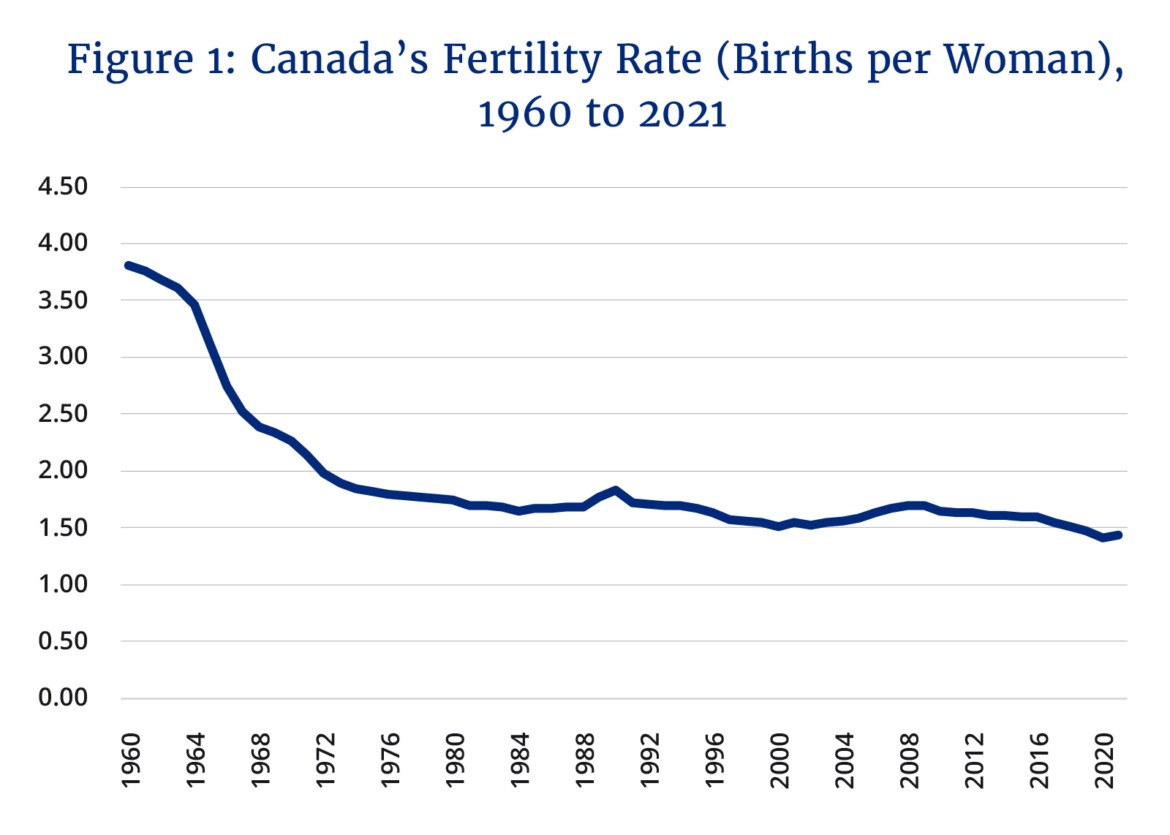
Let’s start with the data. Replacement level fertility is an average of 2.1 children per woman. As Coyne notes, Canada’s fertility rate dipped below replacement level beginning in the early 1970s. It’s now just 1.4 children per woman (see Figure 1).

Although the country’s fertility rate has been below the replacement rate for the past half century, its current rate represents an unprecedented low. As Figure 1 shows, it has steadily fallen to now below the G-7 average and is increasingly one of the lowest rates in the world.

Graphic credit: Janice Nelson

That means that immigration isn’t just doing most of the heavy lifting when it comes to population growth. It’s now nearly solely responsible. Take 2022 for instance. Canada’s population grew by more than 1 million people—the largest single-year growth since 1957—and immigration was responsible for roughly 96 percent. 

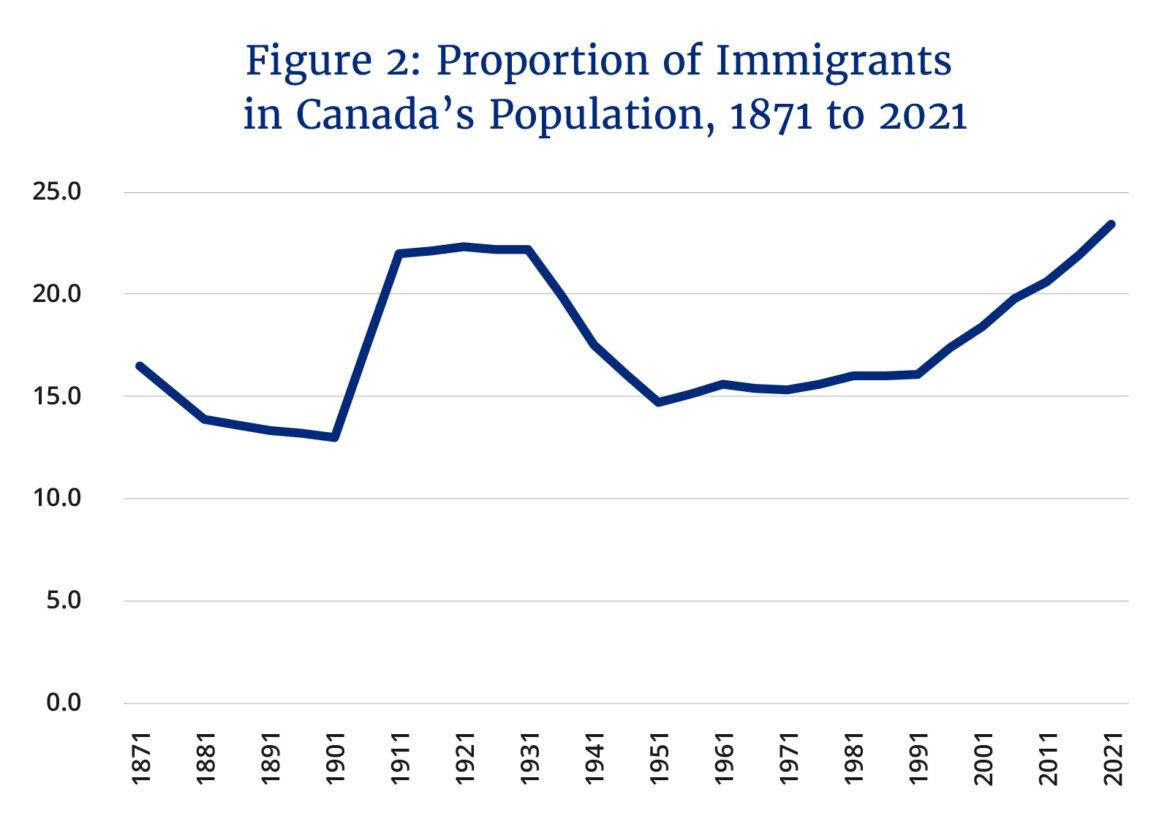
Estimates are that immigration will reach 100 percent of population growth by 2032 and will remain the main driver for the coming decades. As a result, Statistics Canada projects that the overall share of Canada’s immigrant population (which consists of landed immigrants) will rise from 23.4 percent in 2021 (see Figure 2) to as high as 34 percent in 2041. 

Graphic credit: Janice Nelson

There are various ways in which immigration-driven population growth is different than natural growth. These differences will ostensibly produce outcomes that are distinct from past experiences and therefore may limit the utility of historical instruction. There’s an onus on proponents of the Century Initiative to account for them in their analysis and advocacy. 

The first is that it’s older. Although the immigrant population is generally younger than the average age of non-immigrant residents, it’s still self-evidently older than babies. The majority of immigrants fall within the core working age group (25 to 54). Just over one quarter are aged 15 and younger. Immigration-driven population growth may slow the rise of (and even temporarily lower) the country’s average age but it won’t, according to leading economist David Green, “substantially alter Canada’s age structure and impending increase in the dependency ratio.”

The second is that it’s far less geographically distributed. More than half of recent immigrants settle in Montreal, Toronto, and Vancouver and nine of ten settle in a census metropolitan area. Natural growth by contrast would presumably more closely reflect the general distribution of population across the country. Immigration-driven population growth should therefore be expected to impose even greater pressure on housing and other infrastructure in our major cities and contribute to a growing urban-rural divide in our economic and political outcomes. 

The third is that it will reshape the country’s culture. That may not be a bad development—particularly in the eyes of those who value diversity—but it still represents a qualitative difference relative to natural growth that requires a bit more attention. 

Consider two scenarios. First, there’s a strong possibility that it erodes the place of the French language and francophone culture in our national life as Quebec’s share of the total population declines and its conception of binationalism is fully consumed by multiculturalism. Second, it’s also possible that it could at times conflict with the goal of Indigenous reconciliation to the extent that immigration-driven growth produces a growing share of the population that can plausibly argue that it has no role or responsibility for the historic injustices faced by Indigenous peoples. (There are growing calls—including from the Truth and Reconciliation Commission—to expand newcomer education about the Indigenous experience presumably to mitigate this risk.)

These considerations don’t challenge the case that immigration has been a net positive for the country or that we should maintain high immigration levels in the face of aging demographics or even that we should aspire to a bigger population. They do however dispute the idea that the source of population growth is irrelevant. Natural growth and immigration-driven growth may produce the same number but their effects are necessarily different. 

What is envisioned by the Century Initiative and others is essentially without precedent. Immigration has never been solely responsible for such a run-up of Canada’s population. History cannot provide much of a guide. Only prudence can. 

A prudent position would be to recognize the benefits of large-scale immigration without assuming that it can be raised to unprecedented levels or become solely responsible for the country’s population growth free from consequence. Maximalist ends without due consideration of the consequences of maximalist means is rarely the basis of good public policy. Immigration is no exception.

Source: Sean Speer: Not all population growth is created equal

Brownstein: No, Ann Coulter, I Am Not Responsible for the ‘Great Replacement’ Theory

Good response and political assessment on the need for shared narratives for whites and visible minorities:

Ann Coulter, in so many words, thinks that I am responsible for the mass shooting in Buffalo in mid-May.

Not me alone. After the shooting, Coulter wrote a column dismissing the idea that Republican politicians and commentators had popularized the “Great Replacement” theory, a conspiracy theory that the young, white Buffalo shooter cited as a motivation before killing 10 people at a supermarket in a predominantly Black neighborhood. Instead, Coulter argued that the theory had been popularized by political analysts and Democratic operatives who have predicted that the nation’s changing demographics will benefit Democrats over time.

In particular, Coulter, the Fox News host Tucker Carlson, and others on the right have cited the work of journalists like me, the Brookings Institution demographer William Frey, and the electoral analysts John Judis and Ruy Teixeira, authors of The Emerging Democratic Majority, claiming that, by writing about demographic change and its electoral impact, we are responsible for seeding the idea that white Americans are being displaced. “If you don’t want people to be paranoid and angry, maybe you don’t write pieces like that and rub it right in their face,” Carlson, who has relentlessly touted replacement theory on his show, declared in a recent monologue.

It might go without saying that documenting demographic change is not the same as using it to incite and politically mobilize those who are fearful of it. It’s something like the difference between reporting a fire and setting one. But given how many right-wing racial provocateurs are trying to disavow the consequences of their “replacement” rhetoric, it apparently bears explaining how their incendiary language differs from the arguments of mainstream demographic and electoral analysts.

Let’s start with defining replacement theory. It’s a racist formulation that has migrated from France to far-right American circles to some officials and candidates in the GOP mainstream. In its purest version, the theory maintains that shadowy, left-wing elites—often identified as Jews—are deliberately working to undermine the political influence of native-born white citizens by promoting immigration and other policies that increase racial diversity. This conspiracy theory was the inspiration, if that’s the right word, for the neo-Nazis who chanted during their 2017 march in Charlottesville, Virginia, that “Jews will not replace us.”

Stripped of the overt anti-Semitism, replacement theory has become a constant talking point for Carlson. A growing number of Republican politicians, such as House Republican Conference Chair Elise Stefanik and the Ohio Senate candidate J. D. Vance, have incorporated versions of it into their rhetoric. It’s the most virulent iteration of the core message former President Donald Trump has imprinted onto his party: Republicans are your last line of defense against diverse, urban, secular, LGBTQ-friendly, “woke” Democrats, who are trying to uproot the nation from its traditions and transform it into something unrecognizable.

Undoubtedly, some Democrats over the years have argued that the party would benefit from higher levels of immigration. But this is the first point of difference between mainstream demographic analysis and replacement theory: No serious student of history or politics believes that a Democratic plot to import “more obedient voters from the Third World,” as Carlson puts it, has been the driving force behind U.S. immigration policy. Until the 1990s, most of the key decisions in modern immigration policy were bipartisan—from the passage of the landmark 1965 immigration-reform act to the amnesty for undocumented immigrants signed into law by President Ronald Reagan to the Republican-controlled Senate’s passage of comprehensive immigration reform in 2006, with unwavering support from President George W. Bush. A Democratic-led conspiracy that ensnared Reagan and Bush would be pretty impressive—if it weren’t so implausible.

Second, replacement theory pinpoints immigration policy, particularly the potential legalization of undocumented immigrants, as the key reason that white Americans are being “displaced.” But Frey, the Brookings demographer, has repeatedly documented that immigration is no longer the principal driver of the nation’s growing diversity. As he wrote in a 2020 paper, census “projections show that the U.S. will continue to become more racially diverse” no matter what level of future legal immigration the U.S. government authorizes. Diversity will grow somewhat faster under scenarios of high rather than low immigration, but diversity will increase regardless, Frey notes, because it is propelled mostly by another factor. Among those already living in the United States, people of color have higher birth rates than white people, who are much older on average. Even eliminating all immigration for the next four decades would not prevent the white share of the U.S. population from declining further, Frey’s analysis of the census data found.

A third big difference between replacement theory and analyses of demographic change revolves around the role that race plays in the changing balance of political power in America. Many on the right see racial change as the key threat to the Republican Party’s electoral prospects. But demographic analysts have never seen racial change as sufficient to tilt the electoral competition between the parties. White Americans still cast somewhere between two-thirds and three-quarters of all votes (depending on the data source). That number has been steadily declining, at a rate of about two to three percentage points every four years. Even at that pace, it would be another seven or eight presidential elections—roughly until 2050—before minorities cast a majority of the vote.

No party can write off America’s white majority for that long. Instead, I and other analysts have long argued that Democrats have the opportunity to build a multiracial coalition composed of both the increasing minority population and groups within the white population that are most comfortable with a diversifying America: namely those who are college-educated, secular, urban, and younger, especially women in all of those cohorts. The combination of these white groups (many of which are growing) and the expanding minority population is what I have called the Democrats’ “coalition of transformation.”

Even Democratic organizations that are focused on maximizing political participation among nonwhite voters recognize the centrality of building a multiracial coalition, on electoral as well as moral grounds. “First and foremost, multiracial democracy is inherently inclusive of white people,” says Jenifer Fernandez Ancona, the vice president and chief strategist for Way to Win, which helps fund organizations and campaigns focusing on voters of color. “I don’t imagine an America in which a winning coalition across the nation and in the key states we’re going to need to be winning … [is] without white people as part of the coalition.”

This leads to perhaps the most important divergence between replacement theory and theories of demographic change. Those on the right who push replacement theory tell their mostly white supporters that they are locked in a zero-sum competition with minorities and immigrants who are stealing what rightfully belongs to them: electoral power, economic opportunity, the cultural definition of what it means to be a legitimate American. “There’s always this underlying theft—they are taking these things by dishonest means; they are taking what is yours,” explains Mike Madrid, a longtime Republican strategist who has become a leading critic of the party’s direction under Trump.

By contrast, I and other analysts have emphasized the interdependence of the white and nonwhite populations. Building on work from Frey, I’ve repeatedly written that America is being reshaped by two concurrent demographic revolutions: a youth population that is rapidly growing more racially diverse, and a senior population that is increasing in size as Baby Boomers retire but that will remain preponderantly white for decades. (The Baby Boom was about 80 percent white.) Although these shifts raise the prospect of increased political and social tension between what I called “the brown and the gray,” the two groups are bound together more than our politics often allows. A core reality of 21st-century America is that this senior population will depend on a largely nonwhite workforce to pay the taxes that fund Social Security and Medicare, not to mention to provide the medical care those seniors need.

While the likes of Carlson and Coulter tell white Americans to fear that immigrants or people of color are replacing them politically, financial security for the “gray” is impossible without economic opportunity for the “brown.”

This isn’t to say that there is no political competition between older white Americans, who make up the core of the Republican coalition, and younger nonwhite Americans, who are more and more central to the Democratic coalition. In fact, a mistake that I and many other demographic and electoral analysts made over the past decade was to underestimate how big a coalition a candidate like Trump could mobilize in the name of protecting culturally conservative, white, Christian America.

For many years, I have argued that the diversification of the Democratic coalition wouldn’t always work to the party’s electoral advantage. As the party’s most culturally conservative components sheared off, I believed, Democrats would need to take more consistently liberal positions on social issues, which in turn would alienate more centrist voters from the party. That ideological re-sorting, I wrote in National Journal in 2013, would both “increase the pressure” on the Democratic Party “to maintain lopsided margins and high turnout among minorities and young people” and “make it tougher for [Democrats] to control Congress, at least until demographic change ripples through more states and House districts.” That prediction has held up.

At the same time, I stressed—and quoted experts from both parties who shared the view—that Republicans would face a growing long-term challenge in winning the White House if they could not improve their performance among minorities, young people, and college-educated and secular white voters. (The famous Republican National Committee “autopsy” of Mitt Romney’s 2012 presidential loss largely reached the same conclusion.) In one sense, that prediction held up too: Democrats won the popular vote in 2016 and 2020.

But, to a greater extent than I and others had forecast, Trump’s ability to win an Electoral College majority in 2016, and the fact that he came so close again in 2020, made clear that Republicans could seriously compete for the White House with what I have called their “coalition of restoration,” centered on the nonurban, non-college-educated, and Christian white voters who are most alienated by the changes remaking 21st-century America. The difficulty for the Democrats in holding the House, and especially the Senate, which favors smaller states that tend to elect Republicans, was even greater than I and others had expected.

Trump’s success among blue-collar white voters in key Rust Belt states was at least somewhat foreseeable. But his unique persona and message—a more open appeal to white racial resentments than any national figure since George Wallace, a bruising economic nationalism, and a sweeping condemnation of “elites”—generated even greater margins and larger turnout among his core supporters than I thought possible. And although some center-right suburban voters abandoned the GOP in the Trump era, many demographic analysts like me—along with the Never Trump movement—underestimated the number of Republican voters who would still vote for Trump or Trumpist GOP candidates as a way to block Democrats and advance other priorities, including tax cuts and conservative judicial appointments.

A new development in 2020 further solidified Trumpism’s hold on the GOP:Trump’s improved performance among Latino voters. That has convinced many Republicans that they can energize racially resentful white voters using nativist and racially coded messages, while still gaining ground among Latinos who are drawn mostly to the Republican economic agenda, as well as conservative views on some social issues such as abortion. This trend has proved an uncomfortable complication for the purveyors of replacement theory, who often portray Latinos as the invidious replacers. In a recent monologue, Carlson tried to square the circle by insisting that Democrats are still trying to displace white voters, but that they have miscalculated about the loyalties of Latino voters.

Due in part to the provocations of Carlson and others, the United States appears trapped in a cycle of increasing racial, generational, and partisan conflict that is escalating fears about the country’s fundamental cohesion. But imagine, Frey suggested to me, if instead of trying to convince older white Americans that younger nonwhite Americans are displacing them, political leaders from both parties emphasized the growing interdependence between these two groups. Ancona, of Way to Win, offers one version of what that message could sound like: “If we start telling a story that America is the richest country in the world, that there is enough pie for everyone, there is no need for ‘replacement.’ The whole construct is wrong. There should be enough for all of us to be free and to be healthy and to be living the life we want to live. There is a beauty in that story we could tell people, but it’s just not being told in a way that it needs to be.”

The refusal of many GOP leaders to condemn replacement theory even after the Buffalo shooting, and their determination to block greater law-enforcement scrutiny of violent white supremacists, underscores how far we are from that world. To me, the safest forecast about the years ahead is that the Republican Party and its allies in the media will only escalate their efforts to squeeze more votes from white Americans by heightening those voters’ fears of a changing country. I’d like to be wrong about that prediction, too, but I’m not optimistic that I will be.
Source: No, Ann Coulter, I Am Not Responsible for the ‘Great Replacement’ Theory

Doyle: Tucker Carlson didn’t shoot anyone, but he’s monetizing white panic

Good column. Unethical business and financial strategy…

They’re lining up to condemn Tucker Carlson of Fox News and understandably so. That shooter, a self-declared white supremacist who killed 10 people in Buffalo, had reportedly posted an online manifesto espousing the Great Replacement theory, and Carlson is the biggest purveyor of that conspiracy belief.

The conspiracy theory is that non-white individuals are being deliberately brought into the United States (and other Western countries) to supplant white voters, in order to further a political agenda. It’s been around for decades, this crackpot theory, but Carlson is the one who mines it with cunning and determination. He’s touched on it often and sometimes been more brazen.

On one of his shows in April, Carlson said: “I know that the left and all the little gatekeepers on Twitter become literally hysterical if you use the term ‘replacement,’ if you suggest the Democratic Party is trying to replace the current electorate, the voters now casting ballots, with new people, more obedient voters from the Third World. But they become hysterical because that’s what’s happening, actually.”

Moral condemnation of Carlson is in order. He knows what he’s doing. (His use of key words is telling, and we note Pierre Poilievre aims anger at various “gatekeepers” while campaigning for the leadership of Canada’s Conservative Party.) But there’s context to take into account. First, Carlson is only the latest in a long list of demagogues in the United States who incite hate based on fear of non-white ethnicities. You don’t need to be a historian to be aware of Huey Long, George Wallace and Pat Buchanan. You don’t need to be a student of U.S. media to know that there is a through-line going back from Alex Jones and Rush Limbaugh to Father Charles Coughlin, the “radio priest” who had an audience of tens of millions in the 1930s, peddling anti-Semitism and fear about immigrants being “foreign invaders.”

The American tolerance of demagogues who incite hate is an anomaly in Western countries. But the matter was settled decades ago when First Amendment rights were solidified by the courts and all kinds of commentary and assertions were allowed to participate in what U.S. Supreme Court Justice Oliver Wendell Holmes Jr. called, “the marketplace of ideas.”

Carlson is an entrepreneur in that marketplace, as is his employer, Fox News, mining white panic and other alarmist ideas for profit. It’s just business and it’s not new.

What is new is the absence of truly mass media and entertainment. Carlson may only have a tiny fraction of the audience that Father Coughlin once had, but he’s stirring up what exists in the dark corners of the internet, mainly unseen. And there is very little to counter what Carlson is stirring up. The remaining remnants of mass-appeal news and entertainment outlets shine their lights on a sunlit America, not its dark subculture corners. Network TV and cable channels cling on to smaller audiences than before, and only live sports seem capable of engaging a mass audience. If there’s no mass audience, then the expectation of a mass revulsion at Tucker Carlson is futile.

A lot of Americans have no idea that Carlson might be connected to the mass shooting in Buffalo. You don’t have to be a TV critic to understand that Fox News now exists in a shattered landscape in which there is simply too much TV – more and more streaming services producing more content than anyone can catch up with, plus network TV, cable and an array of web services. There’s no national narrative, there are only sparks flying occasionally that briefly illuminate very dark spaces.

While Fox News monetizes white fear of change, other outlets monetize escapism. There have been few attempts to dramatize or illustrate the dangers of racist subcultures. One of the few, HBO’s Watchmen, was very powerful but probably had more critical accolades than it had engaged viewers. The same applies to HBO’s Lovecraft Country, and both present structural racism in the context of an alternative reality or the supernatural. The movies of Jordan Peele, Get Out and Us, treat racial paranoia with seriousness, but they are outlier entertainment in a world of Marvel superheroes.

One could take comfort in the fact that Grey’s Anatomy has been going for 18 seasons in part because it looks like the United States; the diversity of characters is striking and over the years it simply became steadily more and more inclusive. Right now, mind you, diversity is the devil that Fox News and Tucker Carlson are warning viewers about. And there’s more money to made from that in a media and entertainment landscape shattered beyond recognition. That’s the important context.

Source: Tucker Carlson didn’t shoot anyone, but he’s monetizing white panic