ICYMI Globe Editorial: There’s a growing crisis at Roxham Road, and Ottawa doesn’t have a plan to fix it

Valid critique:

Is Canada in the midst of a border crisis? It’s hard to tell. Prior to the outbreak of the COVID-19 pandemic in 2020, however, there was no doubt about it.

In 2017, a dramatic surge in the number of people entering Canada illegally on an uncontrolled rural road running across the border between Quebec and New York State was the hot story of the summer.

Source: There’s a growing crisis at Roxham Road, and Ottawa doesn’t have a plan to fix it

Globe Editorial: How to succeed in Ottawa without ever trying – Immigration excerpt

While over the top, not completely inaccurate either. Continues the increasing contrast between previous Globe events in favour of boosting immigration to a more critical look:

Take immigration. As we have pointed out, what the federal government calls an immigration plan is really just a running tally of new arrivals, lacking any specific goal such as, say, increasing the average standard of living. The federal bureaucracy is instead only committing to an output – X number of immigrants processed each year.

Source: Globe Editorial: How to succeed in Ottawa without ever trying

Globe Editorial: Canada’s immigration plan should involve more than just big numbers

Good editorial, and a sign of a more serious discussion on appropriate levels of immigration and the associated impacts and costs.

A change from the March 2021 Globe event promoted increased immigration and the government’s approach. That in turn prompted my riposte, Increasing immigration to boost population? Not so fast.

As I and others have argued, we need to take these externalities into account in designing and implementation immigration policies and programs, which by their very nature, require joint federal provincial responses:

The word “goal” appears seven times in the Immigration department’s latest annual report to Parliament, a document that purportedly lays out the Liberal government’s vision of how to bring a historic number of permanent residents to Canada in the next three years.

Source: Canada’s immigration plan should involve more than just big numbers

Globe editorial: This is a story about race in Canadian politics. And it’s hopeful

Agree. Recent federal election largely confirms:

This is not a story about race.

But to understand how it isn’t, we have to talk about how, in another, less successful country, it could be.

In 2016, the census found that 31 per cent the residents of the City of Calgary were immigrants. Thirty-six per cent of the population were members of a visible minority, including 9.5 per cent who were South Asian. The picture is almost exactly the same in Edmonton: 30 per cent of residents are immigrants and 37 per cent are visible minorities, including 9.5 per cent who identify as South Asian.

Two weeks ago, the people of Edmonton and Calgary went to the polls and elected new mayors. Both were born outside of Canada. Jyoti Gondek, Calgary’s top magistrate, was born in England to parents of Punjabi descent and came to this country as a child; Edmonton’s Amarjeet Sohi was born in India and immigrated in his teens. On the census, both would be counted among the roughly one in 10 city residents of South Asian descent.

We bring up race not because it was an issue in the elections of Ms. Gondek and Mr. Sohi, but because it was not. And let us give thanks for that.

In many other countries – less happy, less peaceful countries – the story would have been very different. There, race, religion or ethnicity are the basis for politics. Sectarian divides slice through the possibility of shared citizenship, with lives and politics organized along those lines.

That’s how much of the world is. (Ask an immigrant.) In the worst cases, it results in the failed state of Lebanon, or the violently extinguished state of Yugoslavia, or the Rwanda genocide.

But here’s what we believe can safely be said about the mayoral elections in Calgary and Edmonton: The race of the candidates, their religion (or lack thereof), and their status as first-generation Canadians appear to have been irrelevant to most voters. Maybe not all voters, whether pro or con, but surely most.

Consider: Nine out of 10 voters in Calgary and Edmonton are not of South Asian heritage. Yet Ms. Gondek and Mr. Sohi each won 45 per cent of the vote. That means that most of those who voted for them were from “another” community.

And we put the word “another” in quotation marks because, this being Canada in 2021, most voters don’t see it that way. They weren’t marking their ballots through a prism of race. They didn’t see the winning candidates as coming from some other community, but rather as part of their shared community – Calgarian, Edmontonian, Albertan, Canadian – that transcends where you or your parents came from, where you pray or do not pray, and what colour your skin is.

Canadians are not saints, and Canada is not some magic land where racism never existed. It is not some place where no lines have ever been drawn labelling some people as “us” and others as “them.” Canada has a long history of evolving varieties of sectarian divisions.

But Canada also has a long and accelerating history of expanding the definition of “us,” and extending membership in the shared community to people who, in another place or another time, might have been excluded. For example, until 1954, the mayor of Toronto had always been a Protestant from the Orange Order. But that year, the citizens of Toronto ended all that, electing Nathan Phillips. Phillips was Jewish; nearly all of the city’s residents were not. Most were Protestants. It didn’t matter.

It was a similar story half a century later, in the three mayoral elections won by Naheed Nenshi in Calgary. The vast majority of the people of Calgary are not Ismaili Muslims; it didn’t matter. Overwhelming majorities chose Mr. Nenshi as their representative. And though three-quarters of the residents of Brampton, Ont., are visible minorities, in 2018 they elected Patrick Brown as mayor.

This ability to see beyond differences and biology and faith is something that Canada will need ever more of in its future. Canada is on the road to becoming a majority-minority nation, where no ethnic or racial group is the majority. That’s already the situation in Metro Vancouver and Greater Toronto, and the other big cities are not far behind.

The voting in Calgary and Edmonton is a reminder that this future is hopeful, not ominous. If a Canadian is defined by all that we hold in common, in spite of differences, then everybody’s part of the majority.

Source: https://www.theglobeandmail.com/opinion/editorials/article-this-is-a-story-about-race-in-canadian-politics-and-its-hopeful/

Globe editorial: Why did Ottawa kill GPHIN? Because politicians get no credit for averting a disaster that hasn’t happened yet

Of note, the overall challenge facing governments with respect to longer-term planning and preparation.

Silent on some of the internal decision-making processes that led to the weakening of GPHIN as it is still not clear whether the decision to shutter GPHIN was bureaucratically or politically-driven. Suspect the former given the small resources involved.

Somewhat normal to have tensions between scientific/medical experts and public service generalists but more serious in this case.

Notable recommendation that touches on this: 2.8 There should be sufficient public health expertise in GPHIN’s management to fully understand event-based surveillance.

A new independent review of the mismanagement of Canada’s pandemic early warning system, which was effectively shuttered by the Trudeau government in the months before COVID-19 made itself known in Wuhan, China, says all the right things.

Released Monday, the report urges Ottawa to better fund the Global Public Health Intelligence Network (GPHIN), and to make better use of the invaluable intelligence on disease outbreaks around the world that it gathers by scanning medical reports, media and other markers on a constant basis.

That, of course, is very good advice. It’s a given that, in the future, there will be more outbreaks in our connected world; it’s not a question of if, but when. Maintaining a well-funded early warning system, and creating a risk assessment group inside Canada’s Public Health Agency to analyze its finding and directly advise decision-makers, is a no-brainer.

But here’s the thing: Coming up with good advice on how to prepare for the next pandemic, and getting politicians to act on it, isn’t hard when a disease that has killed more than four million people worldwide, including more than 26,000 in Canada, is still spreading.

As the report itself says, “The best time to discuss pandemic preparedness is when it is most present in the minds of Canadians and of the governments who serve them.” 

Okay. But what happens in five or 10 years, if there’s been no outbreak in the interim, and those same governments start to lose interest in life-saving measures that don’t make headlines but which, if successful, prevent them?

The fate of GPHIN is just one of several glaring examples of what happens when Canadian governments decide that, since a disaster hasn’t happened recently, now must be a good time to cancel the insurance policy.

Created in the early 1990s, and eventually folded into the Public Health Agency of Canada, GPHIN was a world-leading scientific body that tracked outbreaks such as SARS, H1N1, MERS and Ebola, and shared its findings with the World Health Organization.

The Harper government indirectly weakened GPHIN in 2014, when it stripped PHAC of some of its independence. But the Trudeau government delivered the coup de grace in May of 2019, when it told GPHIN to stop its international monitoring and focus on domestic outbreaks.

It’s impossible to say for sure that turning off Canada’s early warning system contributed to Ottawa’s sluggish and confused response to the COVID-19 outbreak in early 2020. It certainly didn’t help.

What may be more important, though, is how the evisceration of GPHIN fits a pattern in Canadian politics.

For instance, after the scare of the SARS epidemic in Toronto in 2003, Ontario’s Ministry of Health and Long-Term Care prepared for a future outbreak by spending $45-million on 26,000 pallets of masks, face shields, needles, disinfectant wipes, disposable thermometers and other vital medical equipment.

But in 2017, the province’s Auditor-General found that more than 80 per cent of the supplies were no longer usable. The stuff had been left to rot, because the government never allocated money to manage and replenish the stocks.

In another example, this one from before the SARS crisis, the Ontario government in 2001 laid off a group of PhD-level scientists hired to watch for emerging diseases. “Do we want five people sitting around waiting for work to arrive?” a Health department spokesman asked at the time.

Yes. Yes we do.

This is going to be the real test of Canada’s postpandemic response: Can measures urgently agreed to while COVID-19 is still an omnipresent threat survive subsequent governments that start to chafe at the independence that GPHIN and PHAC need in order to do their jobs, or become annoyed at money being spent on what may at times look like just a bunch of scientists sitting around waiting for a crisis to arrive?

The GPHIN report is wrong: The best time to discuss pandemic preparedness is not when it is top of mind, but when it has receded to the background and there is no political gain to be had by talking about it.

That’s the critical moment. Canadians won’t automatically be at risk the next time a virus threatens to become a pandemic somewhere on the planet. The danger will come before that, when governments decide to cut back on the vital but unheralded work that could have kept them safe.
Source: https://www.theglobeandmail.com/opinion/editorials/article-why-did-ottawa-kill-gphin-because-politicians-get-no-credit-for/

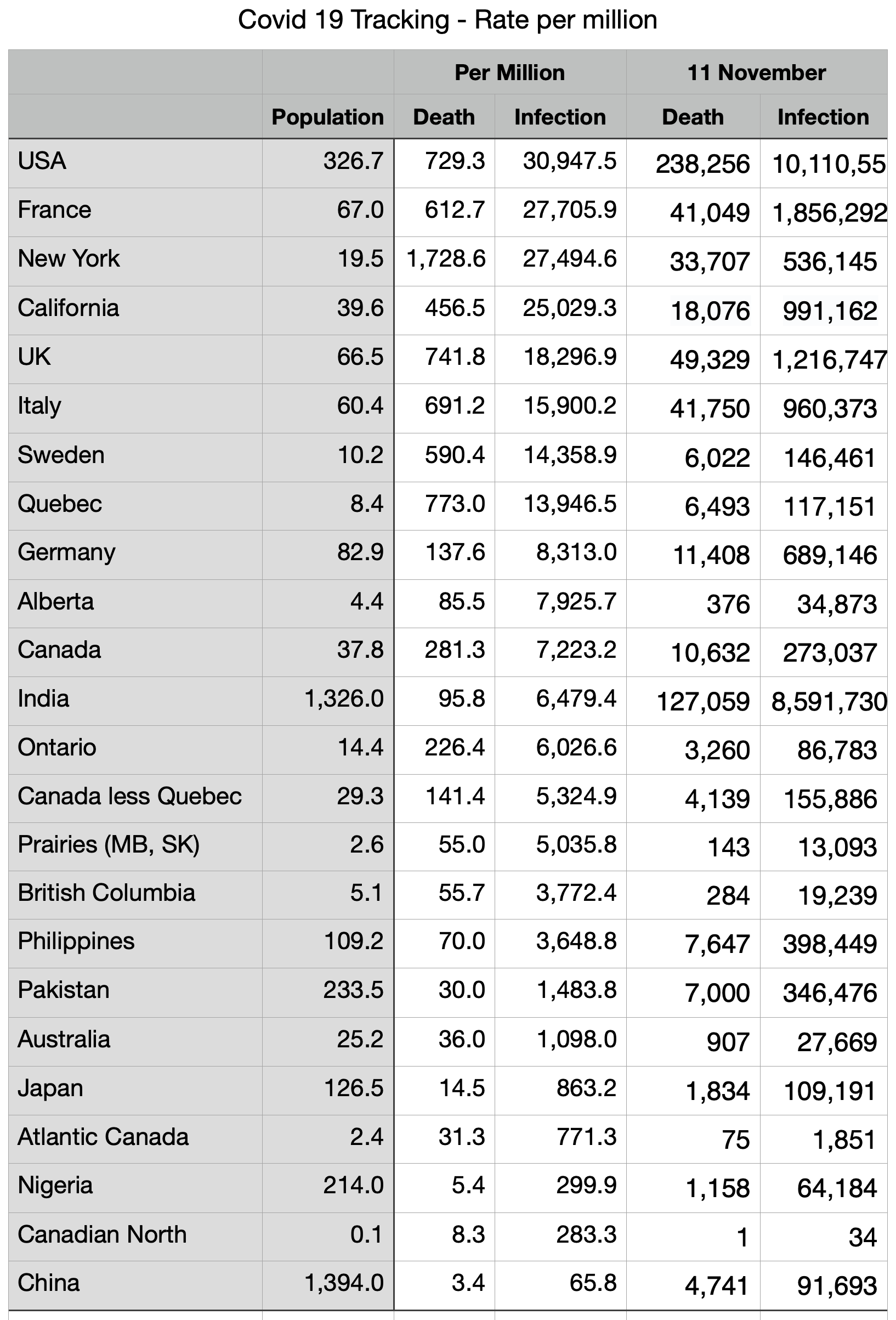
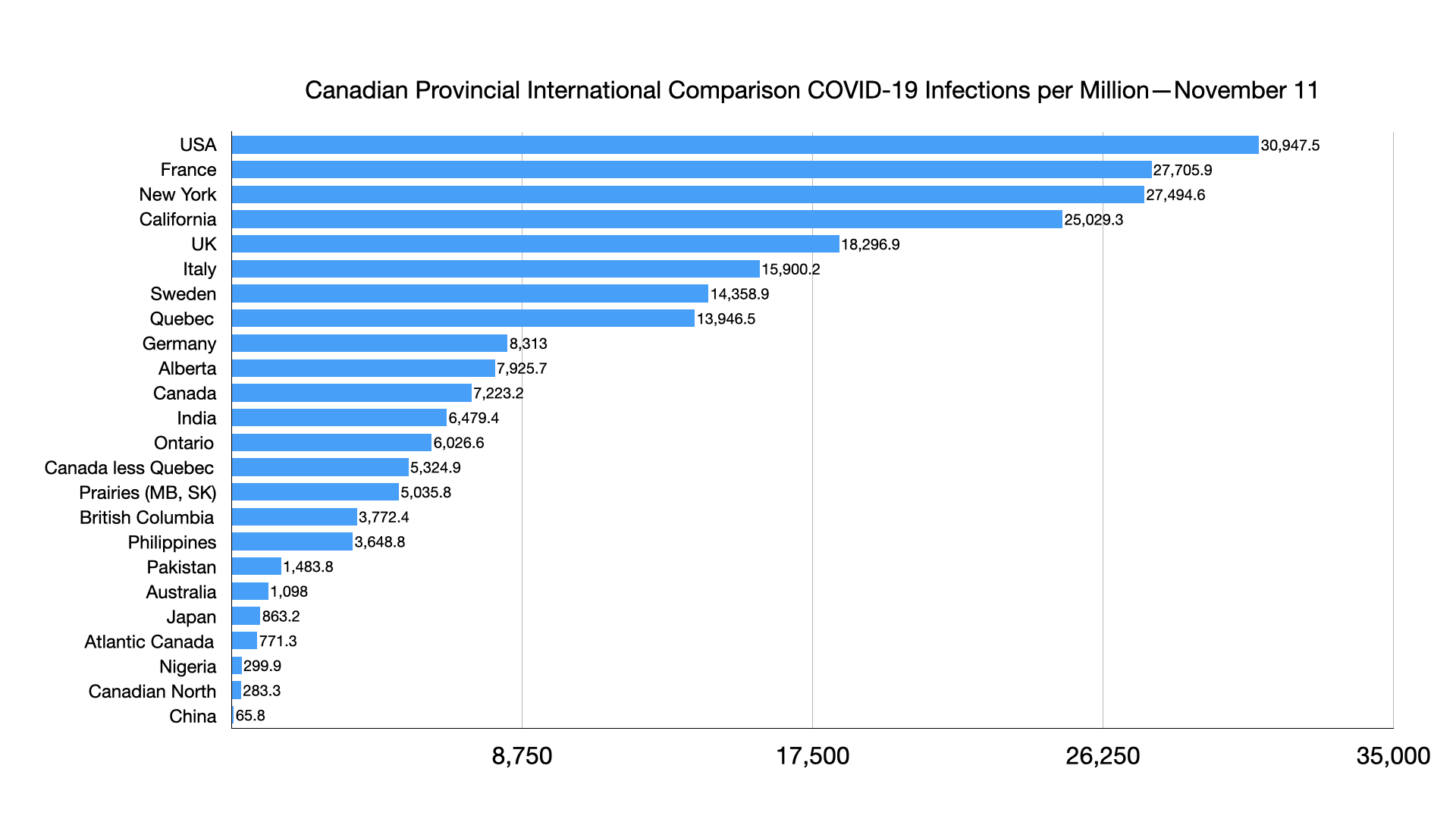
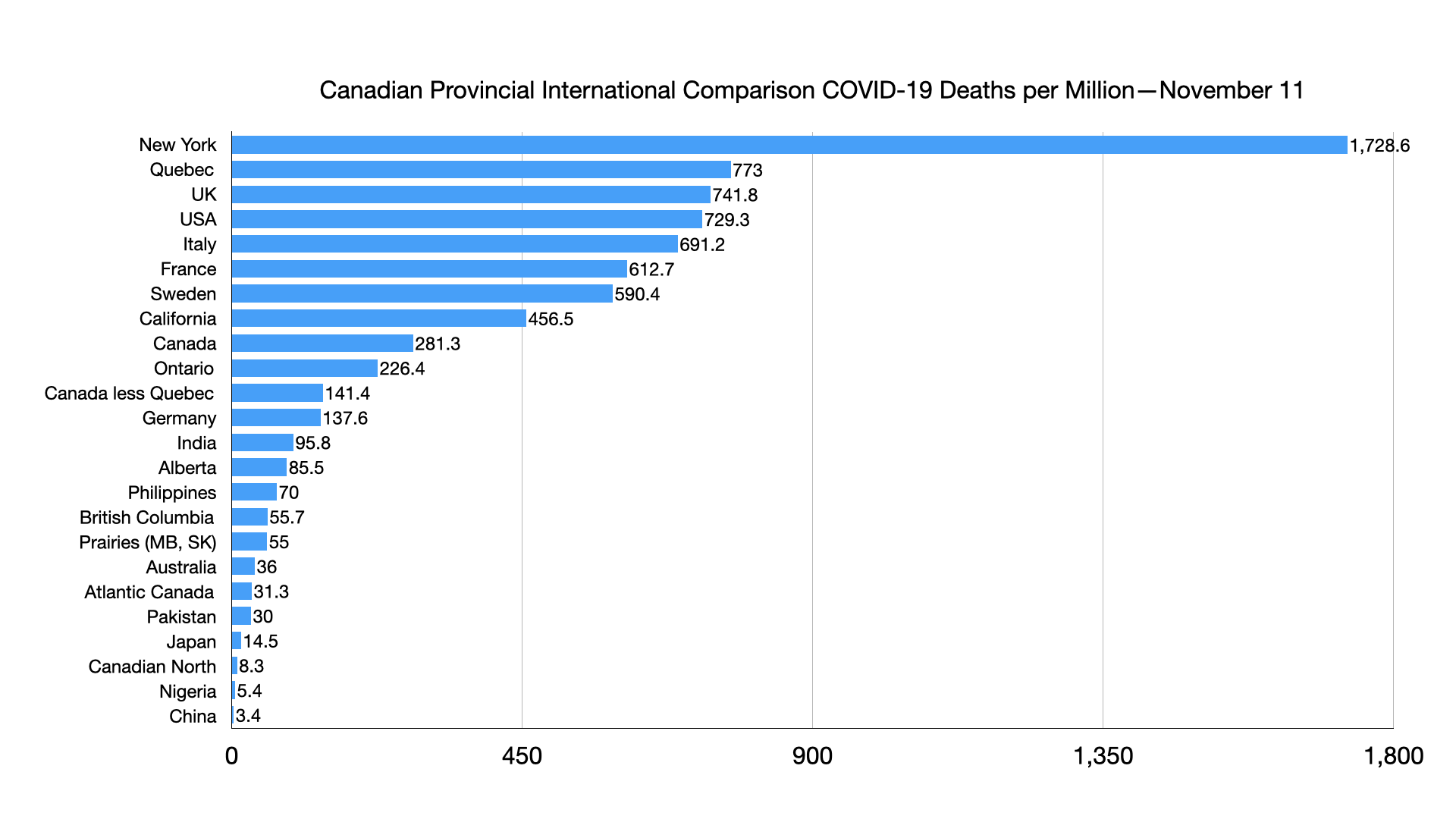
#COVID-19: Comparing provinces with other countries 11 November Update

Main news continues to be with respect to rapid increase in infections in most countries and provinces:
 
Weekly:
 
Infections per million: France ahead of New York, Italy and Sweden ahead of Quebec, British Columbia ahead of Philippines
 
Deaths per millionUK ahead of USA, France ahead of Sweden, Canadian North ahead of Nigeria


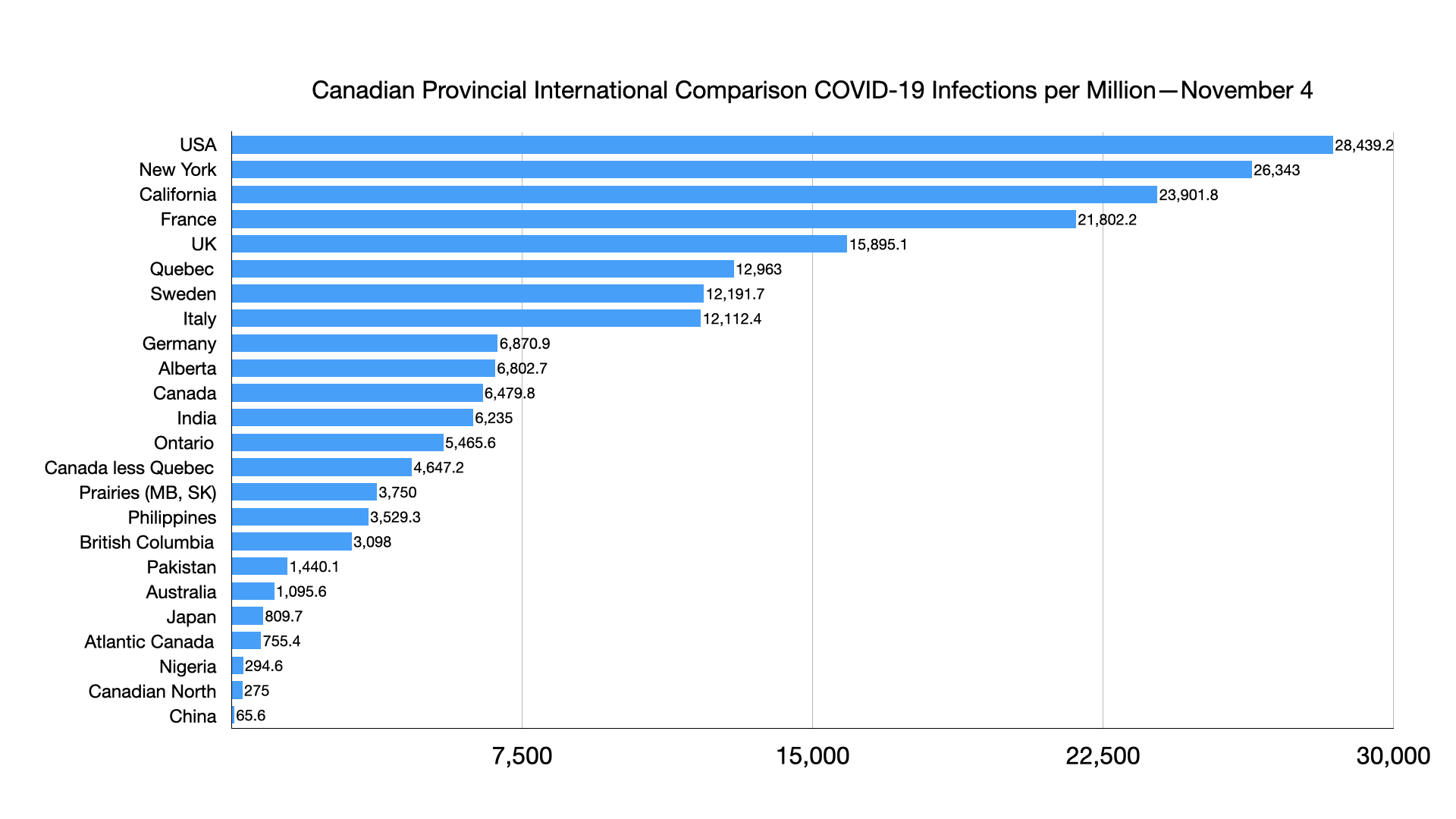
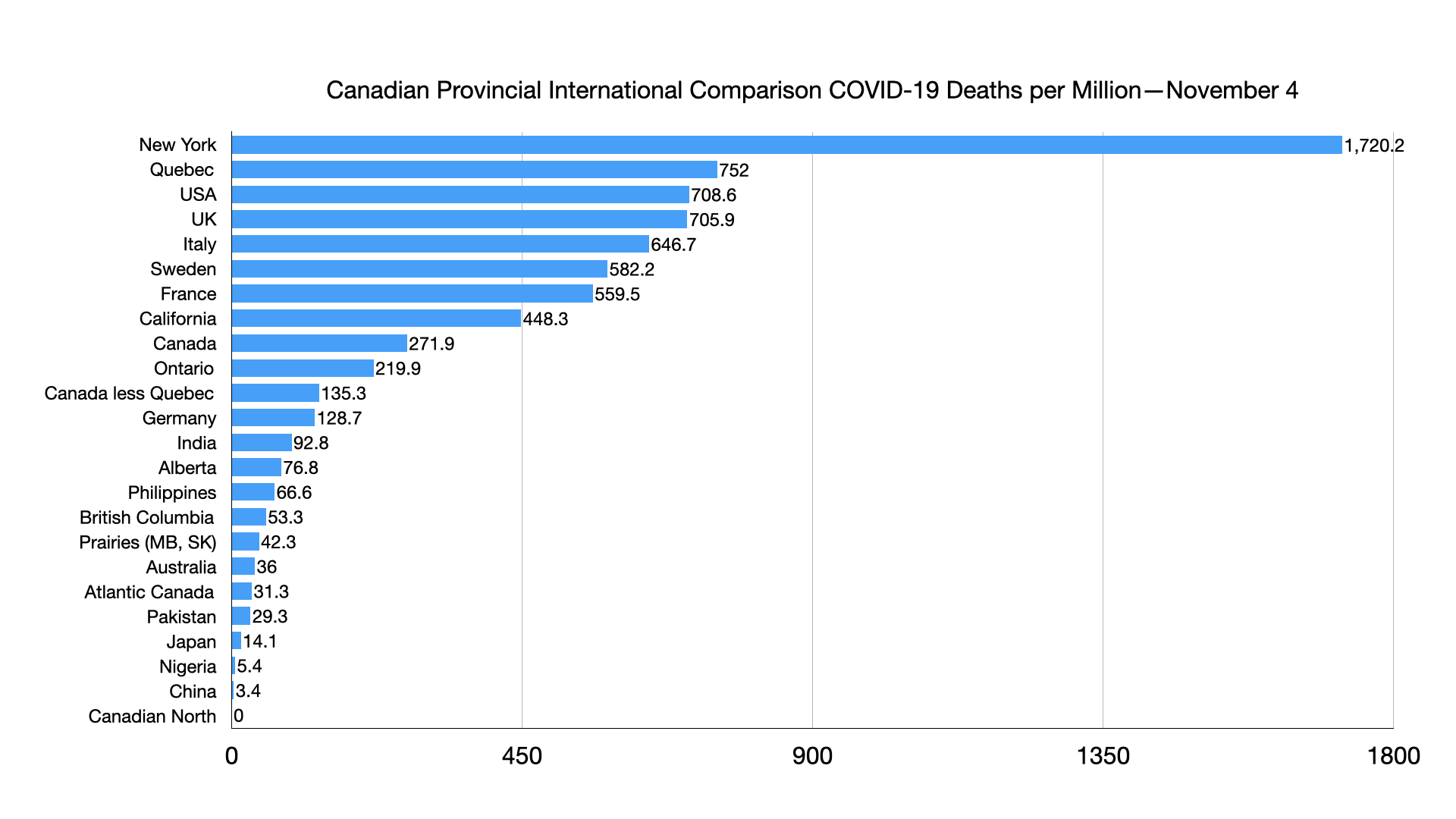
#COVID-19: Comparing provinces with other countries 4 November Update

Main news continues to be with respect to infections and relative increase of COVID cases and deaths in Prairie provinces:
 
Weekly:
 
Infections per million: Germany now ahead of Alberta, Canada, India, Prairies now ahead of Philippines
 
Deaths per million:nPrairies now ahead of Australia


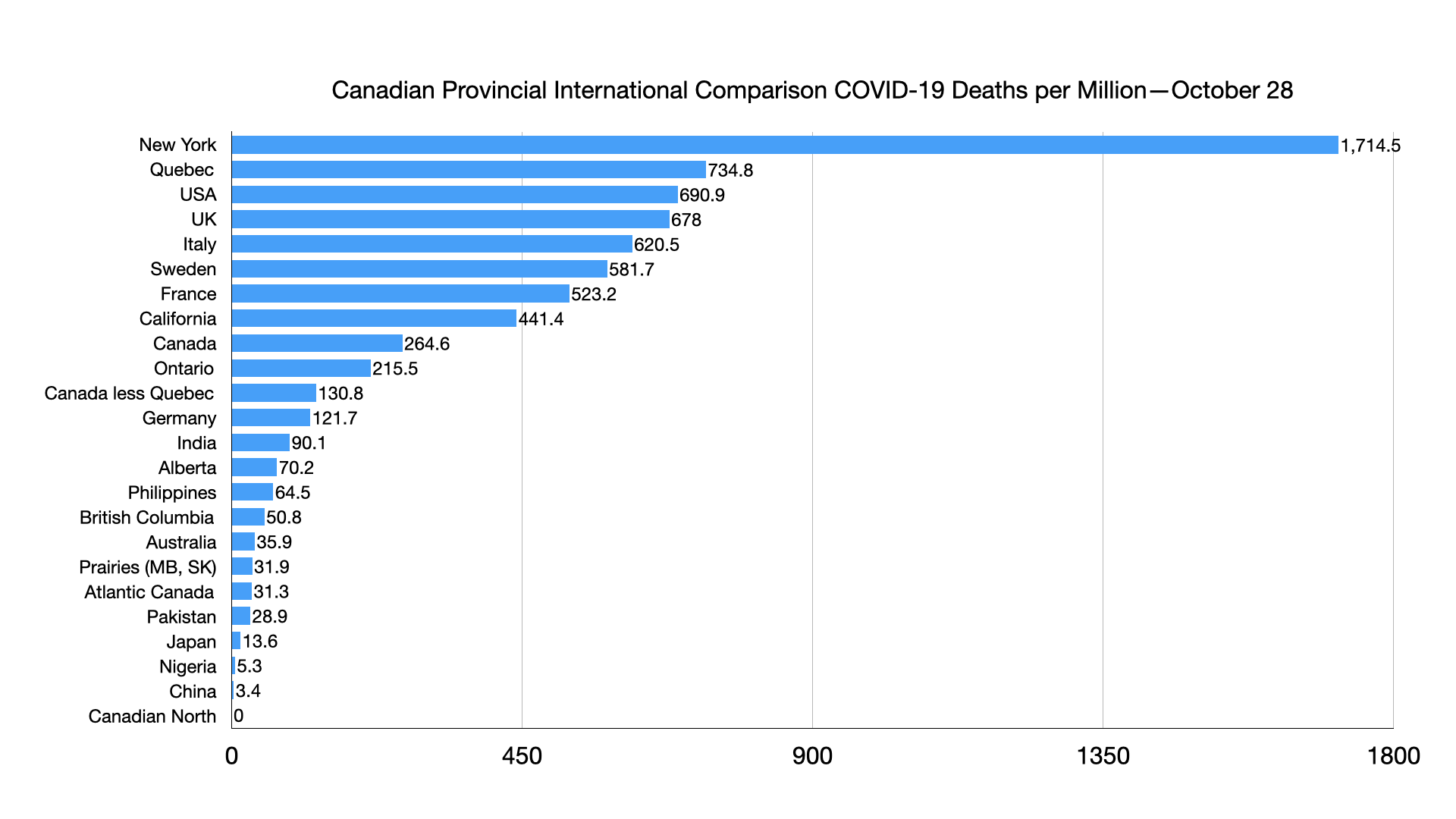
#COVID-19: Comparing provinces with other countries 28 October Update

Main news continues to be with respect to infections:
 
Weekly:
 
Infections per million: UK higher than Quebec, Alberta higher than Canada, Germany higher than Ontario, Prairies higher than British Columbia 
 
Deaths per million: Prairies higher than Atlantic Canada, both higher than Pakistan
 
October 7-28 increase:
 
Infections per million: Prairies (Manitoba, Saskatchewan) join European countries in highest percentage increase
 
Deaths per million: Highest increase in Prairies, particularly Manitoba and Saskatchewan 


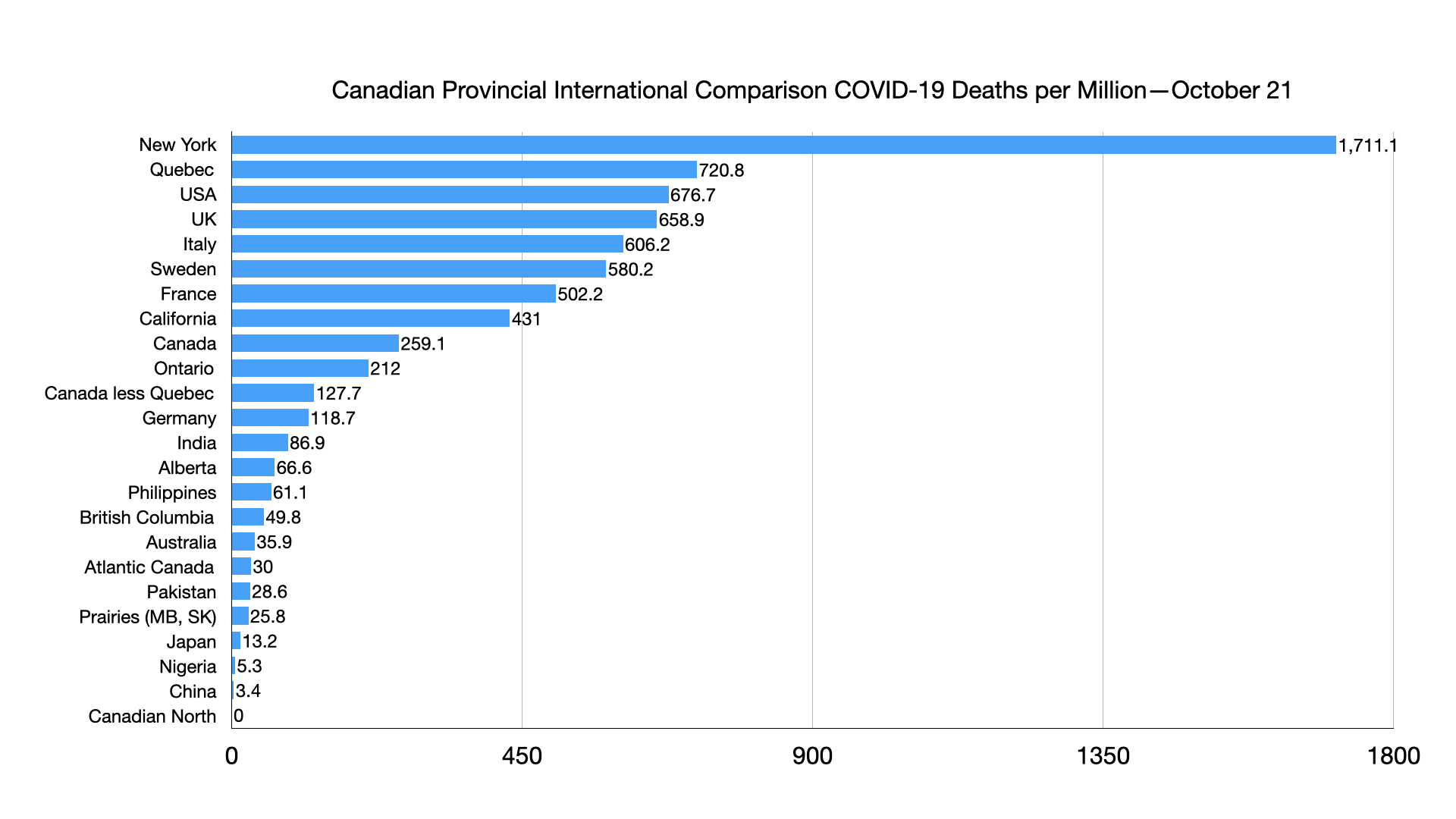
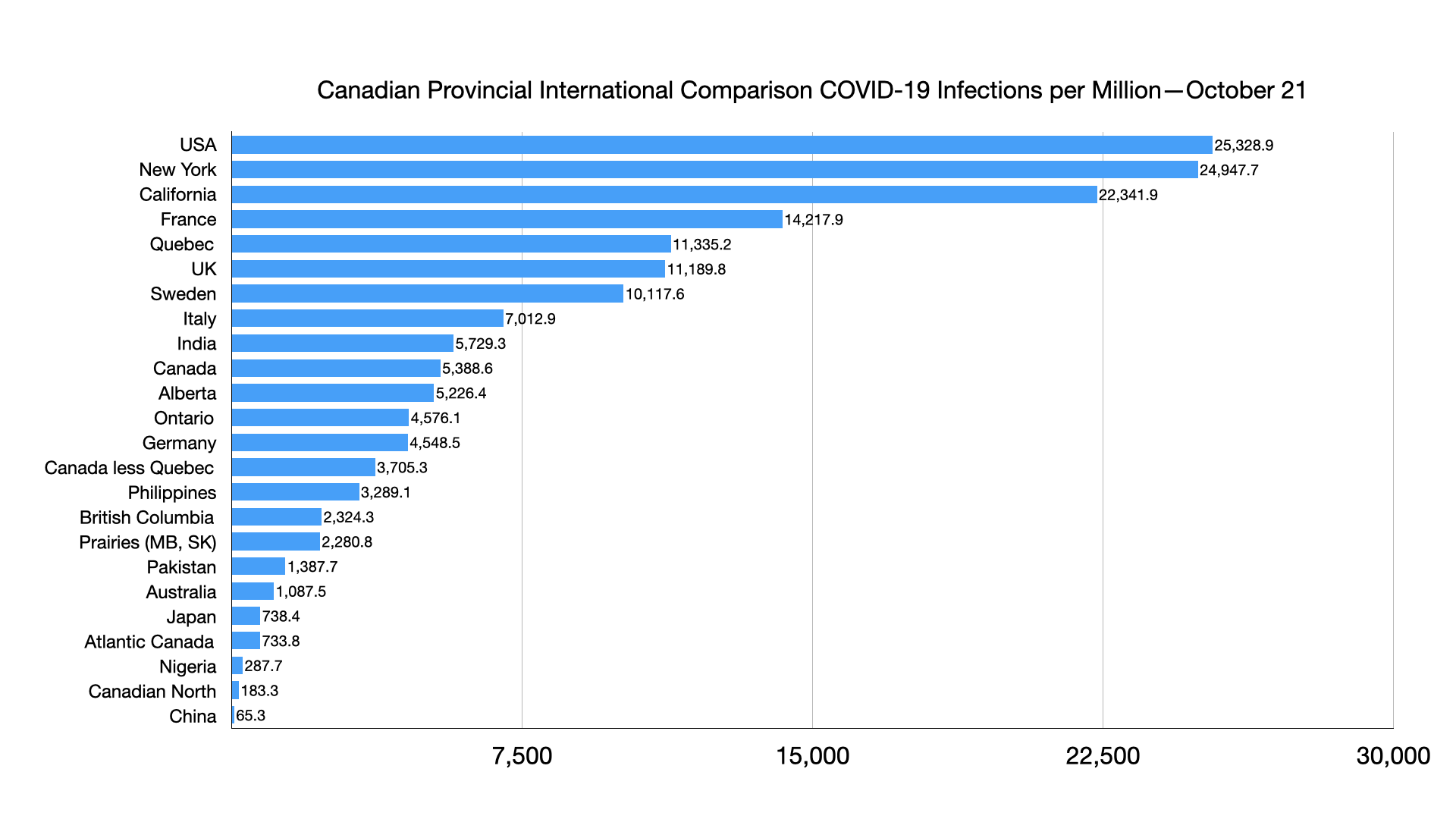
#COVID-19: Comparing provinces with other countries 21 October Update

Apart from overall large increases in infections in most jurisdictions, and corresponding increases in death rates in some, overall country and jurisdiction ranking largely unchanged.

Deaths per million: no change
 
Infections per million: Sweden now higher than UK (so much for herd immunity), Japan ahead of Atlantic Canada
 
Weekly:


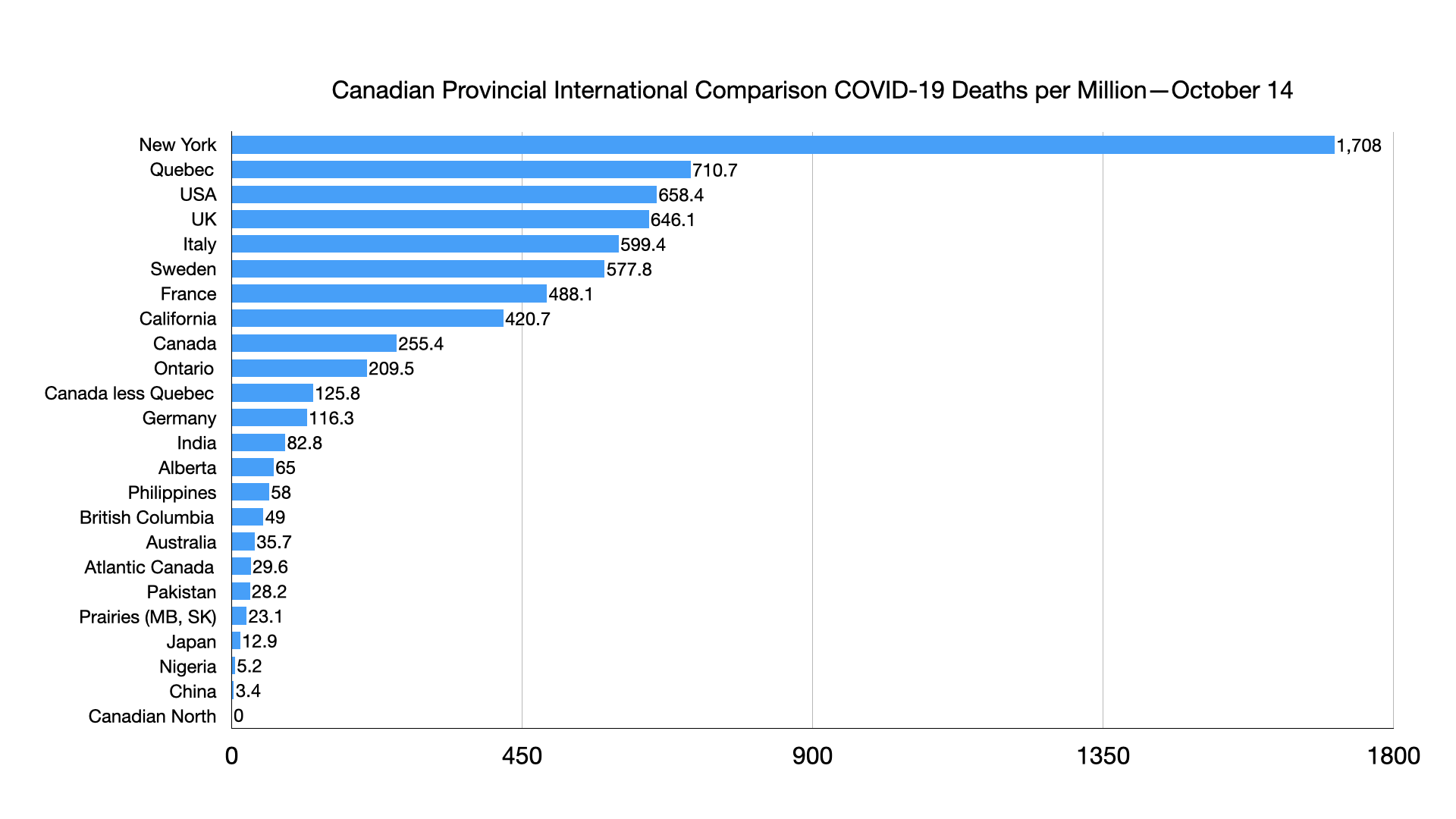
#COVID-19: Comparing provinces with other countries 14 October Update

No changes in relative ranking as overall rate of infections climbs in most jurisdictions:

Weekly: