Hundreds of appointed positions vacant after 8 years of Trudeau’s government

Seems like another example of failure to deliver. But surprising that article makes no mention of the increased diversity of GiC appointments which is one of the successes of the current government (also seen in ambassadorial, senate and judicial appointments).

I am, however, less charitable than UoO professor Gilles Levasseur regarding excusing the government given that they have been in power for 8 years and the system should operate more smoothly:

Almost eight years after Prime Minister Justin Trudeau’s government came to power, hundreds of government-appointed positions — from boards of port authorities and advisory councils to tribunals that hear refugee claims or parole cases — are vacant or are being occupied by someone whose appointment is past its end-date.

A CBC news analysis of governor in council (GIC) appointments to 206 government bodies or institutions found that 418 of the 1,731 positions — 24.1 per cent — are either vacant or are being occupied by someone whose appointment has continued past its end date.

Of that number, 280 positions — 16.2 per cent ot the total — were vacant. Another 138 appointees — 7.9 per cent — were past their end-dates and were awaiting either replacement or renewal of their appointments.

Those figures do not include a number of positions currently occupied by someone who is in an acting or interim capacity. Some of those positions have been held by interim or acting appointments for years.

While some GIC appointments come with lucrative six-figure salaries, others provide only per diems of a few hundred dollars plus expenses when board members attend meetings.

Former Conservative prime minister Stephen Harper’s government went on an appointment spree in the weeks before it left office in 2015, leaving very few vacancies and making 49 “future appointments” of individuals whose terms weren’t due to be renewed until well after the election that brought Trudeau to power.

Some experts say leaving hundreds of positions vacant can affect wait times for services or decisions, while leaving boards staffed by people who are past their end-dates can affect an organization’s ability to make decisions.

Other experts, however, argue that the backlog is understandable given the Trudeau government’s decision in its first mandate to overhaul the appointments process to make it less political and boost diversity.

The problem isn’t confined to GIC appointments.

In the Senate, 14 of 105 seats are empty, with vacancies in nine out of 10 provinces. The Senate’s clerk, who manages the day-to-day operations of Canada’s upper house, has been acting in an interim capacity since December 2020.

There are 86 vacancies for federally-appointed judges across Canada, including one seat on the Supreme Court of Canada. All of the seats on seven of the Judicial Advisory Committees set up to assess judicial candidates — including all three committees in Ontario — are vacant.

In June, Supreme Court Chief Justice Richard Wagner warned of an “alarming” shortage of federally appointed justices.

“There are candidates in every province,” Wagner told reporters. “There’s no reason why those cannot be filled.”

Government officials say they are working on filling positions. Stéphane Shank, spokesperson for the Privy Council Office (PCO), defended the government’s appointment process.

“Governor in Council (GIC) appointments are made through an open, merit-based process on a rolling basis throughout the calendar year,” Shank said in an e-mail.

“The process takes into account current and forecasted vacancies, as well as [incumbents remaining in place], to maintain operational integrity of these institutions. Legislative provisions for appointees to continue in office can provide organizational continuity until such time as a new appointment is made.”

No timelines

Shank said the government made 780 GIC appointments in 2022 and will continue filling openings. He said he could not predict when positions such as the commissioner for conflict of interest and ethics — which has been vacant since mid-April — will be filled.

“A new Conflict of Interest and Ethics Commissioner will be appointed by the Governor in Council in due course,” Shank wrote.

Shank pointed to a website with 49 GIC “appointment opportunities” posted. But most of those appointments began the application review process months ago. Ten of the postings list dates in 2022 for application reviews to begin — one dates back as far as March 2022.

The problem isn’t spread evenly throughout the government.

An analysis by ministerial office found the highest percentage of vacant or past-due appointments at Transport Canada: 47.8 per cent of its 230 GIC positions. The boards of several port authorities across Canada consist entirely of vacant positions or board members who are past their appointment dates.

The second highest percentage was at Global Affairs — 42.1 percent of its 19 GIC positions — followed by Housing, Infrastructure and Communities, with 40.9 per cent of its 44 positions.

Nadine Ramadan, press secretary for Transport Minister Pablo Rodriguez, pointed out that the department has more GIC positions to fill than most other ministries.

“Lots of factors go into appointing the best candidates for the roles,” she said. “Due to the complexity of the files across Transport Canada, these roles are often very technical and finding the perfect candidate with the necessary technical requirements for the position takes time.”

But other ministers with large numbers of GIC appointments to make had better track records.

In his former role as minister of heritage, Rodriguez left only 13.3 per cent of 150 appointments vacant or past their appointment dates. He also made several future appointments to renew or replace positions that were near their end dates.

There are two notable exceptions to that track record, however. The board of directors for the Canadian Broadcasting Corporation (CBC) is 58.3 percent vacant or composed of individuals past their appointment dates, while three of eight positions on the National Arts Centre board are vacant.

Former employment minister Carla Qualtrough had more than 100 appointments to manage — including members of the Social Security Tribunal, which hears appeals of decisions involving things like employment insurance and pension benefits. She left that portfolio with a vacancy rate of only 5.5 per cent.

The Prime Minister’s Office plays an overall role in GIC appointments but is also directly responsible for 22 appointments. After two vacancies on the National Security and Intelligence Review Agency were filled Friday, just two PMO appointments remain vacant: the conflict of interest commissioner and the law clerk of the House of Commons 

Sen. Percy Downe, who served as director of appointments to former prime minister Jean Chrétien, said it’s important to keep GIC positions filled and a normal vacancy rate should be “three to four per cent at the most.”

These appointments “affect Canadians in many ways,” he said. “They affect their security … they affect the economy.”

Downe said positions that are occupied by people past their appointment dates make it difficult for government departments and agencies to make plans.

“For the boards and agencies, it’s important to know the status as you undertake projects and works that may be required,” he said. “Will this person actually be here in three months or six months? Should we involve them? Should we make them a head of a subcommittee?”

Gilles Levasseur, a professor in law and management at the University of Ottawa, said a higher level of vacancies isn’t surprising given the changes the Trudeau government made to the appointments process and the need to reflect Canada’s diversity.

“People can criticize but we’ve also got to make sure that we understand the system itself and the challenge we’re facing because of these new elements that we didn’t have 10, 15 years ago,” he said. “And because we want to be more open to the society, it takes more time to fill these positions.”

Levasseur said it is not a problem if people are past their appointment dates if they’re doing the job and their presence doesn’t interfere with decision-making. He added the government could do more to let Canadians know about openings.

“A lot of people don’t even know that these positions are available,” he said.

Michael Barrett, Conservative critic for ethics and accountable government, said the level of vacancies is symptomatic of a bigger problem with the current government.

“After eight years of Trudeau, this incompetent Liberal government can’t deliver basic government services like passports and there are backlogs, delays and chaos in everything they touch,” he said in a media statement.

“It has been nearly half a year without an Ethics Commissioner and widespread judicial vacancies are allowing repeat violent criminals to walk free because there are not enough judges to hear cases.”

The New Democratic Party has not yet responded to a request for comment.

Source: Hundreds of appointed positions vacant after 8 years of Trudeau’s government

More women, fewer minorities receive appointments under Liberals’ ‘merit-based’ process, documents show

Interesting. When I requested the information earlier, PCO did not provide the breakdown between applications and appointments for GiCs (in contrast to judicial appointments – see Taking stock of Ottawa’s diversity promises):

The Liberal government’s overhaul of the patronage system has led to gender parity in government appointments, but new figures show few of those women are in leadership posts and visible minorities are being left out.

Documents from the Privy Council Office, obtained under the Access to Information Act, show that as of last year, 55.5 per cent of appointees to federal agencies, boards and organizations were women, slightly above their proportion in the Canadian population.

But the Liberals’ “merit-based” process for appointments has screened out 61.8 per cent of visible-minority candidates as insufficiently qualified, compared with 37.6 per cent of applicants who are not visible minorities.

Visible-minority applicants who made it past that cut and into job competitions were less likely to be recommended or appointed.

“This is one of the reasons why we need to know what constitutes merit,” said Kathy Brock, a politics professor at Queen’s University who has studied the changes in the appointments system.

“What are the criteria that are being used to screen people, and embedded in that criteria are there certain considerations that have a negative impact on those communities?”

Despite the changes, final say still sits with the responsible minister or the Prime Minister’s Office, meaning a partisan lens remains in place on appointments, Brock said.

Months after taking power in late 2015, the Liberals changed how the government makes hundreds of appointments each year to the boards of Crown corporations and tribunals that make decisions on benefit payments and immigration claims, for example. The majority are part-time. They don’t include senators, judges or officers of Parliament, such as the ethics commissioner, who are not chosen with the same process.

Before 2015, governments simply decided who would get what position, often giving posts to party loyalists. The Liberals promised to make appointments based on merit, where applications are open to anyone and selection committees recommend names based on precise criteria.

“The government is striving for gender parity, and seeks to ensure that Indigenous peoples and minority groups are properly represented in positions of leadership,” spokesperson Stéphane Shank said in an email, calling the number of visible minority applicants “encouraging.”

As of April 30, 2019, the Liberal government has concluded 1,100 appointments under the new process, he said, noting that 13 per cent of the appointees self-identified as visible minorities. Another nine per cent identified as Indigenous.

The percentage of visible minorities currently serving in the roles nearly doubled, from 4.4 per cent in November 2015 to eight per cent in May 2019.

About 4.5 per cent of appointees identified themselves as having disabilities, below the 15.5 per cent of people with disabilities in the Canadian population.

The government documents show that eight per cent of female appointees had been placed in leadership positions. But they don’t offer the same information for male appointees, so it’s not clear how the sexes compare.

The figures were smaller for visible minorities and Indigenous people: two from each group had been put in “leadership” positions. Like visible minorities and Indigenous people, only two people with disabilities have been appointed to leadership positions.

“It’s that whole analogy of a big ship that has a big wake and you have to give it some space to move. That’s what we’re seeing here with the appointments,” said Carole Therrien, who worked on such appointments in Jean Chretien’s Prime Minister’s Office.

Although upcoming openings are supposed to be flagged a year out, and recommended candidates vetted by the Privy Council Office within four weeks, the new system has often been criticized for leaving too many positions unfilled for too long.

The documents show that at the end of 2018, the selection processes for 181 positions had yet to start, including for some openings as distant as February 2020. The documents don’t identify those positions.

A similar number of appointments — 183 — were sitting with the Prime Minister’s Office or a minister’s office awaiting approval.

Source: More women, fewer minorities receive appointments under Liberals’ ‘merit-based’ process, documents showThe Record·2 days ago

Fake feminist? Trudeau’s track record for appointing women looks real.

Same data as covered in my earlier Taking stock of Ottawa’s diversity promises, with only GiC data, including deputies and not other appointments, most notably judges:

Among the various ways Justin Trudeau is being slammed for his handling of the SNC-Lavalin affair, the charge that the Prime Minister has revealed himself during this controversy to be no real feminist is the hardest to pin down.

Did he fail to properly respect the independence of the attorney general, back last fall when Jody Wilson-Raybould had the job? On this core question, there are meetings and phone calls and text messages to argue about, rules and codes to interpret, in trying to arrive at an answer.

Did he botch efforts to contain the controversy after it exploded, and ultimately go too far in kicking Wilson-Raybould and her chief ally, Jane Philpott, out of the Liberal caucus? On these issues, political strategists, Parliament Hill veterans, and even pundits, have thoughts about crisis management to kick around.

Did he somehow let down the feminist side, though? This question naturally arises because the two former cabinet ministers testing Trudeau’s mettle both happen to be women. And, to quite a few commentators, that fact alone is telling enough. But it is hardly sufficient.

There’s no solid reason I’ve heard to presume that two male cabinet ministers would have fared differently had they dissented from Trudeau’s handling of a file that brings into play hard questions about the administration of justice, worrying possible economic outcomes, and, yes, potential ramifications in the coming fall election.

What’s needed to give the critiques of Trudeau’s feminist credentials heft are facts that don’t require guesses about the dynamics between men and women in Trudeau’s famously gender-balanced cabinet, or speculations about the PM’s own putative biases.

In other words, does any data show that he’s running the government in a way that’s better or worse for woman than what came before him? In fact, there are at least some numbers, and they tend to bolster his feminist credentials.

Maclean’s asked the Privy Council Office (PCO), the branch of the bureaucracy that supports the Prime Minister’s Office, for recent figures on what are called Governor in Council appointees. These are the fortunate individuals who get paid to work on federal commissions, boards, Crown corporations, agencies and tribunals.

As of the end of 2018, 49 per cent of these appointments had gone to women, according to the PCO data, up markedly from 35 per cent in 2015, the year the Trudeau Liberals beat Stephen Harper’s Conservatives in an election. That 14-point rise in the share of these plum federal jobs going to women compares to just a four-point increase, from 31 per cent to 35 per cent, in the previous three-year period.

Those numbers represent—to home in on just one significant segment of them—a shift from women filing only about a third of the seats on Crown corporation boards when the Liberals took power to very nearly half now—up from 34 per cent at the end of 2015 to 48 per cent at the close of 2018. That’s up 14 points in three years of Trudeau rule, compared to six points over the previous three-year span.

Looking more broadly at women in the executive ranks of the federal public service—known to bureaucrats by their “EX 01” through “EX 05” designations—there’s been less dramatic change, but still an uptick. The number of women at that level stood at 2,567 last spring, up from 2,264 in the spring of 2015. That meant women accounted for 49 per cent of the government’s executive ranks, up from 46 per cent over that three-year period.

Arguably even more important, or at least more prestigious inside the government, is the cadre of deputy ministers—the top mandarins in federal departments. Overall the number of women filling these powerful posts climbed to 39 last year from 30 three years earlier. That translates into 46 per cent women at the deputy minister level last spring, compared to 41 per cent three years earlier.

Even taken together, of course, these numbers don’t mean Trudeau’s Liberals have excised sexism from the federal government. Still, weighed against mere impressions of what the SNC-Lavalin affair might signify about his feminist bona fides, knowing how many more women are working in key federal jobs these days has to count for something.

Source: Fake feminist? Trudeau’s track record for appointing women looks real.

Taking stock of Ottawa’s diversity promises

My latest in Policy Options:


Each of the mandate letters given to cabinet ministers by Prime Minister Justin Trudeau over the past three years has included the following commitment: “You are expected to do your part to fulfill our government’s commitment to transparent, merit-based appointments, to help ensure gender parity and that Indigenous Canadians and minority groups are better reflected in positions of leadership.”

With three years of appointments under the Trudeau government’s belt, it’s possible to conduct an analysis of its record with respect to judicial, Governor-in-Council, deputy minister, head of mission and Senate appointments, using available data and public records.

The government has largely delivered on its commitment, but with mixed results on its promise to be more transparent on appointments…
Full article: Taking stock of Ottawa’s diversity promises

Governor in Council Appointments – PCO data

Governor in Council Appointments 2016 Baseline

Following the skimpy information provided in both the mandate checker and PCO’s Departmental Performance Report (DPR), I had asked PCO for more details and they were reasonably quick in getting back to me.
The correspondence below indicates that this is very much a work in progress. Hopefully, future reporting will include an annual table of GiC appointments by the four employment equity groups. Hard to the logic, for a government committed to diversity and inclusion, and one that has improved dramatically the diversity of judicial, ambassadorial and senatorial appointments, not to take this next step of more comprehensive reporting:

PCO response:

“…In February 2016, the Prime Minister announced a new approach to Governor in Council—or GIC—appointments that supports open, transparent, and merit-based selection processes for GIC appointments.
 
Significant progress has been made in making appointments.  Since March of this year, the number of appointments made under the new approach has increased approximately 300%.  To date, over 19,000 applications have been received and over 400 appointments made following an open, transparent, and merit-based selection process and approximately 740 appointments made through other selection processes.
 
Of the appointments following an open, transparent, and merit-based selection process, nearly 60% were women.  Most notably, women have been appointed for the first time to a number of leadership positions, including the Chief Science Advisor, the Chief Commissioner of the Canadian Grain Commission, the Chair of Via Rail, and the Chairperson of the Infrastructure Bank.  Over 10% are visible minorities, 10% are Indigenous peoples, and persons with disabilities are well represented.  The total representation of women serving as GIC appointees has increased by over 5% and is now over 40%.”

My reply to PCO:

“I prepared this little summary table for appointments under the new approach:
Women
VisMin
Indigenous peoples
Total
Number
236
40.4
40
400
0.59
0.101
0.1
Obviously, this is approximate but provides a basis for comparison with other EE data.
In terms of the other selection processes, I assume this would include position such as judges, heads of mission and the like and would appreciate confirmation your end. [PCO later advised that it does not include judges.]
Looking at the total number of GiC appointments (1182 in the index as of today, 40 percent women would mean about 473 women or more.
I would hope that in the future PCO would be able to provide annual tables similar to the EE reports for the public service (simplified) that would essentially tell what is a good news story more effectively and consistently. And that future DPRs are more informative.
But nevertheless this information is welcome, represents progress. Thanks for getting back to me.”

Liberals accused of ‘housecleaning’ of Tory appointees at refugee board

Leave it to others to comment, particularly those with experience in dealing with the IRB.

Like all GiC appointments, there is a strong political element (and has always been).

The delay in appointments appears to be characteristic of the government, partially due to its commitment to increased diversity in appointments, but one that affects the timeliness of decision-making.

The in-depth study, 2016 Refugee Claim Data and IRB Member Recognition Rates | Canadian Council for Refugees, shows a variation in acceptance rates among members, as happens to a certain extent in all such processes:

A slew of seasoned decision-makers tasked with hearing refugee and immigration appeals have either left or will depart from their job in what some call the Liberals’ “housecleaning” of Conservative appointees.

In light of what some critics call inadequate funding and a growing backlog stemming from the recent spike in asylum-seekers crossing into Canada via the United States, the loss of the adjudicators on the immigration and refugee appeals tribunals is expected to toss the system into disarray.

“Our concern is the government is continuing to have a governor-in-council appointment process that is political and discretionary instead of going for a transparent process to appoint the most suitable candidates who are competent, judicious, fair-minded and efficient,” said Raoul Boulakia of the Refugee Lawyers’ Association of Ontario.

“The efficiency and quality of the decisions could be compromised if the people who are brought in do not have the expertise and are not judicious.”

The Immigration and Refugee Board, which oversees both appeals tribunals, said 14 appointees have left their job since last August and another 39 will have their appointments expire by the end of this year. The board confirmed a total of 42 people applied for reappointments to the tribunals, but would not say how many have been successful.

Currently, 23 of the 58 positions at the refugee appeals tribunal are unfilled while the immigration appeals division has six vacancies out of the full complement of 44 appointments.

Like the court system, the refugee and immigration appeals tribunals require adjudicators to have stronger knowledge and experience with the administration of the law in order to review decisions by lower-level refugee judges or immigration officials, who are civil servants.

While failed refugee claimants — and sometimes the immigration minister — can appeal to the refugee tribunal any questionable decisions made by asylum judges, rejected immigration applicants in sponsorships or those facing removal orders can take their cases to the immigration appeals tribunal.

As of the end of December, the immigration appeals tribunal had a backlog of 10,206 cases and a processing time of 20.4 months (compared to 17 months in 2013), while the refugee appeals division had 1,938 cases in the inventory with the average processing time at 124 days (compared to 65 days in 2013), said the refugee board.

Under the old system by the former Conservative government, existing adjudicators seeking reappointment to the tribunals would have all their previous decisions evaluated in terms of quality and quantity before being recommended by the board chair based on their track records.

However, last summer, the Liberal government, which ran an election campaign on transparency and bipartisanship, rolled out a new process for those already sitting on the tribunals by requiring them to reapply for their appointment and pass an online test.

They are then interviewed by a hiring committee made up of the refugee board chair and one representative each from the Prime Minister’s Office, Privy Council Office and the Immigration Department. The composition of the committee opens the door for partisan selection, Boulakia said.

The Privy Council said the government’s new approach to governor-in-council appointments supports “open, transparent and merit-based appointments.”

“All candidates seeking appointment to a GIC position with the Immigration and Refugee Board, be they incumbents or new candidates, are subject to a rigorous selection process developed for the position, which includes inputs and insights from the independent bodies, including the chair of the refugee board,” said Mistu Mukherjee, a spokesperson for the PCO.

“The results of these assessments, made against public and merit-based criteria, are provided to the minister. The minister makes appointment recommendation from this list of highly-qualified candidates.”

Adjudicators who took the test said the questions had nothing to do with immigration and refugee laws and complained they had no way to review the exam or find out why they might have failed.

“The process is partisan and not based on merits. They are cleaning out anyone who was appointed by the previous government, whether they are really affiliated with the Conservatives or not,” complained one adjudicator, who underwent the process and asked not to be identified for fear of repercussion.

“This is complex, technical work. It takes a long time for new members to learn the stuff. This purge means people’s (immigration) status is going to be uncertain for longer. It is going to further affect people’s ability to bring their family members to Canada. This is going to have a huge impact in people’s lives.”

Although it is a common practice for a new government to fill board and tribunal appointments with their party supporters, another affected adjudicator said the test is “flawed” and the process is “rigged.”

“What happens is you feel you are shackled to a political party with your job security resting on the whim of that party. But you are not supposed to get involved in any politics. It is just so wrong when you are not assessed by your performance and good judgment but by who you know,” said the source, whose appointment was not renewed.

“Our political leader has said to refugees, ‘Come to Canada and we will welcome you.’ It’s like an open invitation, but some people who come here are not really who they say they are. With more refugees coming, everybody will be appealing and rushing to the appeals tribunals when they are turned down. This is all about cleaning house.”

Refugee board spokesperson Anna Pape said it is not a requirement for appointees to have experience in refugee and immigration matters and “(complete) training” is provided to all new decision-makers, regardless of their education or experience.

Source: Liberals accused of ‘housecleaning’ of Tory appointees at refugee board | Toronto Star

Trudeau government’s vacant appointments backlog up 80%

Good follow-up story and valid concern regarding the large number of vacancies.

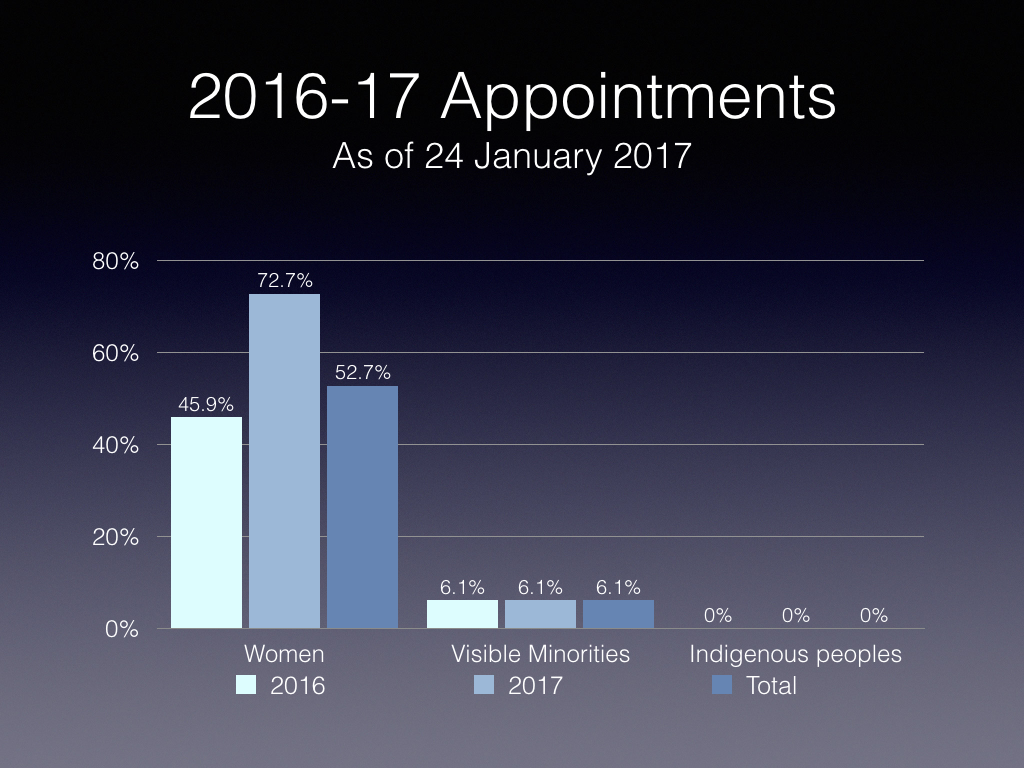
But nice to see that PCO is now tracking more systematically the diversity of appointments and improving representation (of the more than 100 appointments to date, 62 per cent women, 15 per cent visible minorities, 10 per cent Indigenous Canadians):

Five months after Prime Minister Justin Trudeau’s government assured Canadians that its new system would soon fix the backlog of appointments that need to be filled, the problem has gotten much worse.

An analysis by CBC News reveals that one in three governor in council positions — ranging from directors of government agencies to members of tribunals that hear appeals of employment insurance or pension disputes — is currently vacant or occupied by an appointee whose term is past its expiry date.

When CBC first looked at the question in October 2016, 19.6 per cent of the governor in council positions were vacant or past their expiry date.

That number is currently at 35 per cent, although it will drop slightly next week when several appointments to the Immigration and Refugee Board made by cabinet earlier this month take effect.

The backlog in October of more than 300 appointments has now swelled to 572. Of the 515 positions, 354 are vacant. Another 161 are occupied by an appointee, often one named by the previous Conservative government, whose appointment is past its expiry date. However, they are allowed to remain until they are replaced or renewed.

The positions range from lucrative full-time jobs with six-figure salaries to part-time positions that pay per diems and expenses.

There are also 57 vacancies for federally appointed judges, down slightly from the 61 vacancies in October 2016 that prompted concerns about growing backlogs in criminal trials.

In several cases, positions are being filled on a temporary basis because the government was not able to fill them before the incumbent’s term was set to expire. Among them are half of the officers of Parliament — the conflict of interest and ethics commissioner, the commissioner of lobbying and the official languages commissioner, while the chief electoral officer’s position is listed as vacant.

Former prime minister Stephen Harper’s government went on an appointment spree in the weeks leading up to the 2015 election, filling not only most of the positions that were vacant but also making 49 “future appointments” of individuals whose terms weren’t due to be renewed until well after the election.

In October, the government said that the initial backlog was caused in part by the decision to overhaul the appointments process and bring in a more open and balanced merit-based system.

It said that system was up and running, Canadians were applying for the positions and vacancies were being filled.

Five months later, the government said it has received more than 11,000 applications for vacant appointments and more than 100 selection processes are currently underway.

“The more rigorous approach to conducting selection processes represents a significant volume of work,” said Raymond Rivet, spokesman for the Privy Council Office.

Rivet said that since the government launched its new appointments process it has made more than 100 appointments.

“Of this number, 62 per cent have been women, 15 per cent visible minorities, 10 per cent Indigenous Canadians and 50 per cent identify as fully or functionally bilingual.”

However, Conservative MP Tony Clement, former president of the Treasury Board, said the growing backlog of vacant appointments is affecting service to Canadians.

“This clearly a case where these appointments, which are necessary for the proper functioning of government — there could be issues involving people getting their appropriate EI, for instance, or their appropriate pension — are not being processed because of the lack of these appointments.”

Clement blamed the backlog on Trudeau’s director of appointments, Mary Ng, who announced Feb. 15 that she was taking a leave from her job to seek the Liberal nomination in the Toronto-area riding of Markham-Thornhill. The riding became vacant after Trudeau appointed former immigration minister John McCallum as Canada’s ambassador to China.

“It’s very disappointing,” said Clement. “The person in charge of this process is now the Liberal candidate in Markham, and obviously she was spending too much time campaigning for herself and not enough time making recommendations to the prime minister on appointments.”

Diversity in GiC appointments – 2016 Update

My latest in IRPP Policy Options:

election-2015-and-beyond-implementation-diversity-and-inclusion-062Following my 2016 baseline study of the diversity of Governor in Council (GiC) appointments (Governor in Council Appointments – 2016 Baseline), I have analyzed 2016 and early 2017 appointments using the GiC appointments index. There has been a strong push towards gender parity but no clear trend with respect to visible minorities and Indigenous peoples.

Baseline data below:

GiC Baseline 2016.010

Source: Diversity in GiC appointments

How do the feds track diversity of appointments? – Policy Options

My latest, analyzing what PCO ATIP documents reveal about their tracking of GiC diversity, with my usual series of charts, including 25 year series data with respect to women’s representation:

As I have been taking a closer look at diversity in Governor in Council and judicial appointments, the gaps in the available data have become much clearer. Documents I received under the Access to Information Act revealed that while the Privy Council Office (PCO) has been systematically tracking representation of women and French/English speakers in these appointments, there has been limited tracking with respect to the other employment equity groups, that is, Indigenous peoples, visible minorities and persons with disabilities.

A number of the documents appear to reveal a certain scramble to prepare this data for the incoming Liberal government.

Source: How do the feds track diversity of appointments? – Policy Options

2 federal tribunals make high-speed internet access a job condition

Understandable requirement even though some will protest:

Two tribunals have begun making home access to high-speed internet a prerequisite for dozens of well-paid federal government appointments, despite the fact it could disqualify many Canadians living in rural and remote areas of the country where high-speed internet isn’t available.

The Social Security Tribunal and the Veterans Review and Appeal Board have both recently added high-speed internet access to the list of criteria for those seeking the lucrative appointments, which come with salaries ranging from $108,200 to $127,200 for full-time positions, and between $540 and $635 a day for part-time positions.

“You must work from your home office in Canada and have access to high-speed internet,” say the conditions of employment for the Social Security Tribunal, which resolves disputes involving employment insurance, the Canada Pension Plan and Old Age Security.

Candidates expected to work in urban centres

The requirement appears to have been added in recent months. A similar notice of openings for the tribunal in June 2015 said candidates might have to work from home but did not require high-speed internet access.

The Social Security Tribunal has dozens of full-time and part-time members, including several vacancies at the moment.

On Wednesday, the CRTC ruled that access to high-speed internet should be a basic service across Canada. It said two million Canadian households lack access to proper internet service.

The Veterans Review and Appeal Board, which resolves disputes over disability benefits decisions made by Veterans Affairs Canada, also has this requirement.

Spokeswoman Alexandra Shaw said successful candidates for the board are expected to work in one of six urban centres across Canada and to work from home because the board’s only administrative offices are in Charlottetown, Prince Edward Island.

“Members need high-speed internet to maintain a reliable connection to the secure systems that give them timely access to veterans’ documents in order to prepare for hearings and produce decisions,” she wrote. “The board provides members with cellphones with additional hotspot connectivity.”

Source: 2 federal tribunals make high-speed internet access a job condition – Politics – CBC News