Parkin: Spot the backlash [DEI]

More interesting analysis that bucks some of the commentary:

…But maybe we’re not looking closely enough. Thanks to the support of our survey partners at the Diversity Institute and the Future Skills Centre, the survey sample allows us to narrow the focus. Follow along in the chart below, which starts with the responses for employed adults in general, but then zeroes in on gender, racial identity, sexual orientation and age.2
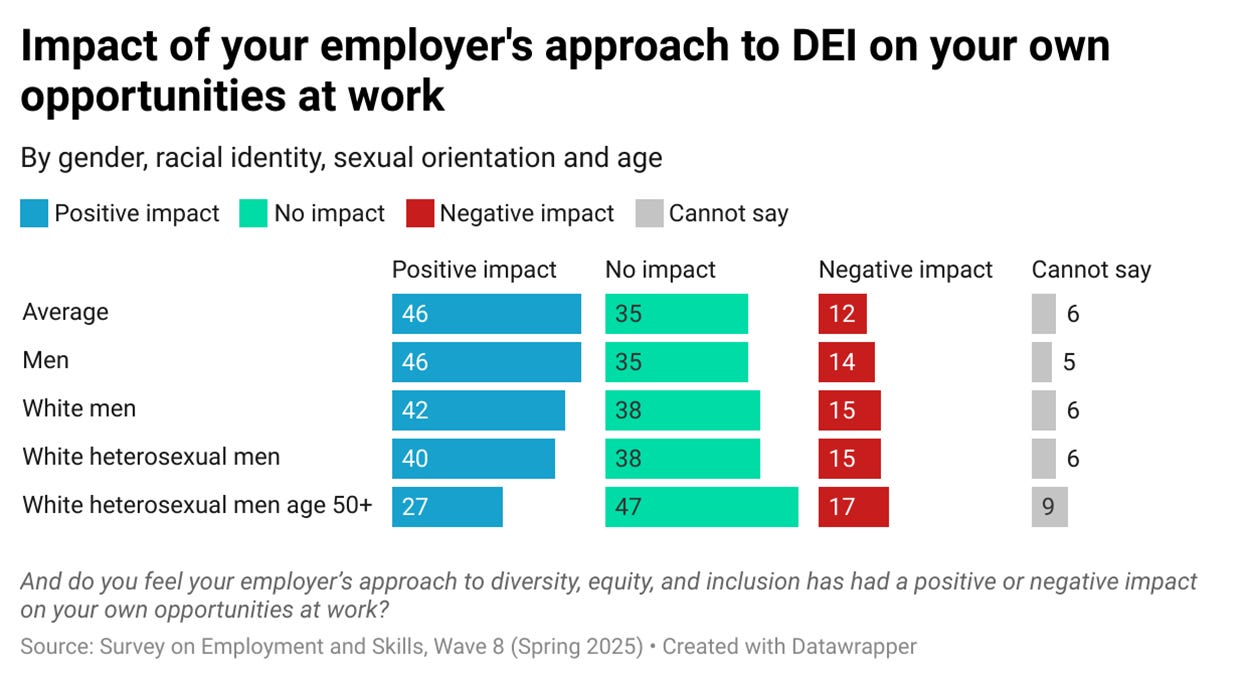
Can you see the backlash taking shape? No, me neither.

Certainly, opinions are influenced by age. Older people are less likely to say that they’ve been positively affected by DEI policies (this holds true for older people in general, not just older white men). But opinions mostly shift to the neutral position (no impact). The proportion of white, heterosexual men age 50 and older who say their own opportunities have suffered as a result of DEI is only five percentage points higher than the average.

Source: Spot the backlash

Immigrants to Canada have long found their qualifications questioned and careers crushed. Things were supposed to have changed — but barriers persist

Perennial issue that has been raised for years. I always found the federal initiatives were more talk than action, given the regulatory bodies are all provincial.

One can only hope that the work underway to reduce barriers to internal trade includes mutual recognition within Canada among provincial bodies and that governments at both the political and official level also consider reducing the impact on those with foreign equivalent certification:

….The result is a system that still underutilizes skilled immigrants, leaving many in precarious work — despite critical labour shortages and an aging population — and is estimated to cost Canada $50 billion in lost GDP each year.

“Are we actually recognizing foreign credentials better? Not really,” said Rupa Banerjee, associate professor at Toronto Metropolitan University and Canada Research Chair of economic inclusion, employment and entrepreneurship of Canada’s immigrants.

Rather than addressing barriers newcomers face that prevent them from applying their existing qualifications, “we’ve circumvented this issue of foreign credentials as much as possible by really prioritizing people with Canadian education and experience.”

There is no “convincing evidence that credential recognition has gotten demonstrably better” said Tricia Williams, director of research at the Future Skills Centre.

“For every example of a regulated profession that’s gotten better, there’s others that have stayed the same.”…

Source: Immigrants to Canada have long found their qualifications questioned and careers crushed. Things were supposed to have changed — but barriers persist