Are you a jihadist? France’s checklist includes questions about diet, wardrobe and not listening to music

Stop jihadism - French

France’s latest effort to counter radicalization:

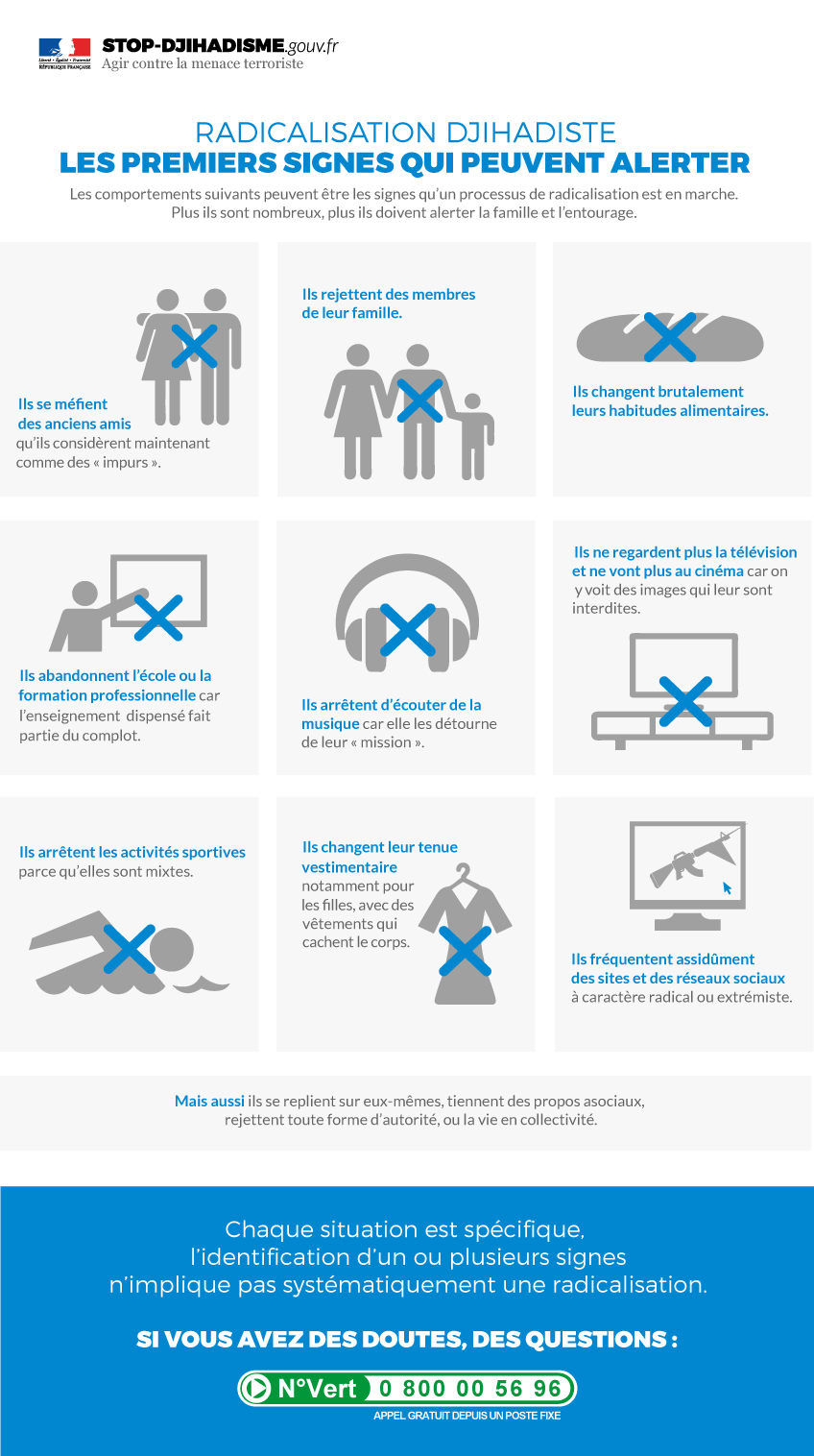
The chart presents a series of behavioural changes that supposedly ought to lead to concern. They range, it has to be said, from the obvious (frequently visiting extremist web sites) to the rather vague (not listening to music, for example). Other warning signs include a significant shift in one’s diet, the abandoning of sporting activities, a change in wardrobe toward more traditional garments, falling out with old friends and quitting school or one’s job.

This all makes sense, though it hardly presents a foolproof guide to spot the radicalization of a would-be jihadist. I’ve recently succumbed to a number of these behaviours myself — I’ve been lousy at going to the gym and often lose my headphones — but I don’t think you need to report me to the French government. And terrorists are often far more clever about concealing their agenda.

The chart risks the sort of mockery we’ve already seen leveled at the U.S. State Department’s “Think Again, Turn Away” campaign, which trolls jihadists and jihadist sympathizers online. Some analysts have called the effort “embarrassing” and “ineffective.”

The State Department, so far, seems undeterred. On Wednesday, it welcomed France’s campaign into the fold.
Are you a jihadist? France’s checklist includes questions about diet, wardrobe and not listening to music

French prisons, long hotbeds of radical Islam, get new scrutiny after Paris attacks – The Washington Post

More on French prisons and radicalization:

France’s prisons have a reputation as factories for radical Islamists, taking in ordinary criminals and turning them out as far more dangerous people. Here at the Fleury-Merogis prison — where Amedy Coulibaly did time alongside another of the attackers in the deadly assaults this month in and around Paris — authorities are struggling to quell a problem that they say was long threatening to explode.

Former inmates, imams and guards all describe a chaotic scene inside these concrete walls, 15 miles from the elegant boulevards surrounding the Eiffel Tower. Militancy lurks in the shadows, and the best-behaved men are sometimes the most dangerous. French Prime Minister Manuel Valls promised last week to flood his nation’s prisons with 60 more Muslim chaplains, doubling their budget to try to combat radicalization. Authorities this week raided 80 prison cells of suspected radicals, saying they found cellphones, USB drives and other contraband. Hundreds of inmates in French prisons are a potential threat, authorities say.

But critics say that these efforts are minuscule compared with the scope of the problem, with prisons so poorly controlled that a leaked French government report once described Osama bin Laden posters hanging on inmates’ walls. The challenge may be compounded by the dozens of people sent to jail after the recent attacks, some for more than a year, under fast-track proceedings in which they were charged with verbal support for terrorism.

“Prison destroys men,” said Mohamed Boina M’Koubou, an imam who works in the Fleury-Merogis prison. “There are people who are easy targets to spot and make into killers.”

French prisons, long hotbeds of radical Islam, get new scrutiny after Paris attacks – The Washington Post.

French citizenship, reward or punishment in fight against terror

France rules citizenship revocation legal:

France’s Conseil Constitutionnel – or Constitutional Council – said that the battle against terrorism permits the courts to strip Ahmed Sahnouni, 44, of his citizenship, prompting his lawyer to denounce the ruling as “discriminatory”.

“It creates two different categories of French people – those who are born here and those who receive French nationality,” Sahnouni’s lawyer Nurettin Meseci said in a telephone interview, adding that his client could face up to 20 years in prison if sent back to Morocco.

However, France’s top legal body said after its ruling that the difference in treatment between French-born and naturalized citizens does not violate France’s principle of equality – on the basis that the gravity of the act outweighs the severity of the punishment.

While Sahnouni is only eighth person to be stripped of his nationality since 1973, French Interior Minister Bernard Cazeneuve said such a measure would be used again.

Prime Minister Manual Valls also welcomed the move saying, “We should not, in any case, deprive ourselves of lawful means to ensure our values are respected.”

Under France’s civil code, Article 25, officials can revoke a person’s French passport if they commit an egregious offense deemed an “act of terror” within fifteen years of being granted citizenship. However, the law only applies to dual-nationals so it does not render them stateless, which would breach international conventions signed by France.

Still unlikely to be ruled constitutional in Canada given Charter rights and the need to treat Canadian solo and dual nationals equally for the same crime.

French citizenship, reward or punishment in fight against terror – France – RFI.

Republicanism vs. Multiculturalism in France | The Nation

Good observations of Katha Pollitt in The Nation from her short visit to Paris in the aftermath of the killings:

What was most striking to me was the amount of sheer outrage that the French people I spoke with bring to these largely symbolic issues. Take the controversy over ham and halal meat in public-school lunchrooms. I’m an atheist, and my daughter went to public school, but if most of the students were Muslim and lunch was thus halal, with pork omitted from the menu, I can’t imagine getting all worked up about it—as I would if that lunch was preceded by even the most nondenominational of prayers. Food, after all, is not proselytizing. “You don’t understand,” said Corinne. “It means the government, the taxpayer, is paying for halal meat! It’s collective bullying, but the minute you object, you’re a racist.”

…It would be good to know more—a lot more—about the situation of Muslims in France, but a 1946 law prevents the collection of statistics by race, religion or ethnicity. As with laïcité, a rule invented to address one situation—the Vichy law forcing Jews to register with the police was later used to deport them to the death camps—has had unintended consequences over time. This lack of information is also part of “republicanism,” a concept of national unity that papers over differences due to poverty and racism. Almost the first thing that Catherine, my husband’s cousin, wanted to tell us when we showed up at her apartment was that the news media were reporting that some Muslim schoolchildren—she claimed 25 percent—had refused to stand for the national moment of silence for the Charlie Hebdo victims. Were they indicating their approval of the murders, as she assumed? Or did the children mistakenly believe that they were being asked to honor the caricaturing of Muhammad, as Nilüfer Göle suggested, and no one had taken the time to explain what the ritual was really about? Maybe, as a much older friend suggested, they were just being rude and noisy, the way kids are these days.

Göle seemed to have the most nuanced and subtle but also the most generous perspective of anyone I’d met. “It’s not a question of ‘national unity,’” she told me, “but of many communities coming together. In practice, republicanism is negation and multiculturalism is avoidance. The European public treats Islam through the lens of secularization and freedom of expression, but this excludes ordinary Muslims, who want to be integrated and yet are different. Why, after all, do people want to build mosques in France? It’s because their life is here.”

Republicanism vs. Multiculturalism in France | The Nation.

France: «une politique du peuplement» contre les ghettos

Direct words by French PM Valls on the lack of integration (not no-go-zones, but nevertheless highly problematic no (or limited) public service zones):

Le premier ministre a également justifié sa dénonciation deux jours plus tôt d’un «apartheid territorial, social, ethnique» qui se serait «imposé» en France: «L’erreur, la faute, c’est de ne pas avoir le courage de désigner cette situation, peu importe les mots».

Dix ans après les émeutes urbaines de 2005, le soutien dans certaines banlieues aux trois jihadistes français auteurs des attentats qui ont fait 17 morts du 7 au 9 janvier à Paris, a rappelé à la France la désespérance de ses quartiers populaires paupérisés.

Mais le chef du gouvernement socialiste, ovationné debout pour sa fermeté face à la menace terroriste dans une scène historique d’unanimité à l’Assemblée nationale le 13 janvier, essuie désormais les foudres de l’opposition de droite.

«Comparer la République à l’apartheid est une faute», a accusé mercredi soir l’ancien président Nicolas Sarkozy, patron du parti conservateur UMP. D’autres élus de son camp ont dénoncé une «insulte» au pays.

«Il ne faut pas penser à je ne sais quelle échéance», a rétorqué jeudi Manuel Valls, dans une pique à l’ambition de l’ex-chef de l’État (2007-2012) de regagner l’Élysée à la prochaine présidentielle de 2017.

Le premier ministre a reproché à l’ex-chef d’État de vouloir «briser l’esprit du 11 janvier», date de la marche monstre à Paris contre le terrorisme. «Moi, j’ai utilisé toujours les mêmes mots depuis dix ans, parce qu’ils disent la réalité», a-t-il ajouté.

«Ne plus faire semblant»

Longtemps élu d’Evry, banlieue populaire au sud de Paris, Manuel Valls avait déclenché une vive polémique en 2009 lorsque, filmé dans une brocante de la ville, il avait demandé en souriant qu’on y ajoute «quelques blancs, quelques white, quelques blancos».

«Arrêtons la langue de bois, arrêtons le politiquement correct, assumons la réalité», s’était-il défendu à l’époque en revendiquant déjà vouloir «casser» les «ghettos», «émanciper ces quartiers qui méritent de représenter demain l’avenir de ce pays».

Classé à la droite du Parti socialiste au pouvoir, le premier ministre a reçu jeudi le soutien d’un élu de banlieue parisienne issu de la gauche du parti Razzy Hamadi, souvent critique à son égard. Selon lui, M. Valls a employé le «mot fort» d’apartheid «parce que la situation est forte».

«Ca veut dire qu’il y a une ségrégation, ça veut dire qu’il y a une séparation, ça veut dire qu’il y a des quartiers où il n’y a pas la culture, où il n’y a pas le service public, plus la police (…) On ne peut plus faire semblant de ne pas voir le problème», a-t-il résumé.

France: «une politique du peuplement» contre les ghettos | Bertrand PINON, Marianne BARRIAUX | Europe.

The Origins of Fox’s Favorite Muslim No-Go-Zone Myth – The Atlantic

Good take down of the ‘no-go-zone’ myth, with the following conclusion (and for those who know French, this parody on Le Petit Journal is both amusing and effective):

http://www.liveleak.com/view?i=28b_1421201170:

Meanwhile, the meme can be seen extending to the United States. Truth Uncensored reports, incorrectly, that there are no-go zones stateside, including in places like Dearborn, Michigan, a Detroit suburb with a large Muslim population. Conservative Tribune even posts a map that allegedly shows no-go zones controlled by Islamists across the United States. I can’t tell where the map originally came from, but it cites data from Steven Emerson, the Fox expert who apologized for his no-go-zone comments. And the map is posted elsewhere on the Internet, labeled as everything from a map of terrorist camps (apparently al-Qaeda is big in Boca Raton—alert your grandparents!) to areas with concentrated Muslim populations.

Erroneous beliefs such as these concentrate along partisan axes, and once an idea has taken seed it’s difficult to root out.

Bottom line: You don’t need to worry about Muslim no-go zones if you live in the United States. And if you’re planning a tourist expedition to Europe, it’s a good idea to avoid high-crime areas, regardless of their demographics. But why, if there’s no evidence for no-go zones and some of the highest-profile propagators of the idea have repudiated it, do such myths survive and thrive?

It probably has a lot to do with the conservative media ecosystem. Erroneous beliefs such as these tend to concentrate along people’s partisan or ideological axes. (The same is true of liberal media, though not in this particular case.) And once an idea has taken seed, it’s extremely difficult to root out. As political scientists Brendan Nyhan and Jason Reifler have shown, corrections can actually backfire, increasing holders’ faith in their incorrect beliefs.

Unfortunately, even reporting on these misconceptions can worsen the problem, so I am part of the problem. But it seems important to note that Jindal is plainly wrong. These sorts of distortions and exaggerations don’t help to fight the very real threat of Islamist terror. They don’t serve the cause of creating an informed, reasoned democratic society. And they don’t help the political prospects of guys like Jindal, who has previously demanded that his GOP stop being “the stupid party.” Maybe this meme is the real no-go zone.

The Origins of Fox’s Favorite Muslim No-Go-Zone Myth – The Atlantic.

Juan Cole: President Hollande: Anti-Muslimism Is as Bad as Anti-Semitism

Worth reading, and an apparent ‘course correction’ nuancing the ‘war’ language :

French President Francois Hollande addressed the Institute of the Arab World on Friday, in a bid to reassure French Muslims, who fear being the victims of a collective guilt campaign or reprisals after the attack of radicals on Charlie Hebdo.

Hollande said:

“It is the Muslims who are the first victims of fanaticism, fundamentalism and intolerance…

We must remember that . . . Islam is compatible with democracy, and that we must reject lumping everyone together or mixing them up with one another, and must have in France French of Muslim faith who have the same rights and the same duties as all citizens.

They must be protected.  Secularism helps in this regard since it respects all religions… Anti-Muslim actions, like Antisemitism, must be denounced and severely punished…

France was formed by movements of population and the flux of immigration.  It is constituted by the diversity of what is in France.  A number of my compatriots have attachments in the Arab world, coming from North Africa or the Near East.  They might be Jews, Muslims, Christians, they might be believers or no.  But they have a link to the Arab world and they have contributed, generation after generation, to the history of France.”

In contrast to the racist discourse of the National Front, which paints Muslims as alien and dangerous and non-Muslim French as monochrome, Hollande adopted an almost American diction of celebration of immigrant communities.

He made the argument that it isn’t importing religion into government (as many states in the Middle East unfortunately do) that guarantees minority rights but rather secular government, which tolerates all religions equally.  He is being a little idealistic about actual French secularism as it is enshrined in law and practice, but the general principle is correct.  Secular government can neutralize religious competition for the state of the sort we have seen in post-Bush Iraq, with all its disasters.

Hollande surely made waves when he put anti-Muslimism on exactly the same level as Antisemitism, and pledged to be as vigorous in combating the one as the other.  I haven’t heard any other Western leader go so far as to equate these two.

Otherwise, his acceptance of the Muslim French as full French citizens is extremely important in the hothouse atmosphere of European politics today, where many right-wing parties determinedly “other” the European Muslims.

Juan Cole: President Hollande: Anti-Muslimism Is as Bad as Anti-Semitism – Juan Cole – Truthdig.

Chérif and Saïd Kouachi’s Path to Paris Attack at Charlie Hebdo – NYTimes.com

A good in-depth piece on the radicalization journey of the Paris killers and the challenge for police forces, suggesting that it may be more a matter of resources than expanded powers:

The 10-year evolution from easily spooked amateur to hardened killer is a story of steadily deepening radicalism that occurred virtually under the noses of French authorities, who twice had Chérif in their grasp. After the arrest of Chérif in 2005, when he was no more than a fledgling jihadist, he spent 20 months in prison. There, he met and became an acolyte of Al Qaeda’s top operative in France, Djamel Beghal, who had been dispatched to Paris to set up a cell aimed at attacking United States interests here, French counterterrorism officials said.

He also befriended a convicted robber, Amedy Coulibaly, who would later synchronize his own terrorist attack with the Kouachi brothers, killing a police officer and staging a siege inside a kosher supermarket in the days after the Charlie Hebdo carnage, bringing the death toll to 17.

Much remains unclear about their lives. But thousands of pages of legal documents obtained by The New York Times, including minutes of interrogations, summaries of phone taps, intercepted jailhouse letters and a catalog of images and religious texts found on the laptops of Chérif Kouachi and Mr. Coulibaly, reveal an arc of radicalization that saw them become steadily more professional and more discreet.

They shaved regularly, eschewing the conspicuous beards worn by many Islamists. They dressed in jeans and basketball sneakers, offering no outward hint of their plans or jihadist beliefs.

After at least one of the Kouachis traveled to Yemen in 2011, the United States alerted French authorities. But three years of tailing the brothers yielded nothing, and an oversight commission ruled that the surveillance was no longer productive, said Louis Caprioli, the deputy head of France’s domestic antiterrorism unit from 1998 to 2004.

The brothers appeared so nonthreatening that surveillance was dropped in the middle of last year, he said, as hundreds of young Muslims cycled back and forth to Syria for jihad and French authorities shifted priorities.

“The system is overwhelmed,” said Jean-Charles Brisard, a terrorism expert who is a former counsel to France’s chief antiterrorism prosecutor.

Chérif and Saïd Kouachi’s Path to Paris Attack at Charlie Hebdo – NYTimes.com.

France Has A History Of Anti-Semitism And Islamophobia | FiveThirtyEight

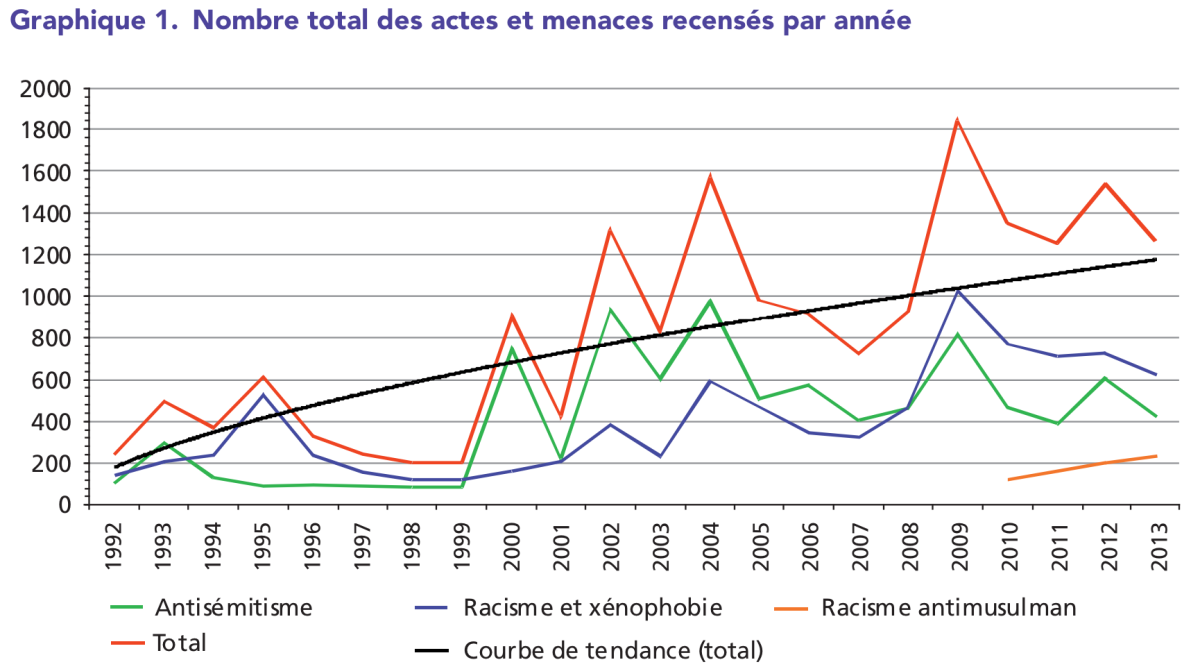
Hate crimes FranceBeyond the anecdotes, hate crime data (chart above) and public polling:

Public opinion surveys might offer some further insight into how Islamophobia is changing in France. In the spring of 2008, Pew surveyed 754 adults in the country about their views on various religious groups. Thirty-eight percent of respondents said they had a “somewhat” or “very” unfavorable opinion of Muslims. That figure was slightly higher than in previous years — in 2006, 35 percent said they had an unfavorable opinion of Muslims in 2005, and in 2004 it was 34 percent.

In 2014, Pew commissioned a new survey, this time posing a question to 1,003 French adults with a slightly different wording. Rather than asking about attitudes toward religious groups in general, the survey asked specifically about attitudes towards religious groups living in France. This time, 27 percent of respondents expressed a somewhat or very unfavorable opinion of French Muslims.

Three-quarters of French respondents believe Islam is an “intolerant” religion, incompatible with the values of French society, according to a January 2013 poll by the French newspaper Le Monde and the market research company Ipsos.

Anti-semitism in France

Rabbis in France have described the country’s Jewish population as “tormented with worry” after Friday’s attack on a French supermarket. On Monday, 5,000 police officers had been sent to Jewish schools and religious sites amid security concerns in addition to 10,000 troops deployed across the country.

The nonprofit Service de Protection de la Communauté Juive (the Jewish Community Security Service, SPCJ) publishes an annual summary of anti-semitic attacks reported to the organization and to police precincts in France. Its latest figures show that in 2013 there were 105 anti-semitics acts and 318 anti-semitic threats. Taken together, the number of threats and acts in 2013 was lower than in 2012 (when there were 614 total incidents) but higher than in 2011 (389).

Pew’s 2014 survey also asked about respondents’ attitudes toward French Jews, with 10 percent of respondents expressing an unfavorable opinion.

In September 2014, Fondapol, a French think tank, posed a range of questions that might reveal anti-semitic attitudes to 1,005 French people age 16 and over. The choice of wording in the survey is interesting. One question asked “when you learn that someone you know is Jewish, what reaction do you have,” to which 91 percent of respondents said “nothing in particular,” 3 percent said “I like them” and 3 percent said “I don’t like them” (the rest refused to answer). However, 21 percent of respondents said they would prefer to avoid having a Jewish president, 14 percent a Jewish mayor, 8 percent a Jewish doctor and 6 percent a Jewish neighbor.

France Has A History Of Anti-Semitism And Islamophobia | FiveThirtyEight.

France’s political elite never champions virtues of a multicultural nation | Elise Vincent

Good piece by Elise Vincent of Le Monde on the problems with France’s approach to diversity and integration:

The problem with the approach of both Sarkozy and Hollande is that it reveals a defensive attitude, never a proactive one. So when the government begins to accept meatless menus in canteens or creates Muslim areas in cemeteries, the impression given to the French public is still that of an “abdication” faced with the claims of Muslim “lobbies”. It doesn’t, as it could, suggest an approach that’s chosen and is beneficial to the French Muslim minority and so, in turn, to the whole of French society.

Similarly, constantly brandishing the idea of a republic “one and indivisible” – as the saying goes – France judges that it is defending itself against Anglo-Saxon “multiculturalism”.

In truth, on the ground, things are very similar. De facto community organisations exist in France, as in the UK. But there’s one key difference: by acting as it does, France prevents the emergence of moderate “community leaders”. Those who manage to emerge in public debate are those who shout the loudest: the radicals.

While failing to review its “model”, France is ignorant of the extent of its mixed relationships and the children born to them. How, without accurate ethnic statistics, can we address properly this grassroots transformation of France? How to measure properly the failures of integration or the success of many immigrants, whether Muslim or not?

The way of speaking of “living together” in France is often too negative, obsessed by the most extreme behaviour, or, alternatively, it is too celebratory, as if it were absolutely necessary to embellish reality to better fight the rise of the Front National. The analyses are often coarse, unnecessarily judgmental. The always subtle, complicated reality of identity and life on the ground is regularly overlooked. All these small shifts in what and how people feel have much more to do with everyday tensions than blind terrorism.

Physicists know that the smell of a dangerous gas is detectable in the air long before becoming harmful and ends in an explosion. There are still two years before the next presidential elections. Two years to prevent French voters massively supporting the Front National, as predicted by many polls. Stopping this leak will not necessarily protect France from terrorism, but it will at least guard against another cataclysm.

France’s political elite never champions virtues of a multicultural nation | Elise Vincent | Comment is free | The Observer.