Ontario human rights chief calls for race-based stats for kids in care

More on the need for a diversity lens:

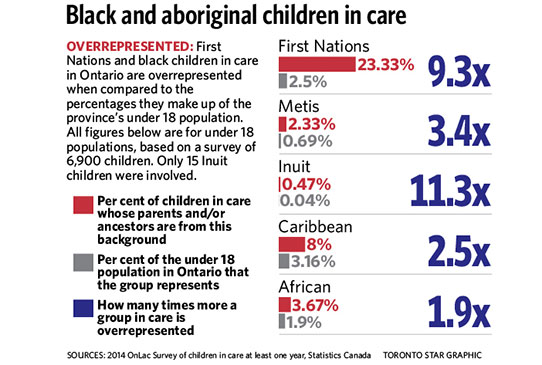
“Systemic and persistent discrimination” is likely involved in a disproportionate number of aboriginal and black children being taken from their families and placed into care, Ontario’s Chief Human Rights Commissioner says.

Ending the trend, Renu Mandhane added, begins with the provincial government collecting race-based data to gauge the full extent of the problem — something it does not currently do.

How can the government and children’s aid societies understand the needs of the children and families they serve — and the discrimination they might be facing — if they don’t know the race and culture of those families, Mandhane asked in an interview with the Star.

“We wouldn’t get involved unless we thought there were elements of systemic and persistent discrimination at play,” Mandhane said, describing her commission’s decision to examine the over-representation of aboriginal and black children in foster homes or group homes.

The human rights commission is the latest in a long list of agencies and community groups to call on the Ministry of Children and Youth Services to collect and make public race-based data. The Children’s Aid Society of Toronto took the step in the summer of 2015 after the Toronto Star revealed that 41.8 per cent of children in its care are black. The city’s under-18 black population, meanwhile, is 8.2 per cent.

Source: Ontario human rights chief calls for race-based stats for kids in care | Toronto Star
Why are so many Ontario black children in foster and group homes?

black kids in careInteresting but not surprising. Having the data allows questions and discussion:

Researchers concluded the results were influenced by the 2008 recession, which affected blacks more than whites and caused more strain on families. Poverty, it noted, is the strongest predictor of maltreatment rates.

Most children’s aid societies in Ontario don’t keep income statistics on the families they serve. The new provincial database won’t capture that information either. But local CAS officials know poverty is often a factor.

“Sometimes people don’t want to make the connection between poverty and child protection,” says David Rivard, chief executive officer for the Toronto CAS. “But there is a correlation. That’s the reality.”

A recent report on child poverty in Toronto co-authored by the agency noted that 41 per cent of children of southern and eastern African heritage are growing up poor — more than three times the rate of children with roots in the British Isles. Meantime, 26 per cent of children whose families are from the Caribbean and 25 per cent from North Africa live in poverty.

Groups serving the black community are trying to bridge the cultural divide that can land children in care. The common use of spanking to discipline children in Africa and the Caribbean, for example, can lead to astonished parents being charged with assault.

… After the Star began asking about the over representation of black youth in care, the Ministry of Children and Youth Services met with CAS officials, the provincial child advocate and Parsons’ African Canadian Legal Clinic.

Children’s aid officials and the legal clinic late last month submitted a funding proposal for a project to look into why the numbers are so high and how to reduce them.

“This cannot be just another study or training program,” Parsons insists. “What I want to see is concrete, substantive change — a reduction in those numbers.”

Parsons and other advocates say the numbers won’t go down until family counsellors from their community team up with CAS workers on every protection investigation involving a black child. That’s how Texas, for example, reduced the number of black children and youth in care.

“I’m not saying there aren’t kids in our community who should be in care,” Parsons says. “But the first approach for an African-Canadian child should not be apprehension and care. And that’s what the numbers are saying to me right now.”

Why are so many black children in foster and group homes? | Toronto Star.