Immigration patterns are reflected in Facebook data on popular foods and drinks
Not surprising but nevertheless interesting:

Researchers have developed a novel strategy for using Facebook data to measure cultural similarity between countries, revealing associations between immigration patterns and people’s food and drink interests. Carolina Vieira of the Max Planck Institute for Demographic Research in Rostock, Germany, and colleagues present these findings in the open-access journal PLOS ONE on February 9, 2022.

Migration may play a key role in shaping cultural similarities between countries. However, its influence is difficult to study, partly due to the challenge of quantifying culture. Typically, researchers have relied on surveys to compare different countries’ cultures, but surveys are associated with several difficulties, such as their cost, the possibility of bias in their construction, and the difficulty of applying them to a large number of countries.

To complement survey data, Vieira and colleagues have now developed a new analytical method based on earlier evidence that and drink preferences may be a proxy for cultural similarities between countries. The new method employs data on the top 50 food and drink preferences for any given country as captured by the Facebook Advertising Platform.

To demonstrate the new method, the researchers applied it to 16 countries, finding that food and drink interests generally reflect immigration patterns. In most countries, including the U.S., preferences for foreign food and drink align with top foods and drinks in the countries from which most immigrants came. Countries with fewer immigrants, such as Indonesia, Japan, Russia, and Turkey, stand apart from the others, showing more idiosyncrasy in their preferences for foreign foods and drinks.

The findings align well with earlier survey data, and they highlight asymmetry between countries; for instance, the top 50 foods and drinks from Mexico are more popular in the U.S. than the top 50 U.S. foods and drinks are in Mexico, reflecting a greater degree of immigration from Mexico to the U.S. than vice versa.

Overall, the researchers say, this study suggests that immigrants indeed help shape the culture of their destination country. Future research could refine the new method outlined in this study or repurpose it to examine and compare other interests beyond food and drink.

The authors add: “We analyze data from Facebook users about their food and drink preferences to measure the cultural similarity between 16 countries. When compared with official migration data, we observe that countries with more immigrants show a higher cultural similarity between the origin and destination .”

Source: Immigration patterns are reflected in Facebook data on popular foods and drinks
Malmö: The Swedish city where Syrian refugees and hipsters have bonded over food | The Independent

A good integration news story from Malmo for a change:

The main square of Malmö’s alternative Möllevången district bursts with colour on Saturdays. The open-air market is in full force; fulsome purple aubergines are stacked proudly next to emerald fronds of coriander and stallholders complain about the weather with friends in foreign tongues. This cosmopolitan corner of Malmö has transformed in recent years from a working class area to a radically multicultural district, where hipsters and refugees rub shoulders. It’s also a hub for some of the most authentic Syrian food outside of Syria.

In 2015, at the peak of the crisis in Syria, Sweden took in more Syrian refugees per capita than any other European country. Of the 163,000 refugees who arrived there in 2015, 32,000 were granted asylum and many of those chose to come to Malmö, where there was already a growing Middle Eastern population.

Shamiat was the first Syrian restaurant in Malmö, founded on 1 October 2013. I visit the branch in Bergsgatan, five minutes from the square. Inside, owner Maurice Salloum twirls the ends of his handlebar moustache ruminatively as his staff lay out a feast of mezze. Salloum arrived in Malmö in 2012, at the start of the civil war, and it took him 18 days to get to Sweden from his home in Damascus. Last year Shamiat was named best Middle Eastern restaurant by a local newspaper. It was the cementing of Salloum’s place in this new city.

“I was feeling fantastic,” he says. “I was very happy and proud that the Swedish people have accepted me to be here in this country”. But he still worries that not all Swedes have accepted the migrant population. There was a terrorist attack in Stockholm in April, perpetrated by a rejected asylum seeker from Uzbekistan who announced his sympathy with Isis. “This made me very sad,” says Salloum, “I baked bread that day and went out there to give the bread away for free.”

Salloum decided to open his restaurant because he saw a gap in the market. The name of the restaurant means “Damascene,” and is also a name for a dish which is only found in Damascus.

“Before we came, there was no Damascene food available in Malmö, so we work hard to give customers something special and unique,” he adds.

I try the fattoush, a salad of roughly chopped leaves, pepper wedges, olives and fried flatbread, drenched in pomegranate syrup. “It’s a very nice, typical dish, a bit like tabbouleh,” says Salloum. It is sharp and sweet and rustic – and nothing like tabbouleh.

The trend for Middle Eastern cuisine was first brought to Malmö by Lebanese and Turkish immigrants, who created the foundations of a food scene that, in turn, helped the Syrian restaurants to flourish here.

Down the road on Baltzarsgatan 21 is Laziza, a modern Lebanese restaurant whose bountiful buffet food attracts 300 customers a day. The owner, Sadoo Iskandarani, says his grandfather opened up the very first falafel place in Malmö.

“He was my idol,” he says. “He was good with bread and falafel. In the Nineties he started a cart selling falafel in Helsingborg and people loved it. The teachers came to eat there and the police officers came, then maybe 20 bikers would come and stand in line, queuing for falafel.

“I think Malmö has the best of all the cultures that live here and that food is building the bridges between the cultures.”

The most recent addition to Malmö’s Syrian restaurant scene is Ayam Dimashq, which roughly translates as “Days of our life in Damascus”. It’s north of Möllevången, on the borders of the Varnhem and Carolikvarteren districts, on Östra Förstadsgatan.

Chef-owner Huni Awwad opened it just nine months ago. He came to Sweden four years ago, when he was 39. Unlike many of the younger men who move to Sweden from Syria, Huni was already well-established with his own large, successful restaurant back in Damascus, called Peacebird.

Ayam is beautifully designed, with a modern, geometric logo and tapestries depicting landmarks and streets in Damascus, with small details picked out in gold thread.

“Everything’s coming together fast here,” says Huni. “In my country everything is a little bit slower, but I come here, open a restaurant, get married and have a boy – and I have another boy on the way – all in four years!”

He came here by boat; it took him five attempts.

“I don’t know why I made it on the fifth attempt but I thought to myself, ‘I can’t turn back this time. I might die, but I can’t turn back. ’Luckily I am here, so it’s good.”

His fattah is a warm blend of pureed chickpeas, yoghurt and sesame, with soft pieces of flatbread melting underneath. It’s topped with toasted cashews, pomegranate seeds, fried strips of flatbread, pine nuts and sprinkled with sumac. The flavours are beautiful.

Awwad’s life seems to have fallen into place here, but the move from Syria was a necessity, not a choice. He works a long day; it’s Ramadan and Midsummer, so he’ll stay open until 4am for his Muslim customers to break their fast.

“It is very hard when you change your whole life,” he says. “It is a good life here, very good, people are very nice and I think my life here resembles my life in Damascus – but it is not my life. My heart is in Damascus.” He looks up at the wall-hanging depicting a winding cobbled street lined with ancient buildings. “I hope one day to walk these streets again, and taste the food of home.”

Source: Malmö: The Swedish city where Syrian refugees and hipsters have bonded over food | The Independent

Film And Food: Sharing The Stories Of Immigrants With Conservative America : NPR

I am a great fan of food and festivals to bring people together.

This project is particularly innovative in the way it tries to get outside the bubble and engage those with concerns or fears:

Like a lot of creatives distressed by the current political climate, filmmakers Daniel Klein and Mirra Fine want to tell stories that matter right now. They want to make a difference.

The husband-and-wife duo behind the Perennial Plate, a weekly web-based program showcasing sustainable food and farming practices, believe in the power of a meal combined with storytelling to bring people together.

Now, Perennial Plate wants to use its platform to spark a dialogue, particularly with conservative Americans, about immigrants and refugees in this country. Klein and Fine want to sow seeds for tolerance and acceptance — in contrast to fear and distrust. And they’re starting with five short films under the banner “Resistance Through Storytelling” about multi-generational immigrant families making a meal and gathering at the dinner table.

YouTube

“Food is as good a place as any to start a conversation. Food and family are the great connectors, something we all have in common,” Klein says. Each film will feature a compelling family who originally hailed from Africa, Asia, Europe, Latin America or the Middle East.

Klein and Fine have spent almost 10 years telling 160 such tales. They started locally, documenting the foodways of Minnesota, their home state. Then they set off around the country, before eventually circling the globe gathering footage and stitching together intimate portraits of the different ways people farm and cook. For example, the episode Our Heart Within Us recounts the story of Francisco and Lucia, Mayan refugees from Guatemala who came to Alamosa, Colo., in the 1980s. The couple grow plants indigenous to their country of origin in their adopted community; by doing so, they’ve held on to a piece of their homeland.

En route, the husband-and-wife team earned two James Beard Awards (they’re like the Oscars of the food world) and added another partner, fellow filmmaker Hunter Johnson, to the mix.

In an intriguing distribution approach, the filmmakers plan to use Facebook advertising, known as sponsored posts, to reach a wider audience and a different demographic than they have to date. They intend to target Americans whose social media preferences suggest they might not be sympathetic to the plight of newcomers to the United States. Sponsored posts can roll out in feeds in specific locations (such as swing states like Wisconsin) and cherry-pick people with particular interests (say John McCain and The Packers).

“We want to get outside of our liberal bubble,” says Klein. “We’re not interested in preaching to the choir.”

The unorthodox distribution model makes sense. These days, many Americans rely on Facebook as a source of news. And the newsfeed on anyone’s social network can create what Klein calls an echo chamber, where a user only sees posts from like-minded people and sources.

The best illustration of this stark division in the dissemination of political information: Perhaps The Wall Street Journal‘s “Blue Feed, Red Feed,”which includes an immigration category. Launched in May 2016, the tool is updated hourly. Even a cursory scroll through the side-by-side feeds reveal there’s nothing fake about the deep divide in news consumed in this country.

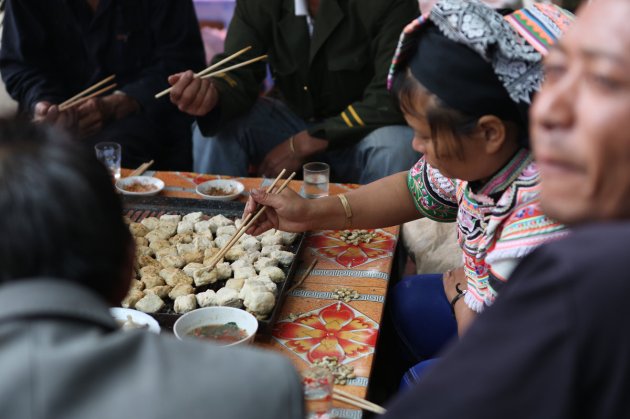
A woman in China’s Yunnan Province makes tofu in an episode of Perennial Plate called “Where The Water Settles.”

Courtesy of Perennial Plate

“My perspective on immigrants and refugees is entirely positive and based on personal experience,” says Klein.

But some of his family members and friends, who see posts in their newsfeeds from right-wing pundits and their ilk, are nervous and worried about immigrants and refugees, he says. Some of them don’t know any actual recent immigrants, which only adds to the disconnection.

“This doesn’t make them ‘bad,’ ” he says, “but I do think it’s time to get more positive stories of immigrants and refugees in front of audiences that don’t normally see that narrative.”

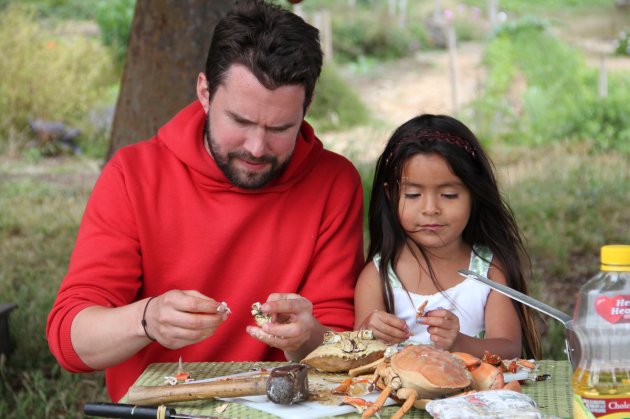
Daniel Klein picks meat from crabs with the young daughter of a former strawberry picker in Oxnard, Calif., for an episode called “A Day In The Life.”

Courtesy of Perennial Plate

It is widely documented, says Klein, that when a person knows someone of a different background or ethnicity, his or her perspective on that “group” changes. He points to a recent anecdotal story about a member of a mostly white, President Trump-supporting southern Illinois county who was detained by U.S. Immigration and Customs Enforcement. Its residents and elected officials rallied around Juan Carlos Hernandez Pacheco, a father, restaurant manager and longtime pillar of the community, who also happens to be an undocumented immigrant. Locals didn’t seem to care. They just wanted Carlos back home — in West Frankfort, Ill., that is, according to a New York Times account. He was released from immigration detention in March.

Source: Film And Food: Sharing The Stories Of Immigrants With Conservative America : The Salt : NPR