Link to report below to this insightful report. Really good analysis across different aspects:
Canadians’ attitudes toward immigration are the most negative they have been since the early 1990s, driven particularlyby young people linking high migrant inflows to the affordability crisis and a housing shortage.
A new report from the Institute for Research on Public Policy, written by University of Toronto researchers, shows just how suddenly and dramatically sentiment toward immigration has changed in recent years. The report is based on 26 surveys produced by the Environics Institute between 1981 and 2024.
Environics surveys the Canadian public annually on a variety of topics. Recent survey results have particularly stood out because of a pointed negative shift in attitudes toward immigration, after more than two decades of mostly pro-immigration sentiment across the country. This prompted the researchers to conduct a historical analysis of immigration attitudes in Canada to gauge when, previously, Canadians held such negative views.
“Such drastic changes in public opinion are not common,” wrote Randy Besco and Natasha Goel, political science academics at the University of Toronto. “Public attitudes are usually subject to short-term shifts, only when there are major events or sustained media coverage, and such swings usually reverse quickly,” they said. …
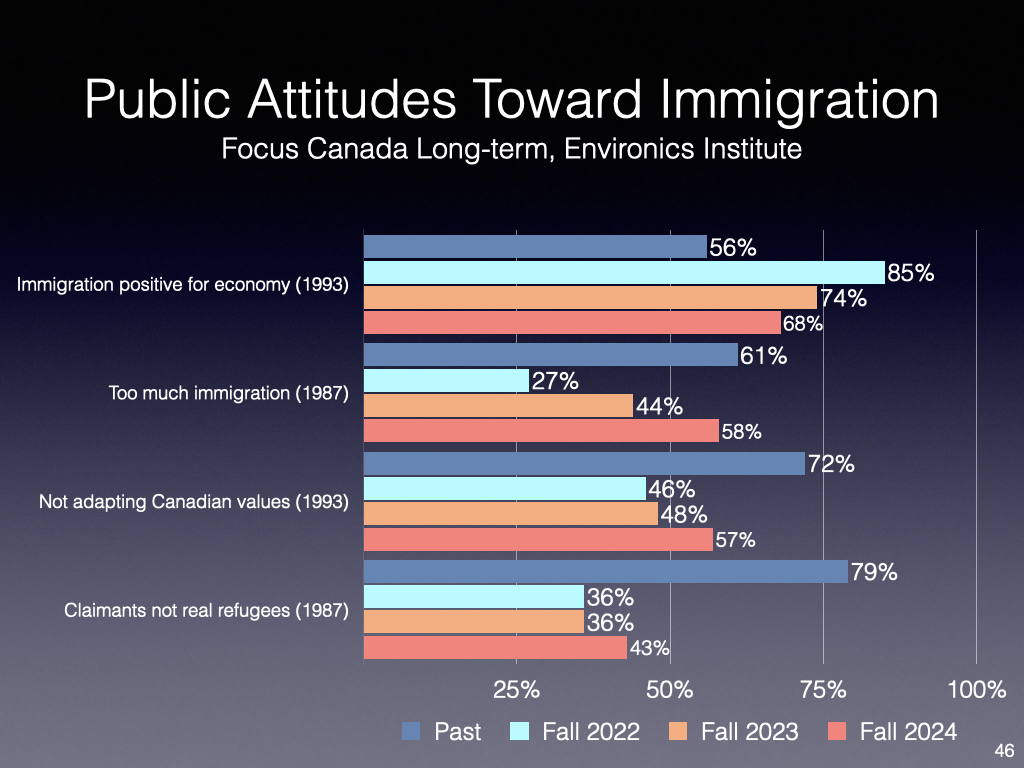
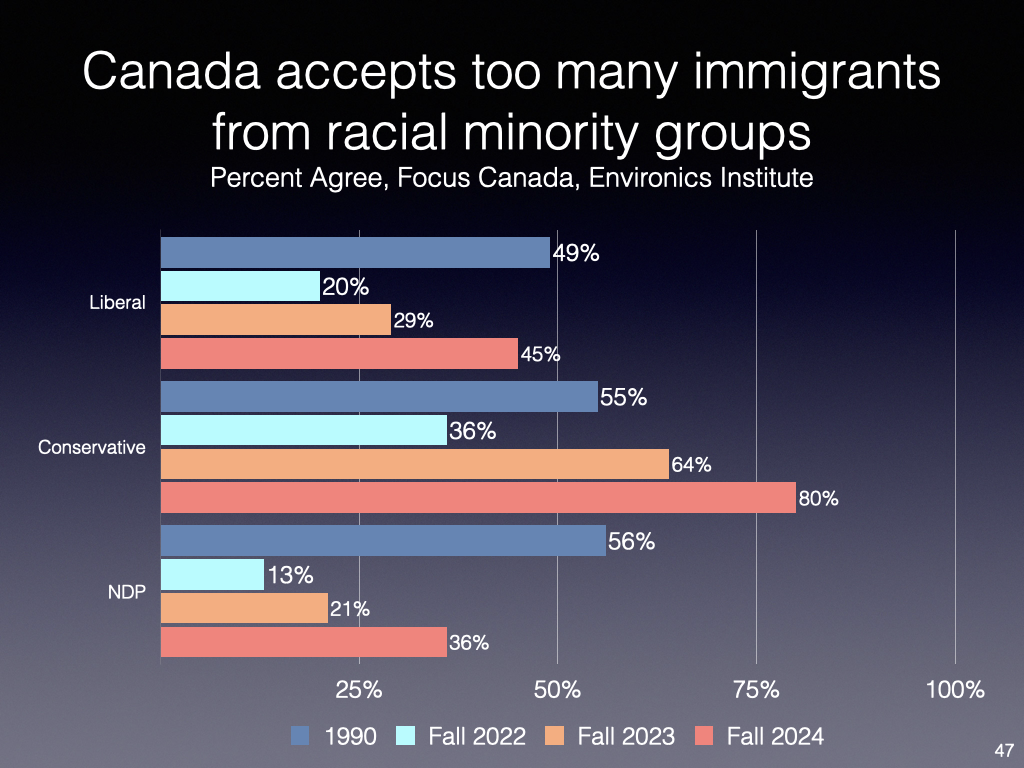
The good news is that for most questions, the decline in support has largely bottomed out. Encouraging that concerns revolve more around immigration program mismanagement and impact on housing, healthcare etc rather than values albeit latter along with refugees and crime remain issues. Partisan differences have increased significantly, likely reflecting Conservative highlighting immigration and citizenship issues and possible influence of USA debates:
A majority of Canadians say there is too much immigration to this country, a new poll suggests, but the percentage of people who believe this has remained stable after a sharp rise over two previous years.
The poll, which was conducted by the Environics Institute for Survey Research in partnership with other groups, also found a widening partisan divide among respondents. Supporters of the federal Conservatives are much more likely to be critical of immigration levels compared with people who support the Liberals or New Democrats.
The survey interviewed 2,004 Canadians via telephone (landline and cellphone) between Sept. 8 and 21. The margin of error for this sample size is plus or minus 2.2 percentage points, 19 times out of 20. The survey has been conducted over decades using broad questions to track Canadians’ feelings about immigration.
Fifty-six per cent of respondents said they agreed with the statement, “Overall, there is too much immigration to Canada,” while 38 per cent said they disagreed with it. …
Clear continuing signs of an inflection point in attitudes, reflecting overly high levels of permanent residents and out of control temporary (students, foreign workers) along with impact on housing availability and affordability.
Recent reversals will take time to work through the system meaning that public opinion unlikely to revert to pre-2022 levels. Clear policy failure on the part of the federal government, along with provincial governments and advocates/lobbyists for high levels.
Reversion to 1990 attitudes or worse as per the summary charts below:
…..Keith Neuman, a senior associate with the Environics Institute, says his organization has consistently found a consensus that immigration was either positive for Canada or not a problem.
But he said Canadians have been growing more concerned about the volume of immigrants. “There are worries and concerns about immigration that we simply didn’t see two years ago to the same extent,” he said in an interview.
However, he said Canadians are not rejecting immigration entirely. “People still value the diversity. They still recognize the economic benefits. They understand that jobs need to be filled. Those things are still part of the general sentiment of the population for most people.
“But there are increasing concerns with how the system is being managed and the number of people coming.”
Among the findings of the researchers is a 10-point increase, to 21 per cent, in those who believe there is too much immigration because it is being poorly managed by government….
Nice breakdown on relative immigration category priorities and related analysis:
If you follow the news, you’ll have seen coverage of our new report on attitudes toward immigration in Canada. Our Focus Canada survey (in partnership with Century Initiative) included a wider range of questions than most – not all of which could fit into the initial coverage. Here’s one that should not get overlooked.
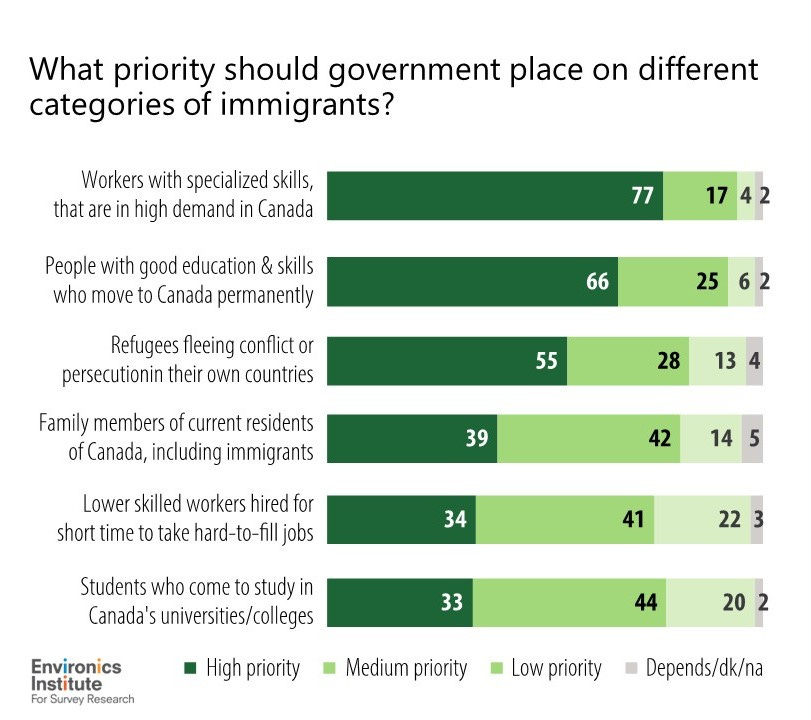
For the first time,* this year’s survey asked about six different categories of immigration as follows:
Each year, Canada accepts immigrants under different categories. Please tell me whether you personally believe the government should place a high priority, a medium priority or a low priority on accepting each of the following categories of immigrants?
Here are the overall results:
The public is most likely to prioritize skilled workers (whether those with specialized skills in high demand, or new permanent residents arriving with a good education). This may not seem surprising, but that’s precisely the point: it’s now widely accepted that our economy needs more skilled workers than we can produce at home. Theoretically, it would have been possible for people to see highly skilled immigrants as rivals who threaten to take away the best jobs from Canadian-born workers. But this is not the case. This type of immigration is seen as a win-win and not a zero-sum scenario.
The next striking finding is that refugees are fairly high up on the list of top priorities (while not quite as popular as skilled immigrants, a majority of Canadians say that accepting refugees should be a high priority). It remains the case that many Canadians continue to value the humanitarian goals of our immigration system, and not just the economic ones.
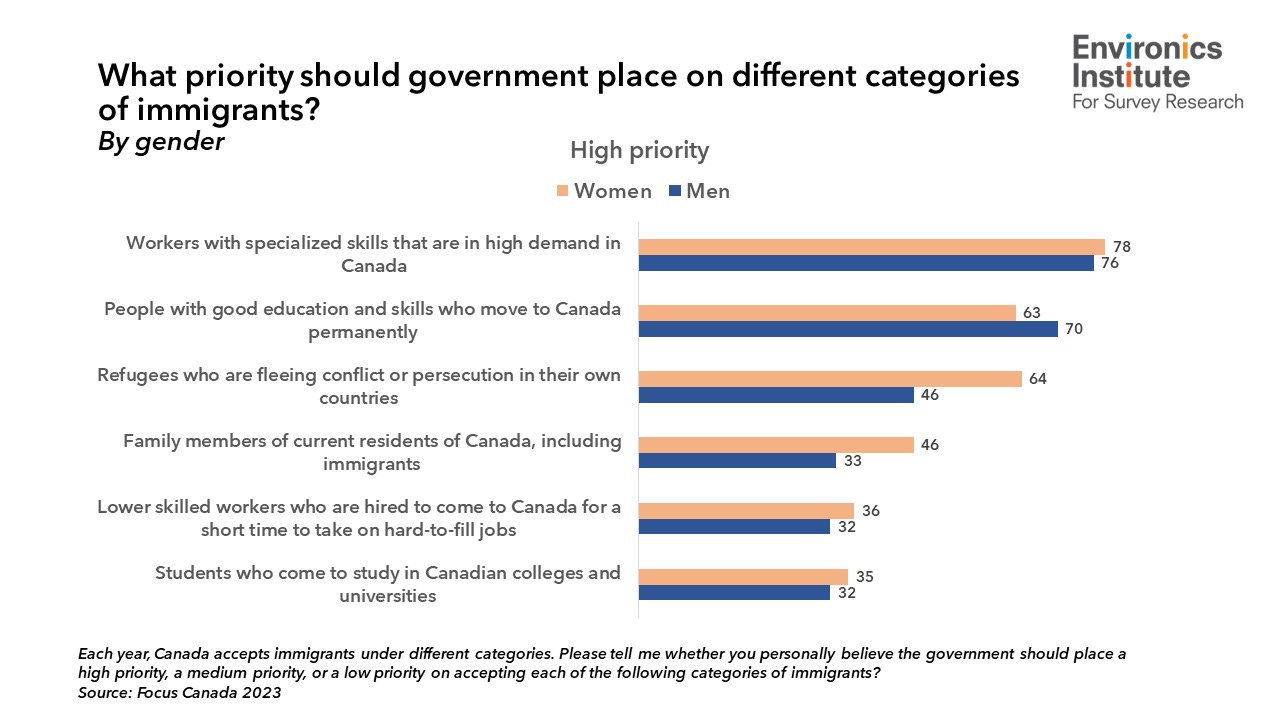
Next comes family reunification. It’s worth noting that there is a significant gender gap on both this item and the previous one about refugees. Women are significantly more likely than men to say that the government should place a high priority on bringing in family members of current residents, and accepting refugees.
Last on the list of high priorities are two types of temporary immigrants: lower-skilled workers and students – something that’s notable at a time when these categories are the ones that have seen the most unexpected increases. Personally, I was surprised to see international students at the bottom of the list; I wonder if the heads of universities and colleges are too.
So much for the high priorities; it’s just as interesting the look at the results the other way around. Relatively few Canadians think any of these six types of immigrants should actually be a low priority. The highest figures come in the cases of lower skilled temporary workers (22%) and students (20%) – but even here, only about one in five say the government should place a low priority on accepting these categories of immigrants.
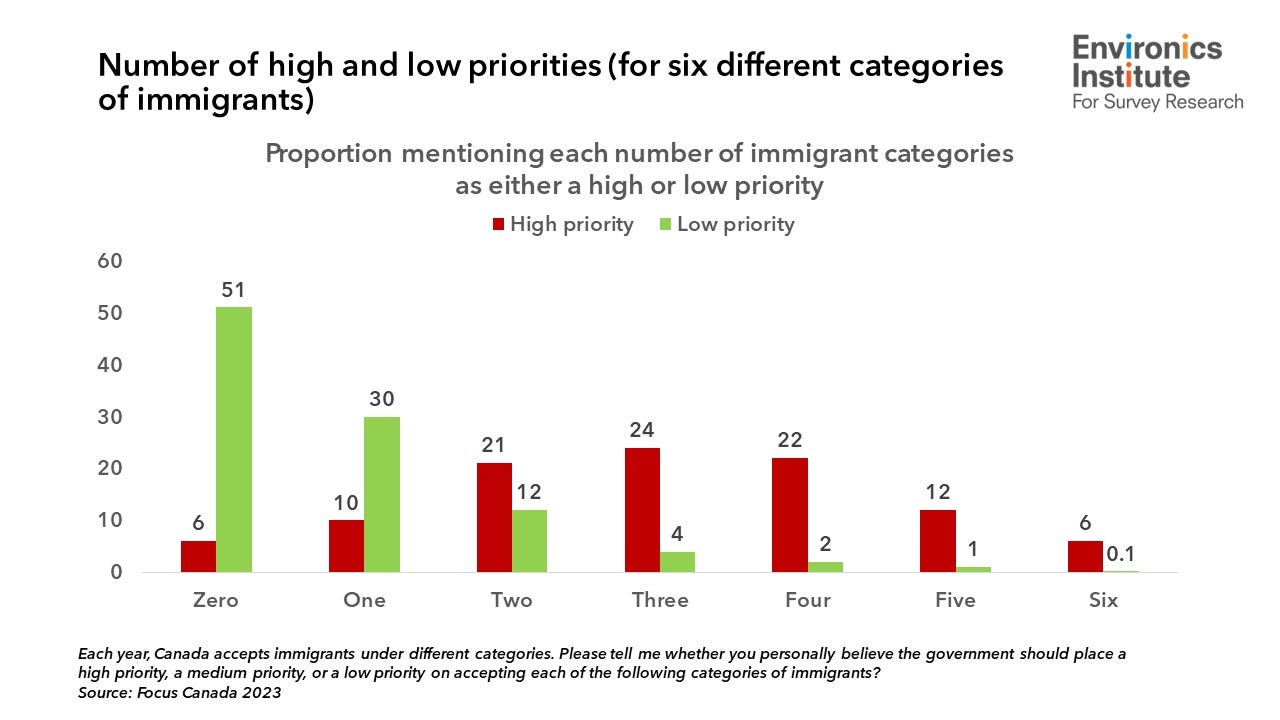
The continuing openness of Canadians to immigration becomes even more apparent if we count up how many of each of the six categories mentioned in the survey are seen as high or low priorities. The count of high priorities has a nice normal distribution: most people are in the middle (66% name two, three or four high priority types of immigrant) and relatively few people are at either end of the spectrum (16% name zero or one high priorities, and 17% name five or six).
The picture is very different when we count low priorities. One in two Canadians do not answer “low priority” for any of the six categories of immigrant. Four in five (81%) name no more than one. Only three percent list at least four of the six categories as low priorities. In a survey of 2,002 Canadians, a grand total of three people (0.1%) think all six categories should be a low priority for the government.
This is important context for interpreting the main headline from the survey, which is that there has been a big jump in the past year in the proportion of Canadians who agree there is currently too much immigration (from 27% in 2022 to 44% in 2023). This is certainly an expression of anxiety about the current state of the economy in general, and housing availability and affordability in particular. But it’s not an expression of growing opposition to the idea of Canada as a country that welcomes immigrants.
To back up this interpretation, consider the following additional findings:
First, a majority of those who agree that there is too much immigration to Canada nonetheless say that the government should place a highpriority on accepting each of the two categories of skilled immigrants mentioned in the survey.
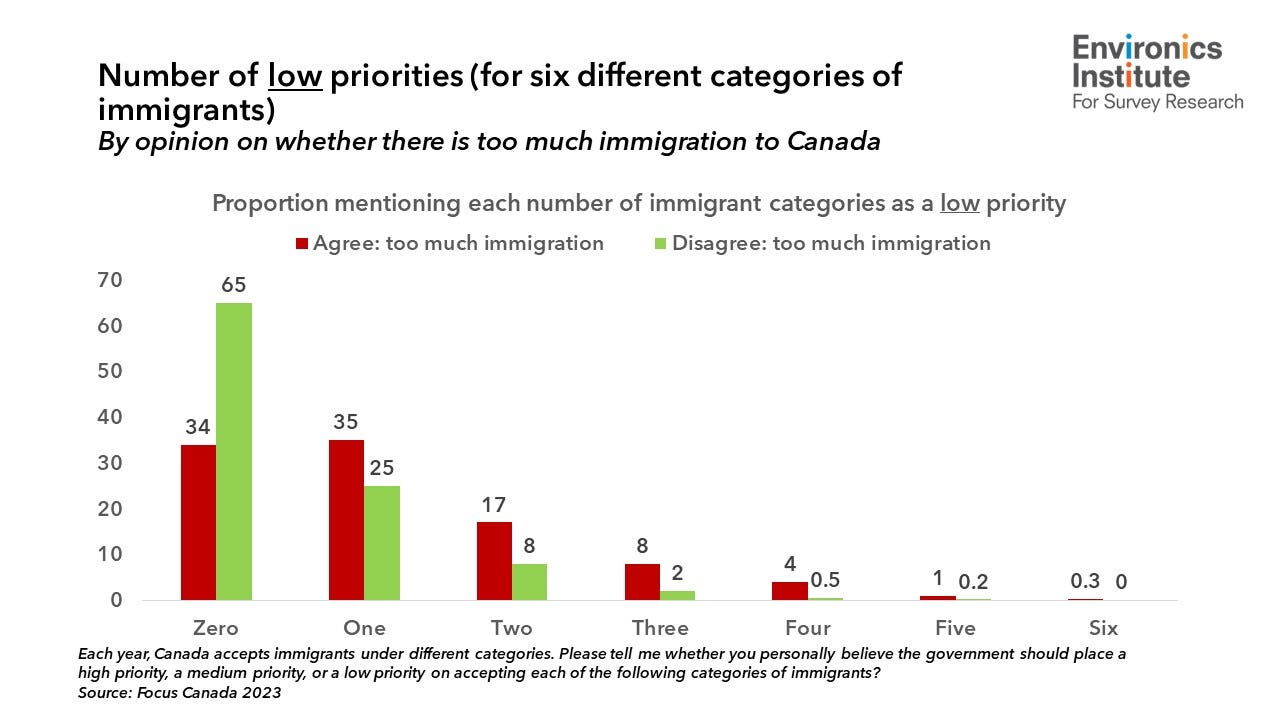
Second, and more generally, 91 percent of those who agree that there is too much immigration to Canada nonetheless say that the government should place a high priority on accepting at least one of the six categories of immigrants mentioned in the survey.
Finally, only 14 percent of those who agree that there is too much immigration to Canada say that the government should place a lowpriority on accepting at least three of the six categories of immigrants mentioned in the survey.
In other words, while a lot of Canadians have concerns about the details of current immigrant policy, very few think it’s time to raise the drawbridge.
Canada has long been an immigrant nation, starting more than four centuries ago when the first European settlers arrived on what many Indigenous peoples call Turtle Island. Today, Canada stands out as having one of the most ethnically diverse populations on the planet. The 2021 census identifies more than four in 10 of us as either first- or second-generation Canadians; roughly half of the people living in Toronto and Vancouver started their lives in another country. This remarkable evolution has not been without blemish, as we know from a history of prejudice and racism directed toward new waves of newcomers over our history, whether Irish, Chinese, East Indian, or Muslim; unfortunately, elements of xenophobia still persist in our society.
But the prevailing sentiment among Canadians is one of acceptance, viewing immigration and immigrants as good for, if not essential to, our country’s growth and diversity. Our research at the Environics Institute reveals that our multicultural character is among the strongest sources of national pride and identity. Globally, the Gallup World poll consistently ranks Canada as the top country for migrant acceptance among its citizens, and we are the second-most desired destination worldwide (just behind the United States) among people considering migration.
Our continuing Focus Canada public opinion research surveys have found solid public support for immigration over the past decade, with notable consistency despite disruptions from the global COVID-19 pandemic, contentious federal and provincial elections, and occasional economic downturns. Our trend lines have looked remarkably stable for a long time.
In 2023, however, something significant has changed. In our latest national survey conducted in September in partnership with the Century Initiative, more than four in 10 Canadians now agree with the statement “there is too much immigration to Canada.” This remains the minority view, but it has grown by 17 percentage points from 12 months ago – a dramatic shift in public opinion that is the most significant one-year change in this indicator in four decades of research.
The primary reason for this change appears to be the growing concern about the potential role that a large number of newcomers may be having on housing, now widely considered to be a crisis in terms of both availability and affordability. Immigration may well be just one of numerous factors affecting the housing market, but recent images of asylum seekers camped out on city streets and homeless encampments in parks are potent signs that infrastructure has not kept up with our ambitious immigration targets.
And it’s not just about housing. Our research found that Canadians are feeling negative about the direction the country is heading, growing concerns about inflation and the cost of living, and diminished confidence in the ability of governments to address the country’s challenges ahead.
At the same time, our research shows no comparable change in how Canadians feel about immigrants and refugees, and what they contribute to the country. A strong majority continues to say that immigration has a positive impact on the country’s economy. Locally, Canadians across the country say immigrants make their own community a better place rather than a worse one, by a wide margin.
What are we to make of this latest change in public sentiment? Canadians are now, for the first time in decades and perhaps the country’s history, increasingly questioning immigration levels from the perspective of what they believe the country can manage in terms of resources, at a time when housing, our health care system and other infrastructure such as transit are under stress. The public’s focus now appears to be shifting beyond concerns about what type of immigrant is accepted, to how many are arriving in their communities.
Up until now, we would have considered anyone who says there is too much immigration to Canada to be expressing a xenophobic sentiment, reflecting fear or rejection of those seen as too different because of race, religion, or culture. This still applies for some, but we must now recognize that the public discourse has changed – that it is increasingly about the country’s capacity to receive the number of newcomers arriving, as well as who it is we are admitting. Some economists and policy experts insist that high immigration levels are essential to maintaining population growth and supporting key labour markets, but our social consensus on immigration and diversity depends on creating a well-functioning society for both Canadians who are already here as well as those still to come.
More coverage of declining public support for current high levels of immigration. Starting with the Toronto Star (arguably, there has been greater misinformation by the advocates of high levels of immigration than from those advocating caution):
A pair of new polls point to a continuing decline in Canadians’ support for immigration — findings one pollster describes as a “clarion call” for the federal government.
The federal government’s current immigration plan, unveiled in 2022, aimed to bring in 465,000 new permanent residents this year, 485,000 in 2024 and 500,000 in 2025. The Immigration Department is on track to meet the 2023 target.
The poll by the Environics Institute for Survey Research and Century Initiative found the number of respondents who agreed “immigration has a positive impact on the economy of Canada” has dropped 11 per cent from last year and reached its lowest level since 1998.
Lisa Lalande, CEO of Century Initiative, said the data is a “clarion call” for proactive economic planning, improved integration policies and investments in infrastructure such as housing in order to preserve the confidence of Canadians.
“Immigration makes us a more prosperous, diverse, resilient and influential country — but only if we do the work to grow well,” said Lalande, whose group advocates for responsible population growth.
The separate poll of 1,500 people by the Association for Canadian Studies and Metropolis Canada revealed similar trends. It found 57 per cent of respondents in Greater Toronto felt there are too many immigrants, compared to 41 per cent in Montreal and 49 per cent in Vancouver.
Respondents in Greater Toronto were also most likely to feel there were too many refugees admitted to Canada, with 55 per cent of them agreement with the statement, followed by 40 per cent among those from Montreal and 39 per cent of those from Vancouver.
“These surveys were indicative of a shift in sentiment around the numbers of immigrants coming to the country, a lot of which, I think, is connected to issues around housing,” said Jack Jedwab, president of the ACS and Metropolis.
Those sentiments are fuelled in part by the lack of knowledge among Canadians of the country’s immigration landscape, he said.
Thirty-seven per cent of participants in the survey thought Canada received more than 250,000 refugees a year, when only about 76,000 were accepted. They also overestimated the number of permanent residents admitted to the country, with 27 per cent of people believing that Canada had already been taking in 500,000 newcomers a year.
The misinformation speaks to the need to better educate and inform the public about Canada immigration, Jedwab said.
“Policymakers have to pay more serious attention to how we manage immigration and manage opinion around immigration,” he said. “They need to explain to people why immigration continues to be so vital to the future of our country.”
At an event on Friday, the immigration minister said discussions about the upcoming immigration plan were ongoing but hinted that reducing immigrant intake was not an option, even though he said he understood the public concerns.
“This is one of the most significant economic vehicles to our country, but we need to do it in a responsible way,” Miller told reporters. “The net entrance into the workforce is 90-plus per cent driven by immigration, so any conversation about reducing needs to entertain the reality that would be a hit to our economy.”
The Environics and Century Initiative report showed 44 per cent of Canadians said they were strongly or somewhat in agreement with the statement, “there is too much immigration to Canada,” up 17 percentage points from a year ago, the largest one-year change recorded on this question since the annual survey started in 1977.
It said those who agreed with this statement were most likely to cite concerns that newcomers may be contributing to the current housing crisis (38 per cent of this group give this reason) compared to only 15 per cent in 2022.
Respondents continued to identify inflation, cost of living, the economy and interest rates as the most important issue facing the country. Overall, just 34 per cent of people said they were happy with the way things are going in Canada, down 13 percentage points from last year.
The silver lining is that the negative public sentiments toward immigration do not appear to have translated into Canadians’ feeling about immigrants themselves, the survey said.
Forty-two per cent of respondents said immigrants make their community a better place, compared to just nine per cent who believed newcomers make it worse, with the rest saying it makes no difference. Those with a positive view cited local diversity, multiculturalism as well as the role immigrants play in economic and population growth.
Of the various admitted classes of permanent residents, the respondents also want the federal government to prioritize those with specialized skills and high education, followed by refugees fleeing persecution and overseas families of Canadians.
Temporary foreign workers in lower-skilled jobs and international students were ranked the lowest, with only about one-third of people saying those two groups should be a high priority, the report found.
The 2024-26 immigration plan is expected to be tabled in Parliament on Wednesday.
L’appui aux cibles d’immigration actuelles est en chute libre. Entre 2022 et 2023, la proportion de Canadiens susceptibles de dire qu’il y a trop d’immigrants dans le pays a bondi de 17 points de pourcentage, ce qui vient renverser radicalement une tendance qui remonte à des décennies.
Quelque 27 % des Canadiens considéraient l’an dernier que « le Canada accueille trop d’immigrants ». Cette année, ils sont 44 % à affirmer une telle chose, une croissance record de 17 points.
« On a déjà vu des périodes où l’opinion restait en mouvement, mais là, c’est un saut. On peut dire que c’est du jamais vu », explique Andrew Parkin, l’un des chercheurs de cette étude. Il faut remonter au début des années 2000 pour observer une telle frilosité à l’égard des seuils d’immigration.
Ce changement d’opinion touche autant les Canadiens les plus fortunés (+20 %) que les immigrants de première génération (+20 %). Il touche aussi les partisans libéraux (+11 %), néodémocrates (+9 %) ou encore conservateurs (+21 %).
Économie et crise du logement
Ce n’est pas le malaise culturel que peuvent susciter les néo-Canadiens qui cause cette volte-face dans l’opinion publique, souligne le rapport. C’est plutôt le contexte économique difficile et la pénurie de logements qui fondent cette nouvelle réticence.
« Ça ne veut pas dire que les immigrants sont la cause de la crise du logement ou du manque de logements abordables, soutient Andrew Parkin. C’est plus : “Est-ce que c’est le bon moment pour avoir plus d’immigration étant donné qu’il y a une crise du logement ?” C’est une nuance. […] Le contexte économique touche tout le monde également. Ça touche aussi les immigrants, qui cherchent aussi à acheter une maison. »
Malgré tout, une majorité (51 %) de Canadiens rejettent encore l’idée que les niveaux d’immigration seraient trop élevés. Et ils sont très peu nombreux à voir l’immigrant comme un problème en soi.
« Certains disent qu’on utilise la crise du logement comme excuse pour se tourner contre les immigrants. Ce n’est pas ça. Le nombre de Canadiens qui disent que l’immigration empire leur communauté, c’est juste 9 %. Au Québec, c’est 4 %. »
Le Québec plus ouvert
Le Québec suit la tendance canadienne, mais demeure le territoire où le sentiment général reste le plus ouvert aux nouveaux arrivants. Environ un tiers (37 %) des Québécois considèrent que les immigrants sont trop nombreux, contre 50 % en Ontario et 46 % dans le reste du Canada.
La vision du Québec sur cette question a grandement évolué depuis les années 1990. Pas moins de 57 % des Québécois considéraient en 1993 que les immigrants « menaçaient la culture du Québec » ; ils ne sont plus que 38 % à avoir cette opinion aujourd’hui.
Yet another poll showing a decline in support for current high levels of immigration over the past year given the impact on housing, in particular.
Public support for immigration has fallen sharply over the past year as Canadians increasingly tie affordability and housing concerns to a historic influx of newcomers, according to survey results published on Monday.
Forty-four per cent of Canadians think immigration levels are too high, up from 27 per cent last year, according to a survey conducted by the Environics Institute for Survey Research, in partnership with the Century Initiative, an organization that advocates for Canada’s population to hit 100 million by 2100. This was the largest change in sentiment between surveys that Environics has observed in four-plus decades of polling on the topic.
Just a year ago, public support for immigration was stronger than ever, Environics found. But since then, Canadians have been consumed by a number of economic worries, including high inflation, rising interest payments and a worsening housing crisis, which is pushing up resale prices and rents across the country.
At the same time, Canada is growing rapidly. Over the 12 months through June, the population expanded by around 1.2 million people, bringing the total number of residents to 40.1 million. At 3 per cent, this was the largest 12-month increase since 1957; international migration accounted for almost the entirety of the expansion.
This surge has led to a spirited debate about immigration and Canada’s ability to absorb so many people so quickly. The results from Environics are similar to other recent surveys, including a Nanos poll for The Globe and Mail that found more than half of Canadians want the country to accept fewer immigrants than Ottawa’s plan.
“We see these results as a clarion call for action,” said Lisa Lalande, the chief executive officer of the Century Initiative. “You cannot address demographic decline through immigration without having these corresponding investments” in housing and other areas.
The survey was published just before the federal government unveils its next three-year plan for immigration this week, covering 2024 to 2026. Last year, Ottawa said it was aiming to admit 500,000 permanent residents annually by 2025, part of a steady increase since the Liberal Party came to power in 2015.
As the Liberals struggle with weaker support in the polls, the Century Initiative is hoping the government doesn’t water down its immigration plans. “Now is not the time to pull back on immigration,” Ms. Lalande said.
Of late, the population increase is mostly driven by the arrival of temporary residents, such as international students and workers, many of whom wish to settle permanently in Canada. There are no limits on the issuance of temporary visas, although Prime Minister Justin Trudeau said last week that his government was considering a cap.
Under Mr. Trudeau, the Liberals have made high immigration a cornerstone of their economic agenda. They argue that not only will immigration lead to stronger growth, but it will also help fill jobs as Canada gets progressively older.
David Williams, vice-president of policy at the Business Council of British Columbia, said this is a naive view of how economies work. He pointed to a stagnation in gross domestic product per capita as a sign that average living standards were not improving, despite the high intake of newcomers. Furthermore, there is ample research that indicates immigration has little effect – positive or negative – on per-capita output or average wages.
“Canada’s immigration policy has really become disconnected from the academic evidence,” Mr. Williams said. “There seems to be a view in Ottawa that ever-increasing immigration levels is a panacea for all of the structural problems in Canada’s economy.”
Rupa Banerjee, a Canada Research Chair in immigration and economics at Toronto Metropolitan University, said the country has struggled for a long time to build homes in sufficient quantities. “People are getting this wrong impression that the immigration situation is causing the housing crisis,” she said.
The Environics survey found the largest declines in support for immigration in British Columbia and Ontario. There was a sharp divide by political party: Nearly two-thirds of Conservative Party supporters agreed with the statement that “there is too much immigration to Canada,” compared with 29 per cent of Liberals and 21 per cent of New Democratic Party backers.
Still, the results suggest that Canadians see the upsides of immigration. Around three-quarters of people agreed that immigration has a positive impact on the economy, down from 85 per cent last year.
The survey was based on telephone interviews conducted with 2,002 Canadians between Sept. 4 and 17. The results are accurate to within plus or minus 2.2 percentage points in 19 out of 20 samples.
The Century Initiative was co-founded by Mark Wiseman, chair of Alberta Investment Management Corp., and Dominic Barton, the former global managing partner of consulting giant McKinsey & Co. Mr. Barton also served as chair of the Advisory Council on Economic Growth, which recommended to the Trudeau government in 2016 that it raise its annual intake of permanent residents by 50 per cent over five years.
“We do not believe in growth at all costs,” Ms. Lalande said. “That growth must absolutely be accompanied by investments in infrastructure, both physical and social.”
Dr. Banerjee said the federal government could do a better job of communicating its plans for how these newcomers will integrate into Canada. Otherwise, she said, people are left with the impression that there is no plan.
“For several years now, I’ve been slightly concerned that we shouldn’t take this high support for immigration for granted,” she said. “It’s very precarious, to be honest.”
Interesting to contrast Canadian and foreign-born along with party. Striking that more immigrants feel levels too high compared to Canadian born. Party differences less surprising:
Overall, there is too much immigration to Canada: Canadian-born 43 percent, Foreign-born 47 percent, Liberals 29 percent, CPC 64 percent, NDP 21 percent
Many people claiming to be refugees are not real refugees: Canadian-born 33 percent, Foreign-born 45 percent, Liberals 29 percent, CPC 49 percent, NDP 21 percent
There are too many immigrants coming into this country who are not adopting Canadian values: Canadian-born 48 percent, Foreign-born 46 percent, Liberals 38 percent, CPC 65 percent, NDP 27 percent
Overall, immigration has a positive impact on the economy of Canada: Canadian-born 72 percent, Foreign-born 81 percent, Liberals 85 percent, CPC 64 percent, NDP 89 percent
The other question that is interesting to look at the breakdown between Canadian and foreign-born pertains to those immigrants considered to be high priority. Not surprisingly, immigrants place higher priority on family immigration and international students but a lower priority on refugees. Both give priority to higher skilled compared to lower skilled:
People with good education and skills who move to Canada permanently: High priority: Canadian-born: 66 percent, Foreign-born: 67 percent
Family members of current residents of Canada, including immigrants: Canadian-born: 38 percent, Foreign-born: 43 percent
Refugees who are fleeing conflict or persecution in their own countries: Canadian-born: 58 percent, Foreign-born: 47 percent
Workers with specialized skills that are in high demand in Canada: Canadian-born: 76 percent, Foreign-born: 80 percent
Students who come to study in Canadian colleges and universities: Canadian-born: 29 percent, Foreign-born: 45 percent
Lower skilled workers who are hired to come to Canada for a short time to take on hard-to-fill jobs: Canadian-born: 34 percent, Foreign-born: 33 percent
Along with the Census release, comes the latest Focus Canada survey of Canadian attitudes to immigration that show remarkable strong and increasing support for immigration virtually across the board.
Governments, with the exception Quebec, business and other stakeholders have clearly been successful in their demographic and economic arguments and I have seen no other major surveys that contradict the overall picture.
As always, partisan differences, particularly between the CPC and the Liberals and NDP are are significant but a majority of Conservatives also disagree that immigration levels are too high (53 to 43 percent).
With respect to whether “Canada accepts too many immigrants from racial minority groups,” again the Conservatives agree more but with a majority disagreeing (56 to 36 percent). Interestingly, while Conservatives are supportive of accepting refugees from conflict zones (64 to 34 percent), particularly so when Ukraine and Afghanistan are mentioned (67 to 27 percent, while Liberals and NDP have 90 percent support). There is also increased overall disagreement with refugees not being “real” refugees but the partisan divide is stark with 53 percent of the Liberals and 30 percent of the Conservatives disagreeing with that statement.
Security and health risks are not perceived as problems but housing and over crowding are unprompted concerns.
Multiculturalism continues to be viewed as part of Canadian identity by two-thirds of those surveyed (95 percent of Liberals, 82 percent of Conservatives and 92 percent of NDP).:
Days ahead of the federal government’s release of its multiyear immigration targets, the latest results in an annual poll suggest Canadians support current immigration levels more than they have in nearly half a century.
Since the Justin Trudeau governmentcame to power in 2015, annual immigration numbers have soared from less than 300,000 a yearto a target of almost 450,000 in 2023. This week, Ottawa will announce immigration targets for the years ahead, including a breakdown of numbers between different immigration streams: economic, family sponsorship and humanitarian, which includes refugees.
“Canada needs more immigrants to increase its population.”
But even with broad public support, the country’s ambitious immigration targets only tell half the story. Immigrants still face many difficulties once they arrive in Canada, including a housing crisis, rising food costs owing to inflation and an underfunded settlement sector to help them find work and access services such as health care and education.
“We’ve pretty much reached a consensus,” said Keith Neuman, a senior associate at the Environics Institute: Not only is immigration good for the economy, it is a vital part of it. “The outstanding issues are about integration,” he said.
An overwhelming majority of those surveyed – 85 per cent – agreed that immigration has a positive impact on the country’s economy, a statement that proved controversial just three decades ago (when only 56 per cent said they agreed).
Environics partnered on this poll with the Century Initiative, a charitable organization that has campaigned for strong immigration levels in Canada. The poll was conducted by phone with 2,000 Canadians between Sept. 6 and Sept. 30. A sample of this size drawn from the population produces results accurate to within plus or minus 2.2 percentage points in 19 out of 20 samples.
When asked whether they agree or disagree with the statement “There are too many immigrants coming into this country who are not adopting Canadian values,” 46 per cent agreed, compared to 72 per cent in 1993.
(In the case of this question and others in the poll with a negative bias, pollsters sometimes phrase statements in a provocative way because that can generate stronger responses, Mr. Neuman said. They also want to preserve the wording of the statements over the decades so they can more accurately track how attitudes may have shifted over time.)
But an external evaluation of how successfully an immigrant has integrated – which may be largely based on how fluently they speak one of Canada’s official languages – might lack a nuanced understanding of the myriad challenges immigrants face after they arrive, said Neda Maghbouleh, Canada Research Chair in Migration, Race and Identity, who runs a refugee research project at the University of Toronto-Mississauga.
Prof. Maghbouleh said the greatest challenge to successful integration among the population she’s studied is housing and how there simply isn’t enough to accommodate all who are arriving in Canada, no matter what stream they’re coming in on.
“Without proper integration, any economic gains are flimsy or short-lived,” she said.
“For thefamilies that are in our study, their urgent situations are pretty much always about housing, about getting evicted. It’s about a family member or someone in their network losing their housing and then having to join into an already overcrowded environment,” she said.
The settlement sector – meant to help immigrants with housing, but also with everything from language training to résumé writing to registering their children for school – has also faced significant strains.
A 2021 report from the Association for Canadian Studies that surveyed workers at settlement agencies found that the field is in turmoil. While record numbers of immigrants are arriving in Canada, the programs designed to help them adjust to their new homes and thrive are not consistently funded, and there is high turnover of workers because their wages aren’t competitive.
In Nova Scotia, the rate of retention for immigrants has been increasing, and currently sits at 71 per cent, meaning those who arrive in the province are finding work and settling into the region, rather than decamping for other parts of the country, as has long been the trend. But having that many more immigrants stay in Nova Scotia means front-line staff are feeling the strain.
Jennifer Watts, chief executive officer of Immigrant Services Association of Nova Scotia, says the biggest challenge her organization faces is development and support for staff.
Another issue Ms. Watts and the ACS report noted is that as the federal government’s targets for different streams of immigrants shifts, so does the funding for different programs, which can make long-term planning difficult.
From 2018 to 2021, the number of permanent residents arriving in Nova Scotia increased 51 per cent, but the funding from the federal government to ISANS in that same period only increased 7 per cent.
“When the country as a whole is committing to higher immigration levels, leaders at that level who are making that decision need to say, ‘This is going to take a significant amount of money to help people settle and move quickly into the labour market and succeed,’ ” Ms. Watts said.
Correct, even if more discussion about the advisability of such an expansionist approach is needed.
But is is striking that the latest Focus Canada survey by the Environics Institute shows remarkable stability in Canadian generally positive attitudes regarding immigration despite a difficult pandemic year:
With a little more than two months to go, Canada is comfortably on track to meet its goal of welcoming 401,000 new permanent residents this year, despite closed borders and other pandemic restrictions.
That Canada is on the cusp of achieving such a goal in such times is remarkable. Even more remarkable is that no one seems to consider this a big deal.
“We’re in the home stretch,” Immigration Minister Marco Mendicino told me. “Our goal of landing 401,000 new permanent residents in 2021 is well within sight.”
And the Liberal government remains committed to setting immigration records every year, with 411,000 new arrivals slated for 2022 and 421,000 in 2023. Canada is now taking in well in excess of 1 per cent of its population of 38.5 million annually.
The Immigration department has been meeting these targets by converting temporary workers, graduated international students and asylum claimants already in Canada to permanent residents. Those measures, however, are winding down. Visa offices are open once again around the world and fully vaccinated travellers are allowed to enter Canada.
The COVID-19 pandemic revealed hard truths. One is that some of Canada’s most essential workers aren’t in high tech or trades; they’re supermarket workers and truck drivers and others who keep the wheels turning. Immigration policy must recognize their importance.
Another is that immigration will account even more for labour-force growth after the pandemic than it has in the past. Canada’s total fertility rate in 2016 was 1.6, short of the 2.1 children per woman needed to keep a population stable. Today it’s down to 1.4.
Don Kerr, a specialist of demography at King’s College at the University of Western Ontario, shared with me data on fertility rates by census metropolitan area, based on Statistics Canada’s 2020 birth data. Many major cities have fertility rates below the national average.
Vancouver’s fertility is 1.09, comparable to the ultra-low fertility rates of Pacific countries such as Japan and South Korea, while Victoria has fallen to a remarkable low of 0.95. Edmonton (1.41), Calgary (1.33) and Montreal (1.41) are at or close to the national average, but Toronto is only at 1.21, and Halifax is at 1.1.
“Canadian women are delaying their first birth further and further, having fewer children and opting for childlessness to a greater extent than ever before,” Prof. Kerr observed. Thirty-two out of 33 census metropolitan areas saw a decline in fertility over the past decade, even prior to the pandemic.
“Canada’s natural increase is at an unprecedented low,” said Prof. Kerr. “If the smaller cohorts to follow the millennials continue with this very low fertility, we can expect even fewer births.”
If so, then immigration is the only route to filling labour shortages and sustaining the economy. The good news is that new polling data provided to The Globe and Mail by the Environics Institute and Century Initiative show that attitudes toward immigration remain positive and stable.
Sixty-five per cent of those polled disagreed with the statement: “Immigration levels are too high.” Only 29 per cent agreed. Flipped around, 57 per cent agreed that “Canada needs more immigrants to increase its population” (37 per cent disagreed) and 80 per cent agreed/16 per cent disagreed that “the economic impact of immigration is positive.”
(The survey was based on landline and cellphone interviews with 2,000 Canadians from Sept. 7-23, and has a posted margin of error of 2.2 percentage points, 19 times out of 20.)
In the recent federal election, every major national party supported an open immigration policy. Maxime Bernier’s People’s Party, which would ratchet the numbers down, received 5 per cent of the vote, but even that modest level of support was probably based mainly on the party’s opposition to vaccine mandates.
Far from opposing immigration, provinces such as Ontario are asking Ottawa to increase the numbers they can bring in under the provincial nominee program.
Mr. Mendicino may or may not remain as Immigration Minister after a new cabinet is sworn in Oct. 26. His and other departments struggled to extricate Canadians and those who had served Canada when the Taliban swept to power in Afghanistan in August.
But overall the country’s immigration performance on this minister’s watch has been impressive. And Canadians should congratulate themselves on remaining an open and welcoming society, even as so many others have closed their doors.
The latest from the Environics Institute, which has been tracking immigration attitudes for some 30 years with consistent questions and is one of the more reliable surveys.
Stronger levels of support than I would have expected given COVID-19, highlighting the degree to which Canadian attitudes differ from most other countries:
Canadians are steadily becoming more open and accepting of immigrants and refugees despite uncertainty caused by the COVID-19 pandemic, a new survey indicates.
In the past year, Canadians’ views toward immigration became more positive than they have been in more than four decades, according to a new survey from Environics Institute, Century Initiative and the University of Ottawa.
The poll provided exclusively to The Globe and Mail shows that two-thirds of Canadians now reject the idea that immigration levels are too high.
When asked if respondents agree or disagree with the statement: “Overall, there is too much immigration to Canada,” 66 per cent said they disagree, an increase of three percentage points from last year, while 27 per cent said they agree with the statement, down seven percentage points, and fewer than 7 per cent have a clear opinion either way.
Strength in opinion has also shifted, the survey found, with 39 per cent of Canadians strongly disagreeing with the statement, and the trend is consistent across the country and among different demographics.
The survey report said that since the pandemic left millions of Canadians out of work and confined to their homes, people might be expected to turn away from immigration. But it said the results indicate the pandemic has not diminished Canadians’ openness.
Keith Neuman, senior associate of Environics, said the overall positive trend is significant because it’s not specific to certain parts of the population.
“We’re seeing this kind of positive trend in almost every region and demographic group we’ve identified, so it is not limited to simply east versus west or only young people, or only people with the most education, or income,” he said.
Mr. Neuman said even groups who have historically been less supportive of immigration became more supportive over the past year.
The survey report said the increase in support of current immigration levels is noticeable among Albertans, people with lower household incomes and first-generation Canadians.
Past surveys showed views on immigration polarized along political lines, but Mr. Neuman said this gap narrowed a bit over the past year.
The survey shows 81 per cent of NDP supporters favour the current immigration levels, as do 75 per cent of Liberal Party voters, both up a tad since last year. The positive trend is most noticeable among federal Conservative Party supporters, with 52 per cent disagreeing with the statement that there is too much immigration to Canada, up seven percentage points.
The survey also shows that 84 per cent of respondents agreed immigration has a positive impact on the Canadian economy, up four percentage points from last year. Fifty per cent of respondents strongly agree with the statement that over all, immigration has a positive impact on the economy, and 12 per cent disagree, with 4 per cent having no opinion.
“Belief in immigration as an economic driver is the majority view across the country, expressed by over 70 per cent in every province and identified demographic group,” the report said.
Seventy-eight per cent of Canadians disagreed with the statement “Immigrants take jobs away from other Canadians,” reflecting a significant increase of 11 percentage points from 2015. This view is also reflected in every region and demographic.
Mr. Neuman said this survey is conducted every six months, when possible, but at least annually, and repeats the same questions to determine how sentiment evolves.
He said every question shows people feel more positive about immigrants.
“What we’re seeing is the continuation of a trend that has been happening for the last few years. So these trend lines for the most part have not reversed, they’re extending the trend we started seeing particularly about two years ago.”
The survey of 2,000 Canadians was conducted Sept. 8 to 23, 2020, through telephone interviews on landline and cellphone. The margin of error is plus or minus 2.2 percentage points in 19 times out of 20.



 Multicultural Meanderings