Indigenous woman fights to stay in Canada, saying traditional territory is B.C.

Interesting case, one that requires joint agreement by the USA and Canada to address, and for that reason, unlikely in the post 9/11 security environment and the overall Trump administration to immigration and citizenship:

A First Nations woman working to revive a threatened language in her traditional territory of northern British Columbia says she’s being forced to leave the country on Canada Day.

Mique’l Dangeli belongs to the Tsimshian First Nation, whose territory straddles the border between Alaska and British Columbia. She says Canada won’t recognize her right to live and work in B.C. because she was born on the American side of the Annette Island Indian Reserve.

She said her visa expires July 1.

“For me, what I consider home is my home community and my people’s traditional territory, which is northern B.C.,” she said. “We’re not immigrants to our people’s traditional territory.”

Dangeli gave up a tenure-track position with the University of Alaska Southeast to teach 65 students how to speak Sm’algyax in the community of Kitsumkalum, just outside of Terrace, because there are so few fluent speakers remaining.

‘I’ve shed a lot of tears’

She says she hasn’t said goodbye to her students yet because it’s too difficult.

“I’ve shed a lot of tears with my elders and family but I don’t want to do that with my students. They’re so young and their love for the language is my inspiration and solace. I wouldn’t have the strength to fight this battle if I didn’t see where the hope truly lies, which is within my students,” she said.

After having two express entry applications for permanent residency fail, Dangeli has started a petition calling on the Canadian government to reciprocate the Jay Treaty, which was signed between the United States and Britain in 1794. The treaty allows status Indians born in Canada, who also have 50 per cent blood quantum, to live and work in the U.S.

Canada does not recognize the agreement as binding because it never codified it.

“The colonial border between the U.S. and Canada dissects Indigenous territories in ways that sever the lifelines between First Nation families, communities, languages and ceremonies,” Dangeli’s petition says.

Dangeli says she considered applying for Indian status in Canada, but learned the two-year process hinged on the baptismal record of her great-great-great grandmother in Prince Rupert, B.C., in the 1860s.

“So if she decided not to convert to Christianity I would not be considered an Indian under the Indian Act. The whole process is about one colonial institution affirming the power of another. It has nothing to do with our inherent Indigenous rights that predate colonial law,” Dangeli said.

Border issues unresolved

The federal government has been working to resolve border issues for First Nations but has not reached a solution. In December 2016, it appointed Fred Caron to examine the issue as a special representative of the minister of Crown-Indigenous Relations and Northern Affairs.

Caron met with representatives from more than 100 First Nations between January and August 2017, submitting a report to a committee of senior federal officials that is charged with developing a plan for addressing the border-crossing issues.

“Among the issues highlighted in Mr. Caron’s report, and that are being examined by the committee of senior officials, are questions relating to the important cultural and family connections between First Nations in Canada and native American communities in the United States,” Crown-Indigenous Relations and Northern Affairs Canada said in a statement.

The government will discuss next steps on the file with First Nations in the coming months, after the committee submits its recommendations, it said.

“The government is committed to working in partnership with First Nations to address their Canada-United States border crossing concerns,” the department said.

Although the Jay Treaty is historic, Canadian institutions are increasingly choosing to honour it, said Mary Ellen Turpel-Lafond, a law professor with the Peter A. Allard School of Law at the University of British Columbia and inaugural director of the school’s Indian Residential School History and Dialogue Centre.

She gave the example of Vancouver Island University, which offers domestic tuition for American Indigenous students who would fall under the treaty.

Border issues have most commonly arisen in Eastern Canada, she said, where communities like the Akwesasne First Nation cross three borders between Ontario, Quebec and New York.

Some are looking for solutions, like Mohawk leaders who called for a special identification card that would ease the border crossing, which hasn’t been granted, she said.

Practical solution wanted

“Indigneous people have been coming forward and saying let’s work this out in a practical way,” she said.

“It’s a case where Canada is actually behind.”

Toronto lawyer Sara Mainville says border issues have been common in Eastern Canada and some First Nations leaders have taken it upon themselves to set up meetings with customs and immigration officials so their community members don’t run into any problems, since Canada isn’t honouring the Jay Treaty.

In 2006, her own community of the Couchiching First Nation sanctioned the adoption of the husband of one of its members who was born on the American side of the Anishnaabe territory, because he needed medical care and Canada wouldn’t recognize his rights to the territory.

Mainville pointed to Canada’s commitment to the United Nations Declaration on the Rights of Indigenous Peoples as something that gives Dangeli’s argument more weight, because it specifically says Indigenous Peoples divided by international borders have a right to maintain contact with their own members.

For Dangeli’s part, she says she hopes her situation is resolved as soon as possible, especially given the critical state of the language.

“This is my heart and soul and the work is very much needed within our nation.”

Source: Indigenous woman fights to stay in Canada, saying traditional territory is B.C.

First Nations School of Toronto ready for brighter future

While I always have mixed thoughts about ethnically (or religiously) based schooling given that it can hamper integration, understand the pressures particularly with First Nations.

It will be important to have some long-term evaluations of this school’s effectiveness, not just in terms of graduation rates (important, where I expect improvement) but 10 years post-graduation in terms of employment and income:

Twenty-five years ago, Shannon Judge was an indigenous student in a Barrie high school where sports teams were named the “Redskins.”

A generation earlier her mother, from Wasauksing First Nation near Parry Sound, wasn’t allowed to speak her first language of Ojibwe at the elementary school she attended on her reserve.

Today, Judge’s two children are finally breaking the cycle at First Nations School of Toronto. Raven, 9, and Rayne, 8, are part of a new era of indigenous education that teaches them through the lens of aboriginal experience and history.

Thanks to their school, both children now speak Ojibwe with their grandmother, which has inspired Judge to take lessons too, provided by volunteers through the school. Morning smudging ceremonies and daily 40-minute language and culture classes with an elder are part of their routine.

“I feel like my kids are getting something from school that’s not only education, but a connection to their history and identity that empowers them and gives them a sense of worthiness,” says Judge.

As of this month, students will have the option of keeping that connection until they graduate from Grade 12, following the school’s long-awaited move from its cramped quarters at Dundas Street Public School.

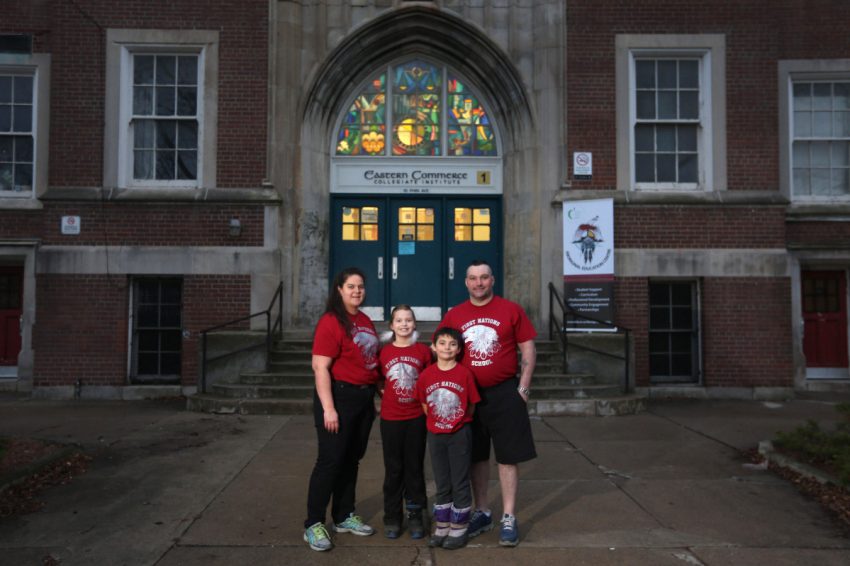
The Judge family - Shannon and Neal with Raven, 9 and Rayne, 8, - are shown outside the First Nations School of Toronto, which opened in its new location this month.

The move to the spacious building — site of the former Eastern Commerce Collegiate, which closed in 2015 due to falling enrolment — means that beginning in September, First Nations School will introduce a new high school grade each fall. The new Grade 9 class next September will become the first graduates in 2021.

That will make it Ontario’s first publicly-funded school to offer aboriginal education from kindergarten through Grade 12.

“The dynamics have changed,” principal Jonathan Kakegamic said following the Jan. 10 opening on the six-acre property, also home to the Aboriginal Education Centre run by the Toronto District School Board.

The kids, currently in kindergarten through Grade 8 and from all over the city, were beside themselves to see all the space, inside and out. Instead of eating breakfast and lunch in a crowded classroom, they now have a cafeteria, along with their own gym and an auditorium.

“I’m just excited to be here,” says Kakegamic, who moved from Thunder Bay last August to become principal. “It’s an honour to be part of this new era.”

Attendance has already risen to 131 students from 96 in September and the new site will accommodate 600.

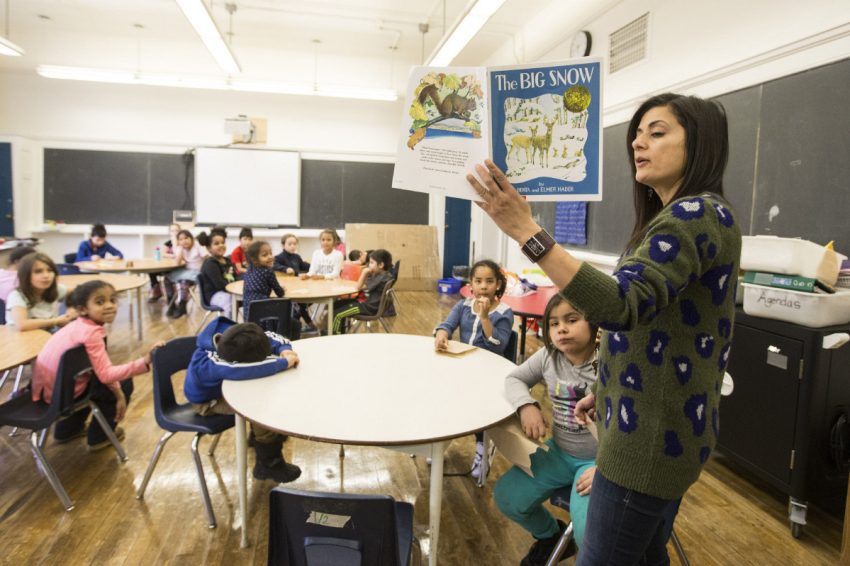
Teacher Maliha Mitha reads to her Grade 1 and 2 class at First Nations School of Toronto during the children's first week at the new site.

Kakegamic and others in the community stress that expanding to secondary school is critical to reducing high dropout rates among indigenous students, who often feel lost in a larger system that doesn’t teach their perspective and history.

Source: First Nations School of Toronto ready for brighter future | Toronto Star

Jonathan Kay: The one place in Canada where racism is still tolerated: native reserves

Jon Kay tackles the thorny integration vs accommodation issue with respect to First Nation reserves:

On the other hand, let’s give the Mohawk Council of Kahnawake their due, shall we? In the modern context, what is the point of the reserve system except to give natives a space that provides them with a measure of autonomy and cultural “authenticity”? Having embraced the notion that one’s bloodline dictates ones rights a notion dismissed as racist in every other context of public discussion and policy formation, Canadian liberals have been forced to accept its noxious corollary — which is that the presence of white people in the midst of reserves comprises a sort of cultural pollutant.

This is the reason politicians and public figures are so loathe to take a strong stand against the Mohawk Council of Kahnawake and other native groups that strike militant postures on behalf of native identity: Such criticisms implicitly strike at the very heart of the utopian liberal notion that natives flourish best among their own, in protected, demographically homogenous enclaves that are geographically rooted in their traditional lands.

In every other context, Canadian liberals zealously embrace the idea of diversity and multiculturalism. In liberal cities such as Toronto, Vancouver and Montreal, the sight of people of every skin colour living side by side, including as husband and wife, is taken as a neighbourhood’s badge of enlightenment. But if the neighbourhood happens to be a native reserve, the exact opposite premise holds sway: Run whitey out of town.

Eventually, Canadians are going to have to make up their mind on the diversity-versus-segregation question. It’s simply untenable to say that while the United Colors of Benetton are ideal for whites, natives should be free to construct miniature societies based on racist principles that were decisively rejected by Abolitionists two centuries ago. It’s an embarrassment to Canadian values and a cruelty upon those natives who have committed no crime except to fall in love with someone of a different skin colour.

Lawrence Hill in his Massey Lectures in Blood picks up a similar theme from an identity perspective (see Blood by Lawrence Hill):

Jonathan Kay: The one place in Canada where racism is still tolerated: native reserves