New rules make it ‘nearly impossible’ for employers to keep foreign graduates on staff

The Liberal government will likely look at this issue as part of reviewing the overall Express Entry point system, along additional points for family siblings and restoration of pre-Permanent Resident time credit:

When Jorge Amigo chose to come to Canada for university, he hadn’t expected to want to spend his life here.

“My decision to come here as a student had nothing to do with immigration,” says Mr. Amigo, 33, who’s from Mexico City. “But after living here for a few months, I realized I loved this place and I wanted to stay.”

Before Ottawa’s points-based Express Entry system was introduced on Jan. 1, international students with a year of Canadian skilled work experience were almost guaranteed to stay by getting permanent residency under the Canadian Experience Class (CEC). But with the change, Mr. Amigo – who has bachelor’s and master’s degrees from the University of British Columbia, an impressive post-graduate résumé and a job with a booming Vancouver-based tech company – fears he may have to leave when his work permit expires in June.

With the new system, it’s nearly impossible for most international student graduates such as Mr. Amigo to get permanent residency under Express Entry – unless their employers can prove that no Canadians can do the job, immigration lawyers say.

“Tens of thousands of students are now heartbroken, stressed and don’t know what to do with their lives because they were misled by the government,” says Vancouver immigration lawyer Zool Suleman. “Employers are looking to lose a group of well-educated students who would be a benefit to the labour market.”

The online system, intended to eliminate a massive backlog of immigration applications from outside of Canada, now makes students compete in a points-based system with everyone else trying to get permanent residency.

“They shouldn’t have included [the CEC] in the Express Entry system because there never was a backlog with it – they never even met their quotas,” says Matthew Jeffrey, an immigration lawyer in Toronto. “These are the ideal immigrants because they’re educated in Canada and they have skilled work experience in Canada and they usually still have that job – they hit the ground running.”

Under Express Entry, applicants get points for education, age, work experience and their skills in English and French. If an applicant’s points are over the minimum score set by the government, they’re invited in.

“The problem for people who came in as students is they can’t rank very highly in the pool,” Mr. Jeffery says, a Toronto immigration lawyer. “They’re young and they only have a year or two of work experience, so their score from the beginning is going to be low.”

Source: New rules make it ‘nearly impossible’ for employers to keep foreign graduates on staff – The Globe and Mail

Temporary foreign workers get first dibs under express entry

More teething pains or more substantive problems? Early results or signalling a trend?

Jason Kenney, who was responsible for the Harper government’s transformation of Canada’s immigration system during his time as immigration minister, on Friday touted express entry as “a system that’s fast, that connects people to the labour market so they can realize their dreams and fulfil their potential upon arrival in Canada.”

“New economic immigrants are arriving in Canada in months rather than years,” Kenney said during a news conference in Vancouver.

“A growing percentage have jobs lined up before they get to Canada rather than being stuck in survival jobs for years following their arrival.”

While that may be the goal, express entry has opened the door to very few new economic immigrants. To date, it has favoured a large number of temporary foreign workers and other foreign nationals already in the country.

Over 85 per cent of the foreign nationals who were selected for admission under express entry in the first six months of the year — 11,047 out of 12,304 — were already in Canada, according to a report published by the Department of Citizenship and Immigration in July.

The report shows that three per cent were living in India, followed by two per cent in the U.S. and one per cent in the Philippines. Even smaller percentages resided in other countries.

As of July 6, Canada had issued 844 visas to foreign nationals and their dependents resulting in only 411 admissions being fast tracked for permanency residency.

“Implementing the express entry system was a significant undertaking and we continue to monitor it closely,” the government report said, cautioning it is only “a snapshot” intended to capture “one moment in time.”

While immigration officials are working tirelessly to iron the kinks out of the system, the report said Canada will meet its immigration quota not through express entry but by drawing from a backlog of applications submitted under the old system.

The majority of new economic immigrants to Canada will not be drawn using the new system until it’s in full flight in 2017.

‘Unusable’ for businesses

Businesses say the system’s biggest flaw is a new requirement borrowed from the newly reformed temporary foreign worker program, which Kenney and Chris Alexander announced last year following a series of stories published by CBC’s Go Public team alleging abuse of the program.

Under express entry, it isn’t enough that economic immigrants have to line up a job before applying to come to Canada — that offer must also be backed by a positive labour market impact assessment. That assessment, or LMIA, is a document all employers now need to hire a foreign worker over a Canadian one.

This is a new requirement under an economic stream that sees upwards of 250,000 new permanent residents admitted each year.

“It’s made it unusable for many employers that we hear from and for small and medium businesses,” said Sarah Anson-Cartwright, the director of skills policy at the Canadian Chamber of Commerce, the largest business association in the country representing some 200,000 employers

Members of the Chamber, she said, are disillusioned with a process that has become too “onerous.” Employers are complaining that their assessment forms are being rejected due to inadvertent omissions or typos.

Source: Temporary foreign workers get first dibs under express entry – Politics – CBC News

An Early Look at Express Entry Candidate Selection

__An_Early_Look_at_Express_Entry_Candidate_SelectionGood summary of experience to date with Express Entry by the Conference Board:

A new report by Citizenship and Immigration Canada (CIC) provides a mid-year update on Express Entry, CIC’s new, two-step application management system.1 Launched on January 1, 2015, Express Entry seeks to be more responsive to Canada’s economic needs while processing immigration applications more efficiently.2 In step one, candidates complete online profiles and are awarded up to 1,200 points based on various criteria. In step two, CIC draws the highest scorers from the pool of candidates, who then become eligible to submit applications for permanent residence in Canada.

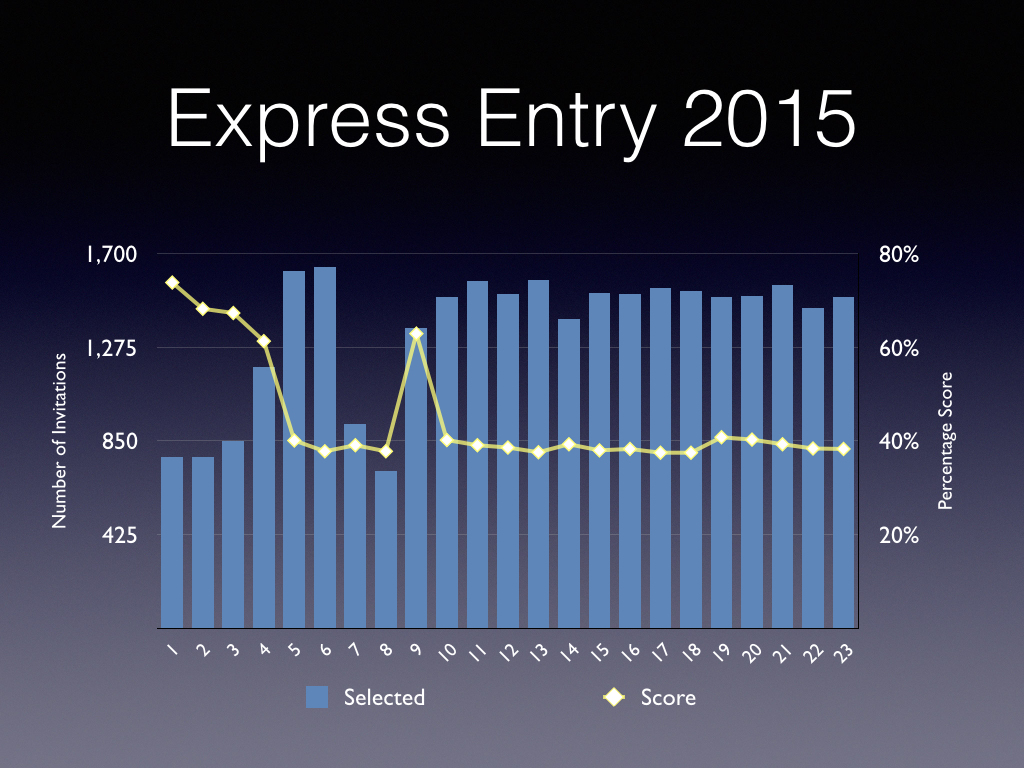
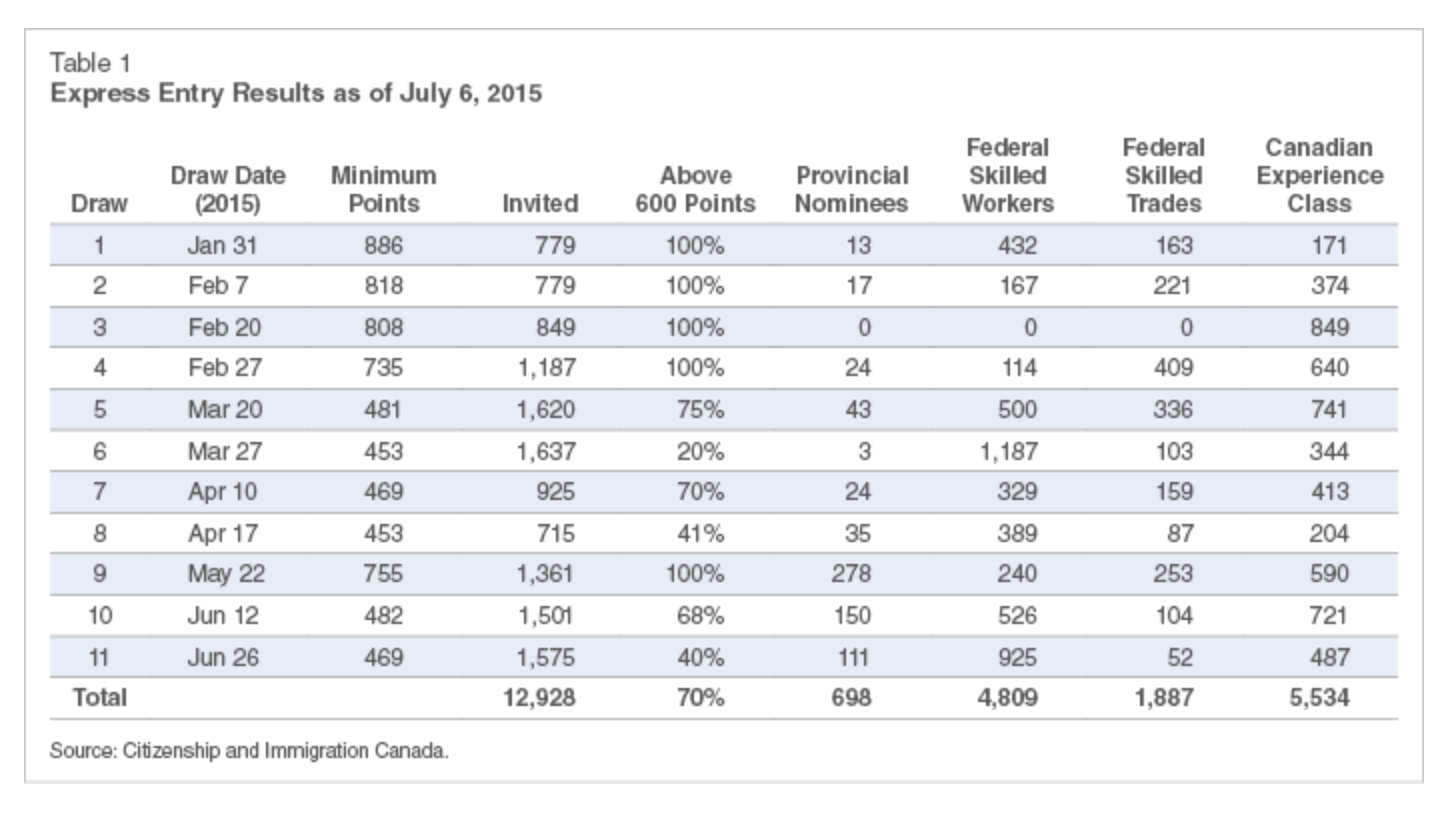
As of July 6, 2015, 112,701 Express Entry profiles had been submitted. Of these profiles, 48,723 candidates (43 per cent) were found ineligible since they did not meet Express Entry criteria. Of the remainder, 12,928 received invitations to apply for permanent resident status (in eleven draws which took place January 1–July 6: See Table 1). Among the invited candidates, 70 per cent scored above 600 points, meaning that the majority either obtained a job offer backed by a Labour Market Impact Assessment (LMIA),3 or a Provincial Nomination Program (PNP) certificate.4 Scoring over 600 points was a prerequisite to receiving an invitation to apply in Express Entry’s first four draws. Since then, point requirements have declined, though never below 453 points.

The overwhelming majority of invited candidates resided in Canada at the time of their Express Entry application (85.5 per cent), followed by India (3.2 per cent), and the United States (1.8 per cent). The top five source countries of invited candidates were India (20.8 per cent), the Philippines (19.4 per cent), the United Kingdom (7.4 per cent), Ireland (5.3 per cent), and China (4.1 per cent).

An Early Look at Express Entry Candidate Selection.

Only 1 in 10 candidates invited to immigrate under Ottawa’s new Express Entry system

Only_1_in_10_candidates_invited_to_immigrate_under_Ottawa’s_new_Express_Entry_system___Toronto_StarTeething pains or more substantial issues?

More than 112,700 people applied for permanent residency in Canada under a highly touted new system Ottawa introduced in January — but only one in 10 succeeded in getting an actual invitation to come.

Despite a promise that Express Entry would allow expeditious processing within six months, only 844 permanent resident visas were issued, including both the principal applicant and family members, and 411 people had arrived in Canada as of July 6, according to the program’s six-month review.

More than 85 per cent of the 12,017 candidates selected from the pool were already in Canada on temporary permits at the time of the application. The top five source countries included India, the Philippines, the United Kingdom, Ireland and China.

“It is remarkable that only 844 visas have been issued for a program which has invited over 12,000 people to apply. Within the 844, only 411 have actually used their visas and been admitted to Canada as permanent residents,” said Toronto immigration lawyer Shoshana Green.

“Is 844 visas considered a successful program? With over 85 per cent of the invitations being made for applicants currently residing in Canada, is the world really interested in Canada anymore?”

…In the first six months of the program, 11 rounds of invitations were held, with the cutoff scores ranging from a low of 453 to a high of 886. Some 70 per cent of people receiving an invitation had a score above 600 points, meaning the majority would be coming with an approved job offer.

Critics have argued that meeting the selection cutoff score and being invited does not necessarily mean the best candidates are chosen, as the new system favours those who have obtained the LMIA.

For instance, someone with a total score of 649 can actually be a weaker candidate than someone with 599 points who earned the score strictly from his or her personal attributes — rather than with the boost of 600 bonus points that comes from an approved job opportunity.

According to Citizenship and Immigration Canada’s six-month review, 112,701 candidate profiles were created as of July 6. Some 48,723 were deemed ineligible, and 6,441 were withdrawn.

Among the 41,218 active candidates remaining in the pool, more than half, or 27,000 people, had a score between 300 and 399. Only 355 had a score over 600; 51 had a score above 1,000.

Only 1 in 10 candidates invited to immigrate under Ottawa’s new Express Entry system | Toronto Star.

ICYMI: Government changes course, promises to help CFL quarterback Henry Burris obtain citizenship

Another reminder of the complexities of life running against more clear-cut program design:

But the 39-year-old Spiro, Okla., native’s citizenship application was rejected under Ottawa’s recently overhauled immigration policy.

The Express Entry program classified his CFL career as “part-time work” because the season lasts only six months, from June to November.

“Our job doesn’t qualify as a full-time occupation since it’s not year-round,” Burris said. “But trust me, due to the fact of what we do on and off the fields, it’s more than just a full-time job.”

In a statement sent to CTV News Sunday, Kevin Menard — spokesperson for Citizenship and Immigration Minister Chris Alexander — said the government would “work with” Burris to help him obtain citizenship.

“Mr. Burris has shown a great commitment to Canada over many years, and his community work through his foundation is an example for Canadian youth and all Canadians,” Menard said. “We will work with the Ottawa RedBlacks and Mr. Burris to ensure he can remain in Canada.”

Government changes course, promises to help CFL quarterback Henry Burris obtain citizenship | CTV News.

Slow start for Express Entry but new immigration system to pick up – Minister

Still early days so we should see the ramp up Alexander refers to:

Mr. Alexander said he doesn’t expect the new system to significantly alter the mix of Canada’s immigration source countries. India, China and the Philippines remain the largest sources for applications.

“We still see strong interest and immigration flows from Asia … but we also see some new markets responding to the prospects of a faster system,” Mr. Alexander said. “I know in France there’s a lot of interest in Canadian immigration and a lot of interest in Express Entry.”

In one round of selections, the top countries of residence were Canada (foreign applicants who are already in the country), the United States, India and England, according to Citizenship and Immigration Canada (CIC).

… “That is truly remarkable,” Mr. Alexander said. Under the old system, would-be immigrants could wait up to eight years to have their applications assessed, since it was run on a first-come, first-served basis. Now, the top candidates go to the front of the line right away, he said.

It’s a competitive system, but fair, he added.

Slow start for Express Entry but new immigration system to pick up – The Globe and Mail.

Ottawa’s new Express Entry immigration system slow off the mark

Seems like normal process of introducing a new approach. We need to see full-year and likely two-year data to judge operational success (economic and social outcomes will take longer):

So far, slightly more than 6,850 prospective immigrants have been invited to apply for permanent residency under Express Entry. It will not be until 2017, two years after its launch, that a majority of immigrants are processed through the new system, Citizenship and Immigration Canada said. The shift to the new economic immigration system was announced in 2012 and has been in place since Jan. 1.

In its 2015 immigration levels plan, the Citizenship and Immigration ministry pledged to accept 260,000 to 285,000 new permanent residents, about two-thirds of them economic migrants. To meet that target, the government needs to admit about 22,500 immigrants a month, about 10 times the number that are admitted through Express Entry at present. Most new immigrants this year will have to be selected through the old system, which was criticized because it was slow and operated on first-come, first-served basis.

“CIC is in a period of transition with recent implementation of Express Entry that will span approximately two years,” said Johanne Nadeau, a Citizenship and Immigration Canada spokeswoman.

A majority of economic immigrants arriving in 2015 will be drawn from the pool of people who applied to enter Canada in the years before Express Entry was introduced, Ms. Nadeau said. It is not clear exactly how large a portion of overall immigration will come from Express Entry candidates, or whether the pace at which invitations are issued will increase.

CIC would not say whether it has annual targets or expectations for Express Entry admissions at this point. The number of new permanent residents coming through the program is expected to grow in 2016 to about half of all admissions. By 2017, most, if not all economic admissions should be through Express Entry, Ms. Nadeau said.

Ottawa’s new Express Entry immigration system slow off the mark – The Globe and Mail.

Changing the rules on immigration changes Canada’s narrative – Omidvar

Good commentary by Ratna Omidvar on some of the likely longer-term implications of Express Entry to the Canadian integration and citizenship model, and noting how the selection by employers of immigrants will reflect the same biases as Canadian recruiters:

Enter the Canadian employer who has a job at hand and has permission from the federal government to troll through this pool for a candidate because there is no one else in Canada who can fit the particular bill. The employer picks this one candidate from a pool of many, based on an assessment of the candidate’s profile which includes education, competencies, experience etc. A bit like a blind date, but not quite, because the employer knows where the applicant went to school, where he graduated and where he worked. And so the employer lands on Nigel, because Nigel appears to fit the bill. Whether the employer acknowledges this or not, the fact that Nigel happens to be from a jurisdiction similar to Canada’s, the fact that his mother tongue is likely English, plays a role in the selection. And so apparently does his name.

We know this from research on Australia’s express entry system on which Canada’s model is based. Two researchers, one in Melbourne and one in Waterloo, Ont., found that Australia screened in more immigrants who were strong English speakers. The researchers concluded that the reason express entry immigrants perform better in Australia appears to be because they are Anglophone and because the Australian work force, like Canada’s, is structured to favour the language proficient. Other research from Phil Oreopoulos and Diane Dechief of the University of Toronto, a study titled “Why do some employers prefer to interview Matthew, but not Samir?”, found that English-speaking employers in Montreal, Toronto and Vancouver are about 40 per cent more likely to choose to interview a job applicant with an English-sounding name than someone with an ethnic name, even if both candidates have identical education, skills and work histories.

Let’s get back to Nigel. We know from the evidence that someone like Nigel will hit the ground running and will contribute more quickly to our economy, his own independence and the needs of his employer. But after some time, let’s say six years, Nigel begins to consider whether he really wants to stay. After all, in his own country (likely the U.S., U.K., Australia or New Zealand), he has access to a relatively similar basket of public goods: good schools for his future children, relative peace, security, law and order, and public health care. He is now a citizen of both Canada and country X and so has the freedom of making a choice. Maybe he decides for Canada, and maybe not. If he decides for Canada, bully for us. But that option of returning for him and for his children is always there for him to exercise.

Now let’s get back to our young candidate from Bangladesh and let’s assume he is allowed to stay in Canada because of his Canadian education. He has a more difficult time finding the first job and struggles to get accepted. But over time, and primarily because he does have a Canadian degree, he finds a job and starts to settle in. When he becomes a Canadian citizen roughly five years later, there is not an attractive “return ticket.” The standard of living in Canada is far and away higher. He commits himself to this country fully. He marries, and has children, and if we are to follow trends from the past, his children go on to become successful students at university and join the professional world.

The question is: who serves our needs better, Nigel or Sarmad?

With one we get immediate success and the least amount of pain. With the other, we get long term attachment. The narrative of Canada’s success and exceptionalism in immigration has always been the narrative of success over time. While immigrants struggle in the short term, be it when they came from Eastern Europe in the early 1900s to settle the West or more recently from countries like India, China and Philippines to work in a variety of jobs, it is the long term that is their friend. They become citizens, buy homes, their children go on to become successful and in time many of these children find partners from other ethnicities and races to create a whole new Canada. To a large extent, the hardships they endured in the early years makes their ultimate success as Canadians that much sweeter. They acknowledge in many different ways that it is Canada that has made them successful. And so a new middle class is born in one of many, as Doug Saunders called them, “arrival cities” in Canada.

Changing the rules on immigration changes Canada’s narrative – The Globe and Mail.

Critics call for fine-tuning of federal skilled immigration program (Express Entry)

Some initial comments and suggestions for improving Express Entry:

The decisive factor was securing a positive Labour Market Impact Assessment (LMIA) by a prospective employer to prove a candidate possesses skills that are in high demand.

Successful candidates were those who scored at least 886 points out of a maximum of 1,200. Securing a positive LMIA automatically earned applicants 600 points, while personal attributes such as education, language skills and work experience made up the other 600 possible points.

However, in the aftermath of Ottawa’s temporary foreign worker program controversy, critics say it has become too difficult to acquire an LMIA as officials tighten the screening for assessing if a foreigner’s skills are in demand.

“It’s the first draw under the new Express Entry program and the numbers were quite low. The pass mark was 35 per cent lower than the max. The kick of it is to get a positive LMIA,” said Toronto immigration lawyer Sergio Karas.

“But LMIAs are incredibly difficult to get. It’s such a laborious, time-intensive and complicated process for employers. Service Canada now looks for things to refuse an application. Why would employers spend the time and money on these applications?”

Karas also said that the pool of applicants should be widened by exempting some people from obtaining LMIAs, since workers from countries that have trade agreements with Canada don’t require the documents.

“That includes those who have graduated in Canada and currently hold postgraduate work permits, and those who are here under exempt categories, such as NAFTA professionals and intracompany transferees,” said Karas.

It will be interesting to watch whether or not the cut-off to be selected remains stable at 74% of the maximum number of points or declines (the second draw cut-off was 68 percent, but we need 6 months to start to see a trend line).

Critics call for fine-tuning of federal skilled immigration program | Toronto Star.

Immigration express entry: 5 things you need to know

The most interesting part to observe, in the short-term, will be the commitment to transparency (not a strong point for the Government), the last comment, about “an aggressive” ad campaign, is little surprise given the Government’s normal approach, particularly acute in an election year:

Immigration Minister Chris Alexander has said individuals with a job offer or a provincial nomination will be “picked first” and that the first “invitations to apply” for permanent residency will be sent out by the last week of January.

Manicom told MPs during the Commons committee that there will be a “draw” every two weeks.

The senior official said applicants will be able to see how they are ranked against each other in the pool. “We are very highly transparent,” he said.

Once a skilled immigrant has received an offer to apply for permanent residency, he or she would have 60 days to accept or decline the offer. If the applicant doesn’t receive an offer of permanent residency after 12 months, he or she will have to start the process again.

… Anita Biguzs, the deputy minister for citizenship and immigration, said the government has budgeted $32.5 million in total funding for express entry.

Of that, $6.9 million has been allotted so the department can align its IT system in preparation for the launch of the new system.

Manicom told MPs to expect a “very aggressive” ad campaign in 2015.He was not asked how much the ad buy would cost taxpayers.

Immigration express entry: 5 things you need to know – Politics – CBC News.