Lang: Ottawa’s bureaucracy has too many managers who are busy managing their own bloat

One of the interesting nuggets in this analysis is that the growth appears highest among ADMs as the overall growth since 2015 has been relatively stable, ranging from 2.9 to 3.0 percent of all public servants:

…Seventy years ago, British historian C. Northcote Parkinson coined “Parkinson’s Law,” which helps explain this staggering growth of the public service and its executive class. Observing the expansion of the British Colonial Office, which occurred alongside the decline of the British Empire, Parkinson pointed out that the ranks of the public service tend to grow regardless of the volume of work to be done. He attributed this to two claims: “An official wants to multiply subordinates, not rivals” and “Officials make work for each other,” in other words, there is a natural tendency to multiply subordinates to sustain the rise of officials, which in turn creates demand for more and more officials. As Parkinson put it, “Far more people have taken far longer to produce the same result. No one has been idle. All have done their best.” 

Ottawa’s bureaucracy is well aware of the problem, even if it hasn’t done much to fix it. According to the Parliamentary Budget Officer, recent attempts at work-force reduction have targeted term and casual employees, while the share of permanent positions, such as those occupied by executives, has reached a decade high

A report by the Public Service Management Advisory Committee could have been lifted directly from Parkinson’s playbook: “New [executive] jobs at all levels are created, in many cases without a significant change in the organization’s mandate.” The result is “dilution and duplication” leading to “unnecessary layers of decision-making and unclear accountabilities. It slows down productivity and creates workplace conflicts.” Former clerk of the Privy Council Michael Wernick has raised concerns that Ottawa’s “pyramid of executives” are slowing decision making and impeding communication.

Businesspeople will recognize the pathology. When companies multiply vice-presidents, decisions slow, accountability blurs and egos multiply faster than outcomes. But in the private sector, profit and loss eventually impose discipline. In government, the taxpayer funds the experiment until someone yells “enough is enough.” …

Source: Ottawa’s bureaucracy has too many managers who are busy managing their own bloat

Internal report describes a ‘cesspool of racism’ in the federal public service

Similar to an earlier report by Zellars on all PCO employees (Privy Council Office workers face culture of ‘racial stereotyping’: internal report). Given the same methodology and consultant, my earlier comments still broadly apply..

Took a look at the Public Service Employee Survey results for PCO. In most cases, broadly comparable to the public service as a whole, with some exceptions. But interestingly, some slippage between the 2020 and 2022 surveys results in harassment and discrimination, perhaps reflecting a mix of greater awareness following the Clerk’s Call to Action and the broader social context.

19.2 percent of PCO are visible minorities, 3.0 percent Indigenous peoples, broadly comparable to other departments [for executives, the numbers are 15.2 percent, 5.2 percent respectively]. Unfortunately, don’t have desegregated data by visible minority and indigenous group.

As to the Zellars report, based on interviews, we see a similar pattern in that the surveys indicate that there are issues, a consultant with experience in diversity issues is engaged, has discussions with a number of employees, many who feel aggrieved by remarks and/or treatment. But the nature of such consultants, given their career, is to have an implicit bias of highlighting discrimination and prejudice rather than a more neutral approach. Doesn’t mean of course findings are not valid but need to be assessed accordingly.

And of course the usual groups of organizations and activists use the survey to further their political aims:

An internal report on workplace racism and harassment at the highest levels of the federal public service shows that not even the federal government’s top executives are immune to the problem.

The government-funded report on the experiences of Black public servants in the senior ranks of government — obtained by CBC News — includes first-hand accounts of racist remarks, harassment, intimidation and threats that have harmed the mental health of public servants, especially Black women.

“Crucially, Black women detailed workplace conflicts so severe that they led to chronic depression, the use of antidepressant medications, and suicide attempts,” the report says.

The report also documents instances of Black public servants being called the N-word at work, sexual harassment and even threats of physical violence. It also raises concerns about internal complaint processes being weaponized against Black executives.

The report was initiated by the Black Executives Network, a support group for Black executives in the federal public service. The network is funded by multiple government departments.

CBC obtained a copy of the report and an email from the country’s top public servant — Clerk of the Privy Council John Hannaford — addressing the report’s findings and providing a preliminary response plan.

“What is relayed in the report is deeply concerning and we are distressed to think that some members of the Black executive community have reported that they have lived or are living through these kinds of experiences,” Hannaford said in the email.

Hannaford and several other senior public servants sent the email to all deputy ministers and the Black Executives Network….

Source: Internal report describes a ‘cesspool of racism’ in the federal public service

Executive Diversity within the Public Service: An Accelerating Trend 

My latest analysis, focussing on diversity among executives as well as an update on hirings, promotions and separations:

Source (behind firewall): Executive Diversity within the Public Service: An Accelerating Trend 

May: Office Blues (government back to office)

Unlikely to garner much sympathy (public servants rarely do!) but out of step with overall trend of office workers returning to the office. Not sure how many will actually “demote out” of being an executive. But appreciate the adjustment challenge:

The more than 9,000 executives who normally keep their heads down publicly are raising alarms.

APEX is getting lots of reaction from its members. Executives are now required back in the office four days a week. Some accept the shift as part of the job, but most are disappointed and surprised at the lack of consultation.

Some say they are thinking of leaving executive roles and “demoting out.” There is also a concern that the four-day requirement will discourage people from applying for promotions.

Many feel they don’t have the tools and support to smoothly manage the transition – like they don’t have the space, desks or the office configurations for their teams to be productive.

They also question this decision when the government is committed to reducing half of its office space portfolio over the decade.

Executives feel they have faced many challenges managing teams at a distance while scrambling to deliver programs during the pandemic. This is seen as another one piled onto an already taxing workload. The “straw that broke the camel’s back,” said one.

APEX says stress is high among executives, mental-health claims are rising, and this decision won’t help.

“These issues are real and concerning,” said APEX CEO Carl Trottier. “APEX has started consulting the executive community to better understand their concerns and will advocate tirelessly on their behalf to support them as they are faced with implementation.”

Source: May: Office Blues (government back to office)

ICYMI: Women in executive roles make 56 per cent less than men, study shows

Of interest:

Women executives earned about 56 per cent less on average than men executives and this pay gap widened even further for racialized women, who earned about 32 per cent less than non-visible minority women, according to a new study from Statistics Canada that underscores the sweeping disparities in Corporate Canada.

Translated into dollar figures, there was a $600,000 difference between the average woman executive’s income ($495,600) and the average executive man’s ($1.1-million). The average compensation for visible minority women was $347,100, while visible minority men took home $681,900.

DOWNLOAD CSV×

The research included data from the Corporations Returns Act, which collects financial and ownership information on mid-size to large corporations, and census information from 2016.

In unpacking the gender divide at the most senior levels, researchers looked at marital status, number of children, education, backgrounds, sector of work, job title and professional networks.

One of the study’s most shocking findings concerned the number of racialized women in executive roles. There were so few Indigenous executives – both men and women – that Statistics Canada was limited in what could be reported over concerns about violating the individuals’ privacy. About 1 per cent of executives were Indigenous, although this group represents about 4 per cent of the working population. Most of the women Indigenous executives worked at large corporations.

Over all, about one in 10 women executives identified as a visible minority. The most common groups represented were South Asian and Chinese, with fewer executives being Black and Filipino.

Paulette Senior, the president and CEO of the Canadian Women’s Foundation, said the report’s findings were extremely concerning.

“It’s worse than I thought,” she said. “This makes me wonder what have we been doing? What have decision makers been doing in addressing [these issues] – whether it’s a leaky pipeline, or who is sitting at tables during hiring. What has been going on that this is the picture in 2021?”

Statistics Canada’s findings are in keeping with an analysis that The Globe and Mail conducted as part of its Power Gap investigation, which has been examining gender inequities in the modern work force. The series found that among women in the top 1 per cent of earners, just 3 per cent were racialized. In general, women were found to be outnumbered, outranked and out-earned by almost every measure examined.

Elizabeth Richards, who co-authored the Statistics Canada paper, said one of the most intriguing findings concerned companies that operate in Canada but are American owned. The researchers found that visible minority women were five times more likely than non-visible minority women to work at one of these American-controlled companies. The same trend – to a lesser degree – was also found with visible minority men, she said.

“That’s a key takeaway,” Ms. Richards said. “That to me says there’s some more country-specific influences that maybe we don’t fully understand and we should dig into further in future research.”

The analysts also examined the family status of the executives. Women were less likely to be in a relationship – about 80 per cent of women executives were married or in a common-law relationship, compared with 90 per cent of men – or to have children. When they did have children, they had fewer of them. About 36 per cent of women executives had two or more children, while about 44 per cent of men did.

The report also found that women executives were, on average, younger than the men – 51 years old compared with 54 years old respectively.

Economist Marina Adshade, an assistant professor with the University of British Columbia, said the finding about age was interesting and perhaps a clue as to the cause of the pay gap. In her own research, she’s found that women are retiring early, perhaps before they can fully reach their potential on the corporate ladder.

Prof. Adshade said that, as a country, the focus has been on keeping women with young children in the work force – which is important – but there hasn’t been enough attention paid to what’s happening at the other end of the career spectrum.

“We are starting to lose women in the work force at 45, 55, 65,” she said. “Why are women leaving the work force? … They have other caregiving responsibilities: caring for parents, spouses, grandchildren, for example. Older women are so undervalued that literally no one wants to think about why they’re not in the work force.”

Prof. Adshade noted that the average age of a senior manager in the federal government is 53, so if women are starting to retire at 45, it’s not surprising they are underrepresented at the top.

Another rationale for the executive wage gap that has been suggested is that women’s networks are smaller. Ms. Richards said that she and her co-author Léa-Maude Longpré-Verret were interested in seeing whether this held true with their dataset – it didn’t.

“There is some previous research that suggests that being connected to more executives leads to higher pay,” Ms. Richards said, “but what we found is that women actually had more extensive networks of colleagues.”

The reason is that women were more likely to sit on large boards with more members. On average, women directors were found to be connected to 7.5 colleagues through their board positions, while men were connected to 6.7 colleagues. Women were also more likely to be connected to other women directors.

Ms. Richards said that in their report, the goal was to quantify the extent of the imbalances in as many ways as possible, but the root causes will be for someone else to explore.

“Hopefully this provides some valuable information for other researchers,” she said. “We wanted to leverage everything that we could from the analysis and share our findings, but it is preliminary and it is exploratory so we would recommend that the academic business community or other researchers continue to really provide more insights in this space.”

Source: https://www.theglobeandmail.com/canada/article-gender-and-diversity-gaps-persist-in-corporate-canada-new-statistics/

StatCan: https://www150.statcan.gc.ca/n1/pub/11f0019m/11f0019m2021005-eng.pdf

Osler: Diversity Disclosure Practices – Diversity and leadership at Canadian public companies

Useful comprehensive and detailed report, looking at representation at the board and executive levels, for Canada’s largest publicly trade companies, including sector breakdowns.

Previous reports have only looked at women’s representation, the current report includes all four employment equity groups. Summary below, along with tables for visible minorities, Indigenous peoples and persons with disabilities:

Women now hold over 21.5% of board seats among TSX-listed companies disclosing the number of women on their boards, an increase of almost 3% compared to 2019. The rate at which women are being appointed to fill newly created or vacated board seats declined slightly to 35%, compared to 36.4% in 2019. As in past years, Canada’s larger companies continue to lead the way as women hold 31.5% of board positions among the S&P/ TSX 60 companies and 28.3% of board positions among the 221 companies included in the S&P/TSX Composite Index. All-male boards continue to wither away, representing only 18.5% of the TSX-listed companies.

We anticipate that certain of our 2020 full-year results, including the percentage of board seats held by women, will be approximately 1% lower than our 2020 mid-year results as a significant number of issuers which historically have had below average diversity results took advantage of permitted extensions of normal deadlines to file their disclosure after our July 31, 2020 cut-off for our mid-year results.

The number of TSX-listed companies with written board diversity policies increased to 64.7% and approximately 97% of the time those policies included a specific focus on women on the board. This year we noticed a significant increase in companies disclosing that their board policy also considers other diversity characteristics – the most common of which was ethnicity/race, which was identified approximately 57.5% of the time.

However, we continue to see no progress being made at the executive officer level. The proportion of women executive officers has remained largely unchanged since 2015, and under 10% of TSX-listed companies have targets for women executive officers.

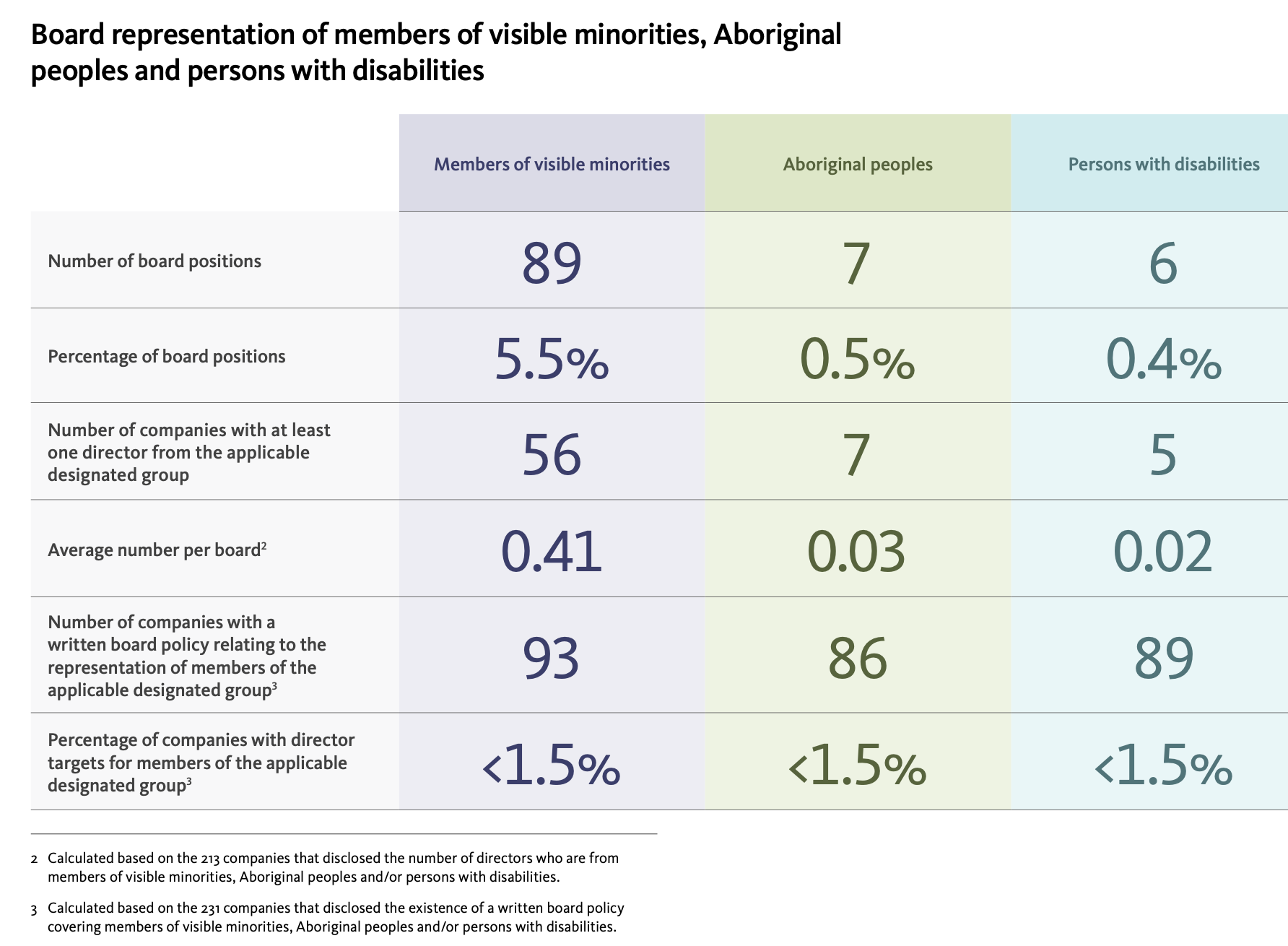
Our review of diversity disclosure by CBCA companies under the new CBCA requirements shows results on the representation of women that are comparable to those reported for TSX-listed issuers under the new CBCA requirements. However, there is a marked absence of directors from other diversity groups. Only 5.5% of the 217 disclosing CBCA company directors are visible minorities. And among the 2,023 board positions of the 270 CBCA companies that provided full or partial disclosure on their practices before July 31, 2020, there were only 7 positions held by Aboriginal peoples and only 6 positions held by persons with disabilities.

The key data tables:

Source: https://www.osler.com/osler/media/Osler/reports/corporate-governance/Diversity-and-Leadership-in-Corporate-Canada-2020.pdf

ICYMI: Huawei: Uighur surveillance fears lead [Danish] PR exec to quit: Time for Canadian executives to reflect

Canadian Huawei executives need to consider their position given overall the company’s links to the Chinese government, its repression of the Uighurs, the takeover of Hong Kong and last, but not least, the arbitrary detention of the two Michaels. Former political staffers in particular:

Tommy Zwicky had worked in the company’s Danish office for six months and was a former journalist.

It comes after internal Huawei documents were made public, which mentioned a “Uighur alarm” system that it had worked on with Chinese facial-recognition specialist Megvii in 2018.

Huawei said it opposed discrimination.

“We provide general-purpose connectivity products based on recognised industry standards, and we comply with ethics and governance systems around emerging technology,” it told the BBC.

“We do not develop or sell systems that identify people by their ethnicity, and we do not condone the use of our technologies to discriminate against or oppress members of any community.”

A spokeswoman for Megvii declined to comment, but the firm has previously said its systems are not designed to target or label specific ethnic groups.

It is believed that the Chinese government has detained up to a million Uighurs in Xinjiang province in what the state defines as “re-education camps”.

Beijing has consistently denied mistreatment and says the camps are designed to stamp out terrorism and improve employment opportunities.

Disputed title

Mr Zwicky had previously worked for a Danish newspaper, and before that was editor-in-chief of the Danish Broadcasting Corporation.

He officially remains under contract to Huawei until February and is unable to discuss his decision further.

He first announced his departure via Twitter and LinkedIn.

Following this, his boss characterised Mr Zwicky as being a low-level PR manager and Huawei also took issue with Mr Zwicky being described as a vice president of communications, as this signifies a senior role in its corporate structure.

However, articles published at the time of his appointment referred to the fact that this specific title had indeed been created for Mr Zwicky and quoted the chief of Huawei Denmark as saying: “Tommy is a well-known and respected name in the Danish media. With him on board, we feel confident that we can take communication to a new level.”

When asked about this, Mr Zwicky told the BBC: “My title was vice president of communications at Huawei Denmark. I have no further comments.”

His decision comes a week after French football star Antoine Griezmann ended his sponsorship deal with Huawei after raising his own concerns about “strong suspicions” that the company had been involved in developing an alert system to monitor the Uighurs.

‘Confidential’ tests

American surveillance research firm IPVM brought to light the Chinese-language documents on 8 December.

They were marked as confidential but were being hosted publicly on Huawei’s European website.

The report referenced an “interoperability test [in which] Huawei and Megvii jointly provided a face-recognition solution based on Huawei’s video cloud solution. In the solution, Huawei provided servers, storage, network equipment, its FusionSphere cloud platform, cameras and other software and hardware, [while] Megvii provided its dynamic facial-recognition system software”.

Among the functions of Megvii’s software that the report said Huawei had verified was a “Uighur alert”. 

IPVM said a separate box added to Megvii’s software was capable of determining ethnicity as part of its “face attribute analysis”.

The page became inaccessible shortly after the Washington Post asked the firm about its existence.

At the time Huawei said the document had referenced a “test”, which had not seen a real-world application. 

But the the Post later published a second article which said Huawei’s site indicated it had worked with four other companies on products advertised to have ethnicity-tracking capabilities.

In response, Huawei promised to carry out a follow-up investigation, but continued to deny it sold systems that identified people by their ethnicity.

Unsatisfactory response

Concerns about both firm’s activities in this area date back further,

The US added Megvii to a trade blacklist in 2019 over concerns that its tech was being used by the Chinese authorities to carry out “repression, mass arbitrary detention, and high-technology surveillance”.

And the same year, a group of 13 UK MPs and members of the House of Lords published a letter raising concerns that Huawei was “facilitating a programme of ethnic repression” against the Uighurs.

The BBC has been told that about this time, Westerners working for the firm asked head office for more details about work it was doing for the Chinese authorities in Xinjiang and felt they had never got a satisfactory answer.

But one noted that this it was not uncommon for companies to be wary about discussing sensitive matters with staff.

Source: https://www.bbc.com/news/technology-55332671

Toronto immigrants face ‘thick glass ceiling’ when it comes to executive jobs, study finds

Would be interesting to see whether the numbers are different for those with Canadian under-graduate degrees, which the article suggests given that those with UK or US undergraduates were excluded:

Immigrants may have made progress reaching the first rung on their career ladder in Canada, but they are getting nowhere near the C-suites, a new report says.

Among the leading Greater Toronto Area employers across the public, private and non-profit sectors, only 6 per cent of executives — those at the level of vice-president or above — are immigrants, according to the study, “Building a Corporate Ladder for All,” to be released Thursday by the Toronto Region Immigrant Employment Council.

While the public and non-profit sectors are faring slightly better with 6.6 per cent of their executives being immigrants, just 5 per cent of corporate executives overall in the GTA are newcomers, says the study, which did not survey executives directly, but examined third-party public sources, such as LinkedIn, to determine immigrant representation.

Being a visible minority immigrant woman is a triple whammy as they only make up one in 100 corporate executives in the region, the report found, though women overall accounted for 36 per cent of the executive positions.

“Immigrants often have to begin their Canadian careers at more junior, even entry levels. This mid- or late-career ‘restart’ makes it unlikely that they will be able to climb up to the top of the career ladder. Taking a lower level position has the potential to affect an immigrant’s entire career in Canada,” says the report, referring to the limited upward mobility faced by newcomers as the “sticky floor” phenomenon.

“Employer reluctance to hire immigrant talent for management-level positions in particular, plays a significant role in limiting advancement … Cultural differences in management and leadership styles can play a role in this. There are certain cultural expectations in Canada around how a leader should behave.”

Report author and researcher Yilmaz Ergun Dinc analyzed the profiles of 659 executives from 69 employers through sampling from the 2019 GTA Top Employers listing by Mediacorp Canada. Only those with headquarters and executive positions in Canada were counted. Data was culled through company websites, annual reports, investor reports, LinkedIn and Bloomberg profiles, as well as other publicly available sources.

Although the findings are not definitive, the report offers a snapshot of immigrant representation in executive roles in the region.

“Immigrant” executives are defined as those who obtained their bachelor’s degree abroad, given only 2.1 per cent of Canadians studied overseas, making this a good indicator of an individual being an immigrant.

Those executives with an undergraduate degree from the United States and the United Kingdom were excluded because professionals from the two countries don’t tend to face the same barriers as others from non-English speaking countries.

The unemployment gap between newcomers and their Canadian peers has been shrinking over the past two decades. However, in the GTA, where newcomers make up 50 per cent of the population, almost half of immigrant men and two-thirds of immigrant women with a university degree were in jobs that required lower levels of education in 2016, compared to one-third of their male and female Canadian-born counterparts.

“As immigrants age, and hypothetically reach more advanced stages in their careers, their incomes should align more closely with people born here,” says the report. “Yet, the salary income gap seems to be growing with age.”

In the GTA, economic immigrants between the ages of 35 to 44 on average earn about 25 per cent less than people born in Canada. However, by the time they are between the ages of 45 to 54, they earn almost 40 per cent less than their Canadian-born counterparts.

Dinc says community efforts have traditionally focused on helping immigrants get their feet in the door in the job market through job and language training, and not enough attention is paid to supporting them in career advancement. It doesn’t help that the economy is shifting toward precarious work and that some organizations lack inclusive promotion processes.

“As more and more jobs are becoming temporary and contract-based and therefore without advancement opportunities, organizations are not investing in grooming these workers for leadership,” he notes, adding that many immigrants do not have senior executive mentors who can act as their champions when it comes to promotion.

To break the “thick glass ceiling” for immigrant professionals, the report recommends that employers establish leadership development and mentoring programs, inclusion training for managers and inclusive professional development strategies.

“We need to be applying our minds to the systematic barriers, especially for women and racialized people, that limit immigrants’ advancement once they do find work, and collaboratively implement the recommendations identified,” the study concludes.

“If our goal is to set Canada apart as a desirable destination for the world’s best and brightest in their fields, we need immigrant leaders that will help Canadian businesses, non-profits and public institutions to innovate, grow and prosper.”

Source: Toronto immigrants face ‘thick glass ceiling’ when it comes to executive jobs, study finds

‘Sunshine’ approach to diversity in federal public service working, [Policy Options] study says

Toronto Star article (excerpt) based on my Policy Options article, Diversity in the public service’s executive ranks:

An employment equity regimen that relies on public disclosure rather than a mandatory quota system seems to have improved representation from women, visible minorities and Indigenous people in the public service, according to a new study.

Women now make up 54.4 per cent of federal government employees while visible minorities and Indigenous people account for 14.5 per cent and 5.2 per cent of the workforce, respectively, according to the report by the Institute for Research on Public Policy.

The latest government statistics say 50.4 per cent of Canada’s population are women, 20 per cent are visible minorities, and 4 per cent are Indigenous. The Canadian government defines visible minorities as non-white people other than Indigenous people.

Under the Employment Equity Act, the federal government is obligated to report annually on diversity within the government and in the federally regulated private sector.

The growth has been steady for both women and Indigenous people, who started at 46.1 per cent and 2 per cent respectively in 1993 when data became available, said report author Andrew Griffith.

And the almost quadrupling of representation for visible minorities from a mere 3.8 per cent in 1993 was remarkable, he noted.

“The transparency, sunshine-law approach and the politics of shame has shifted the representation of public services by a remarkable extent,” said Griffith, a retired director-general with the Immigration Department and now an independent policy analyst specializing multiculturalism and diversity.

“The organic and uncontroversial approach may have worked better than a quota system that would have created more resistance and tension.” 

Source: ‘Sunshine’ approach to diversity in federal public service working, study says | Toronto Star

Diversity in the public service’s executive ranks

My latest, looking at how women, visible minorities and Indigenous people are represented in the highest ranks of the federal public service (DMs and EXs).

The following two charts summarize the historical evolution of how transparency and regular reporting have resulted in a more diverse public service at the overall and executive levels:

Source: Diversity in the public service’s executive ranks