EU States Fail to Record Anti-Semitism as Incidents Increase

A reminder of the importance of collecting reliable, and to the extent possible, consistent data.

The StatsCan Police-reported hate crime in Canada, 2012 is such an example, particularly useful given the inter-group comparisons by ethnicity and religion, and is more objective than statistics collected by individual groups.

report published Wednesday by the Fundamental Rights Agency (FRA) in Vienna finds that anti-Semitic incidents are on the rise throughout Europe, but the virtual absence of proper data collection and “gross under-reporting” make it difficult to trace the trend accurately.

“Despite the serious negative consequences of anti-Semitism for Jewish populations in particular, as the FRA’s relevant survey showed … evidence collected by FRA consistently shows that few EU Member States operate official data collection mechanisms that record antisemitic incidents in any great detail,” the report says. It points out that “this lack of systematic data collection contributes to gross underreporting of the nature and characteristics of anti-Semitic incidents that occur in the EU. It also limits the ability of policy makers and other relevant stakeholders at national and international levels to take measures and implement courses of action to combat antisemitism effectively and decisively, and to assess the effectiveness of existing policies. Incidents that are not reported are also not investigated and prosecuted, allowing offenders to think that they can carry out such attacks with relative impunity.”

But even where data do exist, according to the report, “they are generally not comparable, not least because they are collected using different methodologies and sources across EU Member States. Furthermore, while official data collection systems are generally based on police records and/or criminal justice data, authorities do not always categorize incidents motivated by anti-Semitism under that heading.”

Source: The Jewish Press » » Report: EU States Fail to Record Anti-Semitism as Incidents Increase

Europe’s fear of Muslim refugees echoes rhetoric of 1930s anti-Semitism – The Washington Post

A useful historical reminder by Ishaan Tharoor:

Over the past year, many in Europe have bristled at the influx — from far-right political movements and fear-mongering tabloids to established politicians and leaders. The resentment has to do, in part, with the burden of coping with the refugees. But it’s also activated a good amount of latent xenophobia–leading to anti-Islam protests, attacks on asylum centers and a good deal of bigoted bluster.

Some governments in Eastern Europe have even specifically indicated they don’t want to accommodate non-Christian refugees, out of supposed fear over the ability of Muslims to integrate into Western society.

“Refugees are fleeing fear,” urged a spokesman for the U.N. refugee agency last week. “Refugees are not to be feared.”

It’s important to recognize that this is hardly the first time the West has warily eyed masses of refugees. And while some characterize Muslim arrivals as a supposedly unique threat, the xenophobia of the present carries direct echoes of a very different moment: The years before World War II, when tens of thousands of German Jews were compelled to flee Nazi Germany.

Consider this 1938 article in the Daily Mail, a British tabloid still known for its bouts of right-wing populism. Its headline warned of “German Jews Pouring Into This Country.” And it began as follows:

”  “The way stateless Jews and Germans are pouring in from every port of this country is becoming an outrage. I intend to enforce the law to the fullest.”

In these words, Mr Herbert Metcalde, the Old Street Magistrate yesterday referred to the number of aliens entering this country through the ‘back door’ — a problem to which The Daily Mail has repeatedly pointed.

The number of aliens entering this country can be seen by the number of prosecutions in recent months. It is very difficult for the alien to escape the increasing vigilance of the police and port authorities.

Even if aliens manage to break through the defences, it is not long before they are caught and deported.”

No matter the alarming rhetoric of Hitler’s fascist state — and the growing acts of violence against Jews and others — popular sentiment in Western Europe and the United States was largely indifferent to the plight of German Jews.

“Of all the groups in the 20th century,” write the authors of the 1999 book, “Refugees in the Age of Genocide,” “refugees from Nazism are now widely and popularly perceived as ‘genuine’, but at the time German, Austrian and Czechoslovakian Jews were treated with ambivalence and outright hostility as well as sympathy.”

Source: Europe’s fear of Muslim refugees echoes rhetoric of 1930s anti-Semitism – The Washington Post

When solidarity fails | Institute of Race Relations

Reprinted in its entirety, Liz Fekete, Director of the Institute of Race Relations (IRR), captures all too vividly the failure of Europe in addressing the refugee crisis along with integration:

I want to talk about the immediate institutional crisis in the EU, as hostility grows towards a modest plan by the European Commission to relocate a little over 32,000 asylum seekers from Greece and Italy. The failure of the member states to rise to the humanitarian challenge posed by the boat people arriving via the Mediterranean Sea, the mean-spirited and positively hostile response of some governments, both national and regional, and the breakdown of solidarity between the receiving countries and their richer neighbours, has had consequences. These consequences need to be discussed in terms of cause and effect, in order to fully grasp the intersection between the breakdown of a humanitarian approach to asylum and the growth of racism.

But I would first like to frame my points by making two short observations. First, failures in the institutional response should not blind us to the absolute heroism of ordinary people and over-stretched civil society actors such as Refugees Welcome (Germany), Caritas (Austria) and Migszol (Hungary) who are feeding, clothing and welcoming the new arrivals. Second, we must recognise that the current lack of political leadership, and the failure to find adequate and secure accommodation, is not something new. What I will describe serves merely as the top layer of an existing situation. Europe has fallen far short of providing a safe haven for displaced people, and deaths of migrants do not just occur in tragic circumstances at Europe’s borders. The fact that deaths inside accommodation or removal centres, or as the result of enforced destitution, are met with official indifference, suggests continuity with the moral inertia towards border deaths [2]. The Institute of Race Relations recently published an audit of 160 asylum-and immigration-related deaths within EU States between 2010 and 2015, 46 per cent of which were by suicide, as desperation reached epidemic proportions.

Scaremongering in the media

The roots of the current spate of attacks on migrant accommodation centres start with a scaremongering media discourse and equally irresponsible words from some politicians. Migrants are represented in the media as toxic waste, a dangerous mob, human flotsam, an unstoppable flood and a terrorist threat. In the UK, they have been compared with insects, through the use of inflammatory terms such as ‘swarms of people’ (British prime minister David Cameron) and ‘like cockroaches’ (Sun columnist, Katie Hopkins). The British foreign secretary, Philip Hammond singled out African ‘economic migrants’ in Calais, describing them as ‘marauding migrants’ ‘threatening our standard of living’ and opining that ‘Europe can’t protect itself, preserve its standard of living and social infrastructure if it has to absorb millions of migrants from Africa.’ (It’s also worth noting here that, in relation to Calais, there has been barely a flicker of concern about the fact that at least thirteen migrants, including two teenagers have died attempting to reach the UK since June.)

Spreading hostility not curbing it

The consequence of such scaremongering – which portrays migrants as a security threat – is that it has become much more difficult for electorates to understand why migrants take such a perilous journey, particularly if they hail from African countries, the problems of which are barely covered in the European press. In this climate, too many politicians are pandering to prejudice, acting for short-term self-interest, whipping up distrust, spreading hostility, not curbing it. Unless politicians at a national, local and regional level are encouraged to act responsibly, xenophobia will continue to be manipulated into something more sinister, and potentially deadly. France has sealed its Italian border at Ventimiglia, Hungary is constructing a wall at the border with Serbia (reportedly with the use of prison labour). The Czech interior ministry demands cultural compatibility of those relocated,[3] and the governor of Lombardy threatens to financially penalise northern Italian prefects who go along with the national relocation plan. Luigi Ammatuna, the mayor of the Sicilian port town of Pozzallo, in the Ragusa region, summed up the Italian North-South divide well when he said that the North’s anti-immigration stance was ‘spreading bad feeling’ about migrants across the entire country, adding that its leaders are ‘heartless’ and ‘selfish’ for not working with the government to solve the crisis. Meanwhile, the leader of the powerful Northern League, has declared that the ‘League is prepared to occupy every hotel, hostel, school or barracks intended for the alleged refugees’.

Anti-black racism, anti-multiculturalism

The first step is to end rhetoric which, in some countries, has now gone beyond anti-immigration into a wider anti-multiculturalism and a discourse with heavy overtones of anti-black racism. Here we can specifically identify the interventions of electoral extreme and far-right politicians. For example, the Finns Party – the second largest party in the Finnish parliament – has representatives such as Olli Immonen MP, who wrote on social media that he was ‘dreaming of a strong, brave nation that will defeat this nightmare called multiculturalism’.[4] And Marian Kotleba, the state governor of the Banská Bystrica region, told a rally of 8,000 people in Bratislava protesting against relocation of refugees, ‘I wish you a nice, white day … we are here to save Slovakia’.

Demonstrations and vigilante-style attacks

Such rhetoric encourages hostility at a local level, where examples abound of migrants, seeking safety, being greeted by hate-filled mobs. In Prague, anti-immigration demonstrators waved gallows and nooses, calling for the death of ‘traitors’, i.e. all those who support migrants. In Treviso, Italy, 100 migrants had to be evacuated from one town after two days of protests spearheaded by fascists from Casa Pound – and after the Northern League mayor for the Veneto region had called for the refugees to be cleared out of accommodation near tourist resorts, warning that the region was in danger of ‘Africanisation’. And in Germany, where attacks on refugee accommodation centres for 2015 – specifically arsons – now exceed that of the whole of 2014 (in turn, attacks in 2014 were up threefold from 2013), journalists and local politicians are now facing death threats and the car of one east German politician was blown up.

When politicians lead the way

While Germany has its protest movement, PEGIDA, hostile responses in other countries are led by politicians – in Hungary, by the prime minister,[5] and in others, such as Austria, where the Social Democrats in Burgenland have formed a coalition government with the extreme-right Freedom Party, by state governors and local mayors from both centre Left and centre Right. In Bavaria, the state premier Horst Seehofer has been accused by the Central Council of Jews of provoking hostility towards asylum seekers, and across the North of Italy, hostility has been fuelled by senior politicians in Liguria, Lombardy and Veneto. Other countries like the UK and Denmark have started to cut welfare payments to migrants, in a further lurch towards the nativist agenda of the anti-migration movements. The UK government, for example, has slashed asylum support payments and is proposing to withdraw automatic support for families whose claims are refused but who for legitimate reasons cannot return home – amounting to enforced destitution. And both Italy and the UK are attempting to drive those without papers out of private housing, by outsourcing immigration controls to landlords.

The danger is that xenophobia ‘from below’ will combine with structural neglect of human rights ‘from above’. This will result in a further deterioration of conditions (overcrowding, lack of health care) in reception and detention centres. ‘Fast-track procedures’ to speed up asylum claims will not only lead to grave injustices but more forcible deportations, which also claim lives, as we saw most recently in March 2015 in Sweden when an Iraqi asylum seeker suffocated during a deportation attempt, the seventeenth such deportation death in Europe since 1991.

Though there has been a huge drive by ordinary European citizens to welcome refugees, to take a stand for human dignity, another trend is undermining it. The truth is that we face the possibility of a perfect storm unless those in power take cognisance of their positive duty to combat racism, rather than fuel it.

Source: When solidarity fails | Institute of Race Relations

European far-Right parties ‘seeking anti-Islam coalition with Jewish groups’

Not surprising but encouraging that most European Jewish groups have rejected the overture:

Right-wing European political parties are seeking to sow religious discord in Europe by approaching Jewish organisations in a bid to form an anti-Islamic alliance.

Speaking to Newsweek on condition of anonymity, a senior figure in one of Europe’s largest Jewish organisations has revealed that their group has been approached in the past year by MEPs, including members of the Austrian Freedom Party, seeking to create a coalition to combat the rise of Islam in Europe. They emphasized that all approaches had been flatly refused.

Last week, Marine Le Pen and other far-Right politicians met with Vadim Rabinovich, the chairman of the European Jewish Parliament (EJP), prompting criticism from European Jewish leaders.

Now the source says that far-Right’s rapprochement with Jewish groups is far from new as politicians from various parties have attempted to court their group, offering to “be friends with Jews” if Jewish groups “help us in our fight against Muslims”.

… The meeting drew criticism from prominent Jewish leaders and led to one member of the EJP, French rabbi Levi Matusof, resigning after the meeting which he called “opportunistic and inappropriate”.

The European Jewish Association, which claims to be the biggest federation of Jewish organisations in Europe, said that the EJP risked “magnifying the problem” of anti-Semitism by “giving a platform to those seeking to spread messages of hate”.

Dr Moshe Kantor, president of the European Jewish Congress, said he was shocked that the EJP met with “fig leaf racists and anti-Semites” and added: “It goes without saying that these people [the EJP] are as unrepresentative of the vast majority of European Jews as this collective of Le Pen’s MEPs is of the vast majority of European citizens.”

In a statement on the EJP’s website, Rabinovich said he was “very surprised” by the negative reaction from other Jewish groups.

“The meeting with the [Europe of Nations and Freedom] opens the new dialogue, which, in our firm conviction is what Europe needs today – a dialogue of everybody with everyone, in order to preserve peace and tolerance and combat anti-Semitism in Europe,” said Rabinovich.

He added that a joint statement with Le Pen had condemned anti-Semitism as “the cancer of Europe”.

European far-Right parties ‘seeking anti-Islam coalition with Jewish groups’.

Pew Research: Anti-Minority Sentiment Not Increasing in Europe

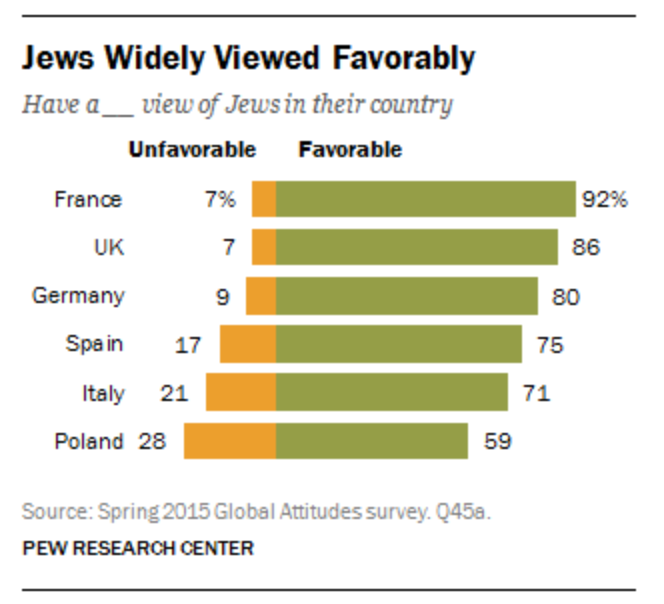
European Perceptions of Roma European Perception of Jews European Perceptions of MuslimsInteresting recent public opinion research on attitudes in Europe, with above charts showing highlights. Summary conclusion:

The economic downturn in Europe that followed the euro crisis raised concerns that economic stress would turn Europeans against each other, as many severe economic downturns have done throughout history, sparking xenophobia and anti-Semitism. And Europe has seen a number of hostile actions against Muslims, Jews, Roma and other minorities in recent years. But the activities of a few are not necessarily reflected in the views of the general public.

The 2015 Pew Research Center survey was conducted after the Charlie Hebdo massacre and the simultaneous attack on a Jewish grocery store, perpetrated by radical Islamists in Paris. But, in the wake of these events, there is no evidence that the atrocity sparked new public antipathy toward Muslims in any of the six European Union nations surveyed. In fact, favorability of Muslims actually improved in some nations. At the same time, French sympathy for Jews increased.

http://www.pewglobal.org/2015/06/02/chapter-3-anti-minority-sentiment-not-rising/

The Failure of Multiculturalism: Kenan Malik

While much of Kenan Malik’s arguments reflects the European experience (rather than Canadian or Australian multiculturalism with its integration and participation focus), he largely ends up in the right place in noting that it is the particular variant of multiculturalism that is important, and that it needs the assimilationist (or integrationist) element to succeed:

Multiculturalism and assimilationism are different policy responses to the same problem: the fracturing of society. And yet both have had the effect of making things worse. It’s time, then, to move beyond the increasingly sterile debate between the two approaches. And that requires making three kinds 
of distinctions.

First, Europe should separate diversity as a lived experience from multiculturalism as a political process. The experience of living in a society made diverse by mass immigration should be welcomed. Attempts to institutionalize such diversity through the formal recognition of cultural differences should be resisted.

Second, Europe should distinguish colorblindness from blindness to racism. The assimilationist resolve to treat everyone equally as citizens, rather than as bearers of specific racial or cultural histories, is valuable. But that does not mean that the state should ignore discrimination against particular groups. Citizenship has no meaning if different classes of citizens are treated differently, whether because of multicultural policies or because of racism.

Finally, Europe should differentiate between peoples and values. Multiculturalists argue that societal diversity erodes the possibility of common values. Similarly, assimilationists suggest that such values are possible only within a more culturally—and, for some, ethnically—homogeneous society. Both regard minority communities as homogeneous wholes, attached to a particular set of cultural traits, faiths, beliefs, and values, rather than as constituent parts of a modern democracy.

The real debate should be not between multiculturalism and assimilationism but between two forms of the former and two forms of the latter. An ideal policy would marry multiculturalism’s embrace of actual diversity, rather than its tendency to institutionalize differences, and assimilationism’s resolve to treat everyone as citizens, rather than its tendency to construct a national identity by characterizing certain groups as alien to the nation. In practice, European countries have done the opposite. They have enacted either multicultural policies that place communities in constricting boxes or assimilationist ones that distance minorities from the mainstream.

Moving forward, Europe must rediscover a progressive sense of universal values, something that the continent’s liberals have largely abandoned, albeit in different ways. On the one hand, there is a section of the left that has combined relativism and multiculturalism, arguing that the very notion of universal values is in some sense racist. On the other, there are those, exemplified by such French assimilationists as the philosopher Bernard-Henri Lévy, who insist on upholding traditional Enlightenment values but who do so in a tribal fashion that presumes a clash of civilizations.

There has also been a guiding assumption throughout Europe that immigration and integration must be managed through state policies and institutions. Yet real integration, whether of immigrants or of indigenous groups, is rarely brought about by the actions of the state; it is shaped primarily by civil society, by the individual bonds that people form with one another, and by the organizations they establish to further their shared political and social interests. It is the erosion of such bonds and institutions that has proved so problematic—that links assimilationist policy failures to multicultural ones and that explains why social disengagement is a feature not simply of immigrant communities but of the wider society, too. To repair the damage that disengagement has done, and to revive a progressive universalism, Europe needs not so much new state policies as a renewal of civil society.

The Failure of Multiculturalism.

The real reasons why migrants risk everything for a new life elsewhere: Saunders

Good in-depth piece by Doug Saunders, putting the current situation in context:

Even in its worst years, the Mediterranean boat-people flow is only a small part of the migration picture: tens of thousands of entrants in a continent of half a billion people that receives three million immigrants a year. Most Africans living in Europe are fully legal, visa-carrying immigrants who arrive at airports. Even the majority of illegal African immigrants in Europe aren’t boat people: They’re legal visitors who’ve overstayed their visas.

What has compounded the matter during the past 24 months has been the conflict in Syria. While only a fraction of people fleeing that country have attempted to go to Europe – the vast majority are encamped in Turkey, Jordan or Lebanon – that fraction has multiplied the numbers of boat people dramatically in 2014 and 2015. It now accounts for perhaps half of Mediterranean boat migrants (though the boat that was the subject of last weekend’s tragedy carried passengers almost entirely from sub-Saharan Africa).

Refugees tend to be temporary (the much larger exodus of asylum seekers that confronted Western Europe during the Balkan wars of the 1990s – a population shift that seemed even more intractable – mostly returned to their countries after the conflicts ended), and are dealt with through different policies than are migrants. In Europe, those policies are deeply dysfunctional, with little agreement among the 28 EU countries about how to handle refugee claimants or how to deport illegitimate ones – which has contributed to the death toll.

“There should be no reason for Syrian refugees to be getting on these boats, except that there has been no proper pathway for safe refugee acceptance opened up,” Dr. de Haas says. If Western countries would take their United Nations refugee responsibilities more seriously, Syrians wouldn’t be dying at sea.

The most insidious notion is the one that holds that the Africans on the boats are starving villagers escaping famine and death. In fact, every boat person I’ve met has been ambitious, urban, educated, and, if not middle-class (though a surprising number are, as are an even larger number of Syrian refugees), then far from subsistence peasantry. They are very poor by European standards, but often comfortable by African and Middle Eastern ones. And no wonder: The boats cost upward of $2,000 to board (and you need more money to make a start in Europe). That’s a year’s income in many African countries.

Why would somebody risk their life, and their comfort, for a journey that at best would promise a marginal life in the underground economies of Europe?

Linguère Mously Mbaye, a scholar at the Bonn-based Institute for the Study of Labour, conducted a study of hundreds of people in Dakar, Senegal, who were planning to make the crossing to Europe.

The migrants tended not to be very poor. And they tended to be well-connected in Europe: They knew large numbers of people from their home country already living in Europe and working in similar occupations. In other words, they were tied into “migration networks” that communicated information about employment, small-business, housing and migration opportunities. Migrants tend to choose their European destinations not according to culture, language or history, but according to the number of people from their network who are living there – and also according to the economic success of their destination country.

The Syrian refugees are less tactical – and not as well linked into existing economies – than the Africans, but they, too, tend to come because they have connections to people or organizations in Europe. Concludes Dr. Mbaye, “Illegal migration starts first in thoughts, based upon the belief that success is only possible abroad.”

Both major studies found that the Africans who get onto the boats are not running from something awful, but running toward a specific, chosen opportunity, in employment or small business.

That’s a big reason that the boat-people flows have gone up and down so dramatically: Dr. de Haas’s studies found that the main driver of cross-Mediterranean migration is not any economic or political factor in Africa but “sustained demand [in Europe] for cheap labour in agriculture, services, and other informal sectors.” Even those who are fleeing – the Syrians, some Eritreans – are choosing where they flee based on a sense of opportunity.

The real reasons why migrants risk everything for a new life elsewhere – The Globe and Mail.

How can we help Jews stay in Europe despite anti-Semitism: Jeffrey Goldberg’s Atlantic article doesn’t answer that question.

Interesting take by William Salatan on antisemitism in Europe:

I don’t mean to suggest that Muslims don’t understand anti-Semitism. They do. But the anti-Semitism they’re familiar with is the anti-Semitism of resentment, not the anti-Semitism of genocidal success. Goldberg describes a French Jew whose parents fled Tunisia in 1967, “driven out by anti-Jewish rioters who were putatively distressed by Israel’s victory in the Six-Day War.” The key word in that sentence is victory. If Israel had lost—if the Jews of Palestine had been annihilated—Muslims in the Middle East and North Africa might understand anti-Semitism the way Europeans do. Anti-Semitism isn’t about a chant or a salute. It’s about piles of corpses.

Nor do I mean to exonerate the majority of Europeans who are neither Muslim nor Jewish. They’ve played their part in the intimidation of Jews by not playing their part in stopping it. Goldberg credits leaders of Germany, France, and Britain for denouncing anti-Semitism. But he points out that “the general publics of these countries do not seem nearly as engaged in the issue as their leaders. The Berlin rally last fall against anti-Semitism that featured Angela Merkel drew a paltry 5,000 people, most of whom were Jews.” And the silence of the majority leaves Jews feeling isolated. “Everyone is saying ‘Je suis Charlie’ today,” a Jewish student in Paris tells Goldberg, alluding to outrage over the murder of cartoonists at Charlie Hebdo. “But this has been happening to the Jews for years and no one cares.” Another student, using the French term for “Jewish,” suggests: “It would be nice if someone would say ‘Je suis Juif.’ ”

Why don’t non-Muslim Europeans care more about the new anti-Semitism? One reason is that they aren’t Jews. But another reason is that they aren’t Muslims. They’re neither the victims nor the perpetrators. They feel neither the threat nor the responsibility.

…If I were a Jew in Europe, I don’t think I’d leave. Growing up in Texas, I had many encounters—slurs, threats, occasional minor violence—similar to those described by Goldberg as anti-Semitic. They were anti-Semitic. I just had to deal with them. One thing that helped me get through it was the belief that my tormentors represented an ignorant, dying past. The best way to help today’s European Jews is to give them the same confidence, by working on the ignorance at the heart of Muslim anti-Semitism. To do that, you have to focus on the ignorance, not the Islam.

How can we help Jews stay in Europe despite anti-Semitism: Jeffrey Goldberg’s Atlantic article doesn’t answer that question..

Kenan Malik | Why Multiculturalism Failed

While his understanding of multiculturalism is driven by the diverse European approaches to living with diversity, and unfairly, at least from the Canadian perspective, multiculturalism as reinforcing differences rather than being an instrument to further integration and participation.

But his three concluding points are valid, as is of course the reminder that integration happens at the local and individual levels:

First, Europe should separate diversity as a lived experience from multiculturalism as a political process. The experience of living in a society made diverse by mass immigration should be welcomed. Attempts to institutionalize such diversity through the formal recognition of cultural differences should be resisted.

Second, Europe should distinguish colorblindness from blindness to racism. The assimilationist resolve to treat everyone equally as citizens, rather than as bearers of specific racial or cultural histories, is valuable. But that does not mean that the state should ignore discrimination against particular groups. Citizenship has no meaning if different classes of citizens are treated differently, whether because of multicultural policies or because of racism.

Finally, Europe should differentiate between peoples and values. Multiculturalists argue that societal diversity erodes the possibility of common values. Similarly, assimilationists suggest that such values are possible only within a more culturally—and, for some, ethnically—homogeneous society. Both regard minority communities as homogeneous wholes, attached to a particular set of cultural traits, faiths, beliefs, and values, rather than as constituent parts of a modern democracy.

The real debate should be not between multiculturalism and assimilationism but between two forms of the former and two forms of the latter. An ideal policy would marry multiculturalism’s embrace of actual diversity, rather than its tendency to institutionalize differences, and assimilationism’s resolve to treat everyone as citizens, rather than its tendency to construct a national identity by characterizing certain groups as alien to the nation. In practice, European countries have done the opposite. They have enacted either multicultural policies that place communities in constricting boxes or assimilationist ones that distance minorities from the mainstream.

Moving forward, Europe must rediscover a progressive sense of universal values, something that the continent’s liberals have largely abandoned, albeit in different ways. On the one hand, there is a section of the left that has combined relativism and multiculturalism, arguing that the very notion of universal values is in some sense racist. On the other, there are those, exemplified by such French assimilationists as the philosopher Bernard-Henri Lévy, who insist on upholding traditional Enlightenment values but who do so in a tribal fashion that presumes a clash of civilizations.

There has also been a guiding assumption throughout Europe that immigration and integration must be managed through state policies and institutions. Yet real integration, whether of immigrants or of indigenous groups, is rarely brought about by the actions of the state; it is shaped primarily by civil society, by the individual bonds that people form with one another, and by the organizations they establish to further their shared political and social interests. It is the erosion of such bonds and institutions that has proved so problematic—that links assimilationist policy failures to multicultural ones and that explains why social disengagement is a feature not simply of immigrant communities but of the wider society, too. To repair the damage that disengagement has done, and to revive a progressive universalism, Europe needs not so much new state policies as a renewal of civil society.

Kenan Malik | Why Multiculturalism Failed | Foreign Affairs.

Multiculturalism Is Not Dead

Rumours of the death of multiculturalism and related policies are exaggerated according to this recent European study:

Countries will create formal policies for citizenship and declare the issue resolved, but that does not mean citizenship is really possible. The authors found that, even in countries such as Denmark and Germany where multiculturalism was never formally adopted, some public policies were being developed to recognize minority communities and facilitate their participation in the labor market, educational systems and other key social sectors at local and national levels.  Europeans love to insist that Americans should just give amnesty to people who got into the United States illegally but they won’t even give citizenship to their legal residents.

In countries where some multiculturalism has formally been adopted, such as the UK and the Netherlands, the picture was more mixed but showed that newer approaches, such as civic integration – including citizenship education, naturalization ceremonies and language classes – also built on and developed multiculturalism rather than erasing it. National identities have been remade in light of it – players of Indian descent can even get on the British cricket team now.

Dr. Nasar Meer, a Reader in Comparative Social Policy and Citizenship at the University of Strathclyde, lead author of the paper, said, “As European societies have become more diverse, the task of developing an inclusive citizenship has become increasingly important. In recent years, however, there has been a backlash against multiculturalism as path to achieving this.

“The reasons for this include the way that, in some countries, multiculturalism is seen to have facilitated social fragmentation and entrenched social divisions, while for others, it has distracted attention away from socio-economic disparities or encouraged a moral hesitancy amongst ‘native’ populations. Some have even blamed it for incidents of international terrorism.”

Dr. Daniel Faas, of Trinity College Dublin’s Department of Sociology, a co-author of the research, said, “Legislations have become more inclusive of diversity, and the large anti-far right demonstrations highlight the solidarity with migrants, but also show that multiculturalism is a fragile concept there.”

Meer added, “Our study clearly shows that, where there have been advances in policies of multiculturalism, these have not been repealed uniformly, or on occasion not at all, but may equally have been supplemented by being ‘balanced out’ in, or thickened by, civic integrationist approaches.”

Reinforces the Kymlicka analysis of the ongoing multicultural integration policies being implemented.

Multiculturalism Is Not Dead.