Visible minority communities and the Election: More interesting articles from New Canadian Media

Round-up of some interesting stories on the ‘ethnic vote’ in New Canadian Media.

No surprise that Tory Candidates Make Joint Pitch to Chinese Voters, given that Chris Cochrane’s analysis shows considerable support for the CPC (see Immigrants are not a monolithic voting block). Of note is the diversity within the Conservative candidates:

The seven candidates who participated were Bin Chang representing for Scarborough-Agincourt; Joe Daniel, for Don Valley North; Jobson Easow for Markham-Thornhill; Maureen Harquail for Don Valley East; Chungsen Leung for Willowdale; Michael Parsa for Richmond Hill; and Bob Saroya for Markham-Unionville.

Ranjit Bhaskar, in Courting the “Ethnic Vote” notes, among other observations, that:

However, in a blog post on the refugee issue, Andrés Machalski, president of MIREMS, a media monitoring and research firm, observed that many of the stories in the ethnic media reflected those in the mainstream.

But harsher tones could also be seen and heard. A radio host on a Punjabi show said Canada has already admitted enough refugee, adding that settling them costs an enormous amount of money. A former refugee claimant suggested in Sing Tao Toronto that only 5,000 refugees should be let in a year as otherwise Canadian residents might have to pay more taxes.

Silke in The Niqab – Competing Traditions Clash Over Women’s Clothing, captures the diversity of opinion within different ethnic groups, and concludes, erroneously that:

In Canada, the call to allow niqabs at citizenship ceremonies is mostly based on cultural relativism – a call for tolerance of diverse customs – notably a value not practiced by any fundamentalist religion, including the Islamists it is trying to accommodate. The Conservatives’ call to ban it is based on an appeal to traditional Canadian values of having one’s face uncovered when making a commitment – looking people in the eye, so to speak. Others have called for a ban on the niqab not just at citizenship ceremonies, but more widely, as a matter of women’s rights.  However, looking at the question from a gender equality perspective, one wonders why Islamist men should be allowed to swear the oath of allegiance to Canada in their traditional attire, but not their wives and daughters.

It has actually been framed as a Charter human rights issue, given the Supreme Court has ruled that the test for a religious practice is not theological but rather whether it is sincerely held.
Immigrants are not a monolithic voting block

Ethnic_Voting_Cochrane_SlideGood panel organized by the Munk Centre:

If the Conservative Party is banking on the immigrant and ethnic minority vote to win them the election, as some believe they did in 2011, they might need to revisit that narrative.

“They do well with white immigrants, not visible minority immigrants. I think there is a disconnect with the narrative and reality,” says Chris Cochrane, an associate professor of political science at the University of Toronto Scarborough.

Cochrane took part today in the University of Toronto’s Munk School panel, “Courting the Ethnic Vote: Immigration and Multiculturalism in the 2015 Federal Election.” The panel of experts discussed a variety of topics facing ethnic minorities, from the racialization of candidates to the importance of diversity in politics.

Jeffrey Reitz, the president of the Harney Program in Ethnic, Immigration and Pluralism Studies at the Munk Centre, moderated the panel and opened it by discussing the traditional voting narrative of immigrants in Canada: for generations, immigrants voted for the Liberal Party of Canada, because “they were the party of open immigration,” or for the New Democratic Party, because they were the “party of the underdog.”

There was an apparent breakthrough for the Conservative Party in getting the ethnic vote when the former minister of citizenship and immigration, Jason Kenney, embarked on a major outreach effort during the last federal election, said Reitz.

“Old-stock Canadians with conservative values meet new-stock Canadians with conservative values, that was the story.”

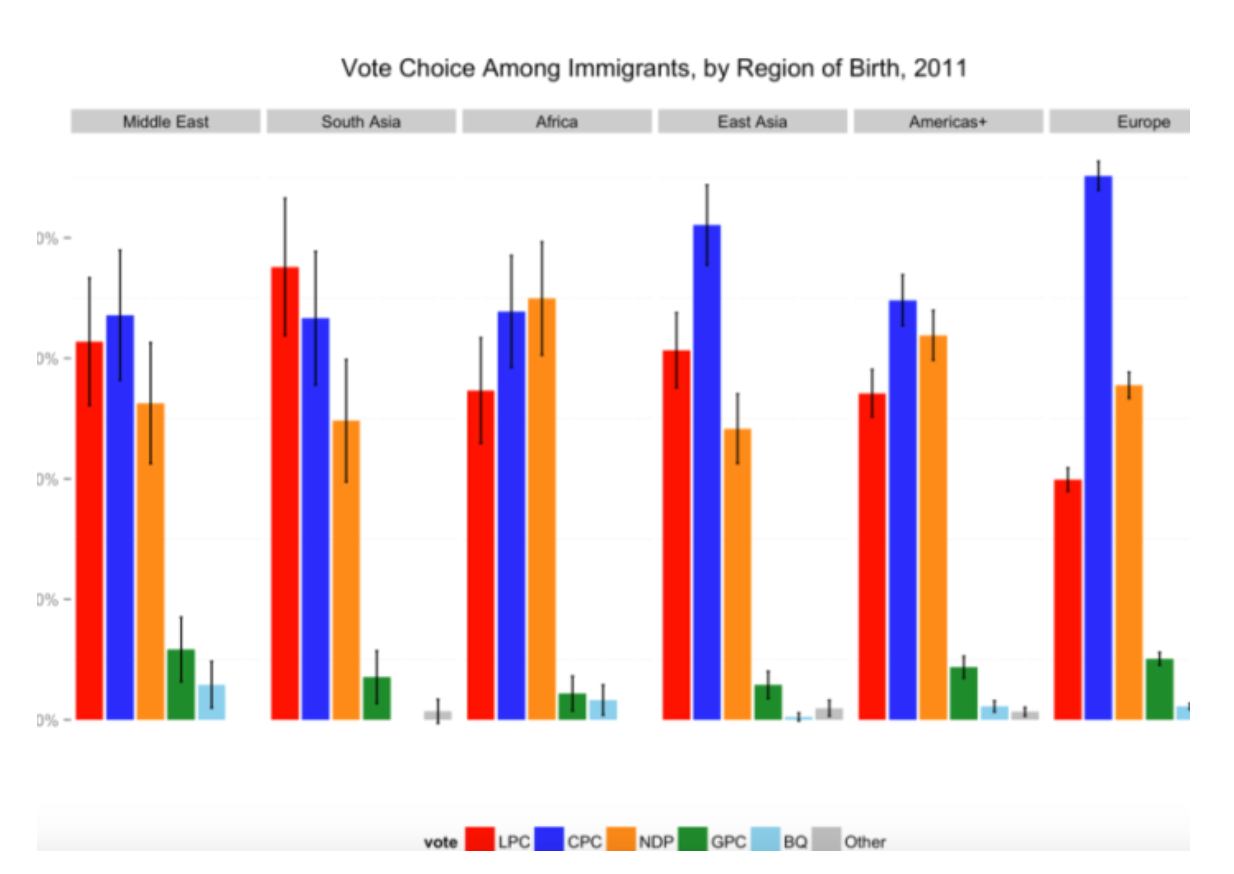
“There is no question about the dominance of the narrative of Conservative inroads among immigrant communities,” said Cochrane, but his findings show different conclusions.

But immigrants who have moved to Canada from the Middle East showed an almost equal vote distribution amongst the parties. South Asians voted strongly for the Liberals, and African immigrants voted for the NDP. The Conservatives were favoured by Europeans, East Asians and Americans.

“A story of a massive special immigrant vote that abandoned the Liberal Party, and shifted to the Conservative Party, outside of Quebec doesn’t seem to be consistent with the data.”

Cochrane’s findings on ethnic minority and immigrant voting patterns came from the “exit surveys” conducted by the research company IPSOS. They surveyed over 100,000 Canadians in the past three federal elections — including over 12,000 immigrant voters.

“This is a unique data set that allows us to look at small communities and discuss it with high statistical confidence, he told iPolitics.”

“Outside of Quebec, the immigrant as a whole mirrors to a larger extent the vote of other Canadians, and is equally heterogeneous. There is a lot of variation in diversity in the immigrant community — just as there is in the non-immigrant community.”

Source: Immigrants are not a monolithic voting block (paywall)

Another good presentation was by Erin Tolley, looking at the news coverage of immigrants and minorities in Canadian politics, sharing the results of her forthcoming book, Framed: Media and the Coverage of Race in Canadian Politics (see her earlier op-ed in the Globe Parties pigeonhole visible minority candidates)

Some 33 federal ridings with more than 50 per cent visible minority population up for grabs on Oct. 19 | hilltimes.com

Further to the analysis in my book, Multiculturalism in Canada: Evidence and Anecdote, this Hill Times article provides polling results in these ridings along with some riding vignettes that provide colour to the somewhat dry stats:

Based on the transposition of votes analysis conducted by Elections Canada, which shows the results for the new ridings had the boundaries been in place in the 2011 election, Conservatives would have won 17 of the 33, and the NDP and the Liberals would have carried eight each. The analysis also indicated that in 20 of the 33 ridings, the margin of victory for the winning parties would have been 10 per cent or less.

In the Oct. 19 election, there are a total of 338 ridings up for grabs, 30 more than the last election, to reflect the population increase in the country between 2003 and 2012.

Most national polling numbers last week indicated that the three major national parties were in a statistical dead heat. If this trend continues, the next government will be a minority government in which every seat will count.

A Nanos poll on Thursday showed that the Liberals had the support of 31 per cent of decided voters, with the NDP and Conservatives tied at 30 per cent and the Green Party at six per cent.

According to an online national poll by Innovative Research of 2,121 Canadians conducted between Sept. 4 and Sept. 10, the three national parties were running neck and neck with the NDP support at 31 per cent, Liberals at 30 per cent, Conservatives at 28 and the Green Party at six per cent.

In the 33 ridings where the visible minority population is more than 50 per cent, the online poll indicated that the Liberals were leading the pack with 36.6 per cent, the Conservatives next with 33 percent, the NDP at 22.3 per cent and the Green Party at 7.1 per cent.

In an interview last week, Mr. Griffith said the strategic significance of the 33 ridings in this election is evident from the fact that the national party leaders have frequently visited the GTA and Vancouver areas in recent months.

“Leaders seem to be spending a fair amount of time in these ridings. It’s part of every party’s electoral strategy,” said Mr. Griffith.

For those interested in the riding list taken from my book: Visible Minority Ridings and Religious Minority Ridings.

Source: Some 33 federal ridings with more than 50 per cent visible minority population up for grabs on Oct. 19 | hilltimes.com

Visible minority communities and the Election

From New Canadian Media, some good articles on different communities and the 2015 election.

Pulse: Arab Media Tack Conservative outlines support for the Government’s position among some Arab communities (primarily Syrian and Iraqi Canadian).

Chinese Canadians Step Up to Fill Representation Gap as there have been fewer MPs than their population warrants. A Willingness to Elect People Not Born in Canada explores the relative success of Canadian Sikhs, reflecting both absolute numbers and their relative concentration in a number of ridings in the Lower Mainland and the GTA.

Lastly, Where are the (Ethnic) Women? analyses the number of visible minority women candidates, showing that between 16 and 21 percent (depending on the party) of all women candidates are visible minorities, slightly greater than the number women visible minorities who are Canadian citizens (and thus who can vote).

The “Ethnic Vote”: All Over the Map – Adams and Griffith

Further to our earlier op-ed in the Globe (Why Canada’s politicians fixate on the ethnic vote), Michael and I expanded it to include more information of visible minority representation and comparisons to the US:

Remarkably, the immigrants who were elected to Canada’s parliament in 2011 had not only become citizens, gotten themselves nominated, and then won election—but they represented all five main political parties and included many visible minorities: 18 Conservatives (15 visible minorities, of 166 elected), 18 New Democrats (12 visible minorities, of 103), four Liberals (2 visible minorities, of 34), and one each in the Bloc (1 visible minority, of 4) and the Green Party (no visible minority).

The Green Party is 100 per cent foreign-born: Elizabeth May is from Hartford, CT.

Another “only in Canada” fact is that our most right-wing party, the Conservative Party of Canada, attracts a substantial contingent of candidates born abroad.

The Bloc is dedicated to dismantling the country, but managed to be inclusive of the foreign-born and visible minorities. Only in Canada!

With respect to visible minorities (defined in the U.S. as non-white races and Hispanic), the U.S. has worse representation than Canada: 20 per cent in the House of Representatives compared to their population share of 37 per cent, only six per cent in the Senate), the vast majority of these are American-born visible minorities, mainly African Americans and Hispanic/Latinos, not immigrants.

Only 16 foreign-born members sit in either of the two houses. But many of these were born abroad to American parents, the most famous being John McCain and Canada’s Ted Cruz.

But even if we include all of these legislators as foreign born, they are still less than three per cent of Congress, where demographic parity would suggest that almost 70 foreign-born “should be” in both houses (to match the 13 per cent of “legal” Americans who are foreign-born).

Another “only in Canada” fact is that our most right-wing party, the Conservative Party of Canada, attracts a substantial contingent of candidates born abroad. In most countries, right-wing parties are anti-immigrant and would be unlikely to either attract or accept foreign-born candidates.

The “Ethnic Vote”: All Over the Map – New Canadian Media.

Why Canada’s politicians fixate on the ethnic vote – The Globe and Mail

From the piece Michael Adams and I did in today’s Globe on the importance of the ethnic vote and Canada’s uniqueness in that all parties compete for it:

In the 2011 federal election, voters sent 42 foreign-born citizens to represent them as MPs in Ottawa. That’s about 13 per cent of the then-308-member House of Commons. That proportion falls short of parity with our foreign-born population (20 per cent of us are foreign-born), but it comes quite close to matching the proportion of us who are foreign-born and Canadian citizens: 16 per cent.

Remarkably, the immigrants who were elected to Canada’s Parliament in 2011 had not only become citizens, gotten themselves nominated and then won election – but they represented all five main political parties: 18 Conservatives (of 166 elected), 18 New Democrats (of 103), four Liberals (of 34), and one each in the Bloc Québécois (of four) and the Green Party (of one). The Green Party is 100-per-cent foreign-born: Elizabeth May is from Hartford, Conn. The Bloc is dedicated to dismantling the country but managed to be inclusive of the foreign-born. Only in Canada.

Another “only in Canada” fact is that our most right-wing party, the Conservatives, attracts a substantial contingent of candidates born abroad. In most countries, right-wing parties are anti-immigrant and would be unlikely to either attract or accept foreign-born candidates. Stephen Harper may loathe much of the progressive agenda the Liberals and NDP have embraced over the past half-century, but he sure loves multiculturalism.

The high proportion of foreign-born MPs suggests a willingness to elect people not born in Canada – but are Canada’s immigrant MPs all from countries like Britain and France, of which the dominant ethnocultural and religious groups mirror Canada’s? No. Canada’s foreign-born MPs came from everywhere: 15 from Europe, 11 from Asia, 11 from the Americas and five from Africa.

Canada’s history of large immigrant inflows combined with a high naturalization rate (citizenship acquisition) has made it an electoral imperative to court – not dismiss – the “ethnic vote.”

Why Canada’s politicians fixate on the ethnic vote – The Globe and Mail.