Advocacy group Equal Voice faces fallout after firing three racialized staffers

I have always had great respect for the needed work Equal Voice does, and Daughters of the Vote were a diverse group.

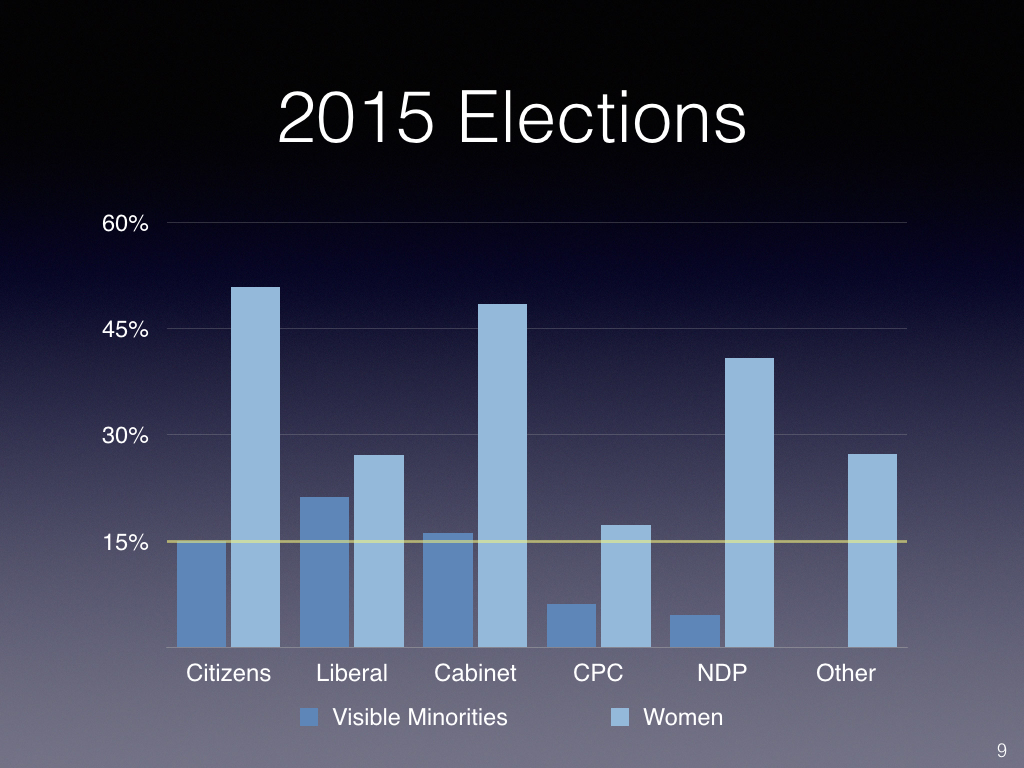
Always felt that they had missed an opportunity, however, in their data collection and analysis in not examining women visible minority candidates and MPs (in 2015, the percent of women visible minorities was about one third of all visible minority MPs, higher than the overall 26 percent representation of women:

An organization aimed at supporting women in politics is facing backlash over its decision to fire three racialized employees last week, sparking resignations and a social media campaign calling its commitment to diversity into question.

Equal Voice, a multi-partisan organization dedicated to getting more women elected at all levels of government, had four members of its board of directors resign in recent days as young women have been tweeting about what they call negative experiences with the organization.

That online conversation, taking place under the hashtag #notsoequalvoice, has included stories shared by young women who were delegates at the Daughters of the Vote conference, which brought 338 young women — one from every federal riding — to Parliament Hill this spring.

The fallout began after three young women — Shanese Steele, 26, and Cherie Wong and Leila Moumouni-Tchouassi, both 23 — were dismissed from their jobs at the national organization’s Ottawa office following months of tension and issues with management.

‘Nothing to do with anyone’s face’

Eleanor Fast, executive director of Equal Voice, said she cannot comment on internal human resources matters, but she defended the organization against allegations that their identities played any sort of role in terminating their employment.

“The recent staffing changes had nothing to do with anyone’s race, ethnicity, religion,” Fast said in an interview. “The insinuation in that regard is completely false.”

Nonetheless, she said, she is concerned about the online discussion, adding that the organization is working on how best to learn from its mistakes and be more inclusive, both internally and externally.

She said Equal Voice wants to take the time to get it right and has hired a senior adviser to work on the issue.

Equal Voice works closely with politicians from all parties and receives its funding from big business, the labour movement and other sources.

It also received $3.8 million from Status of Women Canada for a project aimed at expanding leadership opportunities for young women in politics, for which the organization committed to “using an anti-oppression approach.”

A spokesperson for Maryam Monsef, the minister for women and gender equality, said the department is aware of the situation but cannot comment.

Not the first controversy

The turmoil is expected to come up as the board meets Thursday, although it’s not the first time the organization has grappled with the charge that it has failed to take the needs and perspectives of women and gender non-conforming people from all backgrounds into account.

The Daughters of the Vote event in April saw dozens of young women turn their backs on Prime Minister Justin Trudeau as he addressed them in the House of Commons; others walked out when it was time for Conservative Leader Andrew Scheer to speak.

The National Observer reported that several of the young women who took part in the protests said they had faced open hostility for doing so, and did not receive enough support or accommodations from Equal Voice throughout their experience.

The latest development has raised the question of whether Equal Voice can continue to straddle the line between supporting all women in politics, no matter their ideologies on hot-button issues such as immigration, while also satisfying stakeholders who want the organization to pick sides.

Fast said she does not see a conflict.

“We may support women who have different views on the world than what we believe in at Equal Voice in terms of our commitment to our employees and stakeholders and those that take part in our programs, and there is no issue there,” she said.

Former employees speak out

The three former employees said their work at Equal Voice had included a push for greater cultural competency they felt was not being taken seriously by the organization’s leadership. Each described relationships with managers that were fraught with tension.

“I want to make sure that advocacy includes and raises the voices of black and Indigenous women,” said Wong, who identifies as a Hong Kong-Canadian, and said she felt as if she was being seen as a troublemaker for pushing management on the issue.

Emails the women provided to The Canadian Press show the situation devolved after a dispute over flexible working arrangements, especially after Fast raised the issue of activities during work hours, including streaming television shows while in the office.

The three former employees said they viewed her comments as contributing to an unsafe and inequitable work environment. They also said they felt threatened after another member of the leadership team described their criticism as “personal attacks” and said continuing may result in discipline.

Then last week, Steele published a social media post that she said referred to Fast — without specifically naming her or Equal Voice — as “an ignorant white colonizer.”

Steele, who identifies as an Afro-Indigenous woman, said in an interview that she stands by her statement: “I was not aware that calling someone white was a derogatory term.”

The other two women shared the post on their own social media accounts. All three were fired shortly thereafter.

Moumouni-Tchouassi, who identifies as a Franco-West African woman, said she has been encouraged by the reaction online.

“It really made me hope and see that Equal Voice would maybe take a position of more accountability and be able to recognize their wrongs and move forward,” she said.

Source: Advocacy group Equal Voice faces fallout after firing three racialized staffers
Canada can do better on getting more women elected, 60th place in world right now

Election 2015 - VisMin and Foreign-Born MPs.002Nancy Peckford and Grace Lore of EqualVoice argue for a gender-based lens with respect to evaluating electoral reform proposals. Women who are now more under-represented than visible minorities, where all parties have made major and successful recruiting efforts:

But, it is crucial to understand that “proportional representation” is not one thing and neither is “women’s political representation.” Proportional representation systems vary widely in how individuals become candidates, how votes are cast, and how those votes are translated into seats. UBC political scientist Grace Lore, and EV’s senior researcher, has just finished a multi-country study of electoral systems in Europe and North America with a specific focus on their effect on women’s representation. The data from that research strongly reveals that while the number of women elected is an important indicator of success, so is the ability of these women to act to represent their constituents, including women.

In ‘closed list’ PR systems, parties determine a set list of pre-approved candidates and voters simply pick a party and, de facto, accept the list of candidates in the ordered that is proposed by the party. In ‘open list’ systems, voters have the opportunity to indicate preferences between candidates. In some countries that use open list proportional representation, voters can even indicate a preference for candidates from multiple parties. Like open list proportional systems, alternative vote systems give voters the chance to rank parties instead of just indicating their top choice.

These are not minor or mechanical details—they matter greatly to how one participates in the democratic process. The nuts and bolts of each system also shape the role of parties and the choices available to voters, including the possibilities for women’s political representation. Some features of electoral systems, whether based on proportional representation or not, lead to the election of a greater number of women, while potentially reducing women’s capacity to represent women’s and other interests once they are in office. Other features improve the power of individual women to have influence, but do not maximize the possibilities for the sheer number of women elected. Lore’s extensive research of electoral systems on two continents and 15 countries underscores that if women representatives are more beholden to a political party for their election (versus having a direct relationship with constituents), their lack of independence frequently prevents them from effectively advocating on behalf of other women.

In short, proportional representation is neither necessary nor sufficient to ensure women’s equal representation. Political culture matters significantly, i.e. voters and parties need to seek more women to appear on the ballot and create the conditions for their participation. More women also need to choose politics as the place to dedicate their time, energy, and skills. If we do not also tackle other systemic barriers, including inequality in access to political resources and the uncertainty of the nomination processes, we cannot count on this happening. These concerns can and should be part of the electoral reform discussion. Revisiting the rules around financing and timing of nomination races are two key areas where there is much room for improvement.

Canada can do better than its current 60th place in the global community for its representation of women. Open discussion around electoral reform provides us all—voters, parties, MPs, and organizations, with an opportunity to take action. Action, however, must be thoughtful and evidence based. A consideration of the impacts on women in politics should be incorporated at every stage of the process—from broad principals to basic mechanics.

Source: Canada can do better on getting more women elected, 60th place in world right now |

Women remain a distinct minority in House: Nancy Peckford

Nancy Peckford of Equal Voice on the challenges of gender parity, particularly with respect to committee chairs (we will have the full analysis of committee leadership diversity once all have chairs and vice-chairs have been selected the week of February 15 – currently only half have done so but enough to demonstrate the trend highlighted below):

This said, the excitement about a gender-balanced federal Cabinet has worn off some as we come to terms with the fact that women remain a distinct minority in the House. Many have expressed their dismay at the fact that there are so few women on the 28 House and joint House/Senate committees in Parliament. Some have questioned the government’s commitment to leveraging the talents of the women.

Clearly, few have done the math. While it may seems egregious, the reality is that with women comprising just 26 per cent of the House of Commons, parity on committees is nearly impossible. There are only 88 women in the House (versus 250 men). 50 of those belong to the Liberal caucus—more than half of whom are serving as Cabinet ministers or parliamentary secretaries, thereby precluding their capacity to sit on committees. The remaining Liberal women MPs are fewer than the current number of committees established. The opposition caucuses have, among them, just 38 women MPs and a limited number of seats on each committee. Ensuring there are more women serving as committee members can only happen if there are far more women elected to the House. It’s an obvious point but one that seems lost on many commentators.

This is why Equal Voice is so keen to encourage and equip thousands of more women to seek election—at all levels of government. And it’s precisely why we are preparing to do this work soon. It may seem premature, but the reality is that we will need hundreds of more women across parties to position, to seek, and secure federal nominations in the coming years if we are to achieve anything close to parity in the House of Commons, not just Cabinet. Only the NDP broke 40 per cent female candidates in the past election. As we celebrate an historic 100 years since (some) women in Canada attained the right to vote, achieving equal numbers of women and men on the ballot within the decade should be the ultimate goal.

Source: Women remain a distinct minority in House | hilltimes.com

Trudeau urged to create gender-balanced Senate

Holding the Government to the spirit of the common wording in the mandate letters (“You are expected to do your part to fulfill our government’s commitment to transparent, merit-based appointments, to help ensure gender parity and that Indigenous Canadians and minority groups are better reflected in positions of leadership.”).

The previous Conservative government appointed 18 women out of 57 appointments (32 percent) and 9 visible minorities (16 percent – in line with the percentage of visible minorities who are Canadian citizens) by my rough count.

Good that this group has appropriately broadened their focus beyond gender parity:

The federal government is facing pressure to create gender parity in Canada’s upper chamber, two months after Prime Minister Justin Trudeau attracted global attention by forming a cabinet whose membership is half female.

A group of prominent women from across the country has seized on Mr. Trudeau’s move to achieve gender equality in the cabinet and his promise of Senate reform, and is now calling on him to fill the 22 current vacancies in the Senate with women – which would create gender balance for the first time in the chamber’s history.

In addition, the group – led by Donna Dasko, co-founder and former national chair of Equal Voice, a non-partisan organization advocating for women in politics – is asking that the female appointees be from diverse backgrounds, such as indigenous women and those from minority linguistic, racial and ethnic communities. This, they point out in a letter sent late last month to the Prime Minister, is in keeping with the Senate’s mandate to represent minorities.

“This is an historic opportunity,” Ms. Dasko wrote in the letter that is signed by more than 80 women, including former Progressive Conservative prime minister Kim Campbell, former Liberal deputy prime minister Sheila Copps, actress Sonja Smits and Vancouver’s deputy mayor, Andrea Reimer.

Currently there are 83 senators, 30 of which are women – representing 36 per cent of the Senate. Appointing 22 women immediately would make the chamber 50-per-cent female. The group says in the letter that “future appointees could include both men and women in equal numbers.”

Paul Duchesne, a spokesman for Democratic Institutions Minister Maryam Monsef, told The Globe and Mail in an e-mail on Sunday that “we share the desire of the signatories to achieve gender balance in the Senate.”

Source: Trudeau urged to create gender-balanced Senate – The Globe and Mail

Nancy Peckford and Grace Lore: When it comes to gender parity in Parliament, better is always possible

More from Equal Voice on women representation in Parliament:

But there is one change that we at Equal Voice hoped for that did not happen. The percentage of women elected to the House of Commons did not meaningfully increase. It is just one point higher than the last time, at 26 per cent. How could this be? Many remarkable women were elected. Eighty-eight in fact. Fifty of them Liberal women. Further, the Conservative party, which fielded the lowest percentage of women, lost. Resoundingly. And yet, still the percentage of women barely increased.

In short, we can’t elect more women unless far more of them are on the ballot. More women won’t win unless many more women run. While overall in this election, there was a small uptick in the percentage of female candidates for the major five parties (33 per cent), it wasn’t enough. The significant variability among parties produced, in the end, a House of Commons whose gender balance is no different. While the NDP has a much smaller caucus of over 44 MPs, 18 are women (41 percent). The Conservatives, now with 99 MPs, elected 17 per cent women, the same as when they were in government. The Greens, despite hopeful projections, elected only the party’s leader Elizabeth May. The Bloc Québécois elected two women out of 10.

The women-held NDP seats that were lost in Quebec went to largely male contenders from the other parties. In Ontario, while Liberal women won far more seats, 28, it wasn’t enough to make up the difference. In Alberta and B.C., while the raw numbers stayed the same even with the addition of new seats, proportionally, women won fewer of them than they did last time. Other than Ontario, only in the Atlantic and Saskatchewan did we see an increase in the proportion of women elected.

Election after election, the uneven addition of women candidates to party slates has meant very small incremental gains when it comes to women in the House. And while the dramatic turnover in party fortunes means the addition of some incredibly talented newly elected women, in addition to the return of some high performers from all sides, the pace of change is incredibly slow. Given this rate of change over the last five elections, it will take 89 years before we reach parity.

We know we can and must do better than this. According to the Inter-Parliamentary Union, Canada’s ranking has changed from 50 to 48 among 190 countries when comparing elected women in national Parliaments. Equal Voice has a plan to change this. Our multi-partisan national board has committed to encouraging and equipping up to 5,000 women to run over the next five years. This way, political parties won’t have to do all of the heavy lifting. We will recruit and help prepare hundreds, if not thousands, of prospective women candidates. So that more women will self identify as candidates, say yes when approached to run or, even better, not wait to be asked.

We know the next prime minister, Justin Trudeau, who understands the merit of a cabinet that is 50 per cent women, wants to make his own mark on the just society to which he believed so many Canadians wished to return. We can imagine no better goal than ensuring gender parity in the House during his lifetime. In his words, better is always possible.

Source: Nancy Peckford and Grace Lore: When it comes to gender parity in Parliament, better is always possible | Ottawa Citizen

Myth-busting ridings: Shedding light on visible minority women in federal politics

Worth noting (apart from my book being quoted!):

A new myth-busting study by Equal Voice, a national, multi-partisan organization dedicated to electing more women to all levels of political office in Canada, provides a fresh way of looking at female representation on the federal stage. In analyzing Canada’s 33 most ethnically diverse ridings, they found that, contrary to stereotypes that visible minority communities are less open to women leaders, representation of female visible minority candidates is far higher than that of the non-visible minority candidate pool. Part of the reason? Political parties cultivate visible minority women in these communities in a way we don’t see them do with so-called “old stock” Canadians, to employ the risible term used by Stephen Harper in a recent leaders’ debate.

The Equal Voice study was undertaken to determine candidate diversity in diverse ridings, says its executive director Nancy Peckford. Researcher Grace Lore, a Ph.D. political science student at the University of British Columbia, crunched data on 33 ridings where more than 50 per cent of the population is visible minority as identified by Andrew Griffith in Multiculturalism in Canada: Evidence and Anecdote —23 ridings in Ontario, eight in B.C., one in Quebec and one in Alberta. Forty per cent of visible minority candidates were women; among candidates of the non-visible minority pool, women comprised just 21 per cent. These aren’t lame-duck contenders, says Lore: “Many of the visible minority women in those 33 ridings are absolutely in winnable ridings.”

Parties are strategic in these ridings, says Peckford, many of which are battlegrounds in the current federal campaign: “Parties inherently understand that to be competitive they need to reflect the community back to them,” she says. “I think there is a lot of diligence to ensure they’re choosing candidates who have fairly comprehensive reach.” The effort seems to be encouraging women to come forward, she says: “It’s auspicious. We need more of it.”

Asked why less diverse ridings don’t field women, Peckford is quick to answer: “I don’t think they have to try as hard,” she says.

The study’s finding is consistent with research documenting that female visible minority MPs are better represented in Parliament than in the general population. A 2008 study, “Ethnoracial minorities in the 38th Parliament: Patterns of change and continuity,” by Jerome Black reveals that representation of minority women doubled between 1993 and 2004, from just 4 per cent to 8 per cent (though, as Lore points out: “that’s hardly a level to cheer about”). By 2004, minority women comprised 40 per cent of minority MPs. “Given that, in 2004, women overall comprised just 21 per cent of all MPs, that’s pretty incredible,” Lore says. Minority women have done better than minority men, she points out: “So the way we can phrase this is when we do more to get more women, we end up with more diverse candidates overall.”