The door to reconciliation [with Indigenous peoples] is truly open: Adams

Michael Adam’s overview of the findings of the recent Environics Institute survey on non-indigenous adults on indigenous issues:

The survey measured support for key areas related to the TRC’s recommendations and other long-standing unresolved issues. There is almost universal public support (90 per cent) for increased government spending to ensure that indigenous peoples have decent housing and safe drinking water, basics that most other Canadians take for granted.

Unsurprisingly, the people who support other equity-oriented initiatives like universal health care are the same people who support addressing inequities in indigenous living standards.

Nine in 10 non-aboriginal Canadians (91 per cent) also support the TRC’s recommendation that funding to indigenous schools be increased to ensure that students have equal access to educational opportunities. Canadians today overwhelmingly believe that education is the key to sustained economic well-being.

This finding from the 2016 survey dovetails with findings from our 2010 Urban Aboriginal Peoples Study, which found that the top priority of indigenous people living in Canadian cities was education. Of course, the history of Canadian intervention in indigenous education is a painful one. This country’s policies of forced assimilation through education, which the TRC, Supreme Court Chief Justice Beverley McLachlin and former prime minister Paul Martin have called cultural genocide, robbed tens of thousands of children of family and cultural heritage and inflicted damage across generations.

Our survey shows that awareness not only of the Indian residential school system but of the specific abuses and consequences of that system has grown among non-aboriginal Canadians since 2008; 73 per cent now make this connection.

Canadians see education as not only as a key to economic success, but as one means of unwinding the prejudices and stereotypes that have accrued during Canada’s colonial history. More than nine in 10 non-aboriginal Canadians say that it is very (62 per cent) or somewhat (30 per cent) important for all non-aboriginal Canadians to understand the true history of how indigenous people have been treated by governments and society.

Better indigenous education for all Canadian students has the potential to create a platform for true reconciliation and partnership, a project in which 64 per cent per cent feel strongly that all Canadians have a role to play (a proportion that has increased by 22 points since 2008). Only 6 per cent strongly reject the idea that we all have a role to play in reconciliation.

Our survey did find negative attitudes, including the belief that aboriginal peoples have a sense of entitlement about receiving support from government, and the belief that suffering communities are partly to blame for their own difficulties. Despite the ongoing presence of these sentiments, there is broad public support for key TRC recommendations, some of which the recent federal budget took steps toward.

Of course, government action on issues so deeply rooted in our cultural and political experience will not deliver immediate benefit. But these results suggest most Canadians would rather be moving along the path to progressive change, even if we stumble, than standing still or moving backward.

Source: The door to reconciliation is truly open – The Globe and Mail

For Muslim women in Canada, a sense of vulnerability: Sheema Khan

Sheema Khan focuses on gender differences in analysis of the recent Environics Institute survey:

The recent Environics Institute survey of Muslims in Canada reveals a community that belies facile stereotypes – no more so than when you analyze the results along gender lines.

For example, the survey (for which I served as an unpaid consultant) found that fewer Muslim women share the optimism about Canada felt by their male counterparts. And while both groups believe that their Muslim and Canadian identities are very important, when asked to choose between the two, women choose their Muslim identity at a far higher rate. As a corollary, fewer women than men believe that immigrants should set aside their cultural backgrounds and try to blend into Canadian culture. Furthermore, more female immigrants have indicated that their attachment to Islam has increased since moving to Canada.

The survey, based on telephone interviews with 600 Muslims across the country, also provides an interesting snapshot of gender-based attitudes toward community institutions. For example, only 33 per cent of Muslim women attend a mosque at least once a week for prayer, compared with 62 per cent of men. The lack of female attendance is not surprising, given that many mosques do little to encourage female participation. Interestingly, a core of about 20 per cent of women (and men) is unhappy with opportunities for women to play leadership roles in Muslim organizations. This could provide the basis for an unmosqued movement, or the creation of women’s mosques.

 When it comes to family life, a whopping 90 per cent of Muslim men and women believe the responsibility for caring for the home and children should be shared equally. However, more men believe that the father must be the master in the home, placing the Muslim level of support for family patriarchy roughly equal to that of Canadians in the 1980s. However, today’s younger Muslim generation rejects patriarchy at roughly the same level as that of other Canadians.

Muslim women are less optimistic about relations with non-Muslims than men are, the survey found. A greater number worry about the reaction of Canadians toward Muslims, believing that the next generation of Muslims will face more discrimination. They are also more concerned about media portrayal of Muslims, and stereotyping by colleagues and neighbours.

It seems the crux of the matter lies in discrimination, as 42 per cent of Muslim women (compared with 27 per cent of men) say they have experienced some form of discrimination or ill-treatment during the past five years. Such incidents occurred mainly in public places – stores, restaurants, banks, public transit. Of women who experienced xenophobia, 60 per cent said they are identifiably Muslim. This ratio is reversed among the 25 per cent of Muslim women who experience difficulties at border crossings. As a result, women worry far more about discrimination, unemployment and Islamophobia than men.

The discrimination concerns are real, as illustrated by employment statistics from the 2011 National Household Survey, in which the unemployment rate of Muslims was 14 per cent, compared with the national average of 7.8 per cent, despite Muslims having high levels of education. The unemployment rate was highest in Quebec (17 per cent), which was double the provincial average. In comparison, the national unemployment rate of visible minorities hovered around 10 per cent.

Even Canadian-born Muslims, who graduated from a Canadian institution, fared worse than the national average, with an unemployment rate of 9.5 per cent. One can only imagine the difficulties in finding employment for the 60,000 Muslim women who head a single-parent household.

Clearly, Muslim women feel more vulnerable about the future, given that they bear a greater brunt of discrimination than their male counterparts.

Source: For Muslim women in Canada, a sense of vulnerability – The Globe and Mail

Islam and terrorism: Gurski

Phil Gurski, citing the recent Environics Institute survey on Canadian Muslims, on how integration and participation in Canadian society highlights the “acceptance of the rules of the road in a democracy:’

And yet it would at the same time be difficult to maintain that these groups represent normative Islam.  A very small number of the world’s billion and half Muslims resort to terrorism, and even if we include those that support violence the resulting figure is still minimal.  It should therefore be obvious that Islam does not lead inevitably to terrorism.

Where then does Islam enter into the solution?  We need look no further than to our own country for the answer.  The recent Environics poll on Muslim Canadians provides some intriguing material.  Carried out a decade after the first such survey, the poll shows that a majority of Canadian Muslims feel that this country allows them to practice their faith freely, are proud Canadians, want their communities to integrate into the greater Canadian polity and, of greatest importance for this article, want to cooperate with government agencies to address radicalisation.  This last finding coincides with my experiences and exchanges with Muslim communities across Canada during my time with the federal government.  In addition, the spike in Muslim voting in the last federal election clearly demonstrated that Canadian Muslims engaged in the political process to effect change.  That is the hallmark of one’s acceptance of the rules of the road in a democracy.

The incidence of Islamist terrorism will unfortunately be with us for some time.  Whatever happens to Islamic State and others, the spectre of jihadism will find another body to invade and wreak havoc.  Combating terrorism will take many forms and involve many actors.  Some of the most crucial actors will be our fellow Muslim Canadians.  We have the advantage here that we can have this dialogue about religion: as I heard repeatedly in the UK, EU nations struggle with this topic.

In the end we in Canada will not solve terrorism on our own, but we can make a contribution.  Yes, a small number of Canadians will venture down the path of Islamist violent extremism, and others around the world will act in similar ways.  We cannot, however, allow the fringe to dictate our relationship with our co-citizens who make a real contribution to the success, and envy of many, that is Canada.

Source: Borealis Threat & Risk Consulting

So who says Muslims can’t be both devout and patriotic? – iPolitics

Amira Elghawaby’s take on media coverage of the Environics poll of Canadian Muslims:

CBC’s original headline acknowledged some of the good news — but somehow still managed to frame the results in a negative light: “Muslim Canadians love Canada, but faith more important to their identity: survey”.

That “but” seemed to suggest that one couldn’t both love Canada and strongly identify as Muslim — that somehow, for Muslims, patriotism and faith are mutually exclusive. To its credit, the CBC quickly reacted to the feedback and changed the headline — but the damage had been done. The majority of reader comments reacting to the initial story were negative, harping on stereotypes portraying Muslims as people who are unable or unwilling to integrate — people who want to ‘change’ Canada to suit themselves.

“Faith overrides their ‘love’ of Canada … what does that tell you folks. Tells me importing people more loyal to religious dogma then (sic) laws, culture and peoples of this country is a bad idea,” wrote one commenter.

The Toronto Sun’s coverage was simply obtuse. One Sun columnist offered this observation: “It’s a stretch to say this survey shows Muslims are in fact becoming more Canadian. It paints more of a complicated picture. But based on the increases in the Muslim population and their religious observance, Canada’s certainly becoming more Muslim.” At least one anti-immigrant blogger wallowed in this interpretation of the poll, using it to support his dire warnings of a Muslim takeover.

Given the slant on some of the coverage, maybe we shouldn’t be surprised that two-thirds of the Canadian Muslims polled cited “media representation” among their top concerns — followed closely by anti-Muslim discrimination. That slant helps explain why there is such unease about the media among Muslims — and why close to half of non-Muslim Canadians surveyed still hold negative views of Islam and Muslims.

Source: So who says Muslims can’t be both devout and patriotic? – iPolitics

Liberals won over Muslims by huge margin in 2015, poll suggests

No surprise, given the Conservative party’s use of identity politics in the election and explicit anti-Muslim messaging.

Chris Cochrane’s (UofT Scarborough) exit poll analysis of the election results, presented at Metropolis this spring, shows even stronger support among Canadian Muslims, close to 80 percent:

Muslim Canadians voted overwhelmingly for the Liberal Party in last year’s election, helping Justin Trudeau secure the majority government that nine out of 10 of Muslims believe will help improve relations between themselves and other Canadians, according to a new survey.

The poll of Muslim Canadians also found widespread support for the right to wear a niqab during a citizenship ceremony and a large degree of opposition to the anti-terrorism legislation known as Bill C-51, two hot-button issues that may have cost the Conservatives dearly in the last federal election.

The Environics Institute polled 600 Muslim Canadians between November 2015 and January 2016, asking a number of questions related to identity and religious issues, in addition to more politically themed questions.

Of those who said they had voted in the 2015 federal election, 65 per cent reported voting for the Liberals, with 10 per cent saying they voted for the New Democrats and just two per cent for the Conservatives.

Another 19 per cent of Muslim respondents refused to say how they had voted.

How Muslims voted in the last federal election

The Liberals did particularly well among Muslims in Quebec and those who are Canadian born. The NDP did slightly better among younger Muslims than it did among older Muslims.

These numbers mark a shift away from the NDP and Conservatives compared with 2011. An Ipsos Reid exit poll of voters in 2011 found that 46 per cent of Muslim Canadians had voted for the Liberals, with 38 per cent having cast a ballot for the NDP and 12 per cent for the Conservatives.

Source: Liberals won over Muslims by huge margin in 2015, poll suggests – Politics – CBC News

Why Muslims are proud Canadians: Adams and Bullock 

www_environicsinstitute_org_uploads_institute-projects_survey_20of_20muslims_20in_20canada_202016_20-_20final_20report_pdfWell worth reading the report in its entirety. The finding that the younger generation demonstrates greater religiosity, within the general context of integration, is of particular interest (same-sex relationships appear to be area of greatest divergence):

Our survey found that young Muslims are often more religious than their immigrant parents. For many, their religious identity is becoming more important to them – not less. At the same time, Canadian-born Muslims are now among the most likely to believe their community wants both integration and to remain distinct, suggesting the development of a unique “Canadian Muslim identity.” More than 90 per cent of young Muslims believe that “other cultures have a lot to teach us; contact is enriching.” Canada promises freedom of religion and young Muslims appear ready to take up this constitutional offer.

Interestingly, while religious practice and identity remain salient, other values change. A big one is patriarchy. In Muslim households, as in most other Canadian families, gender roles are becoming more equal. In our 2006 survey, 70 per cent of Muslims strongly agreed “that taking care of home and kids is as much a man’s job as a woman’s.” In 2016, that number is up to 76 per cent. Among those born in Canada, more than eight in 10 reject the notion that the “father in the family must be the master in his own house,” signalling value convergence over time between many in the younger Muslim community and the broader Canadian society.

Modernization and secularization evolve in different ways in different countries as majorities and minorities interact; groups can fight each other, or they can accommodate. Canada has the aspirational ideology of multiculturalism, as well as the policy framework that goes by the same name. Neither inoculates against discrimination or injustice, but if we look at public attitudes, citizenship acquisition among immigrants and minority representation in our legislatures, it seems that ours may be the worst system in the world, except for all the others.

Muslims report positive feelings toward Canada and non-Muslim Canadians are more likely to have positive impressions of Islam than negative ones. As well, the more Canadians report encountering Muslims in daily life, the more positive their impressions: familiarity breeds good feeling, not contempt.

These findings may explain why we see so little conflict between Muslims and other Canadians; when such conflict does erupt (as when a hijab-wearing woman in Toronto was harassed last fall), public figures are unanimous in their condemnation. The data may also help to explain why Canadians, in sharp contrast to Americans, have been so supportive of accepting Syrian refugees by our government and through private sponsorships.

These numbers are the big picture against which the news of the day unfolds. They offer an empirical grounding against which individual incidents – stories of harmony or harassment – can be judged as typical or unusual and they serve as a useful corrective to inflammatory anecdotes and stereotypes.

Whatever the headlines of the day, the deeper story is that Muslims are proud to be Canadian and they appreciate the same things about Canada that other Canadians do.

Source: Why Muslims are proud Canadians – The Globe and Mail

Some of the better analysis of the study to date:

A third of Canadian Muslims say they’ve experienced discrimination (Nicholas Keung)

Muslim Canadians are different — but not that different: Neil Macdonald

Muslim Canadians increasingly proud of and attached to Canada, survey suggests

Noteworthy that increased religiosity seems compatible with attachment to Canada, just as it is with other religions:

An overwhelming majority of Muslim Canadians have a strong attachment to their country and feel that Canada is heading in the right direction, according to a new survey.

But the survey also finds that young Muslims, a cohort that is increasingly devout, have more attachment to their religious identity than older Muslims and are more likely to be concerned and pessimistic about discrimination.

These are the findings of a survey of 600 Canadian Muslims conducted by the Environics Institute between November 2015 and January 2016. It follows up on a survey conducted 10 years ago and suggests that Muslim Canadians are becoming increasingly integrated into the broader Canadian society.

The survey began in the weeks following last fall’s federal election. A good chunk of that election’s campaign was dominated by the debate about Muslim women’s right to wear the niqab, a religious face covering, as well the Conservative proposal to establish a tip-line to report “barbaric cultural practices” that was widely seen as aimed at Muslims.

Strong sense of belonging

The survey found that 83 per cent of Muslims reported being “very proud” to be Canadian, an increase of 10 points since 2006. This was in contrast to non-Muslim Canadians — only 73 per cent of whom said they were “very proud” to be Canadian.

Fully 94 per cent of respondents said their sense of belonging to Canada was very or generally strong, and 58 per cent said their sense of belonging had become stronger over the last five years. Just five per cent said it was getting weaker.

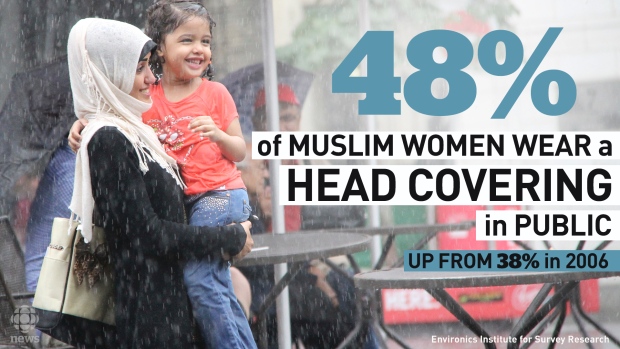
Muslim survey graphic 4

An Environics survey says nearly half of Muslim Canadian women report wearing a head covering in public. (CBC)

Muslims reported that Canada’s freedom and democracy was their greatest source of pride (24 per cent), followed by the country’s multiculturalism and diversity (22 per cent). Younger and Canadian-born Muslims were much more likely to choose multiculturalism and diversity, compared to foreign-born Muslims, who valued freedom and democracy.

The biggest knock against Canada was the weather. Just under one-third of Muslims said that was what they liked least about Canada. Another nine per cent highlighted discrimination and the treatment of Muslims. One-in-five could not name anything they disliked about Canada.

Source: Muslim Canadians increasingly proud of and attached to Canada, survey suggests – Politics – CBC News