…Do these differences among provinces and regions matter to our politics? On the one hand, they should not be exaggerated (and we should always resist the urge to stereotype): opinions in every region are fairly divided, with at least two in five in every region favouring each of the two options. Appeals to either freedom or to equality will win support among a significant number of voters, no matter where you are in the country. On the other hand, promises to make Canada the freest country in the world, and attacks on wokeism or policies to advance diversity, equity and inclusion will appeal more in some regions than others – specifically, they will appeal to more voters in the Prairies than in Quebec, and particularly more to men in the Prairies than to women in Quebec. This is as it should be: the point of democratic politics is to offer people choices. But these public opinion data do contribute something to our efforts to understand the way recent elections have played out.
Link to report below to this insightful report. Really good analysis across different aspects:
Canadians’ attitudes toward immigration are the most negative they have been since the early 1990s, driven particularlyby young people linking high migrant inflows to the affordability crisis and a housing shortage.
A new report from the Institute for Research on Public Policy, written by University of Toronto researchers, shows just how suddenly and dramatically sentiment toward immigration has changed in recent years. The report is based on 26 surveys produced by the Environics Institute between 1981 and 2024.
Environics surveys the Canadian public annually on a variety of topics. Recent survey results have particularly stood out because of a pointed negative shift in attitudes toward immigration, after more than two decades of mostly pro-immigration sentiment across the country. This prompted the researchers to conduct a historical analysis of immigration attitudes in Canada to gauge when, previously, Canadians held such negative views.
“Such drastic changes in public opinion are not common,” wrote Randy Besco and Natasha Goel, political science academics at the University of Toronto. “Public attitudes are usually subject to short-term shifts, only when there are major events or sustained media coverage, and such swings usually reverse quickly,” they said. …
More interesting analysis that bucks some of the commentary:
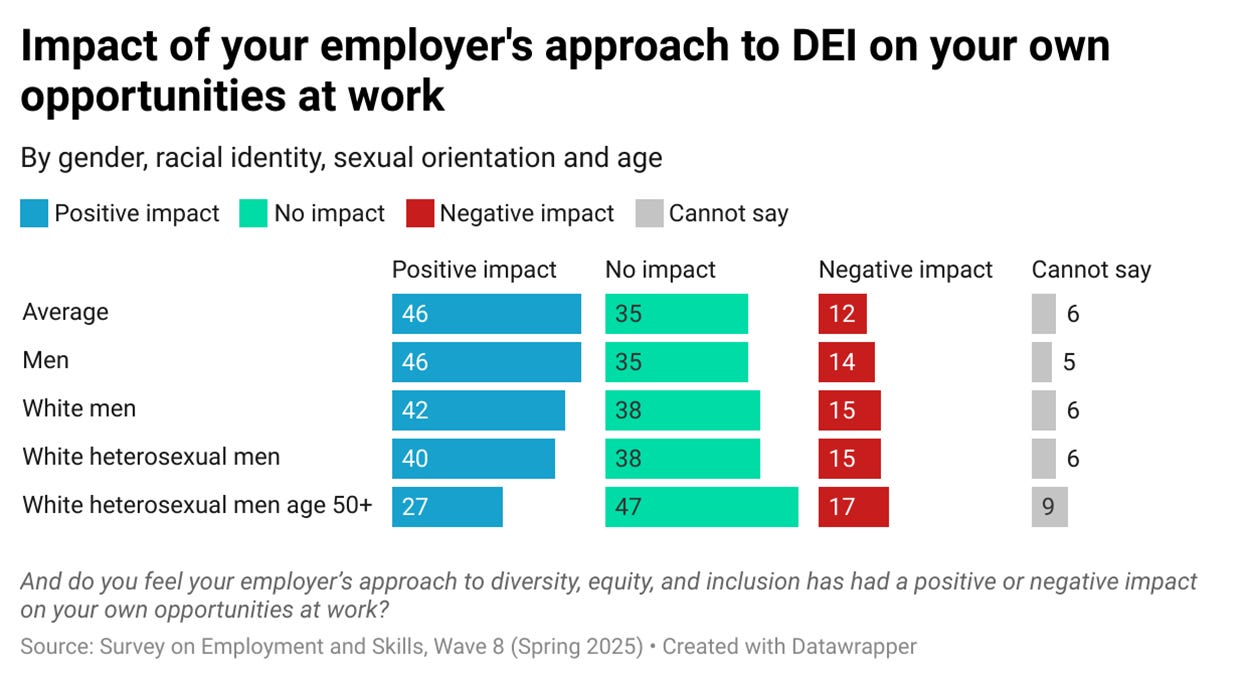
…But maybe we’re not looking closely enough. Thanks to the support of our survey partners at the Diversity Institute and the Future Skills Centre, the survey sample allows us to narrow the focus. Follow along in the chart below, which starts with the responses for employed adults in general, but then zeroes in on gender, racial identity, sexual orientation and age.2
Can you see the backlash taking shape? No, me neither.
Certainly, opinions are influenced by age. Older people are less likely to say that they’ve been positively affected by DEI policies (this holds true for older people in general, not just older white men). But opinions mostly shift to the neutral position (no impact). The proportion of white, heterosexual men age 50 and older who say their own opportunities have suffered as a result of DEI is only five percentage points higher than the average.
More interesting analysis by Parkin and Environics, written in response to the Globe editorial. Main takeaway, problem appears to be more on the Alberta side in terms of resentment:
The Globe and Mail published a special editorial this Sunday on the alliance between the Quebec and Alberta governments in support of greater respect and autonomy for their provinces. You can read it here.
I am going to weigh in. What’s the point of having a Substack if you can’t drop everything you had planned for the morning in order to share some charts?
The editorial, on the whole, is not wrong. Quebecers and Albertans share many frustrations. Our survey confirms they are the two provinces where support for more provincial powers is highest. But there are two specific nuances that are worth noting, since they arguably constrain the prospects for any Quebec-Alberta “rebel alliance.”
The first is one of the findings that jumped out early on in the Confederation of Tomorrow survey project. Quebecers who are critical of federalism are more likely than those who are not to support an asymmetrical distribution of powers (the option in the survey is: “the federal government should offer more powers to those provinces that want them, so that the federal system can respond to the different needs that some provinces may have”). But this is not the case in Alberta, where more insist on the equality of provinces: there is no greater openness to asymmetry among disgruntled Albertans. While many Quebecers and Albertans will find common ground in feeling disrespected within Canada, their solutions are not the same: the asymmetry that represents a step forward for autonomist Quebecers actually represents a step backwards for autonomist Albertans….
The second finding comes from a question added to the survey more recently, about the perceived contribution that the people in each of the country’s major regions make to Canada.
Relatively few Quebecers (12% overall) say that western Canadians contribute less than their fair share to Canada, and the proportion that holds this view is only slightly higher (16%) among Quebecers who don’t feel their province is treated with respect.
Far more Albertans (54%) say that Quebecers contribute less than their fair share to Canada, and this rises to a striking 81 percent among Albertans who don’t feel their province is treated with respect….
In short, whatever it is that annoys some Quebecers about federalism, it’s not their sense of what’s going on in the west. But one of the things that annoys some Albertans about federalism is precisely their sense of what’s going on in Quebec.
Resentment of Quebec (among other things) continues to fuel western alienation. The potential for a meaningful Quebec-Alberta alliance that leads us to a reformed federation, along the lines discussed in The Globe and Mail’s editorial, will be limited until Albertan leaders try to address and even defuse that resentment.
The good news is that for most questions, the decline in support has largely bottomed out. Encouraging that concerns revolve more around immigration program mismanagement and impact on housing, healthcare etc rather than values albeit latter along with refugees and crime remain issues. Partisan differences have increased significantly, likely reflecting Conservative highlighting immigration and citizenship issues and possible influence of USA debates:
A majority of Canadians say there is too much immigration to this country, a new poll suggests, but the percentage of people who believe this has remained stable after a sharp rise over two previous years.
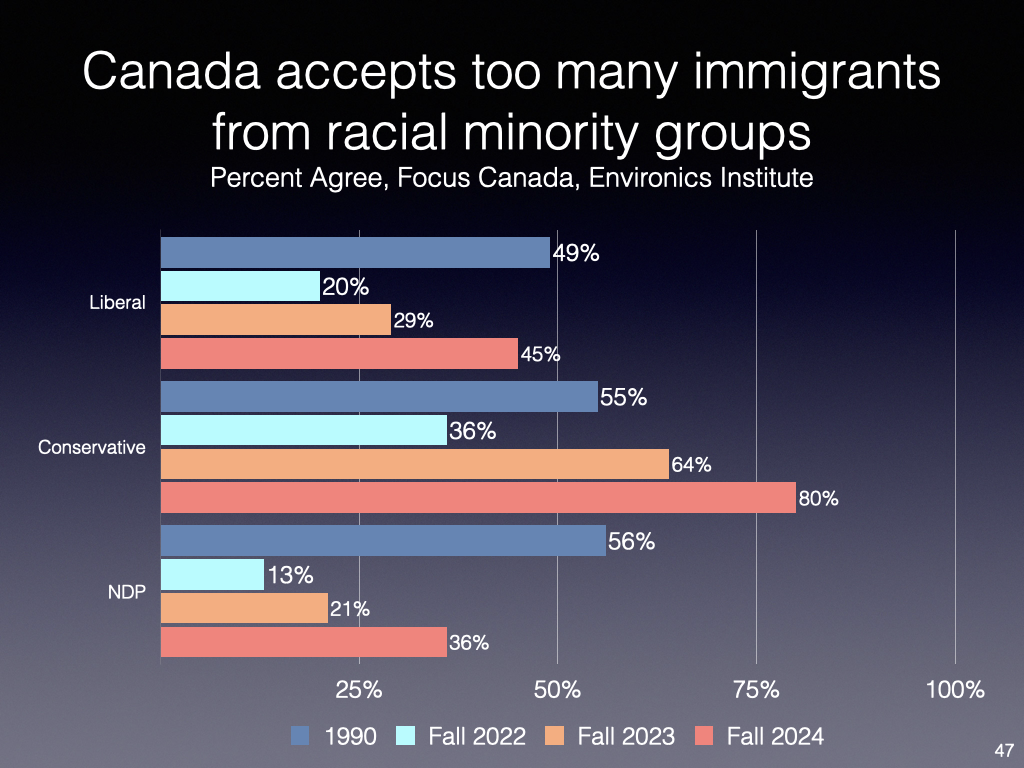
The poll, which was conducted by the Environics Institute for Survey Research in partnership with other groups, also found a widening partisan divide among respondents. Supporters of the federal Conservatives are much more likely to be critical of immigration levels compared with people who support the Liberals or New Democrats.
The survey interviewed 2,004 Canadians via telephone (landline and cellphone) between Sept. 8 and 21. The margin of error for this sample size is plus or minus 2.2 percentage points, 19 times out of 20. The survey has been conducted over decades using broad questions to track Canadians’ feelings about immigration.
Fifty-six per cent of respondents said they agreed with the statement, “Overall, there is too much immigration to Canada,” while 38 per cent said they disagreed with it. …
The survey, conducted by the Environics Institute for Survey Research, also found the vast majority of respondents were strongly opposed to Canada becoming the 51st state.
“It’s really the worst collective opinions of the U.S. that we have recorded” in the more than 40 years the institute has been keeping track, said Keith Neuman, a senior associate at the Environics Institute for Survey Research. “By more than a two-to-one margin, Canadians’ opinions are negative rather than positive.”
It’s the result of what some experts call a “visceral reaction” toward Trump’s tariffs and annexation threats.
“The unfavourable feelings are much stronger this time, and much more intense,” said Adam Chapnick, a Canadian foreign policy analyst and professor of defence studies at the Royal Military College of Canada.
“It’s being reflected in Canadians not travelling to the United States, not purchasing products that are made in the United States and becoming more serious about making hard decisions domestically to improve our productivity and competitiveness in the world.”
Canadian public perception of the U.S. hits new low
That’s a dramatic shift from last fall, when public sentiment toward the U.S. was divided roughly 50-50.
The closest Canadians have come to a similar unfavourability rating was in 2020, during the tail end of Trump’s first administration. At the time, 63 per cent of Canadians felt unfavourable to the U.S.
“In Trump’s first term, it took several years for Canadian public opinion to deteriorate to the same point,” Neuman noted. “The impact on Canadian public opinion has been much quicker this time … there’s not only the history, but he’s been much more aggressive and assertive with policies much quicker this time around.”
A majority of Conservative voters — 57 per cent — still viewed the U.S. favourably, down six points from last fall. In contrast, more than 80 per cent of Liberal, Bloc Quebecois and NDP voters had an unfavourable opinion of the States.
Overall, 78 per cent of Canadians disapproved of Trump’s handling of the U.S. presidency, a figure that matched 2018. Trump was most popular among Conservative voters, 30 per cent of whom approved of his performance.
Canadians can still recover their positive relationship with the States “if we can turn things around in a reasonable period of time,” Chapnick said, referencing Trump’s tariffs and threats against Canadian sovereignty.
“I think that the long-term positive relationship is quite resilient,” he said. “Geography makes us more resilient. Family ties add to that. I think that, should things get back to some sort of new normal, there should be an ability for us to bounce back to a reasonable degree.”
Large majority of Canadians strongly against becoming the 51st state
Canadians have taken an “elbows up” response to Trump’s threats against Canadian sovereignty, Neuman said.
Eighty-three per cent of respondents said they “strongly disagree” that Canada and the U.S. should unite into one country, while just seven per cent said a merger should happen.
That’s a stronger sentiment than when the Canada-US Free Trade Agreement (CUSFTA) — the precursor to the North American Free Trade Agreement (NAFTA) — was negotiated in 1986, stoking fears of an economic and cultural merger between the two nations. Back then, just 63 per cent of Canadians were strongly against Canada and the U.S. uniting.
Shortly after the CUSFTA was implemented in the late-1980s, an Environics poll found 30 per cent of Canadians felt it was “very likely” that Canada will remain independent from the U.S. over the next decade. Today, that figure has jumped to 70 per cent.
“That, in some ways, is maybe the most surprising or notable finding,” Neuman said. “It’s not evident that we should be seeing that strong a level of confidence right now, given the uncertainty with tariffs and the uncertainty about Trump … We have not been threatened as a country like this since before we became a country.”
But Chapnick wasn’t surprised, noting that Canadians grew more confident in their nation’s sovereignty after worries of annexation during CUSFTA negotiations didn’t come to pass….
Always useful to have tracking over time. Encouraing:
Canadians are more optimistic about race relations than they were three years ago, despite a world that’s increasingly defined by inter-group conflict and social divisiveness, says a national survey on racism, race relations and discrimination.
The survey shows that those who view race relations as generally good outnumber those who think otherwise by a three-to-one ratio — with many believing that people from different groups get along with one another and have equal opportunity to succeed, said the report by Environics Institute and the Canadian Race Relations Foundation.
The 2024 survey found that most Canadians acknowledge the reality of racism, prejudice and hate, recognizing these issues both from personal experience and through their understanding of broader societal trends.
Keith Neuman, senior associate at Environics and the report’s lead author, said that compared to racialized people surveyed in 2021, the experiences of those surveyed this time didn’t worsen, and their perceptions of race relations improved slightly. “That, I think, is a point of optimism,” he said.
This was the third wave of a national survey that started in 2019 to monitor the attitudes, perceptions and experiences of race relations among Canadians. The second survey in 2021 was in the wake of the racial reckoning from the Black Lives Matter Movement and surge of anti-Asian racism amid the pandemic….
Clear continuing signs of an inflection point in attitudes, reflecting overly high levels of permanent residents and out of control temporary (students, foreign workers) along with impact on housing availability and affordability.
Recent reversals will take time to work through the system meaning that public opinion unlikely to revert to pre-2022 levels. Clear policy failure on the part of the federal government, along with provincial governments and advocates/lobbyists for high levels.
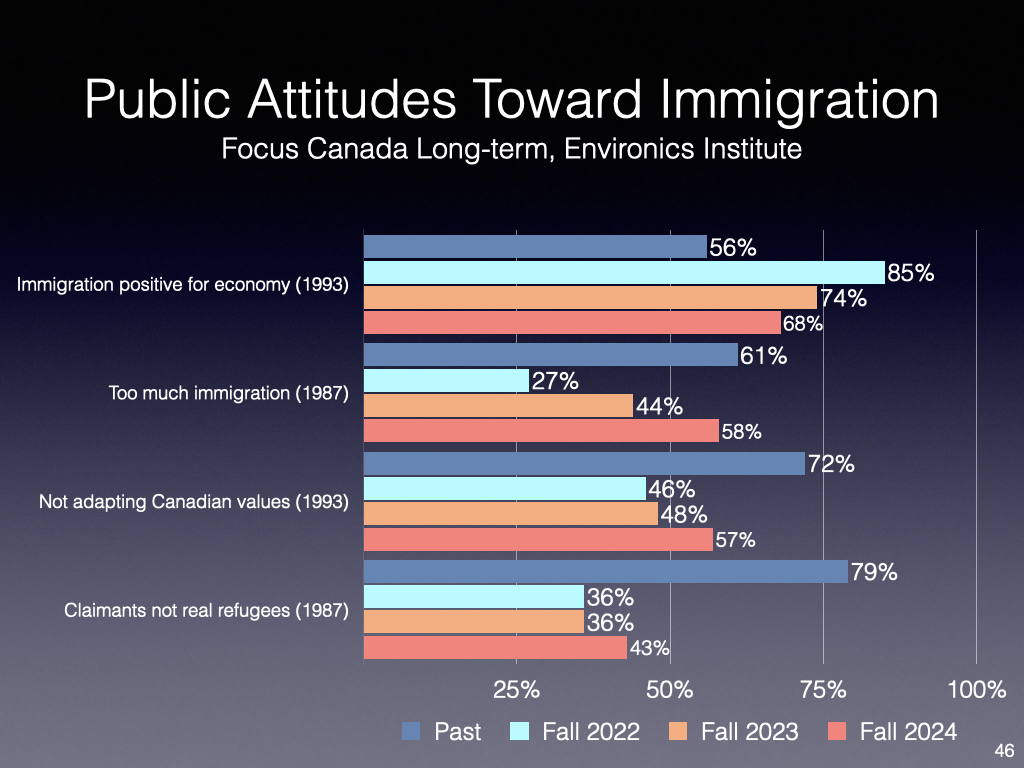
Reversion to 1990 attitudes or worse as per the summary charts below:
…..Keith Neuman, a senior associate with the Environics Institute, says his organization has consistently found a consensus that immigration was either positive for Canada or not a problem.
But he said Canadians have been growing more concerned about the volume of immigrants. “There are worries and concerns about immigration that we simply didn’t see two years ago to the same extent,” he said in an interview.
However, he said Canadians are not rejecting immigration entirely. “People still value the diversity. They still recognize the economic benefits. They understand that jobs need to be filled. Those things are still part of the general sentiment of the population for most people.
“But there are increasing concerns with how the system is being managed and the number of people coming.”
Among the findings of the researchers is a 10-point increase, to 21 per cent, in those who believe there is too much immigration because it is being poorly managed by government….
Correct interpretation IMO. However, the current government’s approach undermines public trust in government competence in immigration and other areas, even as some corrective action is taking place:
….Environics also inquired as to why the shift occurred. And it’s very obviously for one major reason: The housing crisis. In 2022, 15 per cent of respondents agreed that “immigrants drive up housing prices (and lead to) less housing for other Canadians”; in 2023, 38 per cent agreed.
And they’re right. Add demand for a scarce product and prices go up. Canada absolutely should be able to cope with current or higher levels of immigration, and indeed thrive off of it. We’re not exactly short on land or high on population density. But our politicians have never been more motivated to address housing scarcity, and the results have been utterly dismal. For heaven’s sake there were fewer home starts in June 2024 than in June 2022, according to CMHC data.
On the issues more typically associated with anti-immigration sentiment per se, the Environics data show no alarming spikes at all. Only four per cent of respondents cited “security risk” as a factor influencing their desire for less immigration. One-quarter said “immigrants are a drain on public finances (or) cost too much,” or are “bad for (the) economy (and) take jobs from other Canadians” — up from 23 per cent and 21 per cent, respectively, which is hardly any change at all in the polling world.
In 2022 and 2023 alike, just 19 per cent of respondents told Environics there were “already too many people in Canada” — the strongest suggestion, I submit, that what we’re seeing here isn’t a backlash against immigration, let alone against individual immigrants and immigrant populations, but a call for some restraint until we get our crap together. Just nine per cent of respondents told Environics they thought immigrants make their community worse; 42 per cent said they make it better.
For 30 years, Environics has asked Canadians whether they think “there are too many immigrants coming into this country who are not adopting Canadian values” — something you hear often from people who could fairly be called anti-immigration. In 1993, 72 per cent of Canadians agreed with that proposition. Three decades later, amid this so-called “backlash,” the figure was 48 per cent.
Especially at a time when Canadians seem more angst-ridden about the country’s economic future than I can ever remember — potentially fertile soil for xenophobic sentiments, as history shows — these don’t strike me as alarming numbers at all. That’s especially true considering we’ve been admitting more immigrants per capita than at any time since the Hungarian Revolution in 1956, and watching tens of thousands of people traipse illegally across the Canada-U.S. border claiming asylum, and been lectured about racism and intolerance by a government that has basically conceded all of its opponents’ points on the immigration file.
Wanting less immigration isn’t inherently a “backlash” unless the optimal number of immigrants is infinite, which it obviously is not. We have enough problems to deal with without inventing new ones. The immigration consensus lives, despite the federal government’s worst efforts.
Of note. Of course, another dramatic change was the shift to positive support for immigration, under threat to some extent by concerns over housing, healthcare etc)
….The Mulroney government implemented free trade, but (the 1988 election victory notwithstanding) it left office having lost the support of the majority of the public on the issue. Herein lies the first lesson for those aspiring to political leadership, which is perhaps a strange one for pollsters to point out: don’t pay too much attention to who’s on top of the polls. Free trade was a policy championed by experts – the dour economists and the faceless bureaucrats – that became less popular the longer the government that fought for it remained in office. Mr. Mulroney’s ability to see it through was ultimately due, not to his charm, but to his thick skin.
…
The second lesson that political leaders can draw from this incredible turnaround? Vindication takes time. Mr. Mulroney’s Progressive Conservatives endured defeat, then watched while Liberal governments reaped the benefits of free trade, championed its expansion globally, and won praise for defending it in response to the election of a maverick U.S. president. Mr. Mulroney played for the longer-term, which may be one of the hardest things to do in modern politics. But by choosing that path, he ensured that today – 40 years after NAFTA – his praises are being sung.

 Multicultural Meanderings