More visible minority candidates ran — and won — in Canada’s federal election. The Conservatives boosted the numbers

Coverage of our study:

More visible minorities ran and were elected in the spring federal election compared to the previous election, an increase that a new report found was driven by representation in parties on the right.

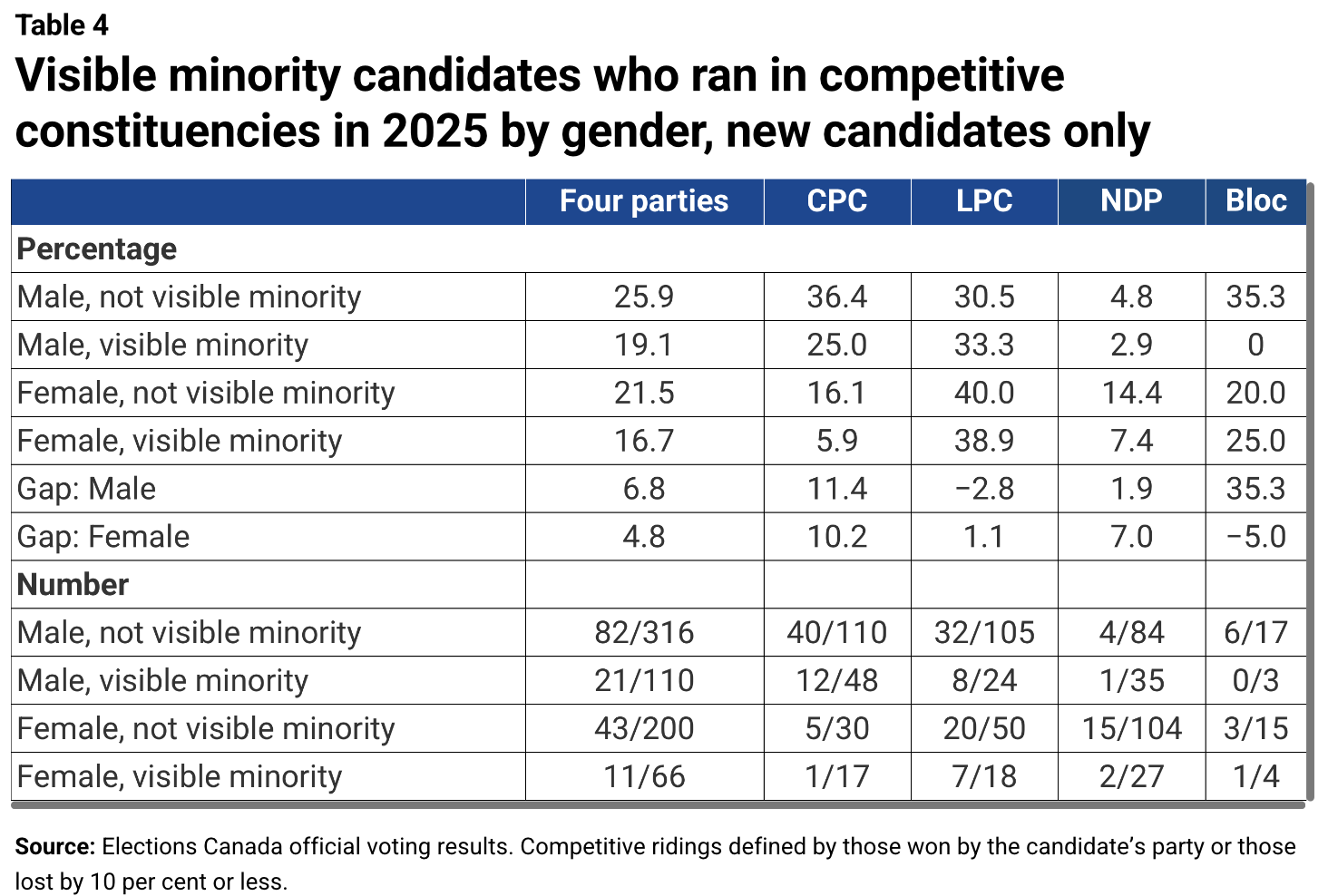
There were 315 visible minorities representing the six major parties, according to the report published by the Institute for Research on Public Policy. The candidates accounted for 20.1 per cent of the 1,568 candidates in the April 28 election. This was an increase from 18.2 per cent in 2021, 16.8 per cent in 2019 and 13.4 per cent in 2015.

While the Liberals, New Democrats and Greens all reported a drop in their visible minority representation from the 2021 race — by 0.9, 3.2 and 1.3 percentage points respectively — Pierre Poilievre’s Conservatives and Maxime Bernier’s People’s Party of Canada saw their numbers up by 5.9 percentage points and seven points, with the Bloc Québécois up 1.3 points. (The People’s Party failed to win a seat.)

The report refers to “visible minorities” as persons, other than Indigenous people, who are non-Caucasian in race or non-white in colour, as defined by Statistics Canada. 

“The Liberals almost seemed to have dropped the ball in terms of candidate recruitment compared to the Conservatives, who obviously were making a fairly concerted effort to recruit a larger number of visible minority candidates,” said Andrew Griffith, who co-authored the report with retired McGill University political science professor Jerome Black.

“They were still building off the Jason Kenney legacy that visible minorities are our natural conservatives,” added Griffith, referring to the former Conservative immigration minister tasked with building bridges with minority communities under the Harper government.

And the deliberate recruitment efforts seemed to yield results, with the proportion of elected visible minority MPs up by 2.4 percentage points, accounting for 17.8 per cent or 61 of the 343 MPs in the new Parliament.

While the number of Liberal MPs who are visible minorities fell by 2.2 percentage points, the Conservatives boosted their visible minority MPs in the House of Commons by 7.5 percentage points. 

The MP breakdown, by ethnicity, was South Asian, 29 seats, Black, 11 seats; Chinese and Arab/West Asian, both seven; Latin American, two; Filipino and Southeast Asian, each with one; and three listed under “other/multiple” backgrounds.

University of Toronto professor Emine Fidan Elcioglu said she was not surprised by the shift as the Conservatives rebranded the party under prime minister Stephen Harper to cultivate support from ethnic communities.

“They wanted to seem like the new party of diversity, so they were very intentional in their ethnic outreach,” said the sociologist, who studies migration politics.

“They were (previously) pushing forward policies that alienated immigrant visible minority communities. They were also reframing themselves as pro-good immigrant, anti-bad immigrant.”

Over the years, she said, visible minority groups have also started to embrace that thinking as shown in recent public debates about the impacts of immigration on the housing and affordability crisis.

Poilievre is “very much looking at these groups as a potential part of his base,” Elcioglu noted. “But I think we need to be really careful to not assume that just because there is more visible minority candidates in the party, that is necessarily going to be fundamental in voter motivation.”

Having more racialized candidates doesn’t necessarily translate to more inclusion, she said, and it could just be a cover for more stringent immigration policies, more austerity measures and more gutting of the social security safety net that affect the society’s most marginalized and vulnerable.

“So, great, you recruit people who are not white men, but what are you doing with that?” asked Elcioglu. 

The report also found the number of women running in the April election down from the 2021 election by 2.4 per cent to 553, and Indigenous candidates by 0.9 per cent to 48. In total, 104 women and 12 Indigenous people were elected.

“It seems like there’s almost a glass ceiling of about 30 per cent for women,” said Griffith. “For Indigenous MPs, it’s a bit different just because of how the population is distributed across the country, but that also has stalled.” 

Candidate profiles and assessments in the analysis are based upon candidate photos, names and biographies, general web searches, and ethnic and other media that focused on particular groups.
Source: More visible minority candidates ran — and won — in Canada’s federal election. The Conservatives boosted the numbers

The diversity of candidates and MPs stalled for some groups in this election

My latest collaboration with Jerome Black on the diversity of candidates and MPs. Stall for women and visible minorities, ongoing increase for visible minorities.

In summary, differences in political-party representation reflect dissimilarities in demographic trends (such as higher growth rates of visible minorities), overall election dynamics, political-party recruitment efforts, and the extent to which groups feel their concerns are reflected in political platforms and messaging.

Source: The diversity of candidates and MPs stalled for some groups in this election

Proportion of women in the House of Commons dips, with slight rise in minority MPs

Latest article with preliminary analysis of 2025 election results in terms of MP diversity:

…In Canada, Indigenous representation in the House also dipped slightly, according to an analysis by Andrew Griffith, a fellow of the Environics Institute and a former director-general in the federal immigration department. He found that 3.3 per cent of elected MPs are Indigenous after this election, down from 3.5 per cent in 2021. 

However, there was a slight rise in the number of visible minority MPs. Mr. Griffith found that their representation stands at 18.1 per cent now, compared with 15.7 per cent at the last election. 

“We appear to have reached a plateau with respect to women and Indigenous peoples MPs,” he said in an e-mail.

“On the other hand, the combination of growth in immigration and visible minorities, matched with most political party candidates being visible minorities in ridings with high numbers of visible minorities and immigrants, continues the trend of increases in their representation.”…

Source: Proportion of women in the House of Commons dips, with slight rise in minority MPs

Number of female candidates drops across parties: study

Results of the preliminary analysis by Jerome Black and myself:

…Mr. Griffith, who has carried out similar research for previous elections, said he was surprised to see the drop in the proportion of female candidates, particularly among the Conservatives. They had a lot of candidates in place soon after the election was called, whereas the NDP and Liberals were later with nominations, he said.

“It’s surprising that the number of women standing for the Conservatives actually declined very significantly: a third of the nominations in 2021 to not even a quarter of the nominations in 2025,” he said. “Conservatives actually made a concerted effort to recruit visible minorities, but they seem to have dropped the ball with respect to women.”

He said some women may have been deterred from standing by the rise in abuse directed toward female politicians.

“It’s certainly part of it,” he said. “But I’m still surprised at such a dramatic decline.”

Source: Number of female candidates drops across parties: study

Elcioglu: Why are so many second-generation South Asian and Chinese Canadians planning to vote Conservative?

Striking that this analysis does not compare outreach efforts of the Harper government, that the same immigrant and visible minority ridings switch between parties in both federal and provincial elections, nor acknowledge that in general, ethnic communities tend to follow the overall electoral changes and demographics. The general trend in this election until recently showed younger voters whatever their group, increasingly conservative given housing and other basic concerns. Would also have been nice to see some gender analysis as the overall shift is more with men than women.

Hard economic realities more influential IMO:

…In Canada, ideas about who belongs are often shaped by race, class and respectability. Racialized people must not only prove they are hardworking and law-abiding, but also demonstrate that they’ve “fit in.” For some, voting Conservative becomes a way to show they’ve done just that — a way of saying: “I’m not like them. I’m one of you.”

But this strategy comes at a cost. In reinforcing the very structures that marginalize them, racialized voters may gain individual recognition while deepening collective exclusion. And in rejecting equity-based platforms, they may forgo the policies that could build a more just society.

This dynamic isn’t limited to the second generation. A recent CBC survey found that four in five newcomers believe Canada has accepted too many immigrants and international students without proper planning. 

Some immigrants are increasingly expressing exclusionary views, often toward those who arrived more recently. This, too, is a form of aspirational politics. And it shows just how deeply race, precarity and belonging are entangled in Canada today.

None of this means that racialized Conservative voters are naïve. Their decisions often reflect a clear-eyed understanding of how power works. 

But if we want a fairer political future, we must reckon with the ways race, class and nationalism shape belonging — not just at the ballot box, but in the stories we tell about who gets to be “Canadian.”

As sociologist Ruha Benjamin reminds us, inclusion shouldn’t be treated as an act of generosity. It’s not about “helping” the marginalized — it’s about understanding that we’re all connected. When fear shapes policy and public goods are stripped away, everyone suffers.

Source: Why are so many second-generation South Asian and Chinese Canadians planning to vote Conservative?

Tremblay | Et si la question des réfugiés devenait l’enjeu principal des élections?

Likely not going to happen, as is the case with so many non-Trump tariff etc issues:

…Rappelons qu’en plus des Haïtiens, un très grand nombre de Vénézuéliens et de migrants latino-américains seraient également dans la mire des États-Unis. Le président américain estime le nombre total des « illégaux » à 8 millions. Combien le Canada peut-il en accueillir ? Bien malin celui qui peut répondre à cette question.

Pierre Poilievre a répondu que le Canada devait accueillir les « vrais demandeurs d’asile ». Le Bloc exige, lui, une meilleure répartition de ces réfugiés à travers le pays. Mark Carney affirme impérativement qu’il les renverrait d’où ils arrivent, c’est-à-dire aux États-Unis. Rappelons que l’Entente sur les tiers pays sûrs permet de refouler les demandeurs d’asile qui proviennent des États-Unis. Mais nos voisins sont-ils encore un pays sûr ?

Voici une belle occasion pour les conservateurs et pour le Bloc québécois. Une bonne réponse à la crise migratoire pourrait déterminer l’issue des élections, autant sinon plus que la réponse aux menaces tarifaires. Pierre Poilievre pourrait ici regagner tous les précieux points perdus depuis l’arrivée de Mark Carney en se montrant ferme dans cette crise humanitaire et en rappelant que la crise migratoire est véritablement une crise de la vision libérale de ce pays que Justin Trudeau qualifiait, il n’y a pas si longtemps, de « premier État postnational de la planète ». Le chef conservateur pourrait même s’imposer comme l’homme fort capable à la fois de protéger le Canada et de résister à Trump.

Le Bloc a de son côté l’occasion de revenir dans la mêlée pour défendre les intérêts du Québec qui ont été particulièrement malmenés par la gestion migratoire du gouvernement Trudeau. Quant à Mark Carney, il faut se poser cette question à plusieurs dizaines, voire à plusieurs centaines, de milliards de dollars : pourra-t-il continuer à cacher le bilan libéral, surtout en matière d’immigration et de logement, alors qu’une nouvelle crise migratoire s’annonce ? Quelle crédibilité auront les libéraux pour nous convaincre qu’ils seront les meilleurs pour freiner l’afflux de réfugiés après des années de déni et de laxisme éhontés en la matière ?

Qui a dit que la campagne électorale était déjà terminée ?

Source: Idées | Et si la question des réfugiés devenait l’enjeu principal des élections?

… Recall that in addition to Haitians, a very large number of Venezuelans and Latin American migrants would also be in the sights of the United States. The American president estimates the total number of “illegals” at 8 million. How many can Canada accommodate? Very smart who can answer this question.

Pierre Poilievre replied that Canada should welcome the “real asylum seekers”. The Bloc demands a better distribution of these refugees across the country. Mark Carney imperatively states that he would send them back to where they arrive, that is, to the United States. Recall that the Agreement on Safe Third Countries makes it possible to push back asylum seekers who come from the United States. But are our neighbors still a safe country?

This is a great opportunity for the Conservatives and for the Bloc Québécois. A good response to the migration crisis could determine the outcome of the elections, as much if not more than the response to tariff threats. Pierre Poilievre could here regain all the precious points lost since the arrival of Mark Carney by being firm in this humanitarian crisis and recalling that the migration crisis is truly a crisis of the liberal vision of this country that Justin Trudeau described, not so long ago, as “the first post-national state on the planet”. The conservative leader could even establish himself as the strong man capable of both protecting Canada and resisting Trump.

The Bloc, for its part, has the opportunity to return to the fray to defend Quebec’s interests, which have been particularly mistreated by the Trudeau government’s migration management. As for Mark Carney, we must ask himself this question at several tens, even several hundred, of billions of dollars: will he be able to continue to hide the liberal balance sheet, especially in terms of immigration and housing, while a new migration crisis is announced? What credibility will the Liberals have to convince us that they will be the best at curbing the influx of refugees after years of shameless denial and laxity in this area?

Who said the election campaign was already over?

Candidate nominations by party websites

Another indicator of party preparedness (as of 8 pm 23 March). Not all candidates have bio information available yet:

  • CPC: 266
  • LPC: 185
  • NDP: 111
  • Bloc: 71 (out of 78 ridings)
  • Green: 40
  • PPC: 284

Jerome Black and I are in the process of analyzing candidate diversity in terms of gender, indigenous, visible minority, religious minority, immigration history, LGBTQ and whether new or previous federal candidates.

Expect that virtually all candidates will be nominated by the end of the month that will allow us to do the initial analysis.