Nearly 100 new MPs offer new face of Parliament, including 60 in flipped seats
More on MP diversity:
In many ways the incoming Parliament looks quite similar to its predecessor, with 240 returning MPs, the same number of MPs who are Indigenous or a visible minority, and 10 more women.
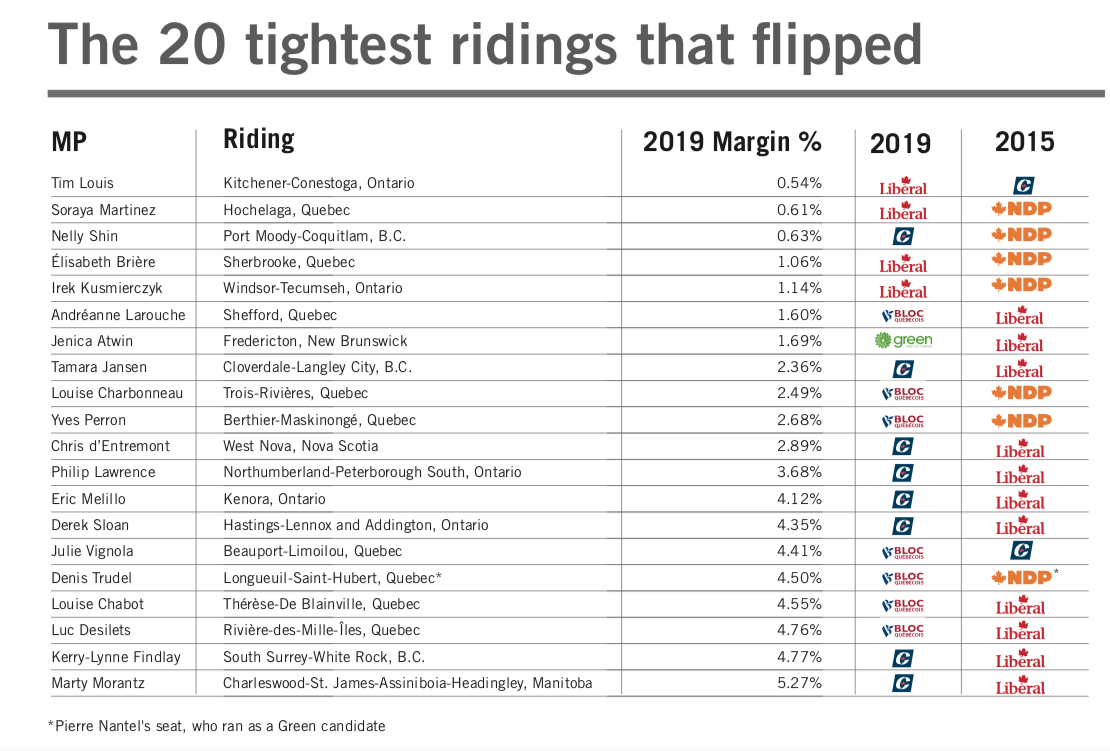
A third of the 60 MPs representing ridings that flipped were won with less than five per cent of the vote.

Eight former MPs, seven lawyers, five farmers, two Olympic athletes, a financial adviser, a musician, and an actor are all among the 98 new MPs headed to the Hill this fall.

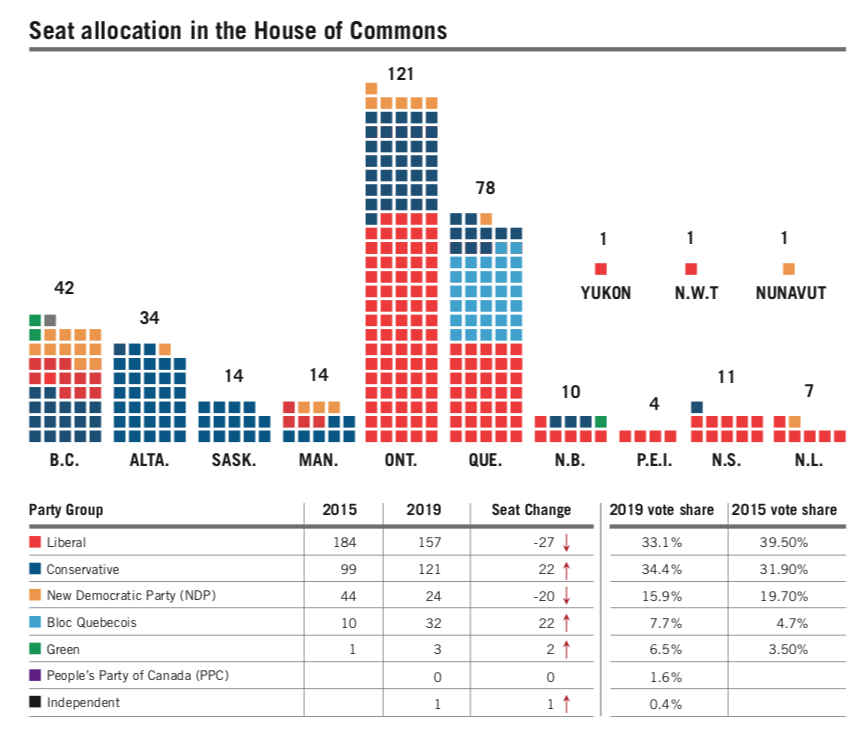
Two-thirds of that group helped change the face of the new Parliament, flipping the ridings in their party’s favour during the Oct. 21 election that propelled Liberal Prime Minister Justin Trudeau (Papineau, Que.) back to Ottawa with a minority government made up of 133 incumbents, like him, holding the Liberals’ 157 seats.

Many of the ridings that flipped were hard-fought battles, with a third won by margins of five percentage points or less of the vote, and Quebec and the Bloc Québécois figuring prominently in that group. Among those who lost their seats are a cabinet minister, the Conservatives’ deputy leader, and the NDP’s Orange Wave legacy in Quebec.

Conservative candidates switched the most seats across the country, at 27, stealing mainly from the Liberals in the Western provinces and often winning by the widest margins. Former MPs John Williamson (New Brunswick Southwest, N.B.) and Rob Moore (Fundy Royal, N.B.) were among those who took their ridings back in decisive victories, more than 20 points ahead of their closest competitors.

Some Bloc Québécois candidates also scored convincing wins to not only return their party to official status in the House, but also rocket past the NDP to a third-place finish. The traditionally sovereigntist party brought the next biggest bloc of flipped seats at 22, mostly to the NDP’s detriment, taking 10 of the 14 seats the NDP lost in the province.

One-third of the Bloc’s caucus of 32 are women—a proportion the House is close to achieving this year.

Election after election, women are eking out greater representation at the federal level. The 43rd Parliament will include 98 women MPs, up from the 88 in 2015, but three shy of the 30 per cent mark championed by Equal Voice and others as a threshold for adequate representation. That bumped Canada’s international standing by four from 61 to 57 for women’s representation in political office.

Sixty-six women are returning MPs, 10 are new but helped their parties hold existing ridings, while 22 are among the 60 ridings that flipped.

The number of Indigenous and visible minority MPs elected Oct. 21 did not change the totals elected in 2015.

Four new Indigenous MPs were elected—three in ridings that switched parties, including Conservative MP-elect Marc Dalton (Pitt Meadows-Maple Ridge, B.C.), and NDP MPs-elect Leah Gazan (Winnipeg Centre, Man.) and Mumilaaq Qaqqaq (Nunavut)—but their number remains static in the House. As in 2015, 10 Indigenous MPs were elected to the House, though this year representing different parties, including six Liberals, one Conservative, two NDP, and one Independent.

The number of MPs who are visible minorities also remained static at 47, according to a preliminary analysis. The Liberals have four fewer MPs who have been identified as visible minorities, with 35, followed by nine Conservatives, and three NDP MPs.[Note: Expect that the large number of Bloc MPs impeded an increase as other parties are more diverse than the Bloc, which all appear to be “pure Laine”]

All numbers are pulled from candidate demographic profiles built by The Samara Centre for Democracy and The Hill Times, in partnership with researchers Jerome Black and Andrew Griffith, based on biographies and other online sources.

Tories lead flipped seats

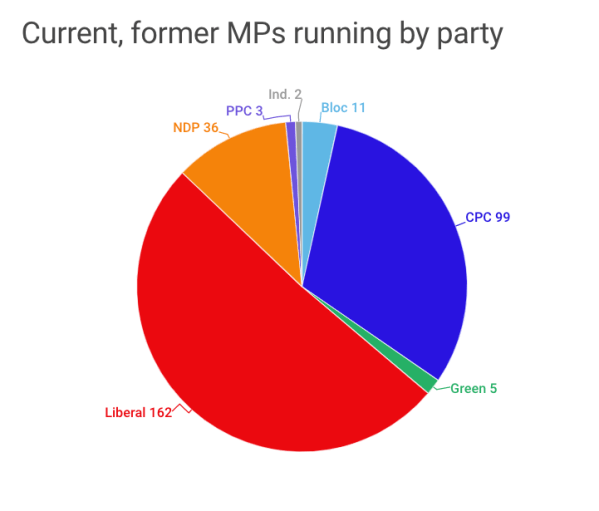
The Conservatives led in flipped seats and also among former MPs trying to make it back to Parliament.

Political experience was a common thread among the successful new candidates—nearly half of the 98 new MPs cited past work as political staffers or representatives, with at least 10 sitting in provincial or territorial legislatures, and at least 14 on city council.

Of the 30 former MPs who appeared on ballots in the general election, five of the successful eight were Tories, including Mr. Williamson and Mr. Moore, Kerry-Lynne Findlay (South Surrey–White Rock, B.C.), Kyle Seeback (Dufferin-Caledon, Ont.), and Tim Uppal, who took back Edmonton Mill Woods, Alta., from Liberal cabinet minister Amarjeet Sohi.

Eight of the party’s 27 new seats came from B.C., followed by four apiece for Alberta, Saskatchewan, and Ontario.

Bloc victorious over NDP, Grits

Several of the new Bloc MPs come to Parliament with backgrounds in education.

Bloc Québécois Leader Yves-François Blanchet led his party’s reversal of fortunes, helping stamp out the last seats that remained from the NDP’s Orange Wave in 2011. Over two elections, the New Democrat’s 59 seats has dwindled to one, held by the popular Alexandre Boulerice (Rosemont-La Petite-Patrie, Que.).

Mr. Blanchet beat two-term NDP MP Matthew Dubé in Beloeil-Chambly as one of 10 NDP seats it flipped.

Also among the Bloc’s new cohort is Alexis Brunelle-Duceppe, the son of former Bloc leader Gilles Duceppe, who took Lac-Saint-Jean, Que., from Liberal MP Richard Hébert. It was among the nine seats the party took from the Grits.

The Liberals, meanwhile, carved a further three of its four seats from the NDP in Quebec, where many of the ridings that flipped were close races.

The NDP took three ridings back from the Liberals, including St. John’s East, N.L., after a successful bid from two-term former MP Jack Harris, who was defeated in 2015.

Human rights activist and educator Ms. Gazan beat one-term MP Robert-Falcon Ouellette by eight per cent to take Winnipeg Centre, Man., while 25-year-old Ms. Qaqqaq is representing Nunavut as one of this Parliament’s youngest MPs, and the first NDP MP to represent the region since it became a territory.

Of the seven seats the Liberals managed to flip (while losing four times that amount), Olympic medallist Adam van Koeverden’s victory in Milton, Ont., over deputy party leader Lisa Raitt was by far the biggest of the night.

And Fredericton’s new Green Party MP Jenica Atwin made history at the Liberals’ expense, when she took the seat from one-term MP Matt DeCourcey and gave the Greens its first federal seat outside of B.C.

Source: Nearly 100 new MPs offer new face of Parliament, including 60 in flipped seats

Nothing but a ‘vanity project’: People’s Party of Canada is likely dead, experts say

Hard not to agree. And it did not seem to have any effect of pulling the Conservatives further to the right:

In the lead-up to this week’s federal election, media outlets around the world wondered whether right-wing fringe candidate Maxime Bernier and his People’s Party represented an expansion of the populist, nationalist and anti-establishment sentiment sweeping the United States and Europe.

“A ‘Mad Max’ candidate offers a far-right jolt to the Canadian election,” read a headline in the New York Times. “Can populism become popular in Canada?” asked the BBC.

Judging from Monday night’s results, the answer appears to be a resounding no. The dismal outcome — the People’s Party clinched zero seats and less than 2 per cent of the popular vote — did not come as a surprise to political watchers, who said Tuesday our first-past-the-post system “inoculates” us from fringe parties. Plus, they said, Bernier’s brand of populism was just too extreme, particularly when it came to his views on immigration.

While Bernier, who lost in his own riding of Beauce, Que., insisted in a concession speech that the movement was “only getting started,” experts said the People’s Party likely would not survive.

“The PPC is rather easily seen now as a vanity project of Bernier’s, and as a very ineffectual attempt to come up with a latter-day Reform Party challenge to more moderate conservatism,” said David Laycock, a political science professor at Simon Fraser University.

Bernier, who held the Beauce riding since 2006, had served under the Conservative banner until last year when he narrowly lost the leadership contest to Andrew Scheer and then formed his own party. On Monday night, he garnered 28 per cent of the vote and placed second to Conservative Richard Lehoux.

Some of the party’s other higher-profile candidates, such as Renata Ford, widow of the late Toronto mayor Rob Ford, and Lee Harding, former Saskatchewan director of the Canadian Taxpayers Federation, barely made a dent — coming in fourth in their respective ridings of Etobicoke North and Cypress Hills-Grasslands and capturing only 2.8 per cent of the vote.

Bernier blamed “nasty and shameless attacks” from opponents for the PPC’s poor showing. (Late last week, The Globe and Mail reported that strategist Warren Kinsella and his firm Daisy Group had been hired by the Conservatives to “seek and destroy” Bernier’s party and portray its supporters as racist. Conservative Leader Andrew Scheer refused to confirm or deny the allegation. Bernier filed a complaint with Elections Canada over the affair).

But experts suggested it was the party’s policies that did them in. While certain aspects of the PPC platform — support for libertarian principles, small government and a repeal of the carbon tax — dovetailed with the Conservatives, the party’s stances on immigration were controversial.

Bernier vowed to repeal the Multiculturalism Act and severely curtail immigration levels. Stealing from Donald Trump’s playbook, he even suggested building a fence along parts of the Canada-U.S. border to thwart irregular migration. Critics accused the party of providing a home to people peddling hate.

“Canadian voters don’t and won’t soon support the kind of overt racism that Bernier courted,” Laycock said. “Comparative public opinion data on immigration and multiculturalism show that while Canada isn’t the multicultural utopia that some commentators contend, Canadians don’t feel comfortable with explicit attacks on minority groups, and value ethnic diversity far more than most Europeans do.”

If Bernier had discussed multiculturalism in a more nuanced way with specific policy proposals, his messaging may have resonated more, said Tamara Small, a political science professor at the University of Guelph.

“The idea of multiculturalism is very important to people — definitely in English Canada,” she said.

Bernier had initially not been invited to take part in televised leaders’ debates, but that decision was reversed by former governor general David Johnston, head of the Leaders’ Debate Commission, who cited the party’s  “organizational capacity,” legitimate chance of electing more than one candidate and the media attention the party had received.

But Laycock and Small said the party received more news coverage than it deserved.

“I can’t think of a party in recent history that has polled at less than 3 per cent that got the amount of attention that he got, frankly,” Small said.

But if the media had ignored the PPC during the campaign, they would have been accused of not giving attention to the broad spectrum of political parties, said Bessma Momani, a political science professor at the University of Waterloo.

“Frankly, populists would have used the absence of coverage … as a way to suggest that the media is overtaken by liberal interests.”

Asked what message the defeat of the PPC now sends to the Conservative Party as it rebuilds after failing to topple the Liberals, Small said there is nothing to be gained by pushing further to the right.

“There’s no more people there. There’s none,” she said.

“If there’s going to be a leadership race, a Kellie Leitch type of candidate probably doesn’t dominate,” Small added, referring to the one-time Conservative leadership hopeful who had controversially proposed screening immigrants for “Canadian values” and setting up an RCMP tip line so people could report “barbaric cultural practices.”

However, there is a chance, Momani said, that backers of right-wing populism may still want to work with the Conservative Party, in the same way the Tea Party movement in the U.S. worked with the Republican Party to elect Donald Trump.

The People’s Party itself though is “probably” dead, Laycock said. Bernier’s poor showing in Quebec indicates there isn’t a regional base for his conservative alternative.

Furthermore, “it is very hard to attract media attention without any MPs, especially when your leader can’t win his own seat.”

Source: Nothing but a ‘vanity project’: People’s Party of Canada is likely dead, experts say

Business tops experience among 2019 candidates, one-third have run for office before

Been fun helping out on this:

Whether debating at town halls, canvassing, or presenting their cases online, it’s a near record year for candidates, with 2,146 running, including 1,741 candidates offering for the six major parties and pitching themselves to Canadians in this election.

One-third of the 2019 Conservative candidates cite their business credentials in their online biographies—far more than their competitors, though business is a top job among all parties. Conservative candidates are more likely to be business owners, while the Liberals are fielding the most lawyers, and the NDP and Greens are popular among professors, teachers and students. Those in arts and entertainment industries are more common among the left-leaning parties, while military and police officers are more likely to appear on the CPC and the People’s Party of Canada’s slates.

This is according to an analysis of the most recent occupations of more than 1,700 people vying for the 338 seats in the next Parliament and was pulled from party biographies and other sources. The analysis is based on research conducted by The Samara Centre for Democracy and The Hill Times in partnership with researchers Jerome Black and Andrew Griffith.

While there are clear clusters of people with certain professional backgrounds who decide to take the leap for federal public office, the skillsets among MP hopefuls in this election are wide: from a semi-professional chess player, to chemists and truck drivers, to the three Olympic athletes trying their luck at a new type of contest.

There are 318 candidates running who have sat in the House, including 288 incumbents and 30 former MPs trying to make it back to Parliament. The Green Party has three former NDP MPs running for it, the PPC has two former Conservative MPs on its slate, and both Independent incumbents are former Liberals.

For many, the campaign trail is familiar territory. At least one-third of the slate is made up of campaign veterans, having previously run for or held political office at the municipal, Indigenous, provincial and territorial, or federal levels. The Liberals, with the most incumbents, lead the pack with at least 214 who fit in that figure, followed by 161 Conservatives. Only 78 NDP candidates cited past political runs, followed by 60 Green and 20 Bloc.

There are 318 candidates running who have sat in the House, including 288 incumbents and 30 former MPs trying to make it back to Parliament. The Green Party has three former NDP MPs running for it, the PPC has two former Conservative MPs on its slate, and both Independent incumbents are former Liberals.

Past political experience

Political experience Bloc CPC Green Liberal NDP PPC Grand Total
Current MP 10 81 3* 162 29 1 288
Past MP 1 18 2 7 2 30
Provincial/Territorial representative 2 11 1 12 1 27
Municipal representative
34 15 24 18 6 97
Past federal, provincial candidate 7 11 36 10 14 7 85
Indigenous government
1 3 4 6 14
Elected in another country
1 1
School board trustee
5 3 2 3 1 14
Total 20 161 60 214 78 18 556

There are clear differences across the parties for professionals they recruit or appeal to—often in expected ways, like business and the Conservative Party, said Paul Thomas, a senior researcher with Samara and Carleton University professor.

“In an ideal world you would have people from all backgrounds in all parties” and those interested would be reflected in the priorities of each, Prof. Thomas said.

The data shows that isn’t happening, he noted, with some sectors disproportionately represented (like business people, professors, and lawyers), while the more precarious sectors (retail, restaurant, or service) have fewer people running for federal office.

“This comes back to the question of whether politics is accessible across employment backgrounds? Do we have people who have experience, say in the retail sector, or in trades, feeling like their views are well represented?” he said.

That’s long been the case, with sales and service experience cited among about five per cent of MPs over the past 10 parliaments, while skilled occupations sat around 20 per cent, according to a Maclean’s analysis in 2015. Double the number appeared in law, social science, education, government services and professional occupations.

It’s a question of “symbolism,” in what it signals to a population that may feel distrust in or disaffected by politicians. It’s also a question of “legitimacy,” he said,  in that those voices should be represented to help with good policymaking.

“There also is the reality of polarization so if people find themselves believing one particular party can represent their best interest, that doesn’t necessarily lend itself well to compromise,” and it can be worrying to see over-concentration of types within a party.

Hopefuls most likely to cite business experience

Candidates most commonly cite their business credentials when wooing candidates, which was mentioned in 20 per cent of candidate profiles, followed by 10 per cent who fit in education, and eight per cent who work in government institutions (whether as staff or as representatives, like city councillors), seven per cent in legal professions, and six per cent in health care.

The Conservatives had the most business owners, at 42, followed by the People’s Party’s 24, the Liberals with 24, Greens with 23, and NDP with 7.The Conservatives were also far more likely to draw out with recent experience in the armed forces (15) as were the PPC (11).

Lawyers have long been an overrepresented profession in the House, and it was the second most common profession this election, with at least 46 running for Liberals, 26 for the Conservatives, 16 for the NDP, 10 for the Greens, and 8 for the PPC.

But that shift has changed over past Parliaments as more business people get elected, according to a 2013 Toronto Star. Before 1993, between 22 and 38 per cent of MPs in each Parliament were lawyers, but that moved down to 15 per cent,

About 10 per cent of each of the Liberal, NDP, and Green candidates are in the education field, with half that amount running for the Conservatives. Twenty-two per cent of the Bloc Québécois candidates cite education as a recent job before running for federal office.

There are a combined 35 professors running for the Liberal, NDP, and Green, while the CPC has four.

Almost a third of the PPC candidates didn’t have their professional experience publicly listed, and so couldn’t be categorized.

In some cases—for the PPC and gaps in other parties—that may signal they’re placeholder candidates that national parties put on the ballot to make sure all 338 ridings are covered. Many of the more minimalist biographies appeared for candidates running in long-shot ridings— facing off against some Conservative candidates in Alberta, for example.

More than 100 PPC candidates didn’t have a website—mostly in Quebec where the party leader Maxime Bernier is trying to keep his seat, Newfoundland and Labrador, and P.E.I.—with many using Facebook, YouTube, or Twitter profiles as their primary place for campaign communications.

That’s likely more a function of them being a new party rather than any particular attempts to hide, said Mr. Thomas, noting it was the party without a standardized web template for candidates.

Their candidate pages were also more likely to have gaps in personal information, focusing instead on issues, values, and platform promises.

“Possibly because it’s a new political movement with distinct political philosophy, people were trying to demonstrate their commitment to cause as compared to lay out their professional experience,” he said. That kind of signalling also came out with Green candidate, he noted, with nearly all biographies making references to environmental commitments.

Liberals have highest education

The analysis also tracked when candidates cited educational experience, ranging from college degrees up to a PhD. More than 200 of each of the Conservative, Green, and Liberal candidates have undergraduate degrees or higher, while the NDP reported 148 and the PPC, 95.

To Mr. Thomas it was “quite striking” to see so many Liberals (141) with postgraduate degrees. Liberal candidates most commonly had PhDs (19), followed by the Greens (11), and the Liberals also have the most masters and law degree holders (122), followed by the Conservatives (97).

Education level Bloc Québécois Conservative Green Liberal NDP People’s Party of Canada Grand Total
Undergraduate degree 29 106 121 78 77 61 472
Post-graduate degree 18 97 74 122 64 29 404
PhD 1 7 11 19 12 6 56
Community College 4 14 19 4 10 15 66
Trade certification / license 1 9 13 2 5 7 37
Total 53 233 238 225 168 118 1035

Though a complete picture can’t be captured as candidates are inconsistent with the amount of information they publicly share about their background and qualifications, Prof. Thomas said how political candidates present themselves matters, as does the experience they choose to highlight.

The low numbers is likely due, in part, to underreporting as both were less consistent with the biographies on party websites.

Even if under-reported, candidates are more likely to be higher educated than the average citizen. In 2016, 54 per cent of Canadians had college-and-above qualifications, compared to at least 58 per cent of those on the ballot this year.

Top occupation, by category

Occupation Bloc CPC Green Liberal NDP PPC Grand Total
Business (owners, entrepreneurs, consultant, realtors) 7 113 54 84 25 70 353
Government (all positions, excluding MPs) 8 51 17 50 34 14 174
Education 17 20 41 36 40 13 167
Law 3 27 10 50 19 9 118
Health care + social work 5 16 18 23 28 10 100
Trades, engineering, construction 3 8 18 6 11 32 78
Media / communications 4 19 9 16 5 8 61
Arts/Entertainment 5 2 26 4 15 3 55
Student 4 1 17 3 23 48
NGO 3 6 13 7 17 46
Military, police, and corrections 1 15 4 4 3 11 38
Agriculture 1 13 7 4 3 4 32
IT sector 2 5 8 2 4 7 28
Restaurant, service and retail 2 3 4 1 12 4 26
Labour / union 3 1 2 16 22
Director / manager 1 2 1 6 3 3 16
Sales 2 4 2 3 1 12
Human resources
3 3 3 1 1 11
IT sector 2 3 2 2 2 11
Scientist 4 3 1 2 10

Top occupation, by job title

Title Bloc Québécois Conservative Green Liberal NDP People’s Party of Canada Total
Business owner 1 42 23 24 7 32 129
Lawyer 3 26 10 46 16 8 109
Teacher 7 8 19 7 15 4 60
Student 4 1 17 3 23 48
Professor 2 4 7 14 14 4 45
Farm / agriculture 1 13 7 4 3 3 31
NGO Director 3 5 6 4 11 29
Entrepreneur 9 9 4 5 27
Engineer 1 3 8 4 3 7 26
Municipal councillor
8 1 8 6 3 26
Armed Forces 1 10 3 2 1 7 24
Political staff, federal
9 7 8 24
Consultant 6 4 7 4 2 23
Social work 3 2 6 3 8 22
IT sector 2 3 7 2 1 6 21
Realtor 3 5 4 2 2 3 19
Public servant, provincial 3 5 3 4 2 2 19
Nurse 1 1 2 3 9 2 18
NGO staff 1 7 2 6 16
Trade 2 2 1 5 6 16
Service industry 2 3 7 3 15
Business manager 2 6 2 1 4 15
Journalist 7 2 4 1 14

Source: Business tops experience among 2019 candidates, one-third have run for office before

Ethnic media election coverage 13-20 October

Latest weekly analysis of ethnic media coverage. For the analytical narrative, go to Ethnic media election coverage 13-20 October:

On immigration, Liberals and Conservatives agree on targets but not on how to get there

Another analysis of party positions on immigration-related issues;

In the months leading up to the federal election, many political observers in Ottawa thought immigration issues would figure prominently in the campaign.

The Conservative opposition had spent months between 2017 and 2019 hammering the Liberal government on their handling of a spike in asylum claimants crossing into Canada, mostly at a single point on Quebec’s southern border.

The Liberals, for their part, continued to trumpet Canada’s openness to immigrants and refugees — something Justin Trudeau had highlighted since the 2015 campaign with his party’s commitment to take in more refugees fleeing war-torn Syria.

But over the course of the campaign, including the two official leaders’ debates last week, immigration has taken a back seat to issues like climate change, or how the various leaders would save you a buck if they formed government.

That might be because, in spite of the rhetoric and the politicking, Canada’s mainstream political parties have a broad consensus on immigration being key to the country’s continued economic and social well-being.

But there are important differences in both tone and policy between the Liberals and the Conservatives — the two parties which have the most realistic shot of governing. How would the first six months of a Conservative or a Liberal government differ?

The Star looks ahead at what this election could mean for Canada’s immigration policies — and for people hoping to make it to Canadian shores.

Liberal majority

Naturally, a Liberal majority would represent the least change from Canada’s current immigration levels. The Liberals have been steadily increasing planned immigration levels since taking office in 2015, and would continue to do so if they were re-elected.

According to the federal government’s immigration levels plan, Canada would aim to grow the number of immigrants from 330,800 in 2019, to 350,000 in 2021. Most of these, around 60 per cent, come through Canada’s economic stream for immigration — skilled workers to fill needs in the economy.

The Liberal party says it will enact “modest and responsible” increases in immigration, with a focus on attracting “highly skilled workers.”

A Liberal government would introduce a municipal nominee program that would allow local communities to directly sponsor permanent immigrants and it would make permanent a separate program to encourage immigration to Atlantic Canada. A minimum of 5,000 spaces would be earmarked for each program. The Liberals say they would also waive citizenship fees for permanent residents.

The number of refugees admitted into Canada fluctuates year-to-year, although irregular migration at the Canada-U.S. border — where asylum claimants have been crossing outside recognized ports of entry in hopes of securing refugee status — decreased in 2019 compared to previous years.

Conservative majority

Conservative Leader Andrew Scheer largely agrees with the Liberal government’s proposed immigration targets of 350,000 newcomers in 2021. Scheer told the CBC this month that immigration levels should not be “politicized.”

“This should be a number that Statistics Canada and experts in various fields say ‘we need this many people to come’ to fill the gaps in the workplace, or to ensure we have a growing population, combined with a humanitarian component for family reunification and refugees,” Scheer said.

So don’t expect a new Conservative government to drastically change course on the top-level numbers. The Conservatives main point of difference with the Liberals is the situation at Roxham Road in Quebec.

Since 2017, more than 50,000 people have crossed the Canada-U.S. border outside of a border services checkpoint. Once they reach Canadian soil, Canada has an obligation — under both domestic and international law — to give their asylum claims a fair hearing.

While the numbers have decreased year-over-year since 2017, when U.S. President Donald Trump’s administration started threatening specific groups with deportation, the Conservatives have continued to heap criticism on the Liberals’ handling of the file.

Last week, Scheer announced that a Conservative government would attempt to “renegotiate” the Safe Third Country Agreement with the Trump administration. The bilateral agreement requires those seeking asylum to make their claim in either the U.S. or Canada, whichever they arrive in first. But convincing the hardline Trump administration to take in more refugees would be an uphill battle — particularly as Trump seeks re-election.

Scheer said there are “other options” if the U.S. is unwilling to renegotiate the agreement — although declined in his news conference to say what those options were. A Scheer government would also hire an additional 250 officers for the Canada Border Services Agency, a significant increase in the agency’s inland enforcement workforce.

The Conservatives would also prioritize funding to immigration services like language training and credential recognition, in addition to emphasizing services to vulnerable newcomers.

Minority government

All the parties recognize the importance of immigration to Canada’s economy at a time when the country’s workforce is aging and concerns mount about labour shortages. This could open the door to more economic immigration as well as increased efforts to recognize the credentials of professionals trained abroad. And three parties want changes to Canada’s Safe Third Country Agreement with the United States — although in very different ways.

The Green party wants it terminated, the NDP says suspend it and the Conservatives want changes, to prevent asylum seekers from the U.S. from making claims when they arrive at unofficial border crossings. The Liberals said only that it would work with the U.S. to “modernize” the agreement.

But a Liberal minority government could come under opposition pressure for more drastic changes.

The NDP say that Canada has an important role to play taking in refugees. New Democrats and Green party members want to speed family reunification. Both want to crack down on “unscrupulous” immigration consultants.

The Green party wants the accreditation of foreign professionals expedited to speed their entry into the workforce. It would eliminate the temporary foreign workers program by increasing immigration levels and working with employers to assist with permanent residency. And it says that Canada must be ready to take in “environmental” refugees, those who have been displaced by the impacts of climate change.

Source: On immigration, Liberals and Conservatives agree on targets but not on how to get there

How the real issues facing people of colour are struggling to gain election traction

Quite striking that none of the people cited make any reference to the party platforms (Election 2019: Party Platform Immigration Comparison), where there are differences with respect to multiculturalism and anti-racism issues:

Although racism has been a prominent and recurring theme in this federal campaign, there’s little evidence that the real issues facing racial minorities in Canada are on the election agenda.

It’s a paradox, given key elements of this campaign. Liberal leader Justin Trudeau was exposed for wearing blackface or brownface three times in his adult life. NDP leader Jagmeet Singh is the first person of colour in Canadian history to run for prime minister.

A new Quebec law bans people from wearing a hijab, turban or any other religious symbol while working in the province’s public sector. People’s Party of Canada leader Maxime Bernier is campaigning on an end to what he calls “mass immigration.” And some of the most hotly-contested ridings in this election are among the most ethnically diverse in the country.

Yet to people who work on improving the lives of Canadians in racialized communities, the debate remains superficial. They’re calling for a much deeper look at what needs to be done to tackle the effects of racism on poverty, employment and the justice system.”When I’m looking at the campaign and across the parties’ platforms, I have to say I’m very disappointed the issues around racial justice [and] racial equity have not been addressed by any party in any substantive way,” said Avvy Go, director of the Chinese and Southeast Asian Legal Clinic in Toronto.Even after Trudeau’s repeated use of blackface exploded into the spotlight early in the campaign, little changed, said Go.

“The focus with respect to that incident was whether Trudeau apologized for his racist act, as opposed to looking at the day-to-day systemic challenges and systemic racism faced by communities of colour and Indigenous people,” Go said in an interview.

She wants political parties to move on from the blackface incidents — “however repugnant and appalling” — to focus on policy discussions and concrete actions to deal with discrimination and its impacts.

So why didn’t that happen?

“Conversation about race is often difficult in Canada,” said Go. “A lot of Canadians still are not able to come to grips with the idea that there’s a lot of racism in our country.”Debbie Douglas, director of the Ontario Council of Agencies Serving Immigrants, agrees that the campaign has failed to address issues of racism. Her theory is it’s rooted in what she describes as a “polite Canadian” tendency to pretend that racism doesn’t exist, and a misguided belief that talking about it would conjure racism into being.Anti-racism groups have been trying to get the issues on the campaign agenda.

The Toronto-based Colour of Poverty Campaign issued a “racial justice report card” last week. The report card examined the Liberal, Conservative, New Democratic and Green parties’ platforms and rated their positions on such issues as criminal justice, employment, immigration and poverty reduction.

It declared that the leading federal political parties are not addressing the concern that “racial inequities are growing and deepening in Canada.”

In a pre-election nationwide survey of Muslims, a group called The Canadian Muslim Vote found that 79 per cent named Islamophobia as an important issue.

“This election was an opportunity for our party leaders and all parties to address this and I don’t think that it’s been done in a way that’s been satisfactory,” said Ali Manek, the group’s executive director. “Overall, I’ve been disappointed.”

He’s also critical that no leader has taken a strong stance against Quebec’s religious symbols law, Bill 21.

“I think all parties have let down the Muslim community and ethnic communities tremendously by not addressing it more head on,” said Manek.

He said he believes minority communities must get out and vote next Monday at a better-than-average turnout rate to put pressure on the parties for change.

“I think that’s a real message that we would be sending to the future prime minister of this country that we want a seat at the table and we want our issues to be addressed,” he said.

So how have race and racism been addressed in the campaign? “Laughably bad, just an all-around disaster from my point of view,” said Andray Domise, a contributing editor for Macleans’ magazine and a black community activist in the Toronto area.

Domise says the parties and most media coverage have been too focused what he calls “spectacle” over substance.

“The purpose of the campaign has been defeated because we’re not talking about people’s lives, we’re talking about how much we like or dislike certain candidates,” said Domise. “I’m a lot more interested in structural matters, what is it that policy can affect, that can improve people’s material lives.”

There’s a palpable sense of frustration and missed opportunity coming from everyone interviewed here. There’s also a clear call for the parties to propose ideas to tackle the disproportionate rates of unemployment, poverty and incarceration on people of colour. But with just a week left in the campaign, there’s little optimism that’s going to happen.

Source: How the real issues facing people of colour are struggling to gain election traction

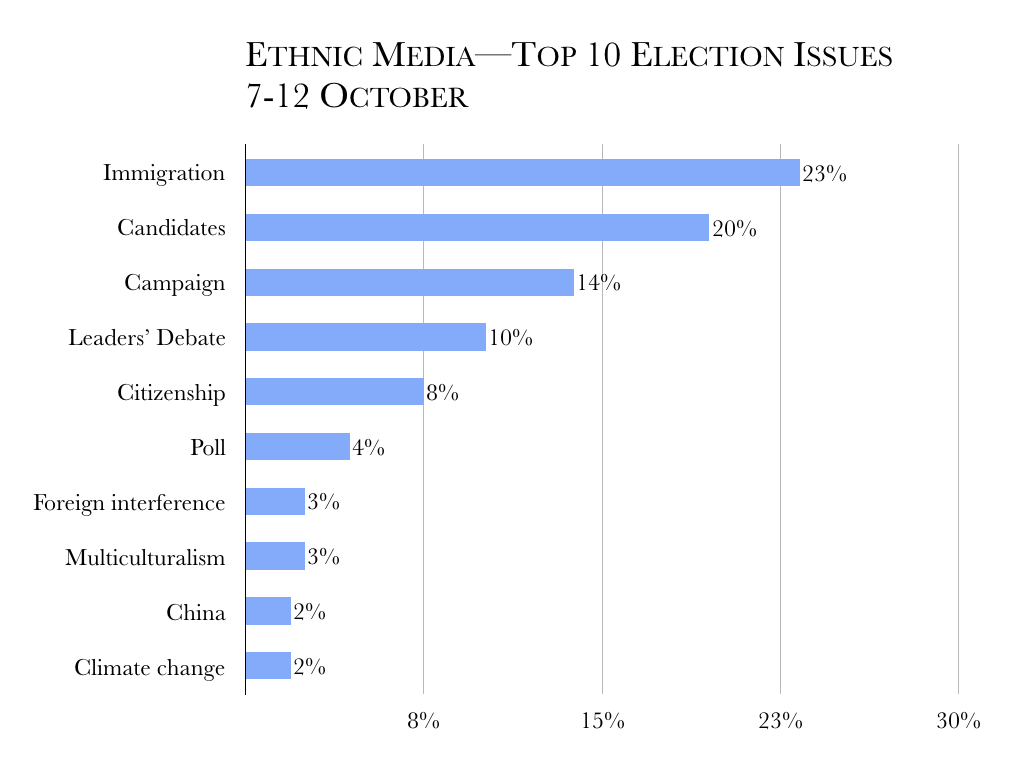
Ethnic media election coverage 7-12 October

Latest weekly analysis of ethnic media coverage. For the analytical narrative, go to Ethnic media election coverage 7-12 October:

Registered voters abroad near 45K, almost triple from 2015

When I was arguing (unsuccessfully) against expansion of expatriate voting rights, I used a number of measures to estimate the degree of connection to Canada, the and the experience of other jurisdictions to estimate the likely percentage of expatriates that would vote (see What should expatriates’ voting rights be? – Policy Options).

I was clearly wrong in my estimate of between 200 to 300,000 based upon Australian and US experience:

Elections Canada figures show 44,843 Canadians living abroad are on its International Register of Electors as of Oct. 6. In the 2015 election, 15,603 Canadians living outside of the country registered to vote.

While not all Canadians residing abroad will cast ballots, chief electoral officer Stéphane Perrault estimated last month that 30,000 citizens outside of Canada would vote in the coming election, up from almost 11,000 in the 2015 election.

When he offered that estimate on Sept. 17, he said about 20,000 Canadians living abroad were signed up to vote.

“At this point, it seems the numbers are what we thought they would be, but it may of course change,” he said.

This election will be the first where all Canadians residing abroad will be eligible to vote, regardless of how long they have been away.

In January, the Supreme Court ruled on a case brought by two Canadians residing in the United States who were barred from voting in the 2011 election because of legislation passed in 1993.

That legislation had been only loosely enforced up to that point, and barred Canadians who had lived outside the country for more than five years from voting in Canadian elections.

The country’s top court ruled the restriction unconstitutional and the Canada Elections Act was subsequently amended to adjust for the change in Bill C-76.

The international register of electors show 19,094 Canadians living in the U.S. are signed up to vote, making up almost 43 per cent of all registered abroad.

The second jurisdiction with the highest number of registered voters was the United Kingdom, with 5,176 Canadians. Hong Kong is third with 2,389 Canadians signed up to vote.

Australia, Germany, France, Switzerland, the Netherlands, Japan and mainland China capped off the top 10 list.

Elections Canada spokesperson Matthew McKenna said it’s important to note that the international register is a permanent database.

“Once a name is added, it remains there year over year, unless the elector requests that it be removed, or passes away,” he said.

Canadians living abroad can vote by mail-in ballot. The deadline to apply to vote by mail is Tuesday, Oct. 15, 6 p.m. E.T.

Perrault cautioned that voters living abroad must also account for the time it takes for an application to be mailed, processed, and for the ballot to be sent back to Canada. On Sept. 17, he said those Canadians should register within the next week to 10 days.

Elections Canada is not accepting ballots it receives later than 6 p.m. on Oct. 21.

Votes from abroad will be counted in ridings of their last permanent address.

Source: Registered voters abroad near 45K, almost triple from 2015

Election 2019: Party Platform Immigration Comparison

With all party platforms out, it is now possible to compare the written policy commitments of each party. 

While each party leader has made additional commitments on the campaign trail (e.g., Conservative Party of Canada leader Scheer on maintaining current Liberal immigration levels, New Democratic Party leader Singh pledging additional funding for Quebec integration and settlement services), this analysis looks only at the official party platforms, as these will form the basis of any future government “report card.”

In general, differences among the four main parties are a matter of nuance as all accept ongoing large numbers of immigrants, programs to facilitate integration, straight forward  pathways to citizenship  and the multicultural reality of Canada. 

The only major dissent from that overall consensus is from the People’s’ Party of Canada. The Bloc québecois’ narrow focus on Quebec issues is reflected in virtue signalling its intent to table private members’ bills that assert or seek to expand Quebec’s jurisdiction in immigration.

Party platforms reflect commitments, which are both concrete and “virtue signalling” to their respective bases and voters that they wish to attract.

The Conservative platform on immigration is sparse, with commitments that reflect their main focus on management of immigration, particularly the irregular arrivals at Roxham Road. This is balanced by their commitment to remove the cap on privately sponsored refugees while clarifying priorities for refugee selection (implicitly downplaying the UN Refugee Agency role). Commitments that reflect more strongly concerns of their base include banning values tests for Grant and Contribution programs (Canada Summer Jobs program) and re-opening the Office for Religious Freedom. 

The platform is silent on high profile issues previously raised in opposition such as M-103 on Islamophobia and other forms of racism and discrimination and their opposition to the UN’s Global Compact for Migration.

The lack of meaningful commitments on immigration levels and mix, citizenship and multiculturalism would provide a Conservative government considerable policy and program latitude should it form the government. The PPC picks up on some of issues the Conservatives dropped, along with prohibiting birth tourism and an overall hard-tone on immigration.

The Liberal platform is stay the course on immigration levels and most other policy areas. Apart from the major announcement of eliminating citizenship application fees, the platform places greatest emphasis on multiculturalism-related issues, whether it be with respect to diversity of appointments, anti-racism and anti-hate strategies, and resources to counter international far-right networks, including additional funding. The platform is silent on family reunification, the Temporary Foreign Worker Program, refugees, and integration.

The NDP and Green platforms are to the left of the Conservative and Liberal platforms. Of the two, the NDP platform is the more coherent. In the event of a minority government, the almost “laundry list” approach in both platforms would provide some areas of agreement, but not their call to abolish the Safe Third Country Agreement with the USA.

Neither major party has chosen to make immigration the big issue that was predicted at the start of the campaign, reflecting that both parties need to win a substantial part of the immigrant and visible minority vote to win the election. So while there are differences in tone and substance,  these have been relatively downplayed in their respective platforms, campaign language notwithstanding.

This table (Election Platforms 2019 Comparison) highlights party positions on immigration (levels, mix, Temporary Foreign Workers, refugees, irregular asylum seekers), integration, citizenship and multiculturalism.

Immigration levels: The Conservative platform is silent on immigration levels. The Liberal platform continues the current trajectory of “modest and reasonable” annual increases along with making the Atlantic Immigration Pilot permanent and establishing a Municipal Immigration Pilot. The NDP platform states that levels should reflect labour market needs.

The Green platform commits to regularize the status of illegal (non-regularized status immigrants) and improve the pathway to permanent residency for international students and Temporary Foreign Workers.

The PPC platform proposes a cut of between 50 and 70 percent of current immigration levels, along with the addition of in person interviews to assess the “extent to which they align with Canadian values and societal norms.” The PPC also proposes increased resources to Canadian Security Intelligence Service (CSIS), Royal Canadian Mounted Police (RCMP) and Immigration, Refugees and Citizenship Canada (IRCC) for the interviews and more thorough background checks.

Immigration mix:  While the Conservative, NDP and Green platforms all promise to speed up family reunification, particularly for parents and grand-parents for the Conservatives and NDP and children for the Greens, the PPC platform calls for abolishing family reunification for parents and grand-parents. The Liberal and Bloc platforms are silent.

The NDP platform calls for faster reunification of caregivers with their families. The Green platform calls for a “robust system” to assess the education and training credentials against Canadian standards prior to arrival along with clear explanations for professionals and an improved pathway to permanent residency for international students and Temporary Foreign Workers.

The PPC proposes to adjust the point system to increase the percentage of economic class immigrants.

Temporary Foreign Workers:  While the Conservative platform commits to match employment backgrounds to employment needs of companies that rely on TFWP, the Green platform calls for the replacement of Temporary Foreign Workers by increased immigration. The PPC platform calls for limiting numbers and ensuring they are only temporary. Both the NDP and Green platforms call for increased regulation of immigration consultants. 

The Liberal and Bloc platforms are silent.

Refugees: While the Conservative platform commits to the elimination of the cap for privately sponsored refugees, the PPC calls for relying solely on private sponsorship, accepting fewer refugees, no longer “relying” on the UN for refugee selection, and taking Canada out of the UN Global Compact for Migration.

The Conservative platform places priority on genocide survivors, LGBTQ+ refugees, and internally-displaced persons while the PPC platform places priority on persecuted religious minorities (e.g.,  Christians, Yazidis) in majority Muslim countries.

The NDP program calls for increased support for refugee integration. The Bloc calls for a moratorium on deportations to countries in conflict or where the life of a refugee would be in danger. The Liberal platform is silent.

Asylum seekers (Safe Third Country Agreement): While the Conservative platform calls for closing the loophole in the STCA that allows irregular arrivals between official border crossings, the Liberal platform states that it will work with the USA to “modernize” the Agreement. The NDP, Greens and Bloc call for its termination. 

The PPC would declare the whole border an official port of entry , deport irregular arrivals,  and fence frequently used border crossings like Roxham Road.

The Conservative platform commits to speed up refugee processing by deploying Immigration and Refugee Board judges to common arrival points and speed up deportations by hiring an addition 250 CBSA agents. The Green platform calls for the establishment of a Civilian Complaints and Review Commission for CBSA. The Bloc platform calls for the hiring of additional IRB members in Quebec to adjudicate claims.

Integration (settlement services): The Conservative platform commits to continue supporting settlement services while the Green platform calls for increased funding for language training through earmarked transfers to the provinces. The platform also calls for increased funding to multicultural organizations to provide language and other services. No other party makes integration commitments.

Citizenship: The Liberal platform commits to eliminate citizenship fees (currently $630 for adult applications). The Green platform commits to address the remaining cases of “lost Canadians” while the PPC platform commits to change the Citizenship Act to make birth tourism illegal.

Multiculturalism: The Conservative platform commits to end values tests for government G&C programs (e.g., the Summer Jobs program) and to reopen the Office of Religious Freedom.

The Liberal platform promises to continue improving the diversity of GiC appointments and senior levels of the public service. The Anti-Racism Strategy will be strengthened through doubling funding, along with increased G&C funding. The platform commits to improve the quality and amount of data collection regarding hate crimes. An additional $6 million over three years will be provided to the Centre for Community Engagement and Prevention of Violence along with resources to counter the rise of international far-right networks and terrorist organizations.

Both the Liberal and NDP platforms commit to hold social media companies accountable for hate speech.

The NDP platform has the longest list of commitments including: ensuring all major cities have dedicated hate crime units; the convening of a national working group to counter online hate; funding for anti-gang projects to deter at-risk youth from joining gangs or becoming radicalized; a ban on carding by federal law enforcement and working to end carding in all jurisdictions; and a national task force to develop a roadmap to end over-representation of Indigenous and visible minorities in prison populations, along with an African Canadian Justice Strategy.

The Green platform commits to improving the integration into the multicultural fabric, assisting cultural organizations to obtain charitable status, amending the Anti-Terrorism Act and Public Safety Act to require that formal charges be brought against all those detained and lastly, investigating allegations that Canadian officials cooperated with foreign agencies known to use torture.

The PPC platform commits to repealing the Multiculturalism Act and eliminating funding that promotes multiculturalism.

The Bloc platform focusses exclusively on Quebec jurisdiction questions: opposing any federal intervention in Bill 21 and laïcité; strengthening relations with immigrant communities;  private member bill “virtue signalling” with respect to exempting Quebec from the Multiculturalism Act; banning offering or receiving public services with face covered; having citizenship applicants living in Quebec demonstrate knowledge of French; and making federally regulated sectors (banks, transport, communications) located in Quebec subject to Bill 101.

Bloc leader apologizes for candidates’ Islamophobic and racist social media posts

Of note (pro forma apologies):

Bloc Québécois Leader Yves-François Blanchet apologized Thursday after media outlets uncovered a number of Islamophobic and racist social media posts by candidates running for the sovereigntist party.

“They all regret having shared in the past videos or messages containing inappropriate comments,” Blanchet said in an emailed statement.

“They apologized. As leader of the Bloc Québécois, I add my apologies on their behalf to the entire population of Quebec.”

Blanchet’s statement does not name any of the candidates, though it indicates he has spoken to five individuals — four women and one man.

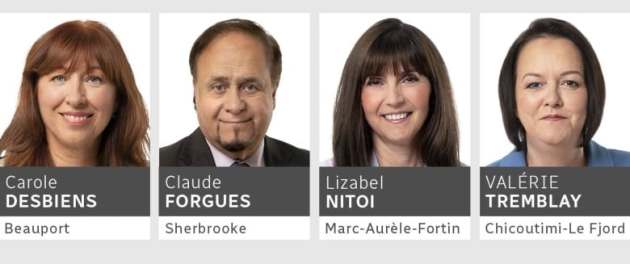
The apology is almost certainly in response to articles published Wednesday in the Globe and Mail and Thursday in the Journal de Montréal that documented numerous posts, tweets and shared links on Facebook and Twitter by: Caroline Desbiens, a candidate in the Beauport riding; Lizabel Nitoi, running in Marc-Aurèle-Fortin; Valérie Tremblay in Chicoutimi–Le Fjord; and Claude Forgues in Sherbrooke.

The four candidates named in the Globe and Mail and Journal de Montreal articles. (Radio-Canada)

The fifth candidate is likely Nicole Morin, a Bloc candidate in Saint-Maurice–Champlain who was found to have shared a video by the far-right group La Meute.

The four Bloc candidates cited in the Journal article issued identical statements of apology on social media Thursday. The apologies note that Le Journal “considers” the messages Islamophobic, but the authors don’t state whether they agree with the assessment.

Desbiens’ remarks were in a publication promoting a law on secularism in 2013. She said she worried that women would soon be forced to either wear a veil to go grocery shopping or be thrown in jail. She also praised France’s far-right leader Marine Le Pen.

Nitoi shared a groundless article about the intelligence of Muslims. Tremblay has shared several anti-Islam messages and conspiracy theories on Twitter since 2016, the Journal de Montreal reported.

Forgues shared a video on Facebook that states “Islam is a disease” and contained other intolerant remarks about Muslims, according to the Journal.

The boilerplate apologies, written in the first person, all say that the candidates did not mean to offend.

The four candidates go on to affirm in their statements their “total and complete support for the values and program of the Bloc Québécois … which in no way advocates measures that go against some communities, whether cultural or religious.”

The controversy lands ahead of the second French-language debate, set for Thursday.

The Bloc Québécois has been building momentum ever since the first French-language debate last week. Polls suggest Blanchet was the big winner of that contest and that the Bloc’s support levels have increased as a result.

Source: Bloc leader apologizes for candidates’ Islamophobic and racist social media posts