ICYMI: Pollsters starting to see uptick in government work

Back to “committing sociology:”

The Trudeau government is reinvesting in public opinion research after it was virtually abandoned in the final years of the last Conservative government, though spending remains far below historical averages, according to veteran pollster Frank Graves.

“They’ve committed to doing more and more work…but it’s certainly nowhere near the levels it was historically both with the early stages of the Conservative government, certainly the Liberal government before that, and the Mulroney government before that,” he told The Hill Times.

Mr. Graves, founder and president of Ekos Research, said in an interview that the federal government has contracted more public opinion research work from his company since the election last fall. He linked this to the Liberals’ push to what they see as a return to evidence-based decision-making.

It pales in comparison, however, to what was seen in even the early stages of the Conservative government, he said.

The Harper government spent $31.2 million polling Canadians in the 2006-07 fiscal year before cutting back to $4.9-million in 2013-14, The Hill Times reported.

This stretch of scarce funding represented a “very unusual period,” Mr. Graves said, with the government conducting “virtually no research” of any significance during this span.

A 2003 auditor general’s report clocks in federal spending on public opinion research in 2002-03, under a previous Liberal government, at $23.7 million and $26.2 million the year before.

Mr. Graves partly attributed lagging “rust” in the bureaucratic channels in preventing the Liberals from revving up polling efforts back to previous levels.

“[It’s] going to take awhile for the bureaucracy to catch up and for the resource envelope [to expand] to do this in levels which would be more commensurate with the need and demand and express priority provided to this approach,” Mr. Graves said, noting that civil servants would also need to catch up with technological advancements in the field.

When reached, the Treasury Board Secretariat said it did not have up-to-date figures on spending on public opinion research or consultations specifically.

….Pollsters optimistic after lean decade

Stephen Kiar, CEO and founder of Ottawa-based public opinion and market research firm Phoenix SPI, said his company has also started to see an increase in public opinion research work in the last month or so.

After the election, the Liberals proceeded “cautiously and deliberately,” as new ministers learned their departments, relevant issues, mandates, and staff, among other considerations, he said.

As a result, Phoenix didn’t see any increase in work before the government’s fiscal year ended on March 31, though things picked up afterwards, Mr. Kiar said, as departments began putting together their research plans for the coming year, and seeking the necessary approvals.

“It appears that many departments have finished that planning process and are starting to engage research firms like ours for their projects,” he explained.

Mr. Kiar said it’s too early to compare spending to the previous Conservative government, which he argued “savaged” the public opinion research budget, while dramatically increasing the media monitoring budget.

Under the Trudeau Liberals, mandate letters to cabinet ministers noted a need for Canadians to see the government’s “willingness to listen” and for the government’s work to “be informed by performance measurement, evidence, and feedback from Canadians.”

Mr. Graves framed the period under the Conservatives that saw a “real paucity” of public opinion research as an “anomaly,” and partly blamed the scarcity of polling on what he saw as the government’s indifferent, sometimes “hostile” approach to empirical research.

Critics accused the Harper government of gutting funding for research and muzzling federal scientists. The Conservatives axed the mandatory long-form census in 2011, drawing strong criticism from a wide range of groups worried about the consequences the decision would have on the reliability on the vital data gleaned from the sweeping survey of Canadians.

The Liberals reinstated the long-form census as mandatory shortly after assuming office last November.

Kara Mitchelmore, CEO of the Marketing Research and Intelligence Association, an industry advocacy group, says numbers on polling activity for 2016 won’t be known until the end of the year, though she cited the re-establishment of the mandatory long-form census as leading to an increase in work.

“I can say anecdotally that with the re-instalment of the long form census, which MRIA strongly supports, there is an obvious noticeable increase in data collection roles,” she said in an emailed statement, noting that this will “trickle down” into more analyst roles, which is “great news” for the industry.

Mr. Graves said he expects funding for polling to eventually be restored to previous heights, though predicted it would only reach a quarter of the historic average this year.

That’s still “a lot better” than what we saw in the late stages of the previous government, he noted.

Source: The Hill Times

Trudeau’s Liberals more in line with Canadians’ fundamental values: Ekos Poll

Not surprising, as most polling during the election showed Conservative over-reach was off-side general Canadian values:

Graves said his polling found that after 10 years in power, Stephen Harper’s Conservatives were facing “growing tension” between what they stood for and the basic values espoused by Canadians.

“I really believe that the election shifted from being an important election about the economy to a historic election about values.”

His conclusion is supported by another poll EKOS conducted Oct. 8-12. Canadians were asked to identify the “most important factor” that would determine their vote.

Forty-seven per cent said it would be the choice that best reflects their values; 33 per cent said it would be a party platform or ideas; 10 per cent said it would be the party leader; and eight per cent said it would be the local candidate.

Canadians were asked about the “choices” that best describe their “vision” of Canada. Sixty four per cent cited humanitarianism and development versus 23 per cent who opted for defence.

Sixty-three per cent favoured active federal government, while 23 per cent supported “minimal government.”

And 57 per cent favoured “reason and evidence” over the 24 per cent who stood by “moral certainty.”

“I think people got fed up,” Graves said of voters.

“They were really resentful to not only this indifference, but hostility, to science and to reason. It was a very strident anti-intellectualism and it didn’t fit well. It’s not where Canadians were.”

Source: Trudeau’s Liberals more in line with Canadians’ fundamental values: Poll | Ottawa Citizen

Harper’s ‘old-stock Canadians’ line is part deliberate strategy: pollster (Ekos)

More on the intent behind ‘old-stock Canadians:’

Conservative leader Stephen Harper’s line about “old-stock Canadians” during  the Thursday leaders’ debate was a deliberate move to energize the Conservative base on an emotional topic, a pollster says.

Frank Graves, president of EKOS Research, says that kind of divisional tactic has been used successfully in the past.

“It’s part of the deliberate strategy to sort Harper’s constituency from the rest of the electorate,” Graves told CBC Montreal’s Daybreak. “It creates a sense of us versus others.”

Graves describes Harper’s comment as a “dog whistle”: something meant to be heard by a target audience, but misheard or ignored by the rest.

Harper made the comment while addressing health care for immigrants and refugees.

Source: Harper’s ‘old-stock Canadians’ line is part deliberate strategy: pollster – Montreal – CBC News

The contrary view is expressed by Andrew Coyne (Andrew Coyne: Harper’s ‘old stock’ faux pas was little more than that) and Lysiane Gagnon (In Quebec, old stock is just a fact of life) who maintain that it simply used in a descriptive sense. But words matter, and are chosen for both explicit and implicit messaging, with ‘old-stock’ having an implicit message in the political context.

The EKOS poll: Are Canadians getting more racist?

Interesting contrast with annual CIC tracking survey which continues to show stable support for current levels of immigration as per chart below:

CIC_Tracking_Survey

Questions of race and religious dress have rarely been ballot box issues in Canada. Now, however, they appear to be the key factors behind major shifts in the voter landscape.

Visible minorities and Immigration - Ekos

Canada has absorbed a large number of visible minority immigrants over the past twenty years, turning us from a largely white society with ancestry drawn from Britain and France to an extremely heterogeneous one. Initial deep reservations about immigration dropped consistently over that period as we became more diverse. The public embraced the ideal of multiculturalism; dire warnings about ethnic enclaves and a fading national identity never came true. Our research over that period shows national attachment remained very high in Canada, while ethnic identifications actually dropped.

It’s useful to remember how far apart public opinion in Canada and the United States was following the 9/11 terrorist attacks. In both countries there was a sharp, immediate rise in opposition to immigration. In Canada, however, that trend soon dissipated, reaching an all-time low around 2005 — when only 25 per cent of us said there were too many immigrants and less than one in five said that too many immigrants were visible-minority. In the U.S., the level of opposition to immigration was nearly three times higher. Canada remained a nation open to the world: pro trade, pro-immigration and pro-diversity. This seemed to confer both social and economic advantages.

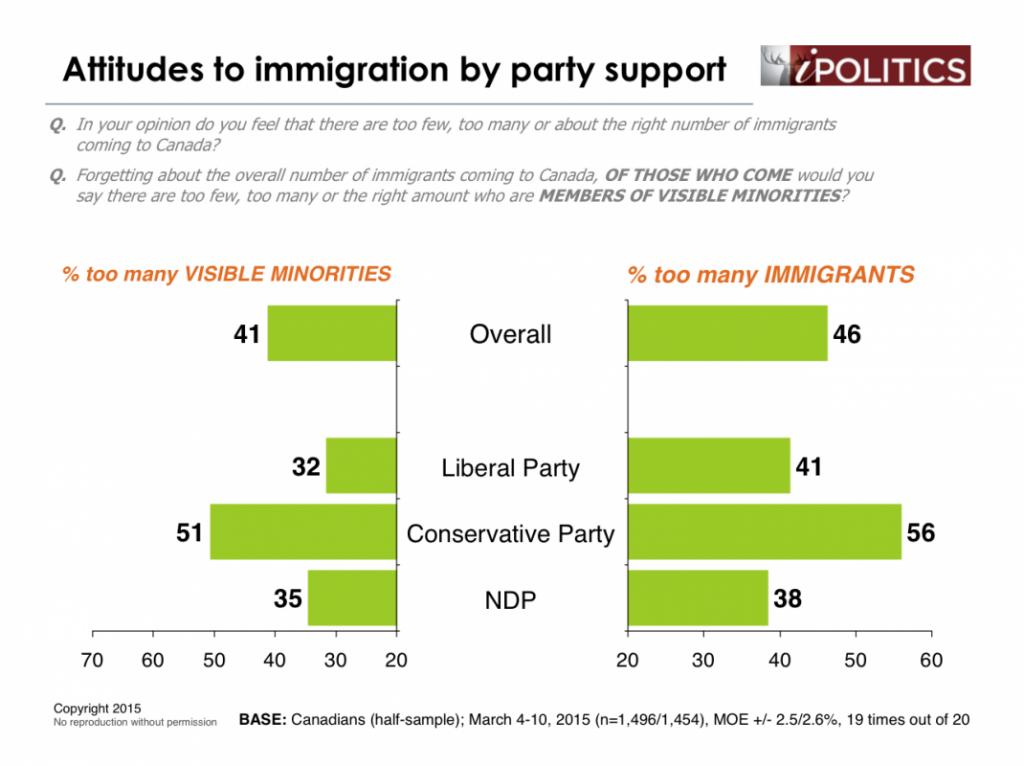
Recent polling shows opposition to immigration has nearly doubled since 2005 and is threatening to crack the 53 per cent level we saw in 1993. Not only is opposition to immigration in general scaling heights not seen in twenty years but the number of Canadians saying we admit too many visible minorities has just cracked the 40-point ceiling for the first time ever.

…When we look at how attitudes on immigration and race spread out among the main federal parties, a pattern emerges. Liberals and New Democrats have no cause to be smug; fully one-third of their supporters think too many of those coming to Canada are visible minorities.

But it’s the Conservative party — which owes much of its current success to wooing votes from new Canadians — that seems to have the problem. Jason Kenney, to his credit, wants new Canadians in his party’s corner. But half of the people who support his party would prefer to see fewer non-white immigrants.

Frank Graves of EKOS polling has some startling new numbers

The EKOS poll: Fear fades — values endure

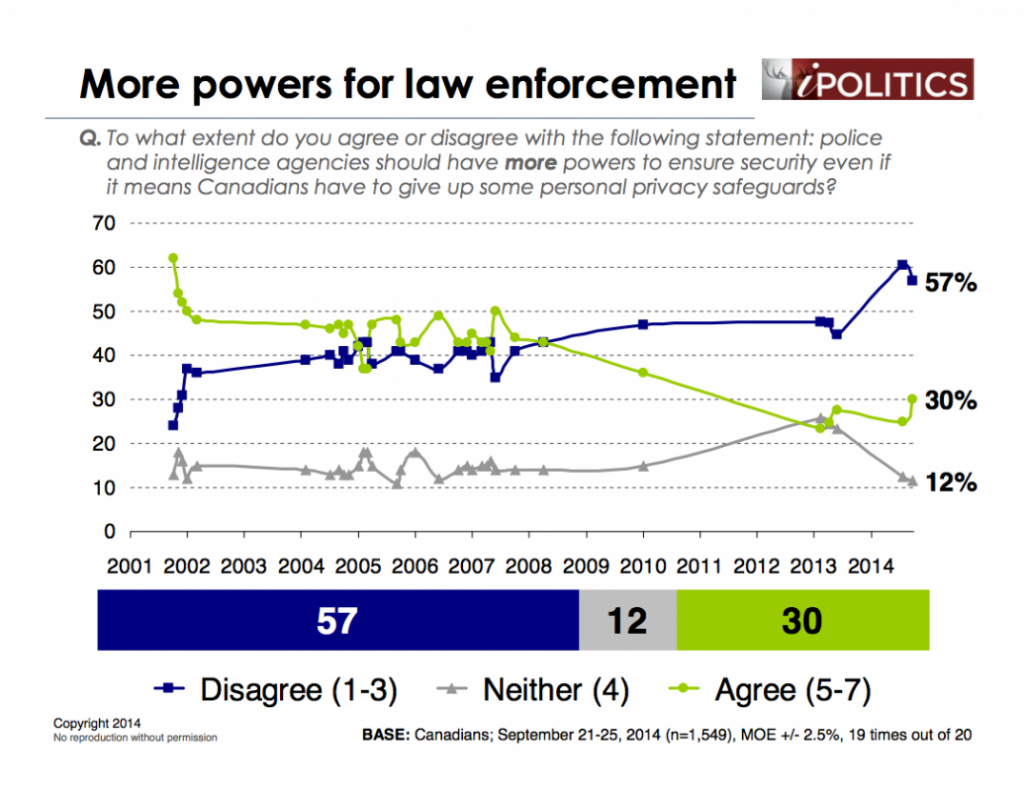
Ekos - Law Enforcement and TerrorismFrank Graves of Ekos on public opinion regarding the threat of terrorism:

  • Virtually all responses made by Western governments to the threat of terrorism in the 21st century have been deemed failures in hindsight. Almost universally, the public sees these past interventions as having yielded nothing but a more dangerous world.
  • Overwhelmingly, Canadians want to see their leaders re-think their reliance on military and security-oriented approaches to the terrorist threat, in favour of approaches more in keeping with our core values as a nation.
  • Canadians have lost faith in the security agenda which says the problem can solved by restricting civil liberties even further, and want to see our leaders place more emphasis on the traditional tools of diplomacy and development.

The EKOS poll: Fear fades — values endure (pay wall)